Investment Trust Dividends

Month: October 2025 (Page 7 of 14)

History doesn’t always repeat but it often rhymes.

Investors are being bombarded with messages about the rising risk of a stock market crash, and more specifically the bursting of the artificial intelligence (AI) ‘bubble’. Some observers predict a grim correction that will lay waste to portfolios, pensions and funds. In such an event, economic growth would also be jeopardised, given that the hundreds of billions of dollars of investments being pumped into AI are estimated to be driving 40 per cent of US GDP growth, while wealth generated by portfolio gains is supporting consumer spending. Others assert that while a correction or bear market is likely to happen, it will not approach the scale of the dotcom collapse because there are too many differences this time around. Former Scottish Mortgage Investment Trust manager James Anderson has nevertheless expressed concern about certain echoes of the turn of the century boom, namely the scale of AI-linked companies’ astonishing leaps in value (after a rocky start to the year, Nvidia has almost doubled its worth since April’s market lows) and a rising trend of ‘circular investments’ whereby companies support key customers by investing in them or offering finance deals. The Bank of England is also concerned about over-exuberance and circular deals. Even the tech giants’ own bosses admit it is a near-impossibility that their earnings can keep growing at the same pace indefinitely. Goldman Sachs warns that when AI investment slows, the knock-on effect on company valuations could wipe up to 20 per cent from the S&P 500.  The counter-argument is that the steep rises in valuations of companies at the heart of the AI bubble are justified by factors that were not present in the dotcom bubble: staggering profitability and margins. Ben Barringer, head of technology research at Quilter Cheviot, adds that valuations are still well below previous bubbles – current valuations are half the peak of 60 times earnings seen in 2001 – while analysts at Capital Economics similarly note that forward price/earning ratios for big tech and the S&P 500 are not as high as they were at the peak of the dotcom era. Capital Economics’ view is that there will be a big correction in the S&P at some point once enthusiasm for AI in the market has peaked, but that this, barring some extraordinary development, will not be before 2027. It sees the S&P 500 hitting 7,000 at the end of this year, reaching 8,000 at the end of the next and then falling back to 7,000 at the end of 2027. How should investors prepare for a bear market, despite not knowing if it will happen soon or in a few years’ time? Crashes happen for a reason and there are plenty of possible triggers to make confidence drain away and pull the whole bull-market edifice down – disappointing US corporate earnings, cracks appearing in the AI story as benefits and promised productivity gains fail to materialise, or an unknown unknown.  Investors will make their own minds up about whether such an event will happen sooner rather than later, but in light of the risk, it would be wise to conduct regular portfolio reviews with a view to adjusting weightings and being mentally prepared to avoid a panicked response. Like the mini earthquakes that precede volcanic eruptions (sometimes by years), we have already seen early warning signs in Tesla’s difficult year, Deepseek’s initial impact on Nvidia’s share price and trade wars causing stampedes for the exits. You may not want to sell down your US holdings if you have faith in your choices and in the long-term resilience of the US market. But you should bear in mind your time horizon: can you ride out a worst-case downturn lasting several years? The Nasdaq took 15 years to recover from the dotcom bust. Even if you are happy to keep backing US exceptionalism, you should pay attention to your tech exposure, which may now be far higher (and your portfolio far less diversified) than you intended with your original strategy. Many investors are still blind to the very significant chunk of Magnificent Seven exposure in their S&P 500 and global index trackers. You could reduce this risk by trimming holdings and reallocating to funds that have deliberately cut back on tech, as we outline here, or to defensive sectors and income generators. Fund flows show that many investors have been doing exactly that as they try to rebalance their portfolios ahead of an anticipated correction. Experienced investors know to stay focused on the long-term outcome, and that time in the markets, not timing the market, is what counts. It’s then a question of being prepared to ride out a correction and accepting the risks that some valuations may never recover, as happened during the dotcom fallout.
Rosie CarrEditor

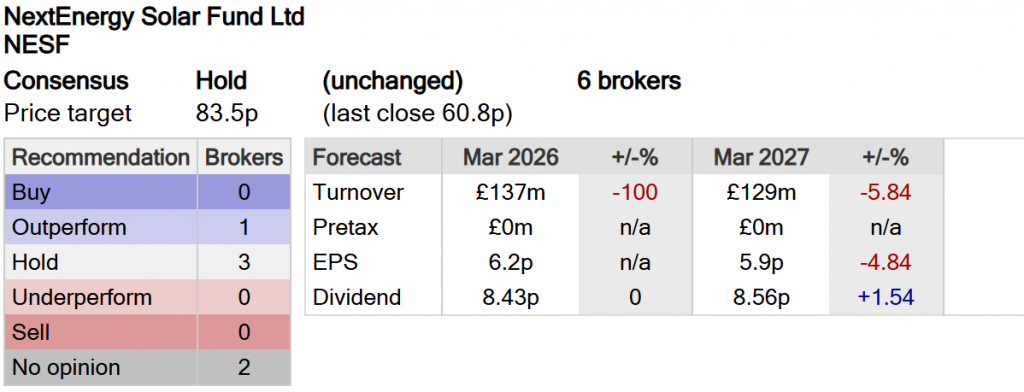
NESF

You are attracted to the Investment Trust because of its high yield, currently

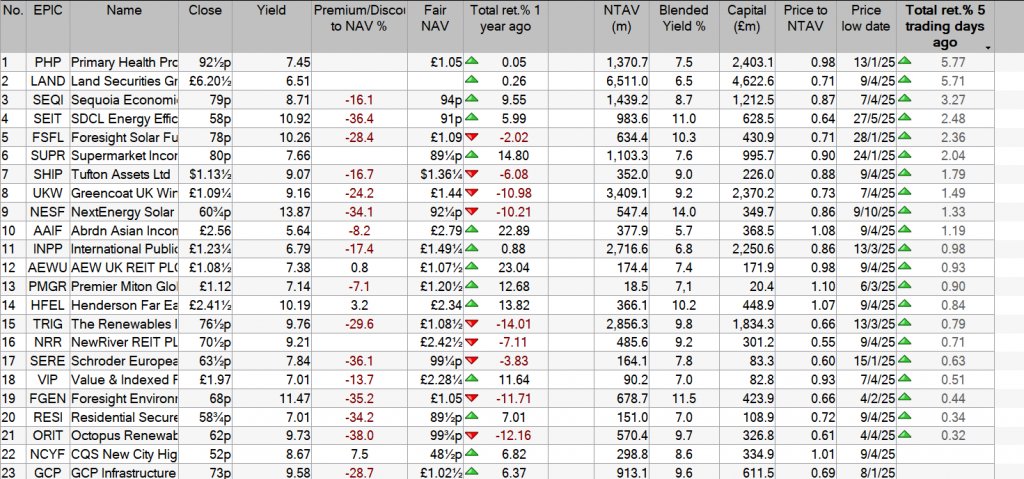
13.8%.

It also trades at a 34% discount to NAV but the NAV could fall in time to nearer the price of the share, so lets call that a possible bonus.

Dividend:

·   Total dividends declared of 2.10p per Ordinary Share for the Q1 period ended 30 June 2025 (30 June 2024: 2.10p), in line with full-year dividend target.

·     Full-year dividend target guidance for the year ending 31 March 2026 remains at 8.43p per Ordinary Share (31 March 2025: 8.43p).

·    The full year dividend target per Ordinary Share is forecast to be covered in a range of 1.1x – 1.3x by earnings post-debt amortisation.

·     Since inception the Company has declared total Ordinary Share dividends of £407m.

·     As at 20 August 2025, the Company offers an attractive dividend yield of c.11%.

The dividend of 8.43p is currently a covered dividend.

The share has a progressive dividend policy, although this year’s dividend is frozen at last year’s level.

If NESF stay in business, there is likely to be some amalgamation in the renewables sector, you could achieve

in seven years when all your cash has been returned and you could have a share in your portfolio that pays you income at zero, zilch, cost.

Because Mr. Market currently flags this is a higher risk share, it would reduce the risk if the dividends received were re-invested in another high yielder, increasing your yearly rate of return.

The fcast EPS are less than the fcast dividend so, the dividend could be trimmed, from its current level.

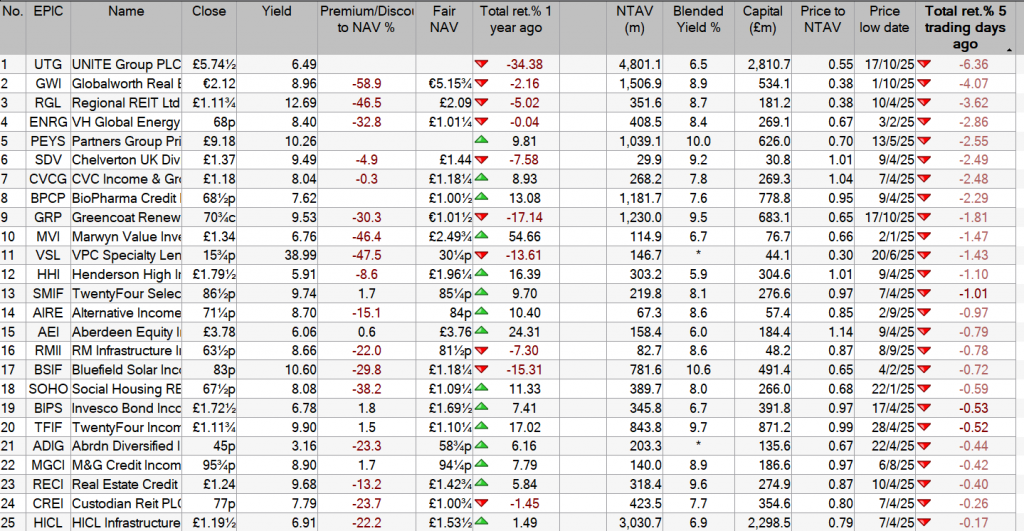
HFEL NESF SDIP

Fancy a 10%+ dividend yield ? 3 passive income heroes to consider

Each of these UK stocks, funds, and trusts has a double-digit dividend yield and excellent long-term growth potential.

Posted by Royston Wild

Published 18 October

HFEL NESF SDIP

Close-up of children holding a planet at the beach
Image source: Getty Images

When investing, your capital is at risk. The value of your investments can go down as well as up and you may get back less than you put in.

The content of this article is provided for information purposes only and is not intended to be, nor does it constitute, any form of personal advice. Investments in a currency other than sterling are exposed to currency exchange risk. Currency exchange rates are constantly changing, which may affect the value of the investment in sterling terms. You could lose money in sterling even if the stock price rises in the currency of origin. Stocks listed on overseas exchanges may be subject to additional dealing and exchange rate charges, and may have other tax implications, and may not provide the same, or any, regulatory protection as in the UK.

UK investors are spoilt for choice when hunting for shares with large dividend yields. Broadly speaking, the London stock market’s strong payout culture makes means it’s packed with top passive income shares.

With this in mind, here are three stocks with a yield above 10% to consider.

Henderson Far East Income: 10.2% dividend yield

Investing in emerging markets can sometimes be a bumpy experience. Political and economic conditions in regions like Asia can be volatile, impacting returns.

This hasn’t stopped Henderson Far East Income (LSE:HFEL) delivering large and growing dividends over time, though. Cash rewards have grown each year since the mid-2000s.

This reflects the investment trust‘s decision to prioritise passive income over growth. It’s also due to its wide range of holdings spanning different sectors and parts of the Asian continent. This diversified approach provides a smooth return over the economic cycle, and protects investors from weakness in specific industries and regions.

In total, Henderson Far East Income has holdings in 71 highly cash generative businesses. These include companies with enormous dividend yields like China CITIC BankTelkom Indonesia, and Evergreen Marine Corp Taiwan.

Roughly 58% of the trust’s assets are currently located in China, Hong Kong, and Taiwan. This leaves it vulnerable to current tough conditions in the region’s largest economy. But it could also help it outperform when the Chinese economy rebounds.

Global X SuperDividend ETF: 10% dividend yield

The Global X SuperDividend ETF (LSE:SDIP) offers similar diversification benefits that reduce risk and can enhance long-term returns.

This exchange-traded fund (ETF) also focuses on high dividend yield businesses across sectors, but does so with a more global flavour. US shares make up its largest single weighting, at 26% of the portfolio. Other well-represented countries include Brazil, Hong Kong, and the UK, providing investors with the stability of developed markets and the growth potential of emerging regions.

In total, Global X SuperDividend has 106 different holdings, including popular FTSE 100 stocks M&G and Phoenix.

Be mindful, though, that a high weighting of financial services stocks may impact performance during economic downturns.

NextEnergy Solar Fund: 13.8% dividend yield

Renewable energy producers like NextEnergy Solar Fund (LSE:NESF) can be among the most stable dividend shares out there.

Electricity demand remains pretty inelastic across the economic cycle, giving predictable cash flows across the economic cycle. Profits can dip during periods of unfavourable weather, but largely speaking these companies are pretty reliable for passive income.

NextEnergy holds particular appeal for me given weather-related uncertainties. It has 101 solar assets spread across nine countries, a diversified footprint that helps compensate for poor conditions in certain places.

This has supported consistent growth in annual dividends since NextEnergy listed in 2014. Encouragingly, the investment trust is increasingly focusing on battery storage to diversify revenue streams and further reduce the weather factor, too.

Across the pond

Contrarian Outlook

My Favorite Fund for Retirement Income (Yields 8.3%)

by Michael Foster, Investment Strategist

I’m regularly struck by something American investors always seem to take for granted: The many choices we have available to gain financial independence.

And investors in closed-end funds (CEFs) make the most of these choices. These high-yielding funds kick out 8%+ dividends on average, and the portfolio of my CEF Insider service, which helps investors make the most of CEFs, pays even more, with its 18 holdings paying a rich average yield of 9.4%.

Plus, these funds offer stock-like upside, which makes them pretty much tailor-made for delivering financial freedom.

We’ll sketch out how two specific CEFs can help you find your way to an earlier, richer retirement in a bit. But first, back to that embarrassment of choices I mentioned a second ago.

What American Investors Take for Granted

Back in my 20s, when I was studying to get my PhD in Europe, I was told I had to pay into the national pension fund, and I would get that money back when I qualified for it. At that time, I qualified at 62, which seemed absurd – nearly 40 years for me (a severely underpaid academic!) to get back money I desperately needed today.

But as it turns out, I was lucky.

Europe’s mandatory retirement age is rising. Denmark, which currently has the oldest retirement age in Europe at 67, is raising that to 70. Germany, where a normal retirement age is currently 66, is discussing raising that to 73.

Whether you like the life of a worker or not, I’m almost certain that you like having the ability to choose that life without having to worry about governments changing the rules on you mid-game.

A Look at America

This lack of choice pushed me away from Europe in my 20s and led me back to America. Here’s what I found when I returned.

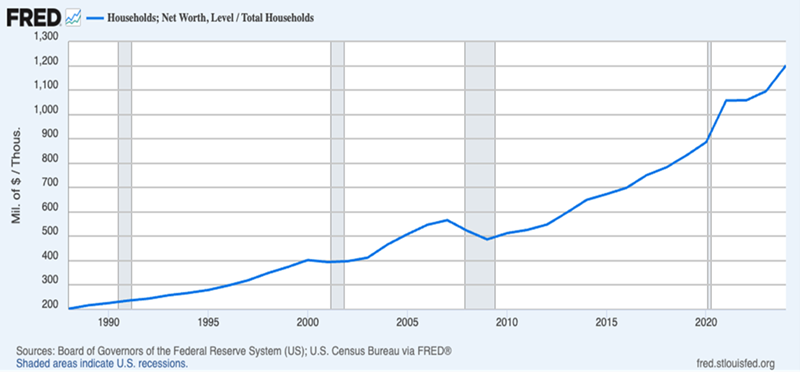
This chart shows that the average American household has gone from $200k in savings in the 1980s to $1.2 million now – and, no, that isn’t due to inflation. That $200k in savings would be $535k in 2025 dollars, so more than half of the jump to $1.2 million is due to actual value being created.

Of course, that wealth isn’t going everywhere. While all households have gotten richer on average, the top 0.1% of the population is attracting a greater proportion of overall wealth in the US, now near 14%.

The ethics of this aside, it’s clear that the households that have more wealth now have more choices – about when to retire, where to live, what lifestyle to adopt and so on.

In a way, it seems like Europeans have too little choice and Americans have so much that retirement investing can be tough for individual investors to navigate without either taking undue risks or locking themselves into weak returns.

CEFs: Your 8%+ Paying “Mini-Pension” (With Upside)

This is where CEFs come in, with their focus on assets from well-established companies. Plus their high yields almost act like a “mini-pension,” boosting your income without leaving you at the whim of the government.

This is the way I viewed CEFs in my late 20s, when I began using their high dividends to get the income I needed to make the choices I wanted. I still view them this way.

And in addition to their big dividends, these funds often chalk up strong returns, too, thanks in large part to their discounts to net asset value (NAV, or the value of their underlying portfolios). As these discounts – which only apply to CEFs, by the way – shrink, they put upward pressure on the fund’s price.

And the best part is that CEFs are easy to buy, trading on public markets just like stocks.

Consider the first CEF we’re looking at today, the Adams Diversified Equity Fund (ADX). It’s one of the oldest funds in the world, tracing its history back to the 19th century (and is a current CEF Insider holding, too).

This one is about as blue chip as it gets, with stocks like Microsoft (MSFT)Amazon (AMZN) and JPMorgan Chase & Co. (JPM) among its top holdings.

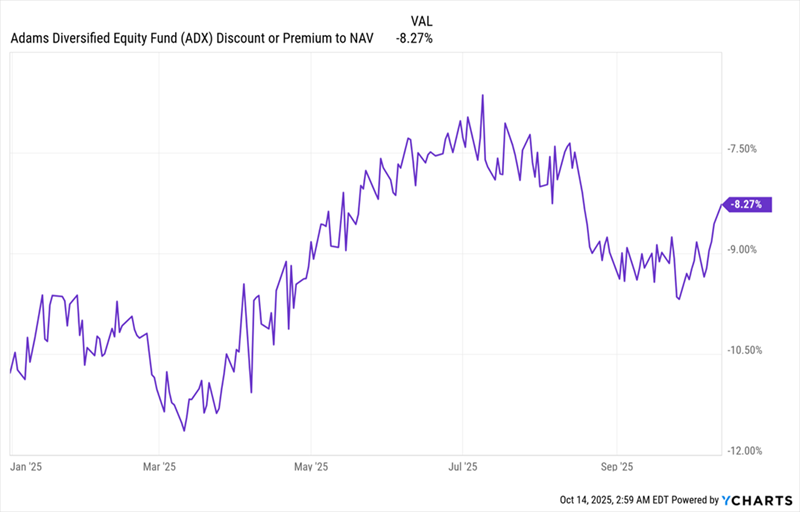
What’s more – and this is the key part – ADX trades at an 8.3% discount to NAV as I write this, and that discount is in the sweet spot, cheaper than it was a few months ago but carrying momentum as it steams toward par.

ADX Is a Rare Bargain in a Pricey Market

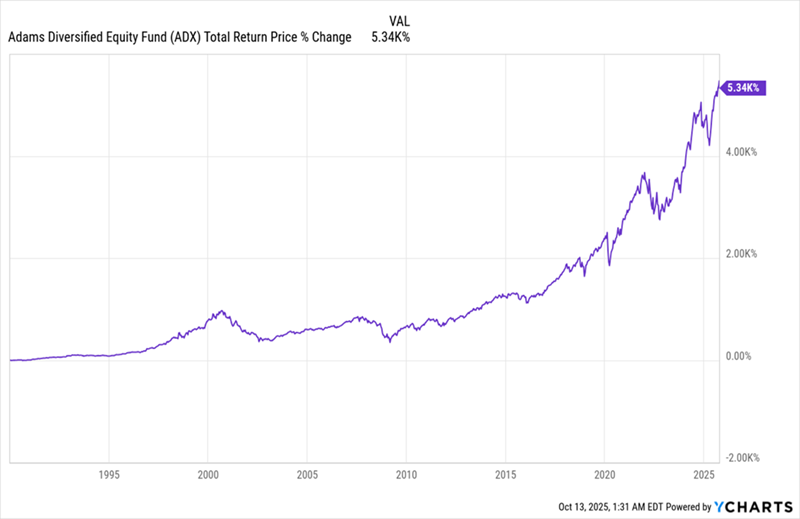
ADX has been paying dividends since before the Great Depression, and its 8.3% dividend yield is fully covered by the 13.3% total NAV return (or the return on its underlying portfolio) it’s enjoyed over the last decade. Moreover, ADX has delivered a 5,340% return to its shareholders, with dividends reinvested, since the late 1980s, when US household wealth just started to meaningfully tick higher.

ADX’s Long-Term Gains

That kind of performance – coming our way at a discount and with an 8.3% dividend – is exactly what we want from our “mini-pension,” and ADX delivers.

But, as I said, we do have choices here. And ADX isn’t the only US-stock-focused CEF that delivers a large income stream and has withstood the test of time.

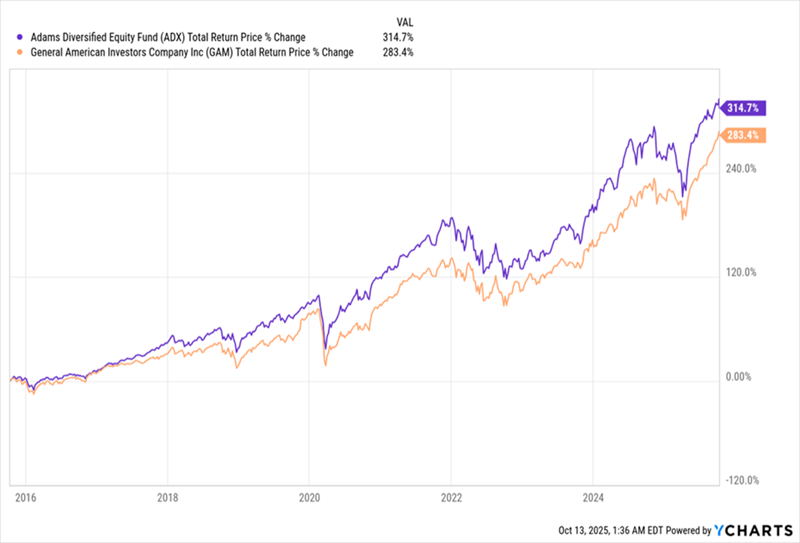
Another is the General American Investors Company (GAM), which was launched in 1927 and yielded an impressive 9.4% to investors in 2024. GAM also holds large caps, with Alphabet (GOOGL)Berkshire Hathaway (BRK.A) and Apple (AAPL) among its top holdings.

And, like ADX, this fund’s market pricebased return has been strong over the last decade – though not quite as strong as ADX – with a 14.4% annualized return.

2 Strong Funds, But ADX Has an Edge

Moreover, GAM’s 9.3% discount sounds like a good deal, but that’s near its smallest-ever level, so we’re not rushing out to buy the fund today. But it is worth watching, and gets tempting when that discount drops to double digits.

But the larger point remains: With high-yielding CEFs like these, we can start generating a meaningful income stream we can choose to use however we like

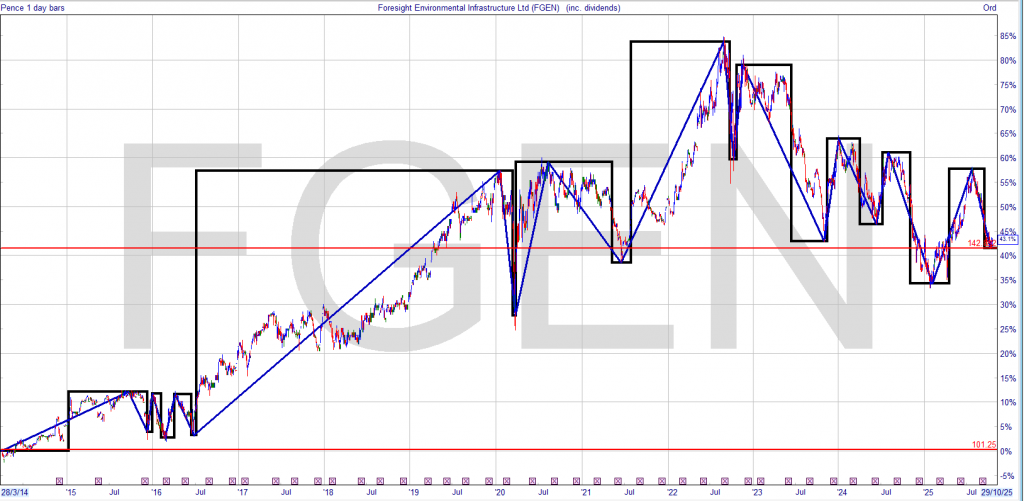
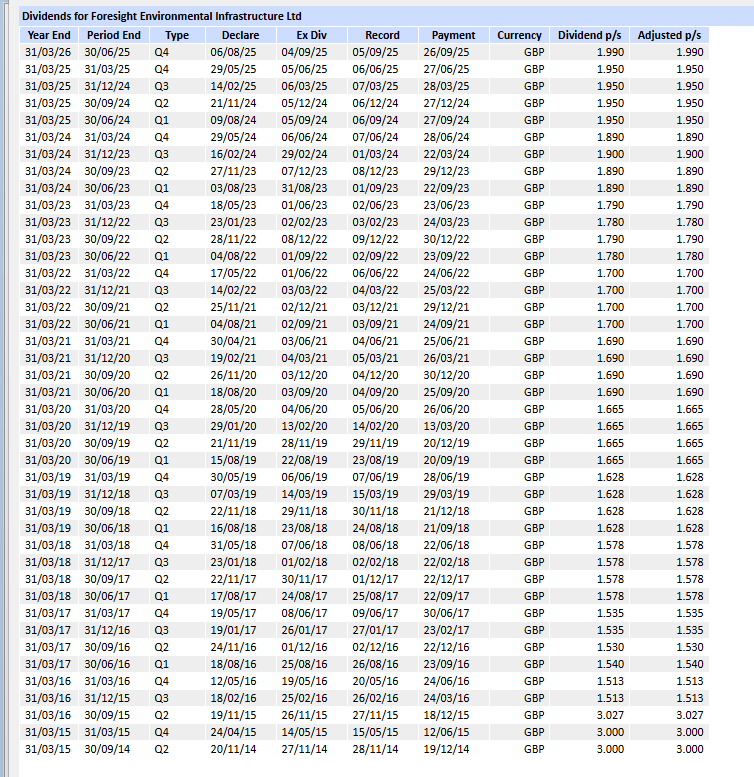
FGEN Case Study

If you want to track the history of FGEN in the Snowball, type FGEN in the search box and the history of the share should be there.

Dividend

The Company also announces a quarterly interim dividend of 1.99 pence per share for the quarter ended 30 June 2025, in line with the dividend target of 7.96 pence per share for the year to 31 March 2026, as set out in the 2025 Annual Report – which represents a yield of 9.7% on the closing share price on 5 August 2025.

Current price 69p dividend 7.96 a yield of 11.5%

Foresight Environmental Infrastructure Ltd (FGEN) may appeal to income-focused investors, but caution is warranted due to recent performance and valuation metrics.
Here’s a breakdown of the key factors to consider before buying:

📉 Performance & Valuation

  • Share Price: Currently trading around GBX 68.40, down roughly 21% over the past year.
  • Net Asset Value (NAV): Estimated at GBX 104.86, suggesting the stock trades at a significant discount to NAV.
  • Dividend Yield: Offers a high yield of ~11.5%, which may attract income investors.
  • Earnings: Recent net income is negative (-£2.84M), and EPS is effectively zero, indicating weak profitability.
  • Forward P/E: Estimated at 6.84, which is low, but reflects earnings uncertainty.

🏗️ Portfolio & Strategy

  • FGEN invests in a diversified portfolio of environmental infrastructure assets, including renewable energy and waste management.
  • Formerly known as JLEN, it has a long-standing focus on sustainability and infrastructure resilience.

⚠️ Risks & Considerations

  • Low RSI (26.22) suggests the stock may be oversold, but also reflects bearish sentiment.
  • Beta of 0.27 implies low volatility, which may suit conservative investors.
  • No consensus analyst rating or price target is currently available, making it harder to benchmark expectations.

🧭 Bottom Line
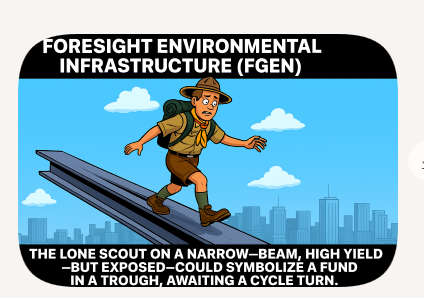
FGEN could be a value opportunity for long-term investors seeking high yield and discounted NAV, especially if you believe in the resilience of environmental infrastructure. However, negative earnings and weak recent performance suggest caution. If you’re building a narrative around institutional cycles, this might symbolize a fund in a trough—potentially poised for recovery, or emblematic of structural headwinds.

Foresight Environmental Infrastructure Ltd (FGEN) trades at a deeper discount and offers a higher yield than its peers, but its recent underperformance and negative earnings make it a riskier bet. Greencoat UK Wind (UKW) and The Renewables Infrastructure Group (TRIG) offer more stability and scale, though they too face headwinds.

Here’s a comparative snapshot to help you sharpen your metaphorical lens:

🔍 Valuation & Yield Comparison

Sources:

🏗️ Portfolio Focus & Strategy

  • FGEN: Broad environmental infrastructure—anaerobic digestion, hydro, solar, and waste. Smaller scale, more niche.
  • UKW: Pure-play wind—onshore and offshore UK assets. Large scale, inflation-linked dividends.
  • TRIG: Mixed renewables—wind and solar across UK and Northern Europe. Diversified geography and technology.

Co Pilot

« Older posts Newer posts »

© 2025 Passive Income Live

Theme by Anders NorenUp ↑