Investment Trust Dividends

Month: November 2025 (Page 4 of 15)

Targeting passive income?

Why every investor should consider REITs 

Mark Hartley explains how real estate investment trust rules provide big benefits to shareholders, making them attractive to income investors.

Posted by Mark Hartley

Published 23 November

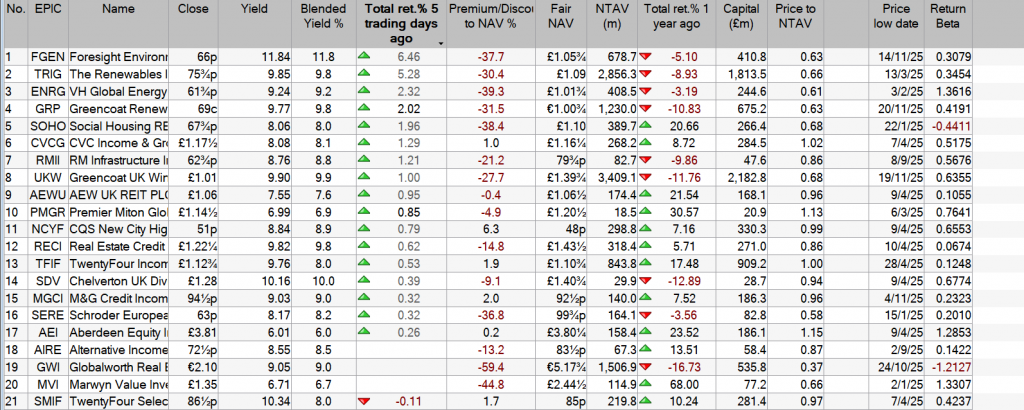
AEWU

House models and one with REIT - standing for real estate investment trust - written on it.
Image source: Getty Images

You’re reading a free article with opinions that may differ from The Motley Fool’s Premium Investing Services.

Real estate investment trusts (REITs) are a specific fund type that focus on buying and letting property. They’ve long been popular among passive income investors due to rules that help ensure steady dividend returns.

They also offer simplified exposure to the real estate market without the high cost and risk of direct investment. Let’s have a look at the pros and cons of this unique investment option.

Should you buy AEW UK REIT plc shares today?
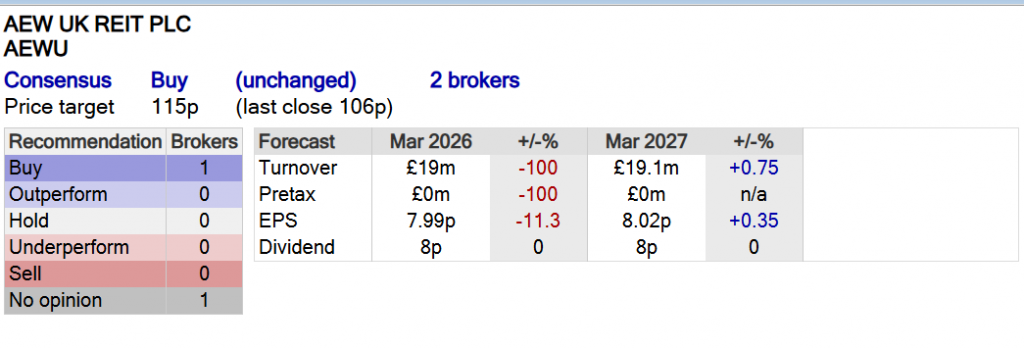
Key benefits

REITs give investors access to large-scale property development projects in residential, commercial and industrial spaces. The relatively low initial investment, combined with an experienced management team, makes them particularly attractive for beginner investors.

What’s more, the rules require them to distribute at least 90% of their taxable income to shareholders annually. This typically leads to high and consistent dividend yields, which is attractive for income-focused investors.

Moreover, they have far higher liquidity than standard real estate, trading on major stock exchanges where the shares can be bought and sold easily.

Please note that tax treatment depends on the individual circumstances of each client and may be subject to change in future. The content in this article is provided for information purposes only. It is not intended to be, neither does it constitute, any form of tax advice.

Notable risks

While the rules result in higher yields, they also limit retained capital for further investment. This can result in slow or even negative growth, which could eat into returns during weak market periods.

They’re also highly sensitive to interest rate fluctuations, which can limit profits during high-rate periods. In addition, they typically include ongoing management fees which must be accounted for when calculating potential returns.

One example

AEW UK (LSE: AEWU) is an up-and-coming REIT that started life just 10 years ago. Its strategy is to buy assets with shorter leases, aiming to exploit re-letting and redevelopment opportunities. It’s an interesting angle — but one with the added risk of tenant departures and higher vacancy rates.

It’s also very small, with a £167m market-cap, putting it at higher risk of volatility. The advantage being that the market tends to undervalue small-cap shares. As such, it has a net asset value (NAV) of 109p per share with shares currently trading at only 103p.

The past decade has dealt its fair share of ups and down but despite everything, it’s grown about 30% since Covid. Analysts expect the current growth trajectory to continue, with the average 12-month price target up 10%.

Importantly, its 7.6% yield isn’t only above average but is well covered by both earnings and cash flow. What’s more, its balance sheet looks healthy, with only £59.9m in debt against £174.4m in equity.

Earnings took a dive in 2022 but have made an impressive recovery, posting £24.34m in profit in 2024. Revenue in 2024 dipped slightly from 2023 but has been steadily increasing over the long term.

A long-term mindset

Whether investing in REITs, growth stocks or dividend shares, the key to building a solid passive income stream is a long-term mindset.

Investors who are quick to panic sell at the first sign of trouble often regret it down the line. No investment journey is smooth, and stomaching the ups and down is part of the ride.

But steady and reliable income stocks can help ease the turbulence. The key is picking the rights ones. With steady growth, a clean balance sheet and a impressive track record, I think AEW UK REIT is one worth considering.
Current yield 7.5%

Across the pond

Contrarian Investor


Turn Your Portfolio Into
a Monthly Income
Machine


Discover the safe, simple way to lock in steady monthly dividends up to 11% right now!


You’ve no doubt heard pundit after pundit say that you need at least a million dollars to retire well.

Heck, we’ve all heard it so often, I bet it’s the first number most people think of when someone says “retirement savings”!

Let me explain why this endlessly repeated fallacy is dead wrong. You’ll actually need a lot less than that.

I’m talking about just $600,000 here. And in some parts of the country you could do it on less: a paid-for retirement for just $500,000.

Got more? Great. I’ll show you how you can retire well on your current stake.

I know that’s a bit tough to believe with the big hikes in the cost of living we’ve seen in recent years, but stick with me for a few moments and I’ll walk you straight through it.

The key is my “9% Monthly Payer Portfolio,” which lets you live on dividends alone—without selling a single stock to generate extra cash.

And you’ll get paid the same big dividends every month of the year – so that your income and expenses will once again be lined up!

This approach is a must if you want to quickly and safely grow your wealth and safeguard your nest egg through the next market correction, too!

This isn’t just a dividend play, either: this proven strategy also positions you to benefit from 10%+ price upside potential, in addition to your monthly dividends.

That’s the Power of Monthly Dividends
We’ll talk more about that price upside shortly. First, let’s set up a smooth income stream that rolls in every month, not every quarter like the dividends you get from most blue-chip stocks.

You probably know that it’s a pain to deal with payouts that roll in quarterly when our bills roll in monthly.

But convenience is far from the only benefit you get with monthly dividends. They also give you your cash faster—so you can reinvest it faster if you don’t need income from your portfolio right away.

More on that a little further on. First I want to show you …

How Not to Build a Solid Monthly
Income Stream

When it comes to dividend investing, many “first-level” investors take themselves out of the game right off the hop. That’s because they head straight to the list of Dividend Aristocrats—the S&P 500 companies that have hiked their payouts for 25 years or more.

That kind of dividend growth is impressive. But here’s the problem: these folks are forgetting that companies don’t need a high dividend yield to join this club—and without a high, safe payout, you can forget about generating a livable income stream on any reasonably sized nest egg.

Worse, you could be forced to sell stocks in retirement—maybe even into the kind of plunges we saw in March 2020 or throughout 2022—just to make ends meet.

That’s a nightmare for any retiree, and leaning too hard on the so-called Aristocrats can easily make it a reality: the ProShares S&P 500 Dividend Aristocrats ETF (NOBL), which holds all 69 Aristocrats, still yields just 2% as I write this.

Solid Monthly Payers Are Rare Birds …
You can certainly build your own monthly income portfolio, and the advantage of doing so is obvious: you can target companies that pay more than your average Aristocrat’s paltry payout.

Trouble is, only a handful of regular stocks pay in any frequency other than quarterly, so we’ll have to patch together different payout schedules to make it happen.

To do that, let’s cherry-pick a combo of well-known payers and payout schedules that line up. Here’s an “instant” 6-stock monthly dividend portfolio that fits the bill:Procter & Gamble (PG) and AbbVie (ABBV) with dividend payments in February, May, August and November.Target (TGT) and Chevron (CVX), with payments in March, June, September and December.Sysco (SYY) and Wal-Mart Stores (WMT), with payments in January, April, July and October.Here’s what $600,000 evenly split across these six stocks would net you in dividend payouts over the first six months of the calendar year, based on current yields and rates:


You can see the consistency starting to show up here, with payouts coming your way every single month, but they still vary widely—sometimes by $1,275 a month!

It’s pretty tough to manage your payments, savings and other needs on a lumpy cash flow like that.

And the bigger problem is that we’re pulling in $18,300 in yearly income on a $600,000 nest egg. That’s not nearly enough for us to reach our ultimate goal of retiring on dividends alone, without having to sell a single stock in retirement.

We need to do better.

Which brings me to…

Your Best Move Now: 9%+ Dividends AND Monthly Payouts
This is where my “9% Monthly Payer Portfolio” comes in. With just $600,000 invested, it’ll hand you a rock-solid $48,000-a-year income stream. That could be enough to see many folks into retirement.

The best part is you won’t have to go back to “lumpy” quarterly payouts to do it!

Of all the income machines in this unique portfolio, nearly half pay dividends monthly, so you can look forward to the steady drip of income, month in and month out from these plays.

That’s How This Grandma Makes $387,000 Last Forever
A while back, I was chatting with a reader of mine who manages money for a select group of clients. He’d been using my Monthly Payer Portfolio to make a client’s modest savings – a nice grandmother who came to him with $387,000 – last longer than she ever dreamed:

“She brought me $387,000,” he said. “And wants to take out $3,000 per month for 10 years.”

The result? The last time I’d spoken with him, it had been over seven years since she started her $3,000 per month dividend gravy train. In that time, she’d taken out a fat $252,000 in spending money.

And that nest egg? She was still sitting on more than $258,000 after seven years and $252,000 worth of withdrawals.

Grandma’s Monthly Dividend Gravy Train 
Her investments pay fat dividend checks that show up about every 30 days, neatly coinciding with her modest living expenses. And the many monthly dividend payers she bought dish income that adds up to 8% (or more) per year.

There’s no work to it; these high-income investments provide a “dividend pension” every month.

I’m ready to give you everything you need to know about this life-changing portfolio now. Let’s talk about Grandma’s secret – her high-yielding monthly dividend superstars (which even have 10%+ potential price upside to boot!)

Monthly Dividend Superstars: 9% Annual Yields With 10%+ Price Upside, Too
Most investors with $600,000 in their portfolios think they don’t have enough money to retire on.

They do – they just need to do two things with their “buy and hope” portfolios to turn them into $4,000+ monthly income streams:Sell everything – including the 2%, 3% and even 4% payers that simply don’t yield enough to matter. And,
Buy my favorite monthly dividend payers.The result? More than $4,000 in monthly income (from an average annual yield just over 8%, paid about every 30 days). With potential upside on your initial $600,000 to boot!

And this strategy isn’t capped at $600,000. If you’ve saved a million (or even two), you can just buy more of these elite monthly payers and boost your passive income to $6,660 or even $13,320 per month.

Though if you’re a billionaire, sorry, you are out of luck. These Goldilocks payers won’t be able to absorb all of your cash. With total market caps around $1 billion or $2 billion, these vehicles are too small for institutional money.

Which is perfect for humble contrarians like you and me. This ceiling has created inefficiencies that we can take advantage of. After all, in a completely efficient market, we’d have to make a choice between dividends and upside. Here, though, we get both.

Inefficient Markets Help Us Bank
$100,000 Annually (per Million)

Fortunately for you and me, the financial markets aren’t 100% efficient. And some corners are even less mature and less combed through than others.

These corners provide us contrarians with stable income opportunities that are both safe and lucrative.

There are anomalies in high yield. In an efficient market, you wouldn’t expect funds that pay big dividends today to also put up solid price gains, too.

We’re taught that it’s an either/or relationship between yield and upside – we can either collect dividends today or enjoy upside tomorrow, but not both.

But that’s simply not true in real life. Otherwise, why would these monthly payers put up serious annualized returns in the last 10 years while boasting outsized dividend yields?

For example, take a look at these 5 incredible funds that pay monthly and soar:


This is the key to a true “9% Monthly Payer Portfolio” – banking enough yields to live on while steadily growing your capital. It’s literally the difference between dying broke and never running out of money!

But I’m not suggesting you run out and buy these funds.

Income Investor

Income Investor: a blue-chip stock for income and growth

These shares have outperformed the FTSE 100 this year and offer a higher yield. Analyst Robert Stephens thinks they’re one to own as returns on cash savings accounts decline.

19th November 2025 08:38

by Robert Stephens from interactive investor

Pound symbol on coins and green growth arrow

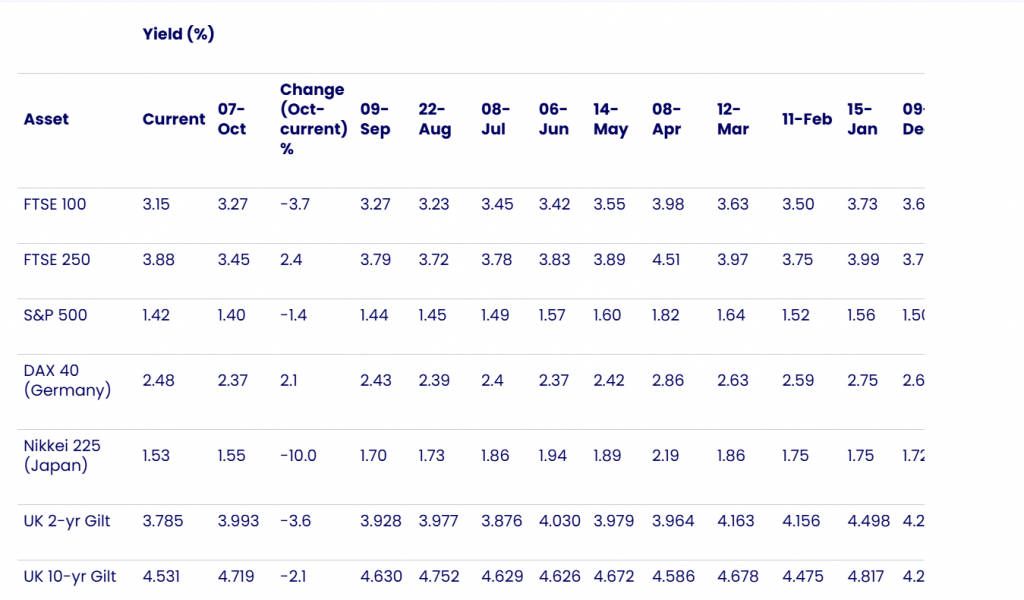
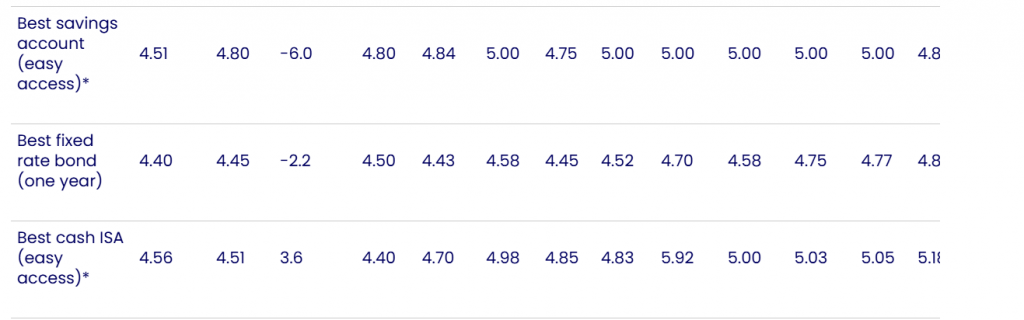
Yields across mainstream asset classes have declined over recent months. For example, easy-access savings accounts now offer little more than 4.0% excluding bonuses following a 75-basis point cut to the Bank Rate since the start of the year.

Similarly, falling interest rates have supported fixed-income prices. This has contributed to a fall in the yield on 10-year gilts, for example, which is down by around 20 basis points to 4.4% year to date.

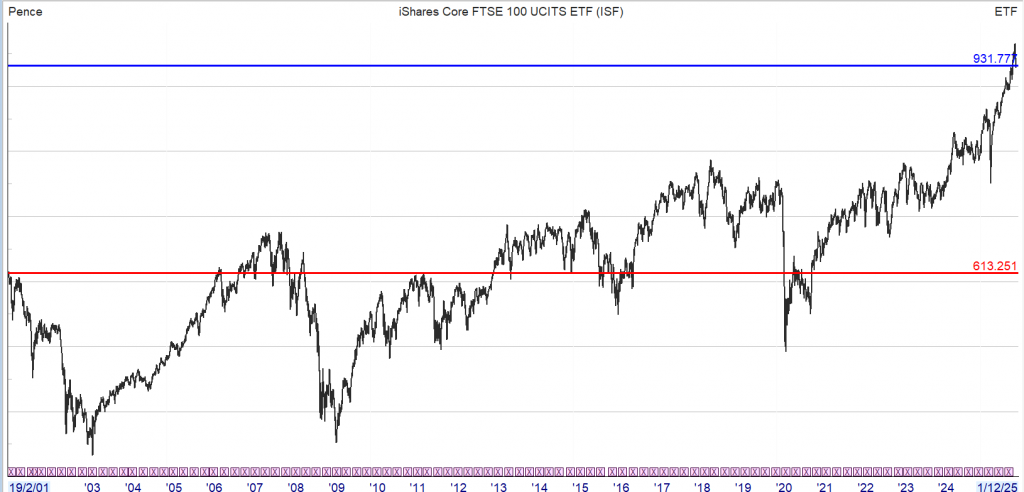
Additionally, the FTSE 100 has surged by 15% since the start of the year. Its performance has been boosted by continued monetary policy easing not just in the UK, but across developed economies including the US and eurozone, given its overwhelming reliance on the global economy (over 80% of FTSE 100 members’ sales are generated from outside the UK). As a result of its recent surge, the UK’s large-cap index now yields just 3.2%.

Future prospects

The recent trend of falling yields is likely to continue in future. While UK inflation is currently 180 basis points in excess of the Bank of England’s 2% target, the central bank said in November that it believes the annual rate of price changes has now peaked. According to its forecasts, inflation will gradually fall to target during the first half of 2027.

When combined with an unemployment rate that currently stands at 5%, its highest since May 2021, and economic growth that amounted to just 0.1% in the third quarter of the year, this suggests further interest rate cuts are ahead.

Falling rates are likely to prompt continued decline in the income return of cash savings accounts. In theory, further monetary policy easing should also lead to a rise in government bond prices, which could prompt a continuation of falling gilt yields. And with lower interest rates likely to be implemented not just in the UK but also in the US, where the Federal Reserve expects inflation to fall to 2% by 2028, the outlook for the world economy is set to improve. This should support the FTSE 100’s future performance, thereby having the potential to further suppress its dividend yield.

Asset allocation

In terms of portfolio positioning, cash savings accounts are set to become an even less worthwhile means of generating an attractive income. Indeed, income investors who rely on them are likely to experience a substantial decline in their spending power even amid falling inflation.

While a looser monetary policy should boost bond prices, thereby providing scope for capital gains in the medium term, a heightened level of UK political and economic uncertainty could weigh on government bond prices. For instance, reaction to the upcoming Budget and any subsequent changes to fiscal policy remain a known unknown that may prompt heightened volatility in gilt prices.

As a result, income seekers may wish to continue to focus on dividend stocks rather than fixed income or cash alternatives. While the FTSE 100 index currently offers a yield that is around 120 basis points lower than that of 10-year gilts or easy-access cash savings accounts, its members provide scope for significant dividend growth amid falling interest rates and an increasingly upbeat global economic outlook.

Source: Refinitiv as at 18 November 2025. Bond yields are distribution yields of selected Royal London active bond funds (as at 30 September 2025), except global infrastructure bond which is 12-month trailing yield for iShares Global Infras ETF USD Dist as at 14 November. SONIA reflects the average of interest rates that banks pay to borrow sterling overnight from each other (14 November). Best accounts by moneyfactscompare.co.uk refer to Annual Equivalent Rate (AER) as at 18 November. *Includes introductory bonus.

An inflation-beating income?

Over the long run, it would be wholly unsurprising if a diverse portfolio of UK large-cap shares provides income seekers with a positive real-terms increase in their spending power. This contrasts with the fixed income offered by bonds, which is set to decline in real terms, and a likely fall in the income return from cash savings accounts.

Although the FTSE 100’s past performance suggests that its future returns could prove to be highly volatile, its earnings multiple of under 18, versus a figure of 27.6 for its US peer (S&P 500), suggests it is not yet overvalued. Alongside improving operating conditions for its members amid likely global interest rate cuts, this indicates that it could deliver further capital gains alongside inflation-beating income growth in the coming years.

Dividend growth potential

GSK’s 30% share price rise since the start of the year means it now has a yield of 3.6%. While the global pharmaceutical firm still has an income return which is 40 basis points greater than that of the FTSE 100 index, some income seekers may feel it now lacks dividend investing appeal having started 2025 with a yield of roughly 4.5%.

However, the company’s shareholder payouts are set to rise at a relatively fast pace over the coming years as a result of its improving financial performance. Recently released third-quarter results, for example, included an upgrade to profit guidance for the full year. GSK 

GSK now expects to deliver earnings per share (EPS) growth of 10-12% versus a previous forecast of 6-8%.

Higher profits should ultimately translate into rising dividends, given that the firm aims to pay out between 40% and 60% of earnings to shareholders. Having already announced dividend payments for the first three quarters of the current year, shareholder payouts are on track to rise by 4.9% for the full year. This is 110 basis points ahead of an elevated inflation rate and gives a forward yield of 3.6%. A consensus forecast of a double-digit rise in profits next year is set to have a further positive impact on dividends.

Solid fundamentals

As with any pharmaceutical company, there are no guarantees that GSK’s product pipeline will deliver on its potential. However, the company is boosting the chances of it doing so by spending a larger proportion of revenue on research and development (R&D).

In the first three quarters of the current year, for instance, it spent 21.5% of total sales on R&D. This is up 2.5 percentage points on the same period of the previous year. When combined with the firm’s improving financial performance, it means that R&D spending was up 20% versus the same nine-month period from the previous year.

Given its solid financial position, the company is well placed to further invest for long-term growth. Although its net debt-to-equity ratio is relatively high at 92%, the firm’s defensive characteristics mean this figure is by no means excessive.

Meanwhile, net interest cover of 17.8 in the first nine months of the year suggests the company could overcome even a material fall in profits should it ultimately experience difficulties in replacing today’s top-selling drugs, for example.

Total return prospects

Clearly, an upcoming change in CEO and ongoing geopolitical risks, notably rumours regarding tariffs on pharmaceuticals, are uncertainties facing the business. They could weigh on investor sentiment and act as a drag on future share price performance.

However, even after its share price surge over recent months, GSK trades on an earnings multiple of just 11.2, and less than 11 on a forward basis. This is more than a third lower than the FTSE 100 index’s price/earnings (PE) ratio and indicates that there is a wide margin of safety present which provides scope for a further upwards rerating over the long run. This is especially the case given the company’s upbeat earnings profile and solid fundamentals.

As a result, GSK appears to offer long-term investment appeal. Its encouraging financial performance and strong earnings growth potential could equate to inflation-beating dividend growth that more than adequately compensates investors for a relatively modest yield. And with upward rerating potential and a rising bottom line, the stock’s total return prospects also appear to be relatively favourable.

Robert Stephens is a freelance contributor and not a direct employee of interactive investor. 

Across the pond

This “Bubble Fear” Is the Best Setup We’ve Had in Years. These 6%+ Divvies Are the Play

Brett Owens, Chief Investment Strategist
Updated: November 18, 2025

What a time to be a contrarian!

The economy is en fuego as AI boosts productivity (even if, yes, it’s cooling payrolls). Yet the mainstream crowd is hunkered down, terrified of an AI bubble.

That sets up some very attractive deals in 8%-paying closed-end funds (CEFs), many of which have gone on sale in the last few weeks.

2 “North Stars” Show Us What to Do Now

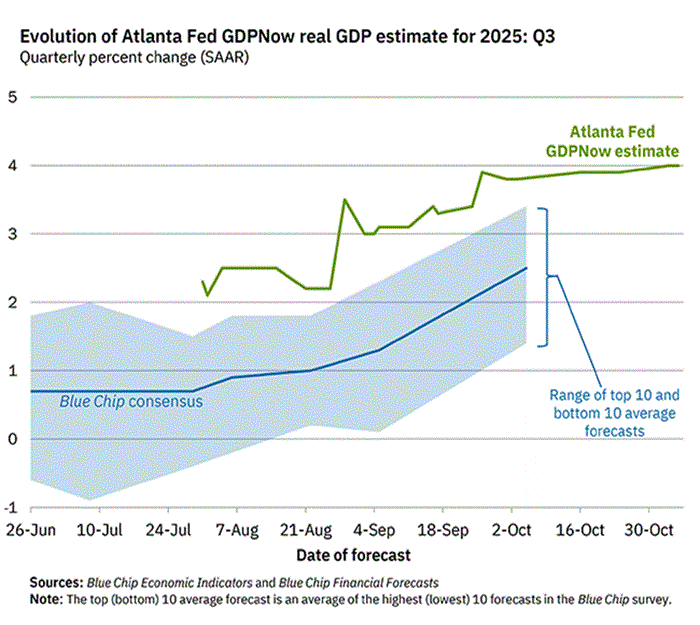
To get a feel for the setup in front of us, all we need to do is look at two things.

First, the Atlanta Fed’s GDPNow indicator, the most current economic “barometer” we have. In the recently completed third quarter, it’s telling us the economy grew a solid 4% annualized. Cooking!

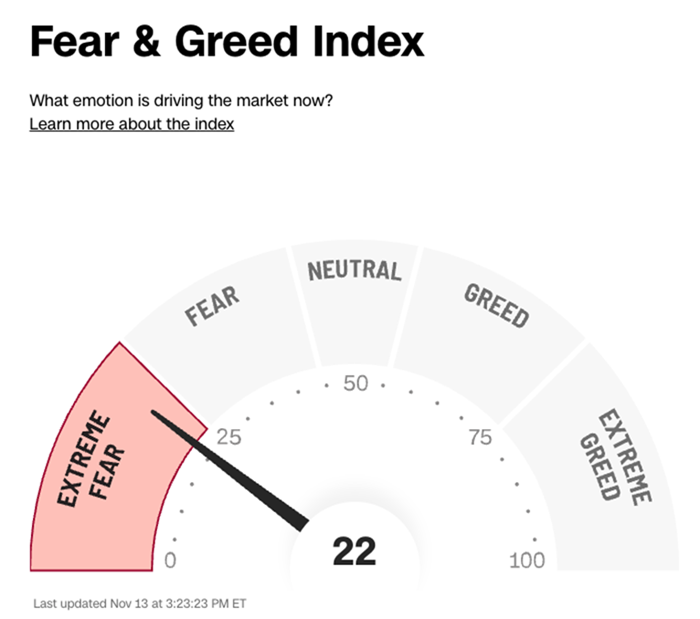
Meantime, the “dumb money” is in full panic mode. Consider the CNN Fear & Greed index, a fairly reliable “investor mood ring”:


Source: CNN.com

Look, I get the bubble fears. But here’s the thing: When you strip out tech and look at things on an equal-weight basis, the S&P 500 is only up about 7% this year. To put that in context, the index has returned around 10% annualized since 1957. So that 7.2% figure isn’t much of a worry.

This is why we want to steer clear of an index fund like the SPDR S&P 500 ETF (SPY) and go with a CEF instead: The latter are run by human managers who can “pick their spots” for bargains.

What’s more, as I wrote last week, CEFs are a “go-to” for us at times like these because these funds are a small market. That means CEF buyers tend to be individual investors—there’s just not enough cash in play here for the big guys to bother with.

But there’s plenty for us! Plus, without competition from institutional players (and their algorithms), we get more bargain opportunities. In addition, CEF investors tend to be conservative sorts, so when the needle moves to “fear” (or better yet “extreme fear,” where it is now), they’re much quicker to sell. And when they do, CEF discounts to net asset value (NAV) get wider. That’s our “in”!

Here are two CEFs paying 6%+ and sporting double-digit discounts today. The first is run by a well-known value-investing guru. The second is a young tech fund paying a huge 9.7% dividend that just delivered its first-ever payout hike.

CEF #1: A Top “Rinse-and-Repeat” Play for Double-Digit Gains

There are few managers better at “picking their spots” than Mario Gabelli. If you’ve been a member of my Contrarian Income Report service for a while, you’ll recall his Gabelli Dividend & Income Trust (GDV), which we’ve tapped for nice double-digit returns a couple times.

The first was from early October 2020 till February 2022, when we booked a solid 44% total return. Then we came back and dipped in for just three months, from October 2023 till January 2024, for another 10.8% return.

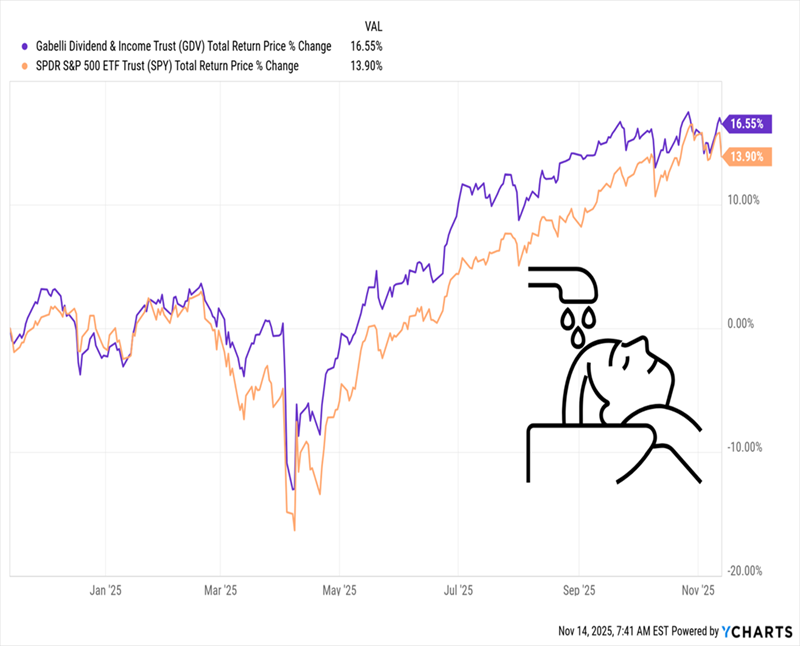
Now, as we near the end of 2025, I’m keeping an eye on GDV again. Why? Because our man Mario’s been putting on a clinic this year, racking up a 16.6% return on GDV’s market price, as of this writing, ahead of the S&P 500’s 13.9%.

“Rinse-and-Repeat” Play GDV Outruns the Market …

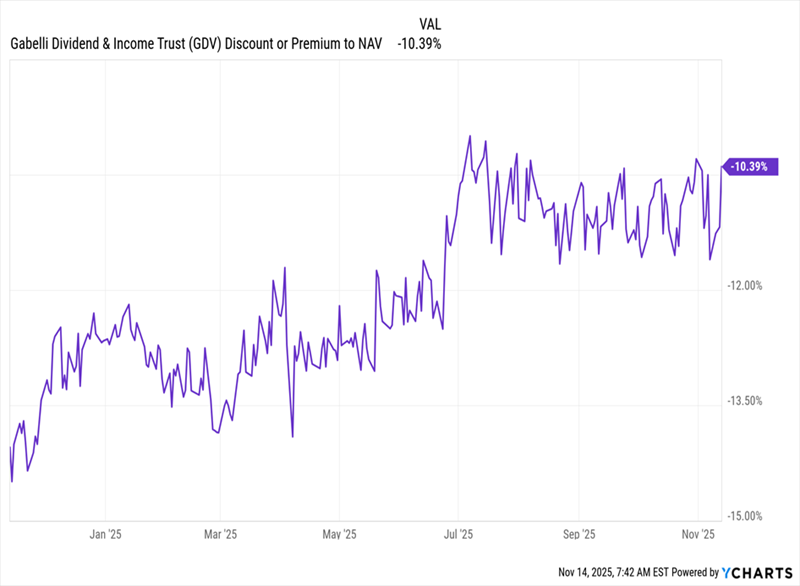
For that, you might think GDV would be trading close to par. Ha!

… And Gets Little Credit for It

Sure, its discount has narrowed a bit, but 10.4% is still far too big for a fund performing this well. That’s an opportunity—as is the fact that GDV’s discount has momentum, showing that it’s getting on at least some CEF investors’ radar.

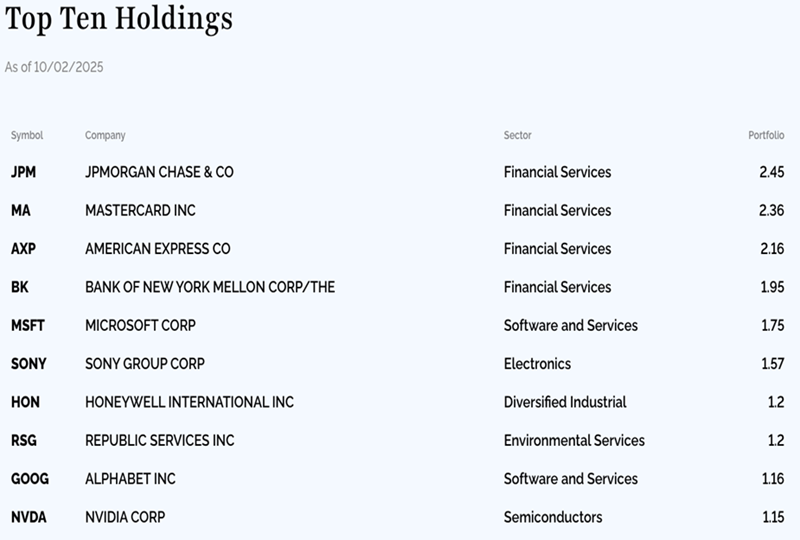
We also like the fact that Mario is looking to other sectors beyond tech, which matches up with our view that industries like finance will be next to streamline their businesses. As you can see below, only three of GDV’s top-1o holdings are AI plays—Microsoft (MSFT)Alphabet (GOOGL) and poster child NVIDIA (NVDA).


Source: gabelli.com

Now, far be it for us to turn up our noses at a 6.2% dividend, but Gabelli’s payout is a bit low for a CEF. However, we can look forward to upside from that closing discount and Mario’s stock picking to make up the difference.

Plus, the dividend—paid monthly—has been rising, so we can consider that 6.2% a “starter yield” on a buy today.

GDV Delivers the (Monthly) Dividend Cash

Source: Income Calendar

(Note that those dips in late 2021 and late 2022 are special dividends, not cuts!)

All of this makes now a good time to consider GDV—especially if you’re looking for a bargain-priced, high-yield way to diversify beyond tech.

CEF #2: A 9.7% Dividend That Just Jumped 

Now just because we’re leaning into GDV’s non-tech bent doesn’t mean we’re turning away from tech. But again, we’re picking our spots—and that’s where the Neuberger Berman Next Generation Connectivity Fund (NBXG) comes in.

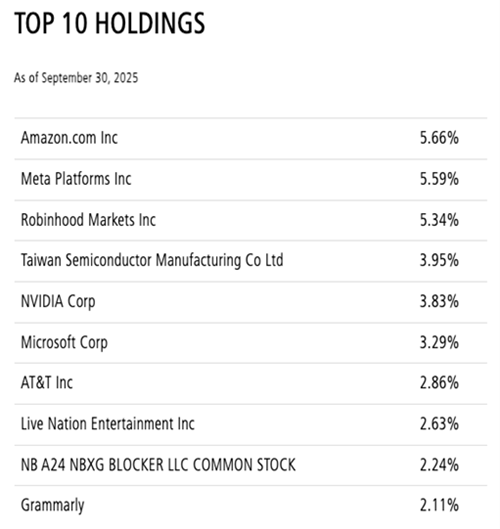
NBXG goes in the opposite direction of GDV, holding the main tech names: Amazon.com (AMZN), Meta and Microsoft are all here, as are some more aggressive tickers, like Robinhood Markets (HOOD) and “adjacent” plays like AT&T (T).


Source: nb.com

Plus, the fund is generous on the dividend front, with a 9.7% payout. And shareholders just bagged their first-ever dividend hike (NBXG hasn’t been around long, having launched in May 2021):


Source: Income Calendar

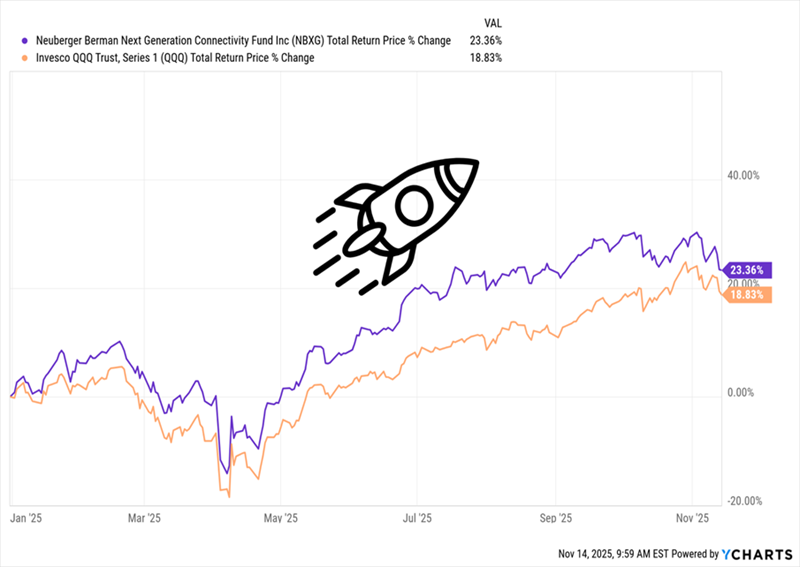
Moreover, the fund has outrun the NASDAQ on a total-return basis this year.

NBXG Crushes Its High-Flying Benchmark

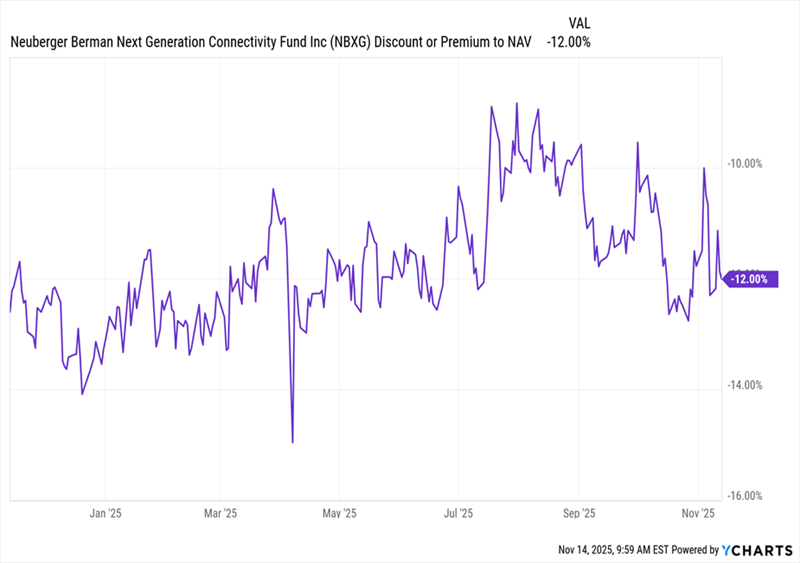
Which brings us to the discount, which is a sweet deal at 12%. But as you can see below, the markdown has largely moved sideways this past year, despite the fund’s strong performance:

NBXG Is Cheap, But Will Likely Get Cheaper

That means we can’t expect much upside from the closing discount, and will be looking to the fund’s portfolio to drive gains. That’s not a bad thing, but I’d wait till that markdown is below 13% before considering this one—and look to GDV till then.

This 11% (!) Divvie Got Tossed in the “Sale” Pile, Too (It Won’t Stay There)

My ULTIMATE buy on this pullback is an 11%-paying fund trading at a truly ridiculous discount.

The incredible 11% dividend this fund throws off also has a history of being hiked—and our top pick’s manager, a top name in the bond world, regularly drops special dividends, too!

This fund has been swept up in the pullback, but that won’t last. Because as rates fall (and they will, especially when Jay Powell’s term ends in May and he’s replaced by someone who will work with the administration to cut rates), this fund’s huge payout will likely be in high demand.

The time to grab a position is NOW, while today’s overdone fears have this 11% payer in the bargain bin.

Why is the renewable energy trusts industry struggling ?

Story by Rupert Hargreaves

 More clouds gather over renewable energy trusts – is there any hope for the sector?

More clouds gather over renewable energy trusts – is there any hope for the sector?

Story by Rupert Hargreaves© Saeed Khan / AFP) (Photo by SAEED KHAN/AFP via Getty Images

Renewable energy trusts were already struggling before the government decided to kneecap them at the end of October. In a major shock, it has launched a consultation on changing the inflation linkage on the subsidies they receive from the retail price index (RPI) to the consumer price index (CPI) in April 2026, three years sooner than expected.

Even worse, the government has floated a second, complex option that would backdate the switch to 2002. This may have been thrown in mainly to make a April 2026 change sound like a concession, but if actually implemented could reduce the income received by generators by billions of pounds over the coming years. The market reacted accordingly and the sector as a whole lost about 5% of its market value on the day.

Feuding with renewable energy trust managers

It is regrettable that many managers were paid fees based on a percentage of NAV rather than performance. This became increasingly controversial once shares traded far below NAV. In the past year, many trusts have belatedly shifted to levying fees on a 50/50 mix of NAV and market value (or in UKW’s case, entirely on market value). Dealings with managers are becoming a common point of contention. Take Aquila European Renewables (LSE: AERI), which has agreed to sell assets to another fund advised by Aquila at a large discount to the current NAV, says Nicholls. How can the same manager assign two different values to the same assets? Or take a plan by Bluefield Solar Income Fund (LSE: BSIF) to merge with its manager, saying this would make it easier to invest in new projects. The trust has instead put itself up for sale after a backlash. Or just this week, TRIG has said it will merge with HICL Infrastructure (LSE: HICL), run by the same manager.

These developments show a lack of concern for investors, says Nicholls, which is clouding the real value of the assets. “If boards were more respectful of shareholders, the share prices would be a lot higher.”

It isn’t clear what it will take to shift sentiment towards the sector. The government’s consultation certainly won’t help. Still, there needs to be a substantial change in the way these trusts are run, with a primary focus on the interests of shareholders. Only then can investors begin to trust NAVs are what managers say they are.

The Snowball 2025

With the final shares in the Snowball declaring their dividends the total income for 2025 should be £11,930.00. There are announced dividends to paid next year of £682.00 as we start the journey again.

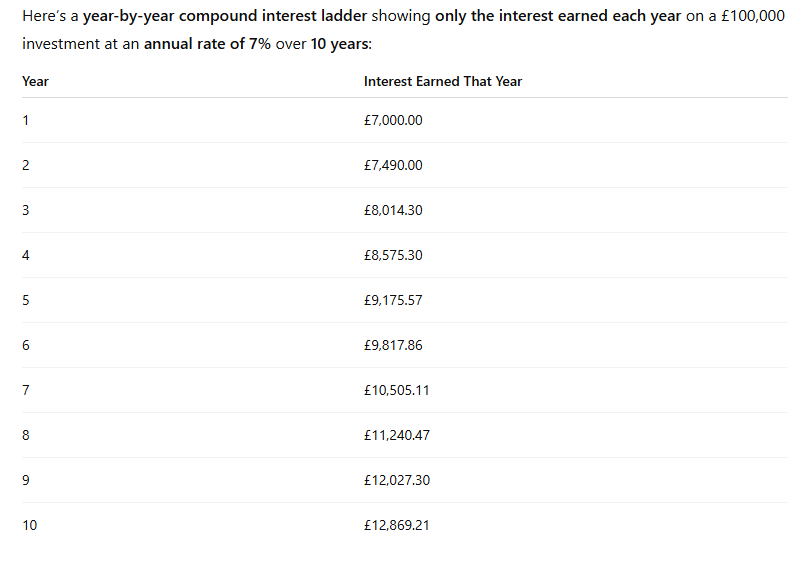
Income for 2025 of £9,175,57 has been exceeded and I will try to exceed next year’s target also.

One advantage the Snowball has on the above figures is that the interest in the table is compounded once a year, whilst the Snowball can add funds as they are received, normally monthly.

Current cash for re-investment £881, with further income to be received this year of £1,511.00.

Current quarterly income pencilled in of £2,479.00, which of course isn’t income until it sits in your account.

Rules for the Snowball

For any new readers, welcome. There are only 3 rules.

Rule one.

Buy Investment Trusts/Etf’s that pay a ‘secure dividend’ and re-invest those dividends into Investment Trusts/Etf’s that pay a ‘secure’ dividend.

Rule two.

Any share that drastically changes its dividend policy, must be sold, even at a loss.

Rule Three.

Remember the Rules.

It’s your duty, if you want to trade your Snowball to check the dividend announcements as they are made.

« Older posts Newer posts »

© 2025 Passive Income Live

Theme by Anders NorenUp ↑