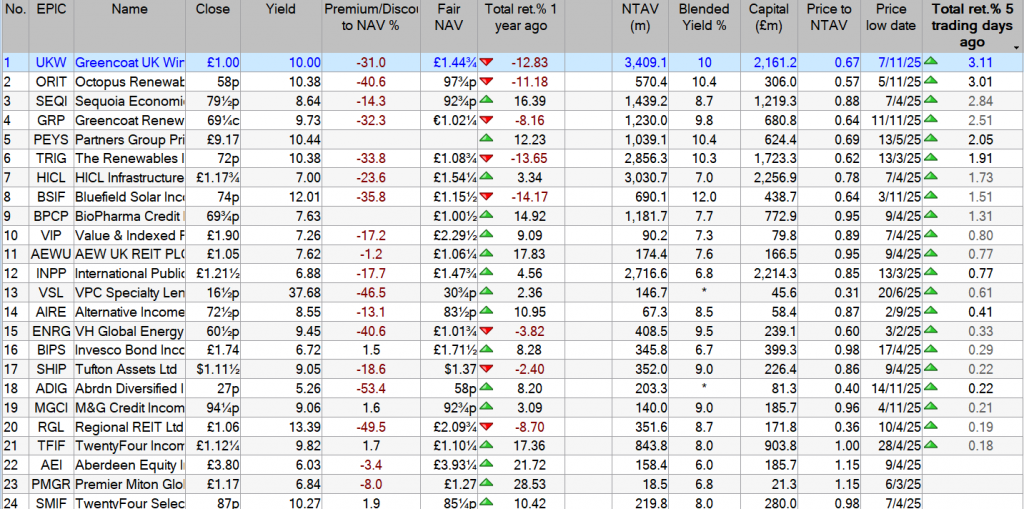
Investment Trust Dividends

Month: November 2025 (Page 7 of 15)

Covered Call ETFs

GPIQ Is Becoming The King Of The Covered Call ETFs

Nov. 15, 2025 8:30 AM ETGoldman Sachs Nasdaq-100 Premium Income ETF

Steven Fiorillo

Summary

  • The Goldman Sachs Nasdaq-100 Premium Income ETF offers a compelling blend of capital appreciation and double-digit yield, amassing $2.12B AUM in just over two years.
  • GPIQ’s dynamic covered call strategy leaves upside partially uncapped, enabling strong monthly income and market-beating total returns compared to peer ETFs.
  • The ETF’s monthly distributions remain stable regardless of Fed rate changes, making GPIQ attractive for income investors in a declining rate environment.
  • While GPIQ carries risks tied to tech sector performance and execution, its proven strategy positions it as a top choice for income-focused investors seeking growth.

Money growth
PM Images/DigitalVision via Getty Images

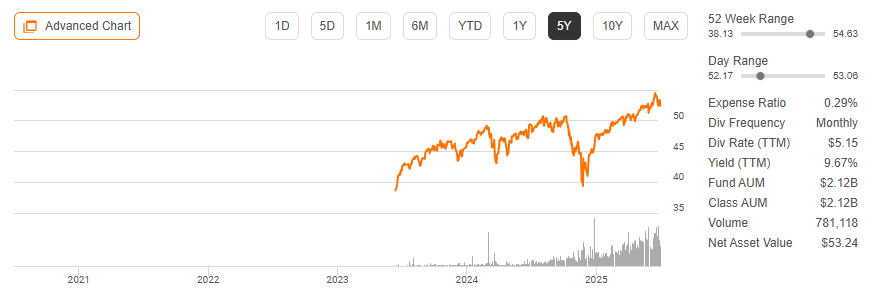
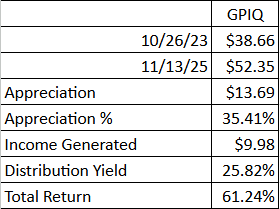
In just over two years, the Goldman Sachs Nasdaq-100 Premium Income ETF (GPIQ) has amassed $2.12 billion in assets under management (AUM) and is becoming the king of covered call ETFs. Their strategy of delivering recurring income while maintaining the ability to generate capital appreciation has led to GPIQ producing 35.41% in capital appreciation while paying out $9.98 (25.82%) in income since inception. No matter how you look at things, GPIQ has maintained an annualized return that exceeds 15% while producing a double-digit yield. I believe this is why GPIQ is gaining a lot of traction in the market, as their strategy is much more refined than the traditional covered-call overwrite strategy, as they utilize a dynamic methodology to maximize the potential to generate additional appreciation while still maintaining an attractive payout. Despite concerns of overvaluations in technology and expectations of a December rate cut being lowered due to incomplete data from the Fed, I believe GPIQ is very interesting for income investors heading into a lower rate environment. The stats speak for themselves, and even during the April sell off due to tariffs, GPIQ was able to rebound while providing recurring income. As the amount of income that is generated from risk-free assets continues to decline, GPIQ should look much more attractive, and I believe that capital will continue to flow into this dual-purpose ETF.
GPIQ
Seeking Alpha

Following up on my previous article about GPIQ

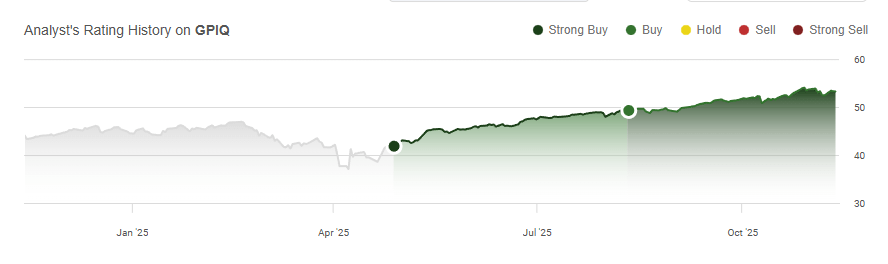
In the middle of August, I had written an article on GPIQ (can be read here) where I had discussed my bullish thesis. Since then, shares of GPIQ have increased by 3.11% while generating a total return of 5.86% as the S&P 500 moved higher by 5.44%. Over this period, its AUM has almost doubled as it has gone from $1.28 billion to $2.12 billion. More people are realizing that GPIQ is becoming the dominant ETF in the covered call option space. I had discussed how its dynamic call option strategy enables strong monthly income and capital appreciation, which sets it apart from similar ETFs. I am following up with a new article, as I am still very bullish on its future prospects and feel it is an interesting ETF for investors looking for a blend of capital appreciation and income in a falling rate environment.
GPIQ
Seeking Alpha

Why I like GPIQ’s strategy and how it operates

GPIQ owns a broad portfolio of assets found within the Nasdaq 100 and then implements a dynamic covered call strategy to generate additional recurring income. In a market where there is no shortage of income focused ETFs, it’s important to understand the product and make sure that it fits your investment needs. GPIQ allocates at least 80% of its assets plus any borrowings into the companies that create the Nasdaq 100 and can purchase common stock, preferred stock, warrants, futures, forwards, ETFs, options, and other instruments. GPIQ has a dual focus of generating recurring monthly income while also producing capital appreciation, which is why I have gravitated toward it. The fund managers at Goldman Sachs (GS) aren’t obligated to maximize income, so they can also focus on scaling the options up or down when opportunities present themselves to create an environment where both objectives can flourish. This has allowed GPIQ to generate a return of 35.41% while producing 25.82% in income since October of 2023.
GPIQ
Steven Fiorillo, Seeking Alpha

I happen to like GPIQ’s approach toward generating income because it leaves the upside partially uncapped. GPIQ has a unique approach with an overwrite strategy where GPIQ sells a call option to generate income with the flexibility to implement this on a variable process. GPIQ can only write call options between 25% and 75% of the value of the equity investments, which leaves a portion of the portfolio always uncapped, so no matter what ratio they choose, GPIQ will appreciate in a bullish environment. GPIQ can also utilize FLEX options, which are customized exchange-traded option contracts with the ability to offer additional terms regarding exercise prices and expiration dates. The Flex options also provide GPIQ with the ability to treat some of the income as return of capital. Over the long haul the composition of the option overlay strategy has allowed GPIQ to outpace the average annualized returns of the market while generating a double-digit yield.
GPIQ Dividend
Seeking Alpha

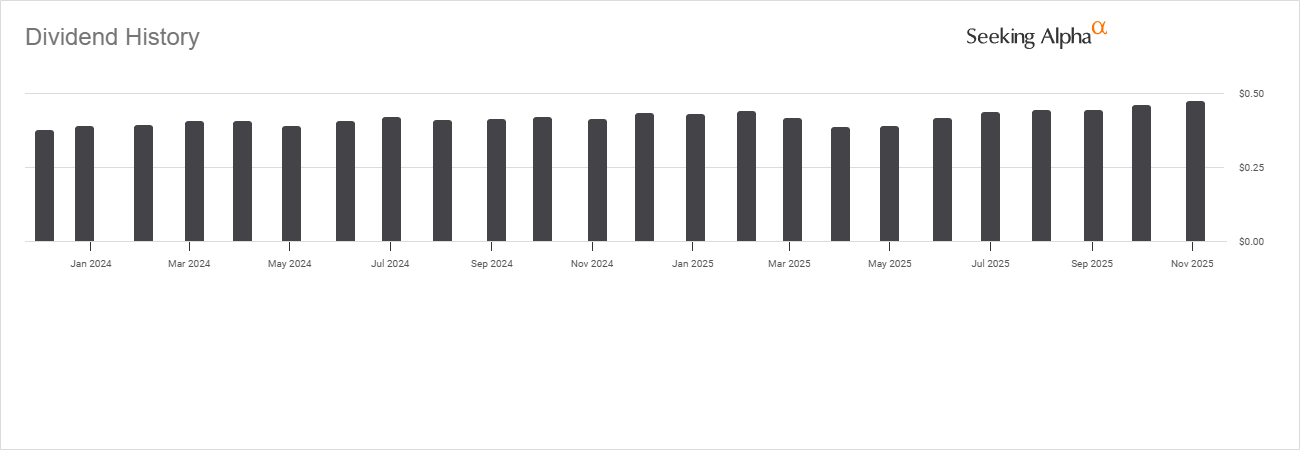
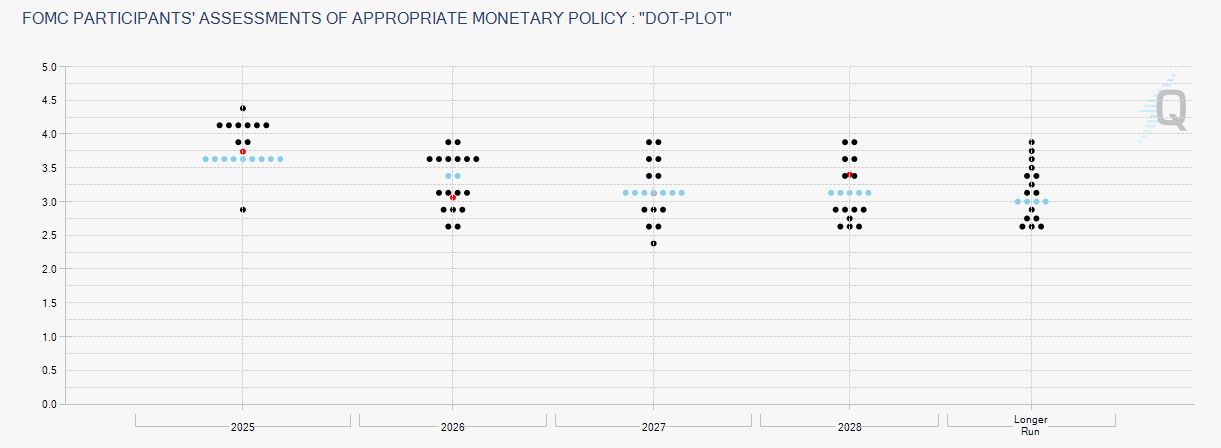
From a pure income perspective, GPIQ has produced 24 distributions with an average monthly distribution of $0.42. GPIQ has a tight dispersion range, and at the current average, it would produce $4.99 of forward income, which is a distribution yield of 9.54% based on the current share price. As the Fed continues to cut rates, GPIQ’s distribution isn’t dependent on what the Fed does, so I believe more investors will gravitate toward its strategy. Whether the Fed Funds Rates have been high or low, GPIQ’s distribution has remained relatively flat, which is a testament to their dynamic overwrite strategy. Leaving a portion of the fund uncapped will allow the underlying investment to appreciate in value while the income strategy works its magic and continues to significantly exceed not just the risk-free rate of return but many other investments in the market.
Fed Dot Plot
CME Group

When I compare GPIQ to other call option ETFs there is no doubt it’s becoming the King

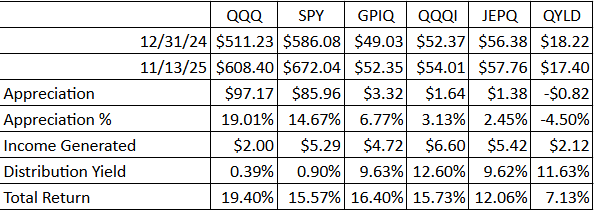
I compared GPIQ to six other ETFs, which include the Invesco QQQ Trust (QQQ) and the SPDR S&P 500 ETF (SPY) as my baselines for the market. The peer group I selected for GPIQ consists of the Global X NASDAQ 100 Covered Call ETF (QYLD), NEOS NASDAQ-100(R) High Income ETF (QQQI), and the JPMorgan Nasdaq Equity Premium Income ETF (JEPQ) since the beginning of the year. I created a table below that shows how much appreciation each one has captured throughout 2025 and how much income they have generated. I utilize SPY and QQQ to create my baseline for the market and then see where the covered-call ETFs fall. GPIQ may not have generated the largest yield on a YTD basis, but the appreciation on the other side of its investment strategy has allowed it to have the largest total return from this peer group.
GPIQ, QQQI, JEPQ, QYLD
Steven Fiorillo, Seeking Alpha

There are very specific reasons I am comparing GPIQ to QYLD, QQQI, and JEPQ. QYLD is the original covered-call ETF that has stayed true to its strategy and generates income by writing calls at or close to the money, which caps most of the upside potential. QQQI is an evolved strategy of QYLD that incorporates call spreads into its investment mix. QQQI will retain a portion of the premium it generates from writing calls to purchase out-of-the-money calls so it can participate in some of the upside. JEPQ utilizes its call option strategy through its equity-linked notes (ELNs) to generate income. These funds all focus on the Nasdaq-100, so it creates a good peer group.

QYLD’s strategy hasn’t held up well in 2025, as its actual ETF has declined by -4.5% in an environment where QQQ and SPY have appreciated by 19.40% and 15.57%. When the distribution is factored in, the total return is 7.13%. JEPQ, which is a top covered call ETF, is also underperforming, as the combination of its appreciation and yield has generated a total return of 12.06%. QQQI, which has implemented call spreads on QYLD’s strategy, has a large yield YTD of 12.6% while producing 3.13% in appreciation, leading to a total return of 15.73%, which is slightly above the total return from SPY. GPIQ has pulled away from the pack with a total return of 16.4%, which is comprised of a 9.63% yield and 6.77% of appreciation. GPIQ has allowed investors to have their cake and eat it too, and it’s outpacing SPY while slightly trailing QQQ.

Risks to investing in GPIQ

While I am bullish on GPIQ, investors should do their own due diligence, as there are risk factors to consider. GPIQ currently offers an appealing blend of income and growth, but it is going to move lockstep with QQQ. If we get an environment where there is a rotation out of technology, GPIQ’s strategy won’t provide much cover, and the share price will follow QQQ lower. GPIQ’s dynamic covered call approach has worked out well in 2025, but there is execution risk. If the managers misjudge volatility, it could cap more upside than intended and underperform previous results from an appreciation standpoint. If you’re looking for long-term appreciation, GPIQ is not created to replicate QQQ, so you could leave some upside on the table in a bull market. Please understand the investment and do your own research.

Conclusion

I am very bullish on GPIQ from a long-term perspective, as the managers have proven that they can produce on both sides of the investment case. The composition of GPIQ sets up well for investors who are looking to grow their capital to some degree while generating a monthly check that outpaces the risk-free rate of return. As the Fed continues to lower rates, GPIQ’s monthly distribution is unlikely to be impacted, which makes it a very interesting ETF going forward. I believe that the market is going to move higher over the next year, and if it does, GPIQ’s construction should allow income investors to participate in more upside than other covered-call ETFs while generating similar yields for a larger total return.

RECI

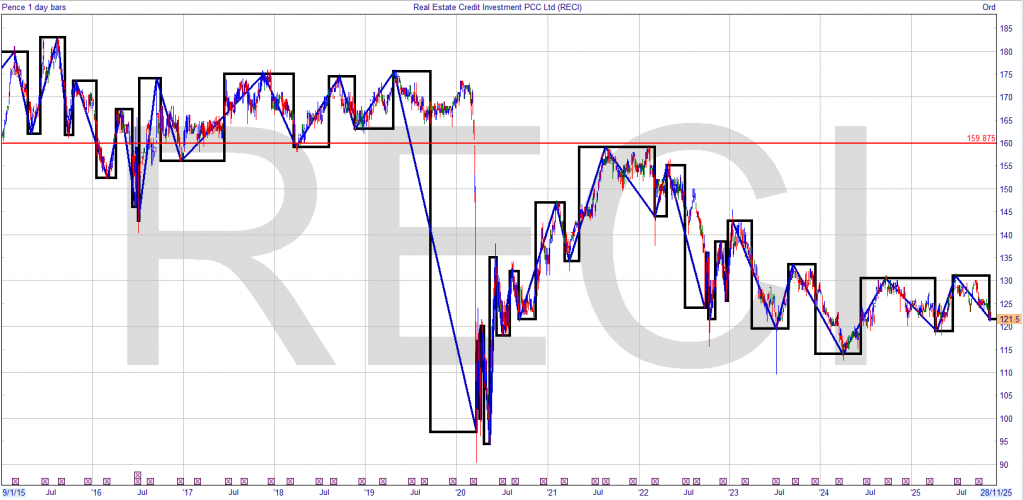
If you look at the chart, it’s a fair reflection of many shares, it’s pretty disappointing. You had to sit thru a lot of thin with very little thick but luckily this share pays a dividend.

If you look at the covid crash, anyone who sold and bought back when the yield was around 11.5% would be pretty pleased with their performance.

Without the benefit of hindsight there was no way of knowing how far the price would fall but if you liked the yield you may have made the trade.

Dividends included.

Even though the dividend hasn’t been increased you would have earned around115p in dividends and be on the road to achieving the holy grail of investing of having a share that sits in your account at zero, zilch, nothing and earns you income. You could have used the dividends to help pay your bills but if you had re-invested into your portfolio, you would be earning income on that also.

Warren Buffett’s advice

As stocks plunge, here’s Warren Buffett’s advice

Some US stocks have plunged in November, causing the wider stock market to wobble. Here’s what Warren Buffett does to prepare ahead of a potential crash.

Posted by Zaven Boyrazian, CFA❯

Published 15 November,

BRK.B

Buffett at the BRK AGM
Image source: The Motley Fool

When investing, your capital is at risk. The value of your investments can go down as well as up and you may get back less than you put in.

The content of this article is provided for information purposes only and is not intended to be, nor does it constitute, any form of personal advice. Investments in a currency other than sterling are exposed to currency exchange risk. Currency exchange rates are constantly changing, which may affect the value of the investment in sterling terms. You could lose money in sterling even if the stock price rises in the currency of origin. Stocks listed on overseas exchanges may be subject to additional dealing and exchange rate charges, and may have other tax implications, and may not provide the same, or any, regulatory protection as in the UK.

You’re reading a free article with opinions that may differ from The Motley Fool’s Premium Investing Services.

Since the start of 2025, Warren Buffett’s Berkshire Hathaway (NYSE:BRK.B) has actually underperformed against the S&P 500. But the same was true in 2021. And yet in the following years, Berkshire’s share price surged by almost 70% compared to the S&P’s 49.5% (including dividends).

Over the long term, Buffett’s strategic investments have vastly outperformed, particularly during times of economic and stock market turmoil. And we could be on the verge of entering another period of high volatility.

Since the latest earnings season kicked off, several Magnificent Seven stocks have taken a big hit. Meta saw its market-cap drop by over 17%, while Microsoft and Nvidia are both down near 10% in November so far.

Of course, not all leading businesses have stumbled, with Alphabet and Apple proving to be more resilient, and Amazon even jumping on its results. But overall, a growing number of stocks have plunged on their latest results.

Yet by making the right moves, phenomenal returns can potentially be unlocked. With that in mind, what advice does the ‘Oracle of Omaha’ have when investing during shaky market conditions?

1. Don’t panic

Buffett has repeatedly stated that the stock market transfers wealth from nervous to patient investors. Making emotionally-driven decisions during market downturns is a guaranteed way to lock in losses and potentially miss out on explosive long-term gains.

Instead, investors should remain focused on the underlying business and its fundamentals. Berkshire’s investment portfolio is filled exclusively with companies that have substantial competitive advantages, talented management, and ample long-term profit potential.

These sorts of companies rarely trade at attractive valuations. But that can quickly change during a market correction or crash. And as such, instead of panic-selling like everyone else, Buffett and his team often start buying.

We’ve seen this first-hand in 2020 when the billionaire started snapping up shares in Apple, American ExpressChevron, and Occidental Petroleum, among others.

2. Have some cash on the sidelines

When markets start getting frothy, Buffett has always built a cash position on Berkshire Hathaway’s balance sheet. And as of 2025, that’s risen to a jaw-dropping $382bn.

It’s clear Buffett’s following his own advice and preparing to capitalise on bargains that could materialise if the stock market decides to throw a tantrum.

Could this have already started? It’s certainly possible. And we’ve even seen some famous short sellers like Michael Burry (who successfully predicted the 2008 financial crisis) start placing enormous bets against stocks like Nvidia.

Yet, Buffett’s always cautioned against timing the market. Instead, he’s often advocated for holding on to high-quality stocks even during the volatility. Why? Because accurately predicting a stock market crash is almost impossible. And in most cases, simply holding on to top-notch stocks generates the best results.

That’s why, despite seemingly growing cautious and trimming some of his positions, Berkshire Hathaway still has hundreds of billions invested in US stocks.

Therefore, when following Buffett’s example, the best move right now could be to build a bit of cash and hunt for the best businesses to invest in. Even if the valuation’s too high to buy today, a potential stock market correction could quickly change that. And it’s the investors who are prepared that can unlock the most wealth in the long run.

REITs

REITs might be big winners in the upcoming UK Budget — here’s what to look for

If income tax thresholds stay fixed, Stephen Wright thinks REITs could be set for a big boost on 26 November — Budget day.

Posted by Stephen Wright

Published 15 November,

GRI

House models and one with REIT - standing for real estate investment trust - written on it.
Image source: Getty Images

When investing, your capital is at risk. The value of your investments can go down as well as up and you may get back less than you put in.

The content of this article is provided for information purposes only and is not intended to be, nor does it constitute, any form of personal advice. Investments in a currency other than sterling are exposed to currency exchange risk. Currency exchange rates are constantly changing, which may affect the value of the investment in sterling terms. You could lose money in sterling even if the stock price rises in the currency of origin. Stocks listed on overseas exchanges may be subject to additional dealing and exchange rate charges, and may have other tax implications, and may not provide the same, or any, regulatory protection as in the UK.

You’re reading a free article with opinions that may differ from The Motley Fool’s Premium Investing Services.

I think there’s a strong chance that real estate investment trusts (REITs) could get a big boost from the upcoming UK Budget. So this might be a good time to consider buying them.

The details of the Budget will be revealed on 26 November. And while there’s a lot that’s uncertain, investors should be thinking now about changes that could be on the way. 

Please note that tax treatment depends on the individual circumstances of each client and may be subject to change in future. The content in this article is provided for information purposes only. It is not intended to be, neither does it constitute, any form of tax advice. Readers are responsible for carrying out their own due diligence and for obtaining professional advice before making any investment decisions.

What are REITs?

REITs are companies that own and lease real estate in the form of houses, offices, warehouses, or just about any kind of property. And they have a unique tax-advantaged status.

Unlike other companies, REITs don’t pay any tax on their income. But they have to return 90% of what they make to investors in the form of dividends.

This makes them very efficient income sources. Where buy-to-let investors have to pay tax on their rental income, REITs can distribute cash to shareholders without having to do this.

Furthermore, savvy REIT investors can use a Stocks and Shares ISA or a SIPP to protect themselves from dividend tax. This is a big benefit – and it might be about to get bigger…

Tax brackets

The Chancellor had been rumoured to be considering increasing income tax. But while that’s been ruled out, a freeze on tax thresholds now seems more likely.

That means people stand to pay more tax as their income increases. And it affects landlords, who pay tax on their rental income.

REIT investors who invest using an ISA or a SIPP, by contrast, are set to be unaffected. And that could make REITs even more attractive to investors than buy-to-let properties. 

If this happens, REITs across the board could get a boost. So now might be the time for investors to have a serious look at the passive income opportunities on offer.

London housing 

One name that I think is particularly interesting is Grainger (LSE:GRI). The firm only became a REIT a couple of months ago, but it has a really interesting portfolio of houses.

Around half of the firm’s properties are located in London. As a result, it benefits from strong demand and there’s not much available space for building, so supply is naturally limited.

One potential risk is the possibility of future changes in rental legislation creating costs and weighing on returns. But it’s worth noting this is also an issue for buy-to-let investors.

At least with Grainger, investors get a management team to deal with this for them. And with roughly 4,500 more properties in the pipeline, the portfolio looks set to grow. 

Long-term thinking

Investors should be thinking about how the upcoming UK Budget might reshape their portfolios. And that includes the rental market and income-generating property investments.

The point isn’t just to be one step ahead of a potential boost in share prices. It’s to be own assets that have better long-term prospects.

If income tax thresholds staying fixed pushes up the amount of tax landlords pay on their rental income, this could benefit the owners of REITs over buy-to-let properties. And it’s being reported as a serious possibility.

As a result, I think investors should take a look at the opportunities in the REIT sector in the UK right now. And Grainger is a new name that’s worth serious attention.

Contrarian Outlook

The Market’s a Ripoff Right Now, But These 4 High Yielders Aren’t

Brett Owens, Chief Investment Strategist
Updated: November 14, 2025

Will the stock market finish the year higher or lower?

Who cares?!

Paying attention to “the market” is a hopeless effort in 2025. The explosion of AI implementation plus the policies from Trump 2.0 are creating winners and losers in the economy.

So why buy a basket when we can cherry pick the undervalued front runners?

Even better? Some are cheap! As I write, four big dividend payers (dishing divvies between 5% and 6%) are trading at bargain-basement valuations. Let’s start with the most established of the four-pack, trading for less than its annual sales…Contrarian Outlook

AI’s explosive growth is lighting up an overlooked corner of the market and one quietly paying nearly 8% a year

Why Your Friends Are Losing $2,300 on Every $10K They Invest in Stocks

Every market wobble tempts investors to sell first and think later – and it’s a habit that can quietly drain thousands from long-term returns.

The data proves it: over a decade, fear-based trading carved a full percentage point off the average portfolio’s performance. Yet for disciplined investors collecting rich monthly checks from high-yield funds, these selloffs can be golden entry points instead of warning signs.

That’s especially true now, as market jitters push reliable 8%+ payers to rare double-digit discounts.

The Market’s a Ripoff Right Now, But These 4 High Yielders Aren’t

Trying to guess where the market ends the year is pointless in an economy being rewired by AI and the new policy landscape.

DISCLAIMER:

Nothing in ContrarianOutlook.com is intended to be advice, nor does it represent the opinion of, counsel from, or recommendations by BNK Invest Inc. or any of its affiliates, sponsors, subsidiaries or partners. None of the information contained herein constitutes a recommendation that any particular security, portfolio, transaction, or strategy is suitable for any specific person. All viewers agree that under no circumstances will BNK Invest, Inc., its subsidiaries, partners, officers, employees, affiliates, agents or sponsors be held liable for any loss or damage caused by your reliance on information obtained.

Contrarian Outlook is owned and operated by BNK Invest Inc.

Sonoco Products (SON)
Dividend Yield: 5.2%

Sonoco Products (SON) is a packaging dinosaur turned value play. This 126-year-old firm is cheap at 6.5-times earnings, has a 42-year raise streak rolling and is still unloved after a messy Eviosys deal ruffled Wall Street’s feathers.

The business itself is beautifully boring. Sonoco is a global packaging company that produces both consumer packaging (rigid paper products, steel containers, plastic containers and the like) and industrial packaging (paperboard tubes, protective packaging, recycled paperboards). It also deals in displays and packaging supply-chain services. And thanks to last year’s acquisition of Eviosys, it’s now the world’s largest metal food can and aerosol packaging manufacturer.

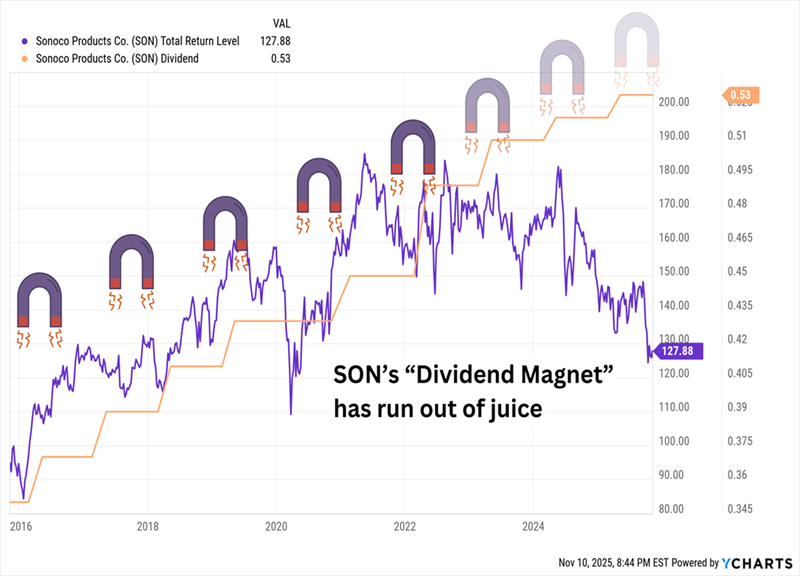
Sonoco yields 5% right now, and the stock is cheap by just about any measure we could want, including forward price-to-earnings (P/E, 6.5), price-to-sales (P/S, 0.7), price-to-cash-flow (P/CF, 7.0) and price/earnings-to-growth (PEG, 0.7) thanks to a sharp pullback:

Sonoco’s Dividend Magnet is Due

Sonoco’s shares have taken several hits over the past couple years, including initial skepticism over the Eviosys deal and high costs and slack demand—the latter two of which contributed to a recent quarterly miss and lowered full-year guidance. Tariffs have also hampered the company more than many expected.

Still, expectations for both the top and bottom lines are pointed in the right direction, and Sonoco boasts a streak of 42 consecutive increases to its dividend (on an annual basis).

International Paper (IP)
Dividend Yield: 4.9%

Another paper giant trading at pulp-level prices, International Paper (IP) fetches just six-times cash flow, pays a 5% yield and is hated enough to be a contrarian setup. IP produces and sells linerboard, whitetop, and saturating kraft paper, among other packaging products. It’s also a major player in pulp, which is used in a variety of personal-care products, construction materials, paints and more.

IP has suffered similar issues to Sonoco—namely, higher input costs, softer demand, and tariffs. Continued economic uncertainty also doesn’t bode well for the company’s near-term prospects.

Those headwinds forced International Paper to lower guidance for 2025 and 2026; “Macro conditions in North America and EMEA [Europe, Middle East and Africa] continue to be challenging,” CEO Andy Silvernail said in the post-earnings call.

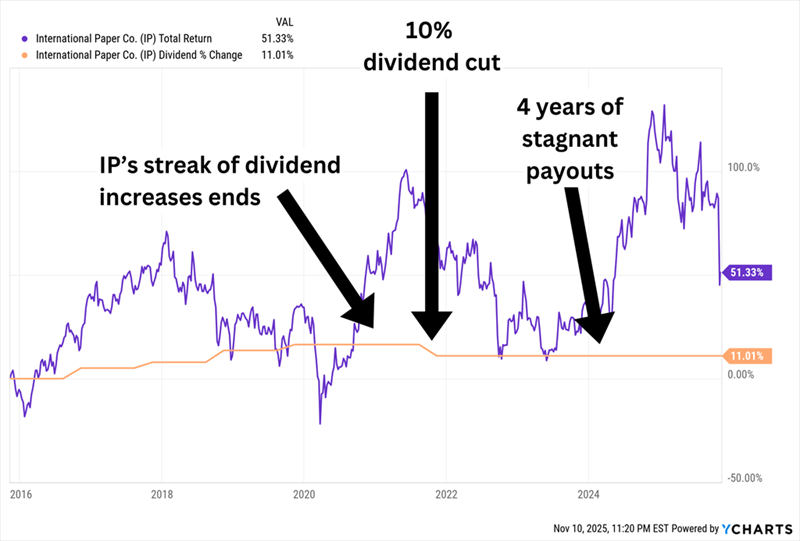
A big dip has IP trading at just 6 times cash flows and a PEG of 0.26, not to mention it has raised its payout to nearly 5%. But that’s the only thing bringing up its yield.

International Paper’s Dividend Has Been Flat for Years

Amcor (AMCR)
Dividend Yield: 6.2%

Amcor (AMCR) is a 41-year dividend grower hiding in plain sight. Its own merger hangover has the stock cheap while its payout has climbed past 6%.

Amcor makes a number of food-related packaging products, including high-barrier paperboard trays for beef and meats, glass dressing bottles, overwrap for home and personal care. Its products are also used in garden and outdoor products, agriculture, pet care, healthcare, even building and construction.

It’s a Dividend Aristocrat with 41 years of dividend growth under its belt. It’s a low-volatility stock, too, with a beta of 0.7 (a beta of less than 1 is considered less volatile than a benchmark; in this case, the S&P 500). And its value metrics are decent to downright attractive, including a P/CF of about 6, forward P/E under 11, and a PEG just slightly below 1. And it now trades at a yield north of 6%.

Every one of those metrics is better than when we checked in over the summer.

Amcor has delivered a pair of reports since then, including a lousy final quarter of its fiscal 2025 that showed the company is leaning heavily on synergies from its merger with Berry Corp. to help offset weakness in its legacy divisions, and a lackluster Q1 for its fiscal 2026 in which it met earnings estimates but continued to struggle with weak volumes.

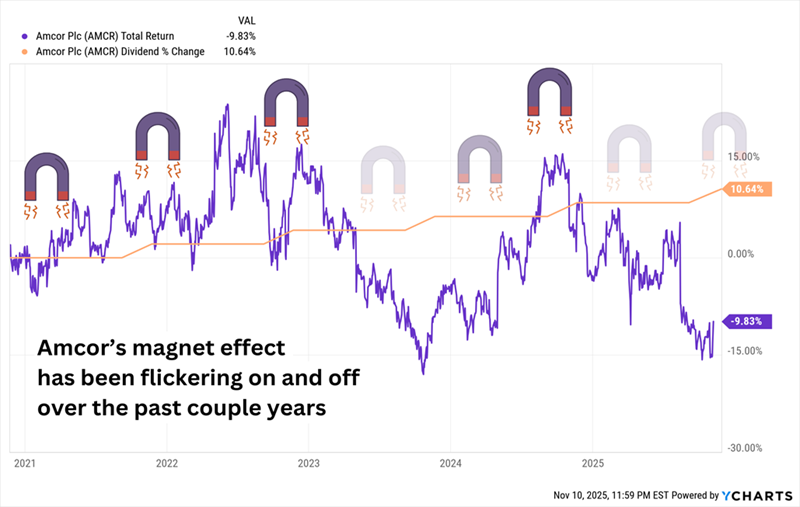
And unlike many other Aristocrats, its stock price has become somewhat untethered from its dividend growth.

Consistent Dividend Growth, But Inconsistent Stock Movement

Bristol-Myers Squibb (BMY)
Dividend Yield: 5.2%

Bristol-Myers Squibb (BMY, 5.2% yield) is big pharma with a small multiple! It trades under eight-times earnings and pays 5.2% while Wall Street frets over patent cliffs. BMY however boasts a deep stable of more than 30 products that includes cancer treatments Revlimid and Opdivo, and the anticoagulant Eliquis.

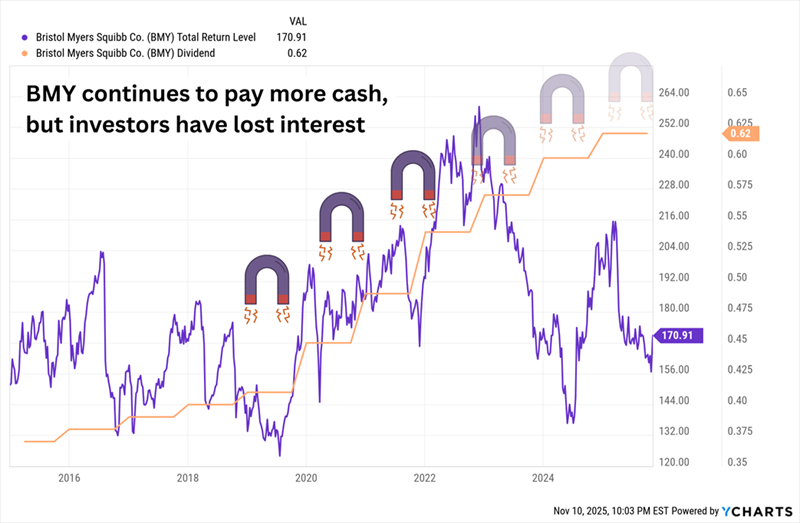
Recently we discussed BMY as one of a few health care stocks that still had a pulse amid a weak year for the sector. The company has since reported an upbeat quarter on the back of strong results for Reblozyl (for anemia due to lower-risk myelodysplastic syndromes) and Camzyos (for symptomatic obstructive hypertrophic cardiomyopathy).

Bristol-Myers’ Dividend Magnet Has Powered Down, Too

Partnerships with BioNTech (BNTX) and Bain Capital (BCSF), plus potential blockbuster Opdivo Qvantiq can help soften the blow when Opdivo’s key patent expires in 2028. BMY “pipeline believers” can receive a 5.2% divvie while they wait for this cheap (P/E 8) stock to roll out new pills.

Across the pond

One High-Yield Stock (5.77%) And One Dividend Growth Pick (10.35% CAGR) For Our Dividend Portfolio

Nov. 13, 2025 ET MSFTVICIBRK.ABRK.BARCCGOOGGOOGLBLK

Frederik Mueller

Summary

  • I added Microsoft (MSFT) and VICI Properties (VICI) to the Dividend Income Accelerator Portfolio, boosting sector diversification and dividend growth potential.
  • MSFT is overweighted due to its strong competitive edge, robust profitability metrics, and high dividend growth potential, justifying its premium valuation.
  • VICI offers an attractive forward dividend yield and consistent dividend growth, making it suitable for both income and dividend growth investors.
  • Portfolio adjustments improved risk-reward balance, increased exposure to Information Technology and Real Estate, and maintained a strong blend of yield and growth.
Microsoft Canada
hapabapa/iStock Editorial via Getty Images

The acquisition of additional shares of Microsoft (NASDAQ:MSFT) and VICI Properties (NYSE:VICI) helps improve our dividend portfolio’s balance of income and dividend growth potential while increasing the proportion of our portfolio that is allocated to the Information Technology and the Real Estate Sector.

While VICI Properties pays investors currently a Dividend Yield [FWD] of 5.77%, Microsoft has strong dividend growth potential, underlined by its 10-Year Dividend Growth Rate [CAGR] of 10.35%.

Through our latest portfolio additions, we have increased the proportion that is allocated to Microsoft from 1.14% to 2.58% and to VICI Properties from 0.83% to 2.38%.

The proportion that is allocated to the Information Technology Sector has been increased from 5.76% to 7.25% and the proportion allocated to the Real Estate Sector has been raised from 8.10% to 9.53%.

After our latest additions, the Weighted Average Dividend Yield [TTM] and 5-Year Weighted Average Dividend Growth Rate [CAGR] stand at 4.14% and 7.46%, respectively.

Why I added additional shares of Microsoft to The Dividend Income Accelerator Portfolio

As I explained in greater detail in my previous article on Seeking Alpha, I suggest overweighting both Alphabet and Microsoft in a diversified dividend portfolio that focuses on dividend growth.

With a proportion of 3.34% on the overall portfolio, Alphabet is already among the three largest positions of The Dividend Income Accelerator Portfolio.

Through the acquisition of additional shares of Microsoft to our dividend portfolio, we have increased the company’s proportion from 1.14% to 2.58%.

Microsoft strongly aligns with the investment approach of our dividend portfolio due to the company’s competitive edge over competitors, its strong dividend growth potential, and its attractive risk-reward profile.

Microsoft in terms of Valuation

Microsoft currently has a P/E [FWD] Ratio of 32.41. This means that Microsoft’s current P/E [FWD] Ratio is 4.41% above the Sector Median and 1.76% above the company’s 5-Year Average, indicating a fair Valuation.

However, from my point of view, Microsoft deserves a Premium Valuation, given the company’s significant competitive advantages, the company’s broad product portfolio, and its high growth rates (EBIT Growth Rate [YoY] of 17.45%).

Microsoft in terms of Profitability

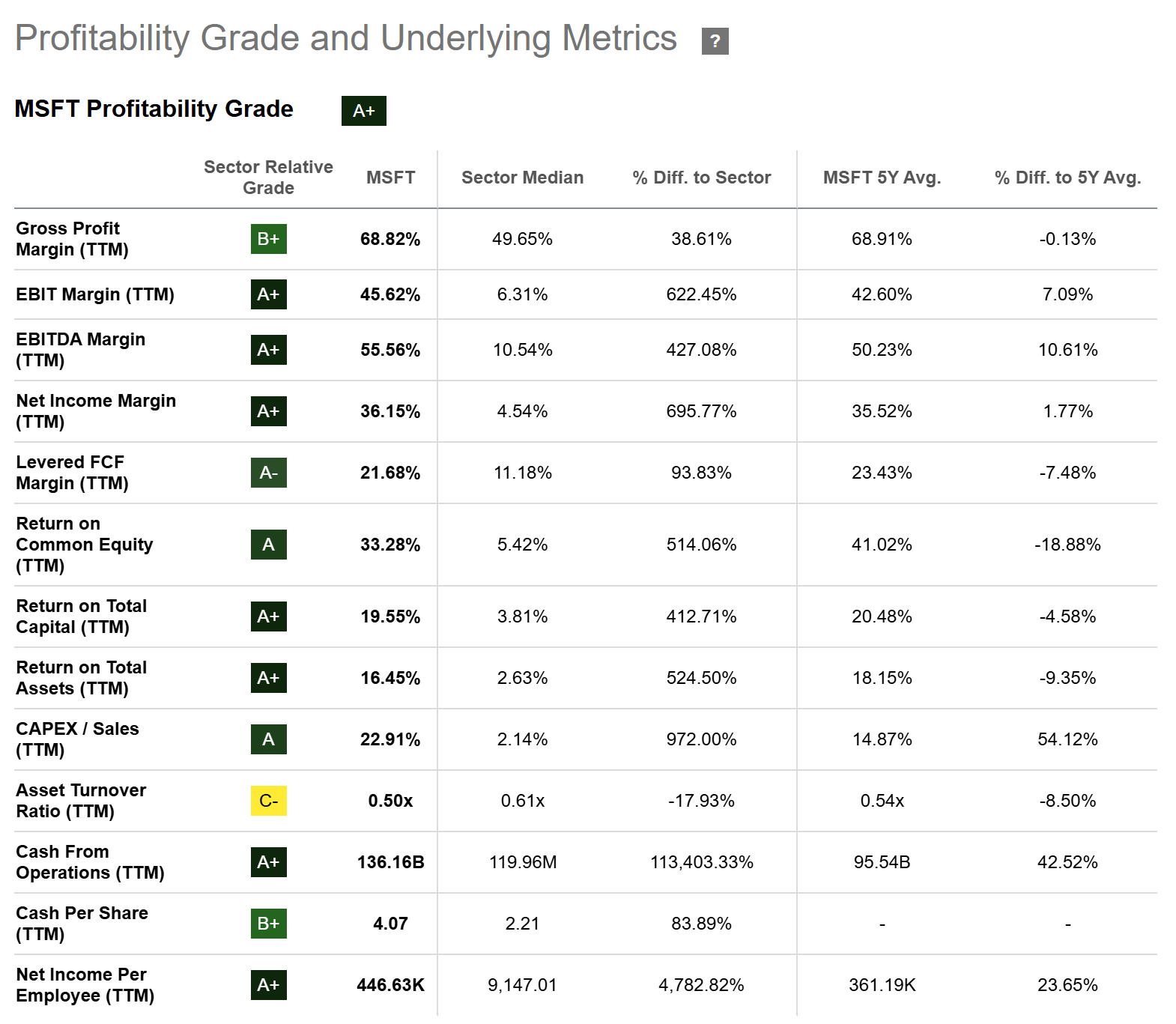
Microsoft’s A+ rating in terms of Profitability Grade is underlined by the company’s Return on Equity [TTM] of 33.28%, which is significantly above the Sector Median of 5.42%, its Return on Total Capital of 19.55%, which is well above the Sector Median of 3.81%, and its Gross Profit Margin [TTM] of 68.82%, which stands significantly above the Sector Median of 49.65%.

Microsoft: Profitability Grade
Source: Seeking Alpha

Microsoft’s strong dividend growth potential

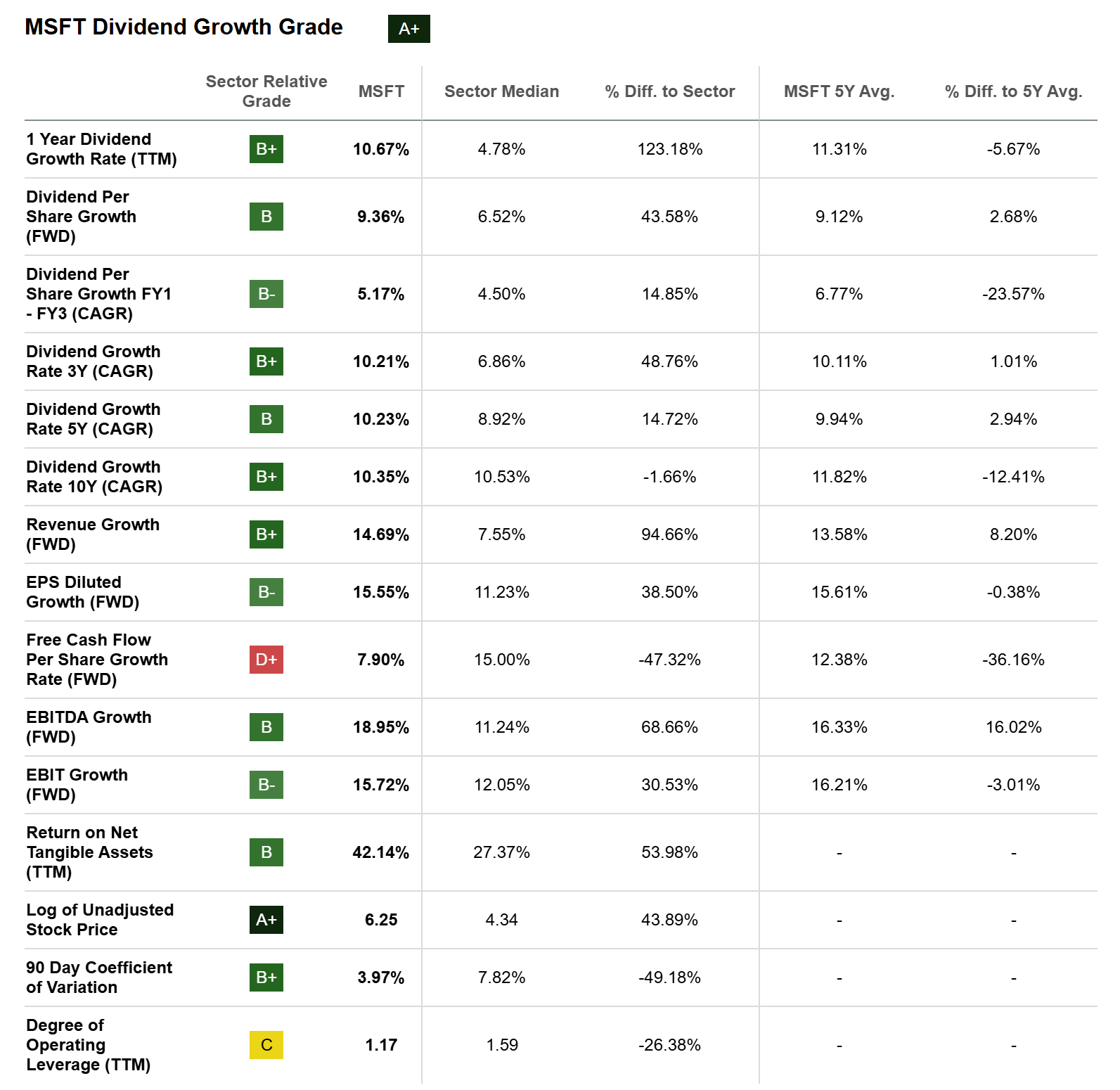
Microsoft currently has a Dividend Payout Ratio [FY1] [Non GAAP] of 22.56%, which serves as an indicator of the company’s strong dividend growth potential. This is also underlined by Microsoft’s 10-Year Dividend Growth Rate [CAGR] of 10.35%.

Additionally, it can be mentioned Microsoft’s EPS Diluted Growth Rate [FWD] of 15.55%, which is another indicator of Microsoft’s potential to raise the dividend in the future.

Furthermore, it can be highlighted Microsoft’s EBIT Growth Rate [FWD] of 15.72%, which further strengthens my belief that Microsoft can strongly contribute to our dividend portfolio’s future dividend growth potential.

Microsoft: Dividend Growth Grade
Source: Seeking Alpha

Why I added additional shares of VICI Properties to The Dividend Income Accelerator Portfolio

Through the acquisition of additional shares of VICI Properties for The Dividend Income Accelerator Portfolio, we have increased the company’s proportion on the overall portfolio from 0.83% to 2.38%.

With a current Dividend Yield [FWD] of 5.77% and the company’s 5-Year Dividend Growth Rate [CAGR] of 7.41%, VICI Properties not only offers investors attractive dividend income potential, but also significant potential to increase this dividend income year over year.

VICI Properties’ Dividend Income Potential

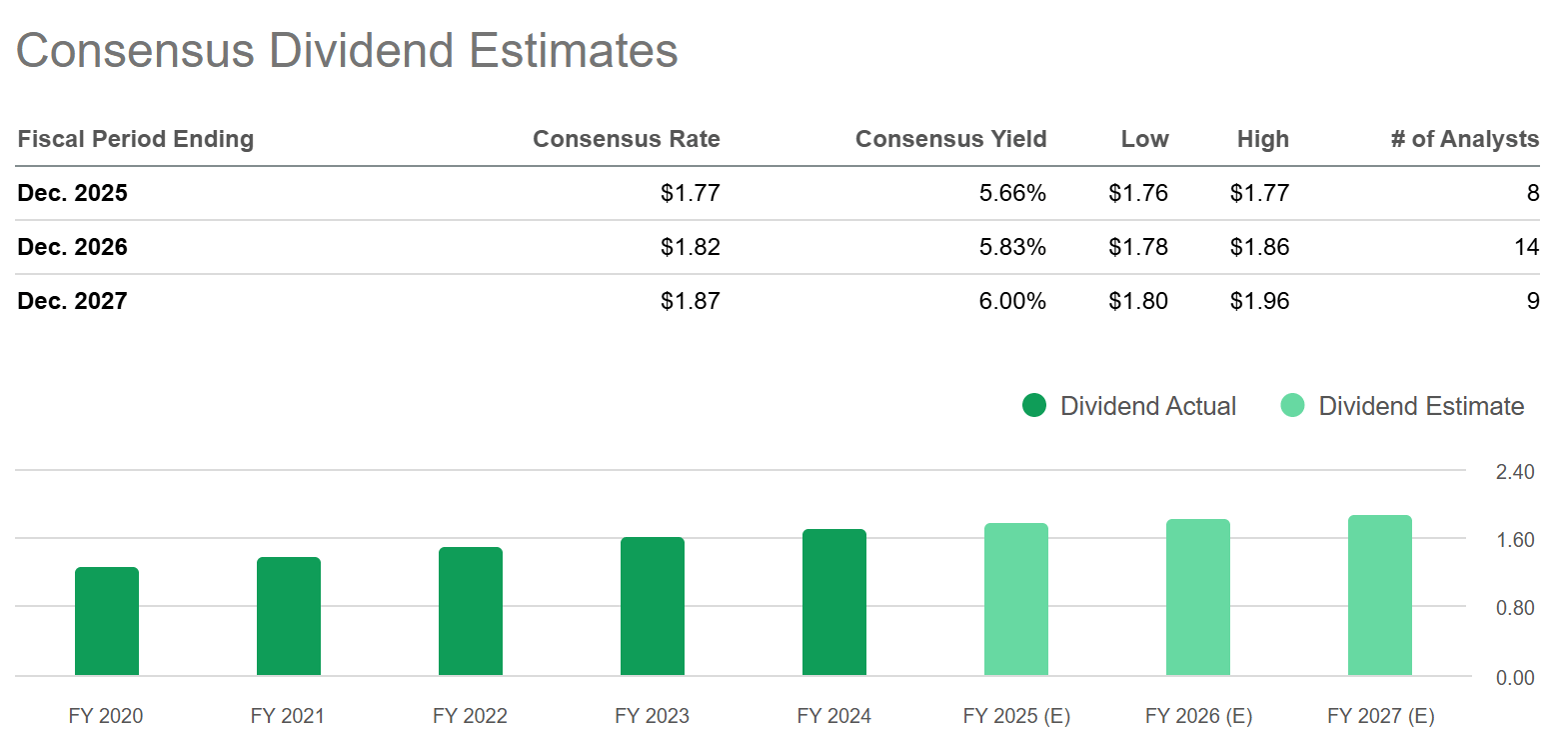
Below you can find Consensus Dividend Estimates for VICI Properties. For 2025, the Consensus Yield stands at 5.66%, for 2026 at 5.83%, and for 2027, at 6.00%, underlining my theory that VICI Properties can be an adequate investment choice for both investors looking for dividend income and for dividend growth.

VICI Properties: Consensus Dividend Estimates
Source: Seeking Alpha

The largest positions of The Dividend Income Accelerator Portfolio after adding Microsoft and VICI Properties

Berkshire Hathaway

After adding additional shares of Microsoft and VICI Properties to our dividend portfolio, the portfolio proportion that is allocated to Berkshire Hathaway (NYSE:BRK.A)(NYSE:BRK.B) has decreased from previously 4.98% to now 4.96%. Despite the fact that Berkshire Hathaway does not pay dividends to its shareholders, the company collects large amounts of dividends and strongly aligns with the investment approach of our investment portfolio due to its focus on companies with significant competitive advantages that are financially healthy.

Alphabet

Alphabet’s (NASDAQ:GOOG) (NASDAQ:GOOGL) proportion of the overall portfolio has increased to 3.34%. This means that Alphabet is presently the second-largest position of our dividend portfolio. Like Microsoft, Alphabet will significantly contribute to our portfolio’s dividend growth potential.

Ares Capital

Through the acquisition of additional shares of Microsoft and VICI Properties, the proportion of our investment portfolio that is allocated to Ares Capital (NASDAQ:ARCC) has decreased from 3.26% to 3.22%. This means that Ares Capital remains the third-largest position of our dividend portfolio.

BlackRock

After adding shares of Microsoft and VICI Properties to our dividend portfolio, the portfolio’s proportion that is allocated to BlackRock (NYSE:BLK) has decreased from 3.09% to 2.89%, implying that BlackRock is presently the fourth largest position of our overall portfolio.

Microsoft

After adding additional shares of Microsoft to our dividend portfolio, we have increased the company’s proportion compared to the overall portfolio from 1.14% to 2.58%. By overweighting Microsoft within our portfolio, we optimize the portfolio’s risk-reward profile and strengthen its dividend growth potential.

Conclusion

By adding additional shares of Microsoft and VICI Properties to our dividend portfolio, we have not only optimized our portfolio’s risk-reward profile, but also kept our portfolio balance of income and dividend growth while, simultaneously, increasing the proportion allocated to the Information Technology and the Real Estate Sector.

The portfolio proportion allocated to the Information Technology Sector has increased from 5.76% to 7.25% and the proportion allocated to the Real Estate Sector has increased from 8.10% to 9.53%. This demonstrates that we have increased our portfolio’s level of sector diversification, thereby reducing our portfolio’s risk level and improving our portfolio’s risk-reward profile.

Our portfolio’s Weighted Average Dividend Yield [TTM] now stands at 4.14% while its 5-Year Weighted Average Dividend Growth Rate [CAGR] is at 7.46%, indicating that our portfolio continues to balance income, dividend growth, and capital appreciation, allowing investors to invest with a reduced risk-level while generating substantial dividend income.

Will you be the next Geoff ?

You decided to buy an IT and stick with it thru thick and thin, knowing that there will be plenty of thin. During the thin periods you are getting more shares for your hard earned and therefore one day more dividends.

Your plan was to re-invest the dividends back into the share better if you could add more fuel to the fire but this example is for seed capital only.

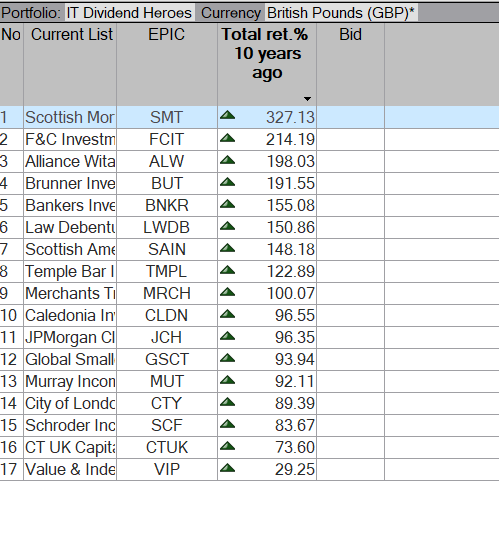
If you started with 5k a hefty sum back in the days of yore, your 5k would be worth 50k, you have to allow for inflation and the current yield is 5%.

£2,500 p.a. a yield on your initial investment of 50%.

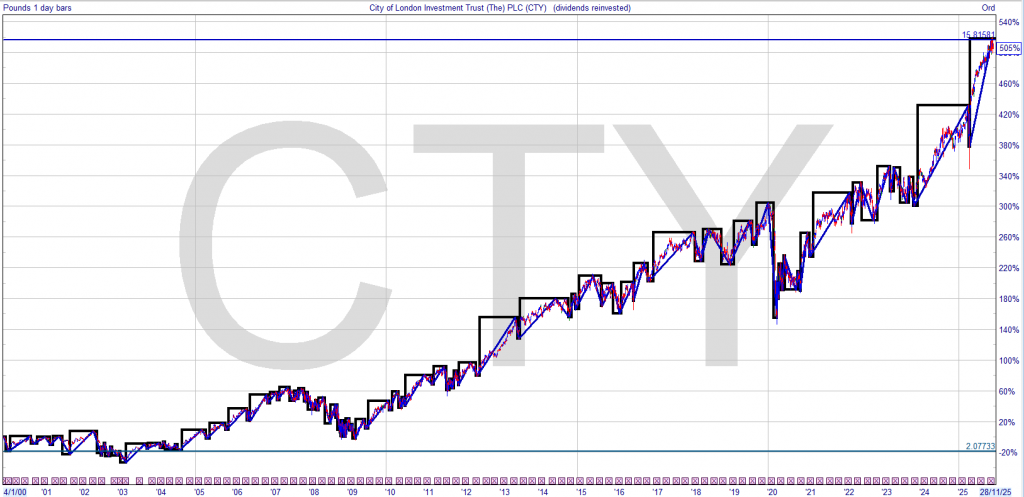
Or you may have chosen CTY or bought both as you wanted to sleep soundly in your bed.

Your investment would be worth 35k and the current yield is 4%.

£1,400 p.a. a yield on your initial investment of 28%.

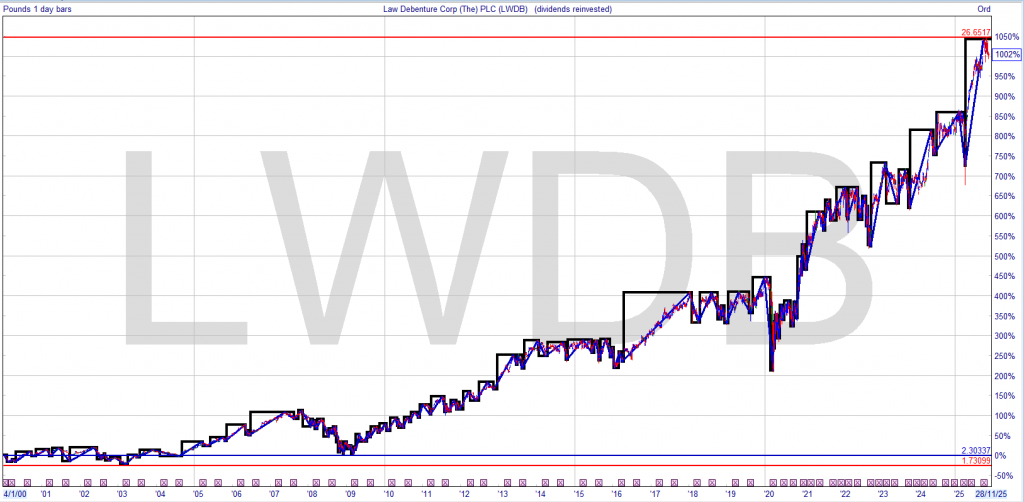
Or you may have chosen LWDB

Your investment would be worth 55k and the current yield is 3.2%

£1,760 p.a. a yield on your initial investment of 32%.

All figures approximations only as prices change constantly.

Trust in trusts

Private investor Geoff Mills wins big – a 40-year journey of patience, process and trust in trusts

  • 14 November 2025
  • QuotedData
QuotedData Investors’ Choice Awards

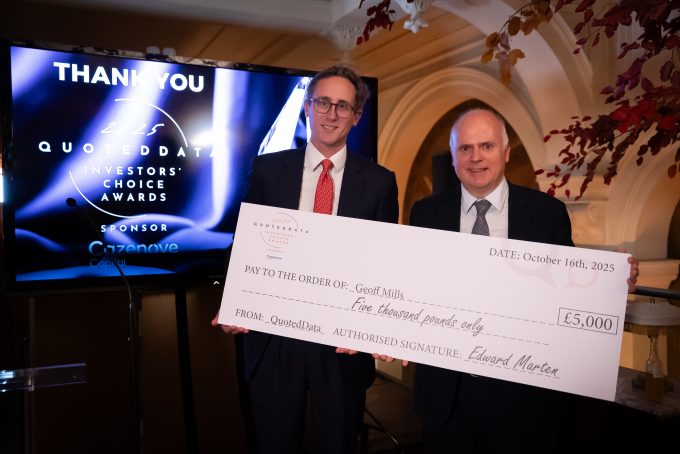
Private investor Geoff Mills scooped the £5,000 prize at the QuotedData Investors’ Choice Awards 2025 after correctly predicting the winners in every category from the judges’ shortlists. An investment trust investor since the 1980s, he has amassed fund selection skills to rival those of the professionals. We look at his journey from curious novice to investment trust champion.  

Geoff’s early interest in investment trusts started in a familiar way. After university, he went to work for NatWest. He was dutifully saving into a cash account but soon realised it would take him years to build a meaningful pot of capital. He’d always had some curiosity about the stock market, and decided this was a better home for his spare cash.

His inspiration came from the personal finance section of his parents’ newspaper, the Observer, and its monthly supplement Money Observer. Edited by Jonathan Davies – who he still follows on the Money Makers podcast – the magazine famously touted investment trusts as ‘the City’s best kept secret’. He liked the idea that those in the know invested in investment trusts.

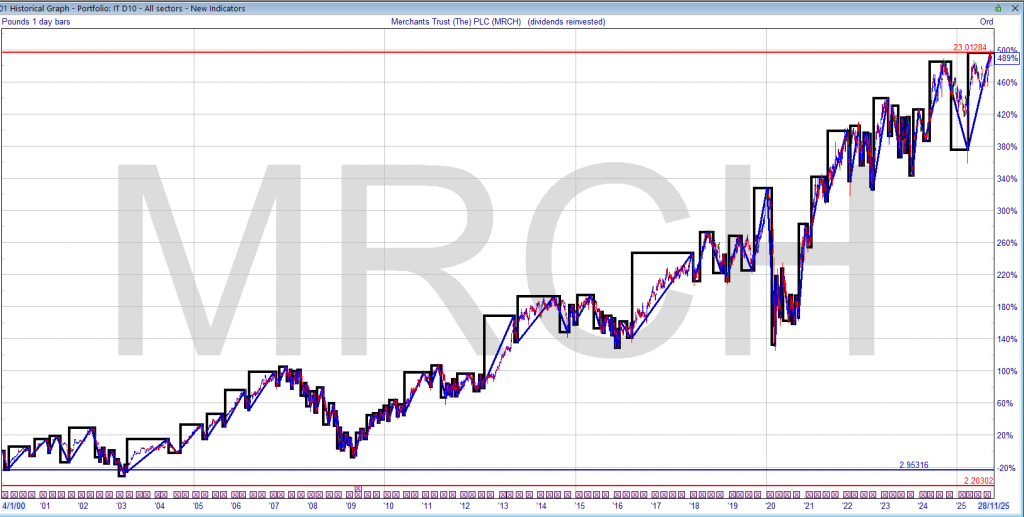
His early forays into investing were relatively cautious. He made monthly savings into two trusts – Alliance Trust for global exposure, and the Merchants Trust for the UK. Long before the era of investment platforms, he dutifully sent off his cheques in the post, kept reinvesting his dividends, and was delighted with the results.

The ’87 crash did not dent his commitment. In fact, it meant he learnt one of the most important investment lessons early on: “I was a bit nervous, of course, but I saw it as a big opportunity. When the investment trusts went down in value, I figured it would only be temporary and took advantage, investing more. I did the same during Covid,” he says.

“If you end up getting into a panic and selling, cut your losses and go into cash, you lose out. I just stuck with it, kept reinvesting the dividends and carried on.” This unemotional approach has served him extremely well over the years.

As time went on, the systems got better and more flexible. Soon he didn’t have to send cheques any more. He could wrap his investments in a PEP, and then an ISA. He could trade online, and at the touch of a button. He began to expand his knowledge, invest in a broader range of trusts and take some more risk around the edges.

He’s had some big winners over the years. One of his favourites has been Law Debenture. The unique structure allows fund managers James Henderson and Laura Foll maximum flexibility on their stock selection because the income is taken care of by the independent professional services business. This has been one of Geoff’s long-term holdings.

AVI Global has been another of his success stories: “I like the way they think, and how they focus on undervalued opportunities. I have a great respect for the team and it’s done very well.” He also bought into Temple Bar when Ian Lance took over the trust in 2020, and it has been a strong performer for him ever since. However, he has also had his misses. He admits that an investment in UK Greencoat Wind was a disappointment and eventually he sold out. Nevertheless, he says, “the winners exceed the losers by some margin.”

He’s also moved into some more esoteric areas, while maintaining diversified investment trusts at the core of his portfolio. For example, he now has Cordiant Digital Infrastructure, which holds a portfolio of digital infrastructure assets: “It’s an area you just can’t replicate in an open-ended fund,” he says. He also holds Seraphim Space, which invests in satellite technology. “These are great examples of what investment trusts can do and both of them are pretty cheap.”

He also holds a few private equity companies. He has held them for a long time, so has made good returns even if their recent performance has been choppier. He still holds Oakley Capital, and ICG Enterprise.

These days Geoff tends to look to the specialist press and research groups for ideas. He enjoys the Money Makers podcast, which interviews fund managers. He also uses QuotedData research and listens to its interviews. He likes Citywire Investment Trust Insider. He also makes extensive use of the AIC website: “It is very good. I use the data to monitor all my investments, see the dividend payments, dates and so on.”

He says the AIC’s site is perfect for those just getting started. “The best thing about all these resources is that they’re free!” This is one of the key reasons he likes investment trusts – he finds that the information is far better than he can get on open-ended funds. He finds he can gather lots of information, updates, investment commentary from investment company websites. “AVI Global, for example, has a monthly commentary, with real detail. It’s excellent. Other trusts could really learn from that. It tells me what they’re doing, exiting investments or considering new ones.”

AGMs are also a vital source of information. Now largely retired, he has even more time to go to more of them. He has been to a few where he is the only person there. He has got to know a few fund managers very well and has developed an acute radar for any obfuscation. He wants to see a manager and board that are well-briefed and can answer his questions properly. He will usually go with a list, and may even seek out the manager for a chat afterwards.

Importantly, he’s always swift to sell if he doesn’t get the answers he wants: “There are some trusts where they haven’t answered the questions properly. I’ve gone back and sold straightaway.”

Geoff is an investment trust loyalist. He has a couple of open-ended funds, but only when he can’t get the exposure in an investment trust form. “Investment trusts are 90% of my portfolio and those of my family.” He has even built something of a reputation among his friends, and is now entrusted with some of their savings pots as well.

« Older posts Newer posts »

© 2025 Passive Income Live

Theme by Anders NorenUp ↑