Investment Trust Dividends

Month: January 2026 (Page 3 of 11)

XD Dates this week

Company Type Amount Currency Ex-Dividend Date Impact Payment Date


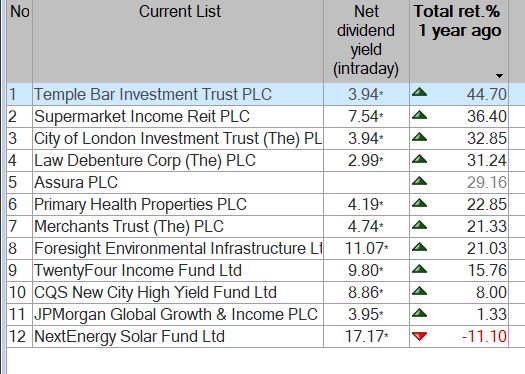
Aberdeen Asian Income Fund Ltd Quarterly 4.46 GBX 22Jan26 1.60% 20Feb26
Bankers Investment Trust PLC Quarterly 0.686 GBX 22Jan26 0.51% 02Mar26
City of London Invest Trust PLC Quarterly 5.4 GBX 22Jan26 0.99% 27Feb26
CQS New City High Yield Fund Ltd Quarterly 1 GBX 22Jan26 1.92% 27Feb26
NB Private Equity Partners PLC Interim 35.117 GBX 22Jan26 2.23% 27Feb26
Smithson Investment Trust PLC Interim 2.1 GBX 22Jan26 0.13% 20Feb26
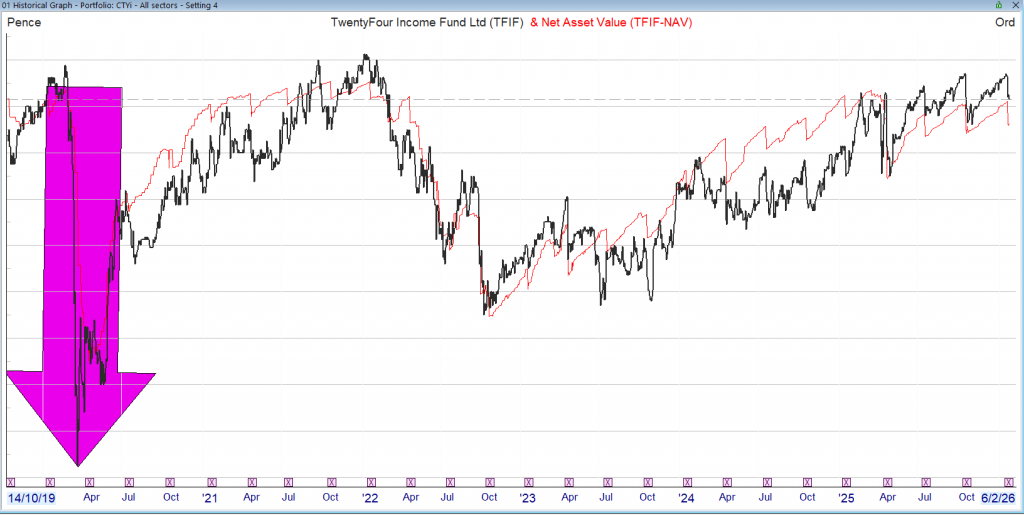
24 Income Fund Ltd Quarterly 2 GBX 22Jan26 1.75% 06Feb26
24 Select Monthly Income Fund Ltd Interim 0.5 GBX 22Jan26 0.57% 06Feb26

I Couldn’t Imagine Retiring Without These 3 Dividend Stocks Part One

Jan. 16, 2026 AMVICIENBENB:CA

Summary

  • Antero Midstream, VICI Properties, and Enbridge each yield over 5% and offer a realistic path to 10–12% annual returns.
  • AM has transformed from a yield trap to a high-quality midstream with robust free cash flow, a 5.1% yield, and significant buyback potential.
  • VICI’s unique Las Vegas Strip assets, 6.4% yield, and AFFO growth support a safe, double-digit total return, trading below historical valuation multiples.
  • ENB’s diversified, regulated network, 6% yield, and 5% annual growth target position it as an ETF-like, defensive income compounder for retirees.
  • Looking for more investing ideas like this one? Get them exclusively at iREIT®+HOYA Capital. 
El Capitan and Merced River from Valley View in Yosemite National Park, California
TAKAYUKI UEDA/iStock via Getty Images

Introduction

A big part of why I love my job so much, besides that I don’t have to sit in a corporate office from 9 to 5, is that I get to share my views with tens of thousands of people every day. It’s like I’m running my own mini newspaper.

That’s a problem for those who seek a high yield right now instead of a decade or two from now.

So obviously, I know that the S&P 500 tends to outperform most high-yield ETFs. That’s why I always advise people to start as early as possible. If you do it right and spend decades compounding, maybe you can even cover all expenses with the elevated yield on cost from past S&P 500 investments. That’s the goal, as it means you have both a huge portfolio and elevated income.

The table below is one of the best examples of that. It shows that a company with a 0.8% yield and 16.0% annual growth ends up providing the same yield on cost as a stock with a 7.0% starting yield and 2.5% annual growth after roughly 16-17 years.

Image
Leo Nelissen

If we assume that a fictional company that grows its dividend by 16.0% per year will also see similar capital gains, that’s the kind of stock that’s perfect for retirement. But then again:

  • Finding a company that grows by 16% per year is tough.
  • Some people need to retire earlier.

That’s why I went on the “hunt” for some middle ground.

I spent the past few days going through the many lists of stocks to find companies that deliver both growth and income. These are companies with yields of more than 5.0% and a realistic path to >10.0% annual returns.

These companies have the best of both worlds. While they may not have the growth rates that some tech stocks have, they have enough growth to provide a path to double-digit annual returns. Over time, this can help us build income and a higher net worth much faster.

While I still don’t recommend people my age (30) or anywhere close to that to build a portfolio with an average yield of >5.0%, these kinds of companies are great to buy when already retired or when adding income a decade or two before retirement.

  • After all, $100,000 compounded at 10.0% for 10 years turns into slightly more than $250,000.

It’s just math, but if I’m right about these companies (I’m sure I am), there’s a lot of value for a wide range of investors. So much so that if I were closer to retirement, I would own all of them.

Now, let’s start with the one I already own.

Antero Midstream (AM) – Why I Bought a Former Yield Trap

Antero Midstream is one of the few high-yield stocks I own. That’s exactly because of the reason I just discussed in the introduction, which is to own an asset I truly never expect to sell because it already has such a favorable income/growth balance.

With that said, Antero Midstream is a C-Corp midstream company. In other words, it doesn’t issue K-1 forms, which some readers hate (some really like these). For me, as a non-American investor, these C-Corps make way more sense, as dealing with Master Limited Partnerships is truly challenging from a tax point of view.

Anyway, Antero Midstream is a midstream company, which puts it in the same industry as ONEOK (OKE) and Kinder Morgan (KMI), with the major difference being size. Antero Midstream has a market cap of $8.5 billion. These other two have market caps bigger than $45 billion. They also have networks that span big parts of the U.S. and multiple oil and gas basins. Antero Midstream doesn’t have any of that.

Antero Midstream was spun off from Antero Resources (AR), which is one of my favorite natural gas producers. Basically, Antero Midstream owns the gathering and processing assets of Antero Resources. It also owns water assets and some pipelines.

Image
Antero Midstream

All of these assets are in Appalachia, which is home to the Ohio Utica Shale and the Marcellus Shale. These are two of the best places to produce natural gas due to very abundant reserves and often low breakeven prices. Another benefit is that these are close to areas with dense populations, including the Northeast, the Midwest, and the strategic LNG corridor to the Gulf Coast. That last area may not be densely populated, but it comes with high natural gas demand due to data center construction and LNG exports.

Because of its relationship with Antero Resources, the company enjoys deep reserves, has a 100% fixed-fee business with a player that is extremely predictable (it helps when midstream and upstream are related through business ties), and a “high-teens” return on invested capital. That last fact is also caused by its relationship with AR, as AM can plan ahead and knows exactly when new assets are needed. It does not have to worry about future utilization rates of its growth projects.

Image
Antero Midstream

Moreover, in 2021, AM cut its dividend. Since then, that dividend has not been hiked. That’s the bad news and a reason why many avoid Antero Midstream. To some extent, I get that. However, when diving deeper, we see that there’s a good reason to like it. That reason is free cash flow generation.

After a few years of aggressive asset investments, the company is now running much lower CapEx programs, as we can see below. In 2025, total CapEx is expected to be just $180 million. That’s way less than the $646 million needed in 2018 and 2019. Even better, because of these assets, the company was able to grow volumes by 10% per year between 2017 and 3Q25.

Image
Antero Midstream

Because of this, the company is a leader when it comes to balance sheet health (it reduced debt quite aggressively in recent years), reinvestment rates, and cash availability for debt reduction, dividends, and buybacks.

Image
Antero Midstream

This mix is very bullish for the company.

To give you an idea of what we’re dealing with here, analysts expect more than $870 million in free cash flow by 2027. That’s more than 10.0% of its current market cap. This is a big deal as AM yields 5.1%. It implies a payout ratio of just 50%, one of the best numbers in the entire industry.

Essentially, at this rate, the company can buy back 5% of its shares on top of paying a 5% dividend. Technically speaking, this alone implies a 10% annual return from 5% income and 5% that improves per-share earnings without any revenue growth.

Over time, these benefits get stronger for dividend investors, as share buybacks reduce the number of shares that are entitled to dividends. That way, the company is paving the way for higher future dividend growth by buying back stock instead of hiking its dividend right now.

I like that a lot.

Even better, analysts expect per-share operating cash flow growth of 9% in 2025 to be followed by 8% and 2% growth in 2026 and 2027, respectively.

Image
FAST Graphs

Moreover, as I do not believe that a 9.3x operating cash flow multiple will post a headwind, I think this company is in a good spot to return 12-15% per year, making it one of my favorite high-yield stocks.

I think it has gone from a 2021 yield trap to one of the highest-quality midstream companies on the market with a lot of room to run, thanks to secular growth in natural gas.

VICI Properties (VICI) – Income, Moderate Growth, and a Thick Layer of Safety

I know what you’re thinking right now. And you’re not wrong. VICI is indeed one of these stocks that every analyst seems to like. On Seeking Alpha, the stock has 7 Strong Buy ratings, 8 Buy ratings, 1 Hold rating, and zero Sell ratings. This reflects Wall Street, which also has no Sell ratings.

VICI Properties is one of these companies that has become a bit of a controversial stock. That’s not because management is doing something controversial (it’s not), but because some people believe it’s a yield trap, while others believe it’s an opportunity of the decade, or something along those lines.

As most of you may know by now, VICI is a net lease REIT like Realty Income (O), as its tenants pay for insurance, maintenance, and taxes. However, that’s where the similarities end, as VICI may be the only REIT (I think it’s the only one) with differentiated assets that cannot simply be replicated. That’s because it generates roughly half of its rent on the Las Vegas Strip, where it owns some of the most iconic casino-focused assets like the MGM Grand, Caesars Palace, Mandalay Bay, Park MGM, and others.

Image
VICI Properties

Most of these deals have multi-decade durations and are protected by master leases. In other words, tenants cannot just default on one rent. It would mean they lose the right to all buildings. Besides that, because these buildings are so unique and critical to their success, not paying rent will be the last thing on their minds when financial headwinds hit.

Image
VICI Properties

One of the reasons why VICI is unloved by some is the trouble that the City of Las Vegas is dealing with. This includes unfavorable visitor numbers due to affordability issues. From what I have learned in recent years, Las Vegas resorts have increasingly focused on margins. While it initially was a town where food and hotel rooms were affordable to get people to spend money on gambling and entertainment, has become a city where the entire “experience” has become much more expensive.

The good news is that VICI is a landlord. It does not make money from slots. That’s why it even raised its guidance in 3Q25 after growing its adjusted funds from operations (“AFFO”) by 5.3%.

Moreover, the company is diversifying and adding growth through deals like the one with Golden Entertainment. That’s the company that owns the Las Vegas STRAT (the big tower) and a wide range of smaller assets. At the end of last year, VICI bought 100% of the land, real property, and improvements on seven casinos, as we can see below.

Image
VICI Properties

This strategy isn’t a high-growth strategy, but it’s a strategy that works. Currently, VICI yields 6.4%. This dividend comes with a 75% payout ratio and has been hiked by 6.6% per year since 3Q18.

Image
VICI Properties

Going forward, that dividend growth rate may come down a bit, as analysts expect 3% per-share AFFO in both 2025 and 2026. In 2027, we could see a rebound to 6%. Generally speaking, it seems to me that the mix of annual rent escalators of 1.7% (including CPI escalators) and deals for external growth provides roughly 3-5% long-term growth.

Image
FAST Graphs

Hence, VICI, which also has an investment-grade credit rating of BBB-, is expected to return 10% to 11% per year based on its dividend and per-share AFFO growth alone. Given VICI’s predictable business model and stable income, that component of the total return is relatively safe, I would say.

The other factor, valuation, is obviously more volatile. However, as VICI trades at just 11.7x AFFO, a mile below its long-term average of 15.7x, I believe this is more of a tailwind than a headwind in the years ahead, meaning the odds of a higher-than-expected total return seem to be better than the odds of seeing a lower total return.

That’s why I like VICI, as the risk/reward of this landlord is so good right now.

Part Two

Enbridge (ENB) – An ETF-Like Company

I have to admit that it wasn’t my intention to include two midstream stocks in this article, as hard as that may be to believe for some. However, Enbridge deserves a spot, which is why I kicked out my initial idea for this article.

For starters, Enbridge is also a C-Corp, which means it doesn’t issue K-1 forms. It’s also the largest midstream company in North America with a market cap of $100 billion.

It currently yields 6.0%.

This dividend is protected by a massive infrastructure network, including liquids, gas transmission, storage, and renewable power. Its liquids network, for example, connects major producing areas like the Western Canadian Sedimentary Basin, the Texas Permian, and high-demand areas like the U.S. Gulf Coast.

Image
Enbridge

As of 3Q25, it generated roughly 53% of its adjusted EBITDA from liquids. Gas transmission and midstream accounted for 30%. Gas distribution and storage added close to C$600 million in EBITDA (13%). The size and diversification make this company an ETF-like midstream player that enjoys safety from a 98% regulated take-or-pay contract, a customer base that almost entirely consists of companies with investment-grade balance sheets, 80% inflation-protected EBITDA, and less than 1% direct exposure to commodity prices.

Image
Enbridge

On top of safety, Enbridge enjoys strong secular growth from its “essential” operations due to booming data center power demand. These assets are often looking to go behind the meter to get data centers up and running much faster and avoid strains on the local grid. That is bullish for midstream companies.

This is one of the reasons why it sees roughly 5% annual EBITDA growth per year after 2026. It expects the same growth rate for its distributable cash flow, its EPS, and its dividend per share. That’s a good deal, as this company yields 6%.

Image
Enbridge

The 6.0% yield and 5.0% growth target alone pave the way for 11.0% annual returns. This excludes acquisitions, major growth projects, and any valuation tailwinds.

Moreover, from a personal point of view, buying Enbridge would make a lot of sense for me once I’m retired. Assuming I’m still in Albania when I retire, I would pay a tax of just 15% on Canadian dividends. That would make ENB a no-brainer for me, especially given its diversification. While I won’t do it, I wouldn’t lose sleep if I had all of my capital in ENB. That’s how I know it’s a company I trust.

Takeaway

To me, the ultimate retirement combo is a mix of stocks that pay big now and can grow.

In this article, I discussed three of them that all yield more than 5.0% and have a clear path to an annual return of 10% to 12% without having to incorporate any wild growth fantasies.

These companies provide income now and a shot at growing your capital for many years, if not decades, to come.

I’m not retired, and I have no plans to retire anytime soon, but knowing that I could buy these, retire, and grow my wealth over time makes me feel a lot safer about my future.

Risks to My Thesis

There are two main risks here. On top of general operational risks, I believe a steep spike in interest rates could pressure both REITs and midstream companies due to the negative impact this has on their cost of capital. It would also give investors a higher risk-free rate, which means they may be less tempted to invest in dividend stocks.

Moreover, although both AM and ENB have almost zero exposure to direct commodity prices, an environment where commodity prices like oil and gas are so subdued that producers cut output could have a negative impact on growth expectations.

SUPR

Here’s how to invest £5,000 in an ISA for a 7.4% dividend yield

In January 2026, there are 73 stocks in the FTSE 250 that pay a dividend yield of 4% or more. Zaven Boyrazian investigates one that pays 7.4%!

Posted by Zaven Boyrazian, CFA

Published 18 January

SUPR

DIVIDEND YIELD text written on a notebook with chart
Image source: Getty Images

You’re reading a free article with opinions that may differ from The Motley Fool’s Premium Investing Services.

Typically, UK shares across the FTSE have offered dividend yields that sit close to 4%. However, after a stellar 2025, higher stock prices have dragged down the yields of the UK’s flagship indexes. The FTSE 100 now only offers a payout of around 2.9%, while the FTSE 250 is closer to 3.3%.

The good news for stock pickers is that there are still plenty of higher-yielding opportunities to explore.

So, with that in mind, let’s break down how investors with £5,000 to invest today can aim to unlock a 7.4% yield in 2026.

High-yielding opportunities

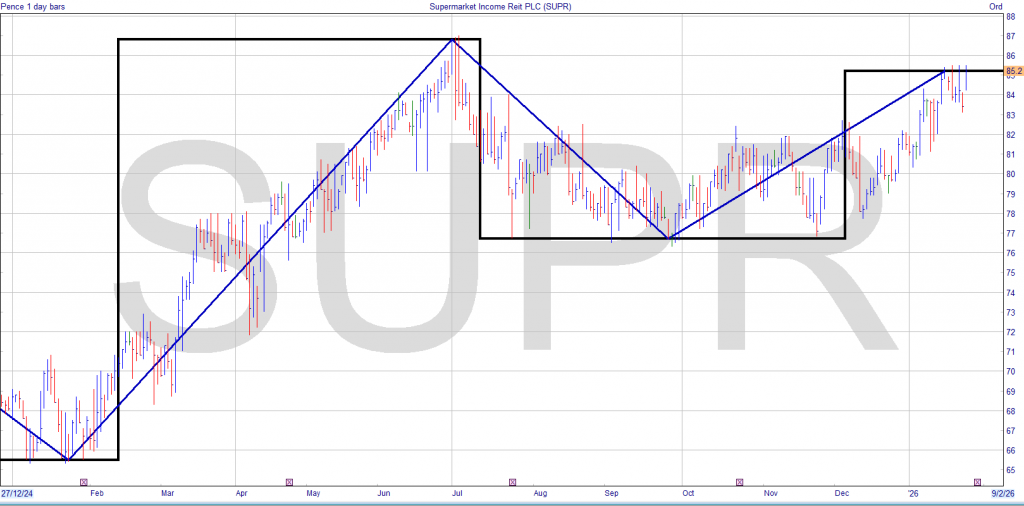
Right now, there are over 70 stocks in the FTSE 250 with a yield larger than 4%. And among these stands Supermarket Income REIT (LSE:SUPR) with its 7.35% — almost exactly in line with our target of 7.4%.

So, should investors just snap up £5,000 worth of Supermarket shares and call it a day? Sadly, it’s not that simple.

Experienced investors already know that higher payouts almost always come with higher risks. Don’t forget, unlike the interest paid on bonds, dividends are completely optional for a company. Yet, there are always some exceptions. And sometimes the risk ends up being worth taking.

So, is that the case with Supermarket Income REIT?

Risk versus reward

As a quick introduction, this company owns and manages a real estate portfolio of supermarket properties across the UK and France.

Given that supermarkets tend to see continuous footfall even during economic downturns and leases on supermarkets often span decades, the company has established a pretty reliable source of cash flow. What’s more, with around 77% of its rent inflation-linked, rent organically grows over time without needing to wait for leases to expire before prices are adjusted.

Please note that tax treatment depends on the individual circumstances of each client and may be subject to change in future. The content in this article is provided for information purposes only. It is not intended to be, neither does it constitute, any form of tax advice.

This continuous and predictable stream of income is actually how management has been able to raise shareholder payouts for seven years in a row so far, boosting the yield in the process.

But this is where things get a bit tricky. While interest rates have started falling, they’re nonetheless still significantly higher compared to a few years ago. Consequently, looking at its latest results, earnings actually fell short of dividends. In other words, the company paid out more to shareholders than it brought in.

The issue isn’t a result of a lack of occupancy or tenants not paying their rent on time. In fact, impressively, the company has maintained 100% occupancy and 100% rent collection since its IPO in 2017. Instead, the problem is debt.

Expanding a real estate portfolio isn’t cheap. And just recently, the group has borrowed yet another £250m through a bond offering at a 5.125% interest rate.

This move provides some welcome near-term capital flexibility. But it further ramps up the pressure on earnings, and in turn dividends – this is the risk income investors face.

The bottom line

With interest rate cuts taking their time and leverage on the rise, the sustainability of Supermarket Income REIT’s dividend is looking a bit wobbly. But as interest rates continue to fall, the group’s debt burden could prove far less troublesome over time, allowing dividends to keep growing.

Personally, the risk profile is a bit too high for my tastes. But luckily, there are still plenty of other high-yield dividend stocks to choose from when hunting for a 7.4% payout.

Current Dividend 6.18p

Fcast EPS 6.05p

The Income Investor: why this high-yield FTSE 100 REIT appeals

While its recent rally has made the FTSE 100’s yield less appealing, it is still possible to obtain a highly attractive income from a basket of UK large-cap shares, argues analyst Robert Stephens. Here’s how.

14th January 2026

by Robert Stephens from interactive investor

Golden coins and per cent symbol on financial chart

The FTSE 100’s recent surge to 10,000 points has inevitably squeezed its dividend yield. The index’s income return now stands at a rather humdrum 3.1%, which is unlikely to hold significant appeal for income investors seeking to deploy their hard-earned capital.

Indeed, it is possible to obtain a substantially higher return from bonds and easy-access savings accounts. The 10-year gilt yield currently stands at just under 4.4%, for example, while cash balances offer an income return in excess of 4% at present.

In the coming months, it would be wholly unsurprising if the FTSE 100’s dividend yield comes under further pressure as a result of continued capital gains. After all, interest rate cuts enacted across the US, eurozone and the UK over recent months are set to have a positive impact on the world economy’s growth rate.

With further monetary policy easing likely to be implemented in the US and the UK as sticky inflation gradually eases, the operating environment for FTSE 100 stocks, which typically have a heavy international bias, should improve. This could lead to rising profits and stronger investor sentiment that prompts further capital gains and a lower dividend yield for the UK’s large-cap index.

Dividend growth potential

Of course, the FTSE 100’s relatively lacklustre dividend yield does not mean that investors should necessarily look to other asset classes for a worthwhile income. Crucially, an upbeat global economic outlook that leads to higher profitability among FTSE 100 members should allow them to raise dividends at a brisk pace. When combined with an anticipated fall in inflation over the coming months, investors in UK large-cap dividend stocks could experience a generous increase in their spending power.

This contrasts with the outlook for other major asset classes. Easy-access savings accounts, for example, are set to offer a falling income return amid declining interest rates. When combined with the effects of inflation, this could lead to a substantial worsening in spending power. And with bonds offering a fixed income, their presently higher income return vis-à-vis the FTSE 100 is set to be eroded as the effects of dividend growth are gradually felt.

Source: Refinitiv as at 12 January 2026. Bond yields are distribution yields of selected Royal London active bond funds (as at 30 November 2025), except the global infrastructure bond which is 12-month trailing yield for iShares Global Infras ETF USD Dist as at 8 January. SONIA reflects the average of interest rates that banks pay to borrow sterling overnight from each other (8 January). Best accounts by moneyfactscompare.co.uk refer to Annual Equivalent Rate (AER) as at 12 January. *Includes introductory bonus.

High-yielding stocks

While the FTSE 100’s yield is now somewhat unappealing, especially on a relative basis, it is still possible to obtain a highly attractive income return from a basket of UK large-cap shares. Indeed, 41 of the index’s members currently offer a higher income return than the FTSE 100, with 27 of them having a dividend yield in excess of 4%. This suggests it is still possible to build a diverse portfolio of companies that together have a higher income return than that of other major asset classes.

Crucially, though, investors should seek to avoid potential dividend “traps”. This is where a stock has a relatively high yield based on historical dividend payments that ultimately prove to be unsustainable. For example, a company may be experiencing a period of financial difficulty that leads to a dividend cut which has already been priced in by investors via its high yield.

Such companies may, as a result, provide a much lower level of income than their historical yield suggests. They could also produce a relatively weak share price performance as a result of deteriorating investor sentiment and/or lower profitability.

Avoiding dividend ‘traps’

Income seekers can increase their chances of avoiding dividend “traps” simply by focusing on company fundamentals. Considering factors such as dividend cover, which states how many times a firm could afford to make its shareholder payouts; interest cover, which shows how many times a company’s debt servicing costs were covered by operating profits; and focusing on a firm’s future financial prospects could help investors to prioritise stocks that are likely to pay a growing, rather than declining, dividend.

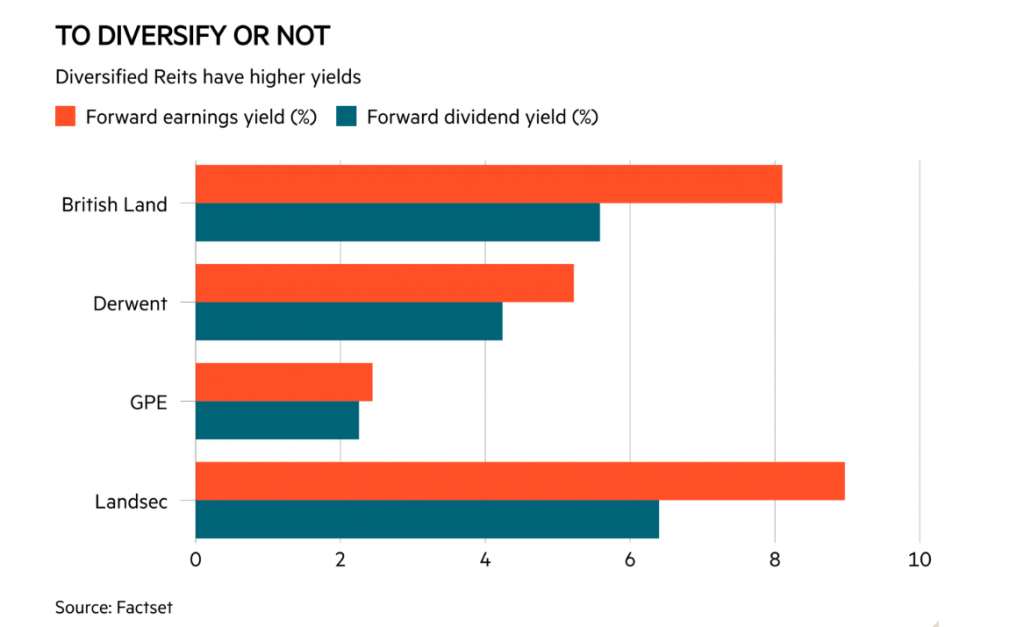
Furthermore, diversifying across a wide range of sectors can help income seekers avoid potential challenges that may be felt more keenly within certain industries. For example, three of the FTSE 100’s current five highest-yielding stocks operate in the Financials industry. Ensuring that a portfolio has exposure to other industries could lessen the impact of unforeseen sector-related difficulties and, ultimately, produce a more reliable and sustainable income stream over the long run.

A relatively high yield

British Land Co  BLND

is among the FTSE 100 index’s highest-yielding stocks at present. The real estate investment trust (REIT), which focuses on London-based offices and out-of-town retail parks, currently yields 5.5%.

While this is 260 basis points higher than the wider index’s income return, the company raised dividends per share by less than 1% in the first half of its current financial year. Furthermore, in its latest full year, the firm’s shareholder payouts were unchanged versus the prior year on a per share basis. This means that investors in the business have experienced a reduction in their spending power of late.

An improving income outlook

This trend could realistically persist in the short run. Although interest rates have been cut by 150 basis points over the past 17 months, their full impact on the economy is unlikely to be felt in the near term due to the existence of time lags. Once they pass, however, lower interest rates that may yet fall further from their current level should have a positive impact on the economy’s growth rate and spur higher demand, and thereby potentially raising rental income for British Land’s office and retail space.

Indeed, the company’s latest half-year results stated that it expects earnings per share to rise by at least 6% in the 2027 financial year and to grow by 3-6% per annum thereafter. This is set to largely be passed on to investors in the form of a higher dividend. And with inflation expected to move closer to the Bank of England’s 2% target in the second quarter of the year, according to the central bank’s own forecasts, investors in the firm are likely to experience a real-terms rise in their income over the coming years.

Capital growth potential

An improving operating environment could also lead to a higher share price over the long run. Not only could it support higher property prices that boosts the value of British Land’s portfolio, but a stronger financial performance may also bolster investor sentiment towards the stock. Given that the company’s shares currently trade on a price-to-book ratio of just 0.7, even after their 16% rise in the past six months, there is scope for a significant upward rerating that could equate to relatively impressive capital returns.

In the meantime, the company’s financial position suggests it has the means to overcome further economic uncertainty. For example, its loan-to-value (LTV) ratio currently stands at 39.1%, while it has cash and undrawn credit facilities of £1.7 billion. The firm’s latest half-year results, meanwhile, stated that it was able to reduce administrative costs by 12%.

Long-term potential

Clearly, British Land’s share price could prove to be relatively volatile in the short run amid continued economic uncertainty. And while it has a far higher yield than the wider FTSE 100 index, the company’s dividend growth rate may prove to be somewhat lacklustre in the short run.

But as the impact of interest rate cuts on demand for commercial property is gradually felt, the company’s financial performance is likely to improve. This should lead to a positive real-terms increase in dividends, as well as scope for capital growth that follows on from its recent strong share price performance.

Robert Stephens is a freelance contributor and not a direct employee of interactive investor. 

Case study UKW

Flash update from Kepler Trust Intelligence

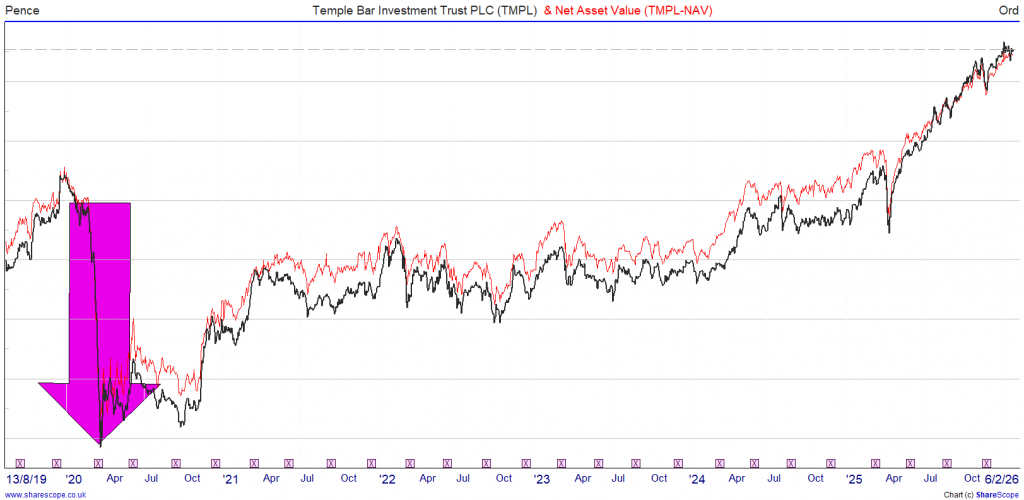
The Department for Energy Security and Net Zero has launched a consultation on proposed changes to the inflation indexation used in the Renewable Obligation (RO) and Feed-in Tariff (FiT) schemes.  This has hit share prices across the renewables sector. It is important to realise that this is only a consultation, and not necessarily an inevitable change. The net result of a previous consultation in 2023, which covered fixed price certificates and included indexation arrangements, was that no amendments were made to indexation (or anything else). Whilst this recent news has added to the already challenging backdrop for the sector, the share price move for UKW seems extreme, such that the worst outcomes would appear to be more than accounted for by the current share price discount to NAV.

10/11/2025

Kepler View

If either proposal in the consultation were implemented, it would likely translate into a one-off hit to NAV. However, whilst UKW is clearly 100% exposed to the UK government subsidy regime (rather than other geographies), it has a mix of revenues streams across Renewable Obligation Certificates (ROCs), other subsidy schemes (such as CfDs) and market power prices. It is only the indexation mechanism on the RO and not value of the certificate itself that is up for debate within the consultation. The potential negative effects will also be mitigated by the relatively short remaining life of the ROCs in the portfolio (average remaining duration c. 7yrs) and we also note the structurally high dividend cover of UKW’s model. UKW also derives a significantly lower proportion of its revenues from the Renewables Obligation than solar peers, and so we would expect UKW to be significantly less affected than many in the listed peer group.


Fundamentally, UKW appears resilient. UKW’s structurally high dividend cover means that it has options to deploy surplus cashflows towards new investments, buybacks or reducing debt. We note that UKW continues to buy shares back, illustrating the confidence the board has in strength of the balance sheet. UKW’s conservative approach means there are likely to be considerable levers to pull in order to mitigate a sizeable amount of any potential impact.

Greencoat UK Wind FY25 total dividend target 10.35p vs 10p YoY

Top 10 funds and trusts in ISAs

Company NamePlace change 
1Artemis Global Income I AccUp 1
2Royal London Short Term Money Mkt Y AccDown 1
3Seraphim Space Investment Trust Ord SSIT3.30%Unchanged
4Greencoat UK Wind UKW0.05%Up 5
5Vanguard LifeStrategy 80% Equity A AccDown 1
6Scottish Mortgage Ord SMT0.04%Down 1
7City of London Ord CTY0.18%Unchanged
8Artemis SmartGARP European Eq I Acc GBPNew
9Vanguard FTSE Global All Cp Idx £ AccUp 1
10HSBC FTSE All-World Index C AccDown 4

Royal London Short Term Money Mkt Y Acc has given up its place as the weekly ISA bestseller, ending a six-month spell at the top of the table.

The fund, which offers cash-like returns, has fallen to second place, displaced by the US-light Artemis Global Income I Acc, which returned roughly 45% in 2025.

The reshuffle partly reflects the sheer strength of returns from the Artemis fund, which takes the top spot for the first time. But there’s also a chance that the Royal London fund, and cash funds in general, could lose their shine as interest rates fall.

The Bank of England cut the rate to 3.75% in December and returns from cash funds (and cash accounts) have reduced in turn.

Investors could well now look to seemingly safe assets which pay out higher amounts, such as bonds, or even turn to riskier assets.

We’ve noted that Artemis is enjoying a moment in the sun, and another of its strong performers crops up in the list this week.

Artemis SmartGARP European Equity, which uses a proprietary screening tool to identify stock picks, returned roughly 56% last year and has a big allocation to financials, moves into the table in eighth place. The UK offering from the same franchise, Artemis SmartGARP UK Eq I Acc GBP, sits just outside the table in 15th place.

There’s the usual presence of global equity trackers (and one of Vanguard’s LifeStrategy funds) in the list, plus two very different investor favourites in the form of adventurous global growth fund Scottish Mortgage Ord  SMT

 and steady UK income play City of London Ord  CTY.

Elsewhere, it’s interesting to see two investment trusts with very different runs of performance in the top five.

With geopolitical strife back on the agenda, shares in Seraphim Space Investment Trust Ord  SSIT

many of whose holdings have been busy signing defence contracts, have returned almost 9% so far in 2026. That has pushed the shares on to a premium to net asset value (NAV), which at one point reached almost 18% last week but has since moderated to around the 9% mark.

Greencoat UK Wind  UKW

which has been in the wars amid a challenging few years for the renewable energy infrastructure sector, moves up to fourth place. It’s likely that investors still spy a bargain here, given that the shares trade on a roughly 31% discount and come with a dividend yield of more than 10%.

There are plenty of big yields now available in that sector, although this may suggest investors are sceptical about how sustainable they are. NextEnergy Solar Ord  NESF

shares now come with a yield just shy of 17%, for example.

Funds and trusts section written by Dave Baxter, senior fund content specialist at ii.

Today’s comment.

96 in com
96.comx
normanelsa76
Howdy! Would you mind if I share your blog with my zynga group ?
There’s a lot of folks that I think would really enjoy your content.
Please let me know. Thanks

Of course you can.

A general note about comments.

All comments are moderated and with the best will in the world no comments can be posted in a foreign language.

Although there is appeal for porn, otherwise there wouldn’t be so many sites, it’s not a suitable topic for this blog.

Ditto sex dolls.

Apologies if any comments slip thru the net.

« Older posts Newer posts »

© 2026 Passive Income Live

Theme by Anders NorenUp ↑