Investment Trust Dividends

Month: February 2026 (Page 11 of 13)

10 funds to produce a £10,000 income in 2026. Part 2

How the 2026 line-up has changed

As mentioned in the introduction, for an investor building an income portfolio today, it is more challenging than a year ago as fund yields across the board are lower.

To address this and reduce the amount required for the £10,000 income challenge, I’ve added in two specialist funds that aim to deliver an extra chunk of income at the expense of capital growth.

Overall, the 2026 portfolio yields 4.67%. Generating £10,000 of income would require a portfolio size of £215,000. This is the lowest starting value in the period I’ve been running the portfolio and is an attempt to give the portfolio a greater bias towards income generation.  

All yield figures were sourced in late January, but bear in mind that yield figures are not static. In each case the income share class has been chosen, as this share class returns the income back to investors rather than reinvesting the income (which is what the accumulation share class does). 

Specialist income funds explained

The specialist income funds are not for everyone and the way they invest is not as straightforward as most other funds. However, they are a way of boosting the overall yield of a portfolio, particularly when only funds can be chosen.

Schroder Income Maximiser and Fidelity Global Enhanced Income have been handed weightings of 10% and 12.5% respectively.

Both funds artificially boost their dividend yields through a special technique that involves selling derivatives to other investors.

Under this strategy, the fund manager agrees to share any future capital gains with a third party. A fee is paid for the agreement, which creates immediate, up-front income. This can be distributed to fund investors as a stream of income.

The downside is that when a fund’s holdings rise in value some of that gain goes to whoever bought the derivative. Therefore, such funds lag the pack in rising markets.

Schroder Income Maximiser’s top 10 holdings are all FTSE 100 income heavyweights. Its top 10 weightings are small in percentage terms, with top holding GSK 

GSK 6.91%

accounting for 3.3% of the fund and 

British Land Co  BLND 1.53%,

the 10th-largest position, a 2.7% position. 

Fidelity Global Enhanced Income has a very low weighting to the US (just 7.4% of the fund) and an overweight position to the UK of 20.4%. There’s one UK name in the top 10 holdings, Reckitt Benckiser (LSE:RKT), the consumer staples giant.

The fund’s top three holdings are 

Taiwan Semiconductor Manufacturing Co Ltd ADR  TSM 2.98%

healthcare giant Roche Holding AG  ROG 2.30%

and Spanish clothing firm Industria De Diseno Textil SA Share From Split ITX3.36%, widely known as Inditex.

My thinking is that given that risk has been spread across various funds with different mandates, this gives the portfolio plenty of diversification in rising markets (even with the two enhanced income funds) and the bond exposure can protect capital if a stock market downturn occurs.

Two funds taken out

Exiting the portfolio are Fidelity Global Dividend and Vanguard FTSE All World High Dividend Yield ETF. This is solely down to both fund yields being low, which makes it challenging to have a sufficiently high enough overall portfolio yield.

Fidelity Global Divided has a yield of 2.5%. If I were to choose it instead of Fidelity Global Enhanced Income and handed it the same 10% portfolio weighting it would bring the portfolio’s yield down from 4.67% to 4.34%.

Fidelity Global Divided does typically have a low yield (it was 2.4% a year ago) as the fund aims to limit downside risks by being defensively positioned. However, while I think the fund is a worthy candidate as a global equity income holding, I could no longer retain it given fund yields have fallen across the board compared to when I made my selections a year ago.

Vanguard FTSE All World High Dividend Yield ETF is now offering a yield of 2.8% compared to 3.2% a year ago. As a result, I’ve opted to remove it as part of my plan to have a higher overall portfolio yield. The exchange-traded fund follows the ups and downs of the FTSE All-World High Yield Index, which comprises more than 2,000 large and mid-cap stocks with higher-than-average dividend yields.

Money market fund removed in favour of higher-yield option

For the bonds, one change has been made to the 2026 line-up. Royal London Short Term Money Market has been removed in favour of L&G Short Dated £ Corporate Bond Index

Over the past couple of years, money market funds have proved to be a solid allocation for cautious investors, or for those looking to park cash for a short time. In 2025, money market funds returned 4%-plus in sterling terms, with negligible volatility.

However, interest rate cuts mean the amount of income such funds can generate is declining. With UK interest rates standing at 3.75% at the time of publication, and the expectation of one or two cuts in 2026, this will quickly feed through into lower future returns for these funds. A year ago, Royal London Short Term Money Market had a yield of 4.8%, but it is now 3.9%.

In theory, lower rates could lead some investors to take on greater risk elsewhere in pursuit of potentially higher returns.

One route for investors with a slightly higher risk appetite might be short-dated enhanced income funds, which generally offer more attractive yields. However, the trade-off is that a bit more risk needs to be taken versus money market funds that aim to deliver a cash-like return.

One option is the L&G Short Dated £ Corporate Bond Index fund, which invests in investment-grade sterling bonds with less than five years to maturity and tracks the Markit iBoxx GBP Corporates 1-5 Index. The distribution yield is around 4.7% and the yearly fee is 0.14%.

Overall, the bond exposure is around 35%, which is slightly less than last year’s 40% weighting. This is due to handing Artemis Monthly Distribution a 15% weighting rather than a 20% weighting due to a lower fund yield (3.7%) than a year ago (4.3%).

Fund Yield (%)Percentage weighting (%)Investment (£)Estimated income How often the dividend is paid 
UK equity income
Artemis Income3.37.516,125532.125Twice a year 
Man Income 4.37.516,125693.375Monthly 
Schroder Income Maximiser 71021,5001505Quarterly 
Vanguard FTSE UK Equity Income Index*4.27.516,125677.25Twice a year 
Global/overseas income 
Fidelity Global Enhanced Income 5.112.526,8751370.625Quarterly 
Guinness Asian Equity Income 3.51021,500752.5Twice a year 
Mixed Asset 
Artemis Monthly Distribution 3.71532,2501193.25Monthly 
Bonds 
Royal London Global Bond Opportunities 61021,5001290Quarterly 
Jupiter Strategic Bond** 4.71021,5001010.5Quarterly 
L&G Short Dated £ Corporate Bond Index***4.71021,5001010.5Twice a year 
Total 4.6675100215,00010,035 (rounded)

All current yield figures sourced from Trustnet at end of January and additional check made that yields are in line with the fund firm factsheets with additional check with latest fund firm factsheets that show dividend yield figures, apart from the three stated below. Past performance is not a guide to future performance.

At a glance: how the other retained funds invest

Artemis Income

This fund aims to provide a steady and growing income along with capital growth. It has a larger company focus, which accounts for 85% of the fund. Banks are well represented, with Lloyds Banking Group  LLOY 0.49%

 and NatWest Group  NWG 0.38% 

having weightings of 4.9%, while 

Barclays BARC3.66% is also in its top 10 holdings, accounting for 4.1%.

Its longstanding fund manager Adrian Frost has managed the fund since 2002, with signs of robust succession planning in place, with co-manager Nick Shenton joining in January 2013 and co-manager Andy Marsh joining in February 2018.

Man Income

The fund adopts a value-driven approach to provide a yield well in excess of the FTSE-All Share’s. Henry Dixon has managed the fund since inception in November 2013, when he joined Man GLG.

It pays a monthly income, which is rare for a UK equity income fund as most pay out quarterly or twice a year.

Vanguard FTSE UK Equity Income Index

The index this tracker fund follows – the FTSE UK Equity Income index – consists of shares “that are expected to pay dividends that generally are higher than average”. Therefore, its performance and income generation is heavily influenced by the biggest FTSE 100 dividend stocks.

It has comfortably outperformed the UK equity income sector average over one, three, five, and 10 years. As well as performance beating many fund managers, the fund generates a higher yield than the wider market at 4.2% versus around 3% for the FTSE 100 index. However, its yield is notably lower than a year ago, when it stood at 4.9%.

Guinness Asian Equity Income

An equally weighted approach to 36 stocks helps to reduce stock-specific risk. Edmund Harriss, who has managed the fund since inception in 2006, focuses on high-quality companies paying dividends and with sustainable competitive advantages, such as firms with products or services that are better than competitors.

China accounts for its biggest country weighting, at 39.7%, followed by Taiwan, which comprises 19.3%.

Artemis Monthly Distribution

The mixed-asset fund paying a monthly income typically has 60% in shares and 40% in bonds.

It is managed by four experienced specialists. Jacob de Tusch-Lec and James Davidson are responsible for managing the equity part of the portfolio, co-ordinating with Jack Holmes and David Ennett who manage the bond exposure.

The fund focuses on “attractive valuation and income characteristics, diversified beyond the ‘usual suspects’ often held by competitors”.

The strategy has a strong track record, ranking in the top quartile of the IA Mixed Investment 20-60% Shares peer group over one, three, five and 10 years.

Royal London Global Bond Opportunities

Investing in under-researched parts of the market, including unrated bonds, this fund’s  been a solid performer across multiple time periods.

It can invest across a broad spectrum of global fixed income, encompassing investment grade (those deemed “high quality”), sub-investment grade and unrated bonds, which helps to mitigate risk while providing considerable opportunities. The combined exposure to high yield and unrated bonds is considerable, sitting at just over 60%.

It is managed by the experienced duo of Rachid Semaoune and Eric Holt.

Jupiter Strategic Bond

This is a “go anywhere” fund, meaning the managers can seek out the best opportunities within the global bond universe while carefully managing downside risk.

Bonds are picked based on the managers’ view of the global economy, with them assessing how much risk it is appropriate to take, deciding which sectors and countries offer the best opportunities, and considering factors such as inflation, interest rates and economic growth.

The fund is managed by the highly experienced Ariel Bezalel since inception in June 2008, alongside Harry Richards, who has been a manager on the fund since 2019 and joined the firm in 2011. 

Purpose of the portfolio

The hypothetical portfolio aims to show DIY investors how they can build their own diversified income portfolios alongside wider research.

The funds are chosen on the basis that over the medium to long term they would be expected to grow both capital and income. However, there are no guarantees these aims will be achieved.

Moreover, it’s important to be mindful of the fact that overall total returns (capital and income combined) can decline, especially in the short term.

Bear in mind that funds must distribute all the income generated each year. Therefore, when income dries up, as it did in 2020 when the Covid-19 pandemic emerged, a dividend cut is pretty much inevitable.

Investment trusts, on the other hand, can hold back up to 15% of dividends received each year, which means they can build up a reserve to bolster payouts in leaner years.


What’s your plan ?

How much income would an ISA need to match the State Pension?

Ever wondered what size an ISA portfolio is required to add up to as much as the State Pension? This Fool crunches the numbers and reveals all.

Posted by Andrew Mackie

Published 4 February

GLEN

You’re reading a free article with opinions that may differ from The Motley Fool’s Premium Investing Services.

Today, the State Pension pays £11,502 a year. The obvious question is what size ISA it would take to generate the same income independently – effectively doubling retirement income for someone who also qualifies for the full State Pension.

The drawdown maths

Once the contribution phase of an ISA ends and withdrawals begin, the challenge becomes simple in theory but tricky in practice: balancing portfolio growth with a sustainable income.

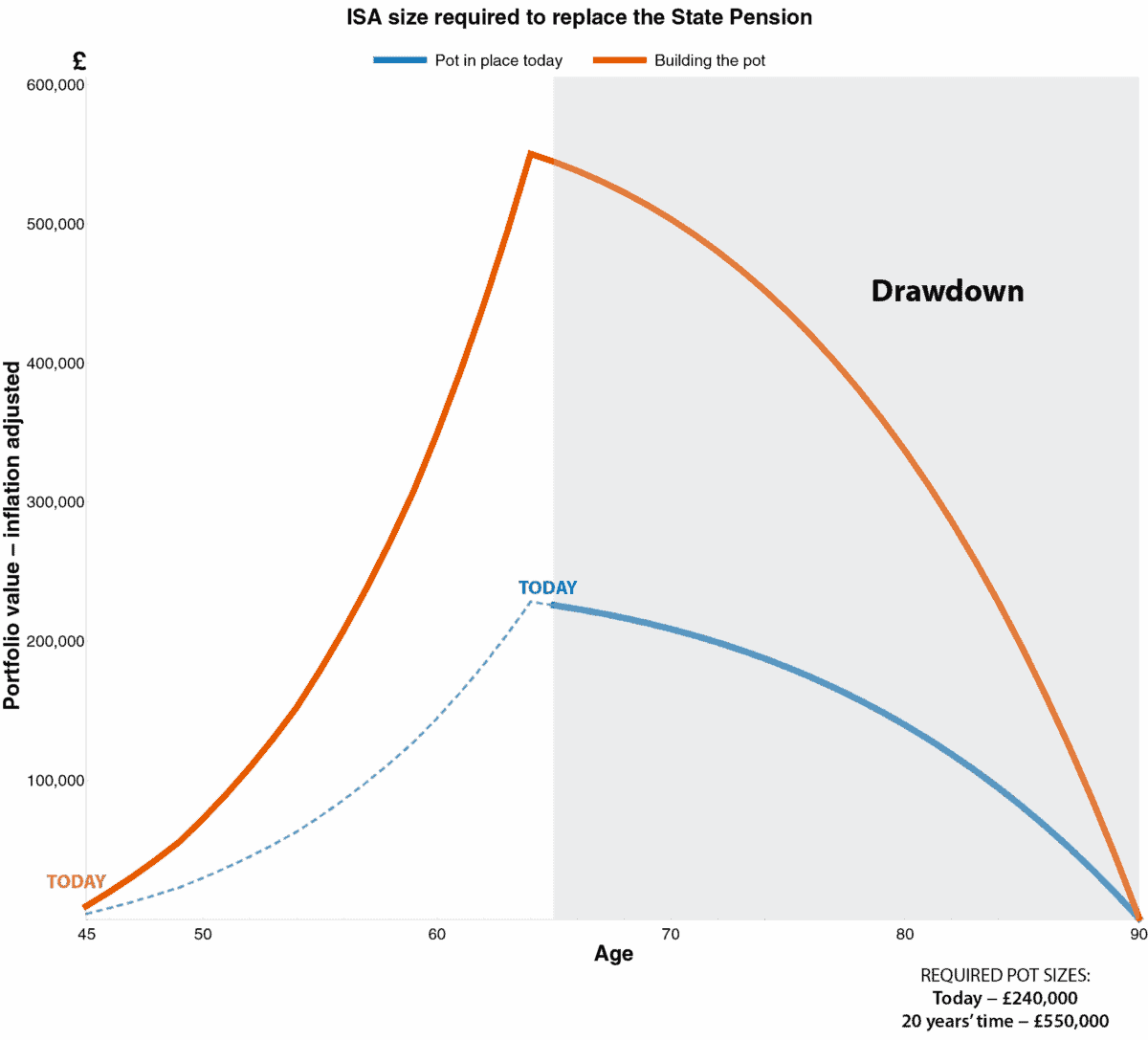
The chart below illustrates this. The blue line assumes contributions stop today and a portfolio is already in place. That portfolio supports a State Pension-matched withdrawal every year until age 90.

I assume the State Pension grows at 4.5% a year, inflation runs at 2%, and the remaining portfolio delivers a conservative 4% annual return. During drawdown, protecting capital matters more than chasing high growth. Under these assumptions, the portfolio required is £240,000.

Chart generated by author

Chart generated by author

Future contributions

The picture changes if you’re still in the accumulation phase. To illustrate, let’s assume an investor is 45 and planning ahead.

Because the State Pension is assumed to rise by 4.5% a year, its annual value in 20 years would be close to £27,000.

That’s where the orange line comes in. As the chart shows, only one trajectory supports a pension-matched withdrawal through to age 90. In this scenario, the required portfolio rises to around £550,000.

Long-term thinking

Reaching a £550,000 portfolio value within a 20-year investing time frame is certainly a challenge. But I believe it’s achievable with a carefully selected portfolio of high-growth stocks and low-volatility dividend stocks.

In the former category, the energy transition provides investors with an opportunity for exposure to a trend that’s still very much in its infancy.

One metal is at the heart of the energy transition: copper and mining giant Glencore (LSE: GLEN) is positioning itself to be one of the biggest copper producers on the planet over the next decade.

The recent merger talks with Rio Tinto highlight the strong position in which the miner’s portfolio puts it. While the deal is far from certain, it underscores how valuable its copper assets are viewed by its bigger peer.

When it reports later this month, copper output will be in the region of 850,000 tonnes. By 2035, its targeting output of 1.6m.

Over the past year, copper prices have exploded 40%. This isn’t only down to increasing demand but also reflects extremely tight supply.

Chile is the undisputed king when it comes to copper production accounting for over a quarter of global production. But new discoveries are becoming increasingly harder to come by and ore grades are in long-term decline.

That said, the recent run-up in the stock can be directly attributable to merger talks. Even if an agreement is reached, a merger of this size brings with it huge risks. Rio Tinto is a pureplay conventional miner, whereas Glencore’s roots are in trading. Marrying such different corporate cultures could potentially result in a larger cost base.

Bottom line

There are many ways for investors to gain exposure to the biggest macro themes of the day including electrification, onshoring and the AI arms race. But for me the greatest value today lies not in the technologies themselves but upstream: sourcing the critical minerals that turn bold ambitions into reality. That’s why Glencore earns a place in my ISA portfolio and could be worth considering.

Remember : a bad plan is better than no plan but a plan without an end destination is still bad plan as it relies on luck.

The Holy Grail of Investing

The holy grail of investing is when you have a share in your Snowball that has returned all your capital, either thru share price appreciation and or dividends. You take out your capital and you have then achieved the Holy Grail of Investing in that you have a share that provides income at a zero, zilch cost and then you can re-invest the capital released, into another high yielding share and try to do it all again.

The current meaning of ‘ Share’ is Investment Trusts (CEF’s) or ETF’s. Currently the SNOWBALL invests mainly in Investment Trusts because some have a discount to NAV, with luck and if you

perseverance may pay off.

The current best share in the SNOWBALL is SUPR, where we have earned two years of dividends. A long road ahead, full of bumps and twists and turns before the Snowball achieves the Holy Grail of Investing.

The worst aspect of having a Snowball, is that you sometimes you wish your life away as you wait for the next dividend, so you can re-invest.

When you start to spend your dividends that problem will disappear, like snow on a summer’s day.

Across the pond

Where Do REITs Fit into a Buffett-less Berkshire?

By Brad Thomas, Wide Moat Research February 2

I was recently reminded of Warren Buffett’s famous speech to Masters of Business Administration students at the University of Florida in October 1998: the one where he emphasized one of his most famous principles…

“Don’t lose money.

It’s a great line – one of many from the Oracle of Omaha. And I’m glad that’s what still stands out today after all these years.

Not the part where he put real estate investment trusts (“REITs”) through the verbal wringer, saying:

REITs have, in effect, created a conduit so you don’t get the double taxation, but they also generally have fairly high operating expenses.

… let’s just say you can buy fairly simple types of real estate at an 8% yield or thereabouts, and you take away close to 1% to 1.5% by the time you count stock options and everything. It is not a terribly attractive way to own real estate.

Maybe [that’s] the only way a guy with $1,000 or $5,000 can own it. But if you have $1 million or $10 million, you are better off owning the real estate properties yourself instead of sticking some intermediary in between who will get a sizable piece of the return for himself.

Buffett wasn’t finished, adding:

REITs have behaved horribly in this market, as you know. And it isn’t at all inconceivable that they become a class that would get so unpopular that they would sell at significant discounts from what you could sell the properties for.

Moreover, even if they did improve as a class, he wondered, “whether management would fight you in that process because they would be giving up their income stream for managing things and their interests might run counter to the shareholders on that.”

But this REIT rebuke?

This wasn’t one of them. In fact, Buffett himself went on to recognize the error of his ways.

Berkshire’s Billboard REIT Bet Is Paying Off

Some of you may remember my August 2025 article titled, “Buffett Bets on Billboards.” In it, I reported how his Berkshire Hathaway (BRK-A)(BRK-B) had just disclosed its investment into Lamar Advertising (LAMR).

Lamar is a REIT. A billboard REIT, to be specific.

Most anyone who drives along major thoroughfares throughout the U.S. has seen its signage towering above the landscape. Those ads direct you to the Chick-fil-A or McDonald’s at the next exit… a lawyer you can call if you’ve been hurt at work… or a jeweler at the outlets 20 minutes down the road.

Lamar has been in the billboard business for more than 100 years now, so it obviously has some staying power. And Berkshire recognized that in the second quarter of 2025 by buying up 1,169,507 shares and then again in the third quarter of 2025 with another 32,603.

Since that first purchase, Lamar has returned around 14%, outperforming the Vanguard Real Estate Index Fund (VNQ), a fairly reliable REIT benchmark.

That wasn’t the biggest purchase Berkshire ever made, of course. But it did mark a major shift in attitude toward REITs.

Nor was it Buffett’s first foray into REITs. His holding company purchased shares in Seritage Growth Properties (SRG), a spinoff from Sears, in 2015. That was a special sort of situation, admittedly, but it was still holding shares.

And in 2017, Berkshire bought a sizable 18.6 million shares in STORE Capital (formerly STOR), a prominent mall REIT that was publicly traded at the time. It then backed the truck up on that decision in the second quarter of 2020 – at the heart of the COVID-19 lockdowns – with another 5.79 million shares.

Could we see more REIT purchases from Berkshire? That’s what I’m wondering, especially now that Buffett has stepped down and there’s new management at the helm.

The ‘Youth’ Factor

Mere weeks ago, on New Year’s Day, Warren Buffett made history by stepping down from managing Berkshire Hathaway’s day-to-day operations… 60 years after he first accepted the CEO role.

Everyone knows the legend he has become, the money he has made, and the wisdom he has provided. But even the best races have to come to an end eventually, and sometimes they need to.

Buffett, who is still chairman, can probably use a bit of a break. He is 95, after all.

Not to say that his successor, Greg Abel, is a spring chicken at 63. One of Buffett’s key lieutenants for the past 25 years, he has been instrumental in acquisitions such as MidAmerican Energy – now Berkshire Hathaway Energy – and overseen important aspects of many other company holdings.

But that combination of experience and comparative “freshness” is probably precisely what a well-established giant like Berkshire needs in a world of artificial intelligence (“AI”), cryptocurrencies, and other alternative investments.

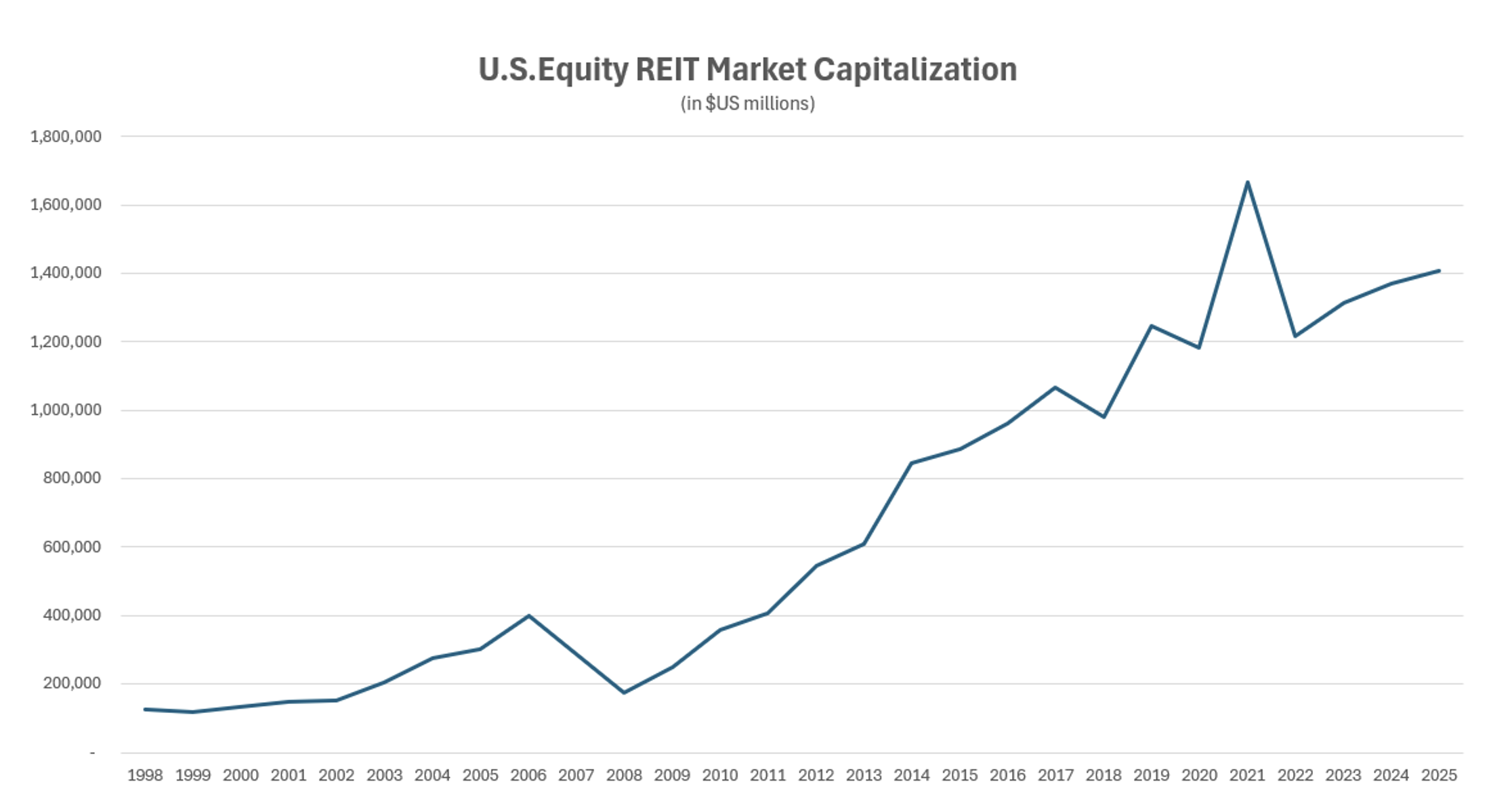
We’ve also long-since crossed the point of REIT profitability. When Buffett talked about them in that speech 28 years ago, the asset class was still in its infancy, with a market capitalization of around $126 billion.

It has since mushroomed to over $1.4 trillion, undeniably erasing Buffett’s prediction that REITs could “get so unpopular… they would sell at significant discounts.”

These real estate companies have also become their own broader investment universe. REITs were formally moved out of the financials sector under the Global Industry Classification Standard and into their own real estate sector in 2016. And they’ve added new categories like cell towers, data centers, farming, timber, and single-family rentals – which I wrote about recently.

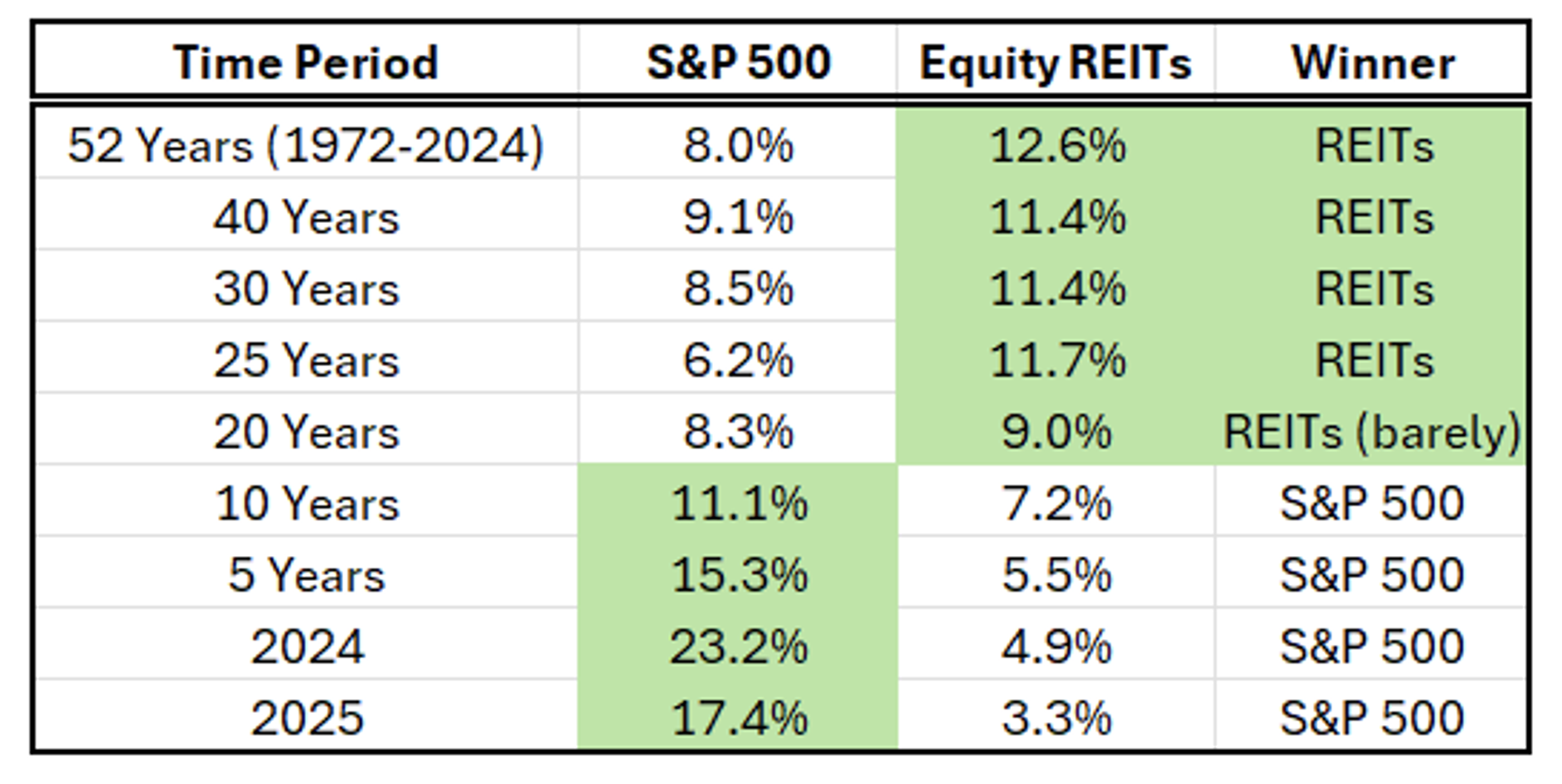
Better yet, over the past 30 years, REITs have delivered strong double‑digit average annual total returns of about 12% across the various subsectors. This places them among the top-performing major asset classes over multidecade periods.

In short, there are plenty of solid, safe, and growing opportunities. And Abel, who might very well have been behind last year’s Lamar purchase, is young enough to more readily forgive REITs their bumpy beginnings.

Source: Wide Moat Research

The Bottom Line

Regardless of what real estate decisions Berkshire makes from here, our team at Wide Moat Research remains laser-focused on REITs – the ones that enjoy durable competitive advantages. So we’ll keep meeting with management teams that create value for their companies, their clients, and their shareholders alike.

To reference Warren Buffett one more time, if you don’t “have $1 million or $10 million” to own “real estate properties yourself”… along with the proper knowledge, wisdom, and time to make that money count…

REITs really can be a great way to own real estate. I’m confident this year will showcase plenty of examples of how worthwhile they can be.

All you need to know about investing.

Warren Buffett once called these stocks’ dividend growth “as certain as birthdays.” Here’s how they’re doing.

Story by William Dahl

Key Points

  • In his 2022 annual letter, Warren Buffett invited readers to “peek behind the curtain” to understand Berkshire Hathaway’s success.
  • Almost immediately, he singled out two stocks.
  • Three years after he called their dividend growth “as certain as birthdays,” their payouts have risen by 21% and 91%.

In his 2022 annual letter to Berkshire Hathaway shareholders, Warren Buffett had no shortage of good news to tout. Since he took the helm of Berkshire in 1964, the conglomerate had notched a 3,787,464% gain, compared to 24,708% for the S&P 500 — enough to turn every $1 initially invested into $37,875.

Yet the first number he brought up, apart from calling his capital allocation decisions in his 58-year tenure “so-so,” was to cite two investments that he said were central to Berkshire’s success.

These two companies, each of which Berkshire coincidentally had invested $1.3 billion into, now paid annual dividends amounting to almost half of Berkshire’s initial investment. This yield on cost was, Buffett predicted, highly likely to grow thanks to dividend hikes.

A line of hundred dollar bills seemingly sprout from the ground.

A line of hundred dollar bills seemingly sprout from the ground.© Getty Images

Of course, this was more than three years ago. What were the two dividend stocks that Buffett felt deserved a special mention? And was his confidence in them well-placed?

1. Coca-Cola

Buffett established his position in soft drink giant Coca-Cola (NYSE: KO) over a seven-year period, buying his 400 millionth share in August 1994.

He hasn’t bought a share since, but neither has he sold. And there’s a good reason.

In 1994, Berkshire was receiving $75 million a year in dividends from Coca-Cola. During the next 28 years, as the dividend increased each year, that number swelled to $704 million in 2022.

Today, Coca-Cola shares yield 2.8%. But while the $1.3 billion Buffett paid for his investment remains fixed, the annual dividend’s continued growth pushed his yield on cost up to almost 50%. That’s a remarkable feat considering that the S&P 500 has averaged annual returns of 10.5% during the past 70 years.

And since Buffett’s 2022 letter, the dividend had been boosted each year as he predicted. Those 400 million shares now pay Berkshire $206 million a year in dividends, at least until this March, when the company’s next quarterly dividend will go out after its expected 64th annual dividend increase.

2. American Express

Today, American Express shares yield less than 1%, as a 191% gain in share price during the last five years has pushed the yield down. But to Buffett, I suspect his yield on cost is far more important. Annual dividends, which totaled $302 million in 2022, have now grown to $577 million, or almost half of Buffett’s initial investment.

Can they keep it up?

Coca-Cola’s management doesn’t release dividend forecasts. However, with more than 50 years of dividend growth to its name, it has won the title of Dividend King, which barely one in 1,000 companies have achieved. Because management will be loathe to give that up, it’s very likely to announce yet another dividend hike next month, especially since it achieved robust earnings growth of 30% year over year last quarter.

Cruise Deals - We Won't Be Beaten On Price - Cruise 118 | Cruise Holidays

Cruise Deals – We Won’t Be Beaten On Price – Cruise 118 | Cruise Holidays

In the case of American Express, the company increased its annual card fees for the 29th consecutive quarter in Q3, and we’ll see if the trend persists in its Q4 earnings call scheduled for Jan. 30. With earnings up 19% year over year, the company should have no difficulty raising its dividend, especially considering how its $2.3 billion in share repurchases means that the company will be mailing checks on fewer shares

With fundamentals and track records like these, you can see why Buffett highlighted Coca-Cola and American Express as examples of “the secret sauce” behind Berkshire’s stunning success. And as in 2022, their payouts look highly likely to rise in the years ahead.

If you haven’t got 40 years to your retirement, investing in shares that yield 1.8%, will not pay for that cruise you promised yourself, so you will have to take a higher risk and buy shares that have a higher starting yield.

« Older posts Newer posts »

© 2026 Passive Income Live

Theme by Anders NorenUp ↑