The Retirement Strategy That’s Failing Millions—Even the Ones Who “Did Everything Right”
In this exclusive briefing, you’ll discover:
- Why “safe” income strategies are failing right now
- How inflation, fluctuating yields and policy chaos are gutting retirement plans
- The hidden risk that quietly drains retirement accounts (and how to avoid it)
- A contrarian dividend blueprint yielding up to 11%—without touching principal
- How to turn $500K into a stable income stream that could last decades
Dear Reader,
You saved. You invested. You followed the “rules.”
And yet here you are—uneasy.
Wondering if you really can afford to retire. Or stay retired.
And who could blame you?
One minute, inflation’s the threat. The next, it’s recession.
A new headline from Washington sends markets whipsawing the very same day.
And the broader economy? It’s bloated with debt and only getting worse.
We touch new all-time highs, then the market zigzags like a drunk squirrel—making it feel impossible to plan, let alone sleep at night.
So you start looking for stability. Maybe trim a position here. Tap a bit of principal there. Just for now.
But that’s exactly how it begins.
And once you start selling shares to supplement your income, you’re on a slippery slope.
A slow-motion wealth drain most retirees don’t realize they’re in—until it’s too late.
I call it…
The Share Selling “Death Spiral”
Some financial advisors (who are not retired themselves, by the way) say that you can safely withdraw and spend, say, 4% of your retirement portfolio every year. Or whatever percentage they manipulate their spreadsheet to say.
Problem is, in reality, every few years you’re faced with a chart that looks like this.
Apple’s Dividend Was Fine – Its Stock Wasn’t

As you can see, the dividend (orange line above) is fine — growing, even — but you’re selling at a 25% loss!
In other words, you’re forced to sell more shares to supplement your income when they’re depressed.
Remember the benefits of dollar-cost averaging that built your portfolio? You bought regularly, and were able to buy more shares when prices were low?
In this case, you’re forced to sell more shares when prices are low.
When shares rebound, you need an even bigger gain just to get back to your original value.
The Only Reliable Retirement Solution
Instead of ever selling your stocks, you should instead make sure you live on dividends alone so that you never have to touch your capital.
This is easier said than done, and obviously the more money you have, the better off you are. But with yields still pretty low, even rich folks are having a tough time living off of interest today.
And you can actually live better than they can off of a (much) more modest nest egg if you know where to look for lesser-known, meaningful and secure yield.
I’m talking about annual income of 8%, 9% or even 10%+ so that you’re banking $50,000 (and potentially more) each year for every $500,000 you invest.
You and I both know an income stream like that is a very nice head start to a well-funded retirement.
And it’s totally scalable: Got more? Great!
We’ll keep building up your income stream, right along with your additional capital.
And you’ll never have to touch your nest egg capital – which means you won’t have to worry about or running out of money in retirement, or even the day-to-day ups and downs of the stock market.
The only thing you need to concern yourself with is the security of your dividends.
As long as your payouts are safe, who cares if your stock prices swing up or down on a given day?
Most investors know this is the right approach to retirement.
Problem is, they don’t know how to find 8%, and 10% yields to fund their lives.
And when they do find high yields, they’re not sure if these payouts are safe. Will the company or fund have enough cash flow to pay the dividends into the future?
And how sensitive are these payouts to the latest headline, Fed policy change or unrest on the other side of the globe?
We’ll talk specific stocks, funds and yields in a moment.
But first, a bit about myself.
 My name is Brett Owens. I first started trading stocks in college, between classes at Cornell.
I graduated cum laude with an industrial engineering degree — which is actually pretty popular with Wall Street recruiters.
But I couldn’t stand the thought of grinding it out in a cubicle for 80 hours a week. So I moved to San Francisco and got into the tech scene.
A buddy and I started up two software companies that serve more than 26,000 business users.
The result was a nice chunk of change coming in … and I had to decide what to do with my money.
I had seen plenty of young “techies” come into sudden cash and burn through their windfall in a year, ending up right back where they started.
That was NOT going to be me. I already had dreams of living off my wealth one day, decades before I retired.
I got plenty of cold calls from brokers wanting to “help” me. But I knew that nobody would care as much about my money as me.
So I went out on my own and invested my startup profits in dividend-paying stocks.
I’ve been hunting down safe, stable and generous yields ever since, growing my wealth with vehicles paying me 8%, 9%, even 10%+ dividends.
Over the past 10+ years, I’ve been writing about the methods I use to generate these high levels of income.
Today I serve as chief investment strategist for Contrarian Income Report — a publication that uncovers secure, high-yielding investments for thousands of investors.
Since inception, my subscribers have enjoyed dividends 5 times (and much more!) the S&P 500 average, plus big annualized gains!
And that brings me to a crucial piece of advice…
The ONE Thing You Must Remember
If I could leave you with just one nugget of investing wisdom today, it would be to NEVER overlook the incredible wealth-building power of dividends.
Few investors realize how important these unglamorous workhorses actually are.
Here’s a perfect example…
If you put $1,000 in the dividend-paying stocks of the S&P 500 back in 1973, you would have had $96,970 by 2023, or 97x your money.
But the same $1,000 in the non-dividend payers would have grown to just $8,990 — 91% less.
That’s why I’m a dividend fan.
The stock market is a fantastic wealth-building machine, but it doesn’t always go straight up!
There have been plenty of 10-year periods where the only money investors made was in dividends.
And that’s what gives us dividend investors such an edge.
When you lock in an 8%+ yield, you’re booking an income stream that’s bigger than the stock market’s long-term average return right off the bat.
Of course you can’t just buy every ticker symbol out there with a flashy yield, or you’ll get burned pretty fast.
So let’s wipe the false promises of mainstream finance from our minds and start thinking the “No Withdrawal” way…
Step 1: Forget “Buy and Hope” Investing
Most half-million-dollar stashes are piled into “America’s ticker” SPY.
The SPDR S&P 500 ETF (SPY) is the most popular symbol in the land. For many 401(K)’s, this is all there is.
And that’s sad for two reasons.
First, SPY yields just 1.1%. That’s $5,500 per year on $500K invested… poverty level stuff.
Second, consider 2022 for a moment (and only a moment, I promise!).
SPY was down nearly 20% that year. That is no bueno, because that $500K would have been reduced to $400K.
The last thing we want to do is lose the money we’re getting in dividends (or more) to losses in the share price. Which is why we must protect our capital at all costs.
Step 2: Ditch 60/40, Too
The 60/40 portfolio has been exposed as senseless.
Retirees were sold a bill of goods when promised that a 60% slice of stocks and 40% of bonds would somehow be a “safe mix” that would not drop together.
Oops.
Inflation — plus an aggressive Federal Reserve, plus a (thus far) persistently steady economy — drop-kicked equities and fixed income before they went on a serious bull run in 2023, 2024 and into 2025 (with a brief interruption for the April “tariff tantrum.”)
It just goes to show that bonds are not the haven guaranteed by the 60/40 high priests. They could easily plunge just as hard (or harder) than stocks in the next economic crisis.
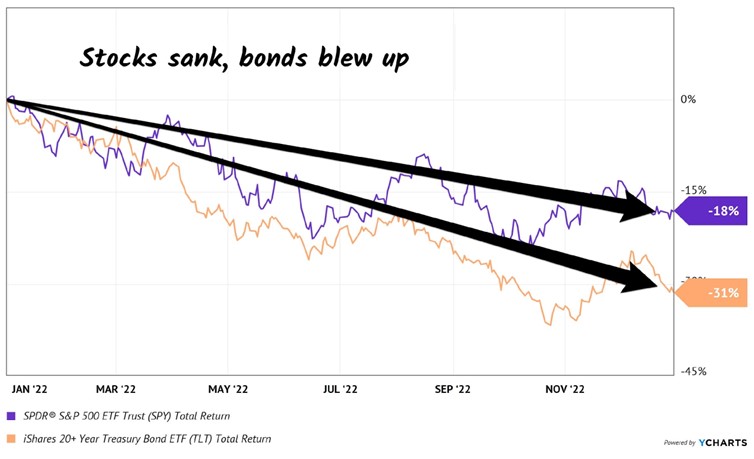
Just like they did in 2022 (sorry, we’re only going to spend one more second on that disaster of a year). US Treasuries plunged, which resulted in the iShares 20+ Year Treasury Bond ETF (TLT) getting tagged.
Sure, it still paid its dividend. But even including payouts, the fund was down 31% — worse than the S&P 500. Ouch!
When stocks and bonds are dicey, where do we turn? To a better bet.
A strategy to retire on dividends alone that leaves that beautiful pile of cash untouched.
Leave a Reply