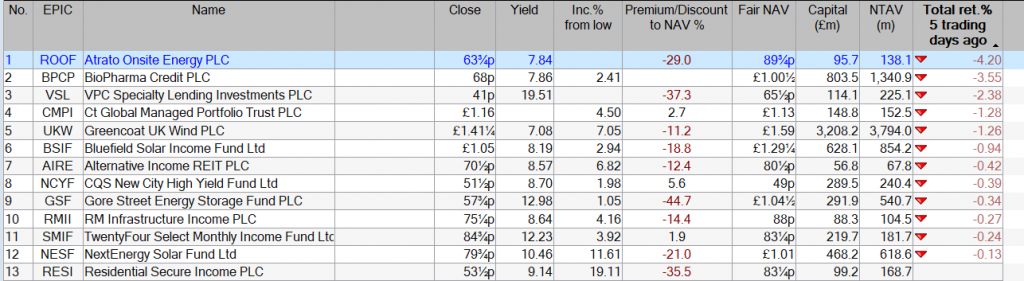
VPC is in a period of wind down. Its dividend on a “headline” basis is one of the strongest on the market at an alleged 19.51% per annum (according to HL).
But is that good value for money? Is it “real” and sustainable? And should existing shareholders hold on, average down, or exit?
For a start, the true dividend is 18.3%. That’s because the dividend is/was/has been 2p per quarter (backed by strong returns on VSL’s loan portfolio) but due to a 0.11p/share B shares capital return this has now been reduced to 1.89p per qtr. 7.56p on a 41.2p ask price is 18.3%.
Still, a chunky old divvy covered by earnings.
For anoraks only.
Is VSL a wee foxy lass?
“The Oak Bloke from The Oak Bloke’s Substack” <theoakbloke@substack.com>
Is it the right time to invest in the UK stock market ? Story by Harvey Dorset
Currently, UK equities are cheap compared to their foreign counterparts. But with potential takeover activity on the horizon, and growth back on the cards, it appears the tide might be beginning to shift.
In recent years, the UK market has been struggling to keep up with its competitors and has suffered due to its lack of high-quality tech stocks as US-based firms have seen meteoric gains.
As a result, UK equities are considerably cheaper than those in the US or Europe, and at the same time are delivering higher dividends and operating in a faster growing economy.
On the rise: Cheap UK equities could be set to grow in value as the economy stabilises Richard Hunter, head of markets at Interactive Investor, said: ‘The FTSE 100 has tended to languish over recent years, not least of which was due to the fallout from Brexit and the index’s relatively low exposure to the technology sector, which has latterly been “the” trade which investors chase.
‘However, there are some signs that fortunes could be on the turn.’
Last month, the Bank of England cut interest rates for the first time in 2024 to five per cent and is expected to make further cuts before the year is out.
In comparison, the US has yet to see a rate cut, though this could be on the cards for the looming Fed decision.
The UK has also delivered strong growth in 2024 so far, with GDP having risen by 0.7 per cent in the first quarter and 0.6 per cent in the second, compared to 0.3 per cent and 0.2 per cent growth for the eurozone and 0.4 per cent and 0.7 per cent growth for the US.
‘The signs are the UK economy is set to keep growing,’ Tom Stevenson, investment director at Fidelity, said.
‘In July, the IMF upgraded its forecast for UK growth in 2024 from 0.5 per cent to 0.7 per cent, while sticking with its forecast that the economy will expand by 1.5 per cent next year.
‘Moreover, the UK is now underpinned by several factors including more growth and the actual onset of falling interest rates.
‘That could fuel a further unwinding of the discount that’s been applied to UK shares ever since the Brexit referendum in 2016.’
While the UK market is increasing in value, data from Fidelity shows it remains at a considerable discount.
The UK stock market has a price to earnings ratio of 11.7, far lower than 21.0 for the US and Canada, and 14.1 for Europe (excluding the UK).
Price to earnings ratios indicate the value of a company’s share relative to its earnings.
Often companies with low ratios are considered to be value stocks.
Stevenson said: ‘The UK stock market is no longer trading in absolute bargain territory – but it is pretty close to it. ‘Valuations in the US – even after the hiatus in markets mid-summer – remain close to their recent peaks.’
With UK equities still trading at a marked discount to those elsewhere, they are becoming increasingly attractive prospects for potential buyers.
‘Evidence of the market’s attractive valuation and newfound political stability comes from the number of foreign takeovers we’ve seen so far this year.
‘Indeed, the value of bids for UK companies hit its highest since 2018 earlier this year,’ Stevenson said.
Cyber-security firm Darktrace and packaging company DS Smith have both seen high-profile bids this year, with Rupert Murdoch’s REA group now mulling a bid for Rightmove.
Added to this, the Government has pledged to promote new investment in the UK, both through a £7.3billion national wealth fund, as well as considering reducing regulation and axing stamp duty in order to make the UK a more attractive prospect.
Hunter said: ‘The possibility of luring pension funds back to the UK in a meaningful way is another intriguing possibility which would immediately bolster prospects.’
He added: ‘For the longer term the UK remains an investment destination full of quality and proven names, and while the returns can be lower than some other indices, the potential rewards coming from many well-regarded names is evident and may be increasingly coming to the attention of overseas investors looking for an alternative outlet.
The main reason I invest is to build my second income. Further down the line when I’m thinking about retirement, I want to have a stream of income that I can rely on to help me enjoy life more. That’s the dream, isn’t it?
How to invest
Before I started to think about how much I wanted to invest, the first step I’d take would be to open a Stocks and Shares ISA. That’s because I wouldn’t be taxed on any profit I made. From the dividend shares I’d be buying, I’d also be able to keep all of the passive income I received from dividend payments.
Please note that tax treatment depends on the individual circumstances of each client and may be subject to change in future. The content in this article is provided for information purposes only. It is not intended to be, neither does it constitute, any form of tax advice. Readers are responsible for carrying out their own due diligence and for obtaining professional advice before making any investment decisions.
Starting out
So, I’ve decided I’m going to invest with my ISA. That’s the best way for me to set myself up for success. But what’s next? Well, now comes the most important part. It’s about getting started no matter how much money I have to invest.
But that’s far from the case. How we start doesn’t matter. What’s imperative is that we start as early as possible and over the long run the stock market work its magic. I think £100 a week is a sensible starting amount.
Phoenix Group Holdings
Let me show an example of just how powerful this can be. The stock I’m going to use is Phoenix Group Holdings (LSE: PHNX).It’s an insurance company and a leader in the sector.
Its share price is down 1.8% so far this year. But a falling share price isn’t always a negative. For savvy investors, it means they can snap up bargains while the rest of the market overlooks it.
At its current share price, it has a dividend yield of 10.1%, way above the FTSE 100 average (3.6%). I like Phoenix Holdings because it has a strong balance sheet with plenty of cash spare as well as a rising dividend payout.
Money to be made
Taking my £100 a week and applying it to Phoenix Group’s 10.1% yield ought to see me make slightly over £525 a year in passive income. Not bad.
However, the longer I leave my money in the market, the better chance I have of building my wealth. If I adopt a 30-year investment time frame and reinvest all the dividend payments I receive, at the end of that I’d be making £10,168 a year in second income. I’d have a nest egg worth £106,269.
Investing always comes with risks and the stock market is volatile. There’s no guarantee that Phoenix Group’s yield will stay the same. It could rise or fall. Nevertheless, what this shows is that even investors starting from scratch are able to build a sizeable pot if they give it time.
The post Here’s how investors can build a meaty second income starting from scratch appeared first on The Motley Fool UK.
The 2025 fcast for the Snowball is income of £9,170 and a target of £10,000.
If the fcast is achieved that will be the plan’s fcast for the year ending 2027.
If the target is achieved that would equate to a future income stream in ten years of 20k pa. a yield of 20% on seed capital, if the dividends are re-invested at 7% or above.
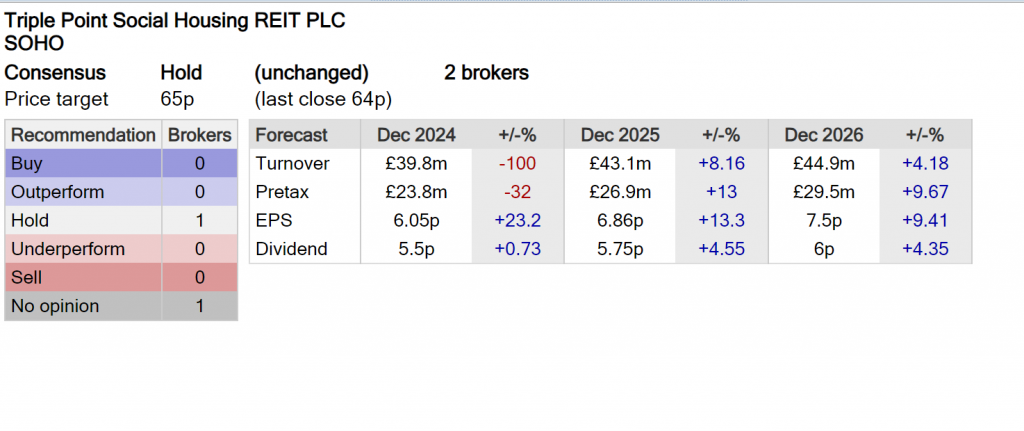
The Board of Triple Point Social Housing REIT plc (ticker: SOHO) is pleased to announce its unaudited results for the six months ended 30 June 2024.
Chris Phillips, Chair of Triple Point Social Housing REIT plc, commented:
“The Company’s portfolio has continued to demonstrate operational and financial resilience and the Group has benefited from strong rental growth that has increased income.
The Group will continue to benefit from having exclusively long term fixed priced debt and we look forward to building on the progress made in the first half of the year particularly in relation to the increase in rent collection and the corresponding increase in dividend cover, which ensured that the dividend was fully covered on an adjusted earnings basis for the six months ending 30 June 2024.”
(the “Company” or, together with its subsidiaries, the “Group“)
DIVIDEND DECLARATION
The Board of Directors of Triple Point Social Housing REIT plc (ticker: SOHO) has declared an interim dividend in respect of the period from 1 April 2024 to 30 June 2024 of 1.365 pence per Ordinary Share, payable on or around 4 October 2024 to holders of Ordinary Shares on the register on 20 September 2024. The ex-dividend date will be 19 September 2024.
The dividend will be paid as a Property Income Distribution (“PID”).
The Company is targeting an aggregate dividend of 5.46 pence per Ordinary Share for the financial year ending 31 December 2024.