Investment Trust Dividends

Author: admin (Page 238 of 371)

Investing lessons

Benzinga

5 Investment Lessons From Benjamin Graham’s Book ‘The Intelligent Investor,’ Which Warren Buffett Called ‘By Far The Best’

Story by Rounak Jain

One of the most illustrious investors in American history, Benjamin Graham, is also known as the “Father of Value Investing.” From an educator to an investor, Graham has inspired millions, including another legendary investor, Warren Buffett.

In fact, Buffett idolizes Graham. He thinks Graham’s book, The Intelligent Investor, is “by far the best book on investing ever written,” and there’s a good reason why he says so.

Here are the top five important lessons from Graham’s book that Buffett loves so much.

1. Investment Versus Speculation

5 Investment Lessons From Benjamin Graham's Book 'The Intelligent Investor,' Which Warren Buffett Called 'By Far The Best'

5 Investment Lessons From Benjamin Graham’s Book ‘The Intelligent Investor,’ Which Warren Buffett Called ‘By Far The Best’© Provided by BenzingaRepresentative image of investment and speculation | Image generated using Dall-E

Graham underscores the importance of understanding the difference between investment and speculation. At the end of the day, he says it’s important to know what makes money.

“People who invest make money for themselves; people who speculate make money for their brokers,” Graham says in his book.

2. Aim For The Long-Term

5 Investment Lessons From Benjamin Graham's Book 'The Intelligent Investor,' Which Warren Buffett Called 'By Far The Best'

5 Investment Lessons From Benjamin Graham’s Book ‘The Intelligent Investor,’ Which Warren Buffett Called ‘By Far The Best’© Provided by BenzingaRepresentative image of long-term investing

While long-term investing has often been recommended by many investing legends, including Buffett, Graham puts it very succinctly.

“In the short term, a market is a voting machine; in the long term, it is a weighing machine.”

Investing in the short term can be more volatile because of several factors, including macroeconomic conditions. However, markets revert to the mean in the long term.

3. Learn From Your Mistakes

5 Investment Lessons From Benjamin Graham's Book 'The Intelligent Investor,' Which Warren Buffett Called 'By Far The Best'

5 Investment Lessons From Benjamin Graham’s Book ‘The Intelligent Investor,’ Which Warren Buffett Called ‘By Far The Best’© Provided by BenzingaRepresentative image of learning from mistakes

This one comes from Graham’s own loss, which he suffered during the stock market crash in 1929 and the Great Depression. This led him to co-author a book named “Security Analysis” where he explains how to analyze securities and price assets accordingly.

“Letting losses run is the most serious mistake made by most investors.”

4. Bull Runs Increase The Risk

5 Investment Lessons From Benjamin Graham's Book 'The Intelligent Investor,' Which Warren Buffett Called 'By Far The Best'

5 Investment Lessons From Benjamin Graham’s Book ‘The Intelligent Investor,’ Which Warren Buffett Called ‘By Far The Best’© Provided by Benzinga Representative image of increasing risk

While bull runs can be very captivating, especially when you’ve invested your money, Graham has a word of caution for investors.

“The intelligent investor realizes that stocks become more risky, not less, as their prices rise—and less risky, not more, as their prices fall.”

Graham says an intelligent investor would dread a bull market because this makes stocks expensive, while they should welcome a bear market because this makes their preferred stocks less expensive.

5. Understand The Business You Want To Invest In

5 Investment Lessons From Benjamin Graham's Book 'The Intelligent Investor,' Which Warren Buffett Called 'By Far The Best'

5 Investment Lessons From Benjamin Graham’s Book ‘The Intelligent Investor,’ Which Warren Buffett Called ‘By Far The Best’© Provided by BenzingaRepresentative image of understanding a business

Last but not least, Graham urges investors to understand the business they want to invest in. A long-term investor will want to understand if a stock is overvalued, undervalued, or fairly valued. Another factor to consider here is the potential for growth in the future.

“A stock is not just a ticker symbol or an electronic blip; it is an ownership interest in an actual business, with an underlying value that does not depend on its share price.”

££££££££££££££

It’s always better to learn from other peoples mistakes

The Snowball

Dividends received £6,768

Cash to re-invest £1,690

The income target for this year of 9k should be beaten.

When the September dividends for the Snowball are announced I should be able to set the fcast and the target for 2025.

Change to the Snowball

I’ve sold £750 of SDCL to reduce the Snowball position back to 10k.

‘Profit’ booked of £288.00, although u can’t choose which shares to sell unless u sell all the shares and then u can book all the profit.

Plant a twig.

Passive and Active: text from letters of the wooden alphabet on a green chalk board

Passive and Active: text from letters of the wooden alphabet on a green chalk board© Provided by The Motley Fool

The Motley Fool

£11,000 in this 9.4%-yielding FTSE 250 gem could make me £17,158 a year in dividend income over time.

Story by Simon Watkins

FTSE 250 investment manager abrdn (LSE: ABDN) is down 20% from its 15 December 12-month high of £1.86.

This is a continuation of its slide since rumours last July that it would be relegated from the FTSE 100. Just before the chatter began, the stock was trading around £2.37.

The demotion duly happened the following month, prompting FTSE 100-tracker funds to sell their shares in the firm.

In my experience as a former investment bank trader, recently relegated companies can provide good bounce-back opportunities. That is not always the case, as it depends on how they react to their fall from the top tier.

In abrdn’s case, I think the reaction has been very good so far.

What’s the new plan?

Broadly, the firm sought to discard the businesses that were not working and focus on the ones that were.

More specifically, one part of this change is to reduce costs by at least £150m by the end of 2025.

Much of this will come from removing layers of management, particularly in the investments division. Having less bureaucracy in the fast-moving asset management and trading business looks a very good idea to me.

Another part of the plan is to sell off underperforming operations such as the US and European Private Equity operations. Instead, abrdn will focus on major profit-generating businesses, including the UK’s leading direct-to-consumer investment platform, interactive investor.

The final part is to maintain a strong balance sheet to safeguard the confidence of shareholders and clients.

How’s it going?

A risk for the firm is that the plan hits a major snag that could prove expensive to remedy. Another is the high level of competition in the sector that can pressure margins.

But its H1 2024 results on 6 August showed an IFRS post-tax profit of £171m compared to a loss of £145m in H1 2023. Earnings per share also increased – to 9.1p from a 7.7p loss previously.

And assets under management (AUM) increased to £505.9bn from £494.9bn. Net outflows in AUM had been a key reason behind abrdn’s demotion from the FTSE 100 last year.

Interactive investor saw 4% customer growth over the period, and net inflows increased to £3.1bn from £1.8bn.

Abrdn maintained its 7.3p a share interim dividend.

Big passive income generator

Last year, it paid a total of 14.6p in dividends, giving a current yield of 9.4%. This compares to the 3.3% average of the FTSE 250 and the FTSE 100’s 3.7%.

So, £11,000 (the average UK savings amount) invested in the firm now would make £1,034 this year. Over 10 years on the same average yield, this would increase to £10,340, and after 30 years to £31,020.

Crucially though, using the dividends to buy more abrdn shares would dramatically increase these returns.

Doing this (‘dividend compounding’) on a 9.4% average yield would add £17,057 instead of £10,340. After 30 years, an extra £171,529 would have been generated rather than £31,020.

The total investment of £182,529 would be paying £17,158 each year in dividends or £1,430 every month.

Compound the compound.

It was the renowned scientist and theoretical physicist Albert Einstein who said, “Compound interest is the eighth wonder of the world. He who understands it, earns it … he who doesn’t … pays it.” These words are reflected by investor Warren Buffett, who is most associated with the basic wealth building strategy.

The concept behind compound interest is simple. Defined by the Consumer Financial Protection Bureau, “Compound interest is when you earn interest on the money you’ve saved and on the interest you earn along the way.”

Buffett explains it’s power in even simpler terms in his autobiography: a snowball rolling down a long hill, picking up more snow as it gains momentum until it becomes a massive snowball. The Berkshire Hathaway chairman and CEO loves compound interest because it works alongside his investing philosophy, and as one of the wealthiest people in the world, the 93-year-old is an example of compound interest’s real-world success.
Here are some of the reasons why compound interest is the “eighth wonder of the world.”

Wealth Grows Exponentially
Compounding increases the value of the money you have invested by getting the interest earned added back or reinvested to the principal, generating even more earnings. This is the concept that makes the snowball grow larger every day. Principal grows faster the more frequent interest is compounded. Compounding works especially well when it’s allowed to build over time, something Buffett learned at an early age.

Save and Invest Early
Compound interest encourages and rewards individuals to start investing early to maximize growth over many years. We all have to start somewhere, and while Buffett is an exception — he bought his first stock at the age of 11 — compound interest uses the power of early action, time and will, which is fundamental to success.

Buffett Loves the Long Game
The key to Buffett’s success is long-term thinking, exemplified in one of Buffett’s most famous quotes about knowing he would reach wealth, yet not being in a hurry to get there. Notoriously patient, the wealth of Berkshire and Buffett is associated with the importance of value growth over time. Berkshire’s portfolio has held onto some stocks for close to 30 years.

Set It and Forget It
One of the great things about compound interest is that it does much of the work without requiring any intervention from the investor. As long as an investment is paying interest, nothing can stop the snowball from doing the work and growing on its own. This aligns with Buffett’s hands-off approach with many of his stocks.

Compound Interest Doesn’t Discriminate
Of course, the more money you start with, the more you’ll make through compound interest over time. You don’t need to start with a lot, though, you just need to start. Regardless of your bank balance, job or background, anyone can build great wealth with time and consistent investing.

Rewarding Patience Through Investing
In an impatient world, investors are looking to get rich quick. Some are fortunate enough to make millions by catching lightning in a bottle; however, compound interest is a proven wealth builder that doesn’t rely on luck. It may sometimes take longer to see the results of your effort, but this doesn’t mean that the effort is going to waste.

With patience and consistency, compound interest can reap great rewards.

JLEN

JLEN Environmental Assets Group Limited

Disposal of 51% of Six Anaerobic Digestion Facilities and Capital Allocation Update

JLEN, the listed environmental infrastructure fund, is pleased to announce that it has signed an agreement for the sale of 51% of a portfolio of six gas-to-grid anaerobic digestion (“AD“) facilities (the “AD Portfolio“) to Future Biogas (“Partial Disposal“), for a total consideration of £68.1 million, in line with the valuation as at 30 June 2024. Completion of the Partial Disposal is subject only to a customary condition precedent.   

JLEN will continue to own 49% of the AD Portfolio, which has a combined generating capacity of 38MW, as well as its interests in three further AD assets which are not part of the agreement.

Future Biogas is a specialist developer and has been the operator of the assets comprising the AD Portfolio since they were acquired by the Company between 2017 to 2019.  The Partial Disposal provides a greater alignment of interests between JLEN and Future Biogas, creating the potential for further asset enhancements and life extensions beyond the current Renewable Heat Incentive (“RHI“) subsidy. These initiatives are expected to deliver uplifts to the valuation of the Company’s remaining holding in the AD Portfolio over time.

The AD Portfolio is located in the East of England and the AD assets have been operational since 2013 – 2016. All of the projects in the AD Portfolio benefit from a RHI and Feed-in Tariff subsidy.

Capital allocation update

JLEN has previously announced that proceeds from sales will be used to pay down debt and consider share buybacks, subject to the Board ensuring that the Company maintains a robust balance sheet and can meet its existing commitments.

In that regard, the proceeds of the Partial Disposal will be used to repay amounts outstanding under the RCF which is available to meet existing commitments within the portfolio. In addition, the Company will allocate £20 million of the proceeds of the Partial Disposal to a share repurchase programme.

The Board and the Investment Manager continue to believe that the discount to net asset value (“NAV“) at which JLEN’s shares are currently trading materially undervalues the Company, and so represents an attractive investment opportunity delivering NAV accretion for shareholders.

The Board and the Investment Manager continue to progress further targeted asset sales to recycle capital within the portfolio.

Ed Warner, Chair of JLEN, said:

“This deal is a great outcome for JLEN, enabling us to recycle capital within the portfolio, while continuing to benefit from the future growth and income generated by this attractive AD Portfolio. This is the Company’s second divestment, following the sale of our French wind assets in January 2022, and provides funds for JLEN to commence buybacks in accordance with our stated approach to capital allocation.

We are pleased to continue our partnership with Future Biogas who we have worked with since 2017. Having them as co-owners will help to deliver further value from the business model they have developed and put into practice on other projects for post-subsidy operations. Anaerobic digestion projects such as these have a valuable role to play in the decarbonisation of heat as part of the UK’s net zero goals.”

NESF

NextEnergy goes xd tomorrow for 2.10p, if u bought at 87.9p u would receive the right to 5 dividends in just over a year, a yield of 12%. U could re-invest the dividends back into your portfolio, thus increasing the yield to be received.

If the NESF share price has gone up in a year’s time, u could either continue to hold the share or spin it and try to do it all over again with another Trust.

All baby steps.

Doceo Discount Watch

With market volatility spiking higher on US recession fears, has the number of London’s investment companies trading at 52-week high discounts followed suit and move higher too?

12 Aug, 2024

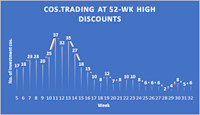
We estimate six investment companies saw their respective share prices trade at 52-week high discounts over the course of the week ended Friday 09 August 2024 – just one more than the previous week’s five.

London’s investment company sector proving to be relatively resilient (so far) in the face of the uptick in market volatility seen in recent days. That’s based on the number of companies trading at 52-week high discounts staying close to year lows. Impressive given that on Friday 2 August 2024, 2-year U.S. Treasury yields fell to 4.10%, the lowest level since May 2023, 10-year yields dipped below 4% for the first time since February, while equity markets lurched downwards with Japanese indices leading the way after shedding over 11% on 5 August 2024. Then on Tuesday 6 August, the VIX Index, a gauge of S&P 500 volatility, recorded its largest daily spike since 1990. The cause, elevated fears that the U.S. economy could slip into recession following a run of poor data. In the case of Japan, a tightening in monetary policy didn’t help much either.

And yet, the number of London’s closed-end funds trading at 52-week high discounts barely budged. The apparent resilience could, of course, prove to be temporary – as the graph above shows it was only back in February/March of this year that the number of 52-wk high discounters soared into the 30s as the narrative of higher-for-longer interest rates took hold.

But perhaps that’s it. This time round, what’s worrying markets are fears of a U.S. recession which could end up forcing the Fed’s hand to bring forward those long-awaited rate cuts. And a lower interest-rate environment could provide a positive tailwind for London’s investment companies. That’s because lower interest rates would likely prompt a lowering in the discount rates used to value assets, resulting in valuation uplifts. Lower interest rates would also reduce the pressure on yields offered by trusts to compete with risk-free assets. And lower interest rates would benefit those funds with high debt levels.

“This time is different”, an overly used phrase that more often than not comes back to haunt market commentators. So, not going to use that phrase here then. Time will tell, will just have to do instead !

The 52-week high discounters

Fund

Discount Sector

Tetragon Financial Group TFG

-72.18%

Flexible

abrdn Diversified Income & Growth ADIG

-40.01%

Flexible

Third Point Investors TPOU

-26.60%

Hedge Funds

JPEL Private Equity JPEL

-44.59%

Private Equity

Regional REIT RGL

-79.45%

Property

Ceiba Investments CBA

-69.64%

Property

« Older posts Newer posts »

© 2026 Passive Income Live

Theme by Anders NorenUp ↑