
The portfolio
New portfolio in place from 22 April 2025
The portfolio was fully realigned to the new strategy by 22 April 2025, with no cost to ongoing shareholders due to the manager’s contribution to expenses and the NAV uplift from the tender offer. Previously, almost 10% of BRAI’s portfolio was in non-US stocks, but it is now entirely invested in US stocks.
Marked shifts in sector and stock exposures
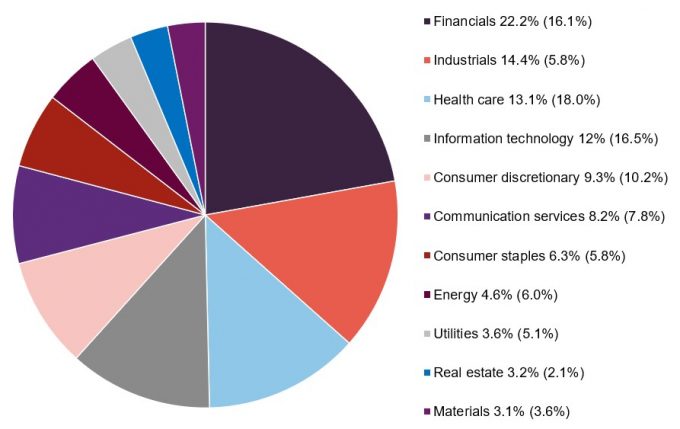
Figure 5 shows the portfolio breakdown by industry sector as at 30 September 2025, compared to the end of the last financial year (31 October 2024). There have been significant changes, with much higher exposure to financials and industrials, and lower exposure to healthcare and information technology. The net effect is that, on a sector basis, the portfolio now closely matches the benchmark, so most of the added value comes from choosing the right stocks.
Figure 5: BRAI asset allocation by sector as at 30 September 2025 (and as at 31 October 2024)
Source: BRAI
There is very little overlap between BRAI’s 10 largest holdings at the end of its last financial year (31 October 2024), before the new investment approach, and the top positions in the portfolio at the end of September 2025.
Figure 6: Top 10 holdings as at 30 September 2025
| % as at 30/09/25 | % as at 31/10/24 | Change | ||
|---|---|---|---|---|
| JPMorgan Chase | Financials | 3.2 | – | 3.2 |
| Berkshire Hathaway | Financials | 2.8 | – | 2.8 |
| Walmart | Consumer staples | 2.6 | – | 2.6 |
| Amazon | Consumer discretionary | 2.6 | 1.7 | 0.9 |
| Bank of America | Financials | 2.3 | – | 2.3 |
| Alphabet | Communication services | 1.9 | – | 1.9 |
| Morgan Stanley | Financials | 1.9 | – | 1.9 |
| Johnson & Johnson | Health Care | 1.8 | – | 1.8 |
| Charles Schwab | Financials | 1.7 | – | 1.7 |
| Pfizer | Health Care | 1.6 | – | 1.6 |
| Total | 22.3 |
Source: BRAI
Performance
Building a track record of outperformance
As mentioned earlier, we do not consider BRAI’s returns before the strategy change relevant here. Figure 7 shows BRAI’s share price and NAV performance compared to its benchmark and the S&P 500 Index.
The data indicate that BRAI has made a strong start, regularly outperforming its objective. The S&P 500’s gains have been driven by a few large AI-related companies, while BRAI’s benchmark is more diversified. Notably, BRAI has delivered solid returns over the past six months without heavily relying on the mega-cap AI trend.
It is still too soon to assess the volatility of these returns, but we will cover this in future reports.
Figure 7: Total return performance data for periods to end October 2025
| Calendar year | 1 month (%) | 3 months (%) | 6 months (%) | Since 22 April 2025 (%) |
|---|---|---|---|---|
| BRAI share price | 2.3 | 8.6 | 17.7 | 16.6 |
| BRAI NAV | 3.6 | 8.1 | 17.2 | 21.4 |
| Russell 1000 Value | 2.9 | 5.9 | 15.1 | 18.5 |
| S&P 500 | 4.9 | 9.0 | 25.6 | 32.3 |
Source: Bloomberg

Dividends
New enhanced dividend policy roughly 6% of NAV each year
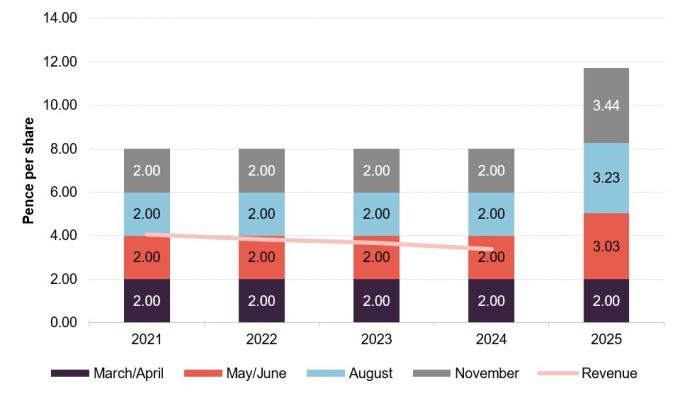
From 17 April 2025, BRAI began paying a quarterly dividend equal to 1.5% of its NAV, or about 6% per year. The chart’s x-axis shows past ex-dividend dates, and future payments are planned for April, July, October, and January.
Figure 8 highlights BRAI’s dividend history over five years, with the final column showing the impact of the higher dividend policy.
To support these higher dividends and potential share buybacks, BRAI had £105.7m in distributable reserves at the end of April 2025. Paying dividends above net revenue is not new for BRAI, as its dividends have not been covered by earnings since FY 2017. This approach allows BRAI to invest flexibly across the US market, aiming to maximise total returns without needing to focus on high-yielding stocks.
Figure 8: BRAI five-year dividend history for financial years ending in October
Source: BRAI, Marten & Co
Premium/(discount)
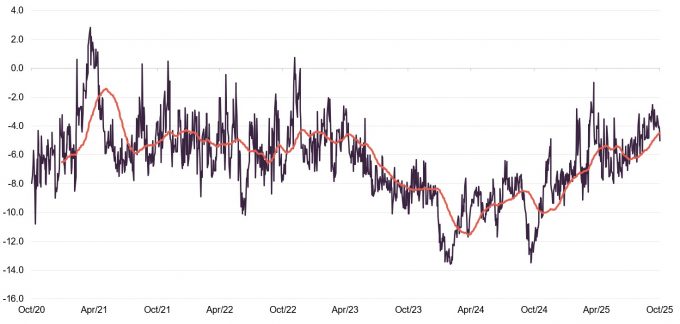
Over the 12 months to 31 October 2025, BRAI’s shares traded at a discount to NAV ranging from 11.9% to 1.0%, averaging 6.3%. As of 26 November 2025, the discount stood at 5.4%.
The discount increased during 2023 as markets were led by the Magnificent Seven and value stocks lagged. BRAI’s rating started to recover in October, helped by the expected tender offer, and is now at a more reasonable level. The board hopes investors will support the new strategy and help the trust grow again.
Conditional tender offers
If BRAI does not outperform its benchmark by at least 0.5% a year after fees over three-year periods (the first ending 30 April 2028), it will offer shareholders a 100% tender at a 2% discount to NAV after costs. This tender offer will also be made if the company’s net assets fall below £125m at the end of any of these periods.
Figure 9: BRAI’s premium/(discount) over the five years ended 31 October 2025
Source: Bloomberg, Marten & Co
Structure
Capital structure
BRAI has 95,361,305 ordinary shares, with 38,949,167 held in treasury, leaving 56,412,138 shares with voting rights. Its financial year ends on 31 October, with AGMs usually in March. The board plans to announce the next annual accounts in January 2026. Shareholders approved the company’s continuation at this year’s AGM, with the next vote set for 2028 and every three years after that.
Fees and costs
From 17 April 2025, BRAI’s management fee is tiered: 0.35% on the first £350m of NAV and 0.30% on any amount above that. There is no performance fee.
The ongoing charges ratio for the year ended 31 October 2024 was 1.06%, based on the previous 0.70% management fee. With the reduced fee, this ratio should be significantly lower in this and future years. The board has estimated that over a full 12-month period under the new fee, the ongoing charges ratio is expected to decrease to around 0.70%–0.80%.
The managers
BRAI’s alternative investment fund manager is BlackRock Fund Managers Limited, while BlackRock Investment Management (UK) Limited serves as its investment manager and company secretary. The lead managers for BRAI are Travis Cooke and Muzo Kayacan.
Travis Cooke
Travis leads the US portfolio management group in BlackRock’s systematic active equity team, overseeing US long-only, partial long-short, and long-short equity strategies. He joined Barclays Global Investors in 1999, which merged with BlackRock in 2009, and was previously a portfolio manager for developed market strategies in the alpha strategies group. Travis holds a BA in Business Economics from the University of California, Santa Barbara (1998), an MSc in Finance from London Business School (2008), and has been a CFA charterholder since 2001.
Muzo Kayacan
Muzo is a portfolio manager and head of EMEA product strategy in the SAE division. He manages US, global, and European funds, and leads the EMEA product strategy team, which connects investment teams and clients.
Before joining BlackRock in 2010, Muzo was a senior associate portfolio manager at AllianceBernstein, where he implemented investment decisions for global equity portfolios and managed currency hedging strategies. From 2005 to 2007, he completed a graduate training scheme at M&G and then worked in product development. Earlier, he was a futures trader.
The board
BRAI has four non-executive directors, all independent of the manager. Alice Ryder stepped down as chair and director after the last AGM, with David Barron taking over as chair. Gaynor Coley is the newest director and now chairs the audit committee, replacing David Barron.
Figure 10: Directors’ length of service, fees, and shareholding
| Role | Appointed | Length of service (years) | Fees (£) | Shareholding | |
|---|---|---|---|---|---|
| David Barron | Chairman | 22/03/2022 | 3.7 | 45,000 | 11,677 |
| Gaynor Coley | Chair of the audit committee | 25/06/2025 | 0.4 | 39,000 | 10,000 |
| Solomon Soquar | Senior independent director | 21/03/2023 | 2.7 | 32,500 | 10,000 |
| Melanie Roberts | Director | 01/10/2019 | 6.2 | 32,500 | 10,000 |
Source: Marten & Co
David Barron
David has 25 years’ experience in investment management. He was chief executive of Miton Group Plc until November 2019, after six years with the company. Before that, he spent over 10 years as head of investment trusts at JPMorgan Asset Management, joining Robert Fleming in 1995. He is now chairman of Baillie Gifford European Growth Trust Plc and, until its planned merger, a non-executive director of Fidelity Japan Trust Plc.
Gaynor Coley
Gaynor Coley is a chartered accountant with over 30 years’ experience in private and public sector finance, focusing on governance, compliance, and risk management. She is a non-executive director and audit committee chair at Foresight Enterprise VCT Plc and Lowland Investment Co Plc, and also chairs the grants committee and serves as a trustee for the Duchy Health Charity.
Solomon Soquar
Solomon Soquar has over 30 years’ experience in investment banking, capital markets and wealth management. He has held senior roles at major firms such as Goldman Sachs, Bankers Trust, Merrill Lynch, Citi and Barclays, most recently serving as CEO of Barclays Investments Solutions Limited. In recent years, he has taken on a range of roles, including non-executive director at Ruffer Investment Company Limited, chair of the Africa Research Excellence Fund, and business fellow at Oxford University’s Smith School of Economics and Enterprise.
Melanie Roberts
Melanie Roberts is a partner at Sarasin & Partners LLP with 29 years of investment experience. She joined the firm in 2011 and became head of charities in January 2023, focusing on strategy, stewardship, and client service for charity portfolios. Before this, she spent 16 years at Newton Investment Management managing charity, private client, and pension fund portfolios.
IMPORTANT INFORMATION
Marten & Co (which is authorised and regulated by the Financial Conduct Authority) was paid to produce this note on BlackRock American Income Trust Plc.
This note is for information purposes only and is not intended to encourage the reader to deal in the security or securities mentioned within it. Marten & Co is not authorised to give advice to retail clients. The research does not have regard to the specific investment objectives financial situation and needs of any specific person who may receive it.

Leave a Reply