JEPQ and QQQI offer hefty yield and broad technology sector exposure.
DIVO and SPYI also provide good yield, but they also feature multi-sector diversification.
Exchange traded funds (ETFs) can benefit investors in multiple ways. They can immediately diversify your portfolio by providing exposure to a wide variety of stocks. Plus, some ETFs offer fabulous dividend yields and pay monthly distributions so you can grow your wealth quickly.
The passive income ETF revolution is here and it’s unstoppable. Are you ready to board the high-yield train with four fantastic funds that pay cash every month? To make it all easier to digest, I’ll divide the ETFs into two categories and you can try some or even all of them.
Two Tech-Focused Funds
Today’s topic is diversified ETFs that send you a check (in the form of a cash distribution to your investment account) every month. These ETFs are convenient because the fund managers do all of the stock picking for you.
Large-cap technology stocks tend to perform well over the long run. Therefore, I would like to feature two ETFs that provide big monthly cash payouts but also concentrate on tech stocks.
JEPQ
$52.75
▲ $24.18(45.84%)5Y
Don’t get the wrong idea, as these funds are focused but are also diversified. For example, the JPMorgan Nasdaq Equity Premium Income ETF (NASDAQ:JEPQ) is centered around the NASDAQ 100 index and comprises 108 stocks.
JEPQ’s holdings include many large-cap technology names that you’ll surely recognize. You’ll find tech leaders like Amazon (NASDAQ:AMZN), NVIDIA (NASDAQ:NVDA), Broadcom (NASDAQ:AVGO), Microsoft (NASDAQ:MSFT), Apple (NASDAQ:AAPL), and Meta Platforms (NASDAQ:META).
Like the other ETFs discussed here, the JPMorgan Nasdaq Equity Premium Income ETF uses option trading strategies to juice more yield for the shareholders. Don’t worry if you’re not familiar with complex options strategies, as you can let the fund managers handle that.
You’ll have to pay expenses totaling 0.35% per year, which will automatically be deducted from the share price. On the other hand, the JPMorgan Nasdaq Equity Premium Income ETF features a rolling 12-month dividend yield (which is similar to an annual dividend yield) of 11.36%. So, the annual expenses aren’t too band when you consider JEPQ’s diversification and high yield, which is distributed on a monthly basis.
QQQI
$51.06
▲ $12.27(24.03%)5Y
A similarly tech-centered fund that pays you every month is the NEOS NASDAQ-100 High Income ETF (NASDAQ:QQQI). This ETF includes approximately 100 stocks in its holdings, and it revolves around the NASDAQ 100 index, much like the JEPQ ETF does.
The percentage weightings toward Microsoft stock, Apple stock, and other tech leaders vary slightly between JEPQ and QQQI. The main differences, really, are the yield and the expenses/fees.
The NEOS NASDAQ-100 High Income ETF involves an expense ratio (i.e., annual fees) totaling 0.68% of the share price. However, the QQQI ETF’s current annual distribution rate is an eye-catching 15.35%, so the monthly payouts can be substantial with this fund.
Two Multi-Sector ETFs
JEPQ and QQQI are great for investors seeking tech sector exposure and monthly paychecks. However, to de-risk your portfolio, it’s a good idea to add some ETFs that pay monthly dividends but also diversify beyond the technology sector.
DIVO
$41.43
▲ $34.93(84.31%)5Y
To that end, I’ve got three terrific monthly payers that include some technology stocks but also involve a variety of non-tech-focused names. The first of these three picks is a passive income powerhouse called the Amplify CWP Enhanced Dividend Income ETF (NYSEARCA:DIVO).
You’ll find technology giant Microsoft stock in the DIVO ETF’s holdings. Yet, the fund has 34 diversified holdings in total, including the stocks of non-technology firms like McDonald’s (NYSE:MCD), Goldman Sachs (NYSE:GS), Procter & Gamble (NYSE:PG), and Chevron (NYSE:CVX).
DIVO’s annual expense ratio is 0.56%, and the fund’s distribution rate is 4.81% per year, which is broken down into monthly cash payments. The annual yield might not be huge, but there’s a safety factor here as the Amplify CWP Enhanced Dividend Income ETF provides exposure to reliable, “steady Eddie” businesses like Visa (NYSE:V), JPMorgan Chase (NYSE:JPM), and Caterpillar (NYSE:CAT).
SPYI
$49.61
▲ $20.29(40.90%)5Y
Finally, we can really ramp up the diversification factor with the NEOS S&P 500 High Income ETF (BATS:SPYI). This fund invests in stocks that you’ll find in the S&P 500 index, and its holdings include around 500 stocks from many different market sectors.
This means SPYI comprises tech names like Microsoft and NVIDIA, but also a slew of stocks from various fields. Some examples include Coca-Cola (NYSE:KO), McDonald’s, Bank of America (NYSE:BAC), Exxon Mobil (NYSE:XOM), and Home Depot (NYSE:HD).
The NEOS S&P 500 High Income ETF deducts an annual expense ratio of 0.68% but provides a head-turning distribution rate of 12.5% per year. The distributions are paid out each and every month, so the SPYI ETF is an enticing portfolio diversifier that can be mixed and matched with JEPQ, QQQI, and/or DIVO.
How much should a 40-year-old put in a SIPP to earn a monthly passive income of £1,000?
A SIPP can be a great way to build up a nest egg for a more comfortable retirement. But what can be achieved if not starting until 40?
Posted by
Zaven Boyrazian, MSc
When investing, your capital is at risk. The value of your investments can go down as well as up and you may get back less than you put in.
For many, turning 40 raises the alarm of suddenly needing to prepare for retirement using a Self-Invested Personal Pension (SIPP) or other pension-building vehicles. While there’s still plenty of time to put money aside, the prospect of being almost halfway through a career can cause a lot of concern. Even more so considering, on average, 40-year-olds only have around £39,500 saved up for retirement, according to the Office for National Statistics.
When combined with the State Pension, passively earning an extra £1,000 each month can go a long way. So with that in mind, how much money does an investor need to put into their SIPP to achieve this?
Retirement income requirements A grand a month equates to £12,000 a year. And when following the 4% withdrawal rule, investors will need to have a SIPP portfolio worth around £300,000. The good news is, thanks to the tax relief benefits of a SIPP, reaching this goal may not be as impossible as it might seem.
An investor who sits in the Basic income tax bracket can enjoy up to 20% tax relief on all deposits into a SIPP. As such, for every £1,000 that’s added gets a nice £250 top-up from the government. And someone with the previously-mentioned £39,500 in average retirement savings can steadily move this money into a SIPP, resulting in £49,375 of investable capital – 16% of the way to reaching the £300,000 goal.
From here, 40-year-olds don’t actually have to contribute any more money if they’re aiming to retire at 63. That’s because after 23 years of compounding at the 8% stock market average rate, a £49,375 initial SIPP will have grown into just over £300,000.
Please note that tax treatment depends on the individual circumstances of each client and may be subject to change in future. The content in this article is provided for information purposes only. It is not intended to be, neither does it constitute, any form of tax advice. Readers are responsible for carrying out their own due diligence and for obtaining professional advice before making any investment decisions.
Taking a step back Even when starting from scratch, for those who can become disciplined savers, it’s possible to secure a decent retirement even with relatively small sums of capital. Sadly, there’s no guarantee that the stock market will deliver an 8% average return. Looking at the FTSE 100, gains over the last 15 years have notably lagged its historical average. And should that pattern continue, investors may end up with a smaller retirement income than expected.
Could you make a plan that could return you more than the 12k mentioned above ?
With £49,375 of investable capital, to KISS let’s say 50k.
Dividends from a portfolio of 50k compounded at 7% for 25 years would provide income of around 18k pa, without taking the gamble withTR.
If you’re looking for ETFs that pay high monthly dividends, here are some popular options across different categories (equity, fixed income, and alternative income strategies):
1. Equity ETFs (Stocks)
These ETFs invest in dividend-paying stocks, often focusing on high-yield sectors like REITs, utilities, or covered call strategies.
JEPI (JPMorgan Equity Premium Income ETF)
Yield: ~7-9%
Strategy: Uses covered calls on S&P 500 stocks to generate income.
Pays: Monthly
DIVO (Amplify CWP Enhanced Dividend Income ETF)
Yield: ~5-6%
Strategy: Active management with dividend growth stocks + covered calls.
Pays: Monthly
SPYD (SPDR Portfolio S&P 500 High Dividend ETF)
Yield: ~4-5%
Strategy: Tracks high-dividend S&P 500 stocks.
Pays: Monthly
SRET (Global X SuperDividend REIT ETF)
Yield: ~8-10%
Strategy: Focuses on high-yield global REITs.
Pays: Monthly
2. Fixed Income ETFs (Bonds)
These ETFs invest in bonds, preferred stocks, or other debt instruments for steady income.
PFF (iShares Preferred & Income Securities ETF)
Yield: ~6-7%
Strategy: Invests in investment-grade preferred stocks.
Pays: Monthly
HYG (iShares iBoxx $ High Yield Corporate Bond ETF)
Yield: ~5-6%
Strategy: High-yield corporate bonds.
Pays: Monthly
BKLN (Invesco Senior Loan ETF)
Yield: ~7-8%
Strategy: Floating-rate bank loans (less interest rate risk).
Pays: Monthly
3. Alternative Income ETFs (Covered Calls, MLPs, etc.)
These use options strategies or invest in high-yield alternative assets.
QYLD (Global X NASDAQ 100 Covered Call ETF)
Yield: ~10-12%
Strategy: Covered calls on the NASDAQ 100 (high income but limited upside).
Pays: Monthly
XYLD (Global X S&P 500 Covered Call ETF)
Yield: ~9-11%
Strategy: Covered calls on the S&P 500.
Pays: Monthly
AMLP (Alerian MLP ETF)
Yield: ~7-9%
Strategy: Focuses on energy MLPs (tax implications apply).
Pays: Monthly
Key Considerations:
Dividend sustainability: Some high-yield ETFs (like QYLD, SRET) may have lower growth potential or principal erosion over time.
Tax implications: REITs and MLPs generate non-qualified dividends (taxed as ordinary income).
Covered call ETFs (JEPI, QYLD, XYLD): Provide high income but may lag in strong bull markets.
3 “Secret” Funds That Could Let You Retire Earlier Than You Think
Michael Foster, Investment Strategist Updated: June 19, 2025
Few things ease financial worry like knowing you can walk away from work anytime you want.
Closed-end funds (CEFs) give us just that kind of security—and we talk about that a lot in my weekly articles and in my CEF Insider service. With yields of 8%, 9% and more, CEFs generate huge payouts that could let you retire earlier than you think.
It’s such a powerful—and overlooked—way to invest that it’s worth revisiting again today. We’ll color our discussion by looking at how some typical American retirees could retire with CEFs.
And we’re going to work in some real-life numbers, too.
I can’t stress enough that we’re not doing anything exotic to grab these yields: One of these three CEFs invests in S&P 500 stocks. The others are almost as familiar, holding corporate bonds and publicly traded real estate investment trusts (REITs).
More on these funds in a moment. First, let’s look at some real figures to see how much income investors could potentially book from CEFs.
Retirees Are Doing Better Than You Think (and Could Do Better Still)
The numbers say something startling: The average retiree is doing well, with the 65-to-74-year-old cohort sporting an average net worth of $1.79 million in 2022, with some of that being in their primary residence. Since that was a lousy year for markets, that net worth is probably higher now.
Of course, not everyone is doing well. Because many haven’t been able to save as much as the top tier, the median retiree has a net worth of about $409,900. This means they need to rely on Social Security.
However, even a less-wealthy retiree could have a comfortable retirement with the three funds I’m about to show you—and we’ll get to those in just a moment.
But first, let’s talk about our average retiree, with that $1.79-million net worth.
They probably have at least some of their wealth in S&P 500 index funds, which yield around 1.3%. That translates into $2,000 in monthly income if they had the full $1.79 million available to invest (an assumption we’ll make as we move through this article).
They could get much more through the three funds we’ll discuss next—all of which will be familiar to CEF Insider readers.
“Financial Freedom” Buy No. 1: Adams Diversified Equity Fund (ADX)
The Adams Diversified Equity Fund (ADX) yields 8.8% and holds well-known stocks like Apple (AAPL), Microsoft (MSFT) and Visa (V). It’s also one of the world’s oldest funds, having launched in 1929, days before that year’s market crash.
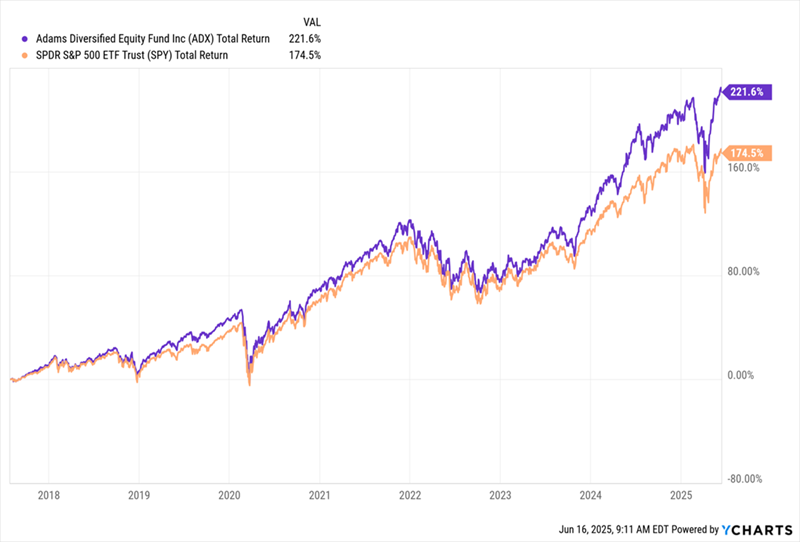
Moreover, ADX has a history of strong returns: It has crushed the S&P 500 for decades, including our holding period at CEF Insider, which began nearly eight years ago, on July 28, 2017.
ADX Demolishes the Index, Returns 222% for CEF Insider
Despite that outperformance, ADX has a 7.5% discount to NAV that has been closing since the middle of 2024 but still remains quite wide. One other thing to bear in mind: ADX commits to paying 8% of NAV out per year as dividends, paid quarterly, so the payout does float as its portfolio value fluctuates.
“Financial Freedom” Buy No. 2: Nuveen Core Plus Impact Fund (NPCT)
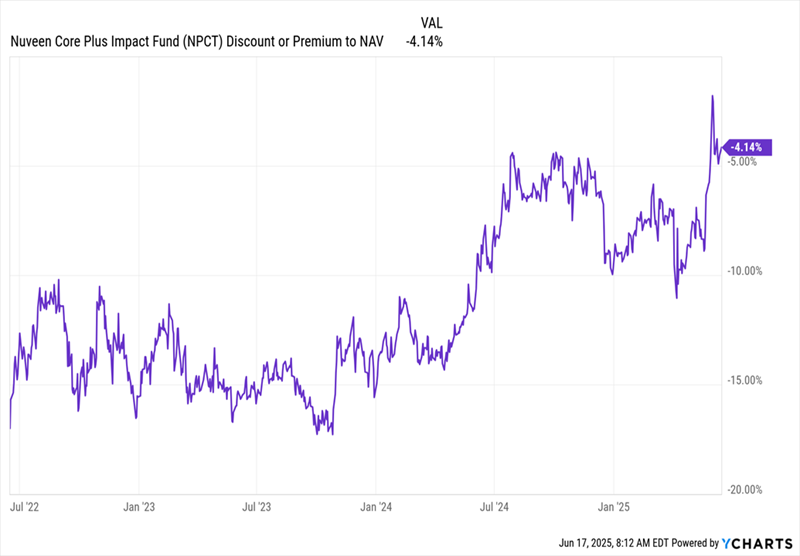
Next is the Nuveen Core Plus Impact Fund (NPCT), a 12.2%-yielding corporate-bond fund. Its discount has been shrinking in the last few years, from over 15% to around 4.1% today.
NPCT Gets Attention
Again, the portfolio shows why: NPCT’s managers have picked up bonds from low-risk issuers, including utilities like Brooklyn Union Gas and financial institutions like Standard Chartered and PNC Financial Services Group.
More importantly, they’ve taken advantage of higher interest rates to lock in high-yielding bonds with long durations, with an average leverage-adjusted duration of 8.4 years. (This measure takes the effect of the fund’s borrowing into account, making it a more accurate description of rate sensitivity.)
That stands to pay off when rates decline, cutting yields on newly issued bonds and boosting the value of already-issued, higher-yielding bonds like the ones NPCT owns.
“Financial Freedom” Buy No. 3: Nuveen Real Asset Income and Growth Fund (JRI)
Let’s wrap with the 12.3%-yielding Nuveen Real Asset Income and Growth Fund (JRI). Its portfolio features powerhouse REITs like shopping-mall landlord Simon Property Group (SPG) and Omega Healthcare Investors (OHI), which profits from the aging population by financing assisted-living and skilled-nursing facilities.
The fund has seen its discount shrink to 3.1% from the 15% level it was at in mid-2023, even after the pandemic hit REITs hard, and that discount continues to have upward momentum.
An 11%-Paying “Mini-Portfolio” That Pays the Bills (and Then Some)
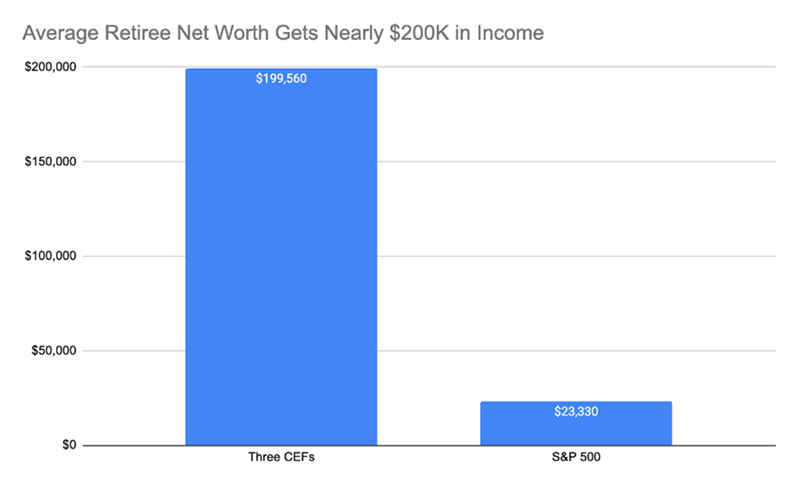
Put those three CEFs together and you have a “mini-portfolio” yielding 11.1% on average. Here’s how that income stream looks with $1.79 million invested.
Source: CEF Insider
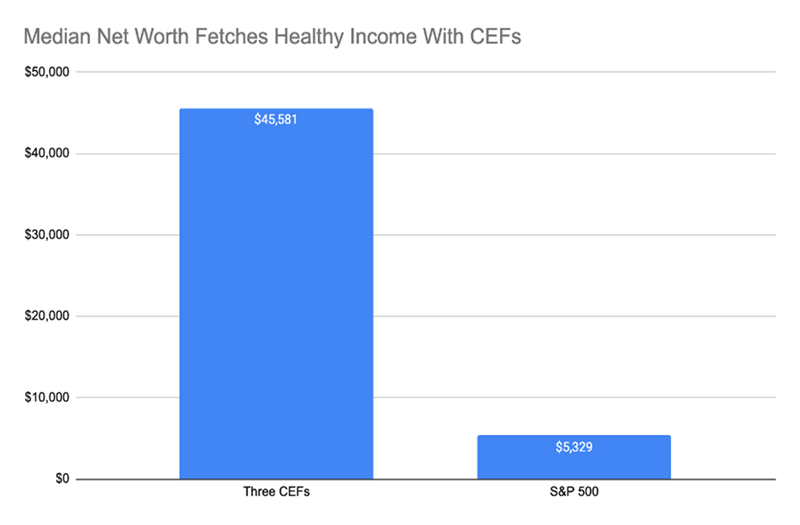
As you can see, with these CEFs, the average retiree’s net worth could fetch around $200,000 in annual income, or $16,630 per month. What about the median, though? Well, their $409,900 would bring in a nice income stream, too.
Source: CEF Insider
Now we’ve got $3,798 per month, a smidge higher than the median income for US workers (which is $3,518 per month, again per the Federal Reserve). Add the median $2,000 per month in Social Security benefits, and that turns into nearly $6,000 a month.
The beautiful thing about CEFs is they’re open to everybody—not just the rich (though these incredible income funds are certainly favorites of the billionaire set).
CEFs aren’t just for retirees, either. Got a job you love? That’s fine—keep at it and use your CEF dividends to reno your home, take more time off or help out the kids. It’s all up to you.
8.5% dividend yield! Should investors consider buying this high-income FTSE stock today ? Story by Zaven Boyrazian, MSc
The Motley Fool FTSE stocks have had a great run in 2025. In fact, the FTSE All-Share index is on the verge of delivering double-digit returns since the year kicked off, and we’re only six months in. Of course, not every business has enjoyed an upward streak, like Greencoat UK Wind (LSE:UKW), which is actually down by almost 10% since January.
However, despite the lack of positive sentiment from investors, management’s maintained dividends with plans to start hiking them even further as we move into 2026. As a result, investors can now lock in a staggering 8.5% dividend yield – one of the highest on the market that’s set to grow even further.
The bull case Being an owner of a vast wind farm portfolio has its perks. With the government pushing for a Net Zero energy grid by 2030, demand for wind power, along with other renewables, is on the rise. Higher interest rates have certainly been testing. But, management’s proactive approach to addressing balance sheet leverage has enabled dividends to keep flowing to investors even with falling energy prices.
Across its 49 wind farms, the company is now generating close to 2% of the UK’s total energy demand. And with further investments planned, its current generating capacity appears set to expand as the firm targets £1bn in net cash generation between 2025 and 2030.
In terms of dividends, that means shareholder payouts will rise from 10p in 2025 to 12.3p by the end of the decade. And that’s under the assumption that its average wholesale price of electricity stays between £66 and £57 per megawatt-hour (MWh) over the next five years. That’s a modest assumption compared to the current rate of £81.45/MWh as per June forward contracts.
In other words, providing that energy prices don’t collapse below management’s conservative forecast, this FTSE dividend seems to be sustainable.
The bear case Even if energy prices fall in line with expectations, there are plenty of other challenges Greencoat has to tackle. Most notable is the threat of interest rates. While they’re slowly falling, a reversal of this trajectory would add severe pressure to the group’s financial health, especially if energy prices don’t rise alongside it.
At the same time, the company’s at the mercy of the weather. Lower wind speeds have already caused the group’s energy generation performance to come in 11% under budget in both 2023 and 2024. And if this pattern continues, that means less free cash flow generation to service debts and pay out dividends.
But let’s assume everything does go to plan. Wind speeds pick up, energy prices rise, and interest rates get cut. Even in this scenario, the group’s still subject to limited growth potential as a result of the previously mentioned Electricity Generators Levy.
The bottom line With the bear case in mind, it’s easy to understand why Greencoat’s lost much of its appeal compared to a few years ago. Yet, despite these challenges and limitations, I remain bullish overall.
The FTSE stock’s trading 21% below its net asset value – a discount that even management’s begun capitalising on with share buyback schemes. Pairing that with a juicy 8.5% dividend yield that looks primed to grow even higher over the next five years, makes this an income stock worth considering, in my mind.