Times are tough but investing a tiny sum such as £3 a day towards building a second income for retirement is well worth the effort.
Everybody needs a bit of cash in an easy access account for emergencies. But for longer-term retirement savings, I believe my money will work a lot harder in stocks and shares.
Stocks beat shares over time
Over the last 20 years, the FTSE 100 has delivered an annual average return of 6.89% a year. That beats even the very best cash savings accounts. It also gives me a better chance of protecting the value of my money against inflation.
Over the long run, history shows that equities beat almost every other type of investment. Better still, by purchasing them inside the £20,000 annual Stocks & Shares ISA allowance, I can take all of my capital growth and dividend income free of tax.
Please note that tax treatment depends on the individual circumstances of each client and may be subject to change in future. The content in this article is provided for information purposes only. It is not intended to be, neither does it constitute, any form of tax advice. Readers are responsible for carrying out their own due diligence and for obtaining professional advice before making any investment decisions.
If I invested £3 a day from age 25 and it grew at 6.89% a year, I’d have an impressive £453,989 by age 65. That’s not a bad return from £3 a day. This assumes I increase my contribution by 5% each year, to keep pace with prices.
If I was 45, my £3 a day would have much less time to compound. It would be worth just £70,499 by 65. That is better than nothing but it shows the cost of putting off investing. If I had no savings at 45, I’d be looking to invest much more than £3 a day. If I put away £10 a day instead, I’d have £234,831 by age 65.
These figures are not guaranteed. Stock markets are volatile, and nobody knows how well they will perform in future.
I like high-yield shares
Either way, I would reinvest all my dividends back into my portfolio while I was working, then draw them as income after retirement
So how much of a second income can a portfolio of shares generate? Let’s say, to keep things simple, that I had £100,000. Placed in FTSE shares that yielded on average 7% a year, I’d have a second income of £7,000.
Next year, the FTSE 100 Index is forecast to yield 4.4%. That would generate income of £4,400 if I placed my £100k into a tracker fund.
Crucially, in both cases I’d still have my capital intact. Its value will rise and fall in line with the stock market. However, history shows that in the long run it should rise and, with luck, so should my second income.
I’ve bought for the blog portfolio 11038 shares in FSFL for 10k.
Declaration of Dividend
Foresight Solar is pleased to announce the first interim dividend, for the period 1 January 2024 to 31 March 2024, of 2.00 pence per ordinary share. The shares will go ex-dividend on 25 July 2024 and the payment will be made on 23 August 2024 to shareholders on the register as at the close of business on 26 July 2024.
The Board confirms its annual dividend target of 8.00 pence per ordinary share for the 2024 financial year.
This is a non-independent marketing communication commissioned by BlackRock. The report has not been prepared in accordance with legal requirements designed to promote the independence of investment research and is not subject to any prohibition on the dealing ahead of the dissemination of investment research.
Overview BRSA’s portfolio trades at a significant P/E discount to the US market and is defensively positioned…
Overview BlackRock Sustainable American Income (BRSA) is a value-focused portfolio of largely US-listed stocks, with an explicit ESG mandate. BRSA also makes full use of its ability to invest in non-US stocks when comparable valuations make for an attractive alternative, with for example Shell currently a top-ten holding in the holding in the trust, both on valuation grounds and on ESG grounds, which is explored in the ESG section.
The team’s focus on value sets the trust apart from many of its peer group and the wider US funds’ universe. Over the last five years BRSA has performed in line with its reference index, the Russell 1000 Value Index, but value investing has lagged the wider market and BRSA has lagged the Morningstar North American investment trust peer group, which is on average more growth-orientated than BRSA. This has led to a very wide gap in valuation between BRSA’s portfolio, on an average P/E of c. 12x and the S&P 500 Index on c. 19x. The very narrow range of stocks that drove the S&P 500 Index’s performance in 2023 has exacerbated this gap, and the team have identified a number of sectors on historically low valuations, notably healthcare.
BRSA currently yields 4.3%. Since 2018, BRSA has paid a dividend totalling 8.0p each year, and for the current financial year ending 31/10/2024 the board has guided investors to expect the same. Dividends are paid from a mixture of revenue and distributable reserves.
BRSA currently trades on a c. 12% discount. Having historically traded at a narrower-than-average discount for the peer group, it recently widened towards the peer group average and the board has increased the rate of share buy-backs in response. With the team currently taking a defensive stance within the portfolio, the trust is currently ungeared awaiting an opportune period to re-apply leverage to the portfolio.
Analyst’s View Many investors were caught on the wrong side of the ‘magnificent seven’ trade in 2023, which saw a very narrow group of large-cap technology-focused stocks in the US drive the overall market’s performance to an unusual extent. It’s writ large that BRSA’s value-based approach means that it was never likely to own these stocks, and as the team point out, the overall valuation on the US market is now at what they consider to be quite a stretched level, even as many stocks continue to trade at attractive valuations, with BRSA’s portfolio’s average P/E at 12x compared to the S&P 500 Index’s 19x. BRSA’s value approach did identify some winners last year, with Cognizant Technology Solutions and Cardinal Health. Cognizant, an IT services company, trades at a large discount to its closest peers. Cardinal Health, a healthcare services and products company that specialises in the distribution of pharmaceuticals and medical supplies, has seen some recent management changes that the team view as a positive to further drive value.
Investors wondering whether the US equity market cares about dividends could do worse than examine the positive share-price reaction of Meta upon its recent announcement that it would commence paying a dividend. Meta isn’t in BRSA’s portfolio on valuation grounds, but we think it is perhaps an interesting juncture for the US market. BRSA’s own portfolio has a yield of 2.5% and an historical dividend growth rate of c. 9%, higher than the S&P 500 Index’s yield of 1.7% and growth of c. 5%. Long-term, valuation and dividend growth can really matter for equity returns, and while the abovementioned Meta’s dividend yield is fractional in comparison to its market cap, perhaps this marks an interesting moment for US investors to re-appraise the value of a dividend policy? We think BRSA could perform well in such a scenario.
Bull Portfolio at a significant P/E discount to US equities Consistent record of dividend paying Shares currently trading on wider-than-average discount
Bear The value style has remained out of favour in 2023 Dividend has not grown since 2018 Some investors may prefer 100% North American exposure
The highest the yield has been was 2%, currently 0.77%, so not for an de-accumulation portfolio. U could of course now take out all the profit an invest in a higher yielder and hope history repeats. Stick to your plan until it sticks to u.
A really great stockmarket, the best, some tell me the best they’ve ever seen
US equities should be the bedrock of any diversified portfolio…
Alan Ray
Updated 03 Jul 2024
Kepler
Disclaimer
This is not substantive investment research or a research recommendation, as it does not constitute substantive research or analysis. This material should be considered as general market commentary.
We’ll let you into a secret. It’s a pretty safe bet, even without the advantage of privileged information, that by the fall, we will all have read, or at least will have been invited to read, some comments about what the US election means for markets. It’s a rather enjoyable internet rabbit hole, if one has a few minutes to spare, to search for something like ‘how does the S&P 500 Index perform under different presidents’ and we expect there will be at least one cut-and-paste of this topic sent to our inboxes before November. On the Thursday before the first presidential debate, we drafted something to the effect that we are in the relatively unusual position of both the main candidates having already served a term and both having seen the S&P 500 Index rise under their tenure, although obviously we accept that the incumbent has a few months to go. By the Friday after the debate, it seems possible that a third scenario, or candidate, could emerge, and all we can say to anyone thinking of writing the abovementioned article then is ‘good luck with all that’.
We Brits probably need a break from politics right now, so let’s park that thought and just for fun make some polarising statements about investment instead. The trouble with US equities, for a UK investor, is that there is a very limited ‘equity income’ opportunity, and as we know equity income is a big priority for many investors. Dividend yields are much lower in the US, and companies prefer to either invest excess cash, or return it via share buy-backs. Thus, while UK investors are probably well aware that the US equity market generally provides a better engine for capital growth, they favour the home team, as it pays a regular dividend.
On the other hand, the trouble with UK equities is that by far the largest group of funds that invest in it are equity income funds, that keep a tight leash on the companies they own, rewarding them for paying out profits as dividends and punishing them if they dare to drop the dividend, even if it’s for good long-term investment reasons.
In writing these two paragraphs, the writer is deliberately setting out two opposing views in simple terms, because the longer, more nuanced version might take a while, and in this era of instant reactions, no one has time for that, right? Suffice to say that a) there are plenty of exceptions to both sides of this argument and b) no one should feel any guilt about investing in companies that pay dividends. Some businesses really are better as dividend machines and investors should be very happy to own them. That said, readers of the financial press will have found it virtually impossible to avoid the existential angst playing out in the press around the London Stock Exchange’s inability to attract or retain high growth companies. It would be wrong to say that ‘equity income culture’ has not been discussed as one factor, but it seems to be playing a much smaller role in the discussion than various other ‘solutions’ such as incentivising or compelling investors to invest in the UK. If the answer is ‘let’s force institutions to own UK equities, and that extra capital is bound to attract companies they actually want to own’ then we think the wrong question is being asked.
Stick with us, this is a piece about US, or North American, equities we promise. The reason for this preamble is that it is possible that investment trust investors, many of whom are underweight US equities, are in that position not because they don’t follow the above argument, and they have seen versions of the chart below before, but because they want and need dividends. The evidence of this has played out across the investment trust sector over many years, with huge amounts of money raised for income strategies, and many investment trusts with little or no underlying income opting to pay dividends from capital profits. In recent days we have seen two further trusts, Schroder Japan Growth Trust (SJG) and Invesco Global Equity Income (IGET), both announce they will be making a contribution or a larger contribution to their dividends from capital. There is though, another pretty simple way an investor can derive an income from owning an investment trust. One can just sell a few shares at the appropriate interval. We of course know that’s a massive behavioural shift for many investors, but is it so different from accepting dividends from capital profits, which is the path that so many investment trusts have gone down over the last decade? It would allow investors to draw their income while enjoying the return potential which has seen the US soar away from the UK indices in recent decades.
US AND UK EQUITIES OVER TWENTY YEARS
Source: Morningstar Past performance is not a reliable indicator of future results
In fact, there are some subtle differences between selling shares and receiving a capital dividend. One of the less-well discussed features of paying dividends from capital is that, should an investment trust trade at or above asset value, then the case for paying those dividends begins to weaken, as shareholders are better off if they sell their shares in the market for a higher price than if they receive capital at NAV through a dividend. On the other hand, when an investment trust is trading at a discount, paying a capital dividend is, from a mathematical point of view, the equivalent of the investor being able to sell some shares at net asset value rather than at the share price, which is a very good thing. Thinking of it like that can quickly help the reader see that when shares are at a premium, a capital dividend may not be the best way to receive a distribution. Of course, generally speaking the percentage differences are tiny and may not matter compared to the convenience, but still, geeks like us feel compelled to point it out. But investors thinking about selling shares versus a capital dividend shouldn’t really get too hung up on the differences if considering investment trusts on relatively small discounts or premiums.
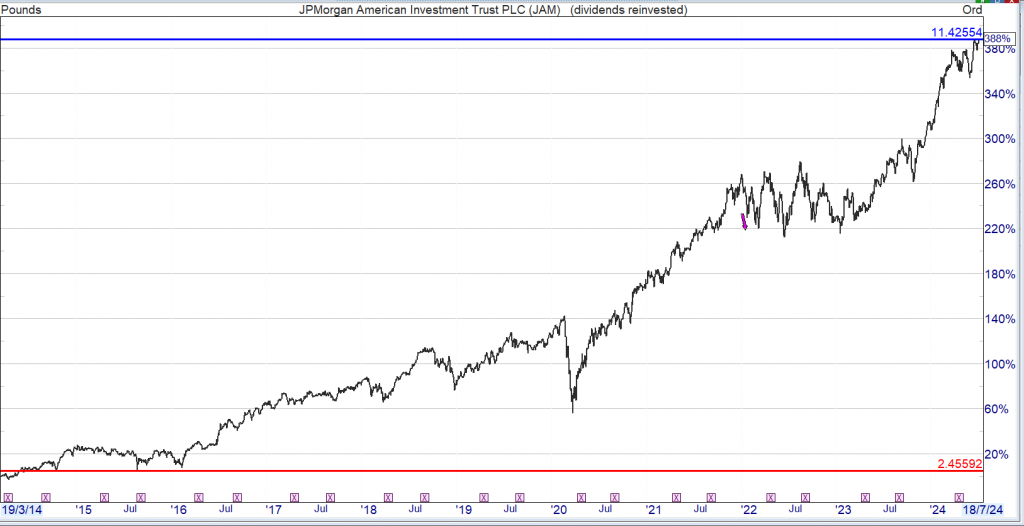
For geeks like us though, it’s good to know that the investment trust we consider to be the essential ‘core’ active holding for US equities, JPMorgan American (JAM), doesn’t pay dividends from capital as it invariably trades close to, or above asset value, being on a c. 2% discount at time of writing after a period earlier in 2024 of trading at a premium. JAM also provides the case study that seems to contradict our statement that investment trust investors are underweight the US, since it is a FTSE 250 Index investment trust with total assets of c. £1.9bn, with little or no discount. Then again, the UK equity income sector has total assets of over £12bn, which doesn’t really square with the US’s 70% weight in the MSCI World Index compared to the UK’s c. 4%. Hence our ‘underweight’ contention.
JAM has built an excellent track record of outperformance balanced with that ‘core’ holding status. It has achieved this by marrying two sets of fund managers with biases to value and growth stocks respectively, meeting on the common ground of ‘quality’ to create a 40 or so large-cap portfolio that tends to grow a little faster and trade a little cheaper than the market. What we like about this is that it gives the trust the flexibility to adapt to different phases of the market but emphasising one or the other style, without ever straying too far into deep value or blue-sky growth. The results have been excellent and the fact that JAM has recently returned to a premium rating, during a period when the investment trust sector is experiencing persistent discounts across many areas, says that we aren’t the only ones to have noticed this. A very good track record of buying shares in when JAM strays to even a small discount should give investors confidence that this trust’s board understands that to maintain its reputation as an essential holding in any portfolio requires that the share price reliably tracks the net asset value. Finally, to provide the full ‘core’ equity experience, JAM allocates a small portion of the portfolio, less than 10% and currently c. 7%, to small caps, which is managed in a similar way with a growth and a value manager working together to build a blended portfolio. Thus in the scenario outlined below, JAM still has the potential to outperform.
While large-cap US equities, notably technology and the ‘Mag 7s’, have put US equities firmly in the spotlight over the last year or two, smaller-cap equities have lagged and the managers of both investment trust specialists in this area, Brown Advisory US Smaller Companies (BASC) and JPMorgan US Smaller Companies (JUSC) continue to highlight the valuation disparity between small- and large-cap equities. We’ve seen the same phenomenon in the UK and the rest of Europe, and the disparity is partly explained by higher rates, which can be more challenging for smaller companies themselves but also tend to make equity investors more risk averse, but there’s also the reality that with passive investing playing such an important role in the US in particular, money flowing into equities will tend to hit the large well-known ETFs first. But let’s not forget that a domestic-facing smaller company in the US is addressing a continental-sized market, slightly bigger in GDP terms than Europe, including the UK, and so very often these are large well-established businesses able to survive a downturn.
Neither of these trusts pays the kind of dividend that an income investor would be attracted to, but again, there is more than one way to take an income. While every small-cap recovery in history is a bit different, falling interest rates and inflation are linking themes. We would though say that interest rate cuts are sometimes driven by the need to stimulate an economy, which means rate cuts aren’t always immediately ‘good news’ and so the path to a small-cap recovery may be more complex than ‘rates go down, small caps go up’. But with the valuation gaps both managers identify being so large, we might expect to see a confirmatory wave of M&A in the US small-cap world presaging an improvement in valuation.
As ever, it’s important not to forget the US’s neighbour Canada, which provides a very different set of opportunities to the US equity market, and for investors unconvinced by our ‘just sell some shares regularly’ argument, has an equity income culture more akin to the UK than the US. Middlefield Canadian Income (MCT) yields c. 5% through a traditional income-based dividend policy and gives investors exposure to Canada’s REIT sector, the trust’s biggest position, alongside the country’s important energy and pipeline infrastructure sectors and Canada’s conservatively managed banking sector. Canada was the first G7 country to cut interest rates earlier this year, and with a c. 25% exposure to interest-rate sensitive REITs, MCT could benefit from a strong recovery in this sector, which like the UK equivalents trades at a very wide discount currently.
Finally, BlackRock Sustainable American Income (BRSA) does pay a yield that is at a level an equity income investor would be interested in. It does this using a mix of current revenue and capital reserves, and over recent years has held the dividend at a constant level, which at time of writing equates to a yield of 4%. BRSA has a long-standing value investment style which has been a performance headwind, but investors who worry about the high valuations that more growth-orientated stocks in the US market trade at might find this value style appealing.
There are, of course, many other ways to invest into the US through investment trusts, and so again we can chip away a little at our own claim that investors are ‘underweight’. The widely owned group of Global trusts will be familiar to all readers, and often the US is the largest single country exposure. We would highlight a couple of other specialist trusts that, notwithstanding global mandates, derive most of their returns from companies listed in the US. Allianz Technology Trust (ATT) provides specialist exposure to the technology sector, and generally has about 90% of the portfolio invested in the US, which is a measure of where much of the technology growth stocks in the world are listed rather than a comment on the manager’s particular preferences. Clearly a sector specialist such as this comes with potentially higher volatility and cyclicality risks than a generalist core trust such as JAM, highlighted above, but there is of course also the potential for higher returns given the nature of the sector ATT specialises in. In a similar vein, International Biotechnology (IBT) provides exposure to the adjacent healthcare and biotechnology space and again the c. 85% exposure to the US is an expression of the US’s importance in this area rather than a management bias. Highlighting these two specialists also helps to highlight that to be diversified across all the important sectors, is not so easy to do without placing the US at the centre of a portfolio. IBT also, income investors will be pleased to know, does pay dividends using capital profits, paying 4% of NAV in four quarterly instalments, which means at its current 11% discount the yield is c. 4.4%. We could obviously reel off a long list of other trusts that also predominantly invest in the US, but these two serve to highlight two of the largest sectors that help set the US apart from other markets.
Conclusion
Eagle-eyed readers may have spotted our choice of ‘fall’ rather than ‘autumn’ in the opening paragraph, and apart from the fact that we just quite like the sound of it, its origins, in old English, are a reminder of the ties that still bind us to the US, however shaky they might appear sometimes. ‘Invest in what you know and understand’ is very good advice and investors shouldn’t feel worried if their comfort zone is UK equity income; it’s a fine way to invest for the long term, and as we’ve discussed before, certainly beats inflation. There’s also no particular reason why an investor needs to care at all what the MSCI World Index, or any other index says about the relative importance of different markets. But given the extraordinary potential of the US’s continental economy to generate equity returns over the long term, discussed a little while ago here, we think it would be a shame if all that was holding investors back was a little thing like dividends.
No savings? I’d put £100 a month into this sleepy giant to generate passive income of £7,772 a year.
Story by James Beard
by The Motley Fool
I recently read that “passive income is the fuel that powers your dreams, giving you the freedom to pursue your passions and live your life on your own terms”. I have no idea who came up with this quote, but I hope they dream well and are in a position to spend their time doing something fulfilling.
Another investing concept that gets a good press is compounding. In the case of income stocks, this is the act of reinvesting dividends to buy more shares, generating an ever increasing level of return. This has been described as the eighth wonder of the world.
Just imagine how happy we could be by combining the two! Well, that’s what I try and do.
Now, I must be honest. I still have to work for a living and I’d love to have more freedom to do what I want. But I do have a steady stream of passive income that I’m reinvesting with a view to having a more comfortable retirement. Take two If I were to start my investing journey all over again, I’d put a relatively modest amount (say £100) into UK income stocks. If I then received dividend payouts of 5.9% a year — payable two-thirds/one-third in January and July, respectively — my hypothetical sum would grow to £67,248 after 25 years.
At this point, my shareholding would be generating income of £3,967 a year.
Readers may be wondering why I’ve chosen such specific numbers. Well, that’s because National Grid (LSE:NG.) presently offers a 5.9% yield and pays a dividend twice a year.
And it’s a share that has a long track record of increasing its payout.
My example assumes zero growth in its dividend. However, factoring in an increase of 3.6% a year — the company’s average annual increase over the past five years — would increase my investment pot to £131,731. This could give me an annual passive income of £7,772.
Remember, there could be some capital growth too.
Caution Of course, the stock price could fall. And dividends are never guaranteed. But this example highlights the potential long-term gains achievable from picking a steady and reliable income stock.
National Grid is able to pay a generous dividend because its earnings are reasonably secure. It operates in a regulated industry, which means as long as it keeps the lights on (literally), it will be able to achieve a pre-agreed level of return.
Because of this its share price performance tends to be unspectacular. This — along with the fact that it’s the UK’s 13th-largest listed company — is why I describe it as a sleepy giant. I think there’s always room for this type of stock in a well-balanced portfolio.
But there are a couple of things that could threaten its ability to maintain its healthy dividend.
Although it doesn’t face any competition it must meet its regulatory obligations. This requires huge capital expenditure.
It surprised shareholders in May by asking them for more money. Due to the company’s large borrowings, perhaps its directors felt they had no alternative other than to approach its owners for additional cash. I wonder if the terms offered by lenders were unfavourable.
However, despite these challenges, the next time I’m in a position to invest I’m going to seriously consider taking a stake.
The post No savings? I’d put £100 a month into this sleepy giant to generate passive income of £7,772 a year! appeared first on The Motley Fool UK.
£££££££££££££££
Take two If I were to start my investing journey all over again, I’d put a relatively modest amount (say £100) into UK income stocks. If I then received dividend payouts of 5.9% a year — payable two-thirds/one-third in January and July, respectively — my hypothetical sum would grow to £67,248 after 25 years.
Whilst u should receive a 5.9% buying yield, the running yield would fall if the price rose and any dividend growth never equalled the yield/price fall.
Amedeo Air Four Plus Ltd ex-dividend payment date Balanced Commercial Property Trust Ltd ex-dividend payment date BlackRock Latin American Investment Trust PLC ex-dividend payment date Custodian Property Income REIT PLC ex-dividend payment date Global Smaller Cos Trust PLC ex-dividend payment date Invesco Bond Income Plus Ltd ex-dividend payment date JPMorgan Asia Growth & Income PLC ex-dividend payment date JPMorgan Japan Small Cap Growth & Income PLC ex-dividend payment date Merchants Trust PLC ex-dividend payment date Real Estate Investors PLC ex-dividend payment date Schroder European Real Estate Invest Trust PLC ex-dividend payment date Schroder UK Mid Cap Fund PLC ex-dividend payment date Supermarket Income REIT PLC ex-dividend payment date
For the third week in a row, the number of investment trusts trading at 52-week high discounts stands at six, but there are a couple of new names that make it onto the list.
By Frank Buhagiar 08 Jul, 2024
Doceo
We estimate there to be six investment companies trading at 12-month high discounts over the course of the week ended Friday 05 July 2024 – no change from the previous week.
For the third week in a row the number of investment companies trading at 52-week high discounts to net assets stands at six. Still, that’s very much at the lower end of what’s been seen year to date.
Among the new names on the Discount Watch – Regional REIT (RGL), the shares of which hit a year-high discount of -80% to net assets. That’s pretty much in line with the -82% discount at which the 10p price set for the fully underwritten £110.5 million fund raise stands at compared to net assets. A case of the market getting into line with the fund raise.
abrdn Diversified Income and Growth (ADIG), another new entrant to the list. The fund is in the process of winding itself up and is due to return £115 million or 38p per share to shareholders via the issue of B shares. The shares went ex on 3 July, meaning those who bought the shares after then would not be eligible to receive the B shares. Share price subsequently shed 38p to 44p. The company also announced that its latest net asset value stood at 69p a share as at Friday 5 July. Once again, that’s 38p lower than the 107p NAV announced on 3 July. All eyes now turn to future returns of capital.
Quick word on Downing Strategic Micro-cap (DSM), which appears on the list for a second week in a row. Last time round, DSM’s year-high discount was reported as -69.40%. This was put down to the shares going ex a 17.5p special dividend on 27 June. Shares subsequently dropped to 8.5p. However, the net asset value of 27.78p that was reported on 27 June did not take into account the special dividend. Hence the -69.40% discount. Net asset value was adjusted the next day to 10.28p leaving the shares trading at a -17.5% discount. 2 July NAV however was reported at 11.65p and with the share price at 8p this equates to the -31.3% discount reported here. Last week’s -69.4% discount, an anomaly, one that was down to timing it seems.
The top-five discounters
Fund Discount Sector
Regional REIT RGL -80.03% Property
Ground Rents Income GRIO -70.60% Property
Ceiba Investments CBA -69.64% Property
abrdn Diversified Income & Growth ADIG -35.01% Flexible
Downing Strategic Microcap DSM -31.31% UK Smaller Companies
James Yardley, senior research analyst at the VT Chelsea Managed Monthly Income fund Provided by City AM
In this weekly series, investment reporter Elliot Gulliver-Needham sits down with a fund manager for a Q&A. This week, we’re hearing from James Yardley, senior research analyst at the VT Chelsea Managed Monthly Income fund.
Top holdings
How does your fund stand out from others in the same market?
Our investors love the fund’s consistent monthly income. The fund pays out exactly the same amount for 11 months of the year with a final remainder payout with any income left over. It’s a fund of funds which combines open-ended Funds, ETFs and investment trusts.
This allows us to get income from a very wide range of sources. Alongside traditional stocks and bonds, the fund also has exposure to infrastructure, renewable energy, supermarkets, GP surgeries and care homes to name a few.
Whilst peers were forced to cut their dividends during Covid, this fund did not. The monthly dividend payout has only ever increased since our launch seven years ago and we model our dividends years ahead.
We have added a huge amount of value from our investment trusts over the past seven years even as much of the sector has struggled. We are able to vary our weights between open-ended funds, ETFs and investment trusts depending on discounts, dividend yields and market sentiment.
Another big differentiator is the fund’s costs. A traditional criticism of fund of funds is they are prohibitively expensive. With this fund’s launch, we were determined to change this – it has a very low AMC, and any discounts or special share classes it obtains all go back into the fund. Its OCF is just 0.71 per cent.
Which of your holdings are you most excited about
We’re really excited about investment trusts.
A combination of technical reasons, higher interest rates, regulations and some individual stock blow-ups has meant the sector is very out of favour. This is providing some amazing opportunities.
Our favourite holding is currently Assura. This REIT, specialising in GP surgeries, gets almost all its rent from the NHS. This is a very boring but reliable strategy. Exactly what we like.
The fund’s earnings and dividends have increased year on year over the past decade. Despite this, the share price has been incredibly volatile, having declined by over 50 per cent while the yield has simultaneously risen to almost 8.5 per cent.
The trust has also locked in the majority of its debt at very low rates for the long term. We think this trust will do very well if rates ever start to come down and, in the meantime, we are happy to be patient and collect the dividends.
££££££££££££
Yields just over 5% so not suitable for the blog, maybe one to consider if u are in a de-accumulation stage along with SMIF yielding 8% for a monthly income stream at the safer end of the market.