This Is Money

Compound growth: A powerful argument for investing long term© Provided by This Is Money
Investing over many years eventually reaches a ‘tipping point’ where your returns double what you’ve put in to date, highlights new research from Interactive Investor.
Putting £250 per month into investments returning 5 per cent a year would see a gain of £83 on your £3,000 total contributions, or 3 per cent, in year one.
This means that your returns after that year would represent just a small percentage of the total pot.
But by year 10, the power of compounding would mean the portion delivered by investment growth would make up 30 per cent of the overall portfolio, and by year 20 it would be 72 per cent.
At year 26 it would hit 105 per cent – with a pot containing £78,000 worth of your monthly contributions over the period now worth £160,229.
Then you’ve reached the tipping point where your returns double what you’ve put in.
If you paid in the same amount but achieved an annual investment return of 7 per cent, it would take 18 years to reach the investment ‘tipping point’, calculates II.
You can use This is Money’s long-term saving and investing calculator to see how compounding works. When considering compounding, you also need to take into account inflation and charges.
Compounding returns offer a layer of protection against investment volatility, says Myron Jobson, senior personal finance analyst at II.
‘Generally, as your investment grows, compounding becomes more significant, and there’s a point where growth outpaces new contributions.
‘This varies for each individual’s investment strategy and market conditions.
‘In our scenario, the investment tipping point is 26 years, but the reality is many investors will hit their financial goal, be it investing to buy a home or for retirement, a lot sooner.’
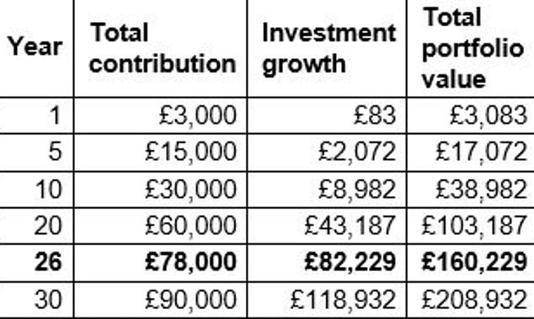
Five per cent growth: Impact of compounding interest over 30 years on £250 monthly contributions (Source: Interactive Investor)© Provided by This Is Money
Jobson explains: ‘The nature of investing means the annual rate of return isn’t fixed, meaning you can earn more or less in a given year, depending on the market environment.
Jobson adds that for pension savers, retirement investments are turbocharged by the tax relief and employer cash that are added to your own contributions.
‘This dual advantage not only amplifies the initial investment but also leverages compounding over time, accelerating the growth of the pension fund.’
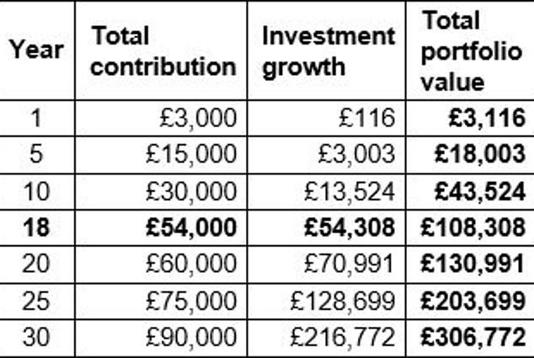
Seven per cent growth: Impact of compounding interest over 30 years on £250 monthly contributions (Source: Interactive Investor)© Provided by This Is Money
Pensions and the magic of compound growth
Pensions are possibly the longest-term investment you will ever have, which makes them particularly fertile ground for compounding to work its magic.
Think of your own and your employer’s pension contributions as the seeds, tax relief as the water, your investment plan as the soil and compound growth as the sunshine, helping to grow what eventually becomes a mature pension pot for when you retire.

The investment ‘tipping point’: When do your returns overtake total contributions?© Provided by This Is Money
One of the beauties of pensions is that if you start paying into them early, as so many workers now do thanks to auto-enrolment kicking in at age 22 (set to come down to 18), you will benefit from around 45 years of compound growth from the investments within that pension.
In fact, assuming roughly similar average annual investment returns, the impact of compound growth for younger pension savers who maximise their workplace pension contributions in their early career rather than starting with lower contributions or even foregoing a pension altogether for more immediate priorities, can be really astonishing.
Someone who makes the same annual contribution of £2,000 a year for their whole working life, but misses five years of pension contributions in their twenties would have a pot £22,000 lower at retirement, at £121,450 rather than £143,215.
“Compounding can work against you too, in that percentage fees on investment products can add up the wrong way, magnifying the reduction in your investment pot over time”
However, if they choose to keep paying in when they are young and instead miss those five years of contributions when they are older, from 60 to 65, the impact on their pension pot is much smaller – with a pot size around £11,000 lower, at £131,895, highlighting the greater importance of contributions made early on to eventual pot size.
Unfortunately, compounding can work against you too, in that percentage fees on investment products can add up the wrong way, magnifying the reduction in your investment pot over time.
Of course if your investment grows by significantly more than the fee, the impact of this is reduced, but it’s worth keeping an eye on and making sure you aren’t being charged over the odds for an investment that isn’t delivering.
How to get the most out of long-term investing
Myron Jobson of Interactive Investor offers the following tips.
1. Take advantage of Isa allowances
The shrinking capital gains and dividend tax allowances provide the impetus for investors to invest through a tax-efficient wrapper if they haven’t already done so.
The transfer, however, will involve selling and buying back shares, which could trigger a capital gains tax bill.
Over the long term Bed & Isa is likely to outweigh the charges that might apply.
2. Consider using your partner’s Isa allowance
You can also help reduce your taxable income by transferring assets between spouses or civil partners.
Each year you can shelter £20,000 from tax in an Isa – so £40,000 between two.
Only married couples and civil partners can transfer assets tax-free, meaning those who aren’t could potentially trigger a tax liability.

The investment ‘tipping point’: When do your returns overtake total contributions?© Provided by This Is Money
Money expert Becky O’Connor of PensionBee reveals the most useful – and profitable – real world sums.
Compound growth, which generates massive gains the longer you save and invest, is lesson number one… so what are the others?
3. Understand your risk profile
Risk is an inherent part of investing, but it’s a tough balance. Take too much risk, and you might find yourself racking up some painful investing lessons.
But taking too little (or no risk in the case of cash) is a risky strategy in itself. It could have a hugely detrimental effect on your finances in the future because you might not reach your goals.
And our risk appetite isn’t static. It can change as our circumstances change so needs reviewing regularly.
4. Diversify your investments
This reduces the risk of any one stock in the portfolio hurting the overall performance.
But diversification doesn’t just mean investing in different stocks. It also means having exposure to different sectors, assets, and regions.
5. Rebalance your investments
Trimming the excesses and redirecting funds into underperforming assets ensures that your risk-return equilibrium remains intact.
This calculated approach of buying low and selling high has the potential to bolster long-term returns.
Whether nearing retirement or sprinting towards a shorter investment horizon, rebalancing grants the opportunity to recalibrate allocations to achieve the desired financial destination.
6. Review costs and fees
Investors cannot control the market, but they can control how much they pay to invest. Understand the costs associated with your investments – not least the platform charge.
7. Drip feed your investments
A good and proven way of lowering your investment risk is by investing small amounts regularly. Most often, investors do this by drip-feeding investments monthly to help smooth out the inevitable bumps in the market.
The advantage is that you also buy fewer shares when prices are high and more when prices are low – a process known as pound-cost averaging.
8. Set clear goals
Define your financial goals and time horizon before making investment decisions. Avoid making impulsive decisions based on short-term market fluctuations. Stick to your investment plan.
£££££££££££££££££
Pensions are possibly the longest-term investment you will ever have, which makes them particularly fertile ground for compounding to work its magic.
Buying your own house is most probably the best investment u will ever make as not only do u have compound interest working for u, u also have somewhere to live as u wait for the magic to happen.