
Update to the previous posted chart, the market goes lower and then reverses. Anyone who never closed their position would now be printing a big loss.
Trading is simple but not easy.
Warren Buffett
Investment Trust Dividends
Update to the previous posted chart, the market goes lower and then reverses. Anyone who never closed their position would now be printing a big loss.
Trading is simple but not easy.
Warren Buffett
I’ve bought for the portfolio 1589 shares in SUPR for £1,200.00
Cash for re-investment £316.00

Story by Charlie Carman
Aiming for £50,000 in annual passive income is a challenging goal. Although it’s not risk-free, I think stock market investing is the best way to achieve this when it comes to my own money.
Here’s how I’d aim to build a passive income empire today.
A sizeable £30,000 savings pot would be the perfect head start, but it’s important to put that money to work as soon as possible in a Stocks and Shares ISA over two tax years.
Please note that tax treatment depends on the individual circumstances of each client and may be subject to change in future. The content in this article is provided for information purposes only. It is not intended to be, neither does it constitute, any form of tax advice.
Over time, inflation erodes the purchasing power of cash since interest rates on traditional savings accounts often don’t keep pace with rising prices.
To target higher returns and benefit from compound returns, I’ll need to embrace volatility by investing in shares.
Shares can fall in value as well as rise — that’s an inescapable possibility with stock market investing. As such, a risk appetite and the ability to keep emotions in check are essential qualities for a good investor.
After all, the potential reward for accepting the risk of capital losses is that well-chosen equities can sometimes turbocharge investors’ returns in a way that cash never could.
I’m aiming for a 4% dividend yield across my final stock market holdings. So, when the time arrives to start spending my passive income, I’d need a portfolio worth £1.25m.
Achieving returns of this nature — or even higher — is hard, but isn’t impossible. Just ask long-term Nvidia shareholders or look at Warren Buffett’s track record.
Nonetheless, it would in all likelihood require me to beat the market by a considerable margin. No mean feat.
Accordingly, I’d want to maximise my chances of reaching my portfolio target by making additional contributions along the way. In doing so, I could still succeed with less spectacular returns.
If I invested an additional £5,000 annually for the next 20 years until I was 50, I could bring my required compound annual growth rate down to 8%. This figure’s broadly in line with the historical returns of leading indexes like the FTSE 100 and S&P 500.
Consequently, if I started with £30,000 at 30 and invested an additional £5,000 a year for much of my working lifetime, I’d have a good chance of securing a retirement funded by £50,000 in annual tax-free passive income from dividend distributions.
Time to start investing !

How much can a £250,000 pension pot get you in your retirement?
© GB News
Increases in food, energy and motoring costs will see those approaching retirement having to save more to afford the lifestyle they want.
Savers typically aim for a pension pot of £250,000 on average but end up with just over half of that in reality, new research reveals.
This is a massive shortfall in the amount they hoped to have available (£250,000) to buy an annuity or invest to generate an income.
A £250,000 pot can buy an annuity – which provides a guaranteed income for life – worth £12,091 a year at today’s rates, according to Standard Life.
A £131,000 fund can currently get someone an annuity of £6,332 a year.
With many people ending up with just over half of their pension saving goal, Britons are urged to carefully consider their retirement plans so they can ensure they have enough to live off in retirement.
With many people ending up with just over half of their pension saving goal, Britons are urged to carefully consider their retirement plans so they can ensure they have enough to live off in retirement.
The Pension and Lifetime Savings Association (PLSA) regularly puts out figures showing how much it costs to fund a minimum, moderate and comfortable level of retirement.
This provides a useful guide to calculate how much someone may need to retire and how much to put into their pension.
The PLSA shows that a couple now needs an income of £59,000 a year to be “comfortable” in old age, whereas a single person needs to save even harder and achieve a £43,100 income to cover this standard of living – covering meals out, holidays, theatre trips, and a car, in addition to everyday essentials.
The figures presented assume that savers qualify for the full new state pension – which is currently £11,500.
Standard Life found half of retirees have regrets about their financial preparation, with 53 per cent wishing they had started saving earlier, and 42 per cent that they had got financial advice or guidance.
Dean Butler, managing director for retail direct at the firm, said: “It can be hard to work out how much you need to save to achieve your desired standard of living in retirement, particularly earlier on in your career.
“Clearly there’s a big gap between what people hope to save, and what they actually do – this is unsurprising, particularly when looking at it during a cost-of-living crisis, however the result can be a significantly reduced standard of living in retirement.
“Ultimately, contributing as much as possible, as early as possible is the key to a good retirement outcome.”
A good way to contribute more if to round up any pension savings.
Rounding up monthly pension contributions to the nearest £100 could generate thousands more in retirement savings, the analysis found.
Those who begin working on a salary of £25,000 per year and pay the minimum monthly auto-enrolment contributions (five percent employee, three percent employer) from the age of 22, could have a total retirement fund of £434,000 by the age of 66, not adjusted for inflation.
£££££££££££££££££
A £131,000 fund can currently get someone an annuity of £6,332 a year and u have to surrender all your capital, at least Dick Turpin had the decency to wear a mask.

As u can see from the chart as the cash has been returned the NAV falls. At the arrow the last dividend paid, which was expected as assets were sold but still at a large discount to NAV. The NAV has continued to fall but the Trust has enough cash in the bank to continue the run down as it waits for developments. The jury is out whether to sell or wait as it makes no difference to the fcast or the target, although if sold it could start earning some dividends.
ICG-Longbow Jan 31 NAV per share 29.86p
£££££££££££
A trust that stopped paying a dividend and should have been given the elbow a while ago. It was trading on a wide discount to NAV but as the remaining loans have been impaired the NAV has been falling. Only the rump of the position remains but a loss will have to be crystalized, one day.
The Telegraph says buy Temple Bar to ride London’s rebirth, while the Times thinks Hipgnosis Songs is better off in private ownership.

ByFrank Buhagiar•07 May, 2024

Questor: The Wall Street bubble could soon burst – buy this trust to ride London’s rebirth
Talk about an eye-catching headline. ‘The Wall Street bubble could soon burst’. That’s according to the investment managers at Temple Bar (TMPL), the trust, Questor, says buy to ‘ride London’s rebirth’.
The Telegraph’s tipster highlights how US stock markets have blown away their UK counterparts over the last 15 years. The FTSE All-Share is up +326%; the S&P 500 +1,019% (sterling). What’s more, the US market now accounts for 71% of the MSCI World index; the UK just 3.8%. According to TMPL, the superior performance and wider choice are behind investors internationalising their portfolios often by indiscriminately selling UK stocks, both good and bad. This results in lowly valuations in the UK. For TMPL, ‘a low valuation is the foundation to good investment returns’ and in their view ‘makes the UK more attractive than the US, despite the gulf in their performance since the financial crisis.’
The numbers speak for themselves. US stocks are valued at over 20 times last year’s earnings. TMPL’s portfolio of 31 stocks, just eight times. Valuations, of course, can stay low for a long time, so TMPL seeks out companies that help themselves by taking shareholder-friendly action such as buying back shares – reducing the share count, enhances earnings per share, which can help share prices recover. And TMPL hopes that higher share prices will trigger higher demand for UK stocks which in turn will help revive the UK market. If TMPL’s results are anything to go by, the theory has legs – a +12.3% return for the year, well ahead of the FTSE All-Share’s +7.9%; while total returns since Redwheel were appointed managers now stand at +86.7%, compared to the index’s +50%. As Questor writes ‘Temple Bar’s performance suggests its managers are good at their jobs and we remain committed backers.’
As for Wall Street’s bubble bursting, TMPL cites Hussman Strategic Advisers’ analysis showing that by the end of 2023, ‘the US stock market stood near a 95-year high when compared to the size of the American economy.’ According to the analysis, ‘This suggests a Wall Street bubble could burst and a 12-year bear market ensue.’ Yikes!
Tempus: It’s hard to put a price on 50 Cent
The Times’ Tempus highlights how the task of valuing HIPGNOSIS SONGS'(SONG) portfolio of 40,000+ songs has been made trickier in today’s higher interest rate environment. Higher interest rates have led to higher discount rates. Higher discount rates (used to value assets) have resulted in lower valuations across the investment company space, including music royalty investor SONG. Throw in a very public spat between the board and the investment adviser and it’s easy to see why the shares have, up until recently, been trading at a significant discount to net assets.
So, with all that in mind, Tempus believes a takeover represents the best way out for shareholders. Luckily, SONG has been on the receiving end of not one but three bids, the latest from asset manager Blackstone. At 104p a share, Blackstone’s bid represents a 4% uplift on Apollo-backed Concord’s highest offer and a 48% premium to the share price before the bidding war broke out. All eyes then on Concord to see if it ups its bid for a second time but, as Tempus writes, ‘Market expectations of another bid may be beginning to dwindle. Too many investors have been burnt by Hipgnosis during its short life on London’s market. Advice Hold Why? Lack of market confidence in Hipgnosis suggests it is better off in private ownership’.
Do you mind if I quote a couple of your posts as long as I provide credit and sources back to your
site? My blog site is in the exact same niche as yours and my users would definitely benefit from a lot of the information you present here.
Please let me know if this alright with you. Appreciate it!
££££££££££££££
Yep, anything I post can be copied, if it’s copied from another source please include the source, e.g. Trustnet. GL
08 May 2024
Experts explain how different macro-environment conditions impact the UK blue-chip index.
Reporter, Trustnet
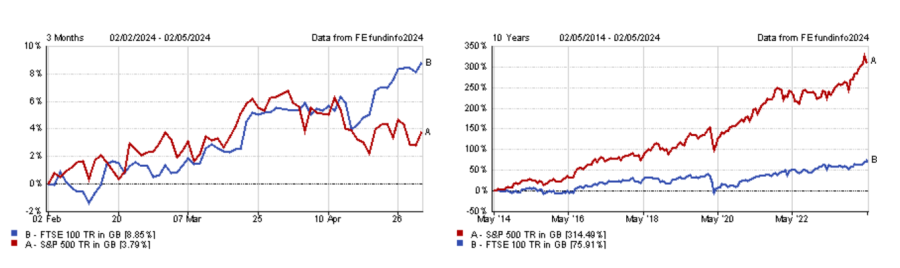
UK equities are having their moment in the sun, with the FTSE 100 recently reaching an all-time high and even outperforming the mighty S&P 500 over the past three months.
Although the UK stock market continues to grapple with a range of structural issues, the recent strong performance may herald brighter days for London-listed equities.
Danni Hewson, head of financial analysis at AJ Bell, said: “Can the FTSE 100’s run of form continue? Can the current momentum tempt more companies and more investors to look again at London?
“It seems churlish to speak of the woes the index has struggled with when there’s such optimism in the air, but there’s no better time to fix the roof than when the sun is shining.”
Performance of indices over 3 months and 10yrs
Source: FE Analytics
Signs of improvements in the UK economy may explain this recent exuberance, but the FTSE 100’s sectoral makeup – rich in energy, resources, pharmaceuticals and banking stocks – also played a role. This mix offers investors support during economic downturns, periods of uncertainty and times of risk aversion.
Jason Hollands, managing director of Bestinvest, said: “Other factors driving the FTSE 100 bounce are perhaps less cheery in nature. Heightened tensions in the Middle East with the risk of a regional war between Iran and Israel breaking out imminently, have propelled both oil and precious metal prices higher.”
The FTSE 100 also exhibits less sensitivity to the ‘higher for longer’ narrative that has recently resurfaced regarding interest rates.
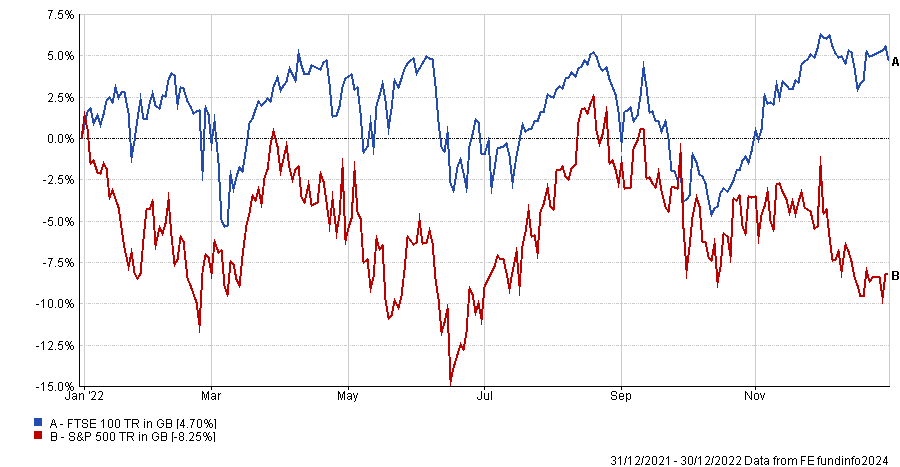
The UK blue-chip index already showed its ability to cope with higher interest rates in 2022 when it held its ground as inflation surged dramatically, forcing central banks to hike rates several times. In contrast, the US market, rich in long-duration stocks (such as the tech names), experienced a significant downturn.
Although rate hikes are still seemingly off the table, rate cut expectations have been tempered dramatically since the start of the year.
Dan Coatsworth, investment analyst at AJ Bell, explained: “Higher rates are negative when calculating the present value of future cash flows – put simply, investors suddenly lost their appetite for ‘jam tomorrow’ stocks and instead became hungry for ‘jam today’ stocks where the equity story is about making profits in the here and now, not about the sharp increase in profits expected in the future.
“The FTSE 100 has lots of ‘jam today’ style names such as tobacco producers and consumer staple businesses, hence why the UK market in this situation suddenly became more attractive than the US.”
Performance of indices in 2022
Source: FE Analytics
However, Rob Morgan, chief investment analyst at Charles Stanley, noted that this lack of ‘jam tomorrow’ in structural growth areas as well as the overrepresentation of economically sensitive sectors in the index could become a headwind if interest rates fall “in a more rapid and synchronised fashion than anticipated”.
As approximately three quarters of the index constituents earn revenue outside the UK, he also noted that a strong pound would negatively impact FTSE 100 companies with international operations. However, he stressed that a strong currency would also have positive implications for the domestic economy.
Bargain opportunity or value-trap?
Despite the recent outperformance, the FTSE 100 remains cheap compared to indices from other developed markets, which may be of interest to bargain investors.
Hollands said: “Although the UK’s blue-chip index is near a record high in point terms, this is certainly not an indication that UK-listed shares are now expensive. Far from it.
“A better measure is where shares prices are in relation to expected earnings and in this respect the market is cheap both compared to global equities – with UK shares trading at a price-to-earnings ratio around 37% lower than global equities – and their long-term median valuations.
“At such giveaway valuations, expect to see continued bids for UK-listed companies by overseas buyers – the number of takeovers of UK public companies reached the highest level in a decade last year – but cheap valuations are also spurring many companies to launch share buybacks, which should boost shareholder returns.”
However, Morgan warned that the cheapness of UK equities is a “double-edged sword”. While it presents “exciting” valuation opportunities for contrarian investors in the short term, the long-term outlook is more concerning as UK companies continue to move their listings abroad in pursuit of better valuations, and investors are selling domestic equities en masse.
For instance, outflows from UK equities reached £8bn in 2023, according to figures from Calastone. In March of this year, British investors withdrew another £823m, marking the 34th consecutive month of net selling for UK equity funds.
Morgan said: “In the long run, a shrinking pool of listed companies that is potentially biased towards less appealing businesses, and those that are simply too big to be swallowed up, is an unhealthy picture for investors.
“A potential longer-term risk is the UK market simply failing to maintain its significance to global investors. Continuing to attract companies to list in the UK and encourage investors to allocate capital is vital, but it remains in doubt.”
How to pair a FTSE 100 tracker
For investors tempted to give domestic equities another chance, a FTSE 100 tracker is likely to be the first port of call. However, due to the concentration of the index and the overrepresentation of specific sectors, they might want to pair it with an active fund to get greater diversification and potentially better long-term returns.
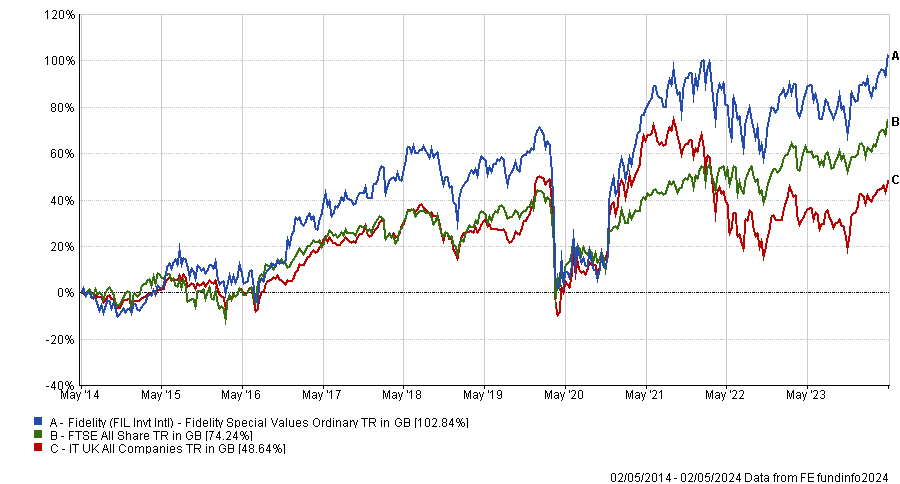
For that purpose, Alex Watts, investment data analyst at interactive investor, suggested Fidelity Special Values, managed by FE fundinfo Alpha Manager Alex Wright.
Watts explained: “The flexible mandate permits bottom-up stock selection across the FTSE All-Share, allowing a 20% overseas allocation. Manager Alex Wright looks for undervalued companies and is willing to take contrarian positions where a company is out of favour. Accordingly, the aggregate valuation across the portfolio of 11.5x earnings is lesser than valuations of the broader market.”
While the manager holds well-known FTSE 100 names such as Aviva, Imperial Brands and Reckitt Benckiser, the portfolio has a small- and mid-cap bias, as this is the part of the UK market where Wright perceives the greatest degree of mispricing.
Performance of investment trust over 10yrs vs sector and benchmark
Source: FE Analytics
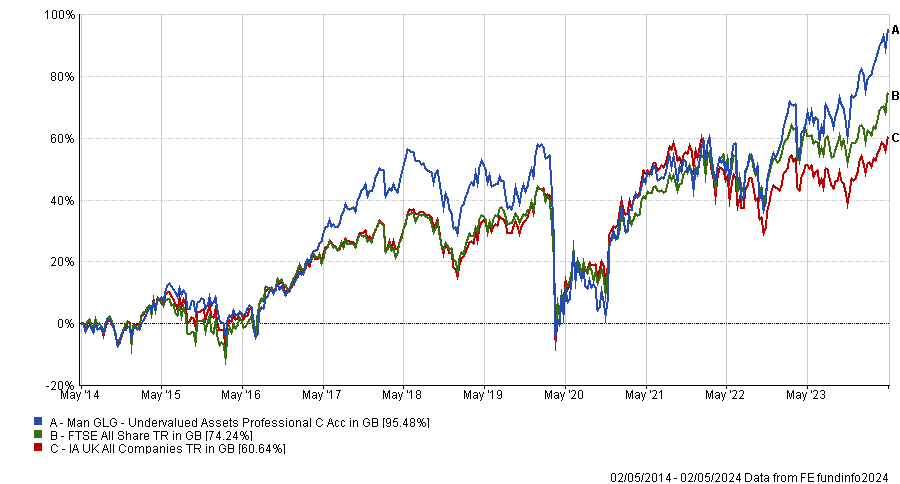
For similar reasons, Rob Morgan picked Man GLG Undervalued Assets, managed by FE fundinfo Alpha Managers Henry Dixon and Jack Barrat.
The fund also follows a value-oriented approach, buying undervalued stocks with the anticipation that their merits will be recognised over time, resulting in a positive re-rating of their share prices.
Morgan said: “The fund has an established, disciplined process with an emphasis on financial strength, good cash generation and operational momentum to avoid potential ‘value traps’. As well as diversification from a tracker it could provide a good-quality standalone fund for UK exposure.”
Performance of fund over 10yrs vs sector and benchmark
Source: FE Analytics
Finally, Ben Yearsley, director of Fairview Investing, explained there are two possible paths to explore when looking to pair a FTSE 100 tracker.
One is to take the plunge and look at opportunities in the small-cap space. In which case, he recommended Artemis UK Smaller Companies, a top quartile fund over 10, five and three years.
Performance of fund over 10yrs vs sector and benchmark
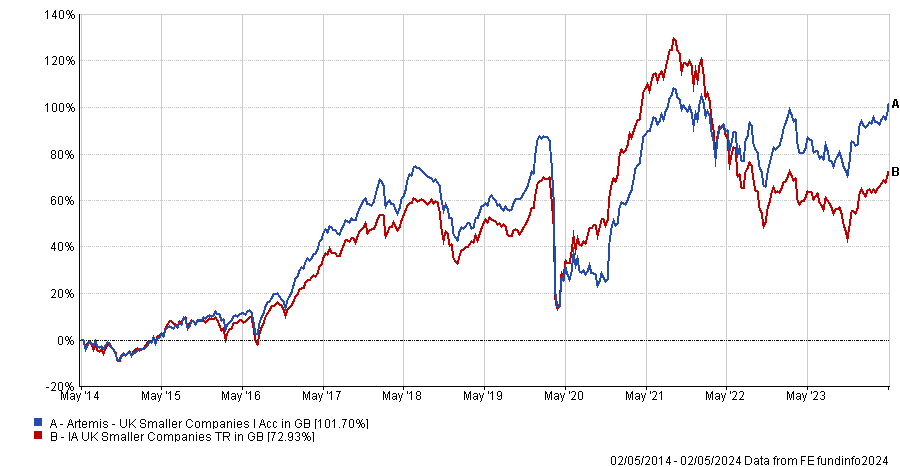
Source: FE Analytics
TwentyFour Select Monthly Income Fund Limited
Re: Dividend Announcement
The Directors of TwentyFour Select Monthly Income Fund Limited have declared that a dividend will be payable, in line with the Prospectus, representing the regular monthly targeted dividend for the financial period ended 30 April 2024 will be paid as follows:
Ex-Dividend Date 16 May 2024
Record Date 17 May 2024
Payment Date 31 May 2024
Dividend per Share 0.50 pence (Sterling)
© 2026 Passive Income Live
Theme by Anders Noren — Up ↑