Investment Trust Dividends

Category: Uncategorized (Page 321 of 346)

XD Dates

Thursday 8 February

Ex-dividend payment date

Aberforth Smaller Cos Trust PLC
Aberforth Split Level Income Trust PLC

Abdrn Property Income
Atrato Onsite Energy PLC
Baronsmead Second Venture Trust PLC
Baronsmead Venture Trust PLC
BlackRock Income & Growth Investment Trust PLC
Bluefield Solar Income Fund Ltd
Chenavari Toro Income Fund Ltd
CVC Income & Growth Ltd – EUR
CVC Income & Growth Ltd – GBP
EJF Investments Ltd
GCP Infrastructure Investments Ltd
Henderson Smaller Cos Investment Trust PLC
Impact Healthcare REIT PLC
Keystone Positive Change Investment Trust PLC
LXi REIT PLC
Octopus Renewables Infrastructure Trust PLC
Picton Property Income Ltd
Residential Secure Income PLC
Taylor Maritime Investments Ltd


Loan Arranger

Risk/reward if u are going to take the risk of lending your money

it’s better to be well rewarded for the risk.

Although the market is stating the safer lone rangers are the Trusts

trading around Net Asset, is the market right ?

As always best to DYOR.

Gore Street Energy

Gore Street Energy Storage Fund plc 

(the “Company” or “GSF”) 

Further Portfolio and Trading Update

Gore Street Energy Storage Fund plc (“the Company” or “GSF”) notes the turbulence in the market and reconfirms its strong liquidity and its commitment to the current dividend policy. The Company also reconfirms its commitment to a diversification strategy, which has insulated it from the current dynamics of the GB market.

Overview:

Dividend policy

·    GSF reaffirms its dividend target of 7% of NAV for the fiscal year. It has met its dividend target since listing.

·    The Company’s dividend cover has been trending upward and was fully covered in the last reported quarter (September-end 2023).

Revenue generation

·    Further to the Company’s update on 10 January, the reported portfolio average revenue across all assets for the fiscal year-to-date stands at £15.1 per MW/hr (H1 & Q3), given its effective diversification strategy.

Liquidity

·    The Company maintains a healthy balance sheet with low debt. As previously disclosed, the Company had £66 million in cash or cash equivalents as of 31 December 2023. Of the available $60 million in the Big Rock Facility, approximately $15.8 million had been drawn down as of 31 December 2023, and there were no draws on the Company’s £50 million RCF with Santander.

Portfolio

·    The Company’s construction program is progressing per the schedule outlined on page 11 of its Interim Report .  

·    The Company’s operational fleet is on track to more than double by the end of 2024.

·    Based on the build-out schedule, by the end of 2024, the Company’s US assets will account for 55% of total operational capacity, while GB will account for less than 30% on a MWh basis.

Background:

The Company has been at the forefront of the energy storage sector since becoming the first energy storage fund to list on the Premium Segment of the London Stock Exchange in May 2018.

From inception, the Company’s strategy prioritised diversification as a critical pillar of success. This led the Company to expand its portfolio into the Irish market in 2019, followed by expansion into mainland Europe, Texas, and California in the United States. This unique portfolio composition across five uncorrelated markets significantly reduces reliance on any single revenue stream, market dynamic, or regulatory regime, positioning the Company to achieve its long-term investment objective of sustainable growth and consistent dividend payments.

The Company has maintained strict control over capital expenditure to achieve a competitive build cost per MW. Through a comprehensive understanding of each market, each system is currently optimally sized for the market in which it operates. Augmentation has also been built into the design assumptions, allowing for upsizing when revenue signals (and capex pricing) dictate an increase in duration. This efficient deployment, including around duration, is a key variable in capex costs and ultimately a determining factor in the IRR of an asset.

Storage investors have relied on forward-looking revenue curves to make capital deployment decisions and determine asset values. The revenue curves employed in valuing GSF’s assets have proven to be the closest to actuals amongst those disclosed in the market, avoiding Net Asset Value volatility.

Liquidity and Dividends:

The Board seeks to reassure shareholders and address any potential concerns on liquidity management and dividends. While these are recognised as valid in light of recent sector news, the Board wishes to provide comfort to investors. The Company maintains a strong balance sheet, with sufficient cash to meet its contractual obligations and undrawn lines of credit totalling c.£83 million. In line with its prudent investment policy on leverage, the Company has a low debt burden and, consequently, a low refinancing risk. The Company also continues to generate a healthy operational cash flow and fully covered its dividend during the last reported quarter (September-end 2023).

The Company continues to follow its mandate to deliver sustainable long-term returns for its investors. Based on the current year’s performance, GSF reaffirms its commitment to a dividend target of 7% of NAV for the fiscal year.

Revenue Generation:

The Board and  Investment Manager of the Company share the concerns expressed regarding the current challenges posed by low revenue generation in the GB market.  The Company’s portfolio diversification serves as the primary driver of the Company’s stable revenue and profit profile and has allowed the Company’s portfolio to generate a consistent revenue profile on a consolidated basis. The Company’s active management strategy continually adapts to navigate the cyclical fluctuations in the GB market while taking full advantage of the portfolio’s broad exposure to much higher growth markets that are able to deliver increased profitability.

Pat Cox, Chair of Gore Street Energy Storage Fund, commented:  

“In this challenging period for the GB energy storage industry, it is crucial to acknowledge the resilience and fundamentally differentiated strategy employed by our Company. The GB market’s cyclical nature has posed significant hurdles, yet we remain well-positioned to navigate these challenges – largely thanks to our investment policy and Investment Manager’s foresight and strategic understanding.

“Fundamentally, the importance of energy storage as a critical asset in driving the energy transition and ensuring the sustainability of the grid remains true. The current headwinds the sector faces in GB highlight some of the more complex aspects unique to this asset class, which require long-term planning and experienced management. We have long recognised the cyclical dynamics of the energy storage sector in GB, which is why we took proactive measures beginning in 2019 to diversify our portfolio across five grids to mitigate consolidated cash flow volatility.

“Today, we can see that this differentiated strategy has proven effective and contributed significant resilience. Our unique portfolio structure allows us to access a diverse selection of revenue streams, including highly contracted ones, such as the Resource Adequacy Contract currently being negotiated for our largest asset to date, which will provide further consistency to portfolio income. Even during periods of low revenue generation, such as the current downturn in the GB market, our portfolio has demonstrated resilience thanks to the far-sighted decisions made five years ago.

“Looking ahead to the coming quarters and years, it is evident that effective capital allocation and our unique diversification strategy have shielded us from the severe impacts others in the industry face. The Company remains well-positioned to weather the current challenges and continue to lead the sector.”

Alex O’Cinneide, CEO of Gore Street Capital, the Investment Manager of the Company, commented: 

“Energy storage is and will remain a critical asset for our transition to a low-carbon society and, I believe, an essential part of every investor’s portfolio. The asset class does, however, require expert knowledge of multiple energy markets, renewables construction and management experience, clear investment execution around capital allocation, correct use of leverage, and, essentially, revenue diversity across multiple geographies. Without that skill set, experience and discipline, energy storage is a challenging asset class.

“We have raised the correct amount of capital when appropriate to do so at a fair price. The GSF portfolio has been built up over multiple years, with the careful addition of new markets and new revenue streams whilst keeping capital expenditure low and leverage correctly managed. This has led to our growing dividend coverage and increasing cash flow, and that consistency will see us through valid concerns over the sector’s performance.

“We continue to be well positioned to capitalise on this growing sector and will benefit as the market leader.”

SDCL

SDCL Energy Efficiency Income Trust plc
(“SEEIT” or the “Company”)

 Company update

Contract Renewal

SEEIT is pleased to announce that Cokenergy, a project within its Primary Energy portfolio, has renewed its long term contract with Cleveland Cliffs at the Indiana Harbor Works East steel mill in the US. The contract provides for the onsite supply of steam and electricity which is generated by Primary Energy’s facility from waste heat from the onsite coke ovens. 

Final terms align with the assumptions included in the September 2023 valuation and reflect the in principle agreement reported in the interim accounts published in December 2023 (“Interim Accounts”). The renewal will also de-risk elements of the contract by passing through certain costs and introducing improved inflation correlation of revenues.

Portfolio Trading Update

The Company is pleased to report that in aggregate the operational cashflows being generated in the final quarter of the calendar year 2023 have remained in line with the Investment Manager’s expectations, continuing the progress outlined in the Interim Accounts, notwithstanding there has been some variability in individual asset performances in the period. The Investment Manager continues to monitor project specific KPI’s carefully and actively engage with the different management teams as required. Further project specific updates will be provided in its 31 March 2024 results.

Portfolio Disposals

The pursuit of selected disposals from the portfolio is a priority for the Investment Manager and it has now received a number of credible proposals in relation to multiple assets which are within its range of pricing expectations and thereby support the most recently published net asset value. Whilst there can be no certainty that these proposals will result in a sale, the Investment Manager is focused on progressing these processes expediently and will provide further updates in due course. 

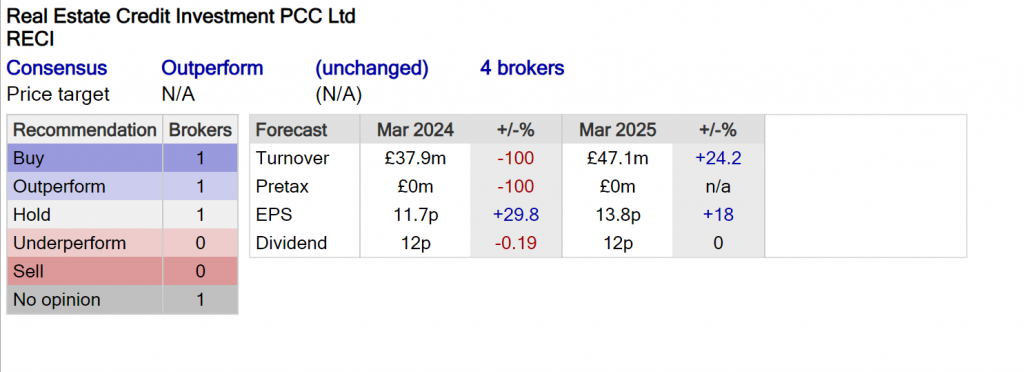
RECI

Appendix: Q3 Investor Presentation Extract

Key Quarter Updates

•     Portfolio

‒    Total NAV Return for the quarter: -0.6% / Total NAV Return to Q3 2023 : +4.1%

‒    During the quarter, one UK loan fully repaid, realising net proceeds of £9.4m, and providing headroom to invest in new deals at enhanced IRRs

‒    Rotation of market bond portfolio into strong senior loans with attractive returns

•     Cash

–    Cash reserves remain targeted at between 5% to 10% of NAV

–    As at 31 December 2023, cash was £12.1m / 3.7% of NAV

•     Dividend

–    Dividends maintained at 3p per quarter, annualised 9.3% yield, based on share price as at 31 December 2023

–    Dividends predominantly covered by net interest income generated from RECI’s assets. The aim is for dividend cover to totally come from net interest income

•     Opportunities

–    The present macroeconomic backdrop is set to continue through 2024, resulting in further constraints in bank lending and alternative sources of capital. The opportunity to provide senior loans at low risk points, for higher margins, is increasingly evident

–    The Company expects to deploy its currently available cash resources to its near term commitments and towards a compelling emerging opportunity set in senior loans

•     Citywire Investment Trust Awards 2023

–    RECI won the Best Performance award for Specialist Debt at Citywire’s London-listed Investment Companies awards held on 01 November 2023. The performance awards are given to investment companies judged to have delivered the best underlying return in terms of growth in NAV in the three years to 31 August 2023.

Investment Trust Starter

CT Global has two share classes.

CMPG is growth orientated where CMPI is invested for dividends.

CMPI current yield 6.5%

A safe trust for the yield as u learn more about the Trusts

held in the portfolio.

A good example of risk/reward GRID/CMPI.

Once traded around 150p so there could be a capital

gain when IT’s have their day in the sun, until then re-invest

the dividends to earn more dividends.

But as always it’s about timing and then time in.

Portfolio

Let’s start with the chart.

I bought for the yield, based on the information about

dividends from the management. Clearly a mistake

but the choice was mine, marry in haste repent at leisure.

There were plenty of red flags after I bought so I could

have exited with my pride intact.

From the chart it’s clearly an avoid, although with fast moving

shares waiting for the price to reverse above the cloud can

make the trade more risky.

Here I should have bought above 50p as I wanted to trade

the yield.

Of course after the Trust missing the next dividend I wouldn’t

have bought.

But we are where we are, nothing to gain crying over split milk.

The management have crashed the price from 111p

and the news of them missing the dividend caused another

spectacular fall, which most probably isn’t over yet.

They have decided to buyback shares but my faith in the management

is at an all time low, so the plan is to exit the position after

waiting to see if the share buyback arrests the shares fall.

The big risk is that this may happen at a much lower price but

I will not buy anymore shares in the Trust.

The fcast for the year of 8k is not affected but the target will be more

difficult to achieve but not impossible.

Investment Trusts

William Heathcoat Amory

Bring some yin-yang into your portfolio in 2024

Inherent contradictions within portfolios can give them stability in a polarised world…

Disclaimer

This is not substantive investment research or a research recommendation, as it does not constitute substantive research or analysis. This material should be considered as general market commentary.

Investors must always confront a wall of worry. Long-term investors reassure themselves that the stock market’s ability to surmount these issues is one of life’s constants, with the adage that it is time in the market, not timing markets, that truly protects and generates wealth. On the other hand, it is always hard to ignore that nagging doubt, and convince yourself to take what feels like an uncomfortable leap into the stock market despite what might seem to be clear warning signals.

In this context, the outlook today seems more than unusually uncertain. Tensions in the Middle East continue to ratchet up, giving an excuse for bad actors such as Putin and the Iranian regime to stir up hostilities elsewhere. If that wasn’t enough, politics globally has become even more polarised, and an unusual number of elections occurring in 2024 will mean the potential for significant shocks and/or shifts in economic policy and sentiment. Within the election cycle, for the first time the risk of AI-generated fakery lies as a malign presence, potentially leading to even less predictable electoral outcomes. China seems to be slowing rapidly, threatening to drag the global economy into recession, with a rumbling crisis in its property sector and declining population raising the stakes for its unelected ruling elite. Is it impossible that they look towards an invasion of Taiwan to distract their citizens from the economic mess?

Run for cover

Time to head back under the metaphorical duvet, and continue to hold those short-dated government bonds?

I don’t think so. As my father is fond of saying, “’Twas ever thus”. And how could it otherwise be? In the 1970s a British scientist working for NASA came up with a hypothesis for detecting the potential for life on other planets that would be both cheap and effective. James Lovelock theorised that planets that have atmospheres that are in chemical equilibrium and therefore chemically stable will be lifeless, but those such as Earth that have highly reactive chemicals, such as oxygen and methane in stable concentrations, will exhibit life. In what became known as the Gaia hypothesis, Lovelock proposed that Earth had evolved into a self-regulating system, in which life itself perpetuates the conditions for life.

The central tenet of the Gaia hypothesis is that in having a dynamic system with feedback loops, the Earth can be seen as self-regulating, and whilst elements in the system are unstable, overall the system is very stable. He theorised that on Earth, if a natural cycle starts to go out of kilter, then other cycles tend to kick in and bring the system back into line, a process which continuously optimises conditions for life. In this way, Gaia may illustrate one of the fundamental truths about stock markets, which are also collectively a dynamic system with feedback loops. In order for markets to function, optimism must always be balanced by fear. At times, one may dominate the other, but only for very short periods before feedback loops start to kick in. One only has to remember the abject fear we all experienced during Q1 of 2020. A new pandemic appeared, politicians had no idea what to do, and with economic activity supposedly grinding to a halt, stock markets cratered. Yet an element of optimism soon crept back into markets, likely a function of prices having fallen, and a new equilibrium was soon reached. The market stopped falling, and then crept back upwards, and it wasn’t long before the S&P 500 had risen back above its previous heights. In fact, taking a step back, the COVID-19 crash seems nothing much more than a blip.

S&P500: WHAT COVID-19 CRISIS?

In order to demonstrate the Gaia hypothesis, Lovelock constructed a thought experiment, known as Daisyworld. Two species of daisy exist, one dark, which does well in less warm conditions, and one white, which does better in warmer conditions. As one competes the other out, it changes the reflective properties of Daisyworld’s surface, and thereby the overall temperature. So when dark daisies start to dominate the surface, the Daisyworld heats up and more white daisies thrive. This in itself increases the amount of the sun’s energy reflected back to space, and Daisyworld cools slightly, meaning dark daisies do better once again. The coexistence of these daisies and their reflective properties mean a constantly evolving equilibrium is maintained, which aligns with the optimum temperature for daisy growth. In the experiment, if the luminosity of the sun is varied, the overall temperature of Daisyworld is significantly more stable than it would be with only one species of daisy. This is a basic example of feedback loops creating stability for a system that would otherwise be less stable.

A precondition for stability in Daisyworld is therefore constant instability. Whilst Lovelock found popularity in the West, similar ideas – written about much earlier – can be found in Russia in the late 19th and early 20th centuries. For example, Vladimir Vernadsky was one of the first scientists to recognise that oxygen, nitrogen and carbon dioxide result from biological process (i.e. life). He pointed out that living organisms in the biosphere (which was a relatively new term at the time) would shape conditions on Earth, and as a result he is considered as a pioneer in environmental sciences. In the east, the Chinese philosophy encapsulated by yin and yang can be summarised as a constant duality, in which complementary forces (rather than opposing forces) interact to form a dynamic system. Everything can be seen to have duality: shadow cannot exist without light, male without female, winter without summer.

The parallels from Gaia, from early Russian scientists, and the ancient Chinese philosophy of yin and yang can all be seen in stock markets. Despite the constant threat of instability, markets actually tend to be fairly stable, except over the very short term. Buyers and sellers find equilibrium, which results in share prices moving constantly, but effectively in a relatively stable system. Yet at all times, and as a precondition of this stability, market commentators and participants continuously recognise and fear destabilising influences on share prices and stock markets.

A topical example of one of these perceived threats to market stability – outside of politics this time – is the rise of passive investing. We recently heard news from Morningstar that in the US for the first time ever, 2023 saw passively managed mutual funds and ETFs reach total assets of greater than actively managed funds and ETFs. According to Morningstar, at the end of December 2023, passive US mutual funds and ETFs held about $13.3tn in assets while active ETFs and mutual funds had just over $13.2tn. Active managers typically decry the rise of passive investors as a systemic threat, while others see hedge funds as a systemic threat to markets. In reality, these market participants are all part of the stock market’s rich tapestry, and all are merely actors that help the market function efficiently. Borrowing the Daisyworld example above, one might rationalise that if passive investors become so dominant that they start to influence share prices too much, active managers should start to turn in better relative returns, attracting inflows at the expense of passives, and thereby restoring equilibrium. The system self-corrects, but is also more stable than if only one type of investor existed.

Ironically, regulation is the godlike external threat to this stability, to the extent that unintended consequences of seemingly ‘good regulation’ leads to extinctions in parts of capital markets. The current campaign to correct the inequalities of cost disclosures for investment trusts is one reaction to the unintended consequences of seemingly ‘good’ regulation. As long as regulators and governments listen (i.e. there is a feedback loop), then even regulation shouldn’t destabilise markets.

And so, back to 2024. What does Gaia or yin-yang tell us about the prospective year ahead? Let’s take the US election as a seemingly intractable problem. Here we have a very polarised election, with two opposing sides who seemingly stand for very different things. And if Trump is elected, his no-holds-barred attitude may conceivably see the US leave NATO, or the green incentives contained within the Inflation Reduction Act may be ripped up. Undoubtedly, the world will look very different depending on how a few floating voters in a small number of US states feel when they get out of bed on 5th November. Who can make a sensible long-term investment with this Sword of Damocles hanging over the world?

Obviously, diversification will help. However, perhaps trusts which exhibit Gaia-like, self-balancing portfolios are the answer. One trust springs to mind, which in our view could potentially demonstrate stability, irrespective of the US election result:  BlackRock Energy & Resources Income (BERI). Following a shift in the mandate in 2020, BERI now has three proverbial legs to its investment stool. The team invest in mining and traditional energy companies, and also in ‘energy transition’ stocks. Allocations between these three are expected to be 40/30/30 respectively over the long term, but can be very dynamic. An example, which has led to very impressive performance, came in November 2020. At the time, energy transition stocks were riding high and the team took decisive action to rotate the portfolio into traditional energy stocks. At the time, these were trading at historically low valuations, but with the news of a COVID-19 vaccine, the thesis was that they would benefit from economic activity normalising. This led to significant outperformance in subsequent years – helped yet further by the underperformance of energy transition stocks and the tailwind to energy stocks from the invasion of Ukraine by Russia. It is interesting, in our view, that the team are now looking at the attractively valued energy transition sector once again.

Aside from the specifics, like the Gaia hypothesis showing that it is only unstable atmospheres that support life, BERI’s seemingly intractable contradictions in its portfolio mean that it offers potential protection for an event like the upcoming US election. Oversimplifying things, if Biden wins, then it is probably safe to say that the energy transition continues, which should benefit BERI’s energy transition stocks, not to mention traditional miners, who are set to benefit from supplying the required metals. On the other hand, if Trump wins there will undoubtedly be a significant degree of uncertainty for renewable energy companies, and their prospects will clearly be dimmer. In this scenario, BERI’s traditional energy stocks may perform strongly, with direct support from Trump and potentially less of a headwind from alternative energy.

This posed a thought – which other trusts also exhibit what might be seen as structurally contradictory portfolios, and would they also offer a way to ride out a bifurcated outlook such as the year we face ahead of us?

In the US’s home market,, JPMorgan American (JAM) has been a standout performer since the current approach was adopted in 2019. It has two managers, running two distinct growth and value portfolios, both in a high-conviction manner. Outperformance relative to the benchmark and the competition has been impressive, especially when one considers how hard it is to deliver alpha from traditional US portfolios. The combination of two, at times contradictory, portfolios enables outperformance over what has been a difficult time for active management. JAM’s discount remains relatively narrow, a result of the board’s careful attention to buyback activity.

Closer to home, Invesco Perpetual UK Smaller Companies (IPU), stands out in a sector that is trading on wide discounts, and underlying valuations that are arguably very low. The UK smaller companies trust sector can be characterised by the majority of the peer group being very much in the growth camp, whilst Aberforth continue to plough a lonely furrow on the value side. IPU’s managers have adopted a barbell approach to the growth and value question, with significant exposure to both. Longer term, they have delivered above-average returns in the sector, with below-average volatility through a diversified portfolio and not exposing investors to any extremes in terms of valuations, sector exposures or balance-sheet strength. Historically ungeared, the managers have for the first time in our long experience of following them drawn down gearing. It is this sort of signal that we think investors should sit up at – prompted as it is by the manager’s contention that valuations are too cheap. If they are right, the prospect of a strong rebound will be compounded by gearing contributing to NAV returns and the prospect of the discount narrowing. However, IPU’s barbell portfolio potentially allows investors to not have to make a call whether it is growth or value that is going to perform most strongly.

Uncertainty and volatility, with diverging central bank responses, is ideal territory for macro hedge funds. As such, the economic and political uncertainty that lies ahead of us in 2024 could make it a banner year for such funds. Whilst many commentators bemoan the choice of interesting companies on the London Stock Exchange, UK investors may consider themselves fortunate to have a highly liquid access point to one of the foremost hedge funds of all time: the Brevan Howard Master Fund. BH Macro (BHMG) is a feeder fund into Brevan Howard’s flagship macro fund. Since IPO, BHMG has delivered equity-like NAV total returns of 8.7%, with significantly lower volatility than equities of 8%. Taking the theme of this article, BH Macro fits the bill because of how the BH Master Fund’s assets are allocated. The investment committee at Brevan Howard effectively allocates capital across a broad range of the firm’s macro traders, who tend to focus on global fixed-income and FX markets but with peripheral exposures to equity, credit, and commodities. Each trader has a very specific mandate, restricting them to areas of a market or even specific instruments. As long as they stay within their mandate and risk framework, each trader is free to position their book in whatever way they see fit. In some cases, it is possible that traders may at times have opposing views or trades. The portfolio and traders are policed by a highly resourced team of risk managers, who are central to everything that the firm does.

It is through this process that the Master Fund aims to provide compelling, asymmetric returns for investors, irrespective of market conditions. Capital is currently allocated across a team of over 170 portfolio managers/traders, aiming to diversify exposure across the best risk-adjusted opportunities within developed markets. Underlying exposures of the Master Fund can be very dynamic. Importantly from a portfolio-diversification perspective, it has historically delivered its strongest returns in periods when equity markets have struggled. Following a relatively poor 2023, and fears about a potential overhang in shares following the merger of its two largest shareholders, BHMG has fallen to a wide and seemingly persistent discount of 10%, which may prove to be an attractive entry point, should sentiment improve. At the time of writing, BHMG has had a very strong second week of 2023, with the NAV now having seen a rise of 0.77% since the start of the year to 12/01/2024.

Finally, one trust that specifically sets its stall out as aiming to have as many eventualities covered within its portfolio at the same time is Ruffer Investment Company (RICA), which invests in the highly flexible Ruffer investment strategy.

The team aim to generate positive returns in all market environments, and not lose capital in any 12-month rolling window. Their approach involves, in the words of founder Jonathan Ruffer, “looking for the opportunities created by juxtaposing investments which benefit and those which suffer from the same impulse”. Typically this is achieved by having equity and bond positions, and the team mitigate the possibility that these two asset classes correlate by also employing protective derivative strategies and non-conventional assets within the portfolio. Historically, this has helped RICA to perform very well in falling markets and rarely lose money. That said, 2023 was uncharacteristically weak, with the strategy having returned -6.2% during the year.

Looking forward, the Ruffer team believe that if the market’s anticipated six US interest rate cuts come to pass, it will be because of the arrival of a recession. However, they reason a soft landing is not an impossibility, and so the fund holds over 20% across equities and commodities, which should benefit from a broader market rally and further economic strength. If recession arrives, the fund’s fixed-income positions and gold equities should rise in value if yields fall further. They believe that the portfolio’s balance, painfully elusive at points last year, is now much more secure. Crucially, if liquidity conditions and the economy do deteriorate – as is their central scenario – the derivative holdings (primarily credit protection and exposure to the VIX) should appreciate sharply. With the trust trading on a discount to NAV of 5%, this may be an opportune time to consider its attractions as a portfolio diversifier. That said, while they have some counterbalancing positions, RICA is likely to do best if the managers’ macro views are proved correct, and as such we think the trust stands out as a hedge against a hard-landing scenario.

Conclusion

At university – bound up with studenty enthusiasm – I smashed through the 10,000 word limit for my dissertation (‘The impact of Gaia on business organisations’), finally handing it in with 45,000 words. I did get a first for that particular bit of work, possibly a result of my tutor giving me the benefit of the doubt and certainly in the knowledge that no one else would ever read the whole thing to find out and say otherwise.

Whilst we all like to think we can see the future clearer than anyone, in reality no one can. Having a manager or portfolio that recognises this fact, and has an element of Gaian portfolio balance or yin-yang, likely enables a smoother ride. In the coming year it looks like having consistent inconsistency in portfolios may make plenty of sense.

Investment Trust News

A 360 view of the latest results from CHRY, ASL, HSL, HOT, APEO, CMPI

Ah those were the days! According to Chrysalis, the number of IPOs in the UK prior to the GFC averaged 217 per annum. How does that compare to more recent averages? Clue – very well! Have a read of the latest Weekly 360 round-up for the answer…

ByFrank Buhagiar•02 Feb, 2024

Unwanted stat of the week

“At the point of the Company’s IPO, the Investment Adviser calculated that the average number of IPOs in the UK had fallen from 217 per annum prior to the GFC, to 94 per annum in the period from 2011 to 2017. In the five years since the Company’s IPO, the average has fallen further to 69.” Chrysalis Investments (CHRY) Investment Adviser’s Report.

A powerful indicator

Full-year results from Chrysalis Investments (CHRY). As Chair Andrew Haining explains: “NAV for the period to 30 September 2023 fell relatively modestly from 147.79p to 134.65p per share. In that period our exciting portfolio of high growth, tech enabled companies experienced a range of positive activity which we believe positions them strongly to benefit from a recovery in markets, which we would expect to see in 2024.” However, “Significant macro issues, which we are unable to influence, have moved sentiment in our asset class so substantially that it has gone from trading at a premium for three years to a discount over the last two…” All is not lost though, “As we look forward, we have good reason to be hopeful that realisations will occur in one or two of our investments during…the 2024 financial year, albeit this will depend on wider market conditions. We hope that these actions, together with the Capital Allocation process…will over time be reflected in a return to more normal market levels of discount/premium for the Company’s share price.”

The portfolio managers add: “The last two years have seen a significant change in market sentiment, the ramifications of which have triggered a widespread reconsideration of strategic priorities across both the Company’s investee companies, and in the Investment Adviser’s approach to running the Company. The Investment Adviser has worked hard with the portfolio companies over this time to extend cash funding runways and assist the quicker transition to more sustainable operating models. As a result, the Company’s portfolio contains a number of companies that are both mature in scale and, conceivably, moving into a window where an exit is a possibility. The recent strength in markets – triggered by yields falling in response to better inflation data – should be seen as encouraging. A backdrop of more optimistic markets should increase the possibility of exits for the Company’s investments…A commitment to return up to £100 million of capital to shareholders – representing approximately 25% of the Company’s market capitalisation at the time of writing – should be viewed as a powerful indicator of the Board and Investment Adviser’s ambition to manage the prevailing share price discount.”

Winterflood adds: “Continuation vote to be held at 15 March AGM. Board recommends continuation, based on shareholder consultation. The managers add that the portfolio is maturing (average holding period 3.6 years) and the market is ‘apparently’ more amenable to exits, with Klarna (7.1% of NAV) reportedly preparing for IPO. Proposed capital allocation policy: £100m capital return (likely via buybacks, subject to discount/premium) from realisations in excess of maintaining £50m cash buffer (current total liquidity £33m). Thereafter intend to return at least 25% of net realised gains against cost.”

Liberum is a buyer: “CHRY’s portfolio is as well-placed as it has been for quite some time with respect to the potential for shareholders to benefit from significant realisations. We believe the current share price does not capture the potential uplifts to NAV from liquidity events. The pathway is beginning to centre on a scenario where CHRY will be in a position to realise some of its core portfolio, particularly with respect to Starling Bank, wefox, Brandtech, and now Klarna, all of which are held at carrying values in excess of £90m. Were these to take place at valuations significantly in excess of NAV and the accompanying proceeds being returned to shareholders while a significant discount to NAV persists, this will be at a very high ROI and particularly impactful to NAV per share given the commitment to return the first £100m of realisations over the next three years, after satisfying the £50m cash buffer…Our TP of 118p reflects a 158p 12M NAV per share forecast and a 25% discount to NAV. 118p TP – BUY.”

Numis is positive too: “…the revised fees and capital allocation policy make the fund a much more attractive proposition. In addition, they have been active in engaging with shareholders, therefore we would expect their views to have been reflected in the various proposals. There has been significant progress in the portfolio with several companies performing well and being at a stage of maturity that makes realisation more likely, which will hand a lot more flexibility to the board, as well as providing valuation validation to shareholders. We would expect shareholders to give the company more time, and vote in favour of continuation, to deliver realisations and returns of capital. There has been significant rotation in the shareholder register, with the stake of Jupiter managed funds falling below 5%. The shares are trading at 81.5p this morning, representing a c.43% discount to the December NAV. We believe this offers significant value and a highly attractive investment opportunity.”

Question of the week

“The UK small company and AIM sectors are full of vibrant companies that can be expected to lead the UK economy’s future growth. Therefore, to be invested in them at the current very depressed valuation levels will, we believe, prove rewarding over the medium to longer term. A question the Board of course asks is ‘when will this recovery happen?’. Unsurprisingly, there is never a very satisfactory answer as the outlook for the UK remains very uncertain.” Henderson Opportunities Trust (HOT) Chair Statement.

A historically wide level

Half-year Report from CT Global Managed Portfolio (CMPI). Chairman David Warnock has the numbers: “…NAV total return was -2.9% for the Income shares and -0.5% for the Growth shares. The total return for the benchmark index for both share classes, the FTSE All-Share Index, was +1.6%.” The Chair adds: “High inflation and rising interest rates were a considerable headwind, particularly for the wider alternatives sector. Investment companies in the renewables, core infrastructure, property, specialist property, credit and royalty income sub-sectors are sensitive to interest rates, gilt yields and discount rates for valuing their underlying assets. This led to declines in reported asset values and, in the main, the share prices of these investment companies moved to wider discounts. This affected mainly the Income Portfolio where a number of investment companies in these sub-sectors have been held for their attractive dividends and diversity of income…Another headwind was leadership within equity markets where in the case of the UK the share prices of larger companies continued to outperform smaller ones.”

In his outlook statement, the Chairman first provides a useful summary of what the fund invests in: “The key themes for both portfolios are: investment companies focused on UK equities with a bias to medium and smaller companies which offer interesting growth prospects at very attractive valuations; investment companies with secular growth characteristics typically with holdings in the technology and healthcare sectors; and private equity trusts which have strong underlying growth characteristics though are at very wide discounts.” Before going on to highlight how “In November, there was a change which is positive for equity markets and investment companies in particular. Inflation data in key economies appears at last to be trending meaningfully lower, which if sustained could pave the way for interest rates to be cut sooner than had been anticipated. Lower inflation and lower interest rates are a more favourable environment for equity markets and investment companies. Discounts are beginning to narrow; however, at around 15%, the average sector discount is still at a historically wide level.”

Winterflood writes: “Performance hit by exposure to interest rate sensitive asset classes, particularly in Income portfolio, as well as underperformance of small caps vs large caps. Discount widening across the investment trust sector also detracted, particularly in alternatives.”

Confidence of the week

“…we know that stockmarkets are cyclical and this gives us confidence that today’s valuations will at some point be the basis of good future returns.” Henderson Opportunities Trust (HOT) Chair Statement.

By no means an outlier

Annual Report from abrdn Private Equity Opportunities (APEO). Chair Alan Devine is heartened: “I am heartened that the APEO portfolio has continued to deliver a resilient annual NAV TR during the period of 5.4%, despite a currency FX headwind of -2.8%, and that the Company continues to regularly return capital to shareholders through its enhanced quarterly dividend, delivering a yield of 3.6% as at 30 September 2023…” As for share price total return, this “…increased by 11.7%, which I would normally consider a strong performance in isolation. However, I recognise that this performance is relative to a low base, in terms of the share price declines we saw in most equities and asset classes in 2022. The APEO share price total return underperformed the 13.8% total return from the FTSE All-Share Index over the period and the share price discount to NAV remained wide at 43.2%…” But as the Chair writes: “APEO’s share price performance is by no means an outlier in the investment trust landscape, and particularly the private equity investment trust sector…I personally find the current share price discount confusing given the quality of APEO’s underlying portfolio companies, the robustness of its valuation…and the long-term nature of its NAV growth.”

The Chair goes on to remind investors that: “…private equity…should be viewed over the long term, where new investment decisions are often made with a five-year time horizon in mind.” And while “The immediate road ahead remains uncertain…the governance model of private equity has proved many times in the past…that it facilitates nimble and active ownership and allows underlying businesses to adapt more quickly to changing market circumstances. Periods of uncertainty also tend to offer up new and different opportunities for investment, which private equity firms have proved adept at generating and completing. This is why I believe that private equity should be particularly attractive to investors at times like these, in order to capture the upside that usually follows…I remain convinced by the strategy of APEO, which is centred on investment selection conviction and focused principally on the European mid-market buyout segment of private equity, where there is a plentiful supply of private companies that are highly resilient niche market leaders or fast-growing disruptive businesses of the future.”

Winterflood sounds positive: “In our view, portfolio valuation growth of +9.4% and EBITDA growth of +23% across the top 50 largest holdings simply does not match up to the level of stress currently implied by a 35% share price discount to NAV. This is compounded by the recent initiation of a share buyback programme, with the Board happy to ‘put their money where their valuations are’, and these results suggest they did so with good reason, given an average uplift of +18% achieved across £149.9m of realisations over the year (with further £53m secondary sales at book value, totalling 17% of NAV). Whether it can continue to deliver this remains the key challenge for the fund moving forwards…”

Numis is a fan: “We continue to believe that abrdn Private Equity is an attractive way to gain diversified exposure to a portfolio of leading buyout managers, although limited trading liquidity can be a drawback. APEO is differentiated from its fund of fund peers by paying a quarterly yield of 3.5% pa, partly financed from capital distributions, as well as its European bias…The shares currently trade on a c.34% discount to NAV and the fund is likely to start buying back shares, following partial realisations of its co-investment in Action, with buybacks expected to be up to €34.6m.”

JPMorgan is neutral: “Although discounts have narrowed a little for many of the listed private equity investment companies, they remain wide. An improvement in the exit market and delivering strong NAV growth may help this, but, in our view, so will a focus on capital allocation. And, with that in mind, we welcomed APEO’s commitment to share buybacks that will be significantly accretive to NAV per share due to the wide discount at which the shares trade. It is hard to justify new investments when there is a guaranteed risk-free way to increase the NAV. While APEO’s discount is wide, compared to its nearest peers, the implied discount on the unlisted assets of 31.7% is narrower than the peer average of 35.5%. We are Neutral.”

Spotlight of the week

“It is not straightforward to identify what will change to shine the spotlight on the value on offer in the UK – were it easy, after all, valuations would not now be so attractive.” Aberforth Smaller Companies (ASL) Manager’s Report.

On a more positive note

Half-year Report from Henderson Smaller Companies (HSL). Chair Penny Freer had this to say: “…NAV…total return fell by 7.7%…while the Numis Smaller Companies ex-Investment Companies Index (the ‘Benchmark’) was almost flat, and the AIC UK Smaller Companies sector average NAV declined by 3.7%. Your Company’s share price total return fell by 5.8% during the six months.” As for what lies behind the underperformance, this “…was largely due to compressed valuations and deratings in the challenging market environment for smaller UK businesses.” In addition, “Growth stocks continued to remain out of favour…” But “On a more positive note, it does seem as though October 2023 may have marked a low point of sentiment towards the UK equity market. Since then, we have had a well-received Autumn Statement from the UK Chancellor and the performance in the second quarter showed a marked improvement compared with returns achieved in the first quarter. The longer-term performance record of the Company remains consistently strong, reflecting an unchanged and proven investment strategy adopted by the Fund Manager and his team.”

And the Chair sounds confident for the future: “The Fund Manager has continued to follow a disciplined and unchanged long-term approach which is focused on bottom-up stock selection through a thorough assessment of a company’s market proposition, balance sheet strength and management. The Board is encouraged by the strong performance seen in the final months of the period under review and since the period end. In December 2023 your Company’s NAV rose by 12.4% compared with the Benchmark return of 9.4%, while the three-month NAV performance to 31 December 2023 was 12.5% compared with the Benchmark return of 8.3%, all on a total return basis. The Board remains confident in the Fund Manager’s ability to create a portfolio which will benefit from the opportunities that will progressively emerge as conditions continue to improve.”

Numis is positive: “Some of the recent underperformance has reversed post-period end and we note that the fund is the best performer in its peer group over the last three months…The long-term track record is still intact, and Henderson Smaller Companies remains one of our top picks within the UK smaller companies sector. We continue to rate the management team highly and believe that following a period of poor performance over the last two years, the manager is starting to reap the rewards of sticking to the Growth at a Reasonable Price investment approach and believe that it is well placed to continue its recent resurgence. We note that the portfolio is currently offering relative value, reflected by a forward PE ratio of 11.0x (at 31 December), which compares to a five-year average of 13.5x. As a result, we believe that this represents a compelling entry point to a high-quality, growth-biased portfolio.”

Bold assumption of the week

“…it would be bold to assume that the recent easing of price pressures means that inflation will return to the very low single digit rates of the pre-pandemic period.” Aberforth Smaller Companies (ASL) Manager’s Report.

Well positioned to prosper

Henderson Opportunities Trust (HOT), another from the Henderson stable to report. As Chair Wendy Colquhoun writes: “Against a backdrop of high interest rates and persistent inflation, continued and significant market volatility and negative sentiment towards the UK equity market and smaller companies in particular, it has been a very disappointing year for the Company in both absolute and relative terms. The NAV total return for the year was -9.3% and the share price total return over the period was -12.2%. In comparison, over the same period the FTSE All-Share Index, the Company’s benchmark index, rose by 5.9%, the FTSE 250 Index of medium-sized companies fell by 1.3%, the FTSE SmallCap Index rose by 1.3% and the AIM All-Share Index of the smallest listed UK businesses fell by 14.1%.” All a matter of timing though for “…the Company’s share price delivered a total return of 10.8% in November and 5.4% in December, outperforming the 3.0% and 0.9% return from the FTSE All-Share in those months respectively.”

As for the outlook: “In due course (and if this is not already starting to happen) the UK market will anticipate a recovery of the economy and smaller company share prices are likely to rebound. The Company’s portfolio of quality companies is well positioned to prosper in these circumstances and the Board shares the Fund Managers’ belief that there is considerable potential for gains in coming years when the current clouds affecting the economic outlook eventually clear. This should benefit shareholders over the medium to longer term.”

Note from Winterflood: “A key driver of underperformance was weak sentiment to domestic smaller companies (FTSE 250 -1.3%), to which the fund was overweight.”

Hope of the week

“We are hoping that in the above reports we are talking about a period that has passed.” Henderson Opportunities Trust (HOT) Fund Manager’s Report.

A powerful and welcome rally

Aberforth Smaller Companies (ASL) makes it a hat-trick of results from UK equity trusts with a small-cap tilt. Unlike the two Henderson funds, ASL’s results run to 31 December 2023 which makes quite a difference, as Chairman Richard Davidson explains: “…net asset value total return in the twelve months to 31 December 2023 was +8.2%…ASCoT’s share price total return was +8.0%.” This compares to the 10.1% “…total return from the Numis Smaller Companies Index (excluding investment companies) (NSCI (XIC))…Larger UK companies, represented by the FTSE All-Share, were up by 7.9% in total return terms. It was a volatile year for financial markets as they wrestled with inflation and its implications for monetary policy. A positive outturn for 2023 seemed unlikely as late as November. But then favourable inflation data in both the UK and the US encouraged the view that the next move in interest rates would be downwards. This triggered a powerful and welcome rally into the year end. In the UK, this has so far been led by the mid cap stocks, to which ASCoT has a relatively low exposure.”

Over to the investment managers for the outlook: “US interest rates are likely to dictate the near-term mood of global financial markets, the UK’s included. But equity returns over time are heavily influenced by starting valuations, which stockmarkets can take to extreme levels in their fits of despondency and elation.” With this in mind “…the low valuations ascribed to UK equities, smaller companies and, in particular, ASCoT’s portfolio bode well for returns over the medium term…while acknowledging the present debate about the relevance of the UK stockmarket, the Managers retain confidence in its ability to reflect fairer valuations in due course. Awaiting a general re-rating of the UK listed companies, ASCoT is well placed to prosper in the meantime.”

Numis writes: “Aberforth Smaller Companies modestly lagged the index during the period despite its value bias, which principally reflects that the portfolio is focused on the smaller end of the small cap segment, which lagged the slightly larger companies in the benchmark in the ‘Santa rally’. A higher interest rate environment has been favourable for the fund’s distinct value style in recent years, reflected in relative outperformance versus its more ‘growthy’ peers and the fund is the best performer in its peer group over three years…The managers have stuck to their value style through both the good times and the bad – so investors know what they are getting in terms of approach, and this differentiates the fund in a peer group that is growth biased.”

« Older posts Newer posts »

© 2026 Passive Income Live

Theme by Anders NorenUp ↑