
Investment Trust Dividends
Figuring out which assets to own and which investors to listen to is a nightmarish task. Hedge your bets instead and go for a balanced approach that has some exposure to equities alongside more defensive and income-oriented funds. Introducing an eight-fund model portfolio for the cautious investor.
By David Stevenson

There’s a strange disconnect at the moment when it comes to investing and markets. Talk to many investors ranging from well-known US market strategists such as John Hussman to hugely popular UK fund managers such as Sebastian Lyons at Troy or Peter Spillar at Capital Gearing and they sound profoundly worried. They are concerned about valuations. They worry about liquidity. And they are concerned about expectations of long-term returns from risky assets like equities.
But the consensus on Wall Street is relentlessly upbeat, there’s been a Santa rally of sorts, and vast amounts of money are flowing into equity funds in both the UK and the US. The US might even have dodged a recession. Working out who is right – the market sages or the crowd – requires the judgement of Solomon and I’d like to propose an alternative – don’t bother and instead hedge your bets, especially if you are worried by the potential for market selloffs.
To explain this statement lest first go back to basics. My core view is that for most investors with a time window of decades, 100% exposure to equities is probably the most fruitful allocation you can make. That thinking informs my suggested Growth portfolio of investment trusts. Trust in the march of the optimists, ride out market volatility, pick good funds, and forget about your portfolio and come back in a few decades. But for many investors, especially those who are either a bit more risk-averse or who are older and approaching that stage of their life where they are looking to lock in any gains, a more pragmatic approach might be better. To be clear, if you are investing as opposed to saving and you have a time window of say 5 years or more, exposure to equities still makes sense, even in a balanced and pragmatic way. If you have a time window is under five years – say you plan to retire in 5 years and cash up fully – then any equity exposure is probably a bit too risky. The best advice given to me by a learned professor of finance was that over five years, equities have in the past been a winner, under five years its best to stick with cash or bonds or other safer options. So, to be clear, in constructing a balanced portfolio I am still assuming that investors still want a bias towards equity exposure but they also want some diversification away from pure stock market growth. In simple terms they want to hedge their bets, but with the ability to capture the upside from owning risky equities.
The classic answer to a balanced approach is to construct a 60/40 portfolio of 60% equities and 40% bonds. I’m not going to argue with decades worth of accumulated market wisdom and say that’s a bad idea – it isn’t and most of the time it has delivered impressive returns. However, implementing that within an investment trust format is fiendishly difficult. Put simply there aren’t more than a handful of bond funds on the market and the few that exist are very focussed on the riskier end of the corporate bond spectrum. There’s nothing wrong with that, it just doesn’t provide all the diversification you might need. An investor could of course construct a workaround and simply switch to bond ETFs or actively managed bond unit trusts for the bond segment of the 60/40 portfolio.
As an alternative, I have put together a slightly different approach which starts with a number of assumptions:
With those principles out of the way, let’s spin through the suggested funds in the eight-fund model portfolio. The two big equity exposures are Murray International (I have also suggested the City of London investment trust as a substitute) which has a great track record and invests in global equities with a defensive, equity income-oriented focus. Next up we have AVI Global which is much more style-driven in its global equity investing approach – in this case, that means a value-oriented approach which involves picking undervalued stocks with lots of upside. Sitting alongside these two main global equities funds are two niche funds: the first is a defensive play on utility stocks globally from Ecofin, and the second is Japanese stocks. I’ll explain each in turn. Utility stocks aren’t exciting, but they are very defensive, and they tend to pay out a decent dividend. The challenge comes with picking the utility stocks that aren’t value traps where dividend growth is unsustainable, which is where Ecofin comes in. It has a long and impressive track record of picking the right utility businesses. Japanese equities are a straight value play and there are very few high-quality Japanese managers I’d trust – CC Japan Income and Growth is one of them alongside the substitutes AVI Japan Opportunity and Nippon Active Value. On the alternatives side of the 50/50 divide the core holding is one of the multi-asset funds with capital preservation as the core investment goal: I have identified the Ruffer Investment Company, but you could also pick Personal Assets and Capital Gearing as substitutes. The latter two have slightly higher equities exposure (the last monthly numbers I have seen show Capital Gearing at 27% equities exposure and Personal Assets at 25%) than Ruffer which is low at 17% of the portfolio but all three are currently heavily exposed to bonds, mainly index-linked bonds. I make no comment on this exposure to inflation-linked government securities except to say that if you think we live in a new world of higher inflation and more volatile markets, then this asset is probably a decent bet. All three managers will opportunistically vary their asset mix but as I’ve said, all three are very capital preservation oriented. On a side note, their equity exposure does mean that on an underlying basis, the overall model portfolio exposure to equities as an asset class is probably closer to 60%. One other point worth noting – Personal Assets has a much higher exposure to gold-related assets at around 11% of the portfolio.
Next up we have a classic bonds fund, in our case the Invesco Bond Plus fund with the CQS New City High Yield fund as a substitute. These funds have a focused approach to corporate debt, with careful management of the risk profile and a generous yield of well over 6% – up to nearly 9% in the case of the CQS fund. I’ve also included two small exposures to the broad infrastructure space, where most of the funds tend to have bond-like characteristics – steady income payouts and lower volatility of share price. I’ve selected the BBGI Global Infrastructure fund (HICL and INPP are very sensible alternatives) because of what it says on the label, it is global, and it has a better long-term NAV return track record. The Renewables Infrastructure Group, TRIG, is a diversified investor in renewable assets such as wind farms and battery projects. It boasts a string NAV track record and respected management but like all renewables funds it’s had a tough 12 to 18 months because of increased interest rates and volatile power prices.
Stepping back from the details, I feel confident in suggesting this mix of eight funds boasts first-rate, respected managers with a very decent track record. There’s a sensible balance of exposures ranging from less volatile, bond-focused funds through to income-oriented, global equity funds, some with explicit dividends focus. This model portfolio will undoubtedly underperform all out growth funds (think Scottish Mortgage or Polar Capital Technology) in a bull market which is full of excitement about the future. It will also underperform straight bonds and cash-only portfolios in a big market sell-off – that equity exposure will hurt in a market panic. But on a balanced basis, this should provide you with something approaching a 60/40 equities/bonds exposure via a cautious approach with substantial income upside.

I’ve sold 3745 shares in TENT for a profit including received
dividends of £229.00.
U can’t actually choose which shares to sell, so it’s actually
a book loss which should unwind when/if the corporate
action happens.
Current yield 8.1% so a strong hold as we await developments.
Cash for re-investment £3,459.00


Top of the Pops
We reveal the winners of our investment trust ratings for 2024…
Thomas McMahon
Updated 17 Jan 2024
I
This is not substantive investment research or a research recommendation, as it does not constitute substantive research or analysis. This material should be considered as general market commentary.
Our ratings seek to reward closed-ended funds which deliver attractive and persistent performance characteristics in three categories which we think match up to broad goals investors usually have: long-term growth, income and growth, and high current income. This includes strong performance versus a fund’s underlying market, as well as attractive risk characteristics which we think suggests they could continue to be premium options for investors looking for active exposure. Our ratings are purely quantitative, meaning the largest asset managers and boutiques are treated alike, and no commercial interests can interfere. In fact, only 56% of the trusts winning ratings this year are clients of ours, down from 59% last year.
Quant ratings are of necessity backward-looking, and tell us what has happened not what will happen. But we have tried to build in risk metrics to the calculations which may be more stable than alpha, as even for the best managers alpha is likely to be cyclical (for the full methodology, see the appendix at the end of this article). Our ratings also use benchmarks which are specific to the style of the manager. This means we are less likely to reward a manager when his or her style is in favour, but equally, we may be rewarding performance in a style which is on the verge of a rough patch. We think this means our ratings provide a palette of funds with different styles and strategies, all of which have a proven track record of strong risk-adjusted performance and a stable management team. They could be a good starting point for fund selection, although we think any selection process should include consideration of qualitative factors and changing macro conditions and correlations.
One of the interesting features of this year’s list of funds is that a number of income-focussed funds have done very well in total return terms, perhaps boosted by strong performance from value stocks at times. This includes Dunedin Income Growth (DIG) and Murray Income Trust (MUT) as well as JPMorgan Global Emerging Markets Income (JEMI). However, overall, there is a broad stylistic spread of funds, as the below table shows. Our Growth / Value Scores and Quality Scores are derived from underlying Morningstar data on which we have performed some calculations to try to build a picture of how funds compare. Both scores are relative, but relative to the underlying universe of funds, i.e. all funds scored, not just the ratings winners. As such, we think the broad spread of Growth (high) versus Value (low) scores is interesting, and suggests we are managing to reward alpha rather than style bias. We do think, however, that strong total returns from equity income funds could be a feature of the coming years, as we discussed in a recent strategy note. Low starting valuations, meaning high yields, and a higher interest rate environment could be creating a good setup for the strategy.
Our ratings look over five years, to try to give a decent amount of time for a track record to build up and to allow us to assess a fund’s performance in different market environments. The five years to the end of December 2023 saw a strong rally in growth in 2019, in tech, ecommerce and China in 2020 and then a surge in value over growth in 2021 and 2022, initially in a rising market and then in a terrible 2022. Last year, meanwhile, saw choppy style performance, with many markets ending, and looking cheap by historical standards, with the most glaring exception being US large-cap tech.

Source: Morningstar, Kepler calculations
One trust worth highlighting in the above list is Ashoka India Capital. This is the first year AIE has had a track record long enough to be rated, and it has shot to the top of the rankings. While India has had a strong run, that is largely irrelevant to the rating, which is due to the trust’s outstanding active record. Our growth ratings are based on the information ratio and the upside/ downside capture ratio, and on both metrics, AIE has scored very well.
2024 Income & Growth Rated funds
A striking feature of the Income & Growth Rated Funds this year is the number of small and mid-cap-focussed funds. These ratings first apply the same filters as for the growth ratings, and then look at income. We screen for funds which have delivered annualised income growth of 3% or more over five years, and then for those which have a starting yield of 3% or more. These funds are intended to be appealing to an investor who wants to draw a growing income stream over many years, while hopefully growing their capital too, as well as to those who like the more defensive attributes of equity income as a total return strategy. It is the 3% initial yield filter which has seen a number of SMID-cap funds qualify this year. Rock-bottom valuations, particularly in the UK, have created a really interesting opportunity. While a fund like Schroder UK Mid Cap (SCP) is obviously interesting as a long-term growth play – the FTSE 250 has historically been one of the best-performing growth markets – at the time of writing you can buy the shares on a 3% yield. For both classes of investors referred to above, this seems pretty exciting. Similar arguments could be made for Mercantile (MRC) and Schroder Oriental Income (SOI).

Source: Morningstar, Kepler calculations
There’s more of a value bias to the above list, as you would expect from a list of income funds, but there are a number with a decent growth bias too. Notable are JPMorgan China Growth & Income (JCGI) and JPMorgan Global Growth & Income (JGGI). These trusts pay a fixed percentage of capital out as a dividend rather than relying on the income from investments to fund it. The drawback of this approach is that if the value of the portfolio falls, the dividend will too. However, both these trusts have delivered strong annualised dividend growth over the past five years, illustrating the power of the approach over the long run. JCGI will need to see good capital returns this year to maintain this strong dividend-growth record, given the falls in the Chinese market over 2023.
What is alternative income all about? Many of the funds do offer some diversification benefits, but ultimately, we think they are there to offer a high immediate yield to investors who are less concerned about capital growth. This is a relatively young space, with many new asset classes appearing over the years, and historically there haven’t been many funds with the track record. Additionally, this kind of strategy can often end up seeing capital depleted. For this rating, we look across the sectors to reward those that have managed to maintain or grow both their dividend and their NAV over five years. In our view, this rating rewards those that have ‘proof of concept’ and could be a starting point for investigation. It’s interesting to see the first energy storage fund appear on the list this year—Gresham House Energy Storage (GRID)—reflecting the growing maturity of that asset class. As many as 14 funds made the cut this year, up from 11 in 2023.

Source: Morningstar, Kepler calculations
Last year was an odd one for markets. For much of the year, high interest rates and high inflation created an environment of fear about an upcoming recession. Equity returns were muted, bonds did poorly, and many investors preferred cash accounts to cheap equities. But it ended with a flurry of excitement, as hopes of any recession being mild in the US and UK increased. There were some potential signs of a broadening of performance in the US equity market too, as lagging equities started to catch up with the strong performance of the ‘Magnificent Seven’. While our ratings take a long-term view on performance, it is still interesting to see how last year’s winners performed through all this.
Pershing Square Holdings (PSH) was the strongest performer in absolute terms, although its 26.8% wasn’t enough to keep up to a benchmark heavy in large-cap tech. also delivered over 20% and outperformed Europe ex-UK equity markets substantially. The worst performers were in China and resources, with the materials markets affected by the slow recovery in China and by falling energy prices. There wasn’t really any pattern in terms of growth or value outperforming, which aligns with our observation that excluding the performance of the Magnificent Seven, style wasn’t as important in 2023 as it had been in the previous few years. Notably though, three European funds are near the top, reflecting perhaps that equities have done well in the region even as recession fears mount, and perhaps also that it is easier to deliver alpha in that market than in the US.

Source: Morningstar, Kepler calculations
Past performance is not a reliable indicator of future results
The top performers of the Income & Growth rated funds include TR Property (TRY). TRY invests in the equities of real estate companies, and its strong returns of 17% on the year indicate that a recovery may have begun in this troubled sector. Also delivering good returns was Utilico Emerging Markets (UEM), which was boosted by holdings in the digital infrastructure space. The worst performers included China and materials portfolios, as well as Weiss Korea Opportunity Fund (WKOF), which suffered due to an underweight to Samsung.

Source: Morningstar, Kepler calculations
Past performance is not a reliable indicator of future results
Short-term returns are probably even less interesting when it comes to the Alternative Income Rated Funds. However, many have been under pressure at the NAV and the share price level due to high interest rates. The NAVs, which are mostly self-reported, generally delivered positive returns, with an average of 1.7%. Share prices have moved to significant discounts in all cases though, with an average of 15%. This compares to an average discount of 2.5% at the end of 2023 and means the average yield on offer is now 7%, up from 5.6% a year earlier. With rate cuts seeming likely to come earlier than previously expected, we think this part of the market could deliver interesting returns over the coming years.

Source: Morningstar, Kepler calculations
Past performance is not a reliable indicator of future results
If you want cynicism about active management then there is plenty on offer these days, but to mangle a quote by a former prime minister on a slightly different topic, we think passive investing is a philosophy of failure. The investment trust space is full of talented managers with interesting and idiosyncratic strategies that have delivered excellent returns to investors over the long run, and our ratings hope to highlight some of the best. It goes without saying, that past performance patterns cannot be guaranteed to repeat, but we think there is a variety of strategies winning a rating this year with the potential to outperform in multiple environments. It is the portfolio construction task to put these together in such a way as to balance risks and opportunities, and we can’t help our readers with that. But we think these lists could be a starting point for research.

If I wanted to buy SEIT, I’m personally not interested in the Trust at the moment
as the major trend is still down, I would wait until it trades above the 60p area,
no guarantees that support is then going to hold.

The Motley Fool
Mark David Hartley
I believe that investing in high-yield dividend stocks can provide me greater returns than a standard savings account. To maximise returns, I’d open a Stocks and Shares ISA, allowing me to invest up to £20,000 a year tax-free.
I formulated the following strategy to get the most out of my initial £5,000 and build towards a goal of £4,752 of passive income by 2034.
The first step in my plan is to do the research. I need to find several reliable FTSE 100 companies with a proven track record of paying dividends. Dividend yields change constantly and companies can choose not to pay them at any time, so I must find companies with a history of reliable payments to improve my chances.
Three FTSE 100 companies that I would consider for reliable dividends include Unilever, Phoenix Group, and National Grid. Although results over the past 12 months aren’t great, I believe they have a decent record of dividend payments.
While good dividend stocks alone could bring in more profit than my standard savings account, the real magic is in compounding gains. By reinvesting my dividends back into the stock via a dividend reinvestment plan (DRIP), I can maximise my profits.
If I were new to investing, I would consider an index like the iShares Core FTSE 100 ETF (LSE:ISF). This index exposes me to well-performing FTSE 100 stocks without needing to pick them myself. It has delivered a three-year daily total return of 7.83%, which is relatively good and would be difficult to beat if I wasn’t an experienced investor. With a total expense ratio of only 0.07%, it’s also one of the cheapest FTSE 100 indexes to invest in.
If the iShares Core FTSE 100 ETF continues to deliver an average annual return of around 7.83%, investing in it would accrue me a meagre £405 of returns after a year. However, by compounding my gains over 10 years, my savings would grow to £10,912 and I’d be earning over £800 a year in passive income.
While my initial £5,000 savings can bring me some profit, I’ll need to continue adding to it if I want to see real gains. I would plan to continue investing a further £300 a month into my portfolio.
Using the iShares Core FTSE 100 ETF as an example, adding £300 per month could build up to £65,278 after 10 years. This would earn me £4,752 of passive income in 2034. After 20 years, my investment would be worth almost £200,000 and bring in over £15,000 of passive income in the following years. With a portfolio of well-selected FTSE 100 dividend stocks, I may even be able to improve on this.
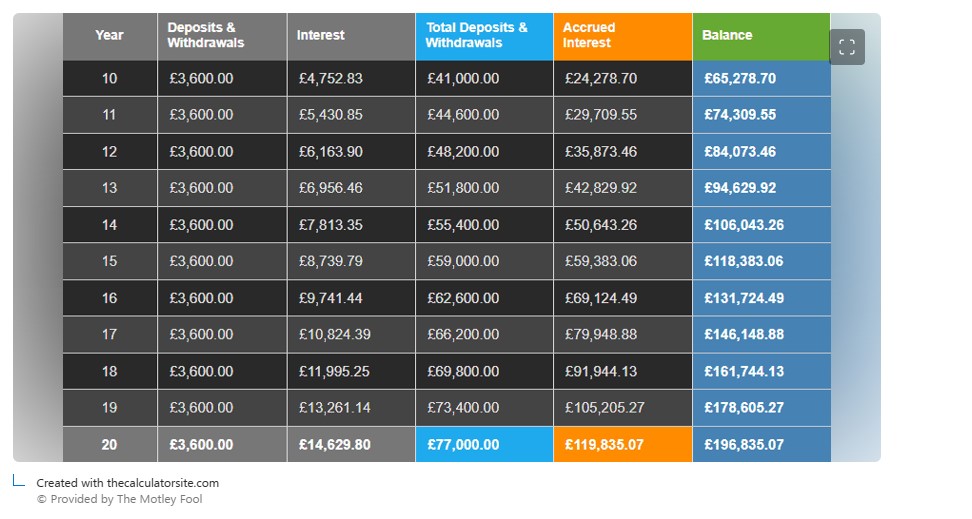
Created with thecalculatorsite.com© Provided by The Motley Fool
Octopus Renewables Infrastructure Trust plc
(“ORIT” or the “Company“)
Increased Dividend Guidance
In line with the Company’s progressive dividend policy, the Board of Octopus Renewables Infrastructure Trust plc is pleased to announce an increase in the target dividend to 6.02p* per ordinary share for the financial year from 1 January 2024 to 31 December 2024 (“FY 2024”).
This increase of 4.0% over FY 2023’s dividend target is in line with the increase to the Consumer Price Index (CPI) for the 12 months to 31 December 2023, and marks the third consecutive year the Company has increased its dividend target in line with inflation. The FY 2024 dividend target is expected to be fully covered by cashflows generated from the Company’s operating portfolios.
The Company is on track to deliver its dividend target for FY 2023 of 5.79p per ordinary share* and expects the dividend to be fully covered by cashflows arising from its operating assets. The fourth interim dividend for FY 2023 is expected to be declared in late January 2024.
Phil Austin, Chairman of Octopus Renewables Infrastructure Trust plc, commented: “We’re pleased to once again announce a dividend target increase in line with CPI, marking our third consecutive increase in line with inflation. This can be attributed to the Investment Manager’s progress in the successful delivery of construction projects, with operational capacity now at 536MW, generated by 29 assets across 5 countries, equivalent to providing enough electricity to power 242 thousand homes. For 2024, 82% of ORIT’s forecast revenues are fixed and 53% are explicitly inflation linked, and this is expected to contribute to stable cash generation over the year.”
© 2026 Passive Income Live
Theme by Anders Noren — Up ↑