Investment Trust Dividends

Category: Uncategorized (Page 371 of 378)

Passive Income

The Motley Fool

5 Steps to earning an extra £500 monthly passive income in 2024

It’s a brand new year, and many investors are looking to start building or expanding their passive income streams as part of a New Year’s resolution. That’s hardly surprising, given that making money without having to work for it is arguably one of the best ways to achieve financial freedom.

There are a lot of different ways to go about this. My personal favourite is capitalising on the potential offered by the stock market. After all, it doesn’t take that much capital to get the ball rolling and is far less time-consuming than managing rental property or running a business.

With that in mind, let’s go over the five main steps to earning an extra £500 each month.

1. Start saving
Like anything in life, investors need money to make money. Depending on the company, a share price can range from a few pence to hundreds of pounds. But there are also trading fees to take into consideration. Even with commission-free investment platforms, hidden fees can quickly eat into capital if not properly managed.

Therefore, it’s prudent for long-term investors to save spare money from a salary each month inside an interest-bearing savings account. Once a lump sum of around £300-£500 has been accumulated, then it’s time to start putting this cash to work.

2. Investigate like a detective
While saving, investors shouldn’t sit idle. Picking stocks successfully requires detailed analysis and research. And investors can use the time in between trades to find promising and potentially lucrative opportunities in the stock market.

Executing this due diligence is by far the most important step. And, sadly, it’s also the most time-consuming, especially for newer investors who have to learn what to look for in a company that makes it investment-worthy. Fortunately, our Share Advisor Premium Service can help make this process far easier.

3. Determine the end goal
With money at hand and top-notch stocks identified, it’s important for investors to outline what their objectives are. If the main one is to earn a passive income, then how much monthly income is desired?

Knowing this enables building a timeline to keep expectations in check. For example, if I’m targeting an extra £500 a month, I need to earn £6,000 from my stock portfolio each year.

On average, UK shares offer a dividend yield of around 4%. By being more selective, it’s not unrealistic to push this to 6% a year without taking on too much additional risk. However, even at 6%, I’d still need a portfolio worth £100,000 to achieve my goal.

4. Invest!
Needless to say, £100k isn’t exactly pocket change. But don’t forget this is the destination, not the starting point. Given time, regularly investing £500 each month at a 10% annualised return would let me surpass this threshold within 10 years.

Of course, nothing’s guaranteed. The world of investing is rife with risk and uncertainty. And a poorly constructed portfolio may even destroy wealth instead of creating it. That’s why investors need to carefully consider the risks against the potential reward before making any investment.

5. Repeat
After adding the first top-notch stock to a portfolio, the final step is to start again. Regularly saving up money for investment allows for a steady drip-feed of capital into a portfolio, accelerating compounding and pushing investors closer to their passive income goals.

Dividends xd this week

Thursday 11 January 
BlackRock Latin American Investment Trust PLCex-dividend payment date
European Assets Trust PLCex-dividend payment date
JPMorgan Asia Growth & Income PLCex-dividend payment date
Keystone Positive Change Investment Trust PLCex-dividend payment date
Murray International Trust PLCex-dividend payment date
Primary Health Properties PLCex-dividend payment date
Supermarket Income REIT PLCex-dividend payment date

Warren Buffett

Warren Buffett is among the most successful investors of all time. He’s amassed a fortune worth in excess of $120bn.

So how can one of the richest people in the world help me? Well, the great man’s advice can even help small savers aim for market-beating returns. And that’s perfect for those of us with less investing experience.

Starting with nothing

The first thing to address is how we can start investing without any existing capital. Well, the answer is simple. I need to put aside a chunk of my monthly salary, every month, and work from there.

Do you like the idea of dividend income?

The prospect of investing in a company just once, then sitting back and watching as it potentially pays a dividend out over and over?

So I’ll need to set up an investment account, perhaps within an ISA if I’m a UK resident, and decide how much money I can put aside each month.

Please note that tax treatment depends on the individual circumstances of each client and may be subject to change in future. The content in this article is provided for information purposes only. It is not intended to be, neither does it constitute, any form of tax advice.

It might not sound like a winning strategy, but these things take time.

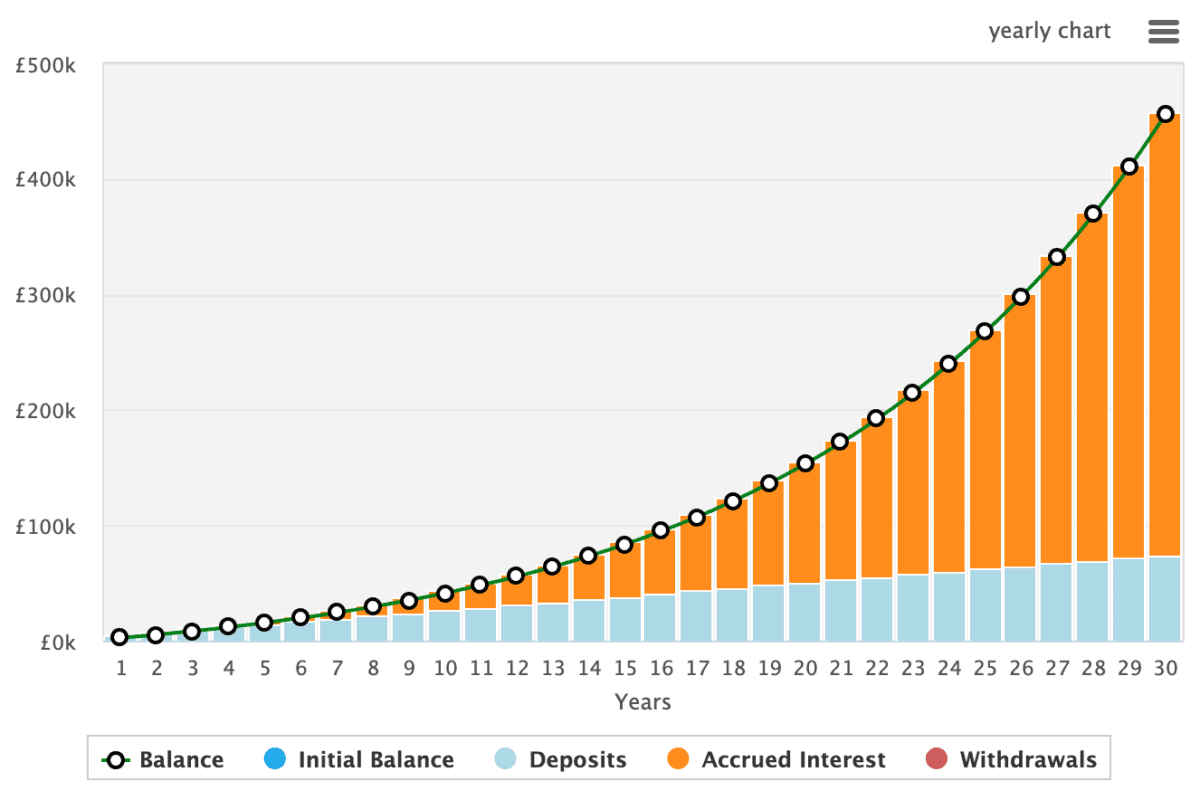
Moreover, with time I can benefit from compounding — this is a key ingredient when investing. Compounding happens when I reinvest my returns year after year. This then allows me to earn returns on my returns.

This leads to exponential growth. Just look at the example below.

Created at thecalculatorsite.com — 10% annualised returns, monthly contribution of £200.

Buffett’s teachings

Buffett has achieved annualised returns near 20% over the decades he’s been investing. That’s quite incredible and hard to replicate.

And his success is partially due to the copious research that he and his team undertake to make the right investment decisions.

However, that’s all secondary to his “rule number one” — often referred to as his “golden rule”.

So what is the rule? “Rule No. 1: Never lose money. Rule No. 2: Never forget Rule No. 1.” 

This might sound obvious, but it’s absolutely key. Protecting capital is paramount in investment strategy.

Avoiding losses not only preserves wealth but also prevents the compounding effect of setbacks. Of course, if I lose 50%, I’ve got to gain 100% to get back to where I was.

Embracing a cautious approach, thorough research, and risk management aligns with these rules, ensuring a disciplined investment mindset.

Remembering Buffett’s timeless advice underscores the fundamental importance of capital preservation in navigating the dynamic landscape of financial markets.

Dividend Shares

FTSE 100 dividends: the top 10 yields

We look at the 10 stocks with the best dividend yields in the FTSE 100 and discuss if you can depend on these blue-chips for income.

Marc Shoffman

BY MARC SHOFFMAN

Blue-chip companies on the FTSE 100 are expected to have returned £77.8bn of dividends to shareholders in 2023, according to AJ Bell’s latest Dividend Dashboard. 

The report considers the highest best dividend yields in the FTSE 100, based on company data and forecasts by City analysts.

It can be a good place to start when looking for investments as it provides an indication of companies that are generating enough cash and profits to reward shareholders.

FTSE 100 DIVIDENDS FEEL THE HEAT 

At the end of 2022, AJ Bell says analysts were projecting a record dividend haul for people buying UK stocks, surpassing the all-time high of £85.2bn returned in 2018. 

But aggregate dividend forecasts for 2023 and 2024 continue to slide, with estimates for each year now around 10% lower than a year ago, AJ Bell said.

Falling profits across the blue-chip index and concerns about the economic outlook are to blame for lower income projections. 

Russ Mould, investment director at AJ Bell, says the FTSE 100 continues to “paddle sideways” and is no higher than twelve months ago or indeed six years ago, especially compared with the strong performance of the US stock market.

“Competition from gilts and even cash in the bank may be one reason why the FTSE 100 is failing to make any major progress,” he says

“Another is worries that the long-awaited recession may finally take hold in 2024, even as the Sunak-Hunt administration tries to provide some boost to the economy.”

Aggregate profit estimates for 2023 and 2024 keep drifting lower, even if the FTSE 100’s members earn more in total overseas than in the UK, the report warns.

“The hefty portion of earnings from unpredictable sectors such as miners and oils, and economically sensitive ones such as banks and consumer discretionary, may not help here,” adds Mould.

The combination of a £2 trillion market capitalisation and aggregate ordinary dividend forecasts of £77.8 billion for 2023 and £83.7 billion in 2024 mean the FTSE 100 offers a forecast dividend yield of 3.9% for this year and 4.2% for next.

That compares to 4.5% for two-year gilts and 4% for ten-year gilts, which offer tax-free gains and come with less capital risk, the report highlights.

However, the value of share buyback announcements keeps growing even if dividends are lower, offering an alternative way to return cash to investors.

FTSE 100 companies announced share buybacks worth £54.7 billion so far this year, not too far behind 2022’s all-time high of £58.2 billion.

If this is added to dividend payouts, that means FTSE 100 firms are primed to return £137.2 billion to their shareholders in 2023, a tiny fraction below 2022’s all-time high of £137.6 billion. That figure equates to 6.9% of the FTSE 100’s market capitalisation.

“This compares favourably to the prevailing rate of inflation, exceeds the Bank of England base rate of 5.25% and handily beats the yield available from two and ten-year gilts at the time of writing,” adds Mould.

“Although it can be hard for retail investors to participate in, and benefit from, share buyback schemes.

 “That is one potential caveat to this cash bonanza. Another is how much easier it is for a company to start a buyback than it is to commit to a higher dividend and how there tends to be less critical comment and share price reaction if a buyback is halted compared to when a dividend is cut.”

Here is a list of the companies where you will currently find the ten best dividends.

THE HIGHEST DIVIDEND YIELDS IN THE FTSE 100 

CompanyDividend yield 2023
Phoenix Group (LSE: PHNX)11%
Vodafone (LSE: VOD)10.8%
British American Tobacco (LSE: BATS)10.6%
M&G (LSE: MNG)9.2%
Legal & General (LSE: LGEN)8.6%
Imperial Brands (LSE: IMB)8.1%
St James’s Place (LSE: STJ)8%
NatWest (LSE: NWG)7.8%
Aviva (LSE: AV)7.7%
Glencore (GLEN)7.4%

 CAN INVESTORS TRUST THESE COMPANIES TO DELIVER?  

This list is dominated by companies in the financial services sector. Pension giants Phoenix, M&G, Legal & General and Aviva, all offer inflation-beating dividend yields. 

These businesses are more likely to offer sustainable dividends than most as they’re highly regulated. Therefore, they’ll only pay what they can afford to and are allowed to by the regulator. 

Also, cashflow from the management of pension assets and insurance products offered are relatively predictable over the long term. This means management has a lot more visibility over cash flows and can set dividends accordingly. 

Vodafone and British American Tobacco (BAT), also offer double-digit percentage yields, but AJ Bell suggests this may reflect the market’s lack of faith in those companies’ earnings growth potential. 

“Investors are demanding a very high yield to compensate themselves for the risks that are perceived to come with holding the stock,” the report says.

It highlights that Vodafone, which has pressures from high levels of debt, has cut its dividend once in its history while British American Tobacco has never done so but is facing falling sales due to declining smoking rates.

The outlook for other companies on the list is a bit more uncertain. NatWest benefits from higher interest rates, which means it charge more to borrowers. However, if the economy starts to stutter, they may have to deal with higher loan write-offs in their portfolio. They’re also likely to have to pay out higher rates of interest to savers to keep their business. This could hit profit margins and force the lenders to reduce shareholder returns to focus on profits. 

Companies can quickly see their fortunes change. For example, Taylor Wimpey has fallen out of the top ten compared with the third quarter, perhaps reflecting concerns about the health of the property market and how confident people will be about buying or selling property in 2024.

Dividend re-investment. The snowball effect.

Daily Mail
HAMISH MCRAE: Backing Britain pays dividends

The year is off to a mediocre start for shares, and in London, unlike New York, there was not much of a Santa rally.

Big tech America is particularly hard hit, with the biggest enterprise of all, Apple, now worth $2.85 trillion (£2.25 trillion), down from $3 trillion three weeks ago.

But here, the FTSE 100 index shuffles sideways, as it has done for much of this century, unloved by British institutional investors and reliant on foreign buyers to prop it up. So another year of lacklustre performance?

Well, my own target is the Footsie will reach a new high of 8,500, as the value it offers will increasingly be recognised. Supposing that proves premature, remember the power of the dividend. Even if capital values were to move sideways, it offers a dividend yield of close to 4 per cent, more than double that of the S&P 500.
Indeed, if you factor in dividends, the long-term performance of London-quoted companies looks much closer to that of New York-quoted ones. This is a point made by Merryn Somerset Webb, ex-editor-in-chief of MoneyWeek, now writing for Bloomberg.

Backing Britain: The corporate sector can ride out any resurgence in inflation – it knows how to cope – that means it can go on paying dividends
by This Is Money

The Footsie reached the age of 40 last week, and according to the investment company AJ Bell it delivered an annualised return over that period of 5.2 per cent.

That lags the 9.1 per cent from the S&P 500 and 7.8 per cent on European shares, as measured by the MSCI Europe (ex-UK) index.

But if you add in reinvested dividends the gaps narrow. The UK is 8.6 per cent, Europe 8.7 per cent and the US 11.4 per cent. That is over the full 40 years, with strong performance in the 16 years from 1984 on, under the Thatcher and Major governments, and the early years of the Blair/Brown one.

However, if you look at what has happened in the 24 years since 2000 the picture is less good. Even adding in dividends the UK does worse than Europe and a lot worse than the US. The decent overall performance by the UK stems from a great run prior to 2000, offset by a poor one thereafter.

There are many reasons for that, including the relentless disinvestment in UK equities by British pension funds and the downgrading of the banking sector. There were the catastrophes at Royal Bank of Scotland and Bank of Scotland, the unfashionable status of mining and oil giants, the small size of the high-tech sector, and negative commentaries about the UK economy. That last point should not matter, as Footsie companies earn three-quarters of their revenue from the world economy, but I suspect in practice it does.

As a result, UK shares offer exceptional value, as the price/earnings ratio of the Footsie – at just over 11 – is close to the bottom of its long-term range.

Will the negative factors continue? Some will, for I can’t see UK banking becoming fashionable again for a while. But one negative cannot persist. UK institutional investors cannot go on reducing their holdings of equities. They haven’t got enough left to sell.

They may not build their holdings, despite being urged to do so, but the fact they are now a neutral force, rather than an adverse one, is some sort of turning point.

In any case, over any long period much of the return comes from reinvested dividends rather than capital growth.

There are two famous long-range reports on investment that come out each year, both going back to the start of the last century. One is the Equity-Gilt Study run by Barclays, the other the Credit Suisse Global Investment Returns Yearbook, which I assume will continue under UBS. Both show that two-thirds of the return comes from compound growth of reinvested income. That applies to bonds as well as equities, but in the case of non-index linked bonds, you have no protection against inflation.

In equities the protection is not perfect because, as we have seen, a surge in inflation can destroy an otherwise viable business. But the rise in general price levels pulls up the value of well-run companies along with everything else.

That gives a further twist to the ‘power of the dividend’ story. We don’t know what will happen to inflation in the medium-term. It will continue to plunge this year, but we don’t know if it will settle around 2 per cent, 3 per cent, or – perish the thought – 4 per cent.

So we don’t know where bond yields will settle. What we do know, with reasonable confidence, is that the corporate sector can ride out any resurgence in inflation. It knows how to cope. That means it can go on paying dividends. And if you want dividends the best place to get those is the UK.

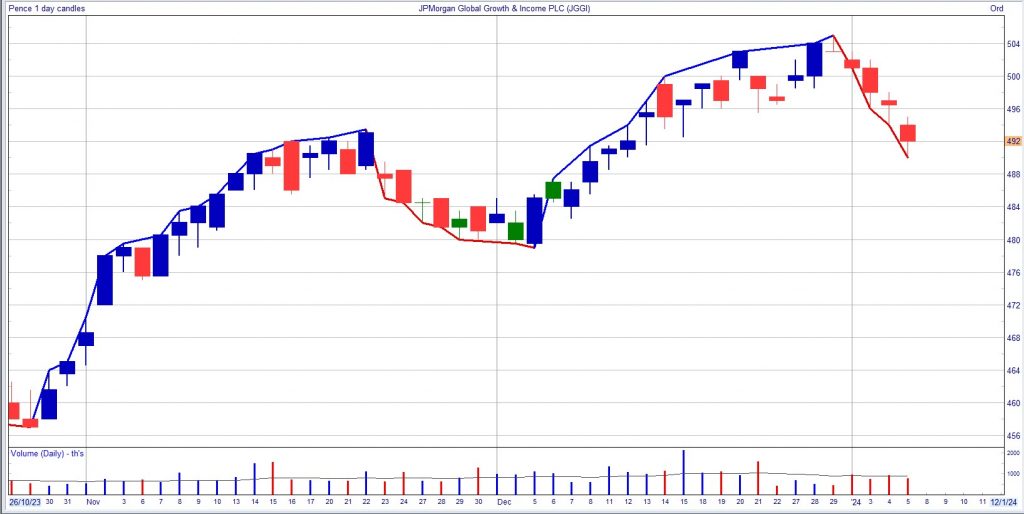
Chart of the day JGGI

I guess that everyone would agree JGGI is not a buy based on the chart

action. Well maybe not everyone.

The question is how much of your profit, if u bought, are u willing

to give back ?

Of course the price action may change the picture tomorrow

but the only way I know is to keep watching and waiting.

« Older posts Newer posts »

© 2026 Passive Income Live

Theme by Anders NorenUp ↑