Forecast: here’s how far the S&P 500 could crash in 2026.
S&P 500 tech stocks are getting sold off as economic uncertainty and AI disruption fears take over. But if the fear spreads, how far could the index fall?
You’re reading a free article with opinions that may differ from The Motley Fool’s Premium Investing Services.
S&P 500 tech stocks have taken quite a beating over the last few days, and concerns surrounding artificial intelligence (AI) disruption and lofty valuations sent prices falling. But could this just be the beginning of a wider US stock market crash? And if so, how far do the experts believe the market could tumble?
Volatility on the rise
While sudden aggressive drops in stock prices are usually caused by a clear, distinct catalyst, that’s not what’s happened this time around. Instead, the recent downward pressure on the US tech sector seems to be originating from a variety of converging factors.
Weaker-than-expected earnings, combined with further AI capex by Microsoft, triggered an initial wave of selling. This was followed by the launch of next generation AI assistant Claude Cowork by Anthropic that investors believe threatens existing enterprise software solutions.
Combining all this with further early earnings misses and a weaker outlook from key S&P 500 players alongside premium valuations, it isn’t so surprising that volatility has started spiking.
Yet, if some institutional forecasts prove to be accurate, this might be just the beginning. US unemployment’s steadily ticking up, inflation’s proving sticky, and consumer credit quality’s in decline.
While none of this guarantees a recession, the analyst team at BCA Research has estimated the probability at a concerning 60%. And as for the S&P 500, BCA has projected that America’s flagship index could tumble to between 4,200 and 4,500. Compared to where the index stands today, that suggests up to a 40% crash could be on the horizon!
Keep calm and carry on
While concerning, it’s important to highlight that BCA currently has one of the most bearish outlooks for the US market. By comparison, the experts at Goldman Sachs have projected only a 25% chance of a recession paired with a 15% pullback should things turn to custard.
Regardless, the best strategy for navigating volatility remains the same: focus on the business, not the stock price. And if the business continues to thrive while the share price dives, it may be time to consider going shopping.
With that in mind, I’m keeping a close eye on Toast (NYSE:TOST).
An emerging buying opportunity?
The one-stop-shop restaurant tech platform is now trading at a 52-week low, stumbling by over 16% since the start of the year. That isn’t entirely surprising given the stock still trades at a fairly expensive forward price-to-earnings ratio of 22. Yet, looking at the underlying business, the company seems to be thriving
More than 156,000 restaurants now rely on its platform worldwide, driving impressive annual subscription revenue, alongside continuous cash flows from small fees on all transactions moving through its network.
Obviously, a weaker US economic outlook doesn’t bode well for this business. After all, if consumers stop eating out, that means fewer restaurant transactions, resulting in a potentially painful slowdown. And given the high failure rate of restaurants in general, a wider recession will undoubtedly have a nasty impact on its subscription income as well.
Yet, with the stock selling off on what is ultimately a cyclical headwind, it’s hard not to be tempted by this high-growth enterprise. That’s why I think investors should consider taking a closer look. And it’s not the only potential S&P 500 opportunity I’ve got on my radar right now.
4 REITs. 4 Monthly Dividend Programs. 4 Massive Yields of Up to 11.7%
Brett Owens, Chief Investment Strategist Updated: January 30, 2026
Quarterly-paying dividend stocks? Ha!
We save those for the poor vanilla investors. Give us the monthly payers—those that dish divvies every 30 days.
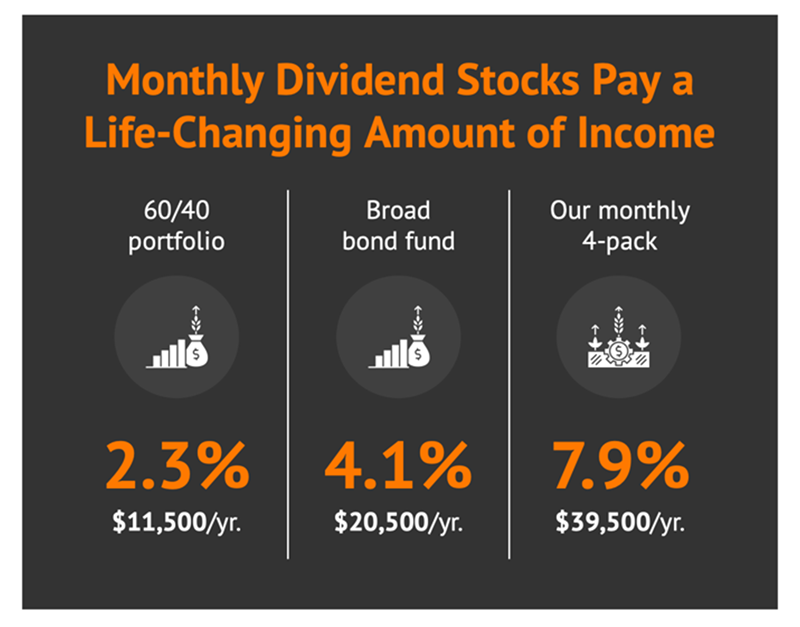
Today we’ll discuss four monthly payers yielding between 5% and 11% per year. An average yield of 7.9%.
This means a $500,000 investment portfolio can buy this four-pack, earn $39,500 per year in dividend income alone and keep principal intact.
Better yet, the payments show up in neat monthly installments. No need to wait 90 days to get paid. The “checks” show up every 30!
Let’s contrast our monthly dividend strategy with the tried, true and (let’s be blunt) inferior techniques employed by unimaginative Wall Street suits who jam their clients into standard broad-based bond funds (or worse, a cheesy 60/40 portfolio):
The advantages of monthly payers are many:
We cut down on “lumpy” portfolio income. Investors who insist on owning nothing but mega-caps and plain ETFs (which usually pay quarterly) must deal with uneven cash flow. A portfolio of monthly dividend stocks pays us the same month in and month out.
Dividends compound faster. The quicker the payouts hit our pockets, the quicker we can put that money back to work.
Do we jump out and buy any monthly dividend payers, however? NO! Remember, our goal is to (at minimum) keep our principal intact. Which means we need to find stocks that are at least likely to grind sideways as they pay their divvies.
With this “price stability” requirement in mind, let’s review these four monthly payers.
Realty Income (O) Dividend Yield: 5.3%
Realty Income (O) is a $55 billion net-lease real estate investment trust (REIT) with 15,500 commercial properties leased out to more than 1,600 clients in more than 90 industries. The vast majority of those properties are leased here in the U.S., but a few hundred of those buildings are scattered across eight European nations.
Realty Income is also a dividend juggernaut, so much so that it calls itself the “Monthly Dividend Company.” It’s a self-given nickname, but it is legit. This REIT has declared 667 consecutive monthly dividends and 113 consecutive quarterly dividend increases; indeed, at more than 30 years of consecutive dividend hikes, it’s a Dividend Aristocrat—and the only monthly payer to enjoy that honor.
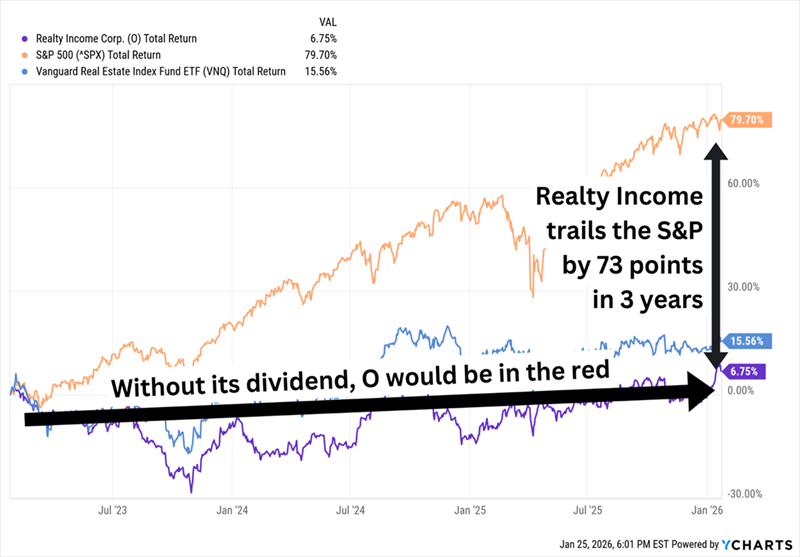
Those are some impressive accolades. Too bad they’ve meant nothing to shareholders over the past few years.
Realty Income: Dead Money Since 2023
The comparisons look a little better since O’s late 2023 low, but the point still stands: Real estate generally has been a lackluster sector, and Realty Income hasn’t differentiated itself. What we need to know is whether that’s primed to change.
Realty Income’s size is a double-edged sword at this point. On the one hand, its broad diversity and long-term leases (its average remaining lease is over nine years!) gives us plenty of reason to believe the dividend will keep inching higher for the foreseeable future. But external growth is increasingly difficult to come by. And as far as its existing properties go: Realty Income is exposed to several industries, including restaurants and health/fitness, that could struggle in a soft economy.
Valuation isn’t helping us either. O trades at about 14 times adjusted funds from operations (AFFO) estimates; it’s not expensive, but it’s hardly a springboard for shares, either.
SL Green Realty (SLG) Dividend Yield: 6.7%
SL Green Realty (SLG), “Manhattan’s largest landlord,” is a much more specialized REIT that deals in commercial real estate in New York City. Its portfolio currently consists of interest in 53 buildings representing nearly 31 million square feet.
The good news? SL Green Realty is one of the biggest landlords in one of the biggest cities on the planet, and its portfolio is stuffed with high-quality and well-located buildings. It also has an extremely well-covered dividend, which currently represents only two-thirds of 2026 FFO estimates.
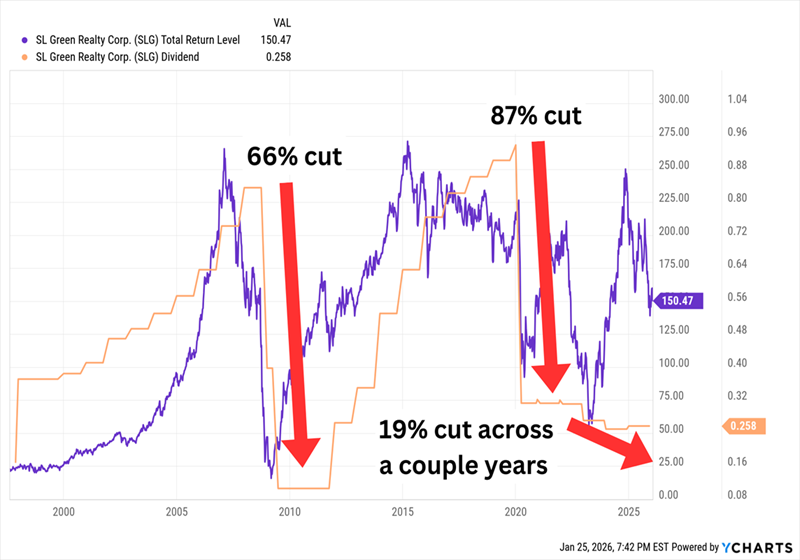
The bad news? SLG is one of the most highly leveraged companies in its category, FFO estimates for 2026 are 19% lower than they are for the yet-to-be released full-year 2025, and SLG’s dividend seems to go whichever way the wind is blowing.
This Is the Opposite of a Dependable Dividend
If there’s any reason to be optimistic, it’s that New York offices have mounted a strong recovery. The stock is also decently priced at 10 times those lower 2026 estimates.
Apple Hospitality REIT (APLE) Dividend Yield: 7.8%
Another monthly payer from the real estate sector is hotel property owner Apple Hospitality REIT (APLE).
Apple Hospitality’s portfolio is predominantly made up of upscale, “rooms-focused” hotels in the U.S. It currently boasts 217 hotels accounting for about 29,600 guest rooms in 84 markets in 37 states and D.C. The portfolio is largely split between Hilton (HLT, 115 hotels) and Marriott (MAR, 96 hotels), though it also has a single Hyatt (H) branded hotel.
Apple Hospitality’s hotels, on average, are on the younger side, they’re well-maintained, and they enjoy some of the best EBITDA margins in the industry. That’s in part because of the “rooms-focused” or “select service” nature of the hotels, which means they focus only on essential amenities such as gyms, business centers, small convenience stores and limited dining. Geographic diversification is a plus. This is a truly inexpensive REIT, to boot, trading at just 8 times 2026’s FFO estimates.
However, APLE doesn’t have much room to broaden margins further. It’s also in the precarious position of being strongly tethered to World Cup 2026 demand—a big showing could drive growth in this hotel name, but concerns over the administration’s immigration policies could dampen demand.
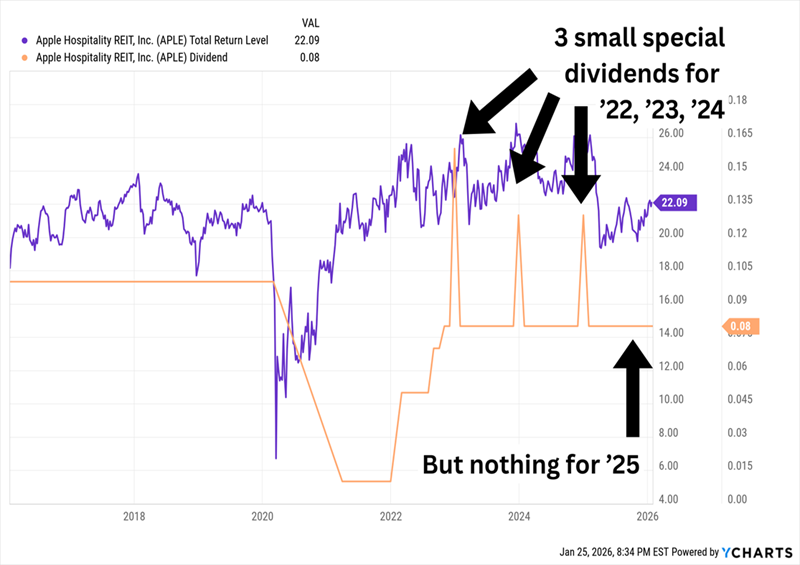
The monthly dividend is a mixed bag, too. It’s extremely well covered at less than two-thirds FFO estimates. But it has never recovered to its post-COVID levels; APLE was paying 10 cents per share, but suspended the dividend in 2020, brought it back in 2021 at a penny per share, and has since raised it to 8 cents per share. It also has been paying small specials at the start of the past three years but didn’t authorize one for 2026.
APLE’s Dividend Growth Has Flattened, And Shares Have Reflected That
Ellington Financial (EFC) Dividend Yield: 11.7%
No surprise at all the highest yielder on the list, Ellington Financial (EFC), is a small-cap mortgage REIT (mREIT). It primarily deals in credit such as residential transition loans, residential and commercial mortgage loans, CMBSs and collateralized loan obligations (CLOs), but it also has lesser (and shrinking) dealings in agency MBSs.
All of that is “paper” real estate, not physical properties. Mortgage REITs like EFC borrow money at short-term rates to buy mortgages and other assets that pay income tied to long-term rates, and they profit off the difference. Naturally, then, management wants short-term rates to be lower than long-term ones, which they typically are.
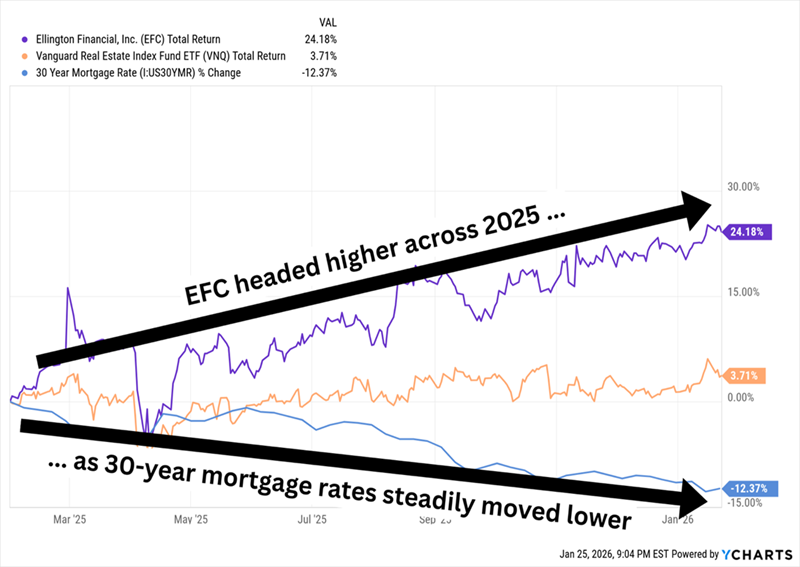
These loans are helped by short-term rates declining while long-term rates hold steady or move lower (because lower rates mean mREITs’ mortgages—issued when rates were higher—yield more than newly issued ones, so they’re worth more). Importantly, the 30-year rate has drifted lower, which is good, but it hasn’t plunged quickly enough to trigger a wave of refinancing or prepayments.
EFC’s Relationship With Long-Term Mortgage Rates Was Pretty Straightforward in 2025
2025’s run in EFC (and other mREITs) could very well continue into 2026 if the Federal Reserve adds a couple more rate cuts this year. Ellington also stands to benefit from government-sponsored enterprise (GSE) reform, with the Trump administration looking at releasing the likes of Fannie Mae and Freddie Mac from government conservatorship.
The mammoth yield on EFC’s monthly dividend grew a little bit more a couple days ago: The company announced an 8.77 million-share secondary offering, with the option to sell up to another 1.32 million shares, to help redeem all of its Series A Preferred Stock. The resulting decline in shares bumped the yield from just above 11% to nearly 12%.
On a nominal basis, Ellington pays out$1.56 per share annually, which is about 86% of 2026 estimates for $1.82 in earnings per share (EPS). Not a ton of breathing room, but not panic territory, either. The stock also trades at less than 8 times those earnings.
Brett Owens, Chief Investment Strategist Updated: February 6, 2026
New tariffs. A government shutdown. A brutal selloff in the software sector with speculation that AI will eat everything in its wake.
Concerned about a pullback? An outright bear market? Fair enough and, if so, let’s talk about beta.
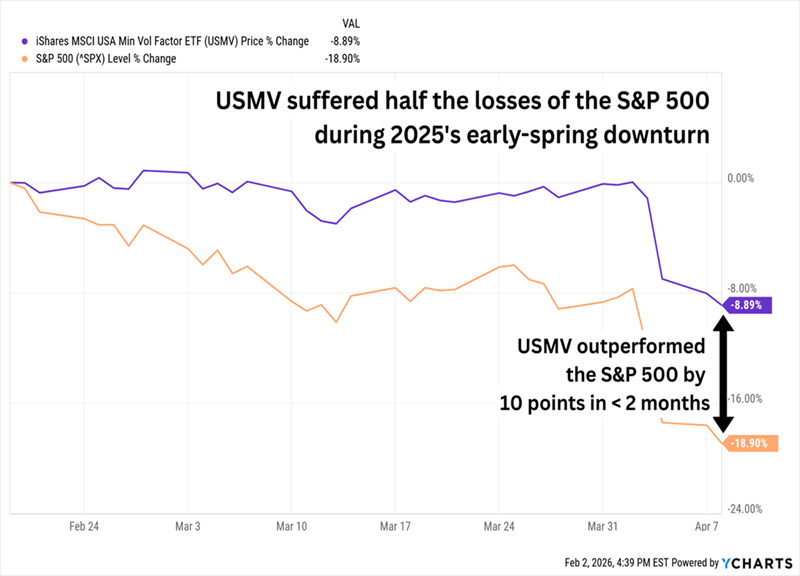
Low beta stocks are our best friends for surviving a bear market. Stocks with betas below 1 are considered less volatile than the overall market. For example, we’d expect a stock with a beta of 0.5 to drop only half as much as the S&P 500 during a pullback.
Let’s consider low-beta fund iShares MSCI USA Min Vol Factor ETF (USMV), which did its job in the leadup to the “Liberation Day” panic last year. The S&P 500 dropped 19% while USMV shed only 9%:
Low Beta Fund Beat the Market
And that’s just a simple fund. We can do even better if we cherry pick our favorite low-beta dividend payers.
The idea, of course, is not to lose money. It’s to make money regardless of what happens in the broader market. To do this we’ll consider six low-beta stocks yielding 5.8% to 8.4%.
First up is Apple Hospitality REIT (APLE, 8.1% dividend yield), featured in my recent breakdown of generous monthly dividend payers. The hotel real estate investment trust is low drama, boasting tranquil 1- and 5-year betas of 0.73 and 0.83, respectively.
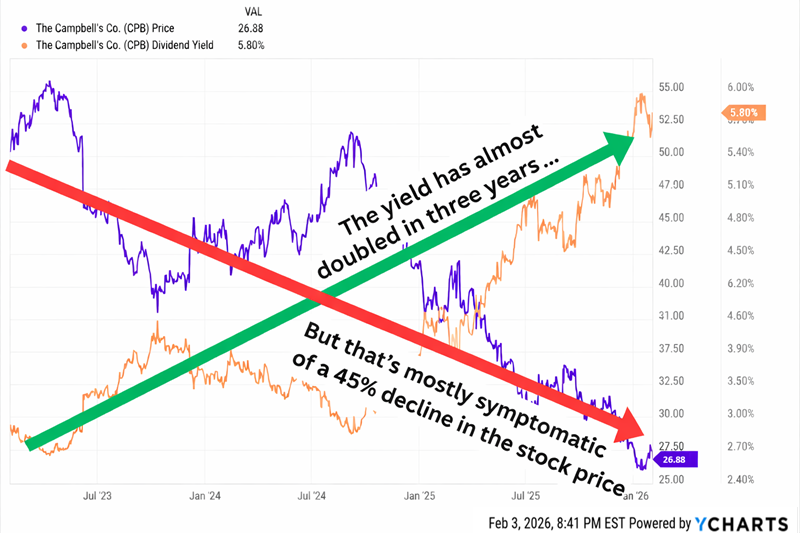
Moving on to aisle five we have Campbell’s Co. (CPB, 5.8% dividend yield), which now boasts a tasty yield. Unfortunately the big divvie is due to a rough three-year price decline.
Unfortunately, CPB Took the Other Route to a High Yield
Can Campbell’s turn the corner? The company is more than Campbell’s soup—its wide portfolio of grocery staples includes Pepperidge Farm baked goods, Goldfish and Lance crackers, Cape Cod and Kettle Brand chips, and Prego pasta sauces, V8 vegetable juices, and Pace salsa, among others. This diversification should be a strength, but the company has struggled virtually across the board amid constant inflation, cautious consumers willing to go private-label to save money, and its own increasing input costs. It has made a few acquisitions in recent years to spur growth—most notably, its 2024 acquisition of Sovos Brands that brought in the fast-rising Rao’s pasta sauce and Michael Angelo’s frozen meal brands.
CPB is expected to rebound next year. Analysts believe Campbell’s will post declines on both the top and bottom lines in 2026. But the dividend—which CPB improved in 2025 for the first time since 2021—is well-covered at about 65% of this year’s meek earnings estimates. The stock’s 1- and 5-year betas of 0.06 and -0.04 would normally be encouraging for defense hunters, but in Campbell’s case, they reflect lethargy more than stability.
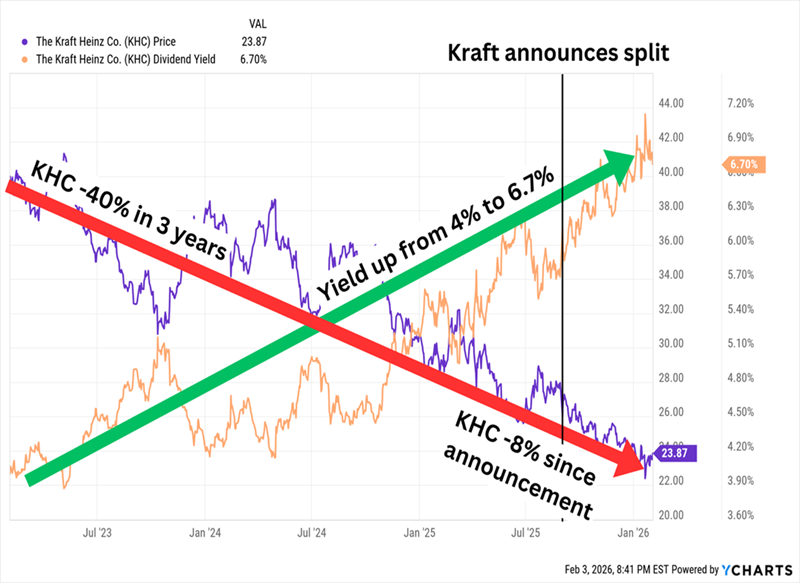
Kraft has since announced it’s splitting its business into:
“Global Taste Elevation Co.”: A “roster of iconic brands and local jewels,” including billion-dollar brands Heinz, Philadelphia and Kraft Mac & Cheese. We frequently see corporate splits divide a company into a growth arm and a more stable, cash-generating arm; Global Taste Elevation is expected to be the former.
“North American Grocery Co.”: A “portfolio of North American staples” that includes its own trio of billion-dollar brands—Oscar Mayer, Kraft Singles, and Lunchables. This is likely to be the stodgier (but perhaps better-paying) arm.
We’re constantly told that M&A is great for “unlocking shareholder value.” This has not been the case with Kraft.
Kraft is a Gooey Mess
Like with Campbell’s, its marginal 1- and 5-year betas of 0.07 and 0.05 signal low volatility but not in a good way. The patient is on life support.
And now, it appears the Kraft bear crowd will add a very big name: Berkshire Hathaway (BRK.B). New CEO Greg Abel recently signaled that he could be exiting the company’s 27.5% stake in the company, making an SEC filing to register the potential resale of up to 325 million shares. That doesn’t necessarily mean Berkshire will sell, but it does set the company up to do so.
Flowers is a bakery giant whose businesses can largely be split into bread (Wonder, Sunbeam, Nature’s Own, Dave’s Killer Bread, among others) and snacks (Tastykake, Mrs. Freshley’s and more). But all of that is the “Branded” segment, which makes up about two-thirds of revenues; the remaining third is generated by an “Other” segment that includes private-label brands and other business.
FLO is facing many of the same pressures as the aforementioned staples companies, but it’s also more susceptible to improving health trends and GLP usage. And it has piled up heavy debt, too. The company is also subject of a case—Flowers Foods v. Brock, which will determine whether last-mile drivers are exempt from the Federal Arbitration Act—heading to the Supreme Court next month.
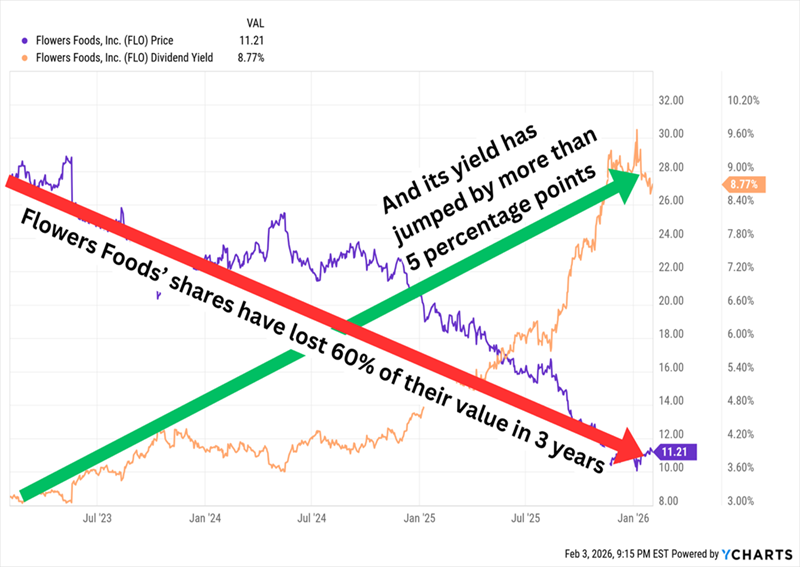
So despite what its 1- and 5-year betas (0.12 and 0.33) might otherwise suggest, shares have cracked under heavy pressure—though that has lifted the yield to nearly 9%.
This Stock Could Use Some Yeast
Not all of that yield jump can be chalked up to stock losses—Flowers has been stubbornly raising the dividend against the tide. But I have to wonder whether management knows something that my calculator doesn’t—its 24.75-cent quarterly dividend comes out to 99 cents per share annually. FLO is expected to earn $1.03 this year and 98 cents in 2027. S&P Global Ratings has noticed: Late last year, the debt-scoring agency lowered its rating on Flowers from BBB to BBB-, which is the lowest tier of investment-grade.
That said, the stock is dirt cheap. Shares trade at half the company’s sales, and FLO’s revenue mix is increasingly leaning into the higher-margin, higher-growth Branded segment. There’s light at the end of the tunnel—whether or not it’s the headlights of an incoming train remains to be seen.
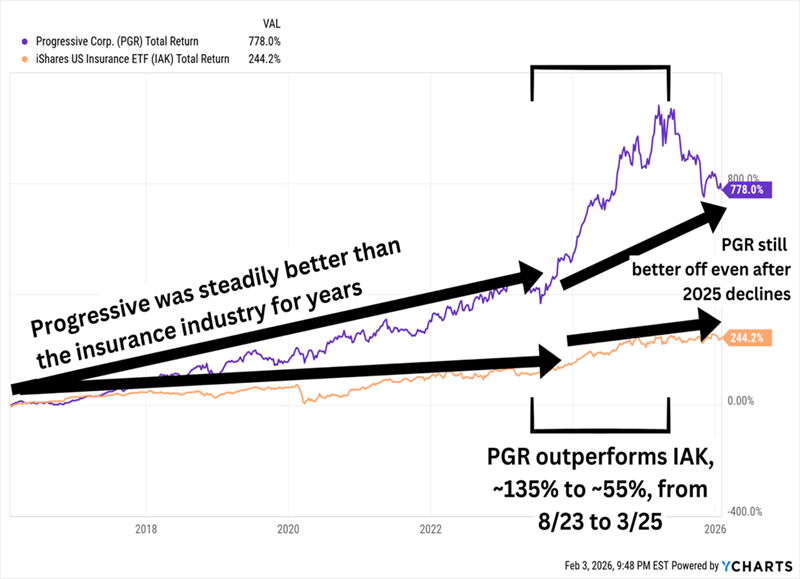
Speaking of “Flo,” let’s look at Progressive (PGR, 7.0% dividend yield), which is admittedly on the schneid itself. But unlike our troubled consumer staples stocks, PGR merely appears to be reverting to the mean after break-neck share growth.
PGR Has Been Working Off High Valuations for a Year
Progressive writes personal auto, residential property, business general liability, commercial property, and workers compensation insurance, among other policies. We’ve previously bagged 87% gains on this stock in my Hidden Yields service, and it remains on my watchlist today.
Artificial intelligence (AI) is changing a lot of industries. Most people immediately think tech—but anyone who knows an actuary or two knows that AI is coursing through the insurance business, too. Progressive, for instance, is currently using AI to refine Snapshot—its program that adapts rates based on real-time data from a customer’s car—as well as to analyze photos of damage to speed up claims.
Like with the staples companies, Progressive’s modest 1- and 5-year betas (0.54 and 0.31) more so reflect its struggles than anything else, but PGR has historically been a smooth operator.
But the high yield? That’s new. And it might—or might not—be fleeting. PGR pays a nominal quarterly dividend of a dime per share that comes out to a yield of about 0.2%. However, it has also been paying increasingly large special annual dividends in each of the past three years; its most recent distribution of $13.60 per share cranked that annualized payout up to 7%. It’s probably not an ideal situation for anyone relying on regular income, but it’s a nice kicker for anyone focused on total returns.
But as I said before, it’s on my watch list, and I’m still watching. Despite its selloff, PGR still trades at 4 times book.
My Hidden Yields service also has a brief history with Gaming & Leisure Properties (GLPI, 7.0% dividend yield), a casino and gaming REIT with 69 assets under brands such as Caesars Entertainment (CZR), PENN Entertainment (PENN), Boyd Gaming (BYD), and more. GLPI stands out from other gaming names in that it has extremely little exposure to the hub of American casinos, Las Vegas—its only property there is The Tropicana. Instead, its properties are spread across 20 states, from New Mexico to Ohio to Rhode Island.
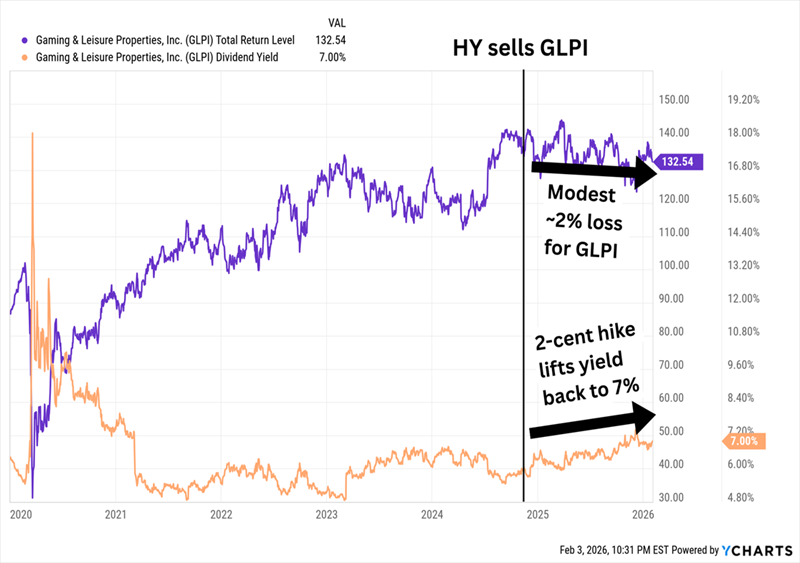
We held GLPI for a little more than a year between 2023 and 2024 before collecting a tidy profit. And despite selling just as the Fed started cutting its target rate (generally good for REITs), the stock—even including its sizable dividend—is sitting on a small loss since then.
The House Has Held GLPI to Roughly Breakeven
Here, though, GLPI’s 1- and 5-year betas (0.17 and 0.68) are actually proof that GLPI has largely been hanging tough. The past year-plus especially has been brutal on the gaming space between a stiff decline in international tourism and a tougher economic backdrop holding back domestic gamblers.
There’s no sign of weakness in Gaming & Leisure Properties’ capital plans, with the company primed to spend more than $3 billion over the next two years while still keeping a reasonable amount of leverage. Meanwhile, GLPI’s dividend surpassed its pre-COVID-cut heights years ago, and it keeps growing, including a roughly 3% hike last year. The current 78-cent quarterly payout comes out to roughly 75% of adjusted funds from operations (AFFO) estimates, which is plenty safe in REIT-speak. Shares trade at less than 11 times those estimates, too.
GRS without taking big risks with your hard earned.
When markets fell you may have been fearful of trading as prices could have kept falling but if you traded the enhanced yield you would have been lucky.
How lucky would depend on the choices you made and if you had cash to invest.
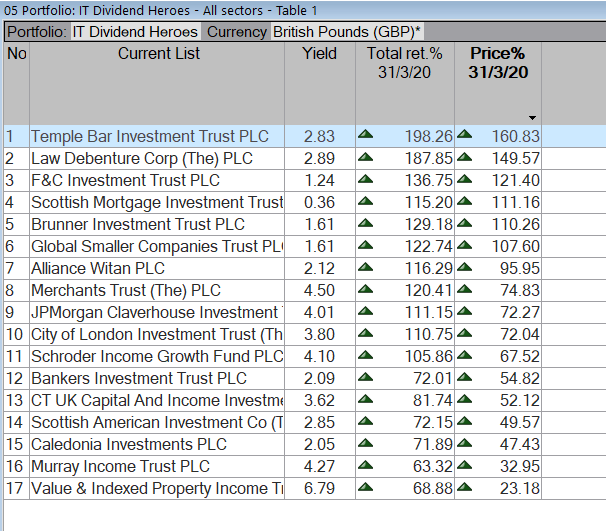
Low risk LWDB has outperformed high risk SMT but it could be different the next time markets crash, not if but when. GL
Warren Buffett has built his legacy not by attempting to predict short-term market movements but by investing in high-quality businesses with durable competitive advantages and holding them for the long term. He has repeatedly stated that trying to time the market is a fool’s errand and that even the most experienced investors struggle to do so consistently. Instead of attempting to buy at the lowest point and sell at the highest, Buffett advocates for a strategy of steady, disciplined investing that allows the power of compounding to work in an investor’s favour.
Market timing – the practice of attempting to buy stocks when prices are low and sell when they are high – may seem like a logical approach, but in reality, it is extremely difficult, if not impossible, to execute with precision. Economic cycles, geopolitical events and investor sentiment drive market fluctuations, often in unpredictable ways. Buffett warns that even professionals fail to accurately predict market cycles and the risk of making poor decisions based on short-term noise far outweighs the potential benefits of timing trades correctly.
Rather than trying to outguess the market, Buffett believes that investors should identify strong businesses, invest at reasonable prices and stay invested through market cycles. This philosophy has allowed him to outperform the market over decades and it offers valuable lessons for individual investors looking to build long-term wealth.
BUFFETT’S ARGUMENTS AGAINST MARKET TIMING
Short-term fluctuations are unpredictable: Even experts fail to time markets accurately
One of Buffett’s core beliefs is that no one can predict short-term market movements with consistency. The stock market is influenced by countless factors, including economic data, corporate earnings, geopolitical developments, interest rates and investor sentiment. These elements interact in complex ways, making it nearly impossible to forecast short-term price changes.
Buffett has frequently criticised the financial media and market commentators who attempt to predict market trends. He argues that their forecasts are often incorrect and can lead investors astray. Even professional fund managers, with access to extensive research and sophisticated models, often struggle to time the market effectively.
To illustrate this point, Buffett points to his own experience. Despite decades of investing success, he has never attempted to time the market. Instead, he remains focused on evaluating businesses based on their long-term prospects rather than reacting to daily price movements. His approach underscores a fundamental truth: investing is about buying great businesses, not predicting short-term price swings.
The risk of missing the best days: How staying invested yields better long-term results
One of the greatest dangers of market timing is missing the best days in the market. Investors who try to jump in and out of stocks based on short-term predictions often find themselves on the sidelines during the strongest rallies. Since markets tend to rebound quickly after downturns, being out of the market even for a few key days can significantly reduce long-term returns.
Historical data supports this point. Studies have shown that missing just a handful of the best-performing days in the stock market over a 20- or 30-year period can dramatically reduce an investor’s overall returns. For example, if an investor had been fully invested in the S&P 500 over the past 30 years, they would have earned an average annual return of around 10%. However, missing just the 10 best days in the market during that period would have cut returns nearly in half.
Buffett’s wisdom is clear: the best way to benefit from long-term market growth is to remain consistently invested, rather than trying to jump in and out based on market forecasts. He advises investors to ignore short-term volatility and trust in the power of compounding over time.
Compounding works best over time: The longer you stay in, the greater your returns
Buffett’s investment success is largely built on the principle of compounding returns. Compounding occurs when an investor earns returns on both their initial investment and the accumulated gains from previous years. Over long periods, compounding leads to exponential growth.
However, compounding only works effectively if investors remain invested for long enough. Those who attempt to time the market often interrupt the compounding process, missing out on the gradual accumulation of wealth. Buffett likens investing to planting a tree – the sooner you plant it and the longer you let it grow, the larger and stronger it becomes.
Buffett’s own track record is a testament to the power of compounding. By holding investments for decades rather than months or years, he has allowed companies like Coca-Cola, American Express and Apple to compound in value, generating massive long-term gains.
For individual investors, the key takeaway is that time in the market is more important than timing the market. The longer an investor stays invested, the more they benefit from the exponential growth of compounding returns.
HOW INVESTORS CAN FOLLOW BUFFETT’S APPROACH
Focus on buying great businesses rather than predicting market cycles
Buffett’s strategy revolves around identifying strong companies with durable competitive advantages and holding them for the long term. Instead of trying to predict when markets will rise or fall, he focuses on:
Finding businesses with strong fundamentals, such as stable earnings, high return on equity (ROE) and robust free cash flow.
Looking for companies with economic moats, ensuring they can maintain profitability over time.
Investing when valuations are reasonable, rather than waiting for the ‘perfect’ moment to buy.
By prioritising business quality over market timing, investors can build a resilient portfolio that delivers strong returns over decades.
Ignore short-term noise and media speculation
Buffett often warns investors against paying too much attention to financial news and market speculation. Media headlines frequently focus on short-term market movements, economic uncertainty or geopolitical risks – all of which can create fear and lead investors to make impulsive decisions.
Buffett advises that investors tune out the noise and instead concentrate on the underlying strength of their investments. He has famously stated: “The stock market is designed to transfer money from the active to the patient.” This means that those who react emotionally to news and market fluctuations often make poor decisions, while those who remain patient and disciplined tend to succeed.
A practical way to apply this lesson is to review investments periodically, rather than obsessing over daily price changes. Checking stock prices too frequently can lead to overtrading and emotional decision-making. Instead, investors should focus on fundamentals and long-term growth.
Invest consistently and let time do the work
One of the best ways to overcome the temptation of market timing is to invest consistently. Buffett recommends a dollar-cost averaging strategy, which involves investing a fixed amount at regular intervals, regardless of market conditions.
This approach helps investors:
Avoid emotional investing, as they continue to invest regardless of market sentiment.
Take advantage of lower prices during downturns, buying more shares when prices are down.
Benefit from compounding over time, as investments grow steadily.
Buffett has even recommended this approach to everyday investors, suggesting that most people simply invest in a low-cost S&P 500 index fund regularly. This strategy ensures participation in long-term market growth without the risk of mistiming trades.
Buffett’s wisdom on market timing is simple: it doesn’t work and it isn’t necessary for investment success. Instead of trying to predict market movements, investors should focus on buying strong businesses, holding them for the long term and letting compounding do the work.
This Trustnet Learn article was written with assistance from artificial intelligence (AI). For more information, please visit our AI Statement.
The good news is if you only have modest savings, compounding takes time to make a noticeable difference, you stand to make more in the last few years than you do in all the early years.
You decided to trade the breakout, the yield at 500p was around 6%. If the breakout failed you would still collect the dividend. Your analysis worked and you would currently be up 30% in less than a year. You would be watching the market to be ready to take part profits, maybe reducing the share holding back to your initial stake.
Performance and portfolio
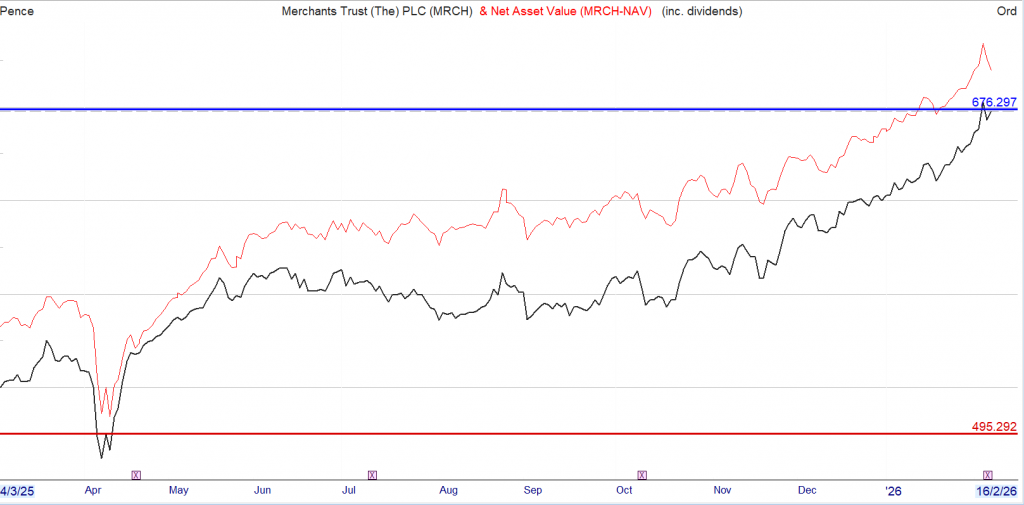
Merchants delivered a NAV total return of 5.4% over the six-month period, compared with 7.5% for the FTSE All-Share Index. Absolute returns were positive, though relative performance lagged the benchmark and some peers. This was largely due to the narrowness of market leadership: as in the US, certain groups of companies drove the market higher.
Some of these leading stocks did not align with our Manager’s long-term value approach. Instead, greater emphasis has been placed on attractively valued domestic cyclicals, which have underperformed in the recent low-growth environment. While this positioning has weighed on short-term results, we remain convinced that it provides the best foundation for long-term returns. The Board has reviewed the Manager’s strategy in detail and continues to support this disciplined, value-focused approach.
Portfolio activity reflected evolving opportunities, with an unusually high number of new investments compared with a typical half-year. Selective purchases were made where valuations and income prospects were attractive, while holdings with more limited capital growth potential were reduced.
The share price return of 1.5% reflected a widening discount to NAV, in line with a broader trend across UK investment trusts as international investors reduced exposure to UK equities. The Board, together with advisers and the Manager, monitors this closely and retains the option of share buybacks if appropriate. Meanwhile, we remain active in shareholder engagement and marketing to improve awareness and demand.
Earnings and dividends
Total income from the portfolio was £28.8m, 2.5% higher than the £28.1m generated in the first half of last year. Earnings per share rose by 3.5% to 17.7p (2024: 17.1p). This strong income performance provides confidence both in the sustainability of the dividend and in rebuilding revenue reserves.
With the final dividend for the 2025 financial year now approved, Merchants has increased its dividend for 43 consecutive years – earning the Company “Dividend Hero” status from the AIC. The Board has declared a second interim dividend of 7.3p per share, payable on 20 November 2025 to shareholders on the register at 10 October 2025. This brings the total dividend for the first half of the current financial year to 14.6p, compared with 14.5p last year – a year-on-year increase of 0.7%.
One to consider for your Snowball, when Mr. Market gives you the opportunity.
Or how to get rich without taking big risks with your hard earned.
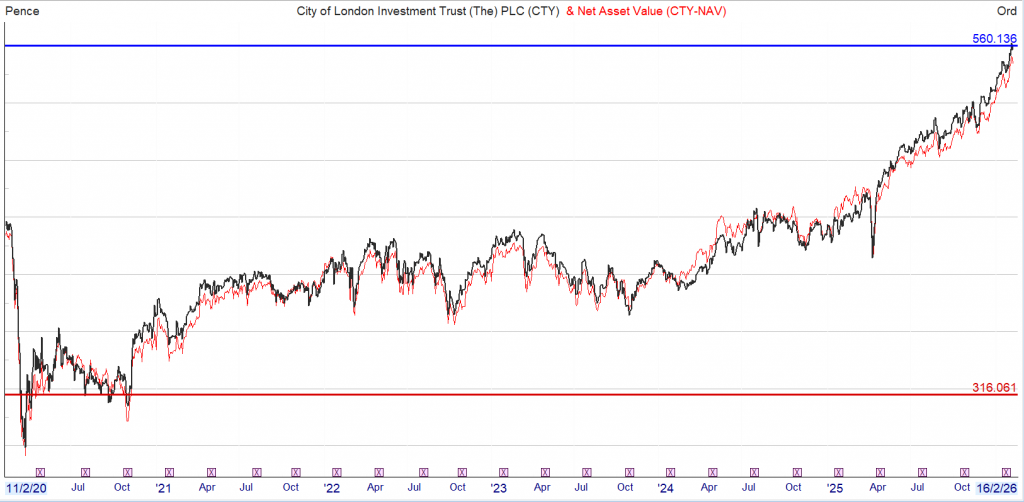
You knew that CTY had paid an increasing dividend for over 40 years. The share was sold off during the covid crisis as some shares cut their dividend forecasts but you knew that CTY had reserves to pay their dividend in crisis times and you knew that CTY had only had to use their reserves to pay their dividend, in 40 years plus, twice.
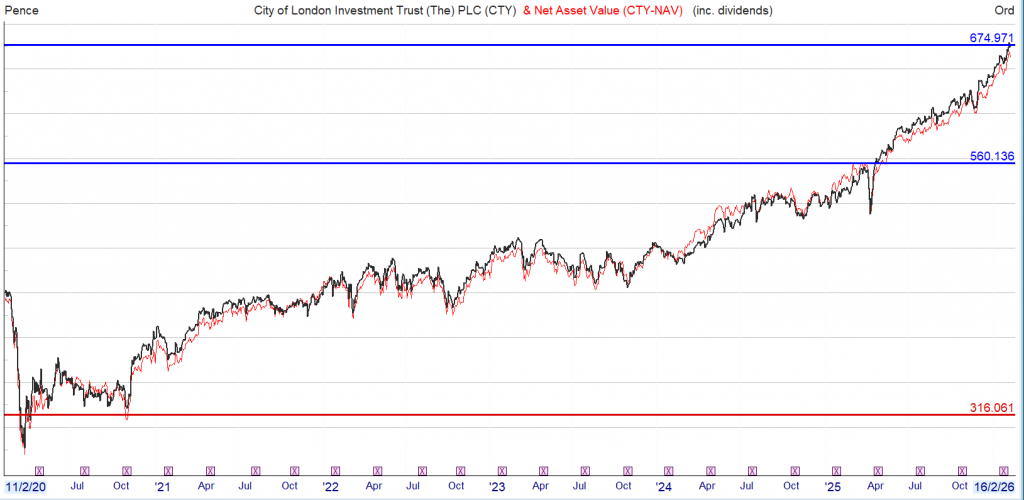
If you bought at 316p the dividend was 19p yield was 6%, the dividend is now 21.3p, you will receive the 6% plus yield for
One problem would be there were other dividend hero shares that were paying a higher yield as the prices fell but
With dividends included you have achieved the
The current yield is 3.8%, as the price rises the yield falls, you could take out your capital and invest in another higher yielding share and still earn 3.8% on a share that sits in your account at zero, zilch, cost.
Plus you would be earning say 8% on your new share, a yield of 12%.
NOTE
I was requested to include more memes for those where English is not their first language, keep everything crossed for another market crash, which becomes more certain as markets continue to rise, when is the known unknown, until then
Jon Smith highlights a REIT he thinks could be set for a long-term comeback as more people return to office working. It also comes with a generous yield.
You’re reading a free article with opinions that may differ from The Motley Fool’s Premium Investing Services. Become a Motley Fool member today to get instant access to our top analyst recommendations, in-depth research, investing resources, and more.
Real estate investment trusts (REITs) are companies that focus on property. By managing and leasing sites, income can be generated, making them attractive options for dividend investors. Ones that have been beaten down recently can be undervalued, with one high-yielding option catching my eye.
Why the stock is down
I’m talking about the Regional REIT (LSE:RGL). It focuses on regional office properties, mainly commercial buildings outside London’s M25. It owns and manages a portfolio of these and aims to generate income and capital growth from rents and asset value increases.
Over the past year, the stock ‘s fallen 12%, which is broadly in line with the portfolio’s net asset value (NAV) decline. In theory, these should correlate well with each other, although I note that the stock trades at a long-term discount to the NAV. This typically indicates weak sentiment towards the company, but in years to come it should reduce to be closer to the NAV.
The drop in the NAV reflects the decline in value in the commercial property market. However, I don’t see this as a big risk going forward. Several of my friends are slowly being forced back to working three or four days a week in the office. In a few years’ time, I think most traditional businesses will be back with staff in the office every day as standard. Based on this reasoning, I think the REIT’s long-term outlook’s positive.
Please note that tax treatment depends on the individual circumstances of each client and may be subject to change in future. The content in this article is provided for information purposes only. It is not intended to be, neither does it constitute, any form of tax advice.
Juicy income
Historically, Regional REIT’s paid income out quarterly. From looking at the dividend per share over the past year, the rise in dividend yield has come partly from the payout increasing, as well as the stock falling.
Aside from the yield, the main thing I look at is the dividend cover. It’s currently 1, which means earnings per share can completely cover the dividend. This is a good sign, as the business isn’t paying shareholders more than it can actually afford. One risk is that if it falls below par, then it’ll start eating into retained earnings, which isn’t great.
Another factor I check for REIT dividends is rent collection. In the latest quarterly update, this stood at 97.7%. I want this to be as close to 100% as possible, so that the company can maximise the revenue potential.
The outlook from here
Back in November, the company said: “Leasing momentum has been negatively impacted by the uncertainty stemming from the broader economic environment and specifically by the inconsistent messaging from the UK Government regarding the forthcoming budget“.
This has now passed, and I don’t feel it was as bad as many expected. Of course, it’s a risk going forward, but I think the next report should detail more management certainty about the UK economy for 2026, helping the stock. Overall, I think it’s a good income share for investors to consider.
Looking for the best dividend stocks to buy in 2026 ? These top real estate investment trusts (REITs) might merit serious attention, says Royston Wild.
You’re reading a free article with opinions that may differ from The Motley Fool’s Premium Investing Services. Become a Motley Fool member today to get instant access to our top analyst recommendations, in-depth research, investing resources, and more. Learn More.
Real estate investment trusts (REITs) can be an excellent way to target a long and lasting passive income. Dividends aren’t guaranteed, but they have qualities than can make them better income choices than most other UK shares.
Under REIT rules, companies must pay at least 90% of annual rental earnings out in dividends. This still leaves payouts sensitive to profits performance, but it also provides a higher level of income visibility for investors than most other stocks.
Should you buy Alternative Income REIT Plc shares today?
Despite ongoing uncertainties from Trump’s tariffs to global conflicts, Mark Rogers and his team believe many UK shares still trade at substantial discounts, offering savvy investors plenty of potential opportunities to learn about.
So what are the hottest REITs to buy right now. In my opinion, three of the hottest to consider are:
Schroder European Real Estate Investment Trust
Alternative Income REIT
Regional REIT
Each of these property powerhouses offers a forward dividend yield of at least 10%. Want to know what makes them true dividend heroes?
Please note that tax treatment depends on the individual circumstances of each client and may be subject to change in future. The content in this article is provided for information purposes only. It is not intended to be, neither does it constitute, any form of tax advice.
Euro giant
Schroder European Real Estate Investment Trust holds a top-class portfolio of properties in continental hotspots. We’re talking about highly desirable cities with strong economies and infrastructure. Think Paris, Berlin, and Hamburg, to name a few of its locations.
It’s a winning strategy that leads to reliable rent collection and strong occupancy (portfolio occupancy was 97%, latest financials show). The trust’s exposure to different sectors like logistics, office, retail, and data centres also gives it strength.
The forward dividend yield here is 8.1%. I think it’s a top trust to consider, even though adverse currency movements could take a bite out of earnings.
Another diversified REIT
Like the Schroder trust, Alternative Income REIT takes a diversified approach to the property market. If anything, things are even more wild and wonderful — they range from hospitals and petrol stations, through to hotels, gyms, and thermal power plants.
Its rent collection is even higher, at 100%. And its tenants are locked down on ultra-long contracts, providing protection from (if not totally eliminating) cyclical pressures on rent collection. The weighted average unexpired lease term for its 23 tenants sits at 17 years.
With more than 92% of rental income linked to inflation, too, Alternative Income is in great shape to grow shareholder payouts. For 2026, the dividend yield is a brilliant 8.5%.
Double-digit yield
At 10%, Regional REIT is today the highest-yielding property trust on the London stock market. It carries greater risk than the other contenders we’ve looked at, reflecting its narrow exposure to the UK and broader weakness in the office market in which it specialises.
This has caused its share price to slump over the past year (down 10%). But is the bad news now baked into the trust’s share price? I think it might be. As well as having that enormous yield, Regional REIT trades at a 51% discount to its net asset value (NAV).
To my mind, it’s a top recovery share to consider. The REIT retains a high-quality portfolio, and is selling non-core assets to boost occupancy and repair the balance sheet. As for dividends, this year’s predicted payout is covered more than twice over by expected earnings, providing a wide margin of error.
SERE
Schroder European Real Estate Investment Trust PLC – London and Johannesburg-listed property investor – Dutch telecommunications company Koninklijke KPN NV formally terminates its lease at Schroder European Real Estate’s Apeldoorn property. KPN occupies this mixed-use office and data centre property in Netherlands, representing about 19% of the company’s portfolio income and 6% of portfolio value as at September 30, 2025. The lease termination will take effect from December 31, 2026. Early this month, Schroder European Real Estate Investment warned of the risk of maintaining its dividend following the departure of KPN.
Kepler View
As the board notes, alongside broader market factors, two specific factors play a role in Schroder European Real Estate’s (SERE) persistent discount. The largest tenant, KPN, has already provided verbal confirmation and is expected to formally confirm shortly its intention not to renew its lease, which expires in December 2026. We note that this is a large site that, aside from its current use, could be repositioned for residential development. But it’s current mixed use, particularly as a datacentre, are in an area which is seeing strong tenant demand across Europe.
We understand from the manager that there is a strong case to believe that the French tax claim will not be paid, and the board confirms that it has received professional advice on the same basis. Alongside this change, there is now a timetable for when we might expect a resolution, and as the board notes, there is an appeal process should the initial assessment go against SERE.
SERE’s significantly wider than average discount, c. 36% , says to us that the market is taking a wait and see approach on the above issues and while that’s frustrating given that there has been an improvement in sentiment to REITs more generally, with some of SERE’s UK-listed peers turning in very good share price performances over the last year, taking this approach is understandable given the binary nature of both issues. Once the outcome of either or both is known, then SERE’s remaining portfolio, which has maintained a relatively stable valuation and income, could be significantly undervalued by the share price.
to the fact that bargain hunters have seized on the (briefly) wilting premium on 3i Group Ord III
But it also shows us that one particularly battered Association of Investment Companies (AIC) sector, Renewable Energy Infrastructure, continues to draw in buyers after a horrific run of performance.
both sit in the top 10 list for January and seem to be a common addition to portfolios, what with their ultra-high dividend yields and wide share price discounts to net asset value (NAV).
But shareholders have been through the wars: rising interest rates (and bond yields) did huge damage to share prices across the sector in 2022.
All manner of problems, from a backlash against renewable energy to low wind speeds in the first half of 2025 and a broader crisis for the investment trust universe, have continued to hurt returns in the following years.
The government confirmed its decision to go ahead with this option last week, although the news did in fact prompt the sector to rally. It’s worth asking what triggered this – and what bargain hunters buying the likes of UKW shares now need to understand.
Lesser evils – and the funds feeling the most pain
The sector rallied because the switch from RPI to CPI from April, while unwelcome, seemingly represented the lesser of two evils. The government had also considered temporarily freezing the subsidy level to make way for “a gradual realignment with the CPI”.
As the table below shows, some of the renewable trusts have substantial exposure to certain subsidy schemes and would see their NAV fall on the back of either change.
But the first option (now chosen by the government) is less harmful, with modest hits to NAV. While the damage is lessened, it’s the solar funds that are expected to take the biggest hit.
Estimated NAV impact of switching from RPI to CPI now vs a temporary freeze
Trust
Estimate of revenues from affected subsidies (%)
NAV change (%) from switching now
NAV change (%) from a temporary freeze
Bluefield Solar Income
50
-1.9
-9.9
Foresight Environmental Infrastructure
20
-0.3
-1.7
Foresight Solar
49
-2.2
-10.9
Greencoat UK Wind
40
-1.7
-6.1
NextEnergy Solar
45
-2.9
-10.3
The Renewables Infrastructure Group
15
-0.7
-2.5
Source: JPMorgan.
Buy or avoid?
As mentioned, there’s plenty to draw a bargain hunter in, from wide discounts to high yields.
In theory, we now have plenty of catalysts for a recovery: interest rates have been on a downward trend, high dividend yields mean investors are “paid to wait”, while such payouts are in most cases fully covered by earnings, and corporate action could also drive improvements. That could range from asset sales to mergers and buyouts.
Note, for example, that names such as Harmony Energy Income and Downing Renewables saw bids at decent premiums to share prices in the last year. That could prompt a recovery from depressed valuations.
It’s worth pointing out that not all specialists are keen on the sector at all, with Charles Murphy, senior research analyst at Singer Capital Markets, arguing that the underlying assets could ultimately prove hard to value in future, undermining the investment case.
Meanwhile, investors are seemingly overwhelmed with factors that complicate the picture, from shifts in power prices to bond yield moves and a political environment that looks increasingly hostile to the subsector.
As Hawksmoor’s Dan Cartridge adds, Reform UK is leading in the polls. “They have extreme negative views on the renewables sector,” he says. “That’s an ongoing reason for caution, although the next general election is still quite a long way off.”
Such considerations might understandably put off a potential investor. There are much simpler ways to bag a good yield, be it via a “core” infrastructure trust such as HICL Infrastructure PLC Ord HICL
(on roughly 7%), via equity income or via a UK government bond, whose 10-year instrument offers 4.5%.
Which trusts are the analysts favouring?
With the caveat that some may simply avoid a headache by not investing in the sector at all, trust brokers and analysts did pick out a few names they viewed as appealing.
as an interesting fund thanks to the fact that it’s so heavily diversified.
At the mid-point of 2025, the fund had a 27% allocation to wind power, with 14% in anaerobic crop digestion (where organic materials such as grass are broken down by microorganisms to produce renewable energy), 12% in solar power, 10% in biomass and smaller allocations to areas such as low-carbon transport and energy storage. The trust can have an eclectic mix of assets, with these including a fish farm in Norway.
Hawksmoor’s Cartridge is also a fan of Foresight’s diversification, while pointing to other trusts which have a good spread of assets and “where overall cash-flow profiles are more defensive” – for example with strong solar power generation last year to offset the falls suffered in wind generation. Here, he points to Octopus Renewables Infrastructure Ord ORIT
To briefly linger on these names, ORIT unveiled something of a turnaround plan in September where it promised to continue and extend its share buyback programme, look to reduce its debt, sell down some assets and make selective new investments.
TRIG sought to roll into stablemate HICL last year, a plan that ultimately fell apart after it caused a stink among HICL investors. However, this drama may have alerted investors to the existence of TRIG as a possible takeover target.
The case for Greencoat UK Wind
Meanwhile, Greencoat UK Wind remains popular with the professionals, much as it does with ii customers.
Cartridge notes that it has “a unique funding model that has been successful over a long time”, while Peel Hunt’s Markuz Jaffe adds: “We like Greencoat UK Wind for the pure-play domestic strategy. It remains simple and is perhaps most exposed to the subsidy amendment but is linking [dividends] to inflation even if that’s now CPI rather than RPI.
“It has been a leader in trying to address the discount, via buybacks, changes to management fees and recycling capital to reduce gearing.”
The Peel Hunt team also has an eye on Bluefield Solar Income as a tactical opportunity, with a focus on how its sale process and strategic review is progressing. The trust is expected to give an update when it publishes its interim results in March. Jaffe notes that its peer, Foresight Solar, also looks interesting because of this.
“The portfolio is quite vanilla, it’s on a wide discount and its closest peer is going through a sale process, so there’s reason to expect a catalyst for a material rerating in the shares,” he says.
Not all rosy
An improving environment does not guarantee a recovery. Note, for example, that interest rates have already been falling over the last year, with no discernible rebound for most of the trusts in this sector. And investors may want to tread carefully.
Cartridge notes some caution on certain specialist names, for example. He points to ii customer favourite NextEnergy Solar, noting that the dividend yield at the NAV level is “higher than the discount rate, pointing to it being unsustainable” and Bluefield Solar.
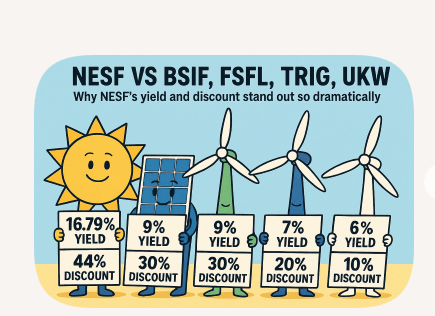
When it comes to NESF, it does have one of the highest yields in its sector.
However, the board has been in the midst of a strategic review “exploring all options to close the current discount”. Options discussed include exploring “opportunities to enhance shareholder returns” and upping the level of capital recycling. The findings of the strategic review are due out this year.
As ever, specialist funds tend to carry greater volatility than generalist options and can reward and punish adventurous investors in equal measure.