Passive Income Live

Investment Trust Dividends

Page 229 of 342

Puzzle solving

The Motley Fool

Story by James Beard

According to Forbes, Warren Buffett is the fourth-richest person on the planet, with an estimated fortune of $121bn. Unlike the three ahead of him — Messrs Musk, Bezos, and Ellison — he’s built his wealth primarily from investing.

I’ve been looking at his career to see how I might go about accumulating significant wealth, without having any savings to start with.

1. Start early

The first thing I’d have to do is begin investing as early as possible. Buffett bought his first stock when he was 11. He’s still investing 82 years later.

Do you like the idea of dividend income?

The prospect of investing in a company just once, then sitting back and watching as it potentially pays a dividend out over and over?

The longer the investment horizon, the more time there is for wealth to grow. And delaying a few years can make a big difference.

The table below shows how much £100 invested today could be worth over different periods. The figures assume an annual growth rate of 7.4% — the average yearly return (with dividends reinvested) of the FTSE 100, from 1984 to 2022.

Period (years)Final value (£)
5143
10204
20417
30851
401,738
8234,862

2. Reinvest those dividends

By withdrawing dividends, the FTSE 100 would have delivered growth of ‘only’ 5.3%. With this lower rate, £10 would have been worth £789 after 40 years — over 50% less.

This demonstrates the power of compounding, which has been described as the eighth wonder of the word.

Berkshire Hathaway, Buffett’s own investment company, doesn’t pay dividends. Instead, it reinvests the cash it saves by buying more shares.

This has helped its stock achieve a compound annual growth rate of 19.8%, since 1964. A sum of £1 invested then, would now be worth over £3.7m!

That’s why — as tempting as it might be to spend dividends on a one-off treat — I always reinvest them.

3. Don’t put all your eggs in one basket

Most investors emphasise the advantages of diversification — spreading risk across a number of stocks.

However, Buffett once said: “A lot of great fortunes in the world have been made by owning a single wonderful business. If you understand the business, you don’t need to own very many of them“.

Some have interpreted this as meaning that he doesn’t believe in owning lots of individual shares.

On the contrary, the point he’s making is that most of us don’t have the skills (or time) to undertake the necessary research to consistently pick winners. In fact, he’s a big fan of diversification for the amateur investor.

In 1993, the billionaire said the “know-nothing” investor is likely to out-perform the average fund manager by investing in a tracker fund.

These are a great way of spreading risk across many companies through the ownership of just one investment.

From 1964-2022, a fund tracking the S&P 500 would have returned 24,708%.

Of course, there’s no guarantee that history will be repeated.

4. Be patient

Finally, Buffett is quoted as saying: “It is not necessary to do extraordinary things to get extraordinary results“.

In my view, too many people get caught up trying to find the next ‘big thing’. Remember, slow and steady sometimes wins the race.

Investing small — and often — can be effective. A sum of £50 a month, earning a return of 5%, will grow to nearly £30,000 after 25 years.

I don’t think I’ll ever be a billionaire, but, in my opinion, it’s never too late to follow in the footsteps of Warren Buffett and start building wealth by investing in stocks and shares.
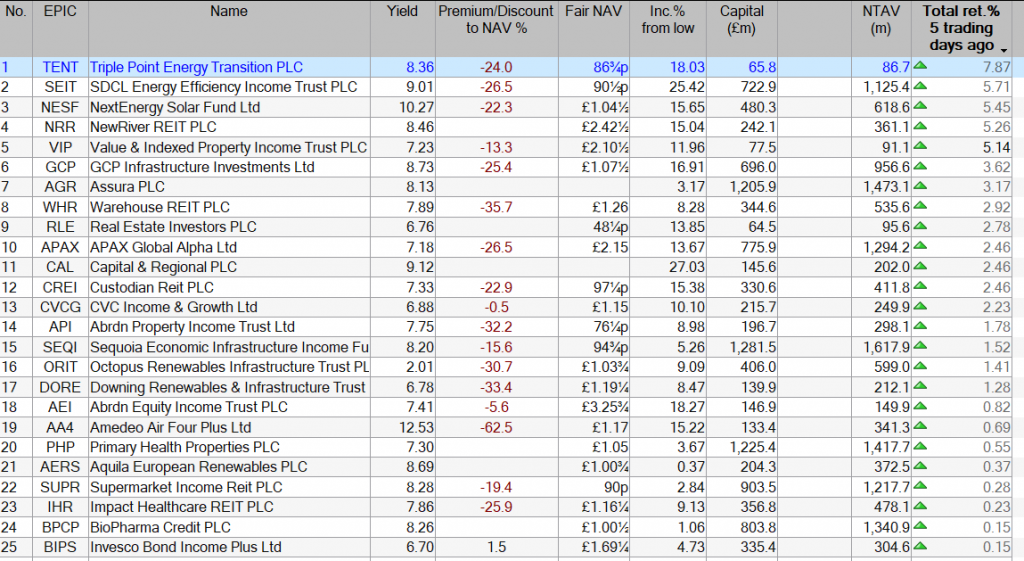
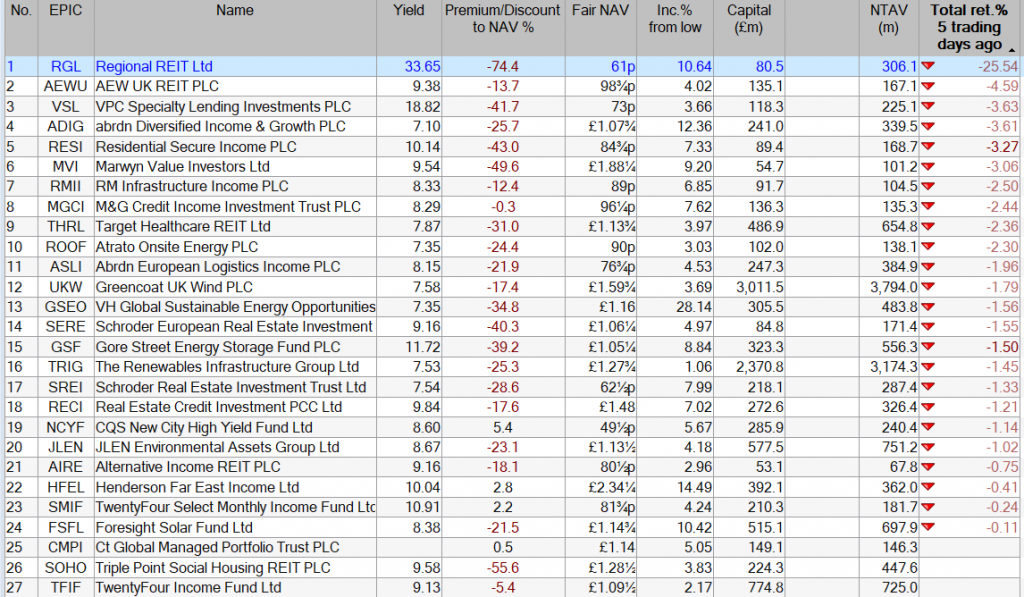
RGL

The blog portfolio will subscribe for it’s entitlement for the new shares to be issued at 10p.

With the cash from IDIG, dividends payable and current cash, there will enough cash, with no need to sell anything.

RGL intends to continue to pay dividends to keep its REIT status but they will be diluted by the new shares being issued.

When the new shares are issued the blog portfolio will be overweight with RGL so the intention is to sell some into the market if the price is favourable.

The Snowball

At the half way stage for this year, dividends received are £5,327.98

Cash for re-investment £1,443.99

Just ahead of the plan for income of 8k and a target of 9k.

I’d buy 11,987 shares of this UK dividend stock for £1,000 a year in passive income

Story by Ben McPoland

Solar panels fields on the green hills

Solar panels fields on the green hills© Provided by The Motley Fool

Perusing the FTSE 250, one dividend stock in particular stands out to me for its eye-popping yield. That’s NextEnergy Solar Fund (LSE: NESF), which has a huge 10.7% yield.

However, this renewable energy fund recently raised its payout for the 11th consecutive year. And the future still looks very bright, despite a big drop in the share price over the past few years.

Please note that tax treatment depends on the individual circumstances of each client and may be subject to change in future. The content in this article is provided for information purposes only. It is not intended to be, neither does it constitute, any form of tax advice. Readers are responsible for carrying out their own due diligence and for obtaining professional advice before making any investment decisions.

How it generates revenue

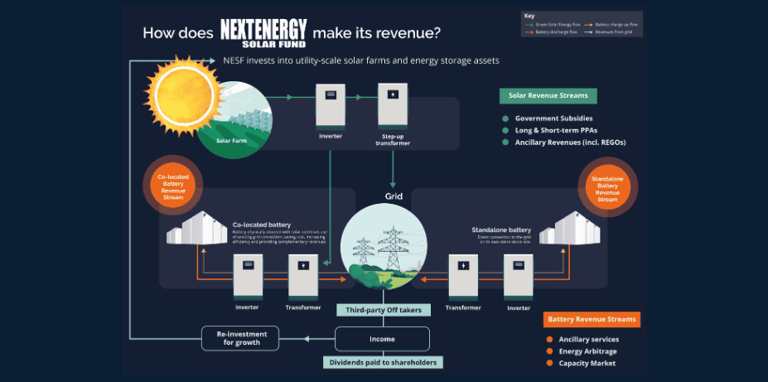
NextEnergy Solar is a specialist investor in solar assets and energy storage. At the end of March, its portfolio had 103 operating assets, enough to power the equivalent of 301,000 homes for one year.

Source: NextEnergy Solar Fund

Source: NextEnergy Solar Fund© Provided by The Motley Fool

A significant portion of the fund’s revenues comes from government-backed subsidies and power purchase agreements (PPAs). These are often indexed to inflation. This means that as inflation rises, the payments it receives also increase, providing a natural hedge.

Why is the share price in the doldrums?

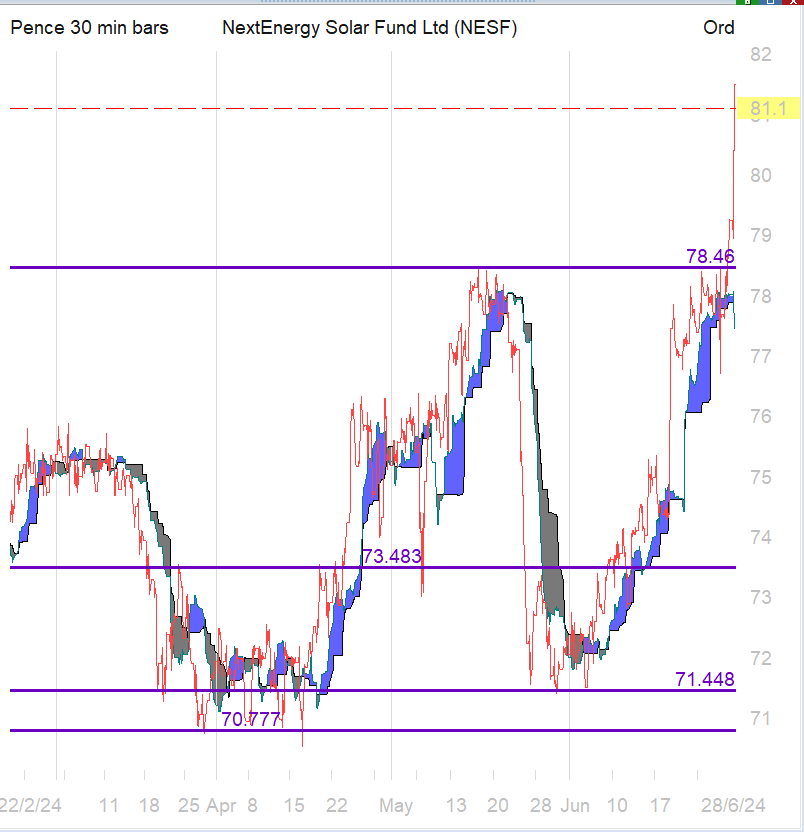
The share price has fallen from 126p at the start of 2020 to just 78p today. The chief culprit for this is higher interest rates. They’ve impacted the entire renewables sector by increasing the cost of financing for both existing and new debt.

At the end of March, the company’s financial debt was £338m. Of this, 32% was on a floating rate (not fixed), so the high-rate environment is an ongoing risk here.

To reduce debt, the company has embarked on a capital recycling programme. It recently sold a 35.2MW solar farm in Lincoln for £27m. This transaction represented a 14% premium to the March holding value, which is very encouraging to see.

Proceeds from this will be used to reduce the company’s debt. Three other assets are still up for sale.

Massive discount

Higher rates also tend to negatively impact the value of assets, including solar farms. Currently, the fund is trading at a whopping 26% discount to net asset value (NAV).

Chairwoman Helen Mahy said: “NextEnergy Solar Fund continues to maintain a strong financial platform in a challenging environment… [We] view the current size of the company’s discount to NAV as unjustified.”

Big passive income potential

I agree and think that when the Bank of England starts to cut interest rates, the share price could be set for a nice rebound. Longer term, I remain bullish on the clean energy sector and this fund in particular.

Meanwhile, there is that massive 10.7% dividend yield. At the current price, I’d need to buy 11,987 shares to aim for £1,000 in annual passive income. This would set me back £9,350.

While no payout is guaranteed, I reckon the chance to lock in such high-yield passive income is well worth the risk here. So I’m looking to buy this stock myself.

How to become an ISA millionaire

How to become an ISA millionaire
Investing is a long-term game so don’t expect to get rich quick with an ISA.

Performance can be volatile but by staying invested you benefit from the power of compounding.

If you can invest the full £20,000 annual ISA allowance each tax year and get a 5% return before fees, you could hit the million-pound mark in 25 years with a pot worth £1,002,269.08.

An annual return of 7% could get you to the million-pound target within 22 years, while a more conservative 3% would take 31 years.

“Starting your ISA investing early is a key component to joining the ISA millionaire club,” adds Hasler.

“Other important steps to getting the best returns and seeing that money grow are using your ISA allowance every year, investing wisely and regularly, then leaving the money there.”

Doceo Tip Sheet

The Tip Sheet

The Telegraph reveals its top pick among London’s generalist listed property funds, while This is Money notes that The European Smaller Cos Trust is ‘underpinned by rather good performance numbers’.

ByFrank Buhagiar

Questor: This fund is our pick of the property Reits

With so many London-listed property REITs to choose from wouldn’t it be handy if a national tipster came out with its top pick in the sector? Enter The Telegraph’s Questor, although the Column does make the reader wait for 15 paragraphs before the big reveal. For the record, the preceding 15 paragraphs run through how shares in generalist listed property funds trade at over 25% discounts to net assets and that these ‘abnormally wide discounts present a good opportunity with real estate recovering after a two-year slump’ – the commercial property market is showing signs of stabilising and encouragingly, rents are growing, most notably in the logistics sector.

As for which is Questor’s top pick, three funds stand out based on the latest round of financial results from the sector. First, there’s Custodian Property Income Reit. Questor thinks the 21% discount ‘looks great value for a diversified £412m portfolio of smaller properties outside London that is 40pc invested in industrials and 23pc in retail warehouses.’ What’s more, with the shares trading on an 8.4% prospective yield, shareholders are effectively being paid to wait for a recovery.

Next up, Schroder Real Estate on a 7.8% yield. According to Questor, ‘On a 23pc discount the shares look attractive, particularly with a 61.5pc exposure to industrial estates and retail warehouses.’ Although the article does points out that asset sales are required to lower the company’s debt levels which currently stand at 37% of assets.

Making up the top three, Picton Property Income. Like the Schroder fund, its £525m portfolio has a large weighting to industrials (59%). A further 7% is in retail warehouses and 30% in offices. But, ‘despite beating its commercial property benchmark for 11 years in a row, with 153pc growth in net asset value over 10 years, the shares languish on a 30pc discount.’ Compared to the previous two funds, Picton’s yield (5.5%) is lower, but growth prospects are higher thanks to having an estimated rental value 29pc above current rents’. Because of this, ‘While Custodian and Schroders may attract income seekers, we believe Picton could generate higher total returns.’ Guess that makes it the Picton of the crop.

This is Money THE EUROPEAN SMALLER COMPANIES TRUST: Fund that runs with the winners in global markets

The European Smallers Companies Trust’s turn under the This is Money spotlight. And it’s easy to see why. That’s because the fund ‘is underpinned by rather good performance numbers’. Over one year, the fund is up 23%. Over five years, the gain stands at 95%. ‘Trusts with a similar investment mandate have somewhat trailed in its wake.’

A big reason behind the strong numbers is the £739 million fund’s focus on investing in undervalued companies that are global businesses as opposed to being European-centric. So, even though many European countries are faced with economic and political uncertainty, businesses across the continent are still able to flourish.

Fund manager Ollie Beckett also cites the trust’s diversified portfolio – there are currently 131 holdings with the biggest position only accounting for 3.1% of the trust’s assets. As Beckett explains ‘In the smaller companies’ space, diversity pays – not high conviction investing. As an investment manager, you are going to get around 44 per cent of your stock picks wrong.’ Important then to squeeze as much as possible out of the 56% that are the winners ‘The key is to gain confidence in these winners, build positions and run with them. That way, you make profits for your shareholders.’

« Older posts Newer posts »

© 2026 Passive Income Live

Theme by Anders NorenUp ↑