3i Group PLC ex-dividend payment date AVI Global Trust PLC ex-dividend payment date Baillie Gifford China Growth Trust PLC ex-dividend payment date Barings Emerging EMEA Opportunities PLC ex-dividend payment date British Land Co PLC ex-dividend payment date Diverse Income Trust PLC ex-dividend payment date Fidelity China Special Situations PLC ex-dividend payment date Mercantile Investment Trust PLC ex-dividend payment date Templeton Emerging Markets Investment Trust PLC ex-dividend payment date
Five investment trusts wiping the floor with their open-ended siblings
Three-quarters of investment trusts have outperformed open-ended funds with the same manager and strategy, according to Wealth Club.
By Emma Wallis,
News editor, Trustnet
Investors would have been considerably better off choosing investment trusts over their open-ended siblings, according to new research from Wealth Club, which compared returns from 80 fund/trust pairs over the past decade.
Three-quarters (75%) of investment trusts delivered higher returns than their sister open-ended funds over 10 years on an underlying net asset value (NAV) basis, outperforming by an average of 5.3 percentage points.
Source: Wealth Club
The data is less conclusive on a total return basis, given that investment companies’ share prices have not, on the whole, kept up with their net asset values, resulting in pervasive discounts. Indeed, at present investment trusts sit on an unusually wide discount compared with their long-term history.
Over the long term, however, share price volatility accounts for a diminishing proportion of total returns, so although investment trusts’ share price returns have lagged their open-ended siblings over five years, they have outperformed over 10 years, as the chart below shows.
Source: Wealth Club
Five trusts in particular stand out for trouncing their open-ended siblings, outperforming by an average of 59.6 percentage points on an NAV basis.
The Montanaro European Smaller Companies trust is managed by George Cooke and Stefan Fischerfeier. The pair also managed the Montanaro European Smaller Companies fund until 31 March 2024, when Cooke stepped down from that particular strategy, although Fischerfeier continues to run it.
The trust has a £264m market capitalisation and its discount has widened by 3.2% over 10 years.
Performance of Montanaro European Smaller Companies fund vs trust over 10yrs on a total return basis
Source: FE Analytics
The JPMorgan UK Small Cap Growth & Income trust was recently formed through the merger of JPMorgan UK Smaller Companies and JPMorgan Mid Cap. Georgina Brittain and Katen Patel managed both trusts previously and now run the new entity.
For this study, Wealth Club compared the track records of the JPMorgan UK Smaller Companies trust with the open-ended fund of the same name.
Performance of JPMorgan UK Smaller Companies fund vs trust over 10yrs
Source: FE Analytics
In third place, the Schroder Asian Total Return trust and fund are both managed by Robin Parbrook, who was recently named FE fundinfo Alpha Manager of the Year, and King Fuei Lee.
Their best ideas portfolio of 40-50 stocks is complemented by derivatives to provide an element of capital preservation.
Performance of Schroder Asian Total Return fund vs trust over 10yrs
Source: FE Analytics
Nicholas Hyett, investment manager at Wealth Club, said investment trusts tend to outperform for three reasons: “gearing, reduced liquidity concerns and the opportunity to buy back their own shares”.
“Investment trusts let you invest in things like private equity and infrastructure, that are otherwise the preserve of institutions and the mega wealthy,” he explained.
“Not having to worry about meeting investor redemption requests at short notice means that investors can take positions in small illiquid companies they might otherwise avoid. A wider opportunity set, together with the ability to harvest the premium that is usually associated with illiquid stocks, has the potential to boost returns over the long term.”
Share tips 2024: MoneyWeek’s roundup of the top share tips this week – here’s what the experts think you should buy
Five to buy One to sell The rest…
BY KALPANA FITZPATRICK LAST UPDATED 14 JUNE 2024 If you’ve been keeping a close eye on share tips 2024, then don’t miss this weekly round up of the top stocks to consider for your portfolio each week.
The MoneyWeek share tips 2024 guide pulls together some of the best UK stocks from some of the top share tipsters around.
As well as the UK financial pages, we look at publications across the pond for investors who want to diversify their holdings internationally.
From investing in UK equities, European stocks, to finding the best performing stocks in the S&P 500 – here are our top share tips of the week.
Share tips 2024: top picks of the week FIVE TO BUY
QinetiQ (LON: QQ) The Telegraph QinetiQ’s shares have doubled since 2017. The defence contractor’s upgraded guidance, rising revenue, stable profit margin and potential for future acquisitions reflect its solid financial position. With Nato members expected to increase defence spending and a modest price/earnings (p/e) ratio, the company’s capital growth potential and share buyback programme make it an attractive investment. Some investors may be tempted to sell after large gains, but it’s “more logical” to keep buying. 451p
Sanderson Design Group (LON: SDG) The Sunday Times Sanderson Design Group, a luxury interior-furnishings business hit by the housing market slowdown, has made significant improvements despite challenging conditions. It has increased inventory, boosted margins, and pocketed record licensing revenues from its designs. It has a solid balance sheet and has seen strong growth in the US. Falling inflation and increased consumer confidence after the general election could help the stock. 106p
Oakley Capital Investments (LON: OCI) The Mail on Sunday Private equity has a bad reputation, but Oakley Capital Investments is different. It focuses on helping companies grow by working with management and taking a conservative approach to debt. It has a portfolio of 28 companies, and recently invested in a French healthcare consultancy and a German broadband business. Oakley’s shares are a “bargain”, with the group’s investments valued at 693p a share. The stock has risen by 18% in two years and there is further to go. 490p
On the Beach (LON: OTB) Shares Investors are taking notice of On the Beach (OTB) after positive first-half results and an analyst upgrade. The online package holiday provider trades at just 8.6 times its September 2025 forecast earnings and is returning to meaningful dividend payments. There is potential for further market-share growth in the long-haul and premium holiday markets. OTB has also secured a partnership with budget carrier Ryanair, and consumers’ appetite for travel is expected to remain healthy. OTB is a “big value opportunity” for investors. 142p
Paragon Bank (LON: PAG) Investors’ Chronicle Paragon’s strong interim results bode well. With robust deposit growth, a higher net interest margin, and improving mortgage and commercial lending, underlying pre-tax profit at the specialist lender rose by 13.5% to £146m. Signs of recovery have prompted Paragon to upgrade lending and net-interest margin guidance for the year. It’s “difficult to argue with the quality of the earnings and the expected shareholder returns”. 749p
ONE TO SELL
Petrofac (LON: PFC) Investors’ Chronicle Petrofac has missed a coupon payment and is in default. The energy engineering and services company is seeking a cash injection of $300m to avoid insolvency, but not all lenders support the rescue package. Liabilities amount to $1.7bn, and Petrofac experienced a $222m cash outflow in 2023. Despite an $8bn order backlog, new contracts, and the wider industry’s rude health, Petrofac’s future looks uncertain. “Most investors probably left the sinking rig some time ago,” but those that didn’t will hope there’s something to salvage now its shares are no longer suspended. 22p
THE REST… Taylor Wimpey (LON: TW) The Telegraph Housebuilder Taylor Wimpey’s outlook is “increasingly upbeat”, with falling inflation, expected interest-rate cuts and a faster-growing economy, leading to higher profitability and dividend growth. Given the 6.3% dividend yield, solid balance sheet and strong competitive position, Taylor Wimpey looks appealing. Buy (152p)
National Grid (LON: NG) This is Money National Grid is raising £7bn through a rights issue to support a £60bn plan to upgrade its energy-transmission networks. The ambitious proposals reflect a shift towards wind, solar and nuclear power. The underwritten issue ensures National Grid will receive the funds to fuel its growth. Shareholders could end up with 30% more stock in a business with a “decent record, a strong growth agenda, and attractive dividends”. 871p
Currys (LON: CURY) Shares Shares in Currys recently surged by 32%, with investors buoyed by the turnaround potential of the electrical retailer and upgraded pre-tax profit guidance. CEO Alex Baldock attributes the success to strengthening performance in the UK, Ireland and the Nordics, with sales and margins improving. Despite the recent rally, Currys’ shares are still trading at a low 8.5 times earnings. Keep buying (80p).
Dr. Martens (LON: DOCS) Investors’ Chronicle Dr. Martens’ sales for the year ended in March fell 12%, leading to a 43% drop in pre-tax profit to £97.2m. The boot maker slashed the dividend, while North America remains challenging. The firm expects a difficult year. Despite a new CEO and cost cuts, “the road to recovery looks long and exhausting”. Sell (86p).
REIT good idea ? sorry but a British take on a Yorkshire accent.
Real estate investment trusts (REITs) can be a powerful addition to a retirement portfolio. These types of businesses are notorious for offering impressive dividends that can build into a chunky passive income with minimal effort. And when left to reinvest over the long term, a carefully constructed portfolio of top-notch stocks could even transform into a £500,000 nest egg.
The power of investing regularly Dividend investing often doesn’t get associated with high levels of growth. After all, it’s typically only large mature businesses that redistribute excess earnings back to shareholders. Yet despite this, dividends have historically provided the lion’s share of investment returns. In fact, since 1960, an estimated 85% of gains have come from shareholder payouts. There are a few reasons behind this phenomenon. However, the leading catalyst is the miracle of compounding. By regularly investing a lump sum each month, as well as automatically reinvesting any dividends received, the number of shares owned in each business increases. For each additional share, more dividends are received when the next payment date comes around. And this process repeats then repeats itself over and over again in a wealth-building loop.
Turning £500 into £500k Ensuring that a portfolio has a constant, steady stream of capital is essential. The more an investor can spare each month, the better. However, it’s critical to try and mitigate, or better, eliminate any risk of falling short. Why? Because in the long run, missing out on even just one month of investing can leave a lot of money on the table.
To demonstrate, £500 compounded at 9% for 25 years is worth around £4,700. In other words, for each missed month, investors lose almost five grand of wealth. But for those who consistently invest at this rate of return without missing a beat, they can expect to have just over £560,000.
Of course, achieving a 9% return each year is easier said than done. The FTSE 100 has historically only offered around 8%, and over the last decade, it’s actually been closer to 6%. This is where REITs come to the rescue. With their chunky yields and steady share price appreciation, reaching a 9% target becomes a bit more straightforward.
Could buying dividend shares be the key to financial freedom?
Provided by The Motley Fool
By Charlie Keough
I want to build my wealth by buying dividend shares. I think it’s one of the simplest ways for me to reach financial freedom. After all, creating a stable cash flow that allows me to stop worrying about money is the dream, right?
Compounding gains
I could go on about why I think shares that provide income are an effective way to build wealth. But there is one key reason. That’s because they allow investors to benefit from the power of compounding.
With the dividends I receive, I use these to buy more shares in the companies I own. Through this, it means that I earn interest on my interest. It also means that I’m able to build up my investment pot a lot quicker.
Warren Buffett once said: “If you don’t find a way to make money while you sleep, you will work until you die”. That’s a quote I’ve tried to heavily instil into my investment strategy.
A favourite of mine
In my attempt to achieve financial freedom, I’m turning to the FTSE 100. The index is home to market-leading companies that have stable cash flows and, as a result, rising yields. That sounds perfect.
That said, there are plenty of companies out there that offer a meaty yield. But I only want to buy the best. I don’t want to buy shares today only for the yield to be reduced or cut in the times ahead. There is always that risk with dividends.
Building a lifelong passive income strategy is not easy. If you really want to retire comfortably you’ll have to put in the work — and the money — to make it happen.
Shortcuts and get-rich-quick schemes seldom work.
As the saying goes, ‘Money doesn’t grow on trees’. However, it can grow in a portfolio of high-yield dividend shares with compounding returns.
With that said, a three-step strategy to building a passive income stream to retire in style.
Step 1: Open a Stocks and Shares ISA You don’t need a Stocks and Shares ISA to begin investing but it’ll certainly make my money go further.
See, with a Stocks and Shares ISA, I can invest up to £20,000 a year tax-free.
Depending on my returns, the ISA fees are likely to pale in comparison to the amount the tax break saves me. There are several options available for UK citizens to open a Stocks and Shares ISA and start investing today. Please note that tax treatment depends on the individual circumstances of each client and may be subject to change in future. The content in this article is provided for information purposes only. It is not intended to be, neither does it constitute, any form of tax advice.
Step 2: Invest in a portfolio of high-yield dividend shares So what shares should I put in my ISA?
While it might seem attractive, it’s usually best to avoid ‘flavour of the month’ shares like booming tech stocks. These might bring short-term gains but usually lack resilience and seldom pay dividends.
Well-established companies that pay high-yield dividends offer more consistent returns even when markets are stagnant.
It’s important I create a diversified portfolio of shares, so I’d add some companies with lower dividends but a more stable share price. I could also add some ETFs to offset unexpected market volatility.
Step 3: Reinvest dividends and contribute further For the final step, it’s important to ensure I benefit from the magic of compound returns. Using a dividend reinvestment plan (DRIP), I would reinvest my dividends and maximise the value of my investment.
More importantly, I should continue to make some monthly contributions to my investment. Even just a few hundred pounds a month can make a real difference in the long term.
£££££££££££££
If u are investing small sums, u do not need to pay for an ISA until u use up your tax free entitlements, which might change with the next government. With a small but growing account it would be better to use an ISA provider who charges a percentage of your portfolio rather than a fixed fee.
Sequoia Economic Infrastructure Income Fund Limited
(“SEQI” or the “Company”)
Monthly NAV and portfolio update
The NAV per share for SEQI, the specialist investor in economic infrastructure debt, increased to 94.30 pence per share from the prior month’s NAV per share of 92.46 pence, representing an increase of 1.84 pence per share.
A full attribution of the changes in the NAV per share is as follows:
The valuation of most fixed rate instruments (which represents 58.6% of the portfolio) has increased during May 2024 due to the marginal reduction in risk free rates and a sustained reduction in benchmark spreads for certain instruments, predominantly in the utility and power/energy sectors. This has also resulted in a reduction in the pull to par from 4.2 pence per share in April 2024 to 3.8 pence per share in May 2024. The Investment Adviser also expects abating inflation to provide a foundation for steadier credit markets, highlighting that the long-term outlook on inflation and base rates points towards a beneficial tailwind to the Company’s NAV, as falling rates would typically increase asset valuations.
As the Company is approximately 100% currency-hedged, it does not expect to realise any material FX gains or losses over the life of its investments. However, the Company’s NAV may include unrealised short-term FX gains or losses, driven by differences in the valuation methodologies of its FX hedges and the underlying investments – such movements will typically reverse over time.
Market Summary
During May 2024, central banks across the UK, US and Eurozone maintained policy rates at 5.25%, 5.50% and 4.00%, respectively. On 06 June 2024, the Eurozone announced the first rate cut of 0.25% to 3.75%, as CPI inflation has declined in the region to 2.4% as at April 2024. On 12 June 2024, the Federal Reserve held rates steady in the US and signalled that just one rate cut is to be expected by the end of the year. In the UK, the next policy rates announcement will be held on 20 June 2024 and the markets have priced in at least one rate cut by the end of the year.
Five-year sovereign debt yields were down marginally in the UK and US by 0.5% and 0.2% respectively, and up marginally by 0.1% to 2.7% in the Eurozone during May 2024. In the UK, the most recent data on annual CPI inflation shows that it has fallen to its lowest level in almost three years, as prices rose by 2.3% in April 2024, down from 3.2% in March 2024. Inflation is also trending in the right direction in the US, down from 3.8% in March 2024 to 3.6% in April 2024. CPI inflation is expected to return closer to the 2% target by the end of the year across all three regions, mainly due to the unwinding of energy-related base effects.
Most people would love to have an extra grand a month in passive income. I most certainly would, which is why I regularly invest in dividend stocks.
Here, I’ll set out a realistic five-step road map to aim for this goal.
1. Build a solid base
Warren Buffett’s right-hand man, the late Charlie Munger, famously said: “The first rule of compounding: Never interrupt it unnecessarily.”
However, once a large expense inevitably cropped up, I had to dip into my portfolio and sell shares –sometimes at a loss — to cover the payment. I was breaking Munger’s first rule of the wealth-building process
Therefore, it’s important to first have a rainy-day fund to cover such expenses and leave the portfolio uninterrupted.
2. Open the right account
Next, I’d make sure I’m investing in the most tax-efficient account possible.
In the UK, this would be a Stocks and Shares ISA, as dividends and interest are free from income tax, while any capital gains are exempt from capital gains tax.
Please note that tax treatment depends on the individual circumstances of each client and may be subject to change in future. The content in this article is provided for information purposes only. It is not intended to be, neither does it constitute, any form of tax advice. Readers are responsible for carrying out their own due diligence and for obtaining professional advice before making any investment decisions.
Buy top-notch shares
Once I’m ready to buy shares, I’d focus on researching and investing in established companies with a solid track record of generating profits. I’d avoid risky biotech start-ups and speculative penny stocks.
One that I think would make a great starter stock today is Diageo (LSE: DGE).
Mind you, this hasn’t stopped the FTSE 100 stock from falling 23% in the past year alone!
The reason is that some consumers, especially in North and Latin America, have been trading down from the firm’s premiums brands, hurting profits. This is understandable considering how high inflation has ripped a hole in people’s budgets.
Weak consumer spending is the main risk with the stock today. We don’t know how long it will persist.
However, Diageo encountered slowing sales during the financial crisis almost 20 years ago. It bounced back from that and I reckon it will from this tricky period.
Meanwhile, the stock is cheaper than usual and offering a 3.1% dividend yield for 2024. And while no payout is guaranteed forever, Diageo makes plenty of cash and is classed as a Dividend Aristocrat.
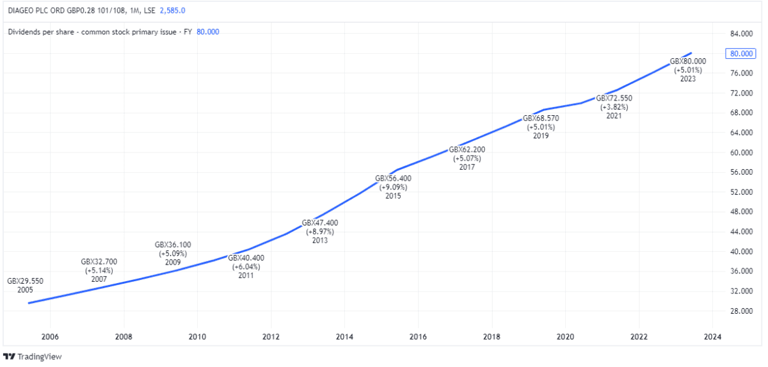
Diageo Dividend per Share (2006-2024)
Created at TradingView Provided by The Motley Fool
Reinvest dividends
As I’m building my portfolio, I’d want to reinvest the dividends I receive rather than spend them.
This fuels the compounding process, which is where interest earns more interest.
Start enjoying dividends
If I invest £500 a month and achieve an average 8% return annually, I’d end up with £284,639 after 20 years.
This return isn’t set in stone, but it is the ballpark average over time.
A £284k portfolio of stocks yielding just 4.25% would generate £12,097 in yearly passive income. Many UK stocks often yield far higher than this though.
The post 5 simple steps to build a £1,000 a month passive income portfolio appeared first on The Motley Fool UK.
Of course, the decade ahead looks hazardous. What with inflation recently hitting 40-year highs, a ‘cost of living crisis’ and threat of a new Cold War, knowing where to invest has never been trickier.