Passive Income Live

Investment Trust Dividends

Page 97 of 343

Across the pond

Contriain Investor

Pillar #1 – Consistent Dividend Hikes

Most investors approach dividend paying stocks backward.

Here’s how it usually works …

An investor will scan the markets looking for stocks paying a high dividend. After all, if a company is currently paying a high yield, it’s a great investment, right?

Dead wrong!

In fact, looking at the CURRENT yield is one of the slowest ways to grow your money.

You see, if you’re focused on current yields, you’re too late to the party. All the major gains have already been made. You’ll need to settle for earning a paltry 4%, 5%, maybe 6% per year … with minimal stock-price appreciation, too.

Sure, chasing high current yields will provide you with instant gratification, but it won’t give you the recession-resistant income … or the 15% year on year returns we want.

Instead, you need to focus on consistent dividend hikes.

In my opinion, selecting companies with a proven track of increasing their dividend payments is one of the safest, most reliable ways to get rich in the stock market. You see, every time a company raises its dividend, you start earning more from your original investment.

For example:

On a $1,000 initial investment, $30 in dividends equals a 3% return. Later, if the dividends go up to $40 a year, you are effectively earning 4% on your initial $1,000 investment.

As this trend continues, you could easily be earning 10%, 15%, even 20% per year just from rising dividends, as your initial investment never changes.

However, this ever-growing income from dividend hikes is just ONE part of the puzzle. To engineer real growth and quickly double an initial investment, we must combine Pillar #1 with the next two pillars of “Hidden Yield Stocks.”

Pillar #2 – Lagging Stock Price

After years of active investing, I’ve only ever found one surefire way to predict whether a stock will go up or down.

I call it the “Dividend Magnet,” and here’s how it works …

After you’ve identified stocks that are built on the foundations of Pillar #1 (consistently hiking their dividends), you want to narrow your search to companies whose share price LAGS behind the rate of dividend increase.

Why? Well, it’s simple really …

Share prices almost always increase as dividends increase.

This is because as a company hikes its dividend, mainstream investors tend to flock to the stock, chasing the new, higher yields. And this inevitably bids up the share price.

Let me give you a few examples where the dividend acts like a floor to keep bumping the share price higher:

UnitedHealth Group: Dividend Up 460% Share Price Gains 510%

Mastercard: Dividend Up 500%, Share Price Gains 532%

Cisco Systems: Dividend Up 111%, Share Price Gains 113%

As you can see in these examples, the stock price lags behind the dividend increases at some point in time …

However, as more investors notice the company’s soaring dividend and buy in, the price lag closes—sending the share price soaring.

So, by investing in the right companies whose share prices have fallen behind despite consistent dividend hikes, you can buy the stock, safe in the knowledge the Dividend Magnet will eventually pull the price up.

Now, investing with Pillar No. 1 and No. 2 alone would stand you in great stead.

However, there’s one final Pillar of a “Hidden Yield Stock” that can rapidly accelerate both the share price and dividend payouts …

Pillar #3 – Stock Buybacks

Uncovering companies that are buying back their stocks is one of the fastest ways to accelerate your gains.

You see, when a company buys back its stock, it is improving every single “per share” metric investors watch (earnings, free cash flow, book value, etc.).

After all, if a company reduces the number of its shares by 50%, its earnings per share will automatically DOUBLE without any actual increase in profits. And I probably don’t need to tell you what will happen next …

Investors quickly bid up the stock’s price to bring it back in line with the value it was trading at before. Indeed, my research shows that simply investing in stocks that are reducing their share counts can help you beat the broader market’s performance.

And it’s important to bear in mind that S&P 500 companies are sitting on huge piles of CASH (more than $1 trillion in all!). They’re rolling out fresh buybacks amid continued economic growth post-pandemic, and they’re getting a nice upside kick in return.

You can see this just by looking at the shares of Union Pacific (UNP), which took an impressive 31% of its stock off the market in 10 years, helping drive a 100% gain in the share price!

And that’s just one example. By targeting cash-rich companies that either continue to buy back shares now or have a long record of doing so (even if they’re holding off today), you can set yourself up for HUGE price gains.

In short …

Combine the Three Pillars … Buybacks,

Dividend Hikes and Price Lags, and Your

Yearly Returns Can Be Absolutely Astounding

DIY Investor Diary

DIY Investor Diary: why this is the only fund in my SIPP

A DIY investor explains how he is investing during retirement, naming his top tips for younger investors, and explaining why he has opted for just one fund in his self-invested personal pension (SIPP).

24th October 2023

by Kyle Caldwell from interactive investor

Thumbnail of our DIY Investor Diary series.

In our DIY Investor Diary series, we speak to interactive investor customers to find out how they invest in funds and investment trusts, what their goals and objectives are, current issues and concerns regarding their portfolio, and what they’ve learned along the way. The premise is to try and provide inspiration for other investors, and we would love to hear from more people who would like to be involved.

When it comes to fund investing, one of the most common questions is whether there’s an ideal number of funds for a portfolio to strike enough balance between risk and reward.

However, as is common with other investment-related questions, there’s no “magic number” that investors should be aiming for.

Although, there is a pitfall to avoid: buying too many funds or investment trusts. If you treat funds like sweets and have too many, you risk ending up doing damage through over-diversifying and unwittingly replicating the market. This is known as “diworsification”.

For example, if you own half a dozen or more UK funds, you could potentially end up owning hundreds of different companies. That makes it harder to beat the stock market because your portfolio ends up looking like it. 

If you want to invest in hundreds of UK shares, this can be done much more cheaply through a passive fund – either an index tracker or exchange-traded fund (ETF).

Therefore, it is important to ensure that each fund is bringing something unique to the party in terms of how it invests and what it is investing in.

The individual profiled in this DIY Investor Diary article ensures that there are no obvious areas of overlap in his fund holdings. He and his wife havehad a stocks and shares ISA for around 20 years, and during this time typically held half a dozen funds in each. 

He said: “I invest in different regions to have diversification, but at the same time I want to avoid being over-diversified, which is why I don’t have a high number of funds. I don’t want to have funds owning the same stocks.

“It is also important to have a manageable number of funds in order to be able to concentrate on them at any one time.”

Examples of funds held over that 20-year period include Artemis IncomeMarlborough UK Micro Cap GrowthJupiter European and Templeton Global Emerging Markets.

Longevity and consistency of performance are among the main qualities he looks for when sizing up funds.

He says: “I like to invest in fund managers who have been running money for a while and those that have a decent track record over three, five and 10 years. I don’t pay much attention to the one-year figure, as anyone can shoot the lights out over the short term.”

However, for his self-invested personal pension (SIPP), just one fund is held: Vanguard LifeStrategy 100% Equity. This passive fund provides diversified exposure to global stock markets by investing in 10 index funds managed by Vanguard. It is considered a potential one-stop shop holding, or a core holding, due its approach.

One of the main reasons why our DIY Investor has opted for just one passive fund is “to keep things simple”.

“It is a very straightforward fund, so I don’t have to think about it much. If I had chosen an active fund or a couple of them, I would need to monitor their performance more closely. I want to enjoy my retirement and focus on that rather than chop and change fund holdings.”

While there are lower-risk options available in the LifeStrategy range, with the four other funds having lower equity content and the balance in bonds, our DIY investor is prepared to accept higher risks in pursuit of potentially greater rewards.

He prefers equities as shares are a growth asset, which is why he went for the 100% option as he doesn’t want exposure to bonds. While the income that bonds offer is more reliable than company dividends, the disadvantage is that as the income is fixed, it does not rise with inflation.

Our DIY investor says that while he is withdrawing from the SIPP, he still wants to see the money that’s remaining growing over time. In addition, he likes the Vanguard fund’s home bias, which is a 25% weighting to UK equities. 

He says: “Our occupational pensions are available in full in 2.5 and four years respectively. However, both could be taken immediately if needed. The SIPP withdrawals can reduce at that point if necessary or, more probably, reduce at age 67 when our full state pensions become available, to keep our respective incomes below the 40% tax thresholds. The SIPPs can then grow in the background as part of our inheritance tax planning.”

Our DIY Investor points out that due to having the workplace pensions and state pensions further down the line he is “happy to take on the risk” of having the SIPP invested in one passive fund and 100% in equities.

In addition, to the ISA, SIPP, and workplace pensions, three bank shares are held: Barclays Lloyds Banking Group and NatWest Group . He views this separate pot as “fun money”, and notes that the “UK banking sector is one we are familiar with investing in.”

The couple also have Premium Bonds and cash savings that are kept below interest tax allowances.

He views the state pension as a “nice to have”, rather than as central to retirement planning. “We are deliberately not relying on the state pensions, regarding them in our overall planning as ‘nice to have’ rather than guaranteed,” he says.

Taking money out of the ISA is being prioritised, due to ISA money typically forming part of an individual’s estate for inheritance tax (IHT) purposes. A SIPP, however, does not form part of an estate for IHT purposes. If you die before age 75, the beneficiary pays no tax. For those who die after 75, beneficiaries will pay tax at their marginal rate on any income they receive.

Our DIY Investor adds: “This is all money set aside for our retirement and we are making a point of enjoying it while we are still fairly young. Our children are all planning and investing towards their own retirements with our support and guidance, although they will get some kind of legacy of course (within overall IHT limits).

“We’re currently drawing slightly over the natural yield from the SIPPs in the knowledge that we have no mortgage or debts, with other savings and investments to fall back on if needed.”

His top tips for fellow investors, and in particular for those who are younger, is to “start as early as possible” to benefit from the wonder of compound interest. “Even if it is only £25 a month, it is worth doing. Also if you are younger, don’t go for cash, go for the stocks and shares ISA instead,” he says.

Another tip is to increase your monthly investments when a pay rise comes into effect to “help keep pace with inflation”.

What’s your plan.

How much passive income will I need to retire comfortably?

Story by Royston Wild

A senior group of friends enjoying rowing on the River Derwent

A senior group of friends enjoying rowing on the River Derwent© 

Provided by The Motley Fool

After spending a lifetime at work, we all hope to enjoy the kick back and enjoy the fruits of our labours. But exactly how much passive income will we need to live comfortably? This can vary substantially from person to person.

The good news is that investors today have more opportunities than ever before to hit their retirement goals. Here’s how I’m confident of achieving a luxurious retirement.

The target

As I mentioned, the exact amount a person needs in later life will vary, depending on factors like their retirement goals, where they live, and their relationship status.

Yet it’s worth considering what the Pensions and Lifetime Savings Association (PLSA) says the average person needs for a comfortable retirement to get a rough ball park estimate.Source: PLSA

Source: PLSA

Its latest research shows that the average one-person household requires a £43,900 yearly income for a comfortable lifestyle. This level of income would provide for essentials and extras like a a healthy budget for food and clothes, a replacement car every three years, and a two-week holiday in the Med and frequent trips away each year.

The figure for a two-person household is £60,600.

A £38k+ income

There are many paths individuals can take to hit that goal. They can invest in property, develop a side hustle, or put money in dividend- and capital gains-generating shares, for instance.

I’ve personally chosen to prioritise investing in global stocks to make a retirement income, with some money also put aside in cash accounts to manage risk. With an 80-20 split across these lines, I’m targeting an average annual return of at least 9% on my share investments and 4% on my cash over the period.

Let me show you how this works. With a monthly investment of £400 in shares and cash, I could — if everything goes to plan — have a £641,362 nest egg to retire on.

If I then invested this in 6%-yielding dividend shares, I’d have an annual passive income of £38,482. Added to the State Pension (currently at £11,975), I could easily achieve what I’ll need to retire in comfort.

Of course, investing in shares is riskier than putting all my money in a simple savings account. However, funds and trusts like the iShares Core S&P 500 UCITS ETF (LSE:CSPX) can substantially reduce my risk while still letting me target the strong long-term returns the US stock market can provide.

Remember, though, that performance could be bumpy during broader share market downturns.

This exchange-traded fund (ETF) has holdings in all the businesses listed on the S&P 500 index. As well as providing me with excellent diversification by sector and region, it gives me exposure to world-class companies with market-leading positions and strong balance sheets (like Nvidia and Apple).

Since 2015, this iShares fund has provided an average annual return of 12.5%. If this continues, a regular investment here could put me well on course for a healthy passive income in retirement. It’s why I already hold it in my portfolio.

The Snowball

As the Snowball rolls down a hill it gathers more snow.

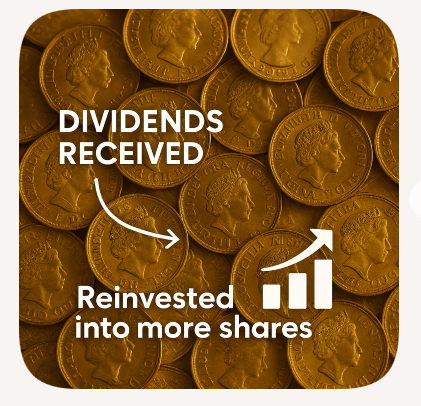
The blog gathers more shares every time it re-invests the dividends.

When the market crashes most shares fall at the same time, you could always sell your shares but easier with hindsight and if your are out of the market you will not have dividends to re-invest.

The Snowball is going to build, over time one position that can be sold to buy a market bargain. Without hindsight you can only buy at the bottom with luck but you can buy the yield when it falls to a yield you would be happy to earn forever.

The yield will be less than 7%, so it will be a drag on performance, that is until the market crashes but the income for the Snowball will still equal this year’s fcast of a yield of 9%. Cash for re-investment to be received on Thursday.

£10k to invest ?

A UK share, investment trust and ETF to consider for an £870 second income this year

The London stock market’s a great place to invest for a second income, in my opinion. Here are three top dividend stocks on my radar.

Posted by Royston Wild

Published 8 June

Shot of an young mixed-race woman using her cellphone while out cycling through the city
Image source: Getty Images

When investing, your capital is at risk. The value of your investments can go down as well as up and you may get back less than you put in.

Diversification’s critical when seeking a reliable second income over time. A broad portfolio can absorb individual dividend shocks better than one containing just a handful of stocks.

Spreading risk over a number of investments doesn’t mean settling for inferior returns either. Take the following shares, investment trusts and exchange-traded funds (ETFs), for example:

StockForward dividend yield

Target Healthcare REIT8.6%

iShares World Equity High Income ETF9%

Phoenix Group (LSE:PHNX)8.5%

As you can see, the dividend yield on each of these stocks comfortably beats the FTSE 100 average (currently around 3.4%). It means a £10,000 investment spread equally across them could — if broker forecasts are accurate — provide an £870 passive income over the next year alone.

What’s more, a portfolio containing just these three stocks would provide (in my view) exceptional diversification. In total, these investments deliver exposure to 346 different companies spanning multiple sectors and global regions.

Here’s why I think they’re worth serious consideration today.

The investment trust

Real estate investment trust (REIT) Target Healthcare’s set up to deliver a steady stream of dividends to shareholders. These entities must pay at least 90% of annual earnings out this way in exchange for juicy tax breaks.

By focusing on the care home sector — it owns 94 in total — this trust has exceptional long-term potential as the UK’s elderly population booms. It also benefits from the sector’s highly stable nature, while inflation-linked leases boost earnings visibility still further.

Be mindful though, that labour shortages in the nursing industry could dent future returns.

Please note that tax treatment depends on the individual circumstances of each client and may be subject to change in future. The content in this article is provided for information purposes only. It is not intended to be, neither does it constitute, any form of tax advice.

The ETF

The iShares World Equity High Income ETF is focused primarily on high-yield and dividend growth stocks. In total, it holds 344 different businesses around the globe, from tech giants Nvidia and Microsoft to insurers like Axa, telecoms such as Deutsche Telekom and banks such as JPMorgan.

However, it also earns income from safe havens like cash and US Treasuries, which provides strength during economic downturns.

The fund’s focused primarily on US shares. In total, these account for 67.8% of total holdings. I don’t think this is overly excessive, but bear in mind that this could impact the fund’s growth potential if sentiment towards US assets more broadly cools.

The share

Phoenix Group, like Legal & General and M&G, is a highly cash-generative financial services provider. And so like those other businesses, it offers one of the three highest forward dividend yields on the FTSE 100 today.

In fact, Phoenix has a sound track record of beating its cash generation forecasts and providing subsequent meaty windfalls to shareholders. During 2024, total cash generation was expected at £1.4bn-£1.5bn. In the end it came in at a whopping £1.8bn!

Like Target Healthcare, I believe it’s well-placed to capitalise on Britain’s growing older population. I’m optimistic demand for its savings and retirement products will grow steadily.

On the downside, this year’s predicted dividend is covered just 1.1 times by expected earnings. However, a Solvency II ratio of 172% could give it scope to meet analysts’ dividend forecasts, even if this year’s profits disappoint.

JGGI Case Study

Combination with Henderson International Income Trust plc

Results of the Scheme and Issue of Scheme Shares

Results of the Scheme and Issue of Scheme Shares

The Board of JPMorgan Global Growth & Income plc (the “Company” or “JGGI“) is pleased to announce that the Company will acquire substantially all of the net assets from Henderson International Income Trust plc (“HINT“) in exchange for the issue of 64,261,713 new shares in the capital of JGGI (“Scheme Shares“) in connection with the voluntary winding up of HINT pursuant to a scheme of reconstruction under section 110 of the Insolvency Act 1986 (the “Scheme“) following the passing today of the resolution proposed at the Second General Meeting of HINT.

28 May 2025

The dividend policy is to make quarterly distributions with the intention of paying dividends totalling at least 4 per cent. of its NAV per Share as at the end of the preceding financial year, funded by distributable reserves where necessary. This policy provides the Investment Manager with the flexibility to adapt the portfolio to meet different market environments, which aligns favourably with HINT’s recently enhanced investment and distribution policy. JGGI’s policy has resulted in an annualised dividend growth rate of 7.2 per cent. since the start of the 2018 financial year.

Until the amalgamation of HINT completes there will be some churn.

£50,369 to live on each year from your portfolio ?

Here’s how investors can target a £50k passive income in retirement with an ISA !

Story by Royston Wild

Sheet of paper with retirement savings plan on it

MotleyFool

You’ll often read that Stocks and Shares ISAs are the best way to build cash for retirement. This is thanks to the excellent long-term returns that share investing tends to provide.

With a £500 monthly investment, here’s how an investor could generate a healthy passive income in retirement.

£50k passive income

As I mentioned, the returns enjoyed by Stocks and Shares ISA investors can be considerable. At 9.64%, the average yearly return for the last 10 years trumps the 1.21% return that the Cash ISAs provided. That’s according to price comparison website Moneyfacts.

Accordingly, prioritising investment in one of these riskier products could be the most effective way to build enough wealth for a comfortable retirement. Of course, Cash ISAs can also play a vital role in wealth creation by reducing risk and providing a stable return across the economic cycle.

Let’s consider how someone with £500 to invest each month could make it work. How much they split between share investing and cash will involve a delicate balance between their long-term goals and their attitude to risk. In this case, let’s say they prefer a 75/25 split that might deliver solid growth while also providing a safety net.

If they can match the averages of the last decade, they would — after 30 years — have:

£785,269 in their Stocks and Shares ISA

£54,220 in their Cash ISA

This would give them a combined retirement portfolio of £839,489 they could use for a passive income. With this money, they could purchase dividend shares, which should give them a steady flow of income. It would also give them a chance to continue growing their portfolio.

If they bought shares yielding 6%, they’d have £50,369 to live on each year from their portfolio. Combined with the State Pension, this could give them a bountiful total retirement income.

A top trust

Investment trusts like the JPMorgan Global Growth & Income (LSE:JGGI) product can be great ways to build wealth with a Stocks and Shares ISA.

Thise diversified approach provides a way to target capital gains and passive income in a way that effectively spreads risk. The JPMorgan vehicle’s aim is to hold between 50 and 90 companies at any one time, across a spectrum of industries and regions:

Benchmark is the MSCI AC World Index. Source: JPMorgan

Through the use of gearing (borrowed funds) — which today stands at 1.85% of shareholders’ capital — the trust’s managers can also better capitalise on investing opportunities as they arise.

Like other equity-based investment trusts, JPMorgan’s product can still fall during broader stock market downturns despite its diversified approach. Its use of gearing may also present higher risk. But I think its long-term record speaks for itself.

Delivering an average annualised return of 12.8% since 2015, it’s proved a great way for UK investors to build wealth for retirement.

If you used a 50/50 split and pair traded it with a higher yielder from the watch list, you could still earn a blended yield of 7%, there will be years when JGGI returns a negative figure.

HFEL

Young Black man sat in front of laptop while wearing headphones

Young Black man sat in front of laptop while wearing headphones© Provided by The Motley Fool

Story by Mark Hartley

When searching for passive income stocks, it’s easy to be swayed by high dividend yields. The higher the yield, the more the income, right?

Technically, yes. However, relying solely on the yield can end in disaster if the company lacks a reliable dividend track record. That’s why this lesser-known UK stock with an 11.4% yield and 17 years of uninterrupted dividend growth caught my attention.

But is there more to the story?

Henderson Far East Income

Henderson Far East Income‘s (LSE: HFEL) a British investment trust that isn’t on the FTSE 100 or FTSE 250 yet. For that reason, it’s flown under my radar for some time.

As the name suggests, it invests in major East Asian companies such as TSMC, China Construction Bank and Alibaba. It invests mostly in financial services and technology, with 20% of assets in China, 15% in Hong Kong, 12% in South Korea and the rest spread across the region.

The trust’s commitment to delivering a high and growing income’s evident in its consistent dividend policy, with payments fully covered by revenues. Recently, its revenue reserves have reached an all-time high, providing a cushion for future payouts. This reliability’s particularly attractive for investors seeking a steady income.

Capital growth prospects

While HFEL’s primary focus is income, it also aims for capital growth. In the year to October 2024, the trust achieved a 17.4% net asset value (NAV) return — a notable improvement on previous years. This is attributed to a strategic portfolio shift towards structural growth opportunities in markets like India and Indonesia, and reduced exposure to China. The trust’s diversified approach across various sectors and countries positions it to capitalise on Asia’s evolving economic landscape.

The trust’s impressive dividend policy is certainly reassuring, but there are still some areas of concern. For instance, its heavy focus on the Asia-Pacific region exposes it to geopolitical tensions, currency fluctuations and regulatory changes. 

In the past, economic challenges in China have impacted performance and may well do so again. Additionally, the use of gearing amplifies both potential gains and losses, adding another layer of risk. At times, it can run at a high premium to NAV, which can affect the long-term value of the investment.

Calculating returns

Unfortunately, the fund’s price performance hasn’t been spectacular, which weighs on total returns. Over the past 10 years, the share price is down 25%. However, when adjusting for dividends, it’s returned around 42% to shareholders — equating to a rather weak annualised return of 3.57%.

After being in a steady decline since late 2017, the price is now near a 15-year low. That means it could be a great entry point if Asian markets recover in the coming years. However, if it continues the same performance over the next decade, it’s likely to return less than a simple FTSE 100 index tracker.

Whether or not an investor wants to consider it would be based on their expectations in that regard. Yes, it may pan out to be a good opportunity, but for now, I’m keeping my sights set on dividend stocks with higher overall returns.

The post 11.4% dividend yield and 17 years of growth — is there passive income potential in a lesser-known FTSE stock? appeared first on The Motley Fool UK.

DIY Investor Diary

DIY Investor Diary: why investment trusts form bedrock of my portfolio

In the latest article in our series, a DIY investor explains his approach to paying himself an income at retirement, shares his top tips for investment success, and acknowledges a ‘weakness’ in knowing when to sell.

12th September 2023

by Kyle Caldwell from interactive investor

Thumbnail of our DIY Investor Diary series.

In our new DIY Investor Diary series, we speak to interactive investor customers to find out how they invest in funds and investment trusts, what their goals and objectives are, current issues and concerns regarding their portfolio, and what they’ve learned along the way.

For income-seeking investors who want a regular cash flow, the investment trust structure is arguably more attractive than open-ended funds. This is because investment trusts do not have to distribute all the income generated by their assets every year, as up to 15% a year can be retained in so-called revenue reserves. When there’s an income shortfall, those reserves can be utilised to keep dividends flowing.

In contrast, funds are required to pay out all the income they receive each year from the underlying investments. Therefore, when there’s an income drought, funds have no option but to cut their dividends, as was the case during Covid-19 and the global financial crisis. Most investment trusts, however, retained or increased their dividends by dipping into their reserves.

Therefore, if consistency of income is of high importance, investment trusts may be better than funds, which are structured as unit trusts or OEICs.

The DIY investor who features in this article is 79 and taking advantage of the investment trust structure to supplement his retirement. He takes around £10,000 a year from his investments – held in a SIPP and an ISA – with investment trusts forming the bedrock of his portfolio.

He has a number of high-yielding trusts including 

Henderson Far East Income  

Henderson High Income Ord 

However, he also has lower-yielding trusts that strike more of a balance between delivering both capital growth and income. Among the holdings are 

F&C Investment Trust Ord 

Caledonia Investments Ord  

Witan .

He says: “I am using my investments to pay myself an income, taking £10,000 a year. This mainly comes from dividends paid, but I am also prepared to sell down or sell out of a holding.”

As well as investment trusts being consistent income payers, with nine trusts in the 50-year plus dividend club, another feature of investment trusts that is typically beneficial is their ability to gear (or borrow) to invest.

While this can go the other way, by causing greater losses in falling markets, over time stock markets generally rise. As a result, long-term investors in a geared investment trust can see their returns turbocharged.

“The ability to gear is one of the main reasons why I like investment trusts over funds. I have also benefited from some very nice special dividends over the years, particularly from Caledonia. Elsewhere, Henderson High Income has done exceptionally well for me, while I like Witan because it always just chugs along.”  

This investor also has some individual stocks, favouring reliable dividend-payers, including 

Imperial Brands 

British American Tobacco 

 Legal & General Group 

Phoenix Group Holdings 

However, due to other commitments, having taken up a new position as president of a sports club, our DIY investor is increasingly preferring outsourcing the stock picking to a fund manager.

“As I have less time to focus on my investments, I have been adjusting the portfolio to become more self-managing.”

In hindsight, he says, “a lesson I have learned over the years is that I should have just stayed with investment trusts over individual shares”.

He adds: “After all, the fund managers have better insight into sectors and the stock market in general than I do.”

However, buying an investment trust at the wrong time can lead to an unsatisfactory outcome. One example cited, which he has now sold, is Smithson Investment Trust Ord 

The trust, managed by Simon Barnard, applies the investment philosophy of Terry Smith’s Fundsmith Equity fund, but instead focuses on global smaller companies deemed too small for the original Fundsmith.

While Smithson’s performance in 2023 has picked up, 2022 was a year to forget as its share price dropped 35.2% and the net asset value (NAV) of its companies fell 28.1%. For comparison, the MSCI World Small and Mid Cap Index declined by 8.7%.

Knowing when to call it a day on an investment is viewed by many as harder than hitting the buy button. Some of this stems from behavioural finance biases, including inertia.

Our DIY investor says that the difficulty of knowing when, or whether, to sell “has been my biggest weakness”.

His top tips for other DIY investors is to think long term, be patient, and watch out for fund charges. On the latter point, he says that investors need to always bear in mind that however a fund performs “the fund management firm still gets its fee”. Therefore, it is important to monitor fund performance and assess whether you are getting value for money.

How to decide whether to sell a fund

Among the questions fund managers ask themselves when deciding whether to hit the sell button is whether, over the long term, the drivers for the company are still in place, and whether the valuation has become too rich.

For funds and investment trusts, the same logic applies. First, step back and try to understand why the fund is underperforming.

If it is because the region it invests in, or the investment style, is out of favour, then a period of subdued short-term performance can perhaps be forgiven.

You could view it as a good time to buy more if you think prospects for the region the fund invests in, or the types of shares it holds, will likely improve over time.

However, if it has been a favourable market backdrop for the fund and it has still notably underperformed peers, then investors need to weigh up whether to hold on in the hope that performance improves, or hit the sell button. Ultimately, it is a judgement call that only you can make.

« Older posts Newer posts »

© 2026 Passive Income Live

Theme by Anders NorenUp ↑