| winzada 777 winzada777-br.comx Zahner39193@gmail.com 223.104.82.189 | Just wish to say your article is as amazing. The clarity in your post is just spectacular and i could assume you’re an expert on this subject. Well with your permission let me to grab your RSS feed to keep updated with forthcoming post. Thanks a million and please carry on the enjoyable work. |
Month: March 2026 (Page 2 of 12)
SDCL Efficiency Income Trust plc

Disposal and gearing reduction
SEIT is pleased to announce the sale of a diversified portfolio of operational and yielding energy efficiency infrastructure assets to Kyotherm SAS (“Kyotherm“), for a total enterprise value of up to c.£105 million (the “Disposal“). The portfolio includes the Company’s interests in Capshare Future Energy Solutions (asset portfolios), Sparkfund, Moy Park Biomass, Tallaght Hospital, Baseload, Lycra, SEEIPL, Northeastern US CHP, CPP Biomass, Supermarket Solar UK and GET Solutions (the “Portfolio“). Kyotherm is a leading investment company dedicated to financing decarbonised heat and energy efficiency projects globally.
The Disposal is consistent with the Company’s stated priority to reduce gearing through asset sales and helps streamline the Company’s overall portfolio which now has greater focus on Commercial and Industrial customers and District Energy solutions. The agreed price represents a discount of c.9%[1] to the carrying value of the Portfolio as at 30 September 2025, and the Disposal is expected to result in a reduction to the Company’s NAV of c. 1.2p.
The Disposal consideration of up to c.£105 million includes an earnout of up to c.£4 million, payable to the Company if agreed performance conditions are met over the next 3-5 years. Day-one cash proceeds expected to be received on completion are c.£84 million, after permitted distributions, transaction costs, debt and debt-like items. Completion of the Disposal is subject to customary closing conditions and is expected by mid-April 2026. Goldman Sachs International acted as sole financial adviser to the SEIT entity involved in the Disposal.
Financial Impact
The Company intends to apply proceeds of the Disposal primarily towards reducing drawings under the existing revolving credit facility. This, along with near term project-level debt reductions, is targeted to bring the pro forma aggregate gearing as a percentage of NAV as at 30 September 2025 to c.65%.
There is no change to the Company’s target dividend of 6.36p for the current financial year. The NAV for the financial year ended 31 March 2026 will be reported in June 2026.
Outlook
As SEIT has previously stated, many institutional and financial investors within the mid-market and energy transition sectors are under pressure to sell assets in order to retire financing or deliver distributions, creating excess supply and increasing demand for scarce capital. This dynamic is enabling buyers to secure assets below carrying values and is illustrative of a strong buyers’ market.
The positive outcome achieved by the Disposal announced today is the result of months of disciplined execution and reflects the attractive, yielding nature of the Portfolio. As with the Company’s other disposals to date, the Disposal is being made to strategic investors, who can realise greater operational benefits. Given the competition for capital in the private capital markets, the Board considers it unlikely that other individual asset sale processes would deliver equivalent shareholder value in the near to medium term, a factor that will be considered as part of the year-end valuation process, including the calculation of the Company’s NAV.
Tony Roper, Chair of SEIT, commented:
“The Board is pleased to announce today’s disposal, in line with our near-term objectives set out in our interim results in December. The net proceeds of the disposal will primarily be used to reduce gearing, targeted to bring aggregate debt levels to c.65% of NAV.
The Board’s intention remains to reduce gearing and generate portfolio liquidity. However, the sale of a high yielding asset portfolio, at even a modest discount to NAV and which has taken longer than anticipated, illustrates the challenges of achieving disposal activity at reasonable valuations. The Board continues to view the status quo, including the current share price discount to NAV, as untenable and is working with the Manager to progress strategic solutions with a clear focus on achieving value for our shareholders.”
Jonathan Maxwell, CEO of SDCL, commented:
“This disposal reflects the commitment and determination shown across our team to deliver strong outcomes for shareholders in a highly challenging market.
The transaction results in a more streamlined portfolio, now increasingly focused on Commercial and Industrial customers and District Energy solutions, where we see the greatest opportunity to drive long‑term value through energy efficiency.”

After significant share price declines in recent years, and with energy prices volatile, analyst Edmond Jackson believes there’s an opportunity here.
10th March 2026
by Edmond Jackson from interactive investor

Amid a big sell-off it is often interesting to see which shares resist or even climb. Renewables infrastructure investment trusts have been in a bear market since late summer 2022 as a boon from Russia’s invasion of Ukraine was replaced by higher interest rates to tackle inflation.
Some such funds had borrowed to expand their asset bases – wind farms, solar panels and the like –whose operational stories also became mixed, the ethical appeal of eco investment replaced by lack of wind or blue sky.
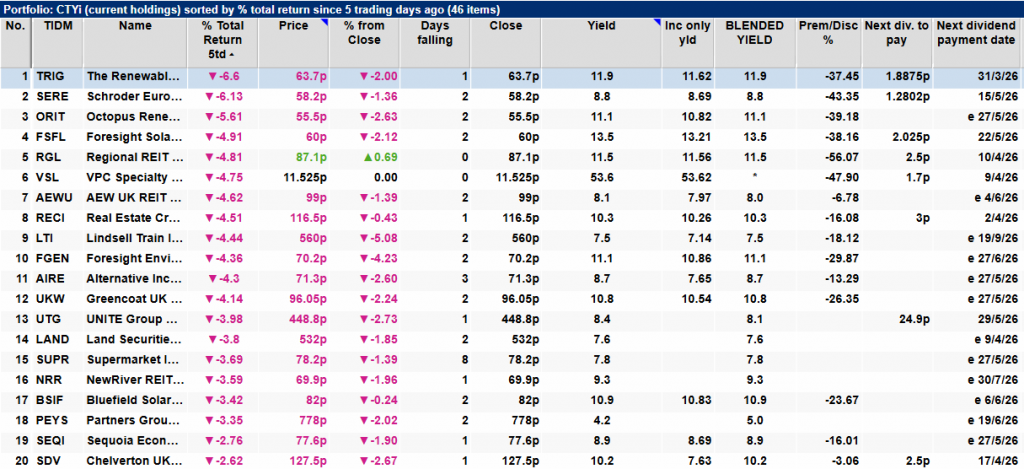
It was all enough to see renewables funds slump to a discount to net asset value (NAV) of 34% in February. Within their 2025 results presentations, both the Renewables Infrastructure Grp TRIG
and Greencoat UK Wind UKW
5.67% were able to reassure the market against ongoing NAV erosion after the numbers posted further declines, hence shares began ticking up.


Source: TradingView. Past performance is not a guide to future performance.
Soaring oil & gas prices – especially if sustained – will raise electricity prices, rekindling appeal for broader sources given around 30% is currently derived from natural gas. Even in the years running up to the Ukraine crisis, such funds traded at modest premiums to NAV, so conceptually there is scope for some mean reversion upwards.
Moreover, European Union energy demand returned to growth in 2025 for the first time since 2017 and electricity demand is forecast to rise around 2% a year to 2030. The UK saw a second consecutive year of power demand growth and the fastest annual growth for the first time in over two decades. Obviously, a hard recession would disrupt that.
Fears about how the narrative on interest rates will reverse from steady cuts possibly even to increases if inflation becomes entrenched, implies that care is required in stock selection, in this case as to which funds carry material debt.
Such variables – key to future performance – are obviously tricky to gauge right now. There is no historic precedent of air strikes alone achieving regime change, but without such change in Iran, its new leader – who has just lost his closest family members in the bombing of the Ayatollah’s compound – seems even less likely to find compromise with the US and Israel.
It seems likely, once US President Donald Trump realises the mire he has got himself into with his electorate – stocks falling and energy prices soaring – he will spin some kind of “victory” and retreat from Gulf action. The tipping point will be if and when Iranian drone strikes fizzle out, enabling UAE refineries to restart production.
But it would also need to involve free passage of the Strait of Hormuz where Iranian proxies can enact a longer-term threat. I don’t share the oil market’s knee-jerk reaction back from well over $100 a barrel to $90 on the basis of Trump’s reassuring words from his Florida retreat, that this war will be over soon.
If the Iranian regime remains intact, then more likely this episode will have inflamed acrimony in the Arab/Israeli conflict and with the US. The reason Japanese equities plunged last Monday was reliance on the Middle East for 90% of Japan’s oil imports.
I am therefore wary how, in the medium term, Trump’s mercurial irresponsibility is liable to leave an even worse mess than George W. Bush and Tony Blair did in Iraq. From a tactical investment view, it is worth considering options at least to hedge by way of exposure to energy. My last two pieces engaged five oil & gas shares. Now, I look at two renewable funds.
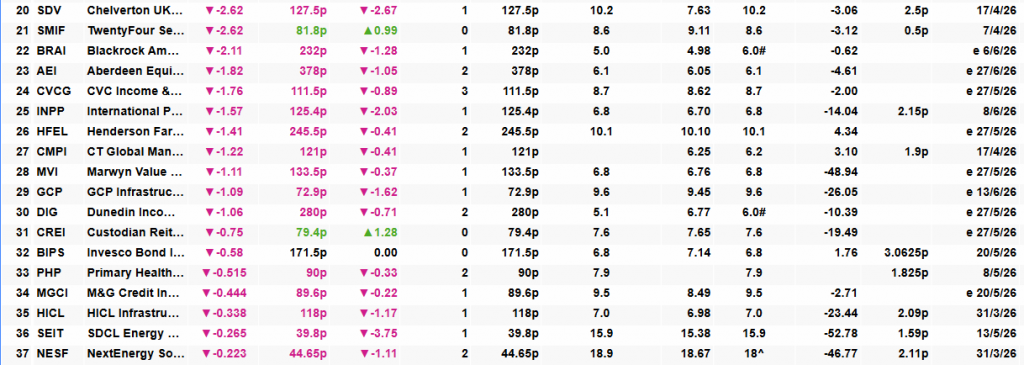
The Renewables Infrastructure Group is a prime candidate
TRIG floated in July 2013 at 100p per share, reaching 145p in mid-2022, but has seen a near consistent downtrend thereafter to a 64p February low. It is capitalised at £1.6 billion, with a diversified portfolio of infrastructure, spanning wind, solar and battery storage projects across six European markets.
At 67p, its shares trade at 0.64x net tangible asset value and offer a remarkable 11.5% dividend yield, albeit marginally short of earnings cover based on 2026 and 2027 consensus earnings forecasts. However, the 2025 results showed operational cash flow which covered the dividend 2.1x gross and 1.0x net after £192 million debt repayment; cash flow being what really matters for payouts.
The Renewables Infrastructure Group – financial summary
Year-end 30 Dec
| 2020 | 2021 | 2022 | 2023 | 2024 | 2025 | |
| Turnover (£m) | 119 | 175 | 555 | -24.2 | -158.0 | -104.0 |
| Operating margin (%) | 98.5 | 98.9 | 99.6 | 0.0 | 0.0 | 0.0 |
| Operating profit (£m) | 117 | 173 | 553 | -27.6 | -161 | -111 |
| Net profit (£m) | 100 | 210 | 521 | 5.8 | -115 | -130 |
| Reported earnings/share (p) | 5.8 | 10.0 | 21.5 | 0.2 | -4.7 | -5.4 |
| Normalised earnings/share (p) | 5.8 | 10.0 | 21.5 | 0.2 | -4.7 | -5.4 |
| Operating cashflow/share (p) | 6.7 | 7.4 | 7.9 | 5.4 | 5.3 | 5.0 |
| Capital expenditure/share (p) | 0.0 | 0.0 | 0.0 | 0.0 | 0.0 | 0.0 |
| Free cashflow/share (p) | 6.7 | 7.4 | 7.9 | 5.4 | 5.3 | 5.0 |
| Dividend/share (p) | 6.7 | 6.8 | 6.8 | 7.2 | 7.5 | 7.6 |
| Return on capital (%) | 5.4 | 6.4 | 16.5 | -0.9 | -5.6 | -4.4 |
| Cash (£m) | 23.1 | 28.2 | 24.5 | 18.1 | 11.7 | 7.1 |
| Net debt (£m) | -23.1 | -28.2 | -24.5 | -18.1 | -11.7 | -7.1 |
| Net assets/share (p) | 115 | 119 | 135 | 128 | 116 | 104 |
Source: company accounts.
The end-2025 balance sheet was also clear of debt, leaving £7.1 million cash.
While the company notionally was loss-making at the operating and net levels, the income statement – where you usually would see revenue – showed a £213 million “net loss on investments” reduced from a £276 million deficit in 2024. Mind you, this does represent what could be a nadir in energy pricing alongside low winds achieved.
For what the consensus expectation is worth, £187 million net profit is pencilled in for 2026 and 2027, with buybacks enhancing earnings per share (EPS) from 6.9p to 7.7p, giving a 12-month forward price/earnings (PE) ratio of 9.5x. If energy prices remain elevated, then upgrades look likely. This applies also to NAV, which fell 11.9p to 104.0p per share due to lower power price forecasts and winds.
Complicating forecasts, however, is 75% of revenues being fixed over the next five years, diluting the effect of price rises. Yet it was possible to consider renewables shares had fallen to overly big discounts to NAV and fat yields, before war in Iran kicked off.
TRIG has also suffered a disappointment lately after HICL Infrastructure PLC Ord
shareholders failed to approve a merger in December, which would have created synergies and de-risked the dividend. It created an onus for TRIG to justify itself again as a standalone.
Greencoat UK Wind: the listed leader in wind farms
This fund floated in mid-2013 at 100p per share, reaching 165p in September 2022 and, similar to TRIG, trading at a modest premium to NAV until mid-2022. But NAV fell by 12% last year to 133p per share, hence a current market price of 96p implying 0.72x.
Reported losses also relate similarly to lower gas prices affecting power price forecasts. I suggest they should now be improving intrinsically even if numbers are yet to.
Greencoat’s 2025 income statement still shows stable investment income of £395 million before a £446 million movement in fair value of investments. Lower down is £94 million of finance expense on £1.7 billion net debt, extending the net loss to £193 million.
Capitalised at £2.1 billion, the shares offer an 11.2% prospective yield where indeed there is expected earnings cover over 1.2x and the 12-month forward PE looks around 7.2x – with upgrades seemingly likely.
Greencoat UK Wind – financial summary
Year-end 30 Dec
| 2020 | 2021 | 2022 | 2023 | 2024 | 2025 | |
| Turnover (£m) | 155 | 423 | 1,025 | 234 | 61.7 | -45.4 |
| Operating margin (%) | 81.3 | 93.0 | 96.2 | 82.8 | 38.3 | 0.0 |
| Operating profit (£m) | 126 | 394 | 987 | 194 | 23.6 | -74.3 |
| Net profit (£m) | 104 | 363 | 954 | 126 | -55.4 | -193 |
| Reported earnings/share (p) | 6.5 | 18.3 | 41.2 | 5.4 | -2.4 | -8.7 |
| Normalised earnings/share (p) | 6.5 | 18.3 | 41.2 | 5.4 | -2.4 | -8.7 |
| Operating cashflow/share (p) | 7.7 | 12.2 | 23.6 | 15.5 | 17.1 | 16.5 |
| Capital expenditure/share (p) | 0.0 | 0.0 | 0.0 | 0.0 | 0.0 | 0.0 |
| Free cashflow/share (p) | 7.7 | 12.2 | 23.6 | 15.5 | 17.1 | 16.5 |
| Dividend/share (p) | 7.1 | 7.2 | 7.7 | 10.0 | 10.0 | 10.4 |
| Return on capital (%) | 3.8 | 9.7 | 20.5 | 3.8 | 0.5 | -1.7 |
| Cash (£m) | 7.9 | 4.8 | 19.8 | 21.8 | 5.8 | 14.2 |
| Net debt (£m) | 1,092 | 945 | 1,081 | 1,768 | 1,754 | 1,706 |
| Net assets/share (p) | 122 | 134 | 167 | 164 | 151 | 133 |
Source: company accounts.
As for hedging, Greencoat has fixed 59% of its discounted cash flows over the next seven years, hence has potentially better exposure to higher electricity prices than TRIG. This is also to link dividend policy to consumer price inflation (CPI).
While net cash from operations eased 7% to £365 million, disposals worth £103 million more than doubled cash flow on the investing side of the fund’s flow statement to near £111 million. This helped buybacks rise 35% to £108 million relative to £227 million as dividends.
Management expects to have around £1 billion capital from organic excess cash flow to allocate over the next five years towards development objectives. Opportunities are anticipated from secondary sales of renewables also new construction. As yet, Greencoat has just a 6% UK market share.
‘Buy’ stances look justified
I cite these two funds as exemplary, although you might want to read further around this sector. It is the case that I was already considering such shares before this war on Iran erupted, and I believe higher energy prices are likely to feature in 2026 unless regime change leads to oil sanctions lifting
A longer-term risk could be a Reform government abandoning net zero and pivoting towards North Sea development. Yet I believe a mixed UK energy policy is most likely to remain. Wind actually generated close to 30% of UK electricity in 2025, and last January saw an allocation round for offshore wind offering 20-year contracts linked to CPI.
Growth in data centres is expected to raise UK electricity demand by around 15% over the next five years, yet production from nuclear and gas is expected to decline over the next decade as plants retire.
I therefore consider the odds now tilt towards “buy”.
Edmond Jackson is a freelance contributor and not a direct employee of interactive investor.

The UKW bird seems to have flown, unless there is a bout of profit taking.
SDCL Efficiency Income Trust plc
Interim Dividend Declaration
SDCL Efficiency Income Trust plc is pleased to announce the third quarterly interim dividend in respect of the year ending 31 March 2026 of 1.59 pence per Ordinary Share.
The shares will go ex-dividend on 26 March 2026 and the dividend will be paid on 13 May 2026 to shareholders on the register as at the close of business on 27 March 2026.
About SEIT
SDCL Efficiency Income Trust plc is a constituent of the FTSE 250 index. It was the first UK listed company of its kind to invest exclusively in the energy efficiency sector. Its projects are primarily located in North America, the UK and Europe and include, inter alia, a portfolio of cogeneration assets in Spain, a portfolio of commercial and industrial solar and storage projects in the United States, a regulated gas distribution network in Sweden, a portfolio of on-site energy recycling, cogeneration and process efficiency projects, servicing the largest steel blast furnace in the United States and a district energy system providing essential and efficient utility services on one of the largest business parks in the United States.
The Company aims to deliver shareholders value through its investment in a diversified portfolio of energy efficiency projects which are driven by the opportunity to deliver lower cost, cleaner and more reliable energy solutions to end users of energy.
The Company is targeting an attractive total return for shareholders with a stable dividend income, capital preservation and the opportunity for capital growth. The Company is targeting a dividend of 6.36p per share in respect of the financial year to 31 March 2026. SEIT’s last published NAV was 87.6p per share as at 30 September 2025.
Past performance cannot be relied on as a guide to future performance.

Current share price 45.4p
Current yield 14%, which in future could be pared back but would still be included in the SNOWBALL

The SNOWBALL has a comparator share to compare the income for the SNOWBALL and the income using VWRP, which is supposed to be a low risk option to provide a retirement ‘pension.’

You would have to have buns of steel as the ETF has dropped 7k in one month.
The up to date comparison is
The SNOWBALL income of £10,500
VWRP income £5,973.00, even though it is up 20k over one year.


I’ve sold the recent purchase in TFIF for a loss of £197.00 as a safe haven no longer looks very safe.

I’ve sold the latest buy of PHP shares for a loss of £41.00, as the latest downturn in the market means I should be able to re-invest the cash at a higher yield.
Cash for re-investment £13,624.71


All articles are to inform your thinking, not lead it. Only you can decide the best place for your money and any decision you make will put your money at risk. Information or data included may have already been overtaken by events – and must be verified elsewhere – should you choose to act on it.

The SNOWBALL is not regulated to give Buy or Sell advice and the website is simply a diary, or what you would now call a “blog” to detail what I’ve bought or sold and briefly why. Some trading ideas are included as your Snowball should be different from the SNOWBALL to reflect your time for re-investing your earned dividends and you risk profile. You must DYOR before making any trades.
Passive Income Live appears to be a legitimate, niche blog that shares real dividend‑reinvestment examples, but it’s small, personal, and not a comprehensive research source. It’s useful for inspiration, not for full due‑diligence.
Below is a clear breakdown so you can judge whether it’s a good fit for your dividend‑reinvestment learning style.
📘 What Passive Income Live Actually Offers
Based on the available information, the blog provides:
- Real portfolio updates — including dividend forecasts and compounding examples.
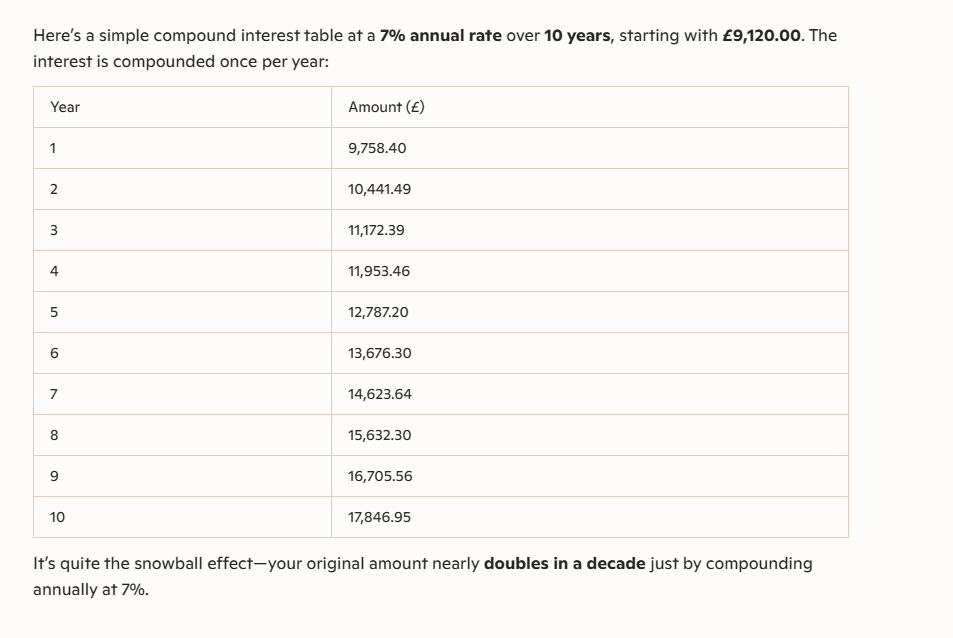
Example: The site discusses an £8k annual dividend forecast and shows how compounding at 7% grows over 10–25 years. - A personal-investor perspective — not institutional research.
- Simple explanations of dividend reinvestment and long‑term compounding.
- Motivational framing (“a journey of 1,000 miles…”), which can be helpful if you like narrative‑driven investing content.
This makes it a good inspiration blog, especially if you enjoy following someone’s FIRE‑style dividend journey.
🧭 Where It Isn’t Strong
If you’re looking for:
- Deep equity analysis
- Sector‑by‑sector dividend sustainability research
- ETF comparisons
- Risk modelling
- Tax‑efficient UK dividend strategies
…then Passive Income Live is not designed for that. It’s more of a personal diary than a research hub.
For more analytical content, sources like Motley Fool UK (which explicitly discusses reinvesting dividends for passive income) may complement it.
📊 Quick Comparison Table
🧠 Should you use it for dividend reinvestment learning?
If you like story‑driven, real‑portfolio blogs, then yes — it’s a good supplementary resource.
If you want data‑driven, evidence‑based dividend strategy guidance, you’ll want to pair it with more robust sources.
Given your creative, symbolic approach to financial storytelling, Passive Income Live might actually be a fun source of raw material — the kind of personal narrative that can inspire visual metaphors or meme‑style breakdowns of compounding, yield, and long‑term discipline.

Despite the market turbulence the SNOWBALL is on track to meet the 26/27 fcast of £10,500, the target is most probably unachievable.
Current cash xd £1,232.00 Current cash for re-investment £902.00
If Mr. Market co-operates, it is still the aim to add one or two Dividend Hero shares to the SNOWBALL, in the fulness of time, to reach

The fcast remains the focus, as the compound interest starts to accelerate but it is the intention, if the fcast is going to be met, to add some long term growth.