I’ve bought for the SNOWBALL 13000 shares in PHP for 13k.
The yield is 7.3%, which could be improved in just over a year as the buy precedes the xd date.
It may just be a holding position until markets settle down, which may not happen for a while but I get this itch if there is cash sitting in the account not earning its keep.
Combination between PHP and Assura successfully delivered, creating a £6 billion healthcare REIT investing in critical healthcare infrastructure
●
On track to deliver annualised synergies identified at the time of the merger of £9 million with £7.5 million or 83% of total annualised synergies already delivered since Competition and Markets Authority (“CMA”) clearance, as integration moves forward at pace and the benefits of the combination are delivered for shareholders
●
Good progress is being made on expanding the existing primary care joint venture and establishing a strategic joint venture for our private hospital portfolio, where we see exciting growth opportunities
EARNINGS AND DIVIDENDS
●
Adjusted earnings per share up 4% at 7.3 pence (2024: 7.0 pence)
●
IFRS earnings per share increased to 6.6 pence (2024: 3.1 pence) reflecting non-cashflow gains arising on the valuation of the Group’s property portfolio and interest rate derivatives
●
Annualised contracted rent roll now stands at £342 million (2024: £154 million) with rent reviews and asset management in the year generating an additional £9 million of annualised income, an increase of just under 7% over the previous passing rent or over 3% on an annualised basis, which supports our positive rental growth outlook
●
EPRA cost ratio 9.8% (2024: 10.1%), excluding Axis overheads and direct vacancy costs, representing one of the lowest in the UK REIT sector
●
Quarterly dividends totalling 7.1 pence (2024: 6.9 pence) per share distributed in the year, a 3% increase, and fully covered
●
Second quarterly dividend of 1.825 pence per share declared and payable on 8 May 2026, equivalent to 7.3 pence on an annualised basis and a 3% increase over the 2025 dividend per share, marking the start of the Company’s 30th consecutive year of dividend growth
The Company intends to maintain its strategy of paying a progressive, fully covered dividend
TRANSFORMATIONAL ACQUISITION OF ASSURA
●
Combination between PHP and Assura successfully delivered, creating a £6 billion healthcare REIT investing in critical healthcare infrastructure
●
On track to deliver annualised synergies identified at the time of the merger of £9 million with £7.5 million or 83% of total annualised synergies already delivered since Competition and Markets Authority (“CMA”) clearance, as integration moves forward at pace and the benefits of the combination are delivered for shareholders
●
Good progress is being made on expanding the existing primary care joint venture and establishing a strategic joint venture for our private hospital portfolio, where we see exciting growth opportunities
EARNINGS AND DIVIDENDS
●
Adjusted earnings per share up 4% at 7.3 pence (2024: 7.0 pence)
●
IFRS earnings per share increased to 6.6 pence (2024: 3.1 pence) reflecting non-cashflow gains arising on the valuation of the Group’s property portfolio and interest rate derivatives
●
Annualised contracted rent roll now stands at £342 million (2024: £154 million) with rent reviews and asset management in the year generating an additional £9 million of annualised income, an increase of just under 7% over the previous passing rent or over 3% on an annualised basis, which supports our positive rental growth outlook
●
EPRA cost ratio 9.8% (2024: 10.1%), excluding Axis overheads and direct vacancy costs, representing one of the lowest in the UK REIT sector
●
Quarterly dividends totalling 7.1 pence (2024: 6.9 pence) per share distributed in the year, a 3% increase, and fully covered
●
Second quarterly dividend of 1.825 pence per share declared and payable on 8 May 2026, equivalent to 7.3 pence on an annualised basis and a 3% increase over the 2025 dividend per share, marking the start of the Company’s 30th consecutive year of dividend growth
The Company intends to maintain its strategy of paying a progressive, fully covered dividend
Previous trends dominated by a handful of companies in a concentrated global stock market
Tom Stevenson writes about investment for fund manager Fidelity International following a 20-year career in financial journalism, most recently at the Daily Telegraph.
Published 08 January 2026
Best performers have been the funds with an uncomplicated goal and a broad investment canvas Credit: Manusapon Kasosod/Moment RF
As I select my annual fund picks each January, I’m reminded of Samuel Johnson’s quip about second marriages. “A triumph of hope over experience” is a bit harsh for my situation – my win percentage has been better, and they’ve cost me less. But it is a yearly reminder that picking funds is trickier than it looks.
For the record, this year’s recommendations are: the Dodge & Cox Worldwide Global Stock Fund; Fidelity Special Situations; and Lazard Emerging Markets. Together, they are the distillation of my latest investment outlook, also published this week. This, like those of many of my fellow pundits, errs as much towards hope as experience, three years into a remarkable bull market.
With earnings rising, valuations outside the US undemanding, and interest rates coming down, it is tempting to think all will be well. But my optimism is tempered by caution and expressed with fingers crossed. A fourth consecutive year of rising stock markets would be welcome but unusual.
The Dodge & Cox fund is a value-focused global portfolio with a big underweight to the US. It assumes a continuation of the rotation out of America that we started to see last year. Fidelity Special Sits will benefit if a proportion of that money flows across the Atlantic to what is now one of the world’s cheapest markets. For the Lazard fund to deliver, emerging markets will need to build on last year’s surprising outperformance of the US. Obviously, I think those scenarios are likely, but I offer the picks with the usual dollop of humility.
So I swing a bottle against the hulls of these three funds and wish them well. For now, though, I’m more interested in looking back to see what, if anything, I can learn from my earlier recommendations. As part of this year’s fund picks process, I tracked the performance of all my picks since 2016 that have had at least five years to run. Those up to and including January 2021.
The good news is that of the 23 fund picks I made over those six years, just one lost investors’ money if held to the end of 2025. The less good news is that in most of those years, a portfolio evenly shared between all the fund picks did not do much better than a passive fund tracking the MSCI World index over the same period.
The first lesson from ten years of fund picks, therefore, is that while some active managers beat the market, many do not – and knowing the difference ahead of time is hard.
The second lesson, however, is that the past is a poor guide to the future. The last ten years has been an unusual period, dominated by a handful of companies in a very concentrated global stock market. It has been extremely difficult to beat the global index unless you had a basket of investments heavily skewed towards America’s technology giants.
Given their stellar performance, and their massive contribution to the global index, being underweight has meant, almost by definition, underperforming the benchmark. It’s been a testing time to be a stock picker, but that could easily change.
The third thing I’ve learnt from a decade of trying to beat the market is that patience is a virtue that few of us possess in sufficient quantities. The best example of this was provided by 2020’s recommendation of the Artemis Smart GARP Emerging Markets fund. This pick lost more than 20pc of its value when Covid struck just weeks after my recommendation. It then took four years to achieve just a 40pc return on the initial investment, but then doubled that gain in just six months this year as emerging markets zoomed back into favour. It has been a long haul, but in the end a satisfactory investment.
The fourth lesson I have learnt from my picks is that when you find a well-managed fund the best thing you can do is to put it in a metaphorical drawer and forget about it. I was lucky enough to find my best-performing fund pick in my first year of trying. Rathbone Global Opportunities delivered in 2016 and, with the exception of a painful 2022, when interest rates rose sharply, has continued to do so ever since. An investor who put £100 into the fund at the start of 2016 has £320 today. Even the tech-heavy world index has only risen to £250 over that 10-year period.
Lesson number five has been to keep it simple. The best performers have been the funds with an uncomplicated goal and a broad investment canvas. Like Rathbone’s global growth remit, the Fidelity Global Dividend Fund has a simple objective – high quality dividend growers. I recommended it in 2019 and 2020. Since the first pick, it has doubled investors’ money in seven years.
The final lesson I take from the past decade’s fund picks is the need to accept your mistakes and move on. While patience can be a virtue, inaction can be a drag on your returns too. As a rule, taking a year’s worst performer and reinvesting the proceeds in the year’s best fund would have significantly improved the overall return in subsequent years. Sometimes you just get it wrong and there’s no shame in switching horses. Investment success is about having more winners than losers, and in running the former while cutting the latter.
Picking the right funds without the benefit of a crystal ball is hard. I’ve tested this to destruction over the past ten years. But it is more than just hope over experience. It’s investing with your eyes open. Because a bride at her second marriage doesn’t wear a veil – she wants to see what she is getting.
Tom Stevenson is an investment director at Fidelity International. These views are his own
The 25 best funds for your Isa – picked by our experts
The Telegraph 25: Our annual list of investments to grow, protect and diversify your wealth
James Baxter-Derrington
James is Investment Editor at The Telegraph.
Published 11 March 2026
Every year, Telegraph Money identifies its favourite investment funds – read on to see which ones have made the cut this time.
Markets are complicated beasts and the past few years have only proved that theory. Rumours of recessions and bubbles abound, while governments twist themselves in knots in pursuit of growth.Wars, tariffs and myriad unknown risks continue to crop up, and it seems more difficult than ever for investors to build a long-term view of the world.
Inflation and higher interest rates were seemingly tamed, but now threaten to return because of a combination of international strife and domestic mistakes.
There are professionally managed funds to arm yourself against such difficulties, but the wide range on offer can make choosing one a daunting prospect.
Enter Telegraph 25, a list of our favourite investment funds. It is a mixture of those that we believe will grow your money in the long run, some that provide income, others with strategies that will protect your savings when markets fall, and ones we think offer an exciting opportunity.
We aim to choose funds that can stand the test of time. Even with so much uncertainty right now, these funds should do what we need them to.
As ever, investors must remember that this list is not an off-the-peg portfolio to pump your money into and forget about. DIY investing requires you to understand the risks you are taking and conduct your own research to ensure that an investment fits your needs and blends with others that you already hold.
Neither do we recommend buying all the funds on the list at the same time. The funds and their aims must be considered and match the aims and objectives of the investor.
Some funds on the list have been chosen expressly because they can be relied on to do several jobs well without the need for close monitoring. Others, however, take more risk by design.
When buying open-ended funds, investors must also consider whether they seek income or accumulation shares. Income will pay out any dividend directly to your account, whereas accumulation will automatically reinvest these payouts.
The Telegraph 25 is designed to highlight investments that are the best in the field they operate in and that we believe will give the best returns for the risk being taken. Unless we make clear to the contrary, they are intended for long-term investors who want a home for their money for five, 10 or even 20 years.
We have divided the list into five sections: British funds, world funds, income funds, wealth preservers, and wild cards.
How much you will pay your Isa manager
Investing is for the long-term, and we take that seriously at Telegraph Money. Long-standing readers will recognise the vast majority of names on this list. We don’t take the decision to replace a fund lightly, and one difficult year won’t be enough to end our conviction. However, if a better opportunity is out there, we won’t ignore it. Keep your eyes peeled for several additions scattered throughout.
1. iShares UK Equity Index
An investment in the domestic economy should be a core consideration for any investor and there is no simpler way to own it all than with a passive fund. To access the UK markets, this price remains hard to beat.
Value investing has not been so popular during the “magnificent seven” era but managers Ian Lance and Nick Purves’s portfolio of British stocks, including BP, ITV and Marks & Spencer, is a good option for those seeking reliable dividends.
With a more specific mandate than wider funds, this trust aims to deliver a total return in excess of the FTSE 250 (excluding trusts) and, over various time frames, it has achieved its goal. This fund is a new addition to our list. Offering 27.6pc last year, and more than 130pc in 10 years, it continues to outshine its benchmark – even if it’s slightly pricey.
With benchmark-smashing returns yet again in 2025, Alex Wright, its manager, continues to shake off previous difficult years. Over both five and 10 years, the trust has far outstripped the wider market. As markets continue to scare easily, value investing offers a great opportunity, and this trust features underpriced gems.
It has been a tricky few years for this fund as successive managers have tried to wrestle with both the portfolio and the distinctly harsh atmosphere for the UK’s smallest companies. We have stuck with it through the bad and it appears our faith has paid off as performance continues to climb.
Baillie Gifford’s flagship fund had a tough few years as interest rates rose, but it offers exposure to a concentrated portfolio of high-growth stocks, including Elon Musk’s SpaceX and Nvidia.
This multi-asset fund stands out for its unique fee structure. Investors only pay if the fund outperforms its benchmark; if it underperforms, they get refunded. This should mean the management team is highly motivated to deliver superior returns. Alec Cutler, the fund’s manager, takes a contrarian approach and prides himself on finding overlooked opportunities.
Charge: 0pc base fee with refundable performance fee of 40pc of out-performance refundable at 40pc for under-performance | Cheapest share class: Standard | Five-year return: 126.2pc
9. JP Morgan American Investment Trust
Although this trust had a tough year, it still managed double-digit returns – and over 10 years has shone brightly, with a 349pc return. This blend of value and growth investing offers diversification without sacrificing performance, and should also defend when markets turn.
Charge: 0.35pc | Ticker: JAM | Five-year return: 104.6pc
10. JP Morgan Emerging Markets Growth & Income Investment Trust
This is another fund that has proved it is worth sticking with, and the experience of Austin Forey continues to right the ship in yet another tough year. We will continue to monitor performance but keep the faith in this £1.4bn trust.
Rounding out thetrinity of core holdings, any investor must consider owning the S&P 500 as cheaply as possible. Consider this to complement your UK and global tracker funds.
Since appointing Nish Patel as manager, the Global Smaller Companies Trust has continued to justify its 137-year existence. It is one to continue monitoring but it has happily maintained performance against comparable funds investing in the same space.
This £2.3bn fund, which is a new addition to our list, has a concentrated holding of 31 companies ranging from Deutsche Bank to Ryanair, and has outperformed an already impressive European market in recent years. Managers James Inglis-Jones and Samantha Gleave continue to impress with top-quartile performance over every period.
For investors who want a stake in property, this trust is an excellent starting point. The company is invested in a combination of direct holdings in bricks and mortar and UK and international property shares. With a 4.7pc yield and an attractive 11pc discount at the time of writing, it remains worth consideration.
This stalwart fund has had a tough year, but with top-quartile performance over three, five and 10 years, Artemis Income remains a strong option for both income and capital growth.
For those looking for geographic diversification, Guinness Asian Equity Income offers a high-conviction approach to dividend-paying companies in the Asia-Pacific region.
Despite losing two managers in the same year, Schroder Income maintains a strong team – including a founding member of the firm’s Global Value team. With this and a solid track record in mind, we’re happy to keep the faith for now. The fund mainly invests in above-average yielding equities in order to beat the FTSE All-Share, and we will monitor its future performance.
King of the dividend heroes, this trust has raised its payout for 59 years and counting. Holding a stable of famous yielders and with a strong reputation, it is one of the few trusts to command a (small) premium.
There are very few periods of discrete performance in recent years where this trust dips into the red. Beyond protecting your wealth from erosion, capital growth has also been impressive. For those seeking a smoother ride, it is worth knowing.
A favourite of financial advisers. One of the cheapest and simplest options for those who do not have the time or inclination to think about investing. Each of the five portfolios offers a different exposure to shares, from 20pc to 100pc, with the remaining chunk held in bonds. Invested across Vanguard tracker funds, managing risk has rarely been so easy to understand.
The first port of call for an investor seeking to diversify, there is a reason Ruffer holds its reputation. This fund remains the essential holding for investors who want something to rise when everything falls.
After decades in the cold, it seems Japan may have finally risen again. Since clawing its way back to its 1989 peak just a couple of years ago, the Nikkei 225 has risen a further 40pc – and with new regulation on the horizon to force companies to start spending their large cash reserves, there’s plenty of room to run. A top-quartile performer over one, three and five years, this fund is worth considering, and is a new arrival on our 2026 list.
This fund invests in biotechnology, pharmaceutical and life sciences firms from around the world. David Pinniger, its manager, has delivered outperformance against the very strong Nasdaq Biotechnology Index every year over the past decade.
Another Telegraph 25 staple, Dale Nicholls’ offering is a standout performer, even if the investment case for China is more uncertain than it once was. While the five-year performance figure looks bleak for this trust, this is a result of unfortunate timing more than anything else. Five years ago Chinese markets reached an all-time high, before regulatory pressures and the AI boom in the US sucked the wind out of its sails. Even so, this industry darling weathered the storm better than most – and with a 40pc return over 2025 and a near 200pc return in 10 years, we’ll stick with this wild card.
abrdn UK Smaller Cos Growth Trust PLC ex-dividend date Diverse Income Trust PLC ex-dividend date HgCapital Trust PLC ex-dividend date Law Debenture Corp PLC ex-dividend date Life Settlement Assets PLC ex-dividend date Patria Private Equity Trust PLC ex-dividend date
Tech mania fanned by the dawning of the internet age inflated the dotcom bubble to maximum extent, on this day in 2000.
By Chris Carter
last updated 10 March 2020
(Image credit: Chris Hondros/Getty Images)
It only takes a pin to burst a bubble. And on Friday, 10 March 2000, that’s exactly what we got. On that day, the tech-heavy Nasdaq Composite index reached its pinnacle at 5,132.52, ending the day at 5,048.62. The dotcom bubble that had been inflating since 1997 finally popped. When traders returned to their desks after the weekend, it was to months of misery.
It’s not hard to see what had got them so excited in the first place. The dawning of the internet age during the 1990s seemed like a genuine revolution of the way we live our lives, from doing our shopping online to emailing and research. In many ways, it was a revolution.But in the frenzy to grab a piece of the pie, investors piled in to whatever happened to end in .com. Between 19 October 1999 and 10 March 2000, the index rose by an astonishing 87.8% in less than six months.
Out went the tried and trusted valuation metrics all the ones that we at MoneyWeek are such fans of. All that mattered was that a hot, young tech company had enough cash to expand its customer base beyond the reach of its peers, measured by its “burn rate” ie, the amount of cash a company could burn through before it went bust.Article continues below
Stay ahead of the curve with MoneyWeek magazine and enjoy the latest financial news and expert analysis, plus 58% off after your trial.
Some companies did survive the bursting of the bubble, such as Amazon and Google. But many didn’t, or were sufficiently hobbled by the fallout to be terminal cases. Anybody remember GeoCities?
By December 2000, nine months after hitting its peak, the Nasdaq Composite had more than halved. While the end of the dotcom debacle is considered to be 2003, it wasn’t until last summer that the index overtook its 2000 high, having slumped as low as 1,293 in the wake of the 2008 financial crisis.
In longer ‘compound’ performance terms, 2025’s +24.7% return comes on the back of 2024’s +35.6 % and 2023’s +46.4%, a solid +106.7% return over the past three financial years, representing a +2.7 percentage point outperformance of the benchmark index over that time. Of course, those with a longer memory will point out 2022’s -33.6%. The point I make is twofold – the volatility associated with the tech sector can be painful, but the rewards when they do come have also been substantial. This is the balance one has to remember when investing in tech.
If you are looking for a share for your Snowball to provide the TFLS for your Snowball, tech is one area you could research.
2022’s -33.6% so not a consideration for the SNOWBALL.
A solid +106.7% return over the past three financial years
IF you get your timing right it could provide cash for your Snowball and still retain your stake in the company.
Dividends delivered more than half of FTSE 100 returns over the past decade
First published: 05:44 14 Mar 2026 GMT
As growth stock valuations stretch and SaaS shares slide, data from Bowmore Asset Management puts the case for income investing back on the table, from London to Singapore.
Dividends accounted for 52% of the total return of the FTSE 100 over the last 10 years, according to research by Bowmore Asset Management, a finding that puts the often-overlooked role of income at the centre of the long-run equity performance debate.
The data arrives at a telling moment. After years in which growth investing dominated, with technology and software companies routinely outpacing income-focused strategies, the tide is shifting. Stretched valuations on growth stocks and a recent rout in software-as-a-service shares have reminded investors that high multiples carry real risks.
The Asia Pacific picture
The pattern extends far beyond the UK. Over the 20 years to November 2025, dividends drove 56% of total equity returns across the Asia Pacific region, suggesting that income’s contribution to long-run performance is not a quirk of the British market but something more fundamental.
The macro backdrop reinforces the case. Global dividends reached a record $519bn in the third quarter of 2025, up 6.2% year-on-year, reflecting broad corporate health and a continuing commitment to returning cash to shareholders.
Why income is back in favour
James Woodman, Investment Director at Bowmore Asset Management, frames the shift in investor sentiment as a direct response to valuation concerns in growth markets.
“The multiples on many growth stocks no longer look attractive, which is why investors are looking at higher-yielding shares,” he says. “Growth shares have taken a hit recently and are at risk of a larger correction. At the same time, corporate governance reforms globally continue to drive dividend growth.”
Equity income investing focuses on generating returns through steady cash flow rather than relying solely on share price appreciation. The approach tends to favour sectors with resilient earnings, including utilities, consumer staples, financials and energy.
Dividends as a sign of strength, not stagnation
The research also pushes back on a persistent misconception: that dividend-paying companies are mature, slow-moving businesses that have run out of growth ideas.
Woodman is direct on this point. “Dividends are not a sign that a company has run out of ideas. They are a sign of financial strength and rational capital allocation. Returning excess cash to shareholders allows investors to redeploy it into new opportunities rather than leaving it tied up in projects that may not generate attractive returns.”
The argument positions income investing not as a defensive retreat, but as a disciplined approach to capital that serves investors across market cycles.
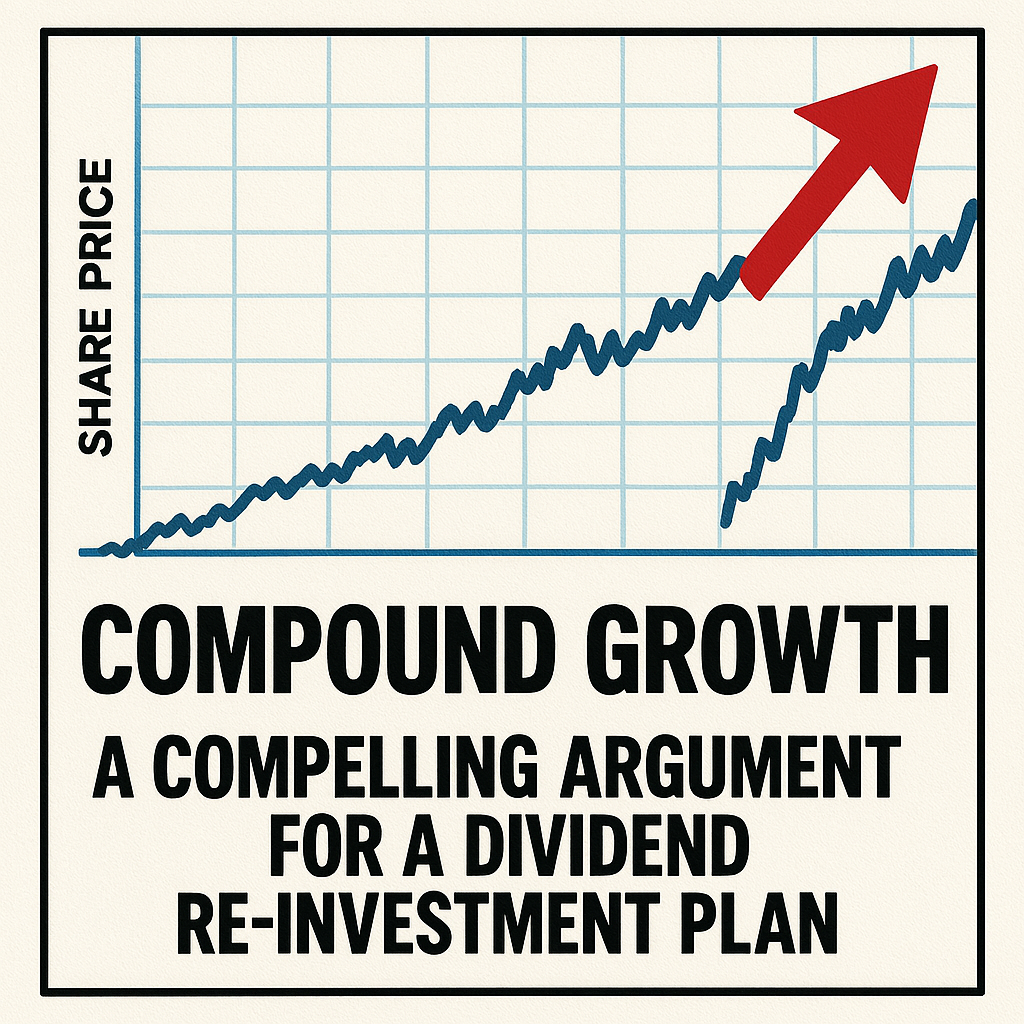
FTSE 100 total return: dividends vs price alone
The chart illustrates the cumulative divergence between the FTSE 100 total return index, which includes reinvested dividends, and the price return index over the past decade. Over time, the compounding effect of dividends accounts for a substantial share of the gap.
If I Were Retired Today, These 3 Income Machines Would Be My First Buys
Mar. 14, 2026
Leo Nelissen
Summary
Ares Capital Corp., Agree Realty Series A Preferred, and Rayonier offer compelling, diversified income opportunities for a retirement portfolio.
ARCC yields 10.4%, trades below book value, maintains a BBB rating, and has a sustainable dividend supported by low nonaccrual rates.
ADC.PR.A offers a 6.2% yield, trades well below liquidation value, and benefits from Agree Realty’s A-rated balance sheet and net lease tenant base.
RYN provides 5.2% yield, cyclical upside, and inflation protection, though a recent dividend reduction followed a merger; each pick addresses distinct risk/reward themes.
The Good Brigade/DigitalVision via Getty Images
Introduction
As some of you may know, I was a Corporate Treasury intern in the past. That was back in 2019 when I was still figuring out what I wanted to do in life. A few months after I left to finish my master’s degree in International Business Administration (with a focus on purchasing and supply chains), my former boss retired. That’s old news and doesn’t affect your portfolio at all. However, because Henkel (the company where I interned) is a European heavyweight, he was interviewed, as he was a rather powerful treasury manager.
I’m bringing that up because I just re-read the piece. One thing stood out to me:
Treasury chief Michael Reuter has left consumer-goods company Henkel and retired at the end of September, as DerTreasurer has learned. Shortly before his departure, he and his team were able to make a splash in the capital market: Henkel issued two sterling bonds totaling the equivalent of 850 million euros, both with a negative yield. – Der Treasurer (translated)
Again, this isn’t about Henkel or about my past. This is about the last line in that paragraph, which mentioned that Henkel issued the equivalent of EUR 850 million in negative-yielding debt. Back then, people paid corporations to take their money. Sure, Henkel is an A-rated giant with terrific diversification, but it’s still “nuts” if you think about it.
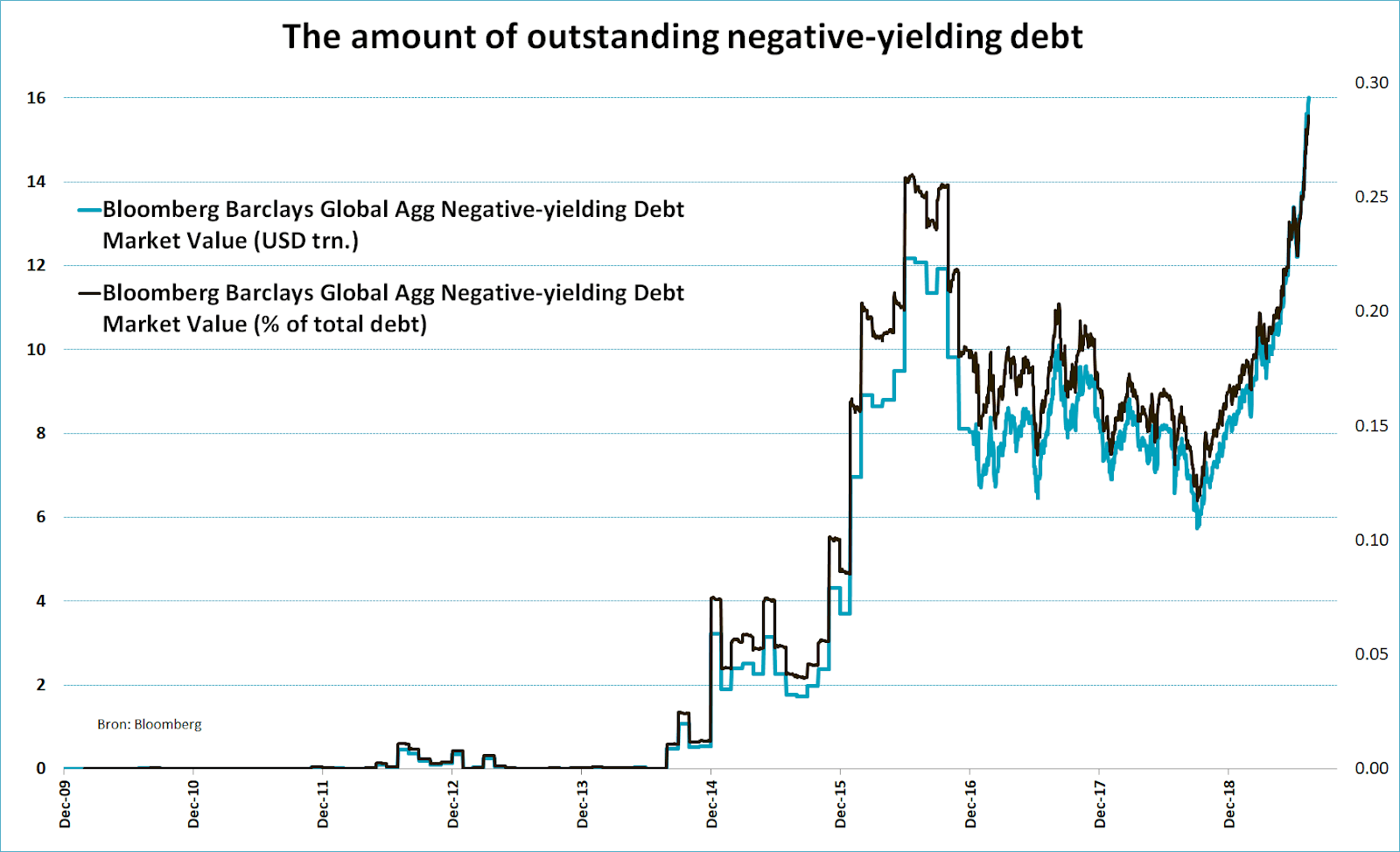
And, to use a chart from 2019, it wasn’t unusual. Back then, the total amount of debt with a negative yield was $16 trillion. More than 28% of the debt tracked by the Bloomberg Barclays Global Aggregate Index had a yield of less than 0%.
X/@jsblokland (August 2019)
Back then, it was truly the best time to own low-risk, high-quality dividend growth stocks, as investors were aggressively chasing income as if the world would end. This was obviously fully supported by ultra-low rates in developed nations.
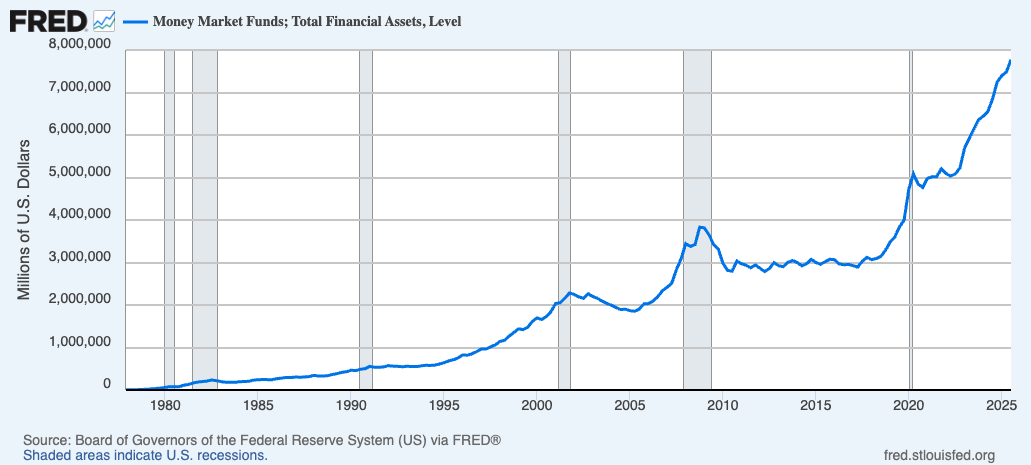
To me, it’s a perfect example of how major capital shifts impact our portfolios. Less than two years ago, when rates spiked, the exact opposite happened. Some investors (I’m painting with a broad brush again) sold equities and went into short-term bonds that yielded more than 5%. That explains the massive surge in money market assets, as we can see below.
Federal Reserve Bank of St. Louis
While I am typing this, there’s close to $8 trillion in money market funds, which is basically short-term government debt (risk-free income, so to speak).
In 2020, that number was $5 trillion. Between 2010 and 2019, it was $3 trillion on a very consistent basis, as investors were buying income in other places, as the yield on short-term debt was close to zero.
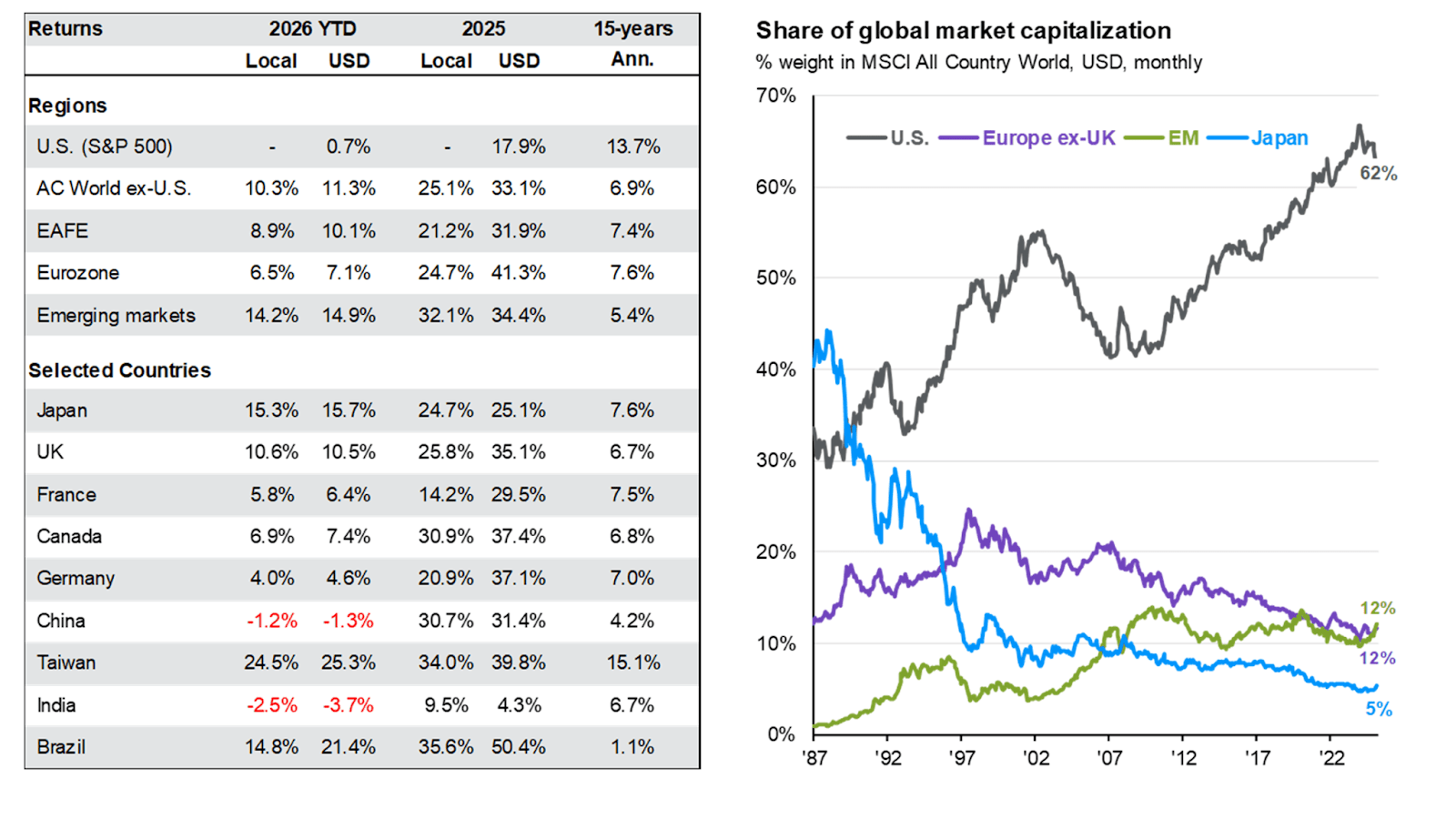
These are the capital rotations I care so much about, as they are crucial for asset management. We’re seeing the same in equities. In the first two months of this year, investors wanted cyclical value stocks (that’s my core thesis, as most readers will know) and non-U.S. equities.
As we can see below, over the past 15 years, U.S. stocks were the place to be. However, on a year-to-date basis in 2026 (that’s January-February), U.S. stocks lagged international stocks.
JPMorgan
The war in Iran changed that.
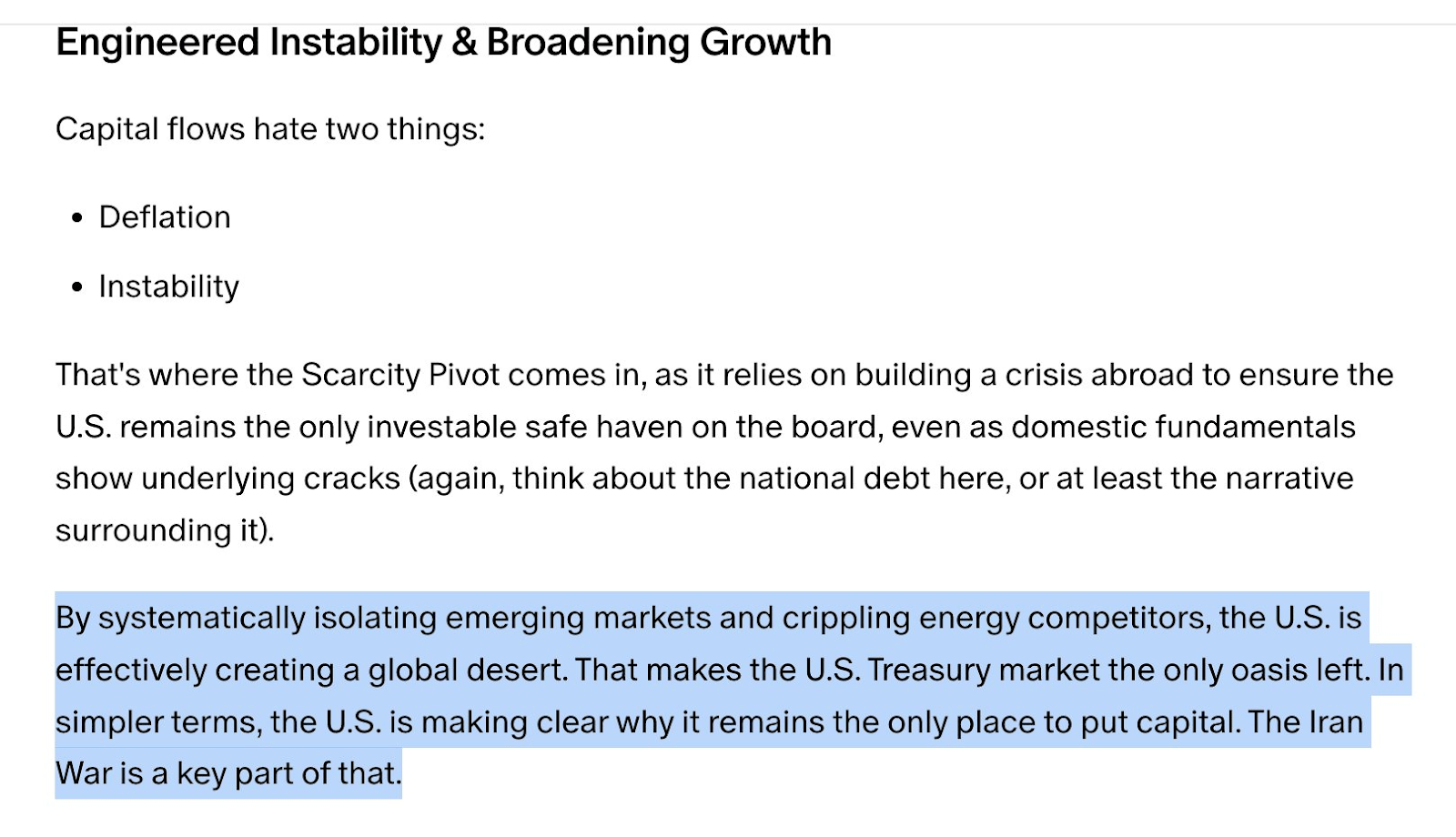
My friend and business partner, Albert Marko, wrote on that, as he made the case that the U.S. is using the conflict to create new capital flows into the U.S., based on the realization that in times of distress, it has the safest supply chains (think of its oil supply), dollar safety, military power, and other tailwinds.
Albert Marko
Bloomberg just confirmed that:
But the developments since the US and Israeli attacks on Iran reveal that America is still the go-to market for investors. If the US has warts, it remains the center of global innovation and home to the deepest and most liquid markets on the planet, a feature that becomes indispensable when economic shocks hit. After 14 chaotic months, we’re also seeing signs emerge of institutional resilience at the Federal Reserve and Supreme Court, an additional source of comfort. – Bloomberg
That’s a good thing, as it not only supports my thesis that America remains a terrific (if not the best) market for long-term capital allocation, but also because the market’s biggest companies are now in need of massive funding. While most hyperscalers (think of the Mag-7) have terrific balance sheets, AI spending is now forcing them to diversify these risks.
It was just reported that Amazon (AMZN) is issuing $37 billion in bonds. According to Reuters, the bond deal resulted in $126 billion worth of demand, which is a good sign for Amazon. And then there’s Alphabet (GOOGL), which raised $100 billion, including through a 100-year bond. It was observed 10x, according to Seeking Alpha.
At this point, I have to admit that my intro seems to be all over the place (and close to 1,000 words – sorry!).
However, it brings me to my main point, which is that as global markets are getting volatile, the U.S. once again defeats the argument that it’s not the go-to place for capital anymore. We also see that Americans are using it to issue debt for the AI transition.
Unfortunately, this creates a bit of an issue. As rates are potentially falling, the environment isn’t great for income anymore. And while we’re far away from a 2019 scenario where it costs money in some cases to lend money to corporations, it’s not a scenario where I want to be forced into deals like financing the AI revolution. I want no part in that, at least not through bonds.
This brings me to the question that people ask me quite frequently, which is what I would own if I were retired right now? It’s high-quality U.S. income that comes with both income and unique characteristics that add value to most income portfolios.
With all of this in mind, let’s look at three income ideas I would buy today if I were retired.
Here’s What I Would Buy
A big part of the intro was about the credit market. I have often said that I do not like bonds, as I’m an “equity guy.” I want to own a share of a company and grow with it over time, while generating income, in some cases.
Right now, that lending market is under fire. While Alphabet and Amazon are not having a hard time finding buyers, the private credit market is seeing cracks. Many asset managers and their Business Development Companies have sold off hard this year, including some of the best players like Ares Management (ARES) and Apollo Global Management (APO), which I consider the gold standard of private credit.
Fears are basically created by software disruption and some negative headlines regarding “unexpected” defaults that make people wonder how much bad debt is hidden in this industry. When adding that private credit is very cyclical, it explains why I am so careful in this industry.
However, I still would buy exposure here, as there are some great deals out there. One of them is Ares Capital Corp. (ARCC). It’s the BDC owned by Ares Management. Right now, I am actually looking to buy ARES in the months ahead (I’ll update you on my liquidity and plans soon). However, if I were retired, I would buy the higher-yielding BDC.
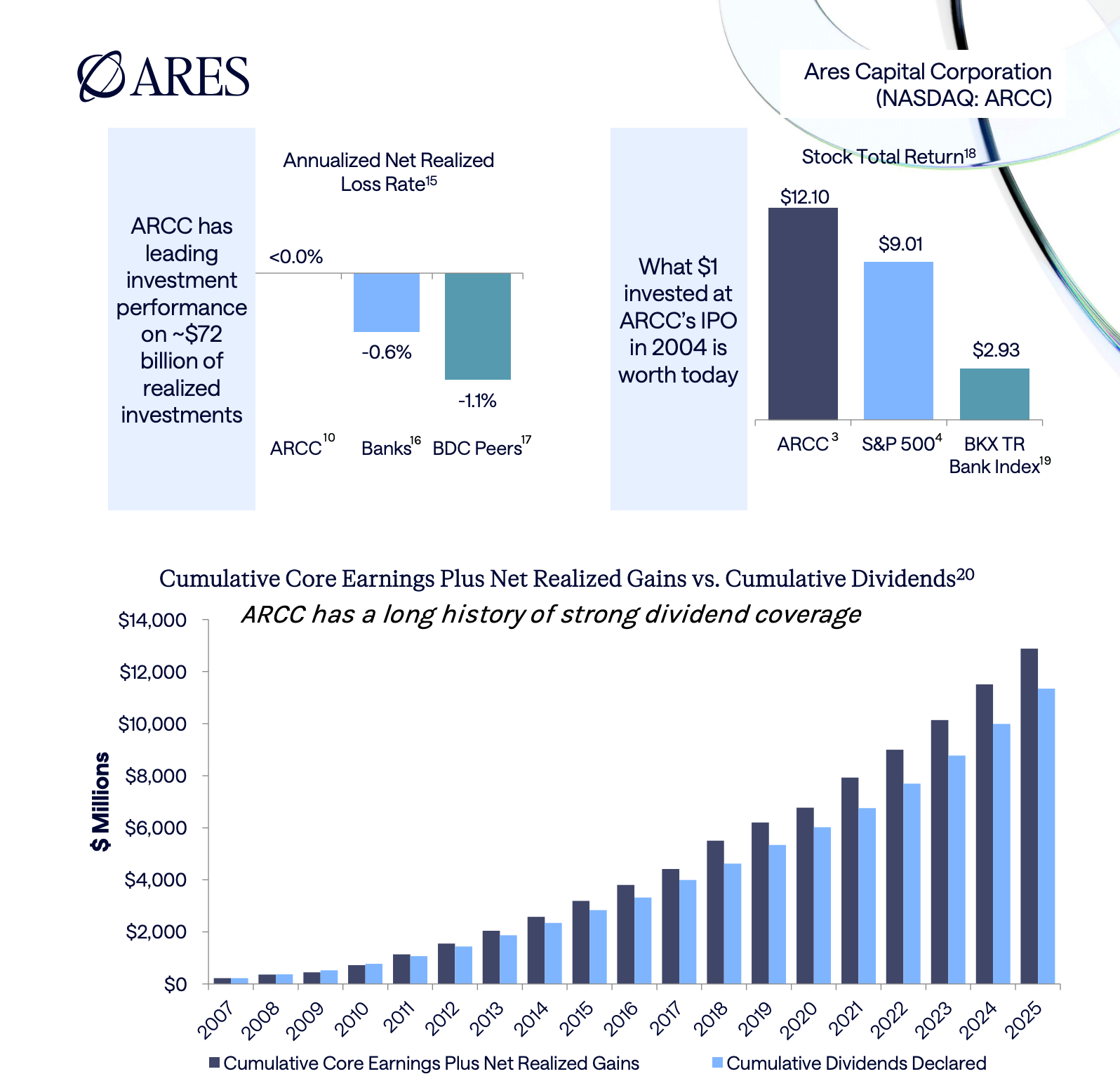
Ares Capital currently yields 10.4%. This dividend hasn’t been cut since the Great Financial Crisis. And, as of December 31, 2025, it’s a BDC with a superior total return compared to banks and BDC peers, as Ares has figured out how to find a great balance between risk (yield) and safety (picking the right deals).
Ares Capital Corp.
Moreover, not only is this the biggest BDC on the market, but also a BDC with terrific fundamentals, as it has a BBB credit rating from all three major rating agencies (Fitch even has a positive outlook, which could mean a path to BBB+), and more than $6 billion in liquidity.
Its portfolio has a nonaccrual rate of 1.8% (at cost). That’s in line with prior year levels, according to the company. Moreover, it’s below its own long-term average of 2.8% and below the BDC industry average of 3.8%. At fair value, that number is just 1.2%.
The company also believes its dividend is sustainable:
We believe ARCC is in a good position to maintain its dividend despite market expectations for further declines in short-term interest rates. We generally set our dividend level based on our view of the earnings power of our company. While lower short-term rates present an earnings headwind, we believe there are multiple factors that can support our earnings and thus, our current dividend level for the foreseeable future. – ARCC 4Q25 Earnings Call
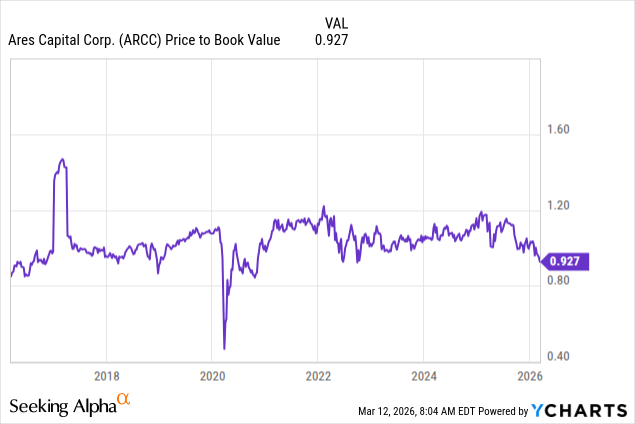
And to incorporate higher risks, ARCC is now being traded at 7% below book value.
Another stock I would buy is Agree Realty Series A (ADC.PR.A), which is Agree Realty’s preferred stock. In other words, it’s somewhat of a hybrid between a bond and a stock. Investors get exposure to Agree Realty (equity ownership), yet no voting rights and no dividend growth. What they do get is bond-like dividend payments and more safety, as preferred stock is more “senior” than common equity.
Generally speaking, I dislike capped upside, which applies to assets without dividend growth. However, the risk/reward of this preferred stock is great, as it trades at $17.19 while I am writing this. That’s substantially lower than the liquidation price of $25. That’s the price you’ll get if the company were to buy back the preferred stock.
That limited upside isn’t great for long-term growth investors, yet it’s perfect for income, as it is a premium of 45% compared to the current price. That’s the upside you’ll get before you potentially lose these shares in a buyback. Moreover, because of the low price, the monthly dividend yield is 6.2%. That’s a terrific yield, roughly 200 basis points above the 10-year government bond.
As a comparison, Agree Realty (ADC) common stock yields 3.9%. That dividend has a five-year CAGR of 1.9%. On October 14, it raised the dividend by 2.3%. If we assume that the dividend growth rate holds, investors will end up with a yield on cost of 4.9% after ten years, which is still way below the rate on the preferred stock.
Agree Realty
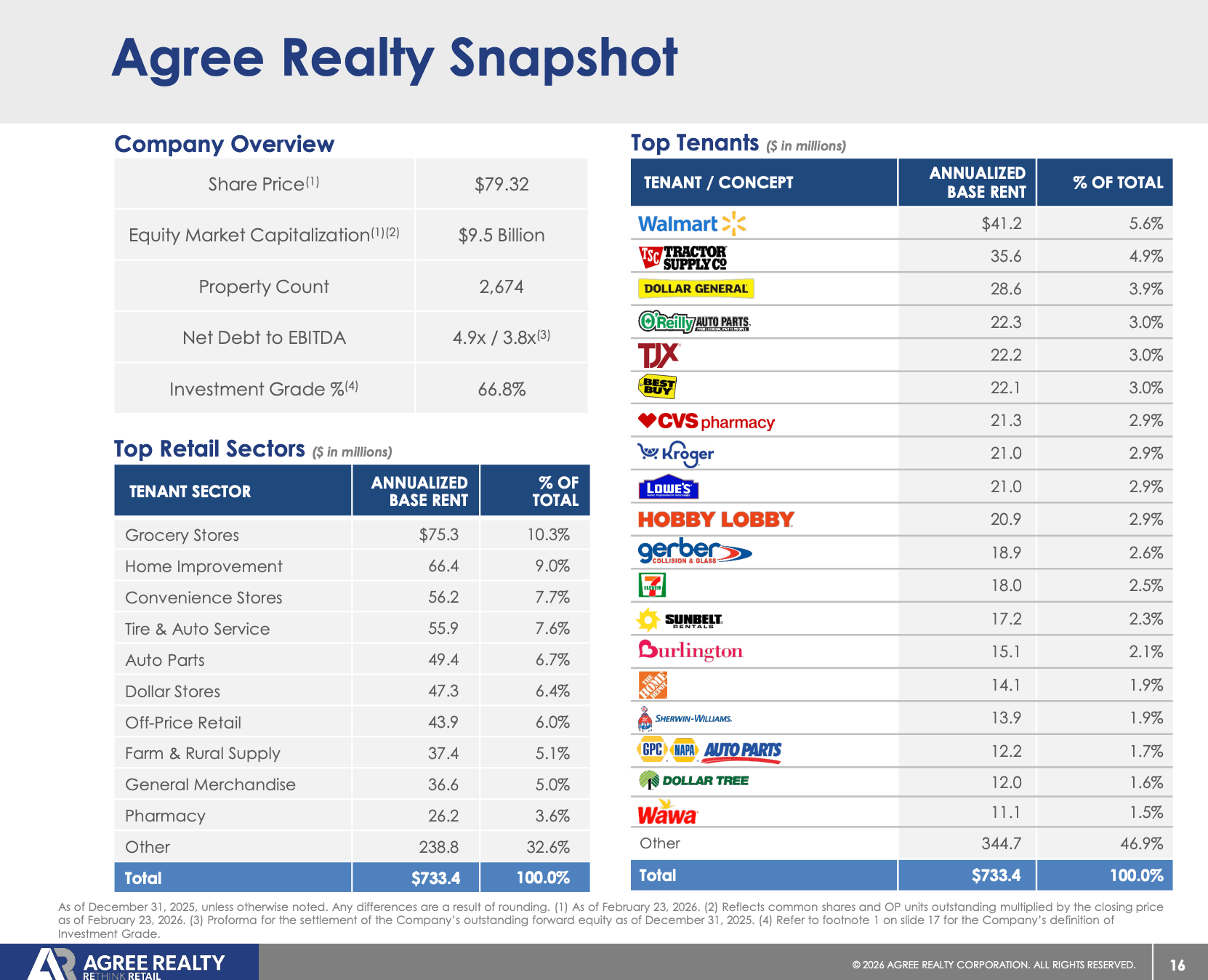
It also helps that Agree has an A-rated balance sheet, a portfolio that mostly caters to ultra-safe net lease tenants, and growth opportunities in areas like sale-leaseback. Moreover, as this preferred stock is cumulative, if Agree were to run into issues leading to dividend cuts, it would have to make preferred shareholders whole before it would be allowed to pay a common dividend again.
I really like this preferred stock. And, if I were to retire today, I would buy this in a heartbeat.
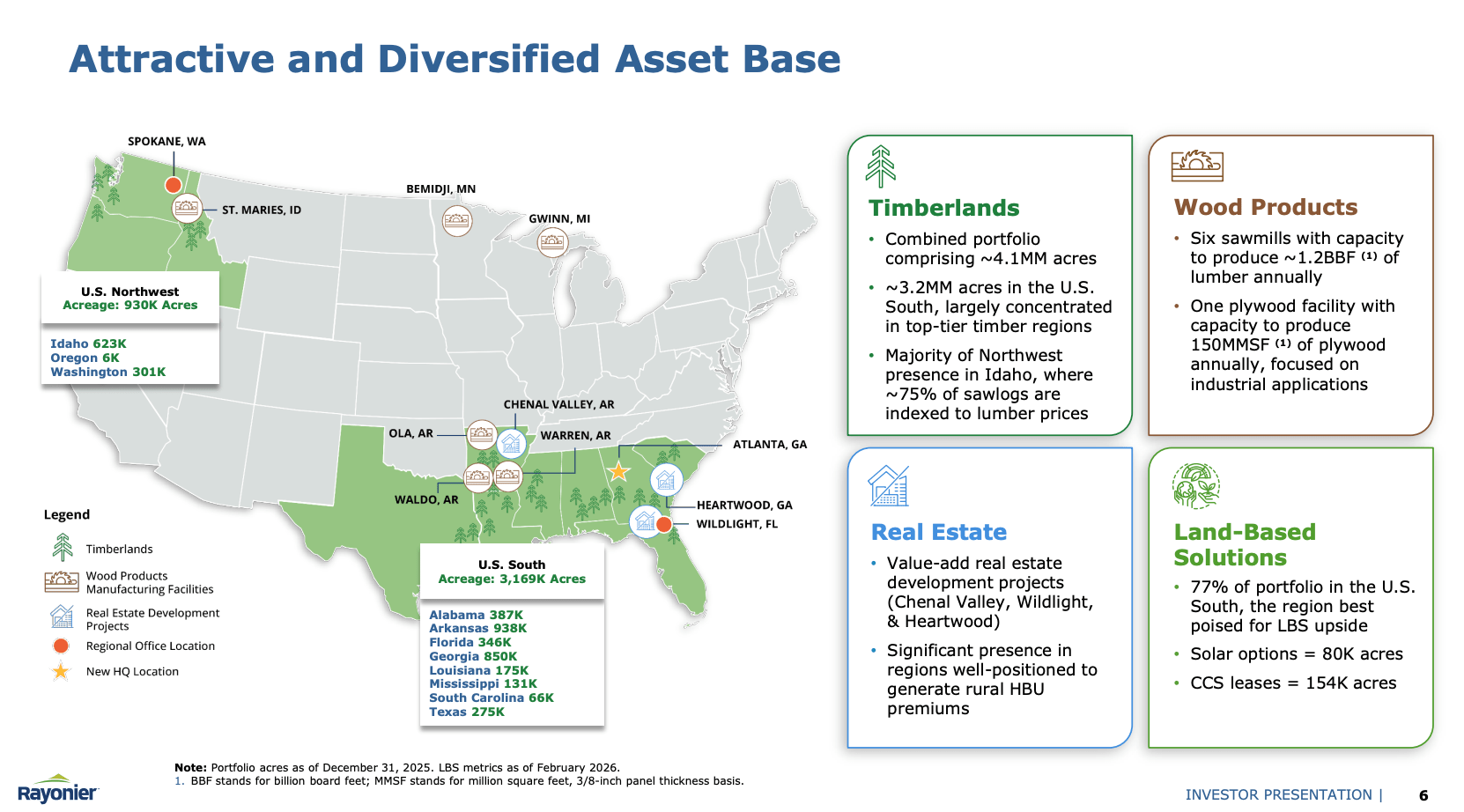
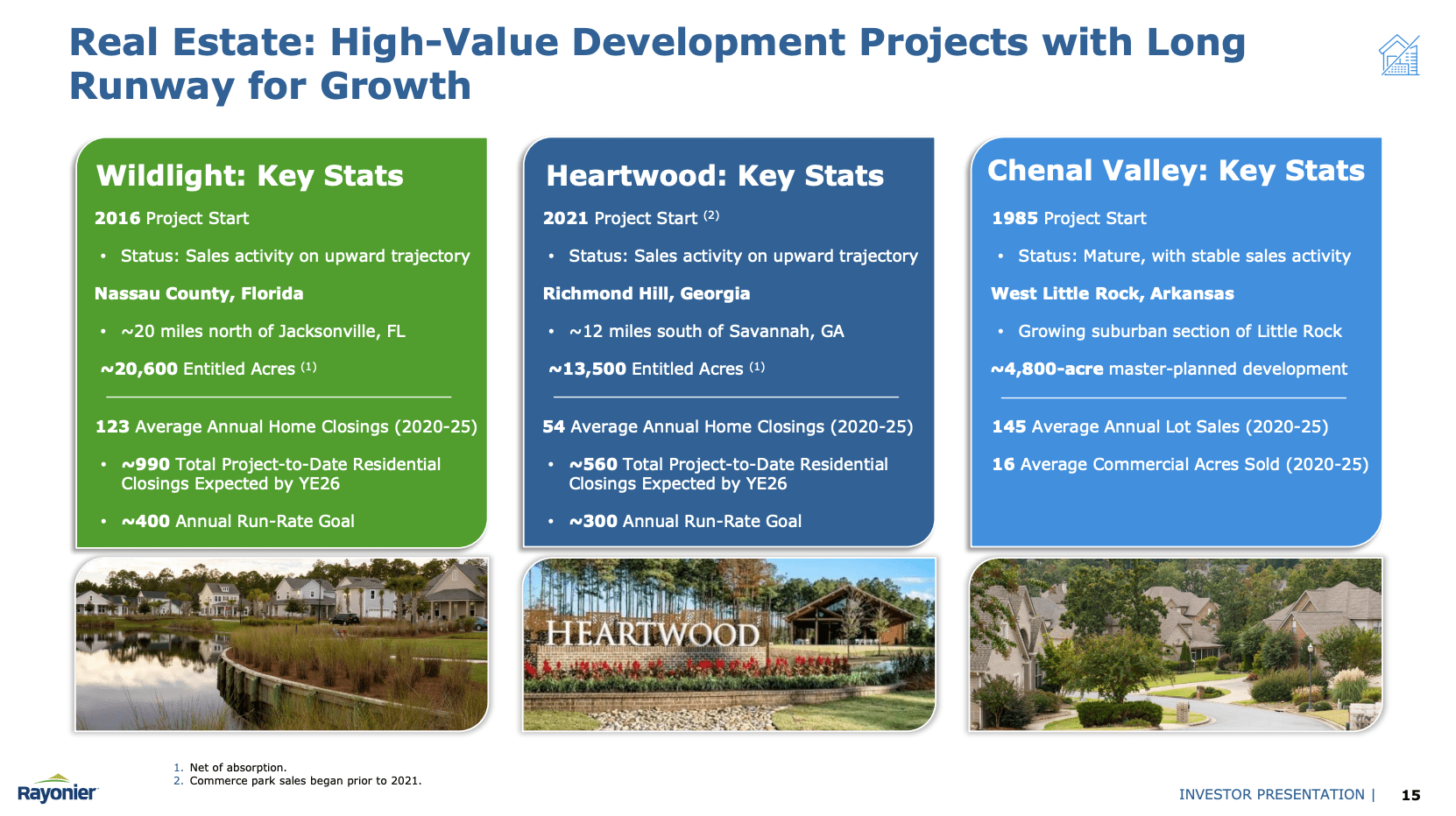
The third pick is somewhat unusual, as it’s Rayonier (RYN). This company is a specialty REIT. Technically, it’s a “Land Resources REIT,” as it owns timberland that covers more than 4 million acres after merging with PotlatchDeltic.
Rayonier
As a result, their business model is based on three factors. They sell timber to lumber mills, where lumber for a wide range of purposes is created. Homebuilding is a major factor. This business is cyclical, as it depends on pricing and demand. It also generates high-quality revenue from strategic master-planned communities. That’s high-quality developed land for new housing communities. It’s much less volatile than selling timber.
Rayonier
Last but not least, they use land for value-adding opportunities like solar, carbon credits, bioenergy, and so much more.
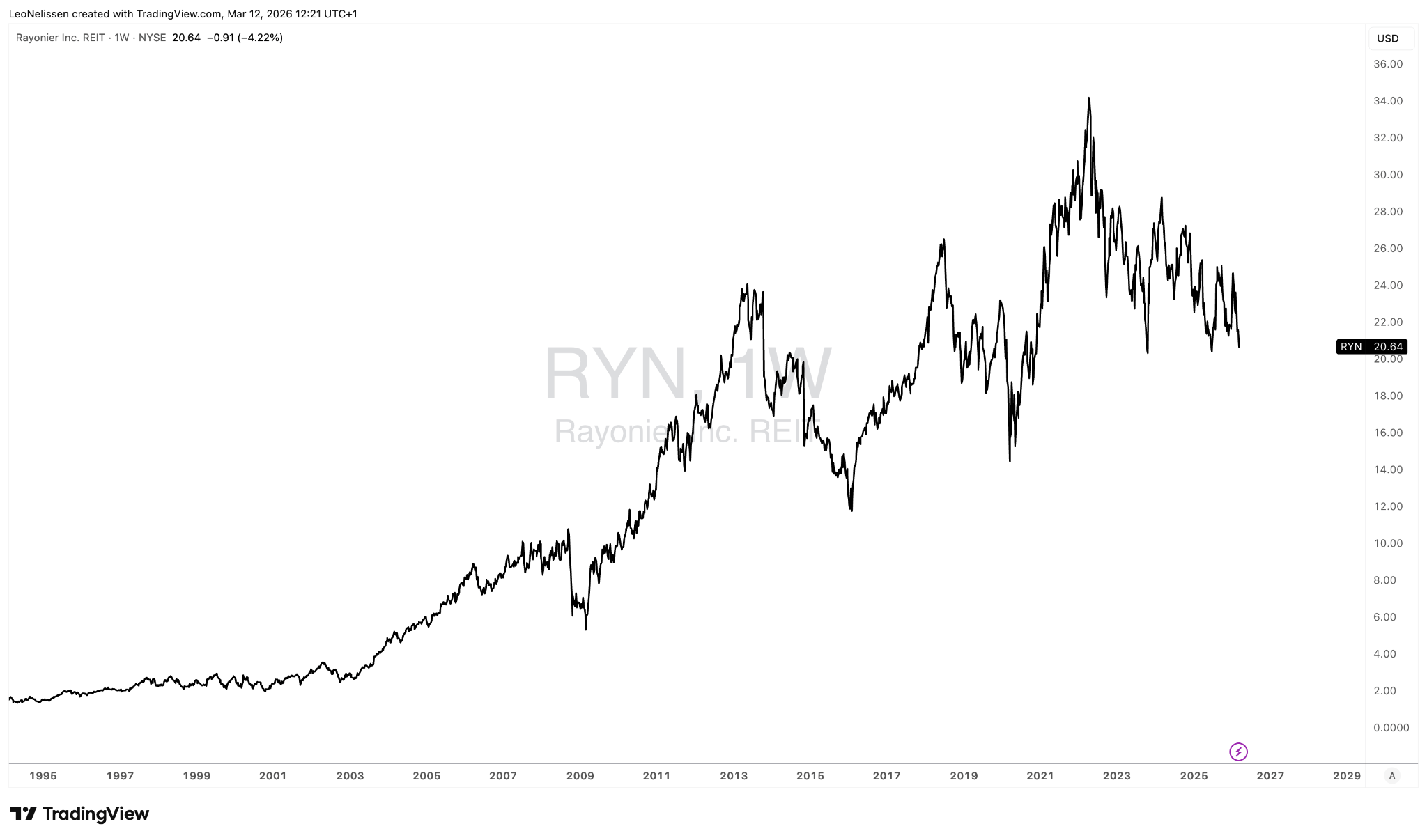
As we can see in the total return chart below (capital gains + dividends), RYN isn’t a low-volatility stock, which is why I have always avoided it. If I want a volatile stock, I prefer buying a housing supplier that tends to rise faster during times of strong economic growth.
TradingView (RYN)
The good news is that the RYN risk/reward looks highly attractive.
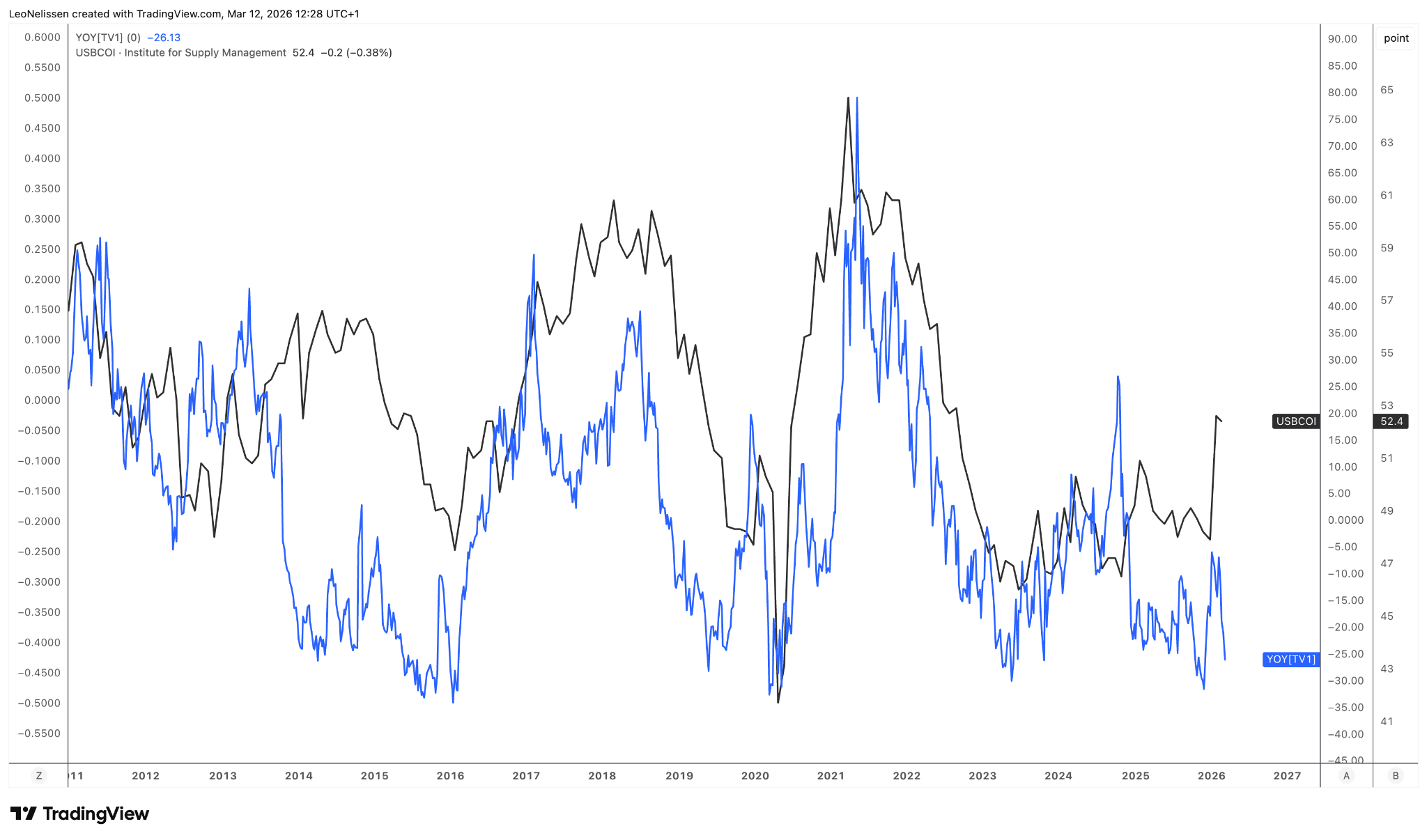
As we can see below, despite the increase in the ISM Manufacturing Index (the black line), the year-over-year performance of RYN has continued to go down. At this point, I like the risk/reward a lot.
TradingView (ISM Manufacturing Index, RYN)
If we get broadening economic growth, we’ll see both pricing and demand tailwinds in this space. Moreover, while the dividend was cut by 4.6% in February, it was part of the merger. Currently, it yields 5.2% based on a quarterly dividend of $0.27.
At points like these, I think RYN makes for a great investment that provides income, a great risk/reward, as well as inflation protection for an income portfolio, as this stock tends to do well in times of rising inflation.
Generally speaking, I truly believe that all three of these picks bring something truly unique to the table that I find highly compelling for an income portfolio. And, as I always say, stay tuned for more ideas!
For now, here’s a short takeaway:
Takeaway
My introduction was pretty chaotic today. However, my point is that it’s all about identifying capital rotations and finding the best risk/reward for an income portfolio, or any portfolio, really.
At a time when money market funds are overflowing with capital, rates are likely to be pressured, and economic growth is set to rebound, I like to apply a diversified approach to buying high-quality income.
If I were retired today, I would buy ARCC for elevated BDC income, preferred Agree Realty stock due to a 6% yield and a terrific risk/reward, and Rayonier because it provides 5% income and cyclical tailwinds and elevated inflation protection.
These are three different themes, but all have one thing in common, which is a unique ability to add value to an income portfolio.
Three Risks You Need To Know
The biggest risk for ARCC is credit risk. While it is protected against further declines in short-term rates, a domino effect in credit could lead to elevated non-accrual rates.
For Agree Realty’s preferred stock, the biggest risk is a surge in long-term government debt rates. As these compete with preferred stock due to the bond-like dividend payments, they could keep a lid on capital gains.
For RYN, the biggest risk is a sluggish housing market and related pricing headwinds in lumber.