Resetting the dividend
Estimated dividend for FY27 is 4.0p–4.6p
This year’s dividend target of 8.43p will be met. Going forward, the dividend would be set at 75% of operating free cashflows, post debt servicing and portfolio and fund operating expenses.
The estimated dividend range for the financial year ended 31 March 2027 is 4.0p-4.6p.
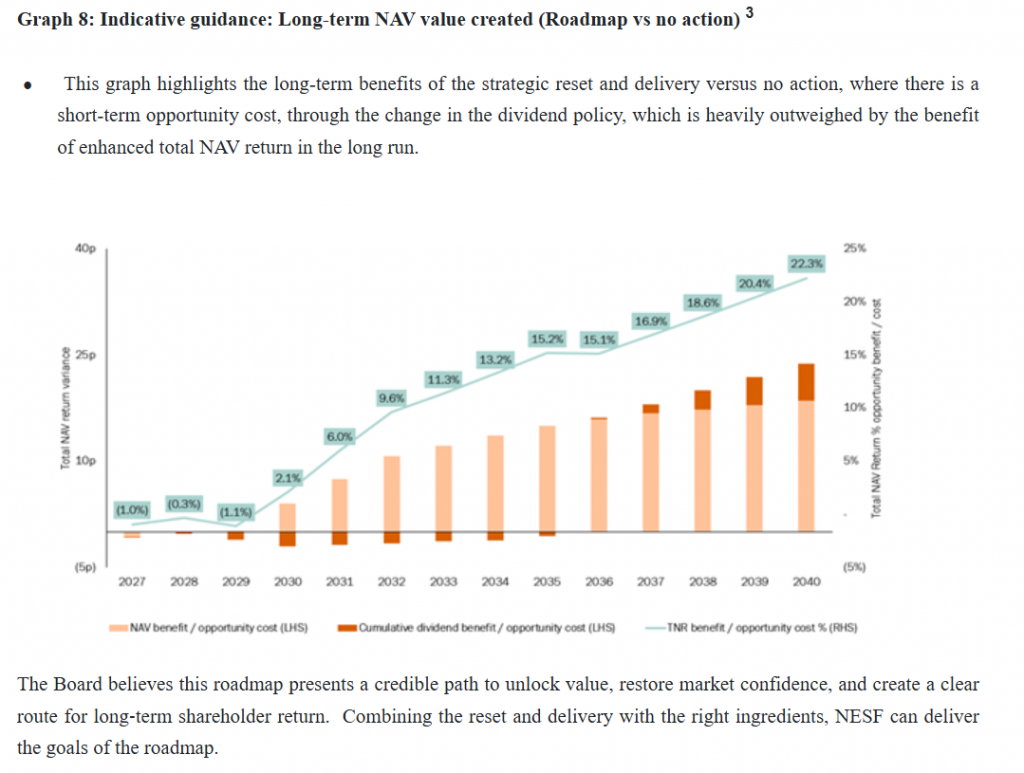
Reducing the dividend would free up an estimated £40m over the next five years.
On the current share price, the lower dividend translates into a yield for FY27 of between 8.3% and 9.6%.
Helpfully, NESF has set out – in the form of the chart in Figure 1 – some guidance around how the dividend might evolve as the company pursues its new objective. The dividend would likely fluctuate rather than grow every year, but the indication is that there is a good chance it would grow from the indicated level for FY27.
As shareholders should already be aware, without making new investments, the company’s cash flows and dividend paying ability would decline as subsidies roll off and assets reach the end of their lives. This is already modelled within NESF’s NAV calculation.
However, Figure 2 demonstrates there is a chance that the dividend can be maintained if a proportion of operational cash flows are reinvested. The chart is based on what could happen to the dividend if 25% of operational cashflows are reinvested back into the portfolio post subsidy end. The scenario is described as conservative.
Figure 1: Indicative long-term ordinary share dividend guidance

Figure 2: Possible long-term ordinary share dividend path post ROC / FiT subsidy end

Conclusion of the capital recycling programme
£119m freed up by capital recycling programme
On 10 March 2026, NESF announced that it had sold the two remaining solar plants that had been identified for sale under its capital recycling programme. The sale of The Grange and South Lowfield raises £46.2m, which will be applied to reducing the balance on NESF’s revolving credit facility, which was £151.9m at the end of December. The sale price came in marginally below the carrying value in the NAV, reducing it by 0.32p. However, overall, the programme freed up £119m, crystalised a 1.1x multiple on invested capital, and added 2.44p to the NAV.
In his remarks, NextEnergy Capital’s investment director Stephen Rossiter observed that there is “renewed momentum in the solar M&A market as we move into 2026”.
New capital recycling targets
Further asset sales planned
The board has plans for up to further 120MW of additional asset sales. The realisations of NESF’s $50m investment in NextEnergy III and two co-investments (from 2027 onwards) – about 116MW in total – will free up additional capital.
A stronger balance sheet
The board believes that the lower dividend and ongoing asset sales can both help fund new investments and bring NESF’s loan-to-value ratio (LTV) to within a 40%-45% range, well inside its 50% investment policy limit.
At the end of December 2025, NESF had total debt of £509.1m, equivalent to LTV of 51%. £200m of that was in relation to its preference shares. The preference shares pay a preferred dividend of 4.75% p.a. until March 2036, after which they have the right to convert, based on 100p per preference share and the NAV per ordinary share at the time of conversion, into new ordinary shares or a new class of unlisted B shares with dividend and capital rights ranking pari passu with the ordinary shares. The preference shares are redeemable at the option of the company at any time after 1 April 2030, in full or in part.
£143.7m of NESF’s long-term debt is amortising and will be repaid in line with the remaining life of the portfolio’s subsidised assets.
The balance relates to NESF’s revolving credit facility (RCF). NESF renewed this £205m facility in March 2025, securing finance at 120bps over SONIA. This is set to mature in June 2026, but NESF has options to extend it up to June 2028.
Significant new investment opportunities
In the face of growing demand for power, the UK government has ambitions to triple the UK’s operational solar capacity to 50GW and quadruple the amount of installed battery storage to 27GW by 2030. Solar has the advantage of being the cheapest form of renewable energy (even here in the UK). It would also help increase our energy security and better insulate us from spikes in fossil fuel prices such as those being currently experienced as a consequence of the Iranian war.
For investors, the availability of predictable, inflation-linked, 20-year revenue streams provided under the government’s new contract for difference (CfD) contracts should help attract private funding.
NextEnergy Capital believes that NESF ought to be playing its part in channelling investors’ capital into this opportunity. It can leverage Starlight, the investment adviser’s development arm, and the considerable resources of Wise Energy, the world’s largest solar-focused asset manager to help it achieve its goals.
Energy storage targeted to rise to 30% of the portfolio
However, given NESF’s inability to raise fresh capital, this morning’s statement identifies more modest goals of improving the health of NESF’s portfolio by repowering existing solar assets with new technology to enhance energy yields and the installation of co-located energy storage. The overall exposure to energy storage is targeted to rise to 30% of the portfolio (this will need shareholder approval, which will be sought at the upcoming AGM).
Co-located storage can optimise generation to align with demand
The board observes that co-located storage can optimise generation to align with demand, unlock additional revenue streams, and materially strengthen project economics by maximising the value of existing grid connections (a lack of grid connectivity is a significant constraint on delivering the government’s clean energy ambitions). NESF says investments in two-hour duration storage can generate IRRs of 10%-13%.
Figure 3: The future of NESF’s portfolio

Figure 3 is designed to give an indication of the potential evolution of NESF’s portfolio. The darker orange boxes represent operational solar assets that can be retained and enhanced, the lighter orange represents the potential to add new-build solar assets, and the dark green boxes are the NextEnergy III and co-investment assets that will be realised. The light green box outlined in orange dashes are the assets that will go into the new recycling programme. There is a chance that this will be expanded over time to encompass the rest of the light green assets. The existing Camilla battery storage asset is in blue, and the dark blue box represents potential new energy storage assets.
A brief history
In April 2023, NESF announced a capital recycling programme, with plans to sell a portfolio of subsidy-free assets comprised of five solar plants – Hatherden (which was still at the ready- to-build stage at the time of disposal), Whitecross, Staughton, The Grange, and South Lowfield. The sale of Hatherden for £15.2m was announced in November 2023, Whitecross was sold in June 2024 for £27.0m, and Staughton in November 2024 for £30m.
In May 2025, the board announced that the dividend target for the financial year ended 31 March 2026 would be maintained at 8.43p, and that it expected this to be covered 1.1x-1.3x by earnings post-debt amortisation. The latest quarterly update from NESF reconfirmed this dividend cover forecast.
Fee cut boosts the dividend cover
In June 2025, the annual results statement included a statement that “NESF continues to explore multiple strategic options for the future”. A couple of days later, the company announced that NESF had negotiated a reduction in management fees, which would now be based 50% on NAV and 50% on market cap (down from 100% on NAV). The estimate at the time was this would save the company about £0.6m per annum, boosting the dividend cover.
At the AGM in August 2025, 12% of the shares that were voted, equivalent to 7% of NESF’s shares in issue, voted in favour of discontinuation.
In November 2025, the UK government launched a consultation on changes to the indexation of subsidies (ROCs and FiTs) and then ignored the feedback it received, opting to impose a switch to using CPI with effect from April 2026. This took 2p off NESF’s NAV.
Covenant restricts buybacks
In December 2025, the interim results announcement highlighted the enterprise value covenant ratio that is part of the USS preference share subscription agreement had been breached. The requirement is that this does not exceed 50% (at 31 December 2025, it was 60.1%). This means that USS’s approval or waiver is needed before NESF can buy back shares, distribute special dividends, or take on additional debt.
No shares have been repurchased since the end of April 2025. The issued share capital had been reduced by about 15m shares from end March 2023 until then.
In February 2026, NESF announced that its end December 2025 NAV was 84.9p (this is before the 2p impact of the indexation change referred to above). This represents a 31% decline from its peak at end September 2022. Various factors have been at work here, including a rise in the weighted average discount rate used to forecast NESF’s future cash flows from 6.8% to 8.0%.
Figure 4: UK power prices (£/MWh)

However, chief of these factors has been falls in power prices. In September 2022, NESF was using £139.1/MWh as its estimate of short-term power prices (between 2022 and 2026). That is the equivalent of £156.8/MWh in today’s money (using CPI). However, in its September 2025 NAV calculation, the estimate of short-term power prices (out to 2029) had fallen to £60.7/MWh.
A significant influence on UK power prices is the price of natural gas. That peaked in August 2022 and at the end of September 2022 it was about 350p/therm. At the end of September 2025, it was closer to 80p/therm. Today, following the outbreak of war with Iran, it is about 125p/therm. If the disruption to gas supplies persists, power prices could be set to climb once again.
Important Information
This marketing communication has been prepared for NextEnergy Solar Fund Limited by Marten & Co (which is authorised and regulated by the Financial Conduct Authority) and is non-independent research as defined under Article 36 of the Commission Delegated Regulation (EU) 2017/565 of 25 April 2016 supplementing the Markets in Financial Instruments Directive (MIFID). It is intended for use by investment professionals as defined in article 19 (5) of the Financial Services Act 2000 (Financial Promotion) Order 2005. Marten & Co is not authorised to give advice to retail clients and, if you are not a professional investor, or in any other way are prohibited or restricted from receiving this information, you should disregard it. The note does not have regard to the specific investment objectives, financial situation and needs of any specific person who may receive it.