I would like to re-position the SNOWBALL for long term growth and dividend growth. There is 40k of cash, which will have to invested otherwise the SNOWBALL will suffer a loss of income of around 3k.
IF the oil price stays high I would like to buy the following shares
MRCH
CTY
SEIT
LWDB
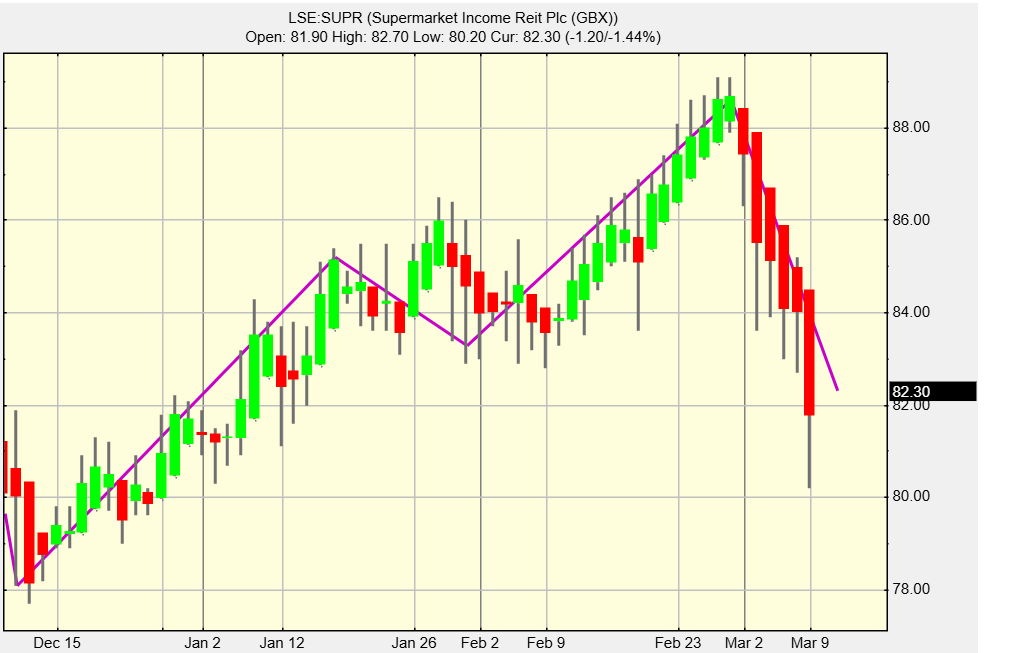
SUPR
IF the oil price stays high the yields on the above may improve and the SNOWBALL could invest at a blended yield of 7%.
The first xd dates, apart from LWDB which is un-important, are a few weeks away, so there is time for the market to fall and the new financial year is also still just under a month away.
I will start to re-invest by buying SEIT and finalise the position in TRIG, which will leave around 26k to re-invest.
abrdn Diversified Income & Growth PLC ex-dividend date BlackRock Throgmorton Trust PLC ex-dividend date Gabelli Merchant Partners PLC ex-dividend date Henderson Smaller Cos Investment Trust PLC ex-dividend date Real Estate Credit Investments Ltd ex-dividend date Safestore Holdings PLC ex-dividend date Schroder Real Estate Investment Trust Ltd ex-dividend date Tritax Big Box REIT PLC ex-dividend date VPC Specialty Lending Investments PLC ex-dividend date
I’ve sold the SNOWBALL shares in TFIF for a loss £238.00.
As the new trading year starts next month I can afford to miss out on some income as I re-balance the SNOWBALL into hard assets, rather than loans, especially as April is a thin month for income from dividends.
The situation could change very quickly and then the SNOWBALL would have to be re-assessed.
£40,902 of cash for re-investment of which 4k is for re-investing in TRIG.
I’ve sold the SNOWBALL shares in DIG, for a loss of £347.00.
It was always a high risk trade buying late in a prolonged bull run, the intention is to improve my stable of shares (Cheltenham this week) by buying a dividend hero share as a replacement.
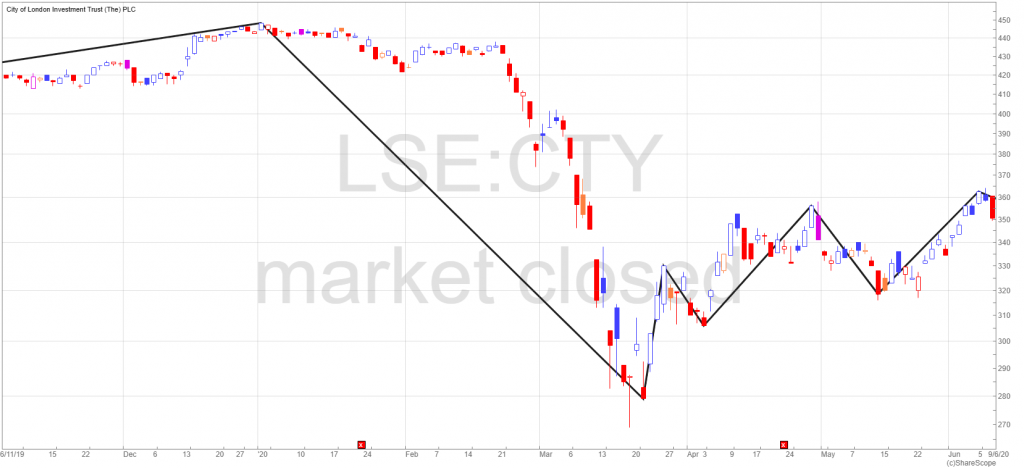
The worry was that companies would not be able to continue to pay their dividends at the same rate. You must remember that CTY has reserves for that scenario.
The yearly dividend before the crash was 19.0p and the yield 4.3%
The dividend after the crash 19.05p and the yield was 6.75%
The current dividend is 21.3p
To receive a yield of 5% the price would have to fall to around 400p.
The SNOWBALL was going to buy some RECI as they go xd this week, the dividend would have been paid in this tax year and the SNOWBALL already has enough income for the current year and as markets are falling I will continue to watch.
The sale of DIG at a loss will proceed and this will give the SNOWBALL around 30k to re-invest at higher yields than is available in the market today, hopefully.
Maybe a purchase of a dividend hero, subject to Mr. Market being nice.
Hypodermics on the shore, China’s under martial law
Rock and roller, cola wars, I can’t take it anymore
Billy Joel had had it with, well, everything geopolitical when he belted these lyrics to his latest number one hit in 1989. We Didn’t Start the Fire reached number one on the Billboard Hot 100 chart for two consecutive weeks, teaching listeners:
It was always burning since the world’s been turning.
And while Fall Out Boy gave us a worthy sequel “cover” of Joel’s hit in 2023 (encompassing Harry Potter to Brexit), the headlines have already lapped them. We are in 2026 now, and the fire is burning hotter than ever.
The “Piano Man” himself couldn’t predict the chaos of 2026. But if Billy were still banging on the keys today, the new verse might go something like this:
Fed is stalling, tensions high, watch the VIX begin to fly!
Joel’s point was that the madness never stops. From Cold War to Trade War. Foreign debts to… even bigger foreign debts.
Most vanilla investors back away from the flame. They panic when the headlines get too hot. They freeze when the Fed fights with the justice department. They melt (sell) when the President threatens tariffs on Europe.
The glaring problem with this knee-jerk approach is that the fire never stops burning. These “first level” investors sell low—when headlines are scariest!
We contrarians take a different approach. We know that the “fire”—market volatility—is actually an asset class. We can tap the madness to create an income stream for ourselves. Here’s how.
When the world gets crazy, fear spikes. When fear spikes, so do option premiums. Which is when we swing into actions and sell options for their sweet premium income.
Sure, we can do this by selling (“writing”) covered call options on individual stocks and ETFs. But that can turn into a fulltime job, and our goal is to retire! So, we prefer the “Easy” button which means we buy covered call funds for yields up to 12.1%. Paid monthly to boot!
Let’s talk about two of my favorite monthly-paying covered call funds today.
First up, we have an assist from a silent partner in Washington working on our side. The administration wants lower long-term yields to boost the economy and unlock the housing market.
One year in, they have been successful. Treasury Secretary Scott Bessent continues to limit the issuance of long bonds, which boosts their price (and keeps yields low). Bessent has unlimited tools at his disposal to keep a lid on yields.
Don’t fight the Treasury!
Bond yields jump every time there is a new headline about Greenland or European tariffs. We’ll gladly fade the hysteria. Our “tariff hedge” is the iShares 20+ Year Treasury Bond BuyWrite Strategy ETF (TLTW).
TLTW holds long bonds and sells options against them for additional income. It turns geopolitical headlines into a 9.9% dividend stream, paid monthly.
Bond Yields Plus Covered Call Income
Think of this as selling “panic insurance” to the herd. When traders freak out about tariffs or a government shutdown, they rush to buy options to protect their portfolios. That spikes the price of premiums. TLTW is on the other side of that trade, selling those expensive options to the nervous masses. The scarier the headlines get, the more income this strategy generates. We are effectively shorting the frenzy.
Sudden geopolitical shocks—like a government extraction in Venezuela or a tariff tweet at 3AM—cause market-wide jitters. The S&P 500 swings wildly. The weak hands get motion sickness.
We take the motion and turn it into a 12.1% income stream with the NEOS S&P 500 High Income ETF (SPYI). This fund holds a basket of S&P 500 stocks to replicate the index, but it adds a “kicker”: it sells (writes) call options on the index to generate meaningful monthly income.
The result is that terrific 12.1% yield. And unlike many other covered call funds, SPYI uses Section 1256 contracts, which means that 60% of the gains are taxed at the favorable long-term capital gains rate.
Fire Burns, Divvies Get Dished
And there is another hidden structural advantage here, too. Most covered call funds cap your upside completely—if the market rips higher, you get left behind. SPYI is smarter. It often uses a “call spread” strategy rather than just simply selling calls blindly for income. This leaves a “skylight” open for the fund to capture some capital appreciation during a relief rally. You get the 12% income floor without crashing into a low ceiling.
Hey, we didn’t start the fire. But as long as it’s burning, we might as well get paid for it.
If you’ve got a (ahem, no judgment) fuzzy memory, well, here’s how it went down. We sang some Billy Joel—good start, I know.
A little We Didn’t Start the Fire. We honored his point that the chaos never stops. That was the case in 1989 when the banger topped the Billboard charts. It remains true today.
Ha, we even belted a 2026 verse over our (virtual) beers!
Wow. About that “Iran missiles here we go” line. Even I didn’t expect the sequel to arrive this fast.
But here we have it. I woke up on Saturday, checked my phone (my unhealthy yet common ritual), and see we’ve got US and Israeli forces decapitating Iranian leadership—Khamenei is dead. Iran flailed back at neighbors in the region. Oil is rallying because the Strait of Hormuz is shut down.
The fire is burnin’. The new verse for our next rockin’ night out together practically writes itself:
Tehran burning, bombs at dawn, Hormuz shipping tankers gone
Oil spiking, gold on fire, Treasuries the world’s desire
Vanilla panics, herd is out, we contrarians grab payouts
Billy said it, now it’s real—we don’t flinch, buy dividend deals!
The Piano Man’s lesson hasn’t changed. It was always burning somewhere since the world’s been turning. The fire never stops. Not our fault! Our job is to get paid while it’s burning.
In February, we discussed the iShares 20+ Year Treasury Bond BuyWrite ETF (TLTW). This fund owns long-term government bonds and sells covered calls against them for additional income, a savvy strategy which elevates a pedestrian 4% paying bond fund into an elite 8.9% dividend payer. It also takes advantage of geopolitical panic and morphs that into a monthly dividend machine.
We are selling panic insurance to the broader herd.
Since then, TLTW has continued paying investors. Readers who followed my Contrarian Outlook recommendation now sit pretty. Subscribers to my Dividend Swing Trader service, who got in even earlier, can now boast 11% on the position including dividends in eight months, an annualized 17%. Not bad for a “boring” bond fund!
Here’s why TLTW loves a crisis. When bombs fall and the world panics, money floods into US Treasuries. Bond prices jump and yields drop. Meanwhile, this fear spike also boosts option premiums, and TLTW is on the other side of that trade. As a seller of these expensive options to nervous traders, the income that TLTW generates actually goes up during times of crisis. Good for TLTW investors.
My only issue with TLTW today is that now the world’s talking about Treasuries. As contrarians, we want to buy ahead of the herd, not with it. So, I rate TLTW a Hold over in our DST portfolio. Of course, we’re happy to collect the dividend checks. We’re just not going to chase TLTW here.
If you missed TLTW, consider the Global X S&P 500 Covered Call ETF (XYLD). It’s a perfect complement to TLTW. The fund does the same thing, but in stocks instead of bonds. XYLD holds a basket of S&P 500 stocks and sells covered call options against the index every month. This generates additional income and provides a much higher yield than from buying the S&P 500 index alone.
And here’s where it gets good with the Iranian situation. When market turbulence spikes—which is exactly what’s happening right now—call options get more expensive. And XYLD, as a seller of these call options, collects more. The result is a 10%+ yield, paid monthly, that is well supported. This is real cash that hits our brokerage accounts twelve times a year, regardless of whether the market trends up, down, or sideways.
XYLD is our bomb shelter dividend. We’re getting 500 of America’s biggest companies and collecting a fat monthly income stream no matter how scary the world gets. In fact, the scarier the world gets, the more premium income the fund generates. Crisis alpha, baby!
The underappreciated secret? These S&P 500 firms are best positioned to benefit from AI in the near term. They’re implementing it across their operations right now—cutting costs, boosting margins, trimming headcount (hot off the presses: Jack Dorsey’s Block, formerly known as Square, announced cuts of 4,000—nearly half its workforce—due to AI!). When these efficiency gains show up in quarterly earnings, the recent hysterical selling will fade and XYLD will benefit even more.
Here’s what I want you to understand: TLTW and XYLD aren’t one-off picks. They’re part of a proven system that works for you.
My Contrarian Income Report portfolio holds 25 positions across bonds, energy toll collectors, covered call funds, BDCs, munis, and utilities—yielding 8.3% on average. When the world catches fire (and it always does, somewhere), this portfolio doesn’t flinch. It keeps paying, month after month!
The fire never stops. Billy Joel told us that in 1989. I reminded you last month. Tehran is reminding you right now.
So, let me ask you: when the next crisis hits (and it will), do you want to be panicking with the herd? Or collecting your monthly dividends with us?
A £100,000 pension pot could last anything from a lifetime to just 13 years, depending on how much income you take and your level of investment returns, according to analysis by Standard Life.
The aim of any retirement plan is to try not to run out of pension money. While the state pension is a guaranteed income once you’ve reached state pension age, likewise a defined benefit pension, drawing down from a defined contribution pension requires a delicate balance to avoid outliving your limited pot.
The impact of investment returns – higher or lower – can mean the difference of tens of thousands of pounds of retirement income over a decade. And while modest withdrawal rates could see a pension last as long as you do, the worst case scenario of taking out larger amounts coupled with poor investment returns can be a recipe for running out of cash.
Hundreds of thousands of people could be at risk from a toxic combination of higher withdrawal rates and lower returns, according to FCA data.
Pete Cowell, head of annuities at Standard Life, said: “Pension freedoms gave retirees greater choice and flexibility, but with that freedom came responsibility and considerable financial planning challenges to weigh up.
“However, with defined benefit pensions in decline, and more people approaching retirement with larger, defined contribution pensions, monitoring the balance between withdrawals and investment returns has never been more critical to avoid outliving a pension.”
How much should I withdraw from my pension?
Two withdrawal scenarios were considered in the research – based on a pension pot of £100,000 – one with a fixed withdrawal of £4,000 per year and a higher one at £8,000 per year.
These are equivalent to the 4% pension rule and 8% of the initial pot respectively and are common withdrawal amounts, according to the Financial Conduct Authority’s retirement income data for 2023/24.
The analysis then assessed the impact of different investment returns on the pension pot after 10 years, ranging from a return of 8%, 5% and 2%.
Impact of annual withdrawal and investment growth rates based on a £100,000 pension pot
Annual withdrawal
Investment growth rate per year
Pot value after 10 years
£4,000
8%
£141,000
£4,000
5%
£101,000
£4,000
2%
£70,400
£8,000
8%
£83,900
£8,000
5%
£51,700
£8,000
2%
£27,800
Figures rounded down to three significant figures. Figures assume annual management charge of 0.75% and are not adjusted to account for inflation
Impact after 10 years of withdrawing £4,000 per year
After 10 years, those who withdrew £4,000 of their pension each year would have a pot worth between £141,000 if they secured 8% returns and just £70,400 with 2% returns. This works out at a difference of £70,600, showing how important investment returns are on people’s retirement incomes.
Impact after 10 years of withdrawing £8,000 per year
For those who withdrew £8,000 each year, their pot would be worth between £83,900 if they secured 8% returns and just £27,800 with 2% returns. The impact of the additional withdrawals is particularly stark when compared to the lower withdrawal outcomes.
How long will my pension last?
The analysis looked ahead to assess how long the pension pots would last in each of the different scenarios.
Those who took £4,000 each year would not exhaust their pot if it grew by either 5% or 8%, as the investment returns would offset those withdrawals. In the 2% growth scenario, their pension would still last 29 years.
In the higher withdrawal scenario, however, each of the pots would eventually run out, with the pot in the high (8%) return scenario lasting 28 years compared to just 13 years in the low (2%) return equivalent.
Impact of annual withdrawals and investment growth rates on the longevity of a £100,000 pension pot
Annual withdrawal
Investment growth rate
Pot longevity
£4,000
8%
Lifetime
£4,000
5%
Lifetime
£4,000
2%
29 years
£8,000
8%
28 years
£8,000
5%
17 years
£8,000
2%
13 years
Figures assume annual management charge of 0.75% and do not account for inflation
Through these illustrative scenarios, the investment returns are predictable each year, but the reality is that people will experience investment ups and downs while in drawdown which makes predicting how much your pot will be worth all the more difficult.
Inflation will also be a key consideration, as people will need to manage this risk over the long-term to ensure their purchasing power isn’t eroded.
The FCA’s retirement income data shows the risk of running out of money is widespread, given the number of people withdrawing at higher levels.
More than 225,000 individuals made withdrawals at 8% or above in 2023/24, according to the regulator’s figures, highlighting the potential risk of outliving their savings.
Of this number, the figures also show more than 50,000 individuals with pension pots between £50,000 and £99,000 made regular withdrawals of 8% or more in 2023/24.
Some 40,000 individuals with pots between £100,000 and £249,000 were also drawing down at this level.
Cowell said: “There are options for those who want to mitigate investment and longevity risk. Many people are opting to cover their essential living costs with a guaranteed income through a combination of the state pension and an annuity.
“This approach removes many of the unknowns as you know your core living costs will be met while also providing the potential for investment growth on any pension placed in drawdown.
“With the Pension Scheme Bill expected to legislate for default retirement income solutions, we expect to see approaches that blend a combination of income certainty and flexibility become more and more mainstream.”
If you have just started your investment journey, you may be thinking
It can be disheartening to see your hard earned disappear from you account.
Remember the rules and stick to your plan, knowing that out of adversity, comes opportunity, as you will be able to buy shares for your Snowball at discounted prices.
Only with luck is it possible to buy at the bottom of the market , so don’t waste too much time and energy trying too.
But it’s possible to buy the yield, so if you are happy with the yield, better if it’s close to the next xd date, you could trade. Of course the price could continue to fall and the yield will improve, no one should pretend it’s easy.
As always it’s best to DYOR, a watch list is published on a Saturday so you can monitor the direction of the yield. Make your own decisions and as long as your are right more often than you are wrong, remember an optimist and a pessimist arrive at the same destination at the same time but the optimist has the better journey.