Investment Trust Dividends

Month: April 2026

UKW

Thinking of stuffing a SIPP with high-yield shares? 3 things to consider

A SIPP filled with shares offering juicy dividends can seem tempting. Christopher Ruane explains some potential pros and cons of the approach.

Posted by Christopher Ruane

Published 31 March

UKW

You’re reading a free article with opinions that may differ from The Motley Fool’s Premium Investing Services.

Senior woman potting plant in garden at home
Image source: Getty Images

Some investors take a very clear approach when it comes to investing their Self-Invested Personal Pension (SIPP). They focus on high-yield dividend shares and try to build substantial income streams, compounding the dividends along the way.

This approach can have both pros and cons. Here is a trio of things to think about when deciding whether it might make sense for your own SIPP.

Growth and income can both help you build wealth

Seeing dividends pile up can feel good, partly because they are not subject to tax while inside the SIPP wrapper.

Please note that tax treatment depends on the individual circumstances of each client and may be subject to change in future. The content in this article is provided for information purposes only. It is not intended to be, neither does it constitute, any form of tax advice. Readers are responsible for carrying out their own due diligence and for obtaining professional advice before making any investment decisions.

By contrast, putting money into a growth share and holding it potentially for decades without receiving a single dividend may seem less exciting. But growth shares can help build wealth, if they end up being sold at a higher price.

Dividend shares and growth shares typically offer different routes to trying to increase a SIPP’s value. In fact, it is possible for both to do so.

High yield can a red flag, but isn’t always

As a general rule, I think it makes sense to invest by finding good companies and then assessing whether their share price is attractive. In practice, a juicy dividend can sometimes distract investors who aim to do that.

They start by finding a high-yield share. They look at whether the payout is covered by earnings. Then, they try to convince themselves that the risks (such as the dividend being cancelled) are manageable.

Sometimes, though, a high yield can be a red flag that the City has doubts about whether a firm will be able to maintain its dividend.

Such dividends are sometimes cut or even cancelled. Others stay the same or grow – and investors can earn chunky passive income streams.

So I think it is important as an investor to be honest about the risks of a given share, not just the potential rewards.

Staying diversified always matters

Often, high-yield shares cluster together in certain stock market sectors.

Right now, for example, three of the FTSE 100’s five highest-yielding shares are financial services firms. The other two are property companies.

The FTSE 250 shows a different bias but the same pattern. All five of its highest-yielding shares are linked to renewable energy.

It is always important to manage investment risk by diversifying. With high-yield shares clustering in certain sectors, that can take a concerted effort.

By nature, a SIPP is a long-term investment vehicle. Its lifetime will likely involve periods when cyclical shares are at different points in the economic cycle. That could mean depressed share prices, dividend cuts, or both.
I did not own any renewable energy shares in my portfolio recently, so I took the chance to add Greencoat UK Wind (LSE: UKW).

The company owns stakes in a number of wind energy projects. That has helped it grow its dividends annually in recent years. The current dividend yield is 10.7%.

The share also sells for a substantial discount to its net asset value, suggesting it could be a bargain.

Still, as the past year’s share price performance and high yield suggest, some investors are nervous about the prospects for energy funds, including this one. Changing attitudes on energy policy combined with current energy price volatility could hurt profitability.

I reckon those fears are more than factored into the current share price, though, so I happily bought the share for its passive income potential. 

UKW

Yield 10.8%. Next xd date early May

Discount to NAV  28%
Across the pond

2 “Defensive” Dividends Growing Fast (Thanks to AI)

Brett Owens, Chief Investment Strategist
Updated: March 31, 2026

Fear is up, markets are down—and we contrarians know that times like these are when we go shopping.

Yes, stocks are wobbling. And yes, those hoped-for rate cuts have dried up. Even one may be a stretch this year. But as worrisome as the situation in the Middle East is, as investors, we need to look beyond it.

Truth is, in the long run, AI will cap wage growth (it already is). That will take a bite out of inflation, and rates, while boosting profits—and our dividends along with them.

Fading Short-Term Fears

At times like this, we come back to our “Dividend Magnet” plays: Stocks growing payouts fast—and pulling up their share prices as they do. In the last few weeks, Middle East tensions have knocked many of these stocks behind their dividend-growth pace. That’s our cue.

Below are two examples. Both have pulled back, even though neither has anything to do with the Middle East. Plus, both are “stealth” AI plays that aren’t getting their due.

WM: More Trash, More (Dividend) Cash

Waste Management (WM) does two things we love:

  1. Raises its dividend and …
  2. Grows its free cash flow (and its share price along with it!).

Geopolitics doesn’t touch this business: It just goes on quietly collecting trash.

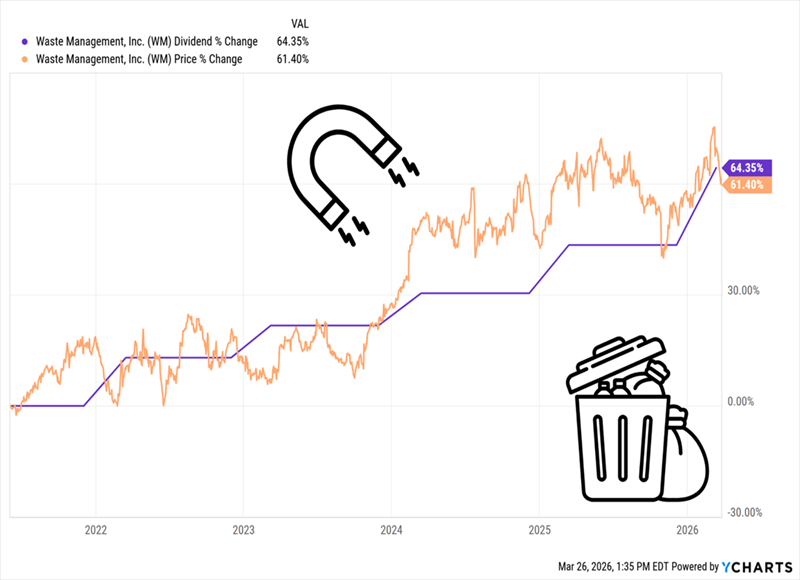
Not just that: It actually controls the entire waste, er, management cycle: as of year-end 2025, WM owned 257 landfills, 482 transfer stations, 162 recycling depots and 17 medical-waste incinerators. All that trash has been rocket fuel for WM’s dividend:

A Trash-Powered Dividend Magnet

Impressive as those numbers are, they’re first-level stuff—known by anyone who takes a glance at the company. Our second-level analysis kicks in with the dividend. With a yield of just 1.5%, most folks dismiss WM.

Here’s what they’re missing: As you can see above, this payout isn’t just growing, it’s accelerating. The latest hike, declared March 2, was 14.5%. This is WM’s 23rd straight year of increases.

That fast growth clip grows an investor’s yield on cost in a hurry. Anyone who bought just 10 years ago, for example, would be yielding around 6.6% on that buy now.

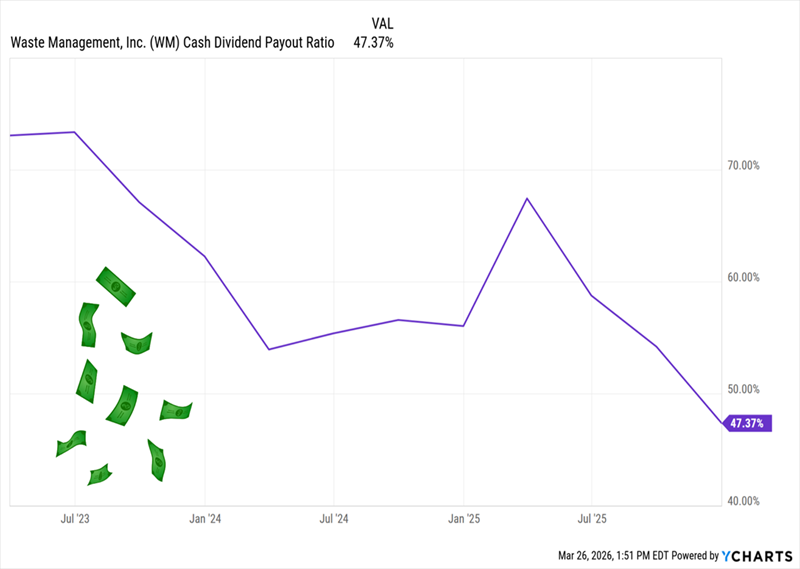
Cash Pile Grows Faster Than Management Can Give It Away

Here’s something else few first-level investors realize: Even with its fast payout hikes, WM’s payout ratio (as a percentage of free cash flow) has been falling for years.

Dividend Surges—and Gets Safer

I expect that to continue, especially with CEO Jim Fish stating in the company’s latest earnings report that he sees FCF growing 30% this year.

That’s in part because WM is investing in AI—and it’s paying off. Management has earmarked $1.4 billion between 2022 and 2026 for automation, including robots that—thanks to machine learning and top-flight imaging tech—can identify and pluck up to 1,000 items an hour from the waste stream. That’s more than 10 times “human speed.”

WM is never “cheap” (its P/E ratio is 34), and it’s gained 3% this year, as of this writing, beating the market. But since Middle East hostilities broke out, the stock has dropped 6%. That’s a solid deal on this top-notch dividend grower.

GILD: Another “Stealth” AI Play

Gilead is just as insulated from the Middle East as WM, and its AI connection is stronger.

That’s because AI is poised to shave a lot of time off of drug development—as much as six years, according to some studies.

That’s a lot more time for companies to profit off a drug before generics move in. Companies can also use AI to game out new treatments in computer simulations, letting any potential failures happen there, not in the middle of a pricey FDA trial.

How do we play this shift? We look for drugmakers with strong pipelines. This sector is also a great place to bargain-hunt because it was hammered last year, first by worries about RFK, Jr. at HHS and then by tariff fears.

My take? AI gains are going to way more than offset these worries.

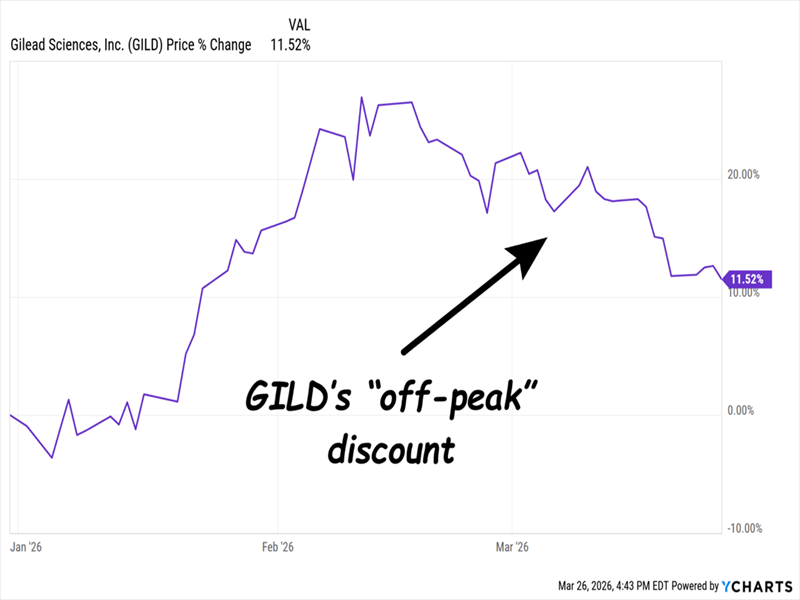
Which brings me to Gilead Sciences (GILD), which we last discussed a month or so ago. It was a good deal then, and it looks better now. That’s because, like Waste Management, GILD has gained this year, while pulling back since the start of hostilities, to the tune of around 7% as of this writing.

Middle East Situation Tees Up Another Shot at GILD

That’s overdone: Gilead focuses on oncology and HIV treatments that generate predictable revenue, and its pipeline is loaded: 25 treatments in Phase 1 trials, 13 in Phase 2 and 15 in Phase 3.

GILD isn’t afraid to put its cash on the line, either: Last year, it spent $5.7 billion, or almost 20% of revenue, on R&D. With AI, it’ll be able to further “de-risk” that spend, while giving itself more treatments to test (and potentially push through to market).

No doubt Gilead’s efforts will be quarterbacked from the new 180,000-square foot AI-enabled research center it started building at its California HQ late last year.

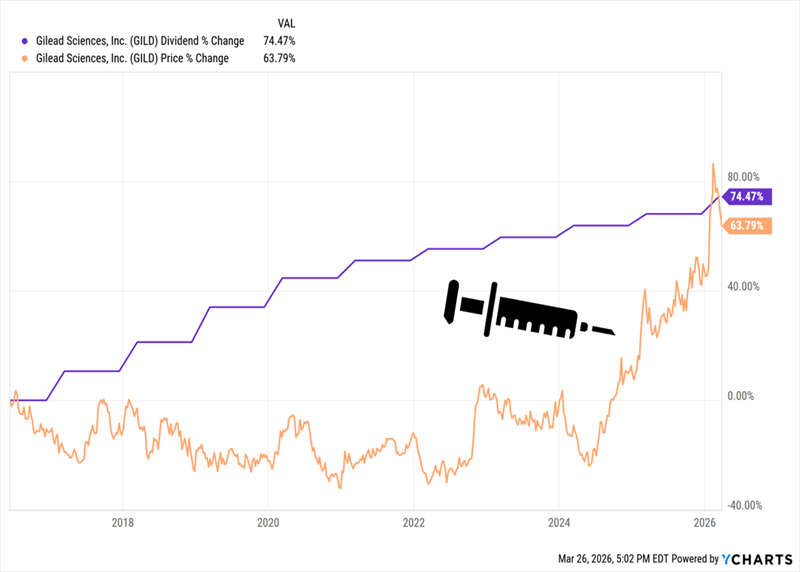
Which brings me to the dividend: Like Waste Management, Gilead shares look uninspiring from a current-yield standpoint, at around 2.7%. But there’s something interesting happening under the hood here:

GILD’s Dividend Magnet Gets a Shot in the Arm

As you can see above, after lagging the payout for the last three years, the stock has nearly caught up. Moreover, its latest dividend hike was bigger than usual: $0.03 instead of $0.02.

An extra penny? Sounds small, but it is a 50% hike. There’s reason to believe more are on the way (beyond the AI bump). For one, in the latest quarter, free cash flow jumped 10%, to $3.1 billion, easily covering the $1 billion in dividends (and $230 million in buybacks) the company kicked out.

Finally, GILD trades at a reasonable 15.7-times forward earnings, even with its latest jump. That shows the market still hasn’t caught on to the AI-driven potential here.

© 2026 Passive Income Live

Theme by Anders NorenUp ↑