From ‘dividend heroes’ to ‘enhanced’ options, the funds are a sensible choice for income seekers
Published on April 15, 2026
by Holly McKechnie
Investorschronicle
Table of contents
Finding a dividend hero, Opting for an enhanced dividend policy. Alternative trusts focused on income generation
Income investors are spoilt for choice when it comes to choosing an investment trust. From traditional equity funds to alternative trusts and those offering ‘enhanced dividends’, there are numerous ways to add a regular payment stream to your portfolio.
Regardless of how you decide to play it there are, however, some underlying principles you should keep in mind.
To start with, building an effective income portfolio should mean investing in a diverse range of trusts, as this helps to avoid duplication in the underlying assets you hold. If one asset class performs badly, the impact on your overall portfolio will be softened if there is sufficient diversity.
This is relatively straightforward to do. An advantage of the investment trust structure is that it allows you to buy into asset classes that are normally difficult for private investors to access, such as infrastructure or private equity. You can, therefore, invest in a broad range of assets alongside traditional equities. Income-focused trusts also tend to cover a variety of geographies, so it’s easy to diversify by region as well.
The complete guide to buying investment trusts

It’s also important not to get too carried away by the pursuit of high dividend yields. A high yield might look attractive in the short term, but not if it comes at the expense of continuous dividend growth over time. If a trust’s yield is at double-digits levels it’s worth investigating why.
“The yield may look attractive because the market is expecting a dividend cut and the shares have de-rated,” says Andrius Makin, associate portfolio director at Killik & Co. To explore whether this is the case, he suggests investigating the trust’s level of dividend cover and gearing alongside the quality of its assets. This will help you to determine whether it is prioritising income over sustainable value creation.
Finding a dividend hero
Reliability is often a key criterion when it comes to selecting a trust. A good starting point in this case is the Association of Investment Companies’ (AIC) list of ‘dividend heroes’.
To earn a spot, an investment trust must have consistently increased its dividend for 20 or more years in a row. However, many in this cohort have been raising their payouts for far longer. As the table below shows, the top four dividend heroes are each now closing in on a 60-year streak.
This is in part due to a handy design feature. Each year a trust is allowed to set aside up to 15 per cent of the income it receives. In effect, this allows trusts to build up a sinking fund. If it has a bad year, the trust can tap into this reserve to cover its dividend.
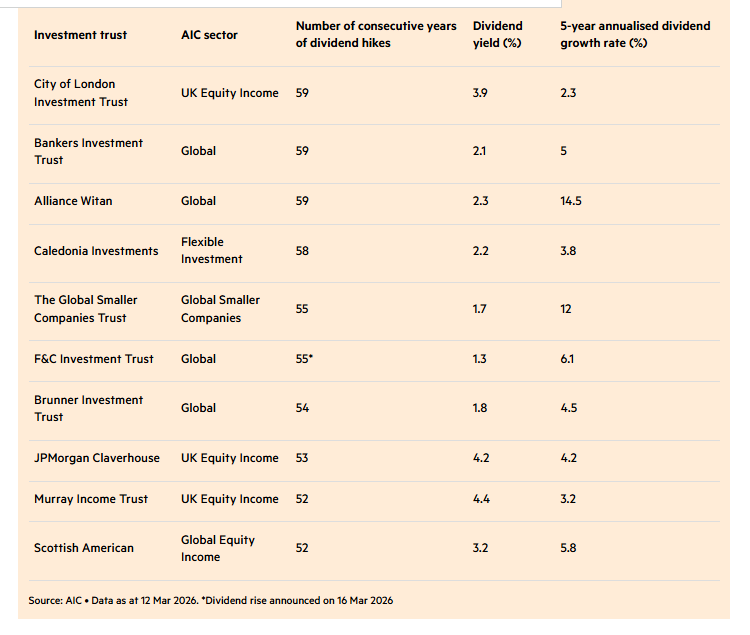
When it comes to sectors, many dividend heroes have a focus on UK equities, and for good reason. We can see why this is the case if we take a look at one of the top three, City of London (CTY).
The UK has long been a popular region for income investors thanks to its established dividend culture and its abundance of high-yielding companies. City of London, with its 59 years of continuous dividend growth and 3.9 per cent dividend yield, invests primarily in equities listed on the London Stock Exchange.
In its latest factsheet, the trust’s managers, Job Curtis and David Smith, argue that they believe the valuation of UK equities remains attractive, as do their dividend yields, when compared with overseas peers.
The trust has a relatively diversified portfolio, with 78 holdings, including a number of UK stalwarts such as HSBC (HSBA) (6.1 per cent), Shell (SHEL) (4.3 per cent) and AstraZeneca (AZN) (3.4 per cent). Financials – typically a high-yielding sector – is its biggest sector allocation, making up 33.8 per cent of the portfolio.
One thing to bear in mind is that a UK focus may lead to lower longer-term returns if other markets perform better overall. For example, the average share price total return for the AIC UK equity income sector over the past 10 years is 97.7 per cent. By contrast, the MSCI World index has returned 233 per cent over that same period.
However, not all dividend heroes invest primarily in the UK; in fact several take a global approach, such as the other two top-ranking trusts, Bankers (BNKR) and Alliance Witan (ALW).
Again, for diversification purposes, it’s not a good idea to construct your portfolio around a single country. A global income trust can, therefore, be a good way to create some geographical diversity.
It can mean you also add some growth exposure as many global funds will hold tech assets. For example, 34.9 per cent of Bankers’ portfolio is currently devoted to tech, compared with 18.3 per cent of Alliance Witan. This might not be enough to beat the index in the long term – Bankers returned 187 per cent over the past 10 years, while Alliance returned 197 per cent – but it will at least prevent your portfolio from being left behind.
Opting for an enhanced dividend policy
A fund’s record of dividend growth is not the only factor to take into consideration. Trusts fund their payouts in a variety of ways. Some, but not all, will pay out of their natural income. Others, however, take a different approach.
In recent years, ‘enhanced dividend policies’ have been gaining popularity. They involve a trust committing to paying out a percentage of its net asset value (NAV) each year as a dividend.
This has its advantages and disadvantages. A positive is that it can be another good way to add diversity to your portfolio. Invariably, income trusts tend to gravitate towards certain sectors (such as financials) in the pursuit of high yields. But having a portfolio that is dominated by certain sectors opens you up to diversification risk, particularly if those sectors are cyclical as is the case for financials. It can also mean your portfolio becomes geographically concentrated, as many income trusts will have a UK bias.
Trusts with enhanced dividend policies are not so constrained in their stock selection choices. Rather than focusing primarily on companies paying dividends, they can afford to prioritise growth-focused assets. This is evident if we look at a high-profile example. JPMorgan Global Growth & Income (JGGI) is one of the most prominent trusts to have an enhanced dividend policy. It aims to pay out 4 per cent of its NAV each year; its dividend yield currently stands at 4.17 per cent.
While it does have a relatively big allocation to financials at 10.2 per cent, its largest sector allocation is technology at 18.9 per cent. It is also overweight geographically to the US (5 percentage points above its benchmark) and underweight to the UK (by 1.2 percentage points). Its top five holdings are tech-dominated and include Nvidia (US:NVDA) at 6.2 per cent, Taiwan Semiconductor (TW:2330) at 4.2 per cent, Microsoft (US:MSFT) at 4.2 per cent, Amazon (US:AMZN) at 3.9 per cent and Apple (US:AAPL) at 3 per cent.
However, enhanced dividend policies are not without their problems. While this strategy works well when the going is good and markets are up, this approach can come undone during downturns. “It can eat into the trust’s assets during difficult market periods when the NAV isn’t growing,” warns Kamal Warraich, head of fund research at Canaccord Wealth. “This means a shrinking asset base and less capital to do other things with, like share buybacks,” he adds.
Alternative trusts focused on income generation
Another way to diversify an income portfolio is to invest in alternative trusts. As the chart below shows, these tend to offer attractive yields.

While there are many directions you can head in if you are interested in alternatives, infrastructure trusts have long been a popular choice thanks to their long-term records of producing a stable income.
High yielders in this sector include GCP Infrastructure Investments (GCP) (9.6 per cent yield), Sequoia Economic Infrastructure Income (SEQI) (9 per cent yield), HICL Infrastructure (HICL) (6.9 per cent yield) and International Public Partnerships (INPP) (6.7 per cent yield).
Of this selection, Makin favours International Public Partnerships. “The portfolio holds some interesting assets, such as the Thames Tideway Tunnel and the Sizewell C nuclear power plant. Although sewage and nuclear power may not be the most glamorous areas to invest in, I’m very confident they will still be in demand in 50-plus years,” he says. On top of this, many of the trust’s assets are government-backed with payments linked to inflation, Makin notes. This may provide some much-needed peace of mind for many investors given the uncertain inflationary climate.
As an infrastructure subgroup, renewable energy trusts are also worth considering due to their high yields. Many currently offer dividend yields in excess of 10 per cent, including NextEnergy Solar Fund (NESF) (19 per cent) and Foresight Solar Fund (FSFL) (12.8 per cent).
However, part of the reason for this is that the sector has had a tricky year, thanks to a combination of low power generation and lower than forecast power prices, along with high discounts. This has even led to some trusts promising to cut their dividends. NextEnergy Solar Fund, for instance, will cut its dividend payout to the equivalent of a 7-8 per cent dividend yield for the 2026-27 financial year following a strategic review. Meanwhile, SDCL Efficiency Income (SEIT), which yields 15 per cent, recently announced plans to wind down. It’s therefore worth closely examining trusts in this sector before making a decision.
Finally, if you do decide to invest in alternatives, bear in mind the size of your holding. Given the riskier nature of these trusts, it is sensible to ensure that no single alternatives fund makes up more than 5 per cent of your portfolio. This way your investment will be sizeable enough to contribute income in a meaningful way, but not so large that it will cause significant damage if something were to go wrong.

Leave a Reply