Investment Trust Dividends

Category: Uncategorized (Page 300 of 345)

The 10 year plan.

The current plan by re-investing all earned dividends is to have final dividend pension of 14k – 16k, it could be higher but let’s work with 16k.

Based on seed capital of 100k with no further cash added to fuel the fire.

The total pot with another 9 years dividends added should be over 200k but as that’s the unknown, let’s work with 200k.

Under current tax laws, u could withdraw 25% tax free, either for a new car or if u need the income to live on re-invested in a ISA, replicating the Trusts sold or higher yielding Trusts.

(U need to make an allowance for inflation but most of the Trusts will gently increase their dividends).

The dividend take from your pension would reduce by 25%, 4k.

12k of dividends pa, of which u could withdraw using a further 25% relief of tax, as long as current tax law remains the same and your dividend stream remains similar.

One problem for the blog is that the last Labour government taxed dividends inside a pension and may do so again, as it raises a lot of cash (to waste) for no effort and are likely to do so again.

A 7% yield with a margin of safety.

The blog portfolio currently wants to re-invest earned dividends at

a yield of 7% as this compounded doubles your cash in ten years.

U have DYOR and would like to buy NESF for their 11% yield with an above average chance of making a capital gain.

U are nervous about buying anything that yields 11%, so u could pair trade it with buying a gilt.

Summary for 3 1/4% Treasury 2033

KEY INFORMATION

ISINGB00BMV7TC88TIDMTR33ExchangeLSEPar Value£100Maturity Date31/1/2033Coupons per year2Next coupon date31/7/24 eCoupon 3.25%Income Yield 3.43%Gross redemption yield3.92%Accrued interest 33.04pDirty Price£95.31

If u hold until 31/01/3033 u will be returned your stake and if

u do the yield will 3.43%.

U will be paid a coupon (3.92% interest) twice a year

10k to invest

5k in a Gilt £196.50

5k NESF £550.00

Total £746.50 = yield £7.46%

Whilst your capital in the gilt is only guaranteed to be returned if u hold to maturity, the income can be re-invested in your portfolio.

Also if/when the next market crash happens u might want to sell your gilt to invest in a Dividend Hero Trust.

But as always best to DYOR.

NESF

NextEnergy Solar Fund – High- and growing-income opportunity

quotes

NextEnergy Solar Fund

Investment companies | Update | 7 March 2024

High- and growing-income opportunity

NextEnergy Solar Fund (NESF) is almost 10 years old. Since launch, it has built a £1.2bn, 933MW portfolio of 100 operating solar assets, powering the equivalent of over 330,000 homes, declared dividends totalling £333m, and avoided the emission of about 2.2 Mt CO2e.

NESF is on track to pay 8.35p in dividends, with forecast dividend cover of about 1.3x. Share price weakness that has afflicted the whole sector means that dividend translates to a dividend yield of 11.1%, one of the highest in its sector, and the share price’s near 30% discount to net asset value (NAV) provides the prospect of attractive capital appreciation when sentiment towards the sector recovers.

Interest rates look to have peaked, which is improving sentiment, but there is further to go. We find it hard to comprehend why any stock with a nine-year track record of growing covered dividends in line with inflation would not trade on a much lower dividend yield.

NESF also has one of the largest capital recycling programmes of its peer group, which is aimed at freeing up cash to slash debt, and fund share buybacks and existing and potential construction projects. Those projects should be both NAV- and earnings-enhancing. A re-rating of NESF’s shares is overdue.

Income from solar-focused portfolio 

NESF aims to provide its shareholders with attractive risk-adjusted returns, principally in the form of regular dividends, by investing in a diversified portfolio of primarily UK-based solar energy infrastructure and complementary energy storage assets.

At a glance

at a glance

10th birthday imminent

NESF’s long-term success reflects the strength and depth of the adviser’s business

NESF is just a few weeks off the 10th anniversary of its launch. The company got off to a flying start, helped by its ability to secure access to a portfolio of projects being developed by NextEnergy Capital’s development arm (now called Starlight) and engaging NextEnergy Capital’s experienced operational asset manager, WiseEnergy, to keep the portfolio operating smoothly. The capital that it raised was deployed swiftly and was soon generating income to cover the dividend.

This year’s dividend target is 11% ahead of last year’s

NESF’s board maintains a progressive annual dividend policy, and in line with that the trust has grown its dividend each year since launch. Since its 2016 financial year, NESF’s dividends have always been covered by cash generated from its portfolio. NESF is targeting an 8.35p dividend for its financial year ended 31 March 2024 (FY24) that is 1.3x covered by cash flow. The target was an 11% increase on the total dividend for FY23.

NESF dividend history, financial years ended 31 March

With the share price where it is, that 8.35p translates to a dividend yield of 11.1%. That seems perverse given the dividend growth track record, the cash flow cover, and the relatively predictable nature of NESF’s cash flows.

Keeping the cash flowing

Since launch, NESF has built a good track record of generating more power than budgeted. In part, that reflects a pattern of sunnier weather in the UK in recent years. However, WiseEnergy’s work to keep plants up and running plays a big part in this too. It is responsible for 1,500 solar and battery assets with an installed capacity in excess of 2.5GW, in nine countries.

Power generation versus budget

At 30 September 2023, around half of NESF’s revenues were coming from inflation-linked, government-backed subsidies, and these had a weighted average life of 11.4 years. In addition, as at 31 December 2023, NESF had pre-sold 98% of its FY24 generation at an average price of £79.2/MWh, 74% of FY25’s generation at £84/MWh, and 29% of FY26’s at £101.2/MWh.

UK power price

Power prices have been volatile but remain well above pre-COVID averages. NESF’s power price forecasts (which combine prices for the pre-sold power with forecasts from three independent energy market consultants) were adjusted at end December to reflect a decrease in short-term (2023-2027) UK power price forecasts provided by the consultants, mainly as a result of lower gas price futures (the pric of gas tends to set the marginal cost of electricity as the grid is reliant on gas peaking plant to balance power demands), influenced by above-average gas storage levels and milder weather across winter 23/24.

Adding value with new investments

Roughly £500m pipeline of new solar projects and battery storage projects

At end December 2023, NESF had identified a pipeline of new solar projects and battery storage projects totalling about £500m. Assets under construction tend to be written up in value once the associated construction risks have passed and they become operational. In addition, the extra revenue that they generate contributes to NESF’s cash flows. Starlight, the development arm of the wider NextEnergy group and an important source of potential investments for NESF, has 8.3GW of projects under development across five markets, underpinning NESF’s long-term investment pipeline.

We described in our December 2022 note how NESF was partnering with battery storage specialist Eelpower to build on the opportunity in that area. At that time, NESF’s first standalone battery project was under construction and the advisers were looking at the potential for co-locating batteries at NESF’s then 99 operating solar sites. There has been some welcome progress since then.

Portfolio

100th operational solar asset

NESF energised its 100th operating solar asset in the summer of 2023. Whitecross is a 36MW solar fam in Lincolnshire. It is contracted to sell power through a CFD that it successfully bid for in the government’s fourth auction round that concluded in 2022. Whitecross is one of the five subsidy-free assets that NESF decided to put up for sale in its capital recycling programme – see below.

Camilla battery project nearing completion

On the energy storage front, NESF is on track to energise its first (and – the manager notes – outside of the battery storage specialists, the peer group’s first) standalone battery project, Camilla, a 50MW project in Fife, Scotland shortly. Camilla is expected to offer high single-digit returns. It will benefit from some grid-related revenues, including £202k of contracted revenue for the period 1

October 2024 through to the end of September 2025, secured through the National Grid ESO;’s latest T-1 capacity auction. However, the bulk of its earnings will come from arbitraging fluctuations in power prices. NESF also has a 6MW storage project under construction that is co-located with its North Norfolk solar farm.

In addition, planning applications are underway for a number of other co-location projects, and NESF has a 250MW pre-construction battery-storage project in the East of England (near the Walpole substation that handles inbound power from three offshore wind farms) that NESF bought in October 2022. The project will be developed in a joint venture with Eelpower, with a target energisation date in 2025.

NESF’s £50m stake in the NextPower III ESG fund (NPIII) gives it exposure to a 1.9GW globally diversified portfolio of 173 solar assets. That fund committed the last of its capital in the final quarter of 2023, including deals to add a 140MW portfolio in Italy and a 55MW portfolio in Spain. NESF has two co-investments that it has made alongside NPIII that are due to come online in the first half of 2024 (these were on a no fee, no carry basis alongside other institutional investors); Agenor (50MW in Spain – NESF owns 24.5%) & Santerem (210MW in Portugal – NESF owns about 13%).

Capital recycling programme

Our last note, published in July 2023, focused on NESF’s plan to recycle capital from its portfolio of subsidy-free solar assets, with the proceeds of disposals used to reduce borrowings and fund a potential share buyback.

Hatherden disposal is a welcome first step in capital recycling programme

As a first step towards this, the company has sold its ready-to-build Hatherden solar farm project for £15.2m (twice what NESF was valuing it at in its NAV calculation). The disposal added 1.27p to the NAV. The proceeds were used to reduce the outstanding balance on NESF’s revolving credit facility (RCF), which was £177m before the disposal. The big uplift reflects the work that the adviser’s team had been doing to enhance the project, including upscaling it from 50MW to 60MW, securing permission for a 7MW co-located energy storage project, and securing a CfD to sell the power produced along the same lines as for Whitecross. It would be wrong to expect similar uplifts for the other four assets, all of which are already operational.

The capital recycling programme is ongoing. The managers say there is interest from multiple parties and expect that the programme will be completed in two further phases (each comprising two assets).

Gearing

Paying down floating rate debt

As at end December 2023, NESF had £163.8m of long-term debt at fixed rates.

The RCFs provided by Banco Santander (£70m) and NatWest (£135m) mature in June 2024. The interest rate on these is at 1.60% and 1.20% over SONIA respectively. The board says it expects the RCF to be refinanced on terms similar to the existing facilities.

The weighted average interest rate on NESF’s debt was 3.9% at end December 2023. In addition, NESF has £200m of long-term preference share finance at a fixed cost of 4.75%. This is an attractive source of finance in the current environment, when costs of capital have risen considerably, and the managers believe that they are a great form of non-amortising debt.

Following the Hatherden disposal, there was a £41.2m undrawn balance on the Banco Santander facility at end December 2023.

Sustainability and biodiversity

As a reminder, NESF is an Article 9 fund under EU SFDR and Taxonomy. At end September 2023, its renewable generation had avoided the production of 2,181ktCO2e since IPO. If the UK is to meet its net zero greenhouse gas emission targets, much more needs to be done and NESF is keen to play its part in this.

NESF is keen to highlight its commitment to biodiversity and has commissioned a new report on this, which should be published soon.

Performance

The end-December NAV fell to 107.7p from 114.3p on 31 March 2023. The main negative drivers of this were higher discount rates used to value the portfolio, and lower forecasted power prices. Offsetting this was an upward move in short-term inflation forecasts and a 1.3p uplift on the sale of Hatherden.

NAV fall driven by higher discount rate, but interest rates look to have peaked

On 17 August 2023, NESF said that it had increased the discount rate for operating UK solar assets with no associated debt by 0.75% to 7.50%. This reflected the higher-interest-rate environment. The weighted average discount rate on the portfolio is now 8.0%. The rate of UK inflation peaked in October 2022 and, barring a small wobble in December 2023, has been declining steadily since, although it remains above target. Towards the end of October 2023, investors appeared to grow in confidence that interest rates had also peaked, and now the debate appears to be about the timing of interest rate cuts.

Share price discount

The impact of the shifting sentiment on UK interest rates is obvious in Figure 4. NESF’s share price discount to NAV was particularly wide at end October 23 and narrowed steadily until the disappointing December 2023 inflation figure was announced. However, over February, the discount has widened again. For us, the key attraction of NESF’s shares is the dividend yield, which ought to attract attention from retail investors come ISA season. These investors form an increasingly important part of NESF’s share register.

Discount had been narrowing, yield attraction should help that continue

We are also hopeful that the cost disclosure issues that have plagued the sector and led to selling by professional investors will soon be rectified – you can read more about this on our website.

NESF share price discount to NAV

Board

Kevin Lyon stepped down as chair of the company and as a director on 20 July 2023, and was succeeded by Helen Mahy. On 3 October 2023, NESF said that Paul Le Page would join its board as a non-executive director. He succeeded Vic Holmes as the company’s senior independent director on 1 January 2024 when Vic retired from the board.

Paul is a non-executive director of RTW Biotech Opportunities Fund Limited, TwentyFour Income Fund Limited, and Highbridge Tactical Credit Fund Limited. He stepped down as director and chair of the Audit and Risk Committee of Bluefield Solar Income Fund Limited at the end of September 2023.

On 12 December 2023, NESF announced that a new non-executive director, Caroline Chan, had been recruited. She will take up the role with effect from 1 April 2024. Caroline was a corporate lawyer for over 30 years, working across London, Hong Kong, and Guernsey, where she specialised in investment funds, mergers and acquisitions, financing, and financial services regulatory work. She served previously as a non-executive director of Round Hill Music Royalty Fund Limited and currently serves as a non-executive director of BH Macro Limited.

Source: Marten & Co

IMPORTANT INFORMATION

Marten & Co (which is authorised and regulated by the Financial Conduct Authority) was paid to produce this note on NextEnergy Solar Fund Limited.

This note is for information purposes only and is not intended to encourage the reader to deal in the security or securities mentioned within it.

Portfolio change.

I’ve bought back for the portfolio 6471 shares in FSFL for 6k.

Yielding 7.2% with a better dividend cover ratio than BSIF of 3.5.

This gives the portfolio 4 Trusts to add dividends to as they are received and also any funds received from the Trusts currently with corporate actions.

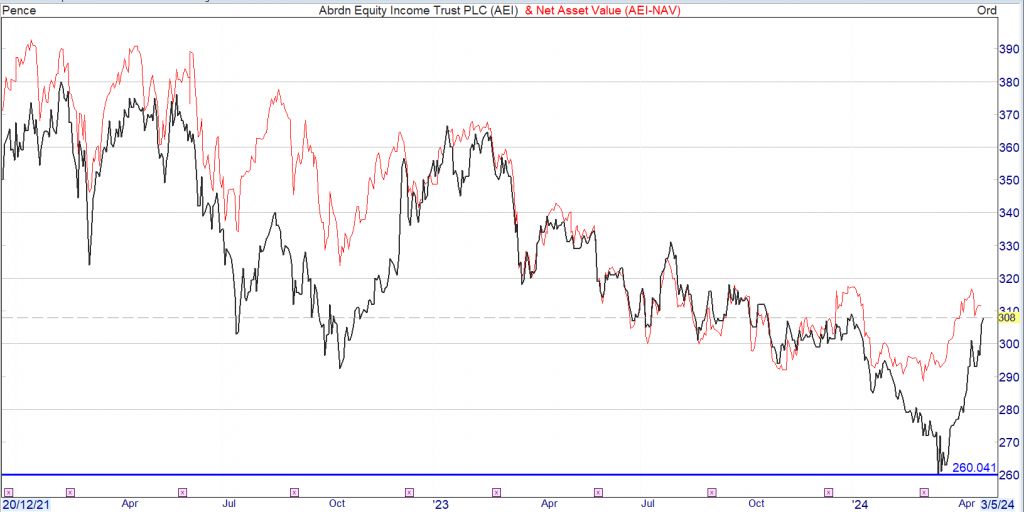
AEI

AGR

FSFL

PHP

Current cash for re-investment £250.00

Current amount invested in the market £111,626.00* after the deduction of the loss from BSIF

*not the current value of the portfolio.

A great idea.

by James Beard

Albert Einstein is often credited with describing compound interest as the eighth wonder of the world.

But even though nobody has any credible evidence of this, I’m not really bothered. That’s because I’m convinced of its merits. And that’s why — just like Warren Buffett — I continue to use all of the dividends I receive to buy more shares.

Investing.

The Motley Fool

by Dr. James Fox

We’d all love a passive income, regardless where that comes from. Some people in the UK invest in buy-to-let properties, other try their hand at trading.

How do we invest?

If I were new to investing, I’d start by opening an investment account with a reputable brokerage. This involves researching and selecting a platform that aligns with my needs, offering a user-friendly interface and access to a variety of investment options.

Personally, I use the Hargreaves Lansdown platform, but appreciate there are alternatives with lower trading fees.

After this, I would have to define my financial goals. I need to establish what and when I’m investing for. For example, when will I want to start taking a passive income?

Understanding my risk tolerance is crucial in determining the mix of assets in my portfolio. I’d have to educate myself on different investment vehicles, considering stocks,  bonds, and even cash.

And finally, when I’m ready, I can start purchasing stocks, bonds, or other investment vehicles.

Compounding is key

If I’m investing £50 a week or £200 a month, I need to appreciate that I’m not going to build a huge portfolio over night.

In fact, the longer I leave my money invested, the faster it grows. And that’s all down to the magical power of compounding. While the initial growth may seem gradual, the power of compounding can significantly amplify returns over time.

As such, it’s essential to stay disciplined and resist the urge to react hastily to short-term market fluctuations.

As the portfolio grows, so does the potential for compounding to work its magic. That’s because I can start earning interest on my interest as well as my contributions.

Compounding takes place when I reinvest my returns year after year. This may involve me reinvesting the dividends I receive.

Or if I invest in a stock like ******, which doesn’t offer a dividend, the company essentially reinvests on my behalf. That’s because it’s focused on growth.

Bringing it all together

A novice investor may look to achieve between 6-10% annually in the way of returns. While an experienced investor might aim for higher returns — perhaps around 10-15% annually.

So if I were starting with nothing, and investing £50 a week, here’s how my investment could grow over 35 years, assuming a 10% annualised return. At the end of the period I’d have £759,327, and it would have generated £71,849 in the final year. Even in 35 years, that’s a strong figure.

Created at thecalculatorsite.com

£££££££££££££

Government loans (Gilts) pay a guaranteed return so your capital is safe.

Can now be bought from online platforms such as AJ Bell as simply as

any other share. Can be useful if u are saving for a specific purpose on a

set day.

At present yielding around 4% so not suitable for inclusion in the blog

portfolio but could be paired trading with a higher yielding Trust to give

a blended yield of 7% with an extra margin of safety.

Wouldn’t it be nice.

Wouldn’t it be incredible to have a tax-free source of passive income? The idea of generating income without the burden of taxes is a dream many of us share.

So, what if I had £5,000 in savings? Could I really turn that into £60,000 of passive income within 30 years? Well, it’s certainly possible

Nurturing a portfolio

£5,000 is a great starting point. But in order to make my portfolio grow faster, I’ll need to embrace the concept of regular saving or regular contributions.

This isn’t rocket science. It’s pretty obvious. If I were to contribute £250 a month from my earnings to the portfolio, it would provide me with additional capital for my investments.

Over time, my commitment to regular saving has several benefits, including pound-cost-averaging and harnessing the power of compounding — the snowball effect where my money makes more money.

By consistently adding to my investments, I can create a cycle of growth, where each contribution builds on the previous one.

Compounding

As noted above compounding is central to long-term wealth generation. This is the process of reinvesting my returns year after year.

It might not sound like a world-beating strategy. But it really is. Essentially, when I reinvest my returns year after year, it means I’ll start earning interest on my interest. In turn, this leads to exponential growth.

In the below charts we can see how an original £5,000 investment would grow when contributing £250 a month.

The first chart shows how the investment would grow with a more modest 6% annualised return, while the second chart highlights how my investments would grow at 10%.

Created at thecalculatorsite.com: Growth over 30 years with 6% annualised returns

Created at thecalculatorsite.com: Growth over 30 years with 6% annualised returns

Created at thecalculatorsite.com: Growth over 30 years with 10% annualised returns

Created at thecalculatorsite.com: Growth over 30 years with 10% annualised returns

Low double-digit growth is what many seasoned investors will be looking for. And while that might sound unachievable, I can do it too by using online resources like The Motley Fool to help me make the right investment choices.

Because, unfortunately, if I invest poorly, I could lose money.

In the final chart, after 30 years, my investment would be worth around £670,000. That’s a huge amount of money. In fact, it would be growing by a phenomenal £62,000 a year.

So, in theory, I could take that £62,000 and treat it as passive income. It’s worth noting that this may involve selling some holdings as my portfolio is unlikely to generate all that money in the form of dividends.

But finally, and perhaps the most important thing worth noting, is that I’ll want to do all of this within a Stocks and Shares ISA. That’s because the wrapper will shield all my earnings from tax. It could be hugely beneficial.

Watch list shares DYOR

Bear

Trusts still not favoured by Mr. Market.

Could still go lower which would mean the yield increases.

Bull

Some great yields which could turbo-charge your portfolio, best to diversify just in case the Trust you choose is a clunker.

« Older posts Newer posts »

© 2026 Passive Income Live

Theme by Anders NorenUp ↑