Temple Bar eyes overseas expansion if UK market ‘continues to reduce materially’
The £1.1bn trust considers expanding its 30% limit on investments outside of the UK.

ByLotte Edwards
CityWire
Temple Bar (TMPL) has delivered another strong set of results, with six stocks in its portfolio rising more than 50% in 2025.
The £1.1bn UK equity income trust’s net asset value (NAV) was up 33.9% in 2025, outperforming the FTSE All-Share’s 24% gain. Returns for shareholders soared an even further 45.3% over the period.
It builds upon a strong few years since Redwheel duo Nick Purves and Ian Lance took over the mandate in November 2020, with shares up 224.9% and NAV climbing 193.2%.
But while the managers continue to see a large enough opportunity set within the trust’s current investment restrictions, chair Charles Cade said he and the board will consider broadening its overseas limit beyond the current 30% constraint should the universe of UK listed companies continue to reduce materially. Any such proposal would require shareholder approval.
Top performers in 2025 included banks and financial services providers NatWest, Barclays and Standard Chartered, Aviva and NN Group, as well as specialist chemicals and sustainable technologies leader Johnson Matthey − each contributing at least 2% to absolute returns.
Another eight stocks − ABN Amro, GlaxoSmithKline, Aberdeen, Macys and BET − added at least 1%, while only one stock, advertising company WPP, detracted more than 1% over the period.
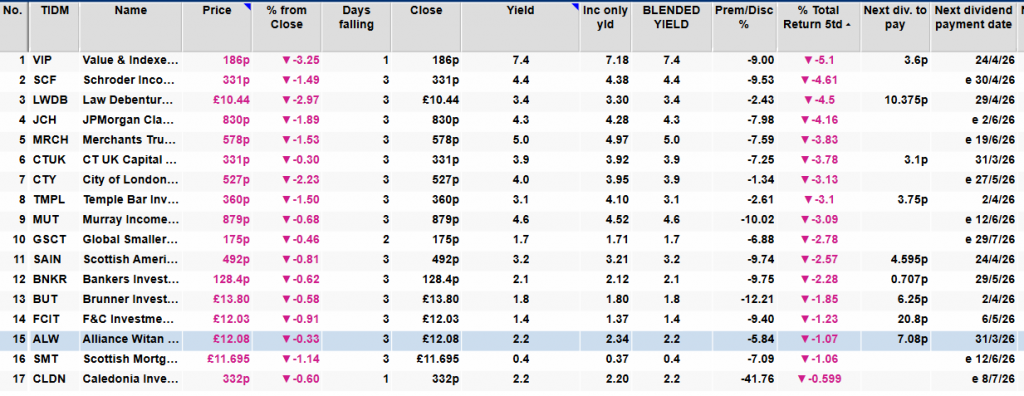
Total dividends of 15p were declared for the year representing an increase of 33.3% . TMPL moved from a discount of 6.6% to a premium of 1.4% and was able the re-issue around 5m shares from treasury at a 3% premium, raising £19m.
Post year-end, an additional 8.1m shares were issued, raising £32m and expanding the trust’s market capitalisation by £1.1bn. The board said it remains committed to discount control, having bought back shares worth £114m since 2021.
Commenting on the results, Purves and Lance noted that ‘although valuations have risen from quite extreme levels seen post the COVID pandemic, they are still low in an absolute and historical sense’.
In aggregate, the trust’s portfolio is now valued at around eleven times earnings, higher than it was, but still a discount to the wider UK market, and around half the valuation given to the wider global equity indices. ‘Accordingly, we believe the company is still price to deliver meaningful excess return, and shareholders can look forward to the future with optimism,’ they said.
Panmure Liberum’s Callum Stokeld recognised a ‘strong streak’ for TMPL under the current management.
‘Undoubtedly the managers have enjoyed style factor-tailwinds when we assess their performance relative to the FTSE All-Share, with Value having enjoyed a strong streak as interest rates normalised from the lows seen during the pandemic, but… TMPL’s NAV has also consistently seen positive alpha generation relative to the wider UK Value-factor index,’ he said.
The analyst added that TMPL’s bumper dividend policy, designed to reflect increasing use of buybacks by UK corporates, ‘looks well-aligned to the investment process too, with the managers placing emphasis on returns of capital from all sources.’
‘We see evidence to support the contention that UK companies are increasingly returning capital via buybacks, with more FTSE companies retiring more than 5% of starting issued share capital over each of the last 4 years than in the S&P 500, aside from the premium level of yield that the UK market offers,’ he said.

Current yield around 4.25%.
Leave a Reply