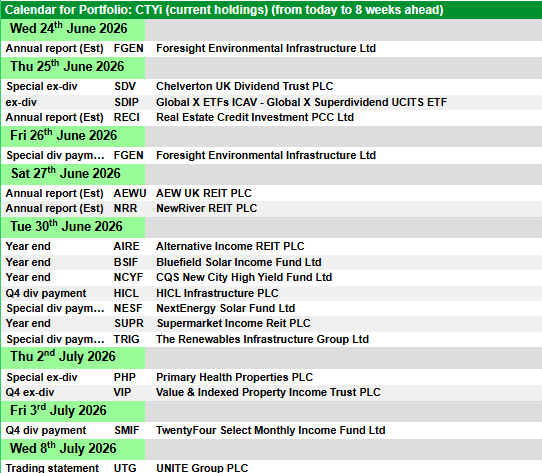
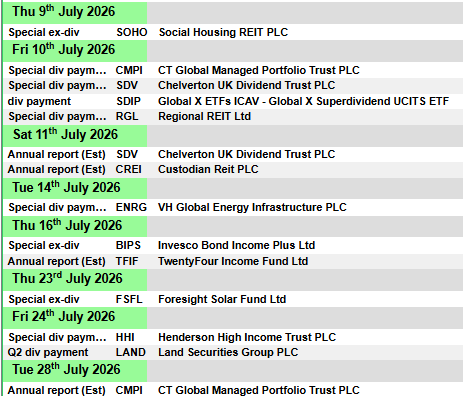
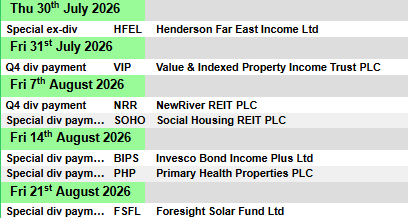
AVI Global Trust PLC ex-dividend date Chelverton UK Dividend Trust PLC ex-dividend date Lowland Investment Co PLC ex-dividend date North American Income Trust PLC ex-dividend date Personal Assets Trust PLC ex-dividend date Templeton Emerging Markets IT PLC ex-dividend date TR Property Investment Trust PLC ex-dividend date
The Renewables Infrastructure Group (TRIG)19 June 2026
Disclaimer
Disclosure – Non-Independent Marketing Communication
This is a non-independent marketing communication commissioned by The Renewables Infrastructure Group (TRIG). The report has not been prepared in accordance with legal requirements designed to promote the independence of investment research and is not subject to any prohibition on the dealing ahead of the dissemination of investment research.
Let’s go back to basics with TRIG: it’s a utility scale energy generator.
Overview
The Renewables Infrastructure Group (TRIG) has a £2.9bn diversified portfolio of renewable energy infrastructure assets spread across five countries and four technologies. The UK is the largest single country exposure at 59%, along with four other European countries. TRIG develops, constructs, operates and optimises assets across onshore and offshore wind, solar PV and battery storage and, in taking on the whole value chain from development, can sustain and extend the asset life of its portfolio without having to periodically raise fresh equity. There is high visibility over revenues with 68% fixed and 56% inflation-linked over the next ten years.
TRIG currently yields 10% and the dividend is fully covered. TRIG’s dividend for the year ending 31/12/2026 is targeted to be held at the same level as for 2025. This follows discussions between the board and shareholders and is a recognition that the dividend is already at a very attractive level. Nevertheless, dividend cover is expected to rise over the coming years, with the long-term objective of normalising at 1.1 to 1.2×.
One factor in TRIG’s high yield is the 29% discount. TRIG and its peer group have traded at wide discounts from the outset of the higher interest rate era, but in the Dividend section we look at how wide the spread between TRIG’s yield and government bonds is, suggesting that while, yes, its share price is sensitive to interest rates, the spread over bond yields has been stretched to its widest point since TRIG’s 2013 IPO. As we see in the Portfolio section, TRIG’s NAV is much less sensitive to interest rates though.
TRIG has a comprehensive capital allocation approach in response to the discount, with a £150m share buyback programme and targeted capital recycling.
Analyst’s View
Over the last few years, it has been very easy to get overwhelmed by all the detail when it comes to renewable energy infrastructure generally and TRIG specifically. And to focus on the big macro factor, interest rates, that has been the main influence on share prices, together with shifts in regulatory policy, the ‘Trump’ factor and power prices. But behind all of that, we find it very interesting that, at a point in time when global energy supply chains have just undergone perhaps one of the largest shocks in history, TRIG, which of course sells energy, is trading at a level where its dividend yield is at the widest spread over UK government bonds that it has been since its IPO. While we follow the short-term logic of investors taking a cautious stance on markets, the irony is striking. There will be, and already is, plenty of rhetoric about how the UK must do more to extract its own gas and oil resources, and whether that’s practical or not it doesn’t change the fact that renewables are not a small side hustle for the UK and other European countries, but an integral part of the energy mix.
TRIG’s big advantage in all of this is its diversification, scale and capacity to become self-sustaining. With wide discounts, raising fresh equity to acquire new operational assets is currently off the agenda, and development and construction have become an important part of the mix. TRIG has the scale to maintain dividend cover while allocating capital to generate higher returns from reinvestment and construction. The 29% discount therefore looks to us to be a remarkable opportunity.
Bull
True utility-scale diversified portfolio of assets
Development and construction pipeline could generate higher returns and extend the portfolio life
Wide discount and yield spread over government bonds
Bear
TRIG uses gearing, which can amplify losses as well as gains, albeit gearing is lower than average for the sector
A high proportion of fixed revenues, with over 55% inflation-linked, mean dividend growth may be lower than inflation
Political risk over energy policy has moved a notch higher in the UK but TRIG’s country diversification helps mitigate this
NextEnergy Solar Fund Limited (LSE:NESF) has unveiled a strategic reset after reporting a significant reduction in net asset value, with NAV per share falling to 76.1p and gross asset value decreasing to £922 million.
Despite the lower valuation, the company highlighted strong operational performance across its solar and energy storage portfolio. Electricity generation exceeded budgeted expectations, while the flagship 50MW Camilla battery storage project continued to rank among the highest-performing assets on the Great Britain grid, demonstrating the resilience and cash-generating capability of the portfolio.
Portfolio Performance Remains Strong
Management emphasised that underlying asset performance remained robust throughout the period, supported by reliable renewable energy generation and growing contributions from energy storage operations.
The company believes the strong operational delivery highlights the quality of its asset base, even as wider market conditions continue to weigh on sector valuations and investor sentiment.
Strategic Reset Targets Shareholder Value
In response to persistent discounts across the listed renewable infrastructure sector, the board has introduced a new strategic framework focused on strengthening the balance sheet, improving capital allocation and addressing the gap between the share price and underlying asset value.
A key element of the plan is the adoption of a revised dividend policy. Rather than maintaining a progressive dividend approach, the fund will distribute 75% of operating free cash flow, resulting in a lower but more sustainable and better-covered dividend.
The company also intends to reduce gearing through targeted asset disposals while recycling capital into projects offering higher returns. Expanding exposure to battery storage remains another strategic priority, reflecting management’s view that storage assets can provide attractive long-term growth opportunities alongside solar generation.
Focus on Balance Sheet and Long-Term Returns
The board believes the combination of deleveraging, capital recycling and disciplined dividend management will help stabilise net asset value and unlock value embedded within the portfolio.
Management is encouraging shareholders to support the company’s continuation proposal at the upcoming annual general meeting, arguing that the revised strategy provides a clearer pathway to improving long-term total returns despite ongoing market challenges.
Outlook
NextEnergy Solar Fund’s outlook continues to be affected by weaker financial performance, including declining revenue and two consecutive years of net losses. Technical indicators also remain negative, with the shares trading below key moving averages and momentum measures such as MACD remaining under pressure.
However, these challenges are partly offset by strong and improving operating cash flow generation, a debt-free balance sheet position reported in 2025 and an attractive dividend yield.
Management believes that successful execution of the strategic reset, combined with the operational strength of the portfolio and increasing exposure to energy storage, should position the company to create greater value for shareholders over time.
More about NextEnergy Solar Fund
NextEnergy Solar Fund Limited is a specialist renewable energy investment company focused on solar power generation and energy storage infrastructure.
The fund owns and manages a diversified portfolio of long-life assets designed to generate stable and predictable cash flows. Its investment strategy centres on utility-scale solar projects and standalone battery storage facilities, primarily located in the UK.
Through a combination of renewable energy generation, active portfolio management and selective investment in storage technologies, the company seeks to deliver sustainable income and long-term capital growth for shareholders operating within the renewables infrastructure sector.
This article was written by the editorial team at InvestorsHub/ADVFN and is provided for informational purposes only.
DYOR. NESF have trimmed their dividend, see above.
Infrastructure trusts have evolved, but are they still being assessed with reference to the past?
Alan Ray
Updated 17 Jun 2026
Disclaimer
This is not substantive investment research or a research recommendation, as it does not constitute substantive research or analysis. This material should be considered as general market commentary.
Had you been around at the time the song referenced in our title was released in 1969, you could be forgiven for thinking that the Rolling Stones was a band that maybe had a couple more years left in it. A dangerous rock and roll band working with a classical choir sounds like it’s closer to the end than the beginning. But here we are in 2026 with the Stones’ latest single, accompanied by an official deepfake video, getting daily airplay on mainstream radio. And whereas the A side of that single takes in modern production techniques that make it sit easily against a backdrop of much younger bands, the B side sounds like an outtake from a session back in the sixties. So, extraordinary longevity, and yet moving with the times, but a core proposition that is unchanged. Leading us quite neatly to the listed infrastructure sector.
Rising interest rates ended a golden era for infrastructure trusts and other so-called ‘bond proxy’ income trusts. For many years, these trusts could raise new capital almost on demand as investors sought higher returns than were on offer from government bonds. This was all taken away in 2022, and the infrastructure trusts’ premiums turned to discounts. That, of course, is extremely well-documented in the pages of many Kepler research reports.
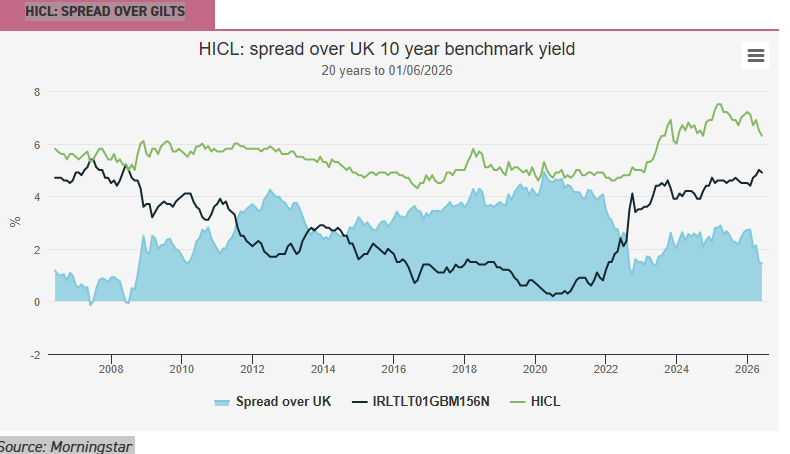
Whether you are a music aficionado or an investment trust historian, the past can be fascinating and teach us many things. But just like in our introduction, it can lead us to make torturous parallels, and we risk anchoring ourselves to what has gone before. After a seismic shift, we might spend some time waiting for things to return to ‘normal’ before it dawns on us that there’s no such thing. Is it time to change our frame of reference for infrastructure trusts? The sector turned 20 years old in March this year, but the last five of those have, in our view, seen the most rapid evolution. The chart below remains an incredibly useful tool, looking at the yield spread of an infrastructure investment trust over UK government bonds. But is it quite as useful as it would have been back in 2006? Here we’ve unapologetically picked HICL Infrastructure (HICL) as the reference, since its IPO was just over 20 years ago and it comfortably meets the definition of being a sector bellwether. Its launch defined what we investment trust investors know about infrastructure investing.
HICL: SPREAD OVER GILTS
Source: Morningstar
Bearing in mind there was an initial ‘ramp up’ period, for most of the data series above, the HICL proposition was very much ‘government-backed cashflows’, and while yes, there was some inflation-linkage and potential for capital growth, investors’ minds were very much focussed on the current yield rather than the growth prospects. So, the spread over gilts would have told you a fair bit about investor sentiment. This remains the case, but as the chart shows, the spread now is lower than it has been for most of HICL’s history. What’s going on?
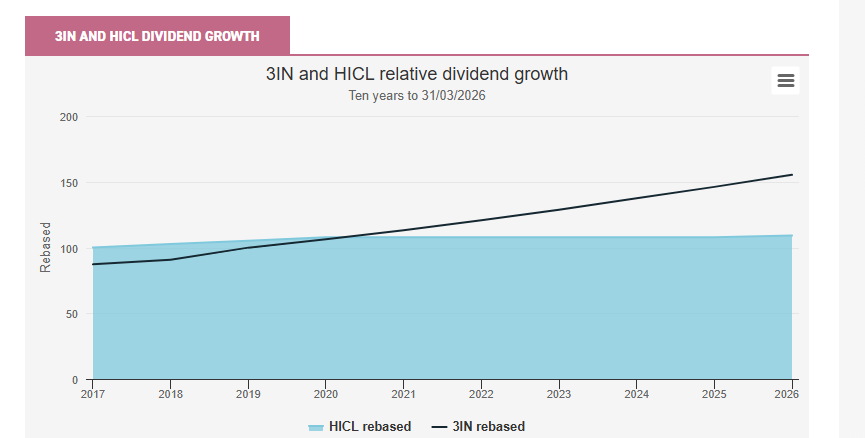
Let’s start by stepping back in time again, this time by ten years. The chart below is one way of looking at the classic dilemma that faces income investors, regardless of whether they are investing in equities, infrastructure, or debt: a higher starting dividend vs higher dividend growth. HICL exemplifies the classic steady government-backed-cashflow approach to infrastructure that started it all, whereas the trust we’ve chosen to compare it to, 3i Infrastructure (3IN), takes a different approach, investing in businesses with infrastructure characteristics. In the chart, we take HICL as the benchmark for dividend yield and at the start of the series, its yield is rebased to 100. Its rising dividend is tracked by the blue area. 3IN’s yield at the start of this series was lower, and this is proportionally reflected in the lower starting point of the black line, which then rises as 3IN’s dividend grows. This allows one to see how much yield one would have foregone in purchasing 3IN instead of HICL at the start of the period and then how quickly one would have caught up, if one measures yield against the starting price or book cost. Looking at yield this way is probably something a lot of income investors do in their heads, if not on a spreadsheet. Thus, “I bought the shares ten years ago at 100p, and this year I got dividends of 10p, so I’m very happy, and I don’t look at the current share price too often.”
In reading the chart, treat the numbers as indicative rather than precise. For example, we have used the prevailing net asset values of the two trusts at the start of the series to calculate the starting yields because it is just as likely that an investor would have acquired shares in both through a capital raise at a price close to NAV as to have acquired them at the market price. Given the range of likely prices paid, taking the net asset value as the starting point seems like the closest thing to a level playing field.
3IN and HICL DIVIDEND GROWTH
Source: Company Reports
Obviously, this chart shows that the yield investor choosing 3IN ten years ago would have ended up today with a higher yield compared to their initial cost, but saying that is, first, rear-view mirror investing and second, completely ignores the context at the time. HICL was valued by its shareholders for its ‘bond proxy’ characteristics: government-backed cashflows from highly predictable projects focussed on core areas of infrastructure. In contrast, 3IN’s equity upside and potential for downside put it into a higher risk category for many shareholders. The reality at the time was that large investors were often not making a choice between the two but putting them into completely different risk categories. It’s no coincidence that, ten years ago, far more of the sector followed the HICL model than the 3IN model, as it’s normally the case that the most influential shareholder groups, wealth managers, and multi-asset funds manage much more money in their low- and medium-risk categories than in higher risk.
Which leads to one important piece of context about the investment trust sector. New investment trust launches are often designed with input from their original investors, and quite a bit of pushing and pulling at the pilot stage prior to an IPO can occur. And in an era of regular capital raises, that influence persisted long after an IPO, with the same investors generally supporting each new raise. The start of the data series above falls right in the middle of an era where the largest investors in the sector wanted ‘alternative income’ to government bonds, rather than equity risk. So, we have a sector and a frame of reference that has been moulded by low interest rates and a certain kind of shareholder.
You might get what you need
Roll forward to 2026, and the infrastructure trusts have seen a significant evolution in who their shareholders are. It’s well known that the giant wealth managers and multi-asset institutional investors are reducing their commitment to the sector. You will still find many of them on the registers of infrastructure trusts, but their size and influence have waned. We’ve moved from an era where strategy is shaped by shareholders with defined risk categorisations to, what we might say is, a more pragmatic group of shareholders who just want the management teams to say what they think the best strategy is, and then get on and deliver it.
Once again taking HICL as the bellwether, in this more pragmatic era, it remains very much focussed on steady, lower-risk investing with a higher dividend but has expanded its capacity to develop projects at an earlier stage and broadened its geographic and sectoral horizons. The capacity for higher returns, both in dividend growth and capital terms, has been building for a while, and we think it will start to show very strongly in the coming years. We also think it is far more likely to find investors placing this alongside 3IN, with its hybrid of infrastructure and private equity, rather than in a different risk bucket. The two are very different, but each can play an anchor role in an equity income portfolio. Going back to our earlier ‘spread over gilts’ chart, we think the market is gradually starting to value HICL’s growth potential alongside its income, and that the narrower-than-average spread isn’t as perplexing as it might seem.
A good illustration of evolving investor attitudes comes from one of the more unique infrastructure investors in the sector. Cordiant Digital Infrastructure (CORD) listed in 2021, around the time that the clock was running down on the ‘bond proxy’ era. This is very much in the mould of buying operating companies that have infrastructure characteristics and assets, which have the capacity to be expanded through the management teams ‘buy, build, and grow’ approach. CORD focusses on digital infrastructure in areas like fibre optic networks, broadcast towers, and infrastructure. Just like 3IN, the risks are higher, but with that comes the potential for higher rewards, including dividend and capital growth.
One trust that has remained firmly in the income first camp is GCP Infrastructure Investments (GCP), which, from inception, has invested in the debt rather than equity of social infrastructure projects in the UK. Whereas GCP’s average project size is smaller than average for the sector, which in some cases exposes it to higher risk, it has a very low loss ratio compared to general private credit, and many of its investments are amortising debt. This puts it in a good position to, first, gradually pay down its debt, which it has almost done, second, buy shares back at very attractive discounts, enhancing the NAV and earnings per share, but third, opens the way to gradually reset the portfolio by writing loans at prevailing interest rates. GCP’s wider-than-average discount hints that its ‘bond proxy’ characteristics are still stronger than others, but in its own way, it has a clear path to recovery through the mechanism described above. A different flavour of debt investment into infrastructure comes from the geographically and sectorally more diverse Sequoia Economic Infrastructure Income (SEQI), which again, lends to infrastructure projects, and it is primarily focussed on generating a high income.
Conclusion
As we have seen, while there is still a broad spread of strategies in the infrastructure sector, and it is still very possible to prioritise high income over dividend growth, there has been a shift to a more balanced total return approach that is more self-sustaining and less dependent on a constant cycle of new capital raises. And possibly more analogous to an equity income fund than a bond fund.
Readers may have noticed how often the topic of infrastructure arises in our coverage of equity trusts. Whether it’s the UK, Europe, the US, or Emerging Markets, companies whose business is associated with infrastructure are woven into the fabric of so many portfolios. From the electrification of economies, datacentres (and all the associated control, power, and cabling systems), or the more conventional restoration and upgrading of core infrastructure, the need for capital is vast, and the definition of what constitutes infrastructure is constantly being refreshed. This serves to highlight that a specialist vehicle able to own and operate the resulting assets over the long-term is even more relevant today than it was two decades ago, and the infrastructure sector is one of the greatest success stories of the investment trust sector. Given the evolving nature of these trusts and the assets that they can own and operate, we think the next 20 years will be even more fascinating and rewarding than the last.
· Net Asset Value (“NAV”) per Ordinary Share of 76.1p (31 March 2025: 95.1p).
· Ordinary Shareholders’ NAV of £437.5m (31 March 2025: £547.4m).
· Gross Asset Value (“GAV”) of £922m (31 March 2025: £1,061m).
· Total Income of £141.3m (31 March 2025: £135.5m).
· NESF Group Portfolio and Holdco EBITDA of £104.5m (31 March 2025: £96.9m).
· Cash income of £71.9m (31 March 2025: £67.1m).
· Amount available for Ordinary Share distribution of £56.2m (31 March 2025: £50.3m).
· Weighted average cost of capital of 6.9% (31 March 2025: 6.6%).
· Weighted average discount rate across the portfolio of 8.5% (31 March 2025: 8.0%).
Dividend:
· Total dividends declared of 8.43p per Ordinary Share for the twelve months ended 31 March 2026 (31 March 2025: 8.43p).
· Dividend cover for the twelve months ended 31 March 2026 was 1.2x (31 March 2025: 1.1x).
· Following the payment of the target dividend of 8.43p for the financial year ended 31 March 2026, the Company has transitioned from a progressive dividend policy to a percentage-based dividend policy, targeting a 75% distribution of operating free cash flows, post debt servicing and portfolio and fund operating expenses.
· The estimated dividend guidance range for the financial year ending 31 March 2027 is between 4.5p – 5.1p per Ordinary Share, subject to portfolio performance. This guidance is the equivalent to a dividend yield range of c.9% – c.11% based on the company’s share price as at 19 June 2026.
· As a result of the 75% dividend payout policy mechanics on earnings post debt amortisation, this would translate to a 1.3x dividend cover.
· As at 31 March 2026, the Company had declared total Ordinary Share dividends of £443m since inception, the equivalent to 84.7p per Ordinary Share.
12 popular dividend disasters you need to dump right now.
How you could bank tens of thousands of dollars in yearly dividend cash for every $500,000 invested, and …
3 incredible monthly payers dishing out dividends up to 14.9%.
Dear Reader,
A half-million dollars is a lot of money. Unfortunately, it won’t generate much income if you limit yourself to popular mainstream investments.
The 10-year Treasury pays around 4.1% as I write this. That’s not bad, historically speaking, but put your $500K in Treasuries and you’re only looking at $20,500 in investment income, right around the poverty level for a two-person household. Yikes.
And dividend-paying stocks don’t yield nearly enough. For example, Vanguard’s popular Dividend Appreciation ETF (VIG) pays around 1.6%. Sad.
When investment income falls short, retirees are often forced to sell their investments to supplement their income.
Of course, the problem here is that when capital is sold, the payout stream takes an immediate hit – so that more capital must be sold next time, and so on.
Avoid the Share Selling “Death Spiral”
Some financial advisors (who are not retired themselves, by the way) say that you can safely withdraw and spend, say, 4% of your retirement portfolio every year. Or whatever percentage they manipulate their spreadsheet to say.
Problem is, in reality, every few years you’re faced with a chart that looks like this.
Apple’s Dividend Was Fine – Its Stock Wasn’t
As you can see, the dividend (orange line above) is fine — growing, even — but you’re selling at a 25% loss!
In other words, you’re forced to sell more shares to supplement your income when they’re depressed.
Remember the benefits of dollar-cost averaging that built your portfolio? You bought regularly, and were able to buy more shares when prices were low?
In this case, you’re forced to sell more shares when prices are low.
When shares rebound, you need an even bigger gain just to get back to your original value.
The Only Reliable Retirement Solution
Instead of ever selling your stocks, you should instead make sure you live on dividends alone so that you never have to touch your capital.
This is easier said than done, and obviously the more money you have, the better off you are. But with yields still pretty low, even rich folks are having a tough time living off of interest today.
And you can actually live better than they can off of a (much) more modest nest egg if you know where to look for lesser-known, meaningful and secure yield.
I’m talking about annual income of 8%, 9% or even 10%+ so that you’re banking $50,000 (and potentially more) each year for every $500,000 you invest.
You and I both know an income stream like that is a very nice head start to a well-funded retirement.
And it’s totally scalable: Got more? Great!
We’ll keep building up your income stream, right along with your additional capital.
And you’ll never have to touch your nest egg capital – which means you won’t have to worry about or running out of money in retirement, or even the day-to-day ups and downs of the stock market.
The only thing you need to concern yourself with is the security of your dividends.
As long as your payouts are safe, who cares if your stock prices swing up or down on a given day?
Most investors know this is the right approach to retirement.
Problem is, they don’t know how to find 8%, and 10% yields to fund their lives.
And when they do find high yields, they’re not sure if these payouts are safe. Will the company or fund have enough cash flow to pay the dividends into the future?
And how sensitive are these payouts to the latest headline, Fed policy change or unrest on the other side of the globe?
We’ll talk specific stocks, funds and yields in a moment.
But first, a bit about myself.
I graduated cum laude with an industrial engineering degree — which is actually pretty popular with Wall Street recruiters.
But I couldn’t stand the thought of grinding it out in a cubicle for 80 hours a week. So I moved to San Francisco and got into the tech scene.
A buddy and I started up two software companies that serve more than 26,000 business users.
The result was a nice chunk of change coming in … and I had to decide what to do with my money.
I had seen plenty of young “techies” come into sudden cash and burn through their windfall in a year, ending up right back where they started.
That was NOT going to be me. I already had dreams of living off my wealth one day, decades before I retired.
I got plenty of cold calls from brokers wanting to “help” me. But I knew that nobody would care as much about my money as me.
So I went out on my own and invested my startup profits in dividend-paying stocks.
I’ve been hunting down safe, stable and generous yields ever since, growing my wealth with vehicles paying me 8%, 9%, even 10%+ dividends.
Over the past 10+ years, I’ve been writing about the methods I use to generate these high levels of income.
Today I serve as chief investment strategist for Contrarian Income Report — a publication that uncovers secure, high-yielding investments for thousands of investors.
Since inception, my subscribers have enjoyed dividends 5 times (and much more!) the S&P 500 average, plus big annualized gains!
And that brings me to a crucial piece of advice…
The ONE Thing You Must Remember
If I could leave you with just one nugget of investing wisdom today, it would be to NEVER overlook the incredible wealth-building power of dividends.
Few investors realize how important these unglamorous workhorses actually are.
Here’s a perfect example…
If you put $1,000 in the dividend-paying stocks of the S&P 500 back in 1973, you would have had $96,970 by the end of 2024, or 97x your money.
But the same $1,000 in the non-dividend payers would have grown to just $8,990 — 91% less.
That’s why I’m a dividend fan.
The stock market is a fantastic wealth-building machine, but it doesn’t always go straight up!
There have been plenty of 10-year periods where the only money investors made was in dividends.
And that’s what gives us dividend investors such an edge.
When you lock in an 8%+ yield, you’re booking an income stream that’s bigger than the stock market’s long-term average return right off the bat.
Of course you can’t just buy every ticker symbol out there with a flashy yield, or you’ll get burned pretty fast.
So let’s wipe the false promises of mainstream finance from our minds and start thinking the “No Withdrawal” way…
Step 1: Forget “Buy and Hope” Investing
Most half-million-dollar stashes are piled into “America’s ticker” SPY.
The SPDR S&P 500 ETF (SPY) is the most popular symbol in the land. For many 401(K)’s, this is all there is.
And that’s sad for two reasons.
First, SPY yields just 1.1%. That’s $5,500 per year on $500K invested… poverty level stuff.
Second, consider a hypothetical year when, say, SPY fell 20%, not at all out of the question, given the multiyear run stocks have been on. Just from that alone, your $500K would be slashed to $400K.
SPY was down nearly 20% that year. That is no bueno, because that $500K would have been reduced to $400K.
The last thing we want to do is lose the money we’re getting in dividends (or more) to losses in the share price. Which is why we must protect our capital at all costs.
Step 2: Ditch 60/40, Too
The 60/40 portfolio has been exposed as senseless.
Retirees were sold a bill of goods when promised that a 60% slice of stocks and 40% of bonds would somehow be a “safe mix” that would not drop together.
Oops.
Inflation — plus an aggressive Federal Reserve, plus a (thus far) persistently steady economy — drop-kicked equities and fixed income before they went on a serious bull run in 2023, 2024 and into 2025 (with a brief interruption for the April “tariff tantrum.”)
It just goes to show that bonds are not the haven guaranteed by the 60/40 high priests. They could easily plunge just as hard (or harder) than stocks in the next economic crisis.
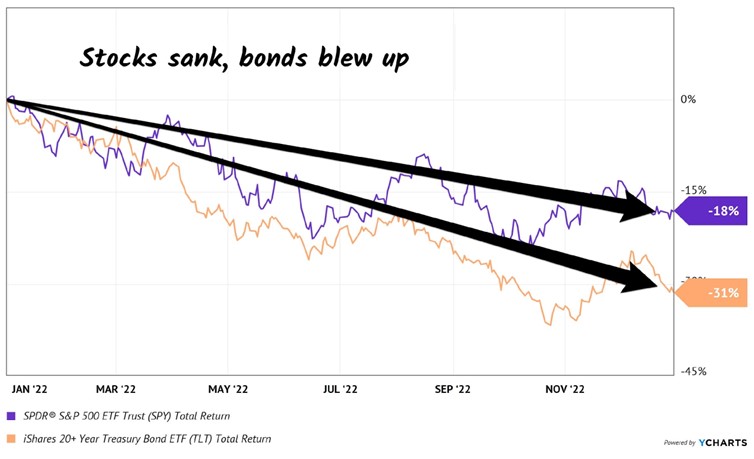
Just like they did in 2022 (sorry, we’re only going to spend one second on that disaster of a year). US Treasuries plunged, which resulted in the iShares 20+ Year Treasury Bond ETF (TLT) getting tagged.
Sure, it still paid its dividend. But even including payouts, the fund was down 31% — worse than the S&P 500. Ouch!
When stocks and bonds are dicey, where do we turn? To a better bet.
A strategy to retire on dividends alone that leaves that beautiful pile of cash untouched.
Step 3: Create a “No Withdrawal” Portfolio
My colleague Tom Jacobs and I literally wrote the book on a dividend-powered retirement.
In How to Retire on Dividends: Earn a Safe 8%, Leave Your Principal Intact, we outline our “no withdrawal” approach to retirement:
Save a bunch of money. (“Check.”)
Buy safe dividend stocks with big yields
Enjoy the income while keeping the original principal intact.
To make that nest egg last, and our working life worthwhile, we really need yields in the 7% to 10% range. We typically don’t see these stocks touted on Bloomberg or CNBC, but they are around.
Of course, there are plenty of landmines in the high-yield space. Some of these stocks are cheap for a reason. Which is why we need to be contrarian when looking for income.
We must identify why a yield is incorrectly allowed to be so high. (In other words, we need to figure out why the stock is priced so cheaply!)
As I write, the top 10 payers in my Contrarian Income Report portfolio yield about 11.4% on average.
On every million dollars invested, this dividend collection is spinning off an incredible $114,000 every single year!
And you don’t have to be a millionaire to take advantage of this strategy.
A $750k nest egg would generate $85,500 annually…
$500K could hand you $57,000…
You get the idea.
The important thing is that these yields are safe, which creates stability for the stock (and fund) prices attached to them.
We want our income, with our principal intact.
It’s really the only way to retire comfortably, without having to stare at stock tickers all day, every day.
Now, many blue-chip yields are reliable. They just need to hit the gym and bulk up a bit. Here’s how we take perfectly good, yet modest, dividends and make them into braggarts.
Step 4: Supersize Those Yields
Mastercard (MA) is a near-perfect dividend stock. Its payout is always climbing, having nearly doubled over the last five years. (MA shareholders, you can thank every business that accepts Mastercard for your “pennies on every dollar” rake.)
Tap, tap, tap. Remember cash? Me neither. Another 2020 casualty, with Mastercard making a few dimes or dollars on every plastic transaction.
The cashless trend has been in motion for years. But international growth prospects remain huge. Just a few years ago, 80%+ of transactions in Spain, Italy and even tech-savvy Japan were in cash.
We expect more dividend hikes as more cash turns to plastic. Or skips plastic entirely and goes straight to e-transfers. Mastercard and close cousin Visa (V) nab a nice piece of that action, too.
The only chink in MA’s armor? Everyone knows it is a dynamic dividend stock. So it only yields 0.6%. Investors keep bidding it higher, knowing that the next dividend raise is just around the corner.
So, the compounding of those hikes makes MA a great stock for our kids and grandkids. You and I, however, don’t have the time to wait for 0.6% to grow. And $3,000 on a $500K investment simply won’t get it done.
Let’s instead consider top-notch closed-end fund (CEF) Gabelli Dividend & Income Trust (GDV), managed by legendary value investor Mario Gabelli.
Mastercard is one of Gabelli’s largest holdings. But we income investors would prefer GDV because it boasts a healthy dividend right around 6.4%, paid monthly, nearly 13 times what Mastercard pays (and this is low in CEF-land; other funds, like the next one we’ll talk about, pay nearly double that).
And as I write this, thanks to the conservative folks who buy CEFs, we have a rare opportunity to buy Mario’s portfolio for just 88 cents on the dollar.
Yup, GDV trades at a 12% discount to its net asset value, or NAV. It’s a way to boost MA’s payout and snag a discount, too.
Where does this discount come from?
CEFs are like their mutual fund cousins, with one exception: they have fixed pools of shares, so they can (and do) trade higher and lower than their NAVs, or “fair” values (the value of their holdings minus any debt).
As contrarians, we can step in when they are temporarily out of favor, like after a pullback, when liquidity is low, and buy them at generous discounts.
GDV holds more blue-chip dividend payers alongside MA, such as American Express (AXP), Microsoft (MSFT) and JPMorgan Chase & Co. (JPM). And with GDV, we have an opportunity to purchase them at a 12% discount.
These high-quality stocks wouldn’t normally qualify for our “retire on $500K” portfolio because everyone in the world knows they are strong long-term investments.
Even though these companies are constantly raising their dividends, constant demand for their shares keeps their prices high (and current yields low). So they never meet our current-yield requirement.
GDV does. The fund pays a monthly dividend that adds up to a nice 6.4% annual yield.
Let me give you one more idea (and this is where that much larger payout comes in): the Eaton Vance Tax-Managed Global Diversified Equity (EXG) is another CEF with a similar blue-chip dividend portfolio.
But EXG generates even more income than GDV by selling covered calls on the shares it owns.
More cash flow means a bigger dividend — and EXG pays an already terrific 8.6%!
So we buy and hold EXG and GDV forever, collecting their monthly dividends merrily along the way? Not quite.
In bull markets, these funds are great. But in bear markets, they’ll chew you up.
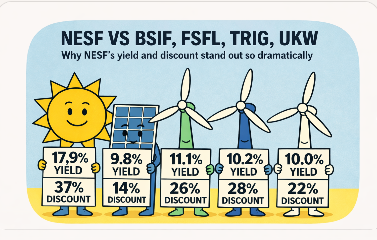
With NESF trimming their future dividends and the highest yielder in the SNOWBALL SEIT (now sold) cutting their next dividend, there is some yield to be replaced.
Some of the lost yield has already been replaced but there is still work to do.
Whilst this year’s target yield will be met, next years may have to be held.
SDV will have to be sold after their next xd date and the funds invested into a higher yielder.
10k compounded at 7% over 20 years £38,700
10k compounded at 9% over 20 years £56,000
An extra 2% compounded for 20 years, equals another £17,300.
Looking at the table both BSIF and FGEN’s prices are up since the start of 2026, so it may be too late to board the train, although there still appears to be some momentum behind FGEN.
Whilst it’s too early to set a target for next year, it’s likely to be the 2030 target.
Here’s a look at what it takes to retire on half a million dollars at full retirement age.
By Dana George – Jun 20, 2026
Key Points
It’s common to worry about running out of money in retirement.
There is no one-size-fits-all retirement budget.
Knowing what you want to do in retirement can help nail down how much money you’ll need.
The Northwestern Mutual 2026 Progress & Planning Study found that 40% of baby boomers fear they’ll run out of money during their lifetimes, and 50% of Gen X feel the same. The anxiety may be driven by the number of reports saying the Americans aren’t saving enough for retirement — a message that can be both frightening and frustrating.
The reality is, there is no one-size-fits-all amount that will allow you to retire. While your sibling or best friend may not be comfortable retiring with $500,000 saved, it could be just right for you. It may not be as easy as it would be with more, but it’s still possible to make it work.
Image source: Getty Images.
If you’re planning for retirement and aim to have $500,000 available, here are four questions to ask yourself.
1. How much do I expect to spend each year?
Naturally, a person who spends $100,000 annually in retirement will need more money than someone comfortable getting by on $50,000. Much of it comes down to how much debt you’re carrying into retirement. If you still have a mortgage, a car payment, and credit card bills, your budget is naturally going to be tighter. The same is true if you live in a high-cost-of-living area.
2. What other sources of income will I have?
Do you expect to receive regular payments from Social Security or a pension, annuity, rental property, or other source? Before determining how far $500,000 will get you, it’s vital to factor in all sources of income.
3. How much do I plan to withdraw from the $500,000 annually?
Let’s say the funds in your retirement account earn an average annual return of 7%. Your first year of retirement, you withdraw 4% ($1,666 per month), and you increase that amount by 2% annually. Due to compound interest, you’ll have over $653,000 left after 30 years.
Your Retirement Plan Might Be Costing You
But what happens if you withdraw 6% in the first year ($2,500 per month) and increase that amount by 2% each year? If your average annual rate of return on the account remains 7%, your money will last just shy of 25 years.
How long you want the money to last depends on several factors, including how many other sources of income you have, your expected longevity, and how much money you’ll need to spend to live your ideal retirement.
4. Is my portfolio diversified?
One tricky aspect of retirement planning is not knowing what the stock market will do at any given time. There are sure to be both bull and bear markets, good times and bad. Having a well-diversified portfolio is the best way to protect yourself against catastrophic losses. That’s because if one sector is hit hard, others can help keep your portfolio afloat.
Still, it’s a good idea to avoid making withdrawals from your retirement account when the market is circling the drain. The goal is to refrain from selling the assets in your portfolio when prices are at rock bottom. If you can live without those withdrawals or have another source of cash to draw from until the market recovers, the funds in your portfolio will last longer.
The answer to whether you can retire with $500,000 saved is yes. However, doing so will involve keeping a close eye on your budget, having a plan to cover emergencies, a way to pay bills when the market is turbulent without depleting your savings, and retirement plans that fit neatly within the amount you want to spend.