Investment Trust Dividends

Month: March 2026 (Page 16 of 17)

JGGI

JPMorgan Global Growth & Income (JGGI)03 February 2026

Disclaimer

Disclosure – Non-Independent Marketing Communication

This is a non-independent marketing communication commissioned by JPMorgan Global Growth & Income (JGGI). The report has not been prepared in accordance with legal requirements designed to promote the independence of investment research and is not subject to any prohibition on the dealing ahead of the dissemination of investment research.

JGGI’s portfolio of high-quality companies has delivered outperformance in a range of market environments.

Overview

JPMorgan Global Growth & Income (JGGI) aims to provide investors with an all-weather portfolio, built on a bottom-up, unconstrained basis. The trust is managed by Helge Skibeli, James Cook, and, since September 2025, Sam Witherow, who has replaced Tim Woodhouse. Together, they focus on investing in high-quality companies exhibiting faster earnings growth and trading at attractive valuations. This approach has delivered strong returns over the past five years, with JGGI outperforming its benchmark, although the trust faced stylistic headwinds in 2025.

Instead of relying on standard industry classifications, Helge, James, and Sam use a proprietary framework to categorise their holdings into four broad areas: high growth defensives, high growth cyclicals, low growth defensives, and low growth cyclicals. Currently, the portfolio is roughly balanced across the focus groups, as the managers do not see compelling valuation discrepancies between them and believe the best opportunities are stock-specific. As a result, they reduced exposure to semiconductor-related names in 2025, although names like NVIDIA and ASML remain high-conviction ideas. They have also introduced Tencent into the portfolio to capitalise on progress in AI made by China. Outside the high-growth focus groups, the managers initiated a new position in Walt Disney, viewing it as a potential recovery story supported by improving revenues and room for margin expansion.

JGGI has traded at an average premium of 0.7% over the past five years, but a small discount has developed since Q2 2025, currently standing at 2.4%. In response, the board has repurchased c. 4.1% of the shares outstanding since the end of June 2025. The board also aims to pay a total dividend of 23p for the current financial year, with two interim dividends already distributed. This equates to a prospective yield of c. 4%, the highest in the AIC Global Equity Income sector at the time of writing.

Analyst’s View

JGGI has an impressive performance track record. The trust has not only outperformed the MSCI ACWI over the past five years but also beat its benchmark for six consecutive calendar years, from 2019 to 2024. In our view, this highlights the repeatability of the process and its capacity to deliver outperformance across a broad range of market environments. While 2025 interrupted this winning streak, as JGGI faced stylistic headwinds due to momentum-driven market returns, we believe this could be a simple blip. Such periods have occurred before, and history suggests that companies with strong fundamentals – such as those JGGI targets – tend to outperform over a full market cycle. As such, we believe JGGI could see improvements in relative returns if the market refocuses on fundamentals.

In addition, JGGI currently offers the highest prospective dividend yield in the AIC Global Equity Income sector. However, this is achieved by investing in stocks with stronger potential for share price appreciation, supported by the trust’s ability to use its capital reserves to help fund dividend payments. As a result, JGGI allows income-seeking investors to gain exposure to growth-oriented stocks – many of which offer low or no dividends – while still meeting their income requirements. Moreover, JGGI has historically traded at small premiums or narrow discounts, with the board proactively buying back shares to maintain an average discount of c. 5% or less. This, combined with the liquidity of the trust’s shares – making JGGI accessible to a broad range of investors – should reassure shareholders that a wide discount is unlikely to develop. Finally, it is worth noting that JGGI is the most cost-competitive vehicle in the AIC Global Equity Income sector. All in all, we believe JGGI makes a compelling core holding for investors seeking exposure to global equities.

Bull

  • Outstanding long-term performance track record
  • Highest dividend yield in the sector
  • Very large and liquid making it investible for a broad set of investors

Bear

  • Could struggle in momentum-driven markets where long-term fundamentals are not rewarded
  • Overweight to US equities could prove a headwind if US equities continue to trail other major markets (in sterling terms)
  • Dividend may experience some volatility in tandem with NAV

Dividend

JGGI funds its dividends from a combination of income generated by its underlying holdings and its capital reserves. This means the managers are not constrained to high-yielding stocks, allowing them the flexibility to invest in low-yielding or non-dividend-paying companies and benefit from their capital growth potential. As such, JGGI benefits from a broader opportunity set than many ‘traditional’ equity income strategies, which are typically limited to high-yielding names. However, this also means shareholders may receive a lower dividend if the trust’s NAV declines from one year to the next.

The board aims to pay dividends totalling at least 4% of the trust’s NAV as at the end of the preceding financial year but retains the flexibility to adjust the target dividend if it appears likely that the resulting yield would be materially out of line with the wider market and other global income trusts.

The trust pays its dividends in four equal interim payments, with the board aiming to distribute a total dividend of 23p in FY 2026, divided into four interim dividends of 5.75p each – two of which have already been paid this year. This total dividend represents a c. 0.9% year-on-year increase and results in a prospective yield of c. 4%, the highest dividend yield in the AIC Global Equity Income sector at the time of writing, excluding British & American (BAF), which we consider an outlier due to its high concentration and focus on biotechnology companies, and which seems likely not to declare a dividend for the current financial year. It also compares favourably with dividend yields of global equity income indices, such as the c. 3.5% yield of the MSCI ACWI High Dividend Yield Index.

Source: J.P. Morgan Asset Management
Past performance is not a reliable indicator of future results

At the end of its last financial year, JGGI had capital reserves of c. £979m, which was enough to cover c. 7.1× the dividend paid over this 12-month period. It is also worth noting that JGGI’s revenue reserves have been exhausted since 2019.

Could be pair traded, not a recommendation.

VWRP

The SNOWBALL has a comparison share VWRP.

If anyone owns the share it’s time to put on those big boy/girls pants as currently it’s down 3k today.

Change to the SNOWBALL

I’ve sold RECI for a profit of £829.00, mostly from earned dividends

I may buy back before the xd date or I may say thankyou to Mr. Market and buy something with a better discount to NAV.

Watch List

Simon Bennett, Non-Executive Chair of Alternative Income REIT plc, comments:

“The Company is on track to deliver an annual dividend target of no less than 5.6 pence per share (“pps”) for the year ending 30 June 2026 (year ended 30 June 2025: 6.2 pps), which is expected to be fully covered subject to the continued collection of rent from the Group’s property portfolio as it falls due. The resetting of the dividend target this year, which is lower than the previous year, is entirely due to increase in financing costs of the new long term debt facilities.

AIRE have cut their dividend.

Current price 77p

Fcast Dividend 5.6p

Current yield 7.25%

Therefore remains in the Watch List.

It’s your duty to monitor the dividend announcements for your Snowball and take any appropriate action.

GL

3 easy steps I’m taking to prepare for a stock market crash

With stocks near historic highs and geopolitical tensions rising, here are three steps Ken Hall’s taking to prepare his portfolio for turbulent times ahead.

Posted by Ken Hall

Published 3 March

You’re reading a free article with opinions that may differ from The Motley Fool’s Premium Investing Services.

Stack of British pound coins falling on list of share prices
Image source: Getty Images

With stock valuations near historic highs, geopolitical tensions escalating, and uncertainty swirling around interest rates and inflation, fears of a stock market crash have increased.

Whether it’s conflict in the Middle East threatening oil supplies, unpredictable US tariff policies, or expensive equity markets, investors are on edge.

No one has a crystal ball to see the future. Instead, here are a few practical steps that I am taking to stay invested long term.

Keep calm and think long term

It is nearly impossible to prepare for a stock market crash. Investors only truly know in hindsight that a crash has occurred.

Trying to time the market by selling out before a fall and buying back in at the bottom is a strategy that consistently fails. Instead, reminding myself of my investment strategy is essential. 

Investors who know their time horizon, their financial goals, and their risk tolerance are far better equipped to ride out volatility without making panic-driven decisions.

Maintain some liquidity

Of course, time in the market is more important than timing the market. That said, I personally like to hold some cash back to act as a defensive cushion when stocks are under pressure.

I find this helps me to have a bit of a defensive buffer, and provides optionality and peace of mind. That suits my individual risk tolerance, goals, and needs. Holding cash is a double-edged sword because I could miss out on further gains from being invested in stocks.

For investors like me who can find themselves losing sleep over market volatility, a small cash position could be the difference between staying invested and making rash decisions.

Diversify the portfolio

Diversification remains one of the most effective tools available to investors. Spreading investments across a range of sectors, geographies, and asset classes helps cushion the blow when specific areas of the market come under pressure.

A portfolio heavily concentrated in a single sector or a handful of stocks is far more vulnerable to sharp falls than one that is well balanced.

What’s caught my eye recently?

In times of uncertainty, I like to think about stocks in defensive sectors like defence group BAE Systems (LSE: BA).

The company has had strong order intake in recent quarters, with its order book reaching record levels above £74bn. Its trailing price-to-earnings (P/E) ratio sits around 31 times forward earnings as I write on 2 March, which isn’t cheap but reflects the quality and visibility of its earnings stream.

The business benefits from long-term government contracts across NATO allies, providing revenue stability that many cyclical stocks lack. Its dividend yield of approximately 1.7% isn’t spectacular, but the progressive dividend policy has seen payouts rise consistently.

Despite the seemingly obvious positives, there are big risks. Competition from US defence giants is a threat, as are programme delays or cost overruns. Of course, investors need to decide for themselves about the ethics of investing in the defence sector too.

XD Dates this week


Thursday 26 February


Aberdeen Equity Income Trust PLC ex-dividend date
Alliance Witan PLC ex-dividend date
Ashmore Group PLC ex-dividend date
Brunner Investment Trust PLC ex-dividend date
North Atlantic Smaller Cos Inv Trust PLC ex-dividend date


Across the pond

CEF Faceoff: These 8% Dividends Look the Same. But One Is the Clear Winner

Michael Foster, Investment Strategist
Updated: March 2, 2026

Today I want to get into a question that comes up on the regular in 8%+ yielding CEFs:

What if you run across two of these income generators that seem to be equal in pretty well every way. Can you just buy one or the other?

Truth is, sometimes you can and sometimes you can’t, but it’s not always clear when simply closing your eyes and picking one fund is the right move. That’s because with CEFs, there are a lot of moving parts one needs to pick apart and look at carefully.

Let me show you what I mean with two CEFs holding real estate investment trusts (REITs)—publicly traded “landlords” holding properties ranging from senior-care facilities to malls and warehouses. The beauty of REITs is that they’re “pass through” investments, sending almost all of the rent they collect to shareholders as dividends.

And we can get even higher dividends from our REITs when we hold them through CEFs, thanks to these funds’ active management and use of tools like a modest amount of leverage.

Which brings us to the two funds in question: the 8.1%-yielding Cohen & Steers Quality Income Realty Fund (RQI) and the 8.3%-yielding Cohen and Steers Total Return Realty Fund (RFI).

These two funds are, as the names say, both run by the same sponsor, Cohen & Steers, a company with deep roots in the CEF business, so we can count on a similar management style here.

Now, just looking at the headline yields, you might be tempted to just buy RFI and call it a day to squeeze that extra 0.2% in yield. But by the time you read this, it’s possible that both funds will yield exactly the same (this happens quite a bit with them). So we need a guide to pick between these funds that’s a bit more enduring.

Both funds have kept their payouts pretty much static for the last nine years (with the occasional special dividend dropped in for good measure), so that doesn’t help much.

The funds both have senior-care REIT Welltower (WELL), cell-tower owner American Tower (AMT) and data-center REIT Digital Realty Trust (DLR) as their top-three positions. And the rest of their top-10 positions are nearly identical, too, including the likes of warehouse REIT Prologis (PLD), self-storage REIT ExtraSpace Storage (EXR) and data-center play Equinix (EQIX).

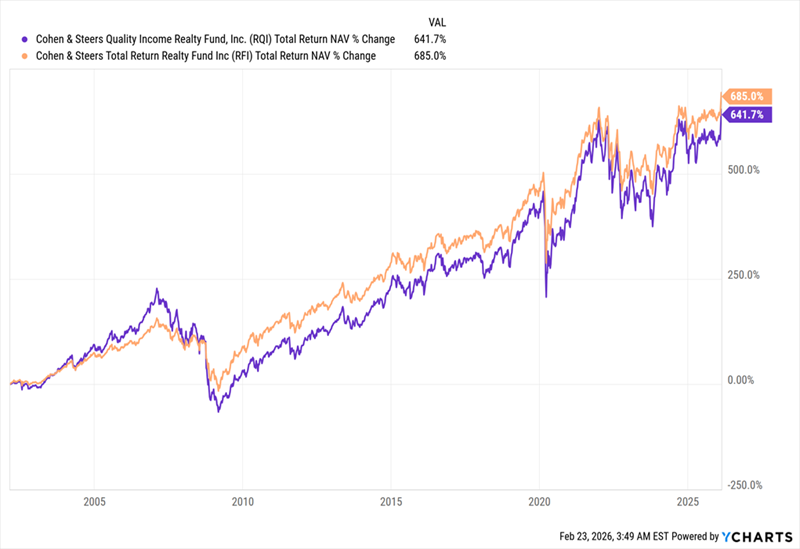
So, with similar holdings, it’s tough to look at the portfolio and say one is definitely better than the other. The performance story doesn’t tell us much, either.

Great Returns Between Them

Both funds go back about 24 years, and over that time, both have delivered a total NAV return (that is, the return based on their underlying portfolios, not their prices on the open market) of 8.8% on average per year. That’s above both funds’ current payouts (meaning those payouts are sustainable) and too close to each other for either to be “better” on its own.

Now let’s talk discounts to net asset value (NAV, or the underlying value of their portfolios)—the key metric for whether these funds are “cheap” or “expensive.”

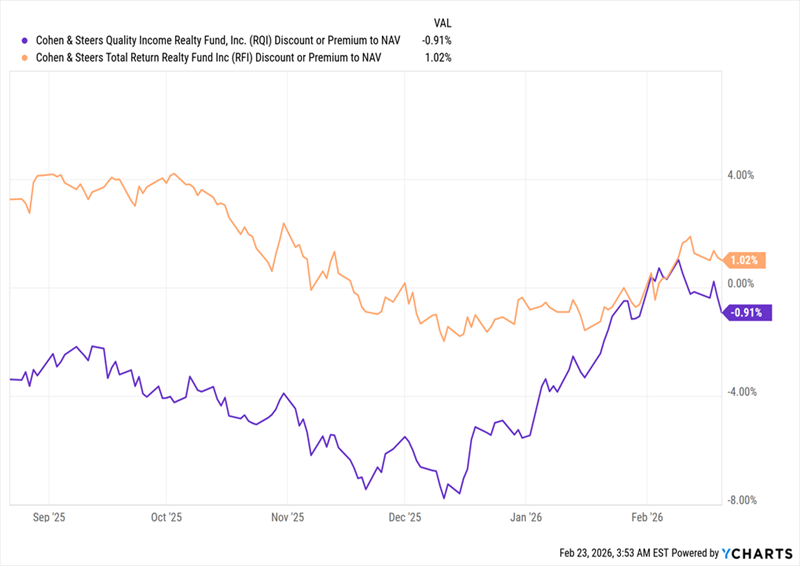
As I write this, RQI (in purple below) trades just below par, with a 0.9% discount to NAV, while RFI (in orange) is just above, at a 1% premium. Here too, the differences aren’t big enough for this to be, on its own, a deciding factor. Yet again, we are stuck.

But wait a second. Let’s zoom in a bit.

A Clear Trend Emerges

Notice how RFI’s 1% premium is a bit lower than where it was six months ago, while RQI’s discount was much larger at the end of last year?

This means you can buy RFI at its current premium and hold till that premium rises back toward where it was six months back. I see a gain in the premium as likely, as interest rates are likely to be cut further in the months ahead (though we’re not exactly sure when), lowering REITs’ borrowing costs. That’s critical for these funds, as they borrow heavily to finance their properties.

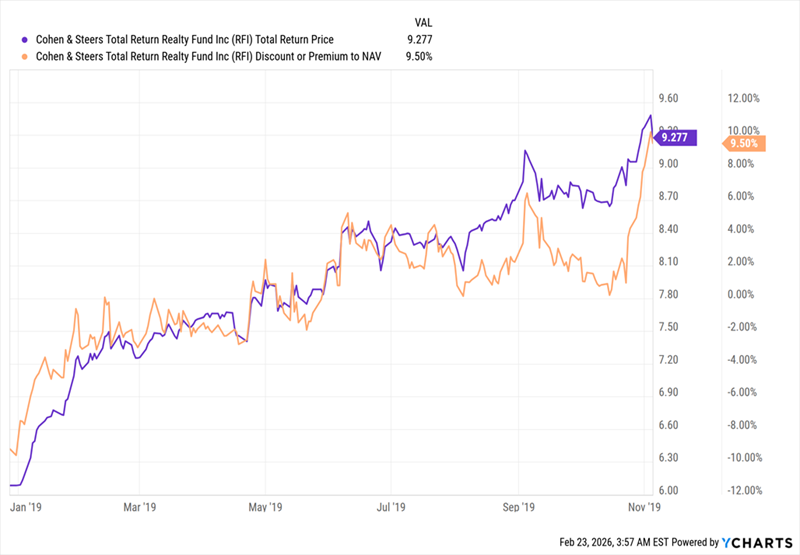
RFI’s Closing Discount Can Deliver Big Gains—Like It Did in ’19

This isn’t the first time RFI has given investors such an opportunity. It happens a lot, actually. For instance, look at the chart above, when RFI’s discount (in orange) cratered in late 2018. It then surged to a 9% premium, giving investors a 52% return in a year.

While it’s unlikely that RFI is going to deliver another 50% return in a year, big returns like this are overdue for REITs. But if the next big rise takes time to show up, that’s fine. This 8.1%-yielder (as I write this) is an income giant likely to keep its payouts high. Some special dividends are also on the table here, just like they have been in the past.

All of this gives RFI an edge over RQI right now. You’re getting nearly identical assets, along with upside, since the fund is more undervalued relative to its history and to RQI right now.

It’s clear that RFI, with its “discount-in-disguise,” is a smart pickup now.

Warren Buffett

Berkshire Hathaway (NYSE: BRK-B) maintains a 9.32% stake in Coca-Cola. The holding company itself pays no dividend, preferring to reinvest earnings and buy back stock, yet generates significant dividend income across its equity portfolio.

How Much Buffett Is Collecting From Coca-Cola

Berkshire Hathaway owns approximately 400 million shares of Coca-Cola. With Coca-Cola paying an annual dividend of $2.04 per share, that stake generates roughly:

400,000,000 shares × $2.04 = $816 million per year

That breaks down to about $204 million every quarter flowing from Coca-Cola to Berkshire.

For a single stock position, that level of income is extraordinary. Coca-Cola has effectively become a steady cash-producing asset inside Berkshire’s portfolio, sending more than three-quarters of a billion dollars annually to the conglomerate without requiring Buffett to sell a single share.

The Power of Yield on Cost

Buffett’s long-term investment approach with Coca-Cola demonstrates the compounding power of dividend growth over decades. The stock’s market value has multiplied many times over, while the dividend growth illustrates the compounding machine Buffett built through patient capital allocation.

Coca-Cola has raised its dividend for 63 consecutive years, earning Dividend King status. The most recent increase came in 2025, when the quarterly payout rose 5.2% from $0.485 to $0.51 per share. Over the past five years, the dividend has climbed from $1.60 in 2019 to $2.04 in 2025 – a 27.5% cumulative increase.

The SNOWBALL pays no dividend, preferring to reinvest earnings and buy back stock, yet generates significant dividend income across its equity portfolio.

If you think that you know better than W.B. and Benjamin Graham. GL

Calendar

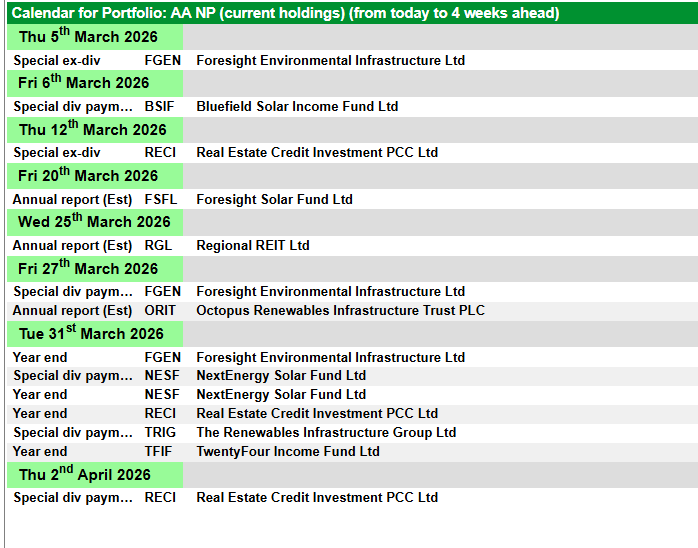
Whilst a profit is not a profit until it sits in your account the same proviso is for dividends but the current income, using the calendar above, is £12,731.00.

The new figure doesn’t change the previous published fcast or target but anyone lucky enough to have ten years of re-investing could, with a fair wind, have income of 25% on seed capital.

Remember also if your investing journey is only just starting out, with compound interest, the good news is, you stand to make more in the last few years of re-investing than in all the early years.

« Older posts Newer posts »

© 2026 Passive Income Live

Theme by Anders NorenUp ↑