
The Oak Bloke
May 20
Regional REIT LON:RGL was a reader voted idea to be included in the OB picks for 26. Has the wisdom of crowds proved to be a folly?
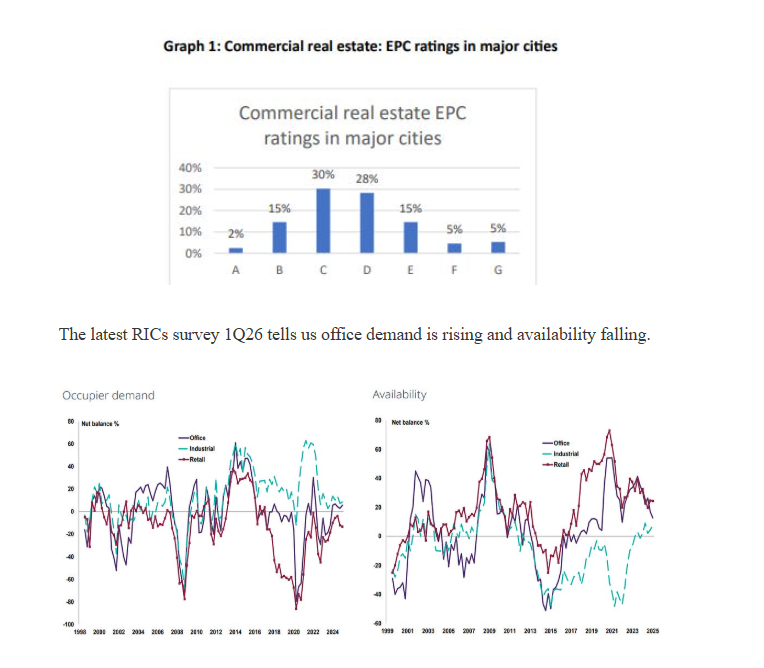
Far from it. RGL’s portfolio graded EPC B grew from 60% to 61.1% in 1Q26. An “A rated” or “B rated” property is important to save money but also necessary by 2030 under MEES is Minimum Energy Efficiency Standard regulations which forces UK landlords to meet EPC standards. In any case more and more businesses and organisations are facing pressure to reduce CO2 under Mandatory Carbon Reduction Plans (CRPs) as part of public sector bids and tenders – but also from their customers registered with ISO14001. Part of ISO14001 is to audit your supply chain and this is beginning to drive compliance.
Charities are also facing growing scrutiny to their ESG under new SORP 2026 rules which mean they need to focus on reduction to impact and ESG reporting in their Charity Accounts. Leasing an office that is EPC C, D or E means higher operational costs and headaches, which is driving demand towards the A and B properties.
RGL tell us the market for these is tight. Tight means better rentals per Sq.Foot and higher occupancy. It’s not just RGL who tell us. The British Property Federation also tell us only 17% of commercial properties meet this criteria, meaning RGL is well placed to serve this growing segment of the market.
The latest RICs survey 1Q26 tells us office demand is rising and availability falling.
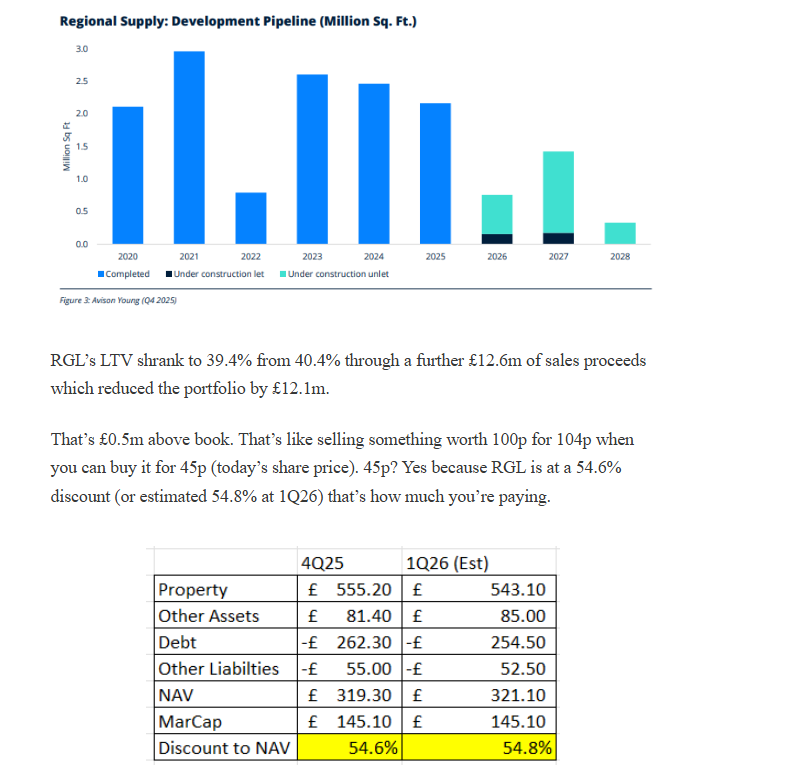
Demand of about 2m square feet per annum meets supply of less than a third of that in the 2026-2028 period where build times are extended and complicated through new legislation like the Building Safety Act. Rising rates will do nothing to improve the appetite to increase office supply or to carry out improvements to achieve EPC A or B.
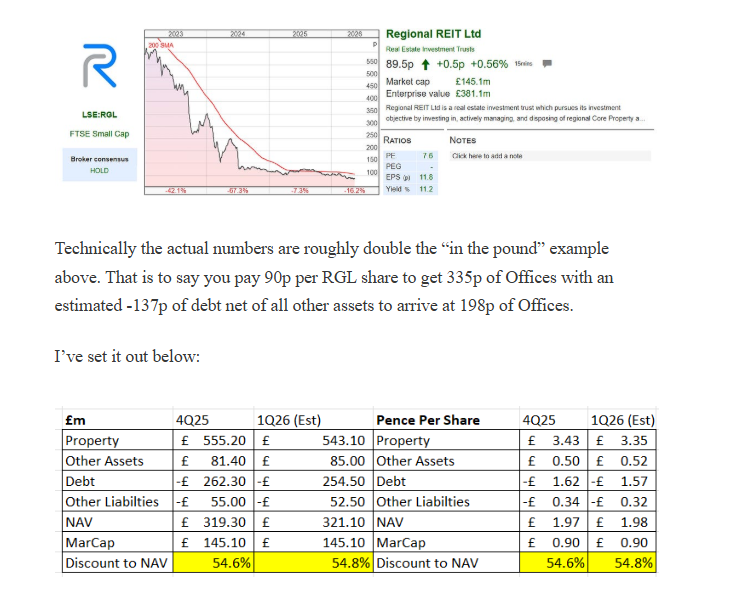
RGL’s LTV shrank to 39.4% from 40.4% through a further £12.6m of sales proceeds which reduced the portfolio by £12.1m.
That’s £0.5m above book. That’s like selling something worth 100p for 104p when you can buy it for 45p (today’s share price). 45p? Yes because RGL is at a 54.6% discount (or estimated 54.8% at 1Q26) that’s how much you’re paying.
Technically the actual numbers are roughly double the “in the pound” example above. That is to say you pay 90p per RGL share to get 335p of Offices with an estimated -137p of debt net of all other assets to arrive at 198p of Offices.
I’ve set it out below:
If we consider what those offices generated in 2025….. Here’s the Cash Flow.
In per share terms RGL generated 7.4p of Rental Cash net of interest charges, and a further 30p of cash from selling off properties it didn’t want minus -8p spent to do up properties it wanted to keep.
But think about it. 29.3p of net cash gen. From a share you can buy for 90p.
You’d not see this interpretation from broker guesses. They don’t provide free cash flow guesses and they forecast stagnant and pitifully poor returns for the next three years, of low single digit profit growth.
Nothing to see here.
The near complete absence of competitive supply and rising demand for EPC A and B will do nothing to improve RGL’s fortunes – apparently. I think that view is deeply incorrect.
At face value the rent roll in 1Q26 can look less impressive too dropping £0.6m to £49.8m. But it’s likely, given the movement in occupancy and portfolio size that the “Core” element rentals grew in 1Q26 and now make up the lion share of the rent roll.
Here are the estimates and the 11.1% rental income growth in CORE properties (in 3 months!).
As unwanted properties get disposed and as net lettings to the Core category are carried out the Rent Roll actually improved.
How? As a proportion of the ERV it grew from 65.5% to 66.4% in 1Q26.
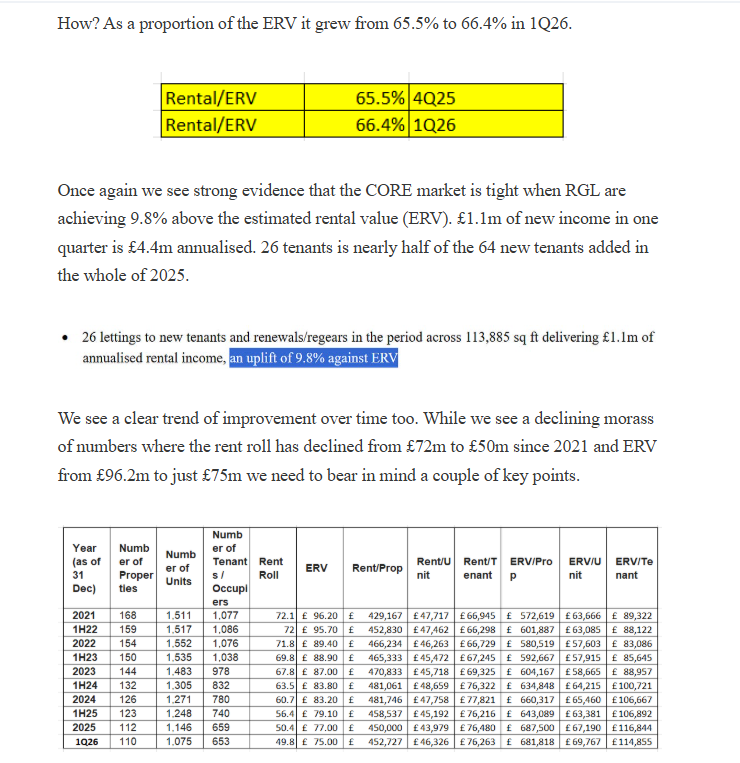
Once again we see strong evidence that the CORE market is tight when RGL are achieving 9.8% above the estimated rental value (ERV). £1.1m of new income in one quarter is £4.4m annualised. 26 tenants is nearly half of the 64 new tenants added in the whole of 2025.
We see a clear trend of improvement over time too. While we see a declining morass of numbers where the rent roll has declined from £72m to £50m since 2021 and ERV from £96.2m to just £75m we need to bear in mind a couple of key points.
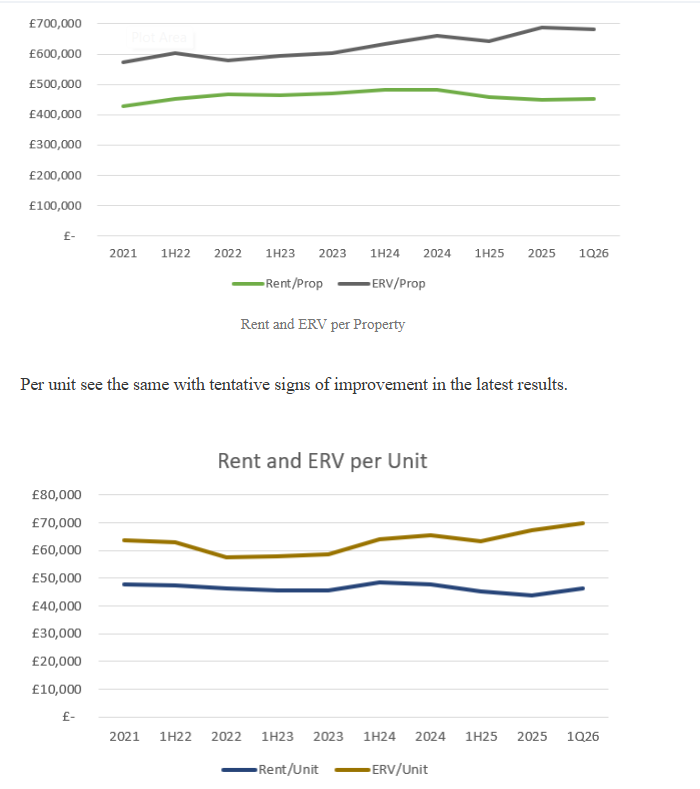
Property Rents are rising in 2024-2025. Per property the ERV is heading upwards, even if we don’t see the benefit of that yet.
Rent and ERV per Property
Per unit see the same with tentative signs of improvement in the latest results.
Similarly per tenants, some improvement per tenant but largely flat over four years.
If you compare annual reports the same conclusion can be drawn by comparing the equivalent yield (the return based on occupancy data) and the reversionary yield (the anticipated yield assuming occupancy is 100%).
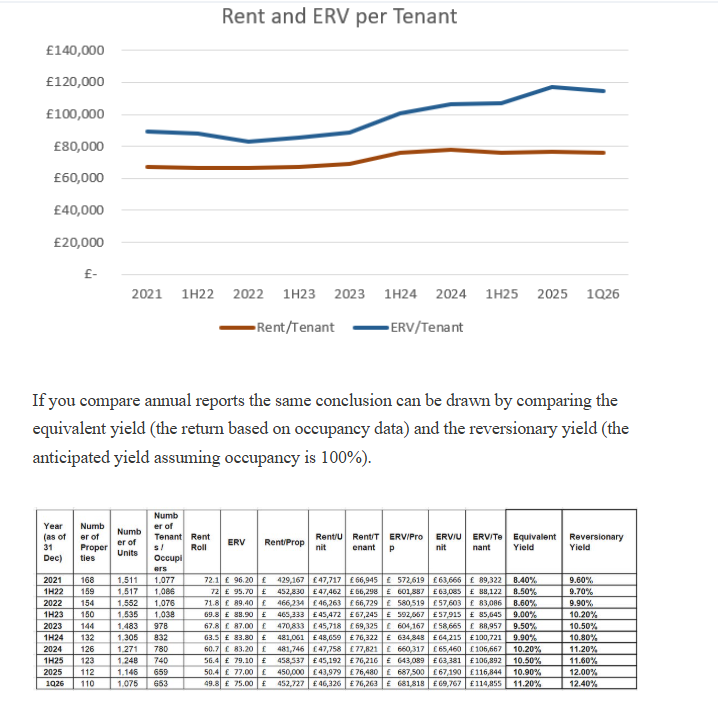
Rent per £1 of RGL
What these “flat” numbers don’t really convey is the value in 1Q26 versus prior years.
Today the buy price is 90p versus a 500p+ price in 2021, or 168p in 2023.
In other words the rent per property, unit and tenant per £1 invested is hugely higher today compared with prior years. 600% higher. Some of that comparison is through share dilution back in 2024 halving the ownership, and some is due to the level of leverage in 2021 too.
Conclusion
With continued progress of £12.6m disposals + £2.5m post period and a continued focus on capex improvement too, the portfolio continues to grind inexorably towards improvement. Selling properties tha were 10% occupied at close to book value.
With a backdrop of rising rates this represents both opportunity and threat to RGL. The opportunity is a tightening market for real assets, where building more will likely be difficult under a high rates environment. This benefits the incumbents including RGL. With fixed/swapped/capped debt and a continued deleveraging and asset improvement programme RGL appears to be well placed in the UK regions.
Post period a further £0.9m of rental income adds to the £1.1m achieved in 1Q26.
I continue to believe – and the evidence shows – RGL is well positioned in the market and probably at a low point so despite a weak share price this is – in my opinion – an owner of interesting and increasingly valuable assets.
Regards
The Oak Bloke
Disclaimers:
This is not advice – you make your own investment decisions.
Micro cap and Nano cap holdings including REITs might have a higher risk and higher volatility than companies that are traditionally defined as “blue chip”.
Thanks for reading! Subscribe for free to receive new posts and support my work.
Leave a Reply