The simple formula that reveals how long it will take to double your money
Story by Rachel Lacey
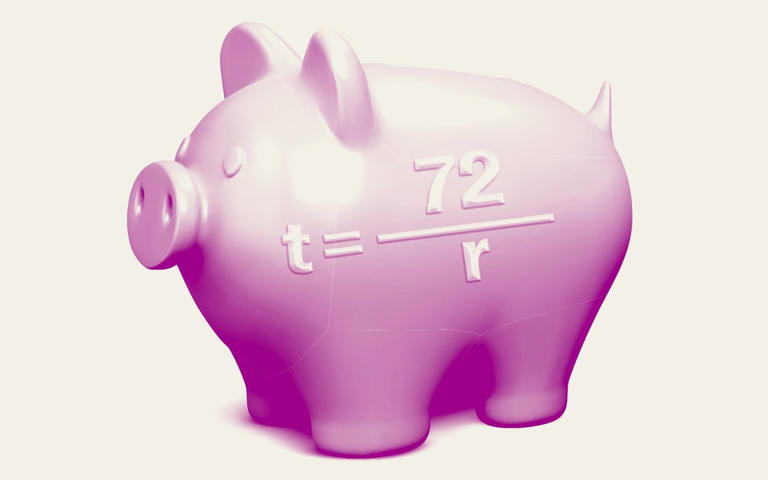
Graphic of a formula on a piggy bank
The Telegraph
One of the most common questions people have when they start investing is: “How fast will my money grow?”
The honest answer is likely to begin with “Well, it depends…”, but there is a handy formula to give you a rough idea of how long it will take to double in value.
Here, Telegraph Money explains how to use the “rule of 72”, and how it could help you make decisions about your savings, borrowing and pensions, but only if you use it properly.
What is the ‘rule of 72’?
“The rule of 72 is a useful financial planning tool. The simple formula helps investors and savers estimate how long it will take them to double their money,” said Jemma Slingo, pensions and investment specialist at Fidelity International.
“The maths is pleasingly straightforward. Just divide 72 by your average return, or your average interest rate, to calculate an estimate in years.”
So, for example, if you have an investment with a 6pc average annual return, your money will double in approximately 12 years (72 ÷ 6 = 12).
Or, if your investment yields a punchier 8pc a year, it will only take nine years or so to double your money (72 ÷ 8 = 9).
The formula will also work in reverse, said Laura Suter, director of personal finance at AJ Bell. “If you want to know what rate of return you’d need to double your money in 10 years, for example, divide 72 by 10 and you’ll get 7.2pc.
“It’s not exact, but it’s a useful guide.”
David Little, chartered financial planner at Evelyn Partners, added: “No calculator or compound interest table is required to make the calculation. The simplicity is exactly why [the rule] is so widely quoted.”
The rule of 72 isn’t just for investments
The rule of 72 is most often employed with investments, but Ms Suter pointed out it’s not its only use.
“Most people think of it purely in terms of investment growth, but it applies anywhere compounding is at work.”
For example, you can also use it to give you an idea of how quickly debts, such as credit cards, can grow if they aren’t repaid.
“Compounding works both ways,” said Mr Little. “A balance growing at 18pc a year doubles in four years (72 ÷ 18). Many borrowers underestimate this, and the rule of 72 makes the reality – and the danger – of debt instantly clear.”
You can also use this rule to highlight the threat of inflation to your cash. By taking the number 72 and dividing it by the prevailing rate of inflation, it’s possible to calculate how long it will take for the spending power of your money today to halve. This can be particularly useful when it comes to planning retirement income.
Ms Slingo said: “If inflation settled at 3pc, you could input this number into the formula to determine it would take roughly 24 years for your purchasing power to halve. This is a sobering thought, given the current state of inflation.
How helpful is the rule for financial planning?
The rule of 72 could, potentially, guide you to make more informed financial decisions.
For example, if you’re comparing cash or stocks and shares Isas as a long-term home for your money, applying the rule of 72 can highlight the power of compounding and give you the nudge to invest.
According to the rule, a cash Isa earning an average rate of 3pc a year would take 24 years to double. But a stocks and shares Isa with an average annual return of 6pc would double in half that time.

Remember if you only have a modest amount in your Snowball but intend to add when you can, compound interest takes a few years to make a noticeable difference. So the sooner you start the sooner you will finish.
Leave a Reply