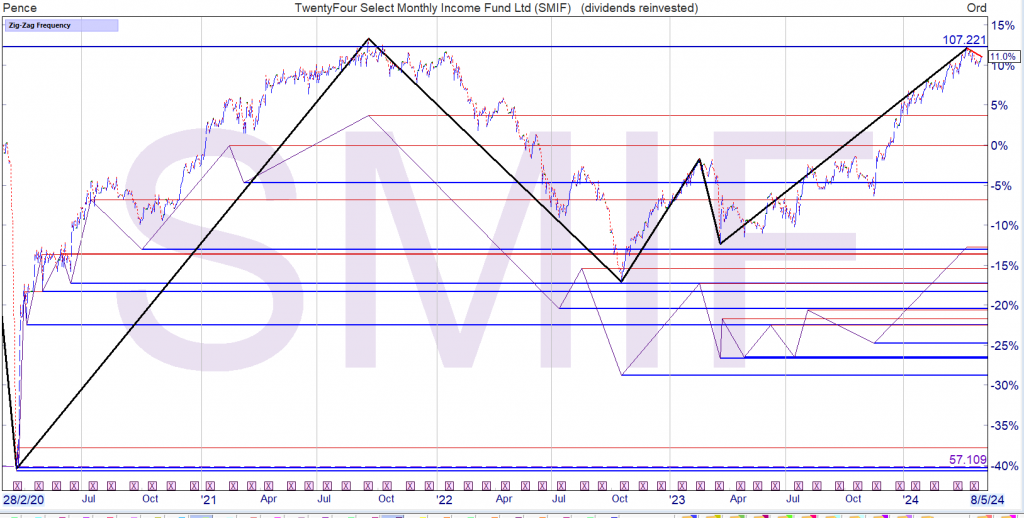
Not naval gazing that’s an entirely different topic.
If u have a Trust earning ten percent per year, u have the following options.
U could spend the dividend to pay for a luxury or to put towards paying your bills.
If u could re-invest the dividends back into the trust whilst it continues to pay an above market yield, or if the yield falls u could re-invest in another high yielding Trust.
U could re-invest the dividends in a low risk option, a deposit account or Government Gilts. After ten years* u will have achieved the holy grail of investing of having a position in your portfolio providing an income at zero, zilch, nothing cost. Even if u re-invested into a savings account u should be receiving income of around 14% pa. I haven’t mentioned, today anyway, that a comparable income from an annuity is around 7% and u have to gift your capital to a pension provider. The worst thing that could go wrong, u will still achieve the income but it may be in a longer time-frame depending on the market.
The Directors of TwentyFour Select Monthly Income Fund Limited have declared that a dividend of 0.5 pence per share will be payable, in line with the Prospectus, representing the regular monthly targeted dividend for the financial period ended 31 March 2024 and an additional dividend of 0.25 pence will be paid as follows:
Ex-Dividend Date 18 April 2024
Record Date 19 April 2024
Payment Date 3 May 2024
Dividend per Share 0.75 pence (Sterling)
Given the ongoing interest rate environment the Directors have given careful consideration to the Company’s projected income for the year balanced against their assessment of risks inherent in achieving its target dividend payment of 6 pence per share per annum. Based on this analysis the Directors believe that dividends payable in respect of the year ending 30 September 2024 are likely to be in excess of 6.5 pence per share, and consequently believe it is appropriate to pay an additional 0.25 pence per share, in addition to its regular monthly targeted dividend of 0.5 pence per share, for the period ended 31 March 2024.
The Directors will continue to monitor the position during the remainder of the year ending 30 September 2024 and, where possible to do so, will provide appropriate updates on dividend expectations.
There is a sister fund
11 April 2024
TwentyFour Income Fund Limited
Re: Dividend Announcement
The Directors of TwentyFour Income Fund Limited have declared that a dividend will be payable in respect of quarter end 31 March 2024 as follows:
Ex Dividend Date 18 April 2024
Record Date 19 April 2024
Payment Date 3 May 2024
Dividend per Share 3.96 pence ** (Sterling)
Current yield 9% trading at a discount to NAV of 2%
** The final dividend is often an enhanced dividend the current dividend paid quarterly is 2p.
When/if the share price doubles u could take out your stake and re-invest in another high yielder around 8% and your yield on your initial investment would equate to 17% per year and your Snowball would grow faster than u ever thought possible.
I’ve sold the portfolio shares in GCP for a profit of £248.00 including the earned dividend but not yet received. An acceptable addition to the Snowball for a couple of days investing.
Before you connect to a website or other online service, your internet traffic is encrypted and routed through the server of your VPN provider via a virtual private network (VPN). This aids in hiding your online persona and behavior. With the use of a VPN, you may get around geographical limitations, protect your online activities on open Wi-Fi, and conceal your true IP address when using BitTorrent and other applications.
Through the Internet, you can establish a secure connection to another network by using a VPN, or virtual private network. VPNs can be used to gain access to websites that are geoblocked, hide your online activities from snoopers on public WiFi, and much more.
A VPN: What Is It? To put it simply, a virtual private network (VPN) links your computer, tablet, or smartphone to a different computer located online, also referred to as a server, and permits you to access the internet through the server’s internet connection. You could be able to access things that you wouldn’t ordinarily be able to if that server is located in a different nation because it will appear as though you are coming from that nation.
The advantages of using a VPN, such as being able to circumvent Internet censorship and remotely access local network resources, stem from the fact that the VPN effectively forwards all of your network traffic to the virtual network. The majority of OS systems support VPNs out of the box.
VPNs have many more uses now than merely enabling you to access business networks from home or securely connecting business networks together over the internet. To get the best deals on the vpn special code just go there.
How Do VPNs Operate? Your computer functions as though it is connected to the same local network as the VPN when you connect it to it—or any other device, like a tablet or smartphone. The VPN receives all of your network traffic via a secure connection. You can safely access local network resources even while you’re on the other side of the globe since your computer acts as though it’s on the network. Additionally, you will have the ability to browse websites that are geo blocked or use public Wi-Fi as if you were physically present at the VPN’s location.
Your computer communicates with the website over the encrypted VPN connection when you browse the internet while connected to one. Through the encrypted connection, the VPN relays the request on your behalf and returns the website’s response. Netflix will see your connection as coming from within the USA if you are using a VPN based in the USA.
Are you looking for the best VPN special coupon code? We got you covered. In theory, your data is automatically at risk when you connect to the internet. Engaging in harmless activities like streaming media, online shopping, web browsing, and others might expose private information, including banking credentials and other sensitive data, to unscrupulous parties. Purchasing a VPN is one simple approach to reduce your risk and secure yourself online. There are several reasonably priced ones available online that have special coupon codes on our website.
By establishing an encrypted secure connection between your device and the internet, a virtual private network, or VPN, helps you browse the web privately and protects your personal information from prying eyes. The most reliable VPN services of 2024 have already been evaluated and compiled, and we’ve included the best ways to sign up for less below.
Remembering that free VPN services aren’t worth the danger is crucial. They are mostly engaged in the same game of collecting and selling your data. Fortunately, there are now some excellent VPN offers available, with costs starting at less than $3.99 per month if you prepaid for a year or two of subscription. We’ve put a few of the industry giants to the test and compiled our list of the top VPN offers.
Without a doubt the best VPN provider is NordVPN and we have the best possible deal for everyone on this site so just click here for the NordVPN special coupon code service.
There are numerous justifications for using a VPN. Did you know, for instance, that your internet service provider collects as much information as it can about your online activities? The top ISPs have collected user information on private subjects like race, sexual orientation, and current location. It has been aggregated, cross-referenced, and shared with other partners by the ISPs.
You can stay safe from these widespread methods of data collection with the use of a VPN. A VPN can help you virtually move your location to a different city or country in addition to hiding your online activity by offering a private and secure “tunnel” to your online destination. This is a nice bonus if you’re looking to circumvent local censorship laws or try out various streaming media offerings in various locales.
VPN Special Coupon Code Privacy Policy Proudly powered by WordPress
Dividend stocks are possibly the only investment where you have the opportunity for capital growth as well as income. It’s truly empowering once you see the impact that dividend stocks can make on any account size. The key ingredient is DIVIDENDS
While many investors focus on an investment trust’s discount, for those trusts with an income remit the distribution rate at time of purchase may have a larger effect on total return over the long term.
Author
Fran Radano
INVESTMENT MANAGER, THE NORTH AMERICAN INCOME TRUST
While closed-end fund investors may find the discount to net asset value (NAV) exciting, as Fran Radano explains, there is a bit more to it than that.
The past few years have been challenging for investors. An elevated stock market and interest rate volatility caused by both inflation and hawkish central banks sent many investors rushing to the sidelines. This dynamic led to indiscriminate selling and, at times, pushed investment trust prices lower, driving discounts to historically wide levels.
In fact, after the Bank of England started raising interest rates at the tail-end of 2021, a great deal of investment trusts have gone on to trade at their widest discounts since 2008’s Global Financial Crisis. In fact, the average investment trust discount fell to 16.9% at the end of October 2023 before recovering to 9% by the end of the year
What are discounts?
An investment trust can trade at a share price that is higher or lower than its net asset value (NAV). When a trust’s share price is higher than its NAV, it is trading at a premium. When the share price is lower than its NAV, it is trading at a discount. A discount or a premium is simply a number representing the relationship between a trust’s share price and its NAV.
Investment trusts often trade at discounts, but over the course of a market cycle it has historically been the case that the discounts narrow and widen, like how the stock market rises and falls.
During volatile markets, discounts can widen significantly, offering investors the opportunity to purchase shares well below their NAV. Some investors prefer purchasing investment trusts at a wide discount because doing so increases a trust’s distribution rate and may present a higher potential for capital appreciation if the discount narrows due to the share price rising to NAV. Because, as many investors fail to realise, discounts can also narrow as NAV falls to the price. Again, a discount or premium is simply a relationship between two numbers – nothing more.
Other investors are less focused on discounts and prefer to invest in a trust due to the trust’s investment objective and its ability to provide regular distribution payments.
“Oh, it’s a 10% discount, that looks good.” Well, unbeknownst to investors, the trust may usually be trading at a 15% discount, and this 10% discount isn’t much of a bargain. Furthermore, an investment trust discount could be driven by many different factors: poor historical performance, low distribution levels relative to peers, or market expectations of poor performance to come.
We believe it’s important to gain an understanding of what is behind the discount. If no reason can be found, or if the only reason is that the trust’s underlying asset class seems to be out of favour, those may be signs the trust’s discount is truly attractive.
Distributions, distributions, distributions
Every investment trust has a formal investment objective which details how they invest. The objective will also indicate if the trust aims to deliver capital growth, income or a mix of both. For those trusts with an income remit, investors have long valued the dividend payments and diversification benefits on offer. Step up the Association of Investment Companies (AIC) which publishes an annual ‘dividend heroes’ list of those trusts that have consistently increased their annual dividends for at least 20 years in a row.
For those trusts with an income focus, it is distributions – not discounts – that have historically been the primary contributor to total returns over longer periods of time. The benefit from a narrowing discount diminishes over time as a contributor to overall total return while distributions remain the dominant contributor.
Consider a trust that distributes 7% of NAV per year and has a 10% discount. If the trust is held for three years, assuming its NAV does not change, and its price rises to the NAV at the end of the three-year period the distribution would account for roughly two-thirds of the price return every year (Table 1). Table 1. Most of return should come through distribution
Year 1
Year 2
Year 3
Starting NAV
$10.00
$10.00
$10.00
Starting price
$9.00
$9.33
$9.66
Yield
7% NAV
Ending Price
$9.33
$9.66
$10.00
Ending NAV
$10.00
$10.00
$10.00
Price return
$0.70
$0.70
$0.70
Total price return
$1.03
$1.03
$1.04
Total price return %
11.4%
11.0%
10.8%
% from distribution
68.0%
68.0%
67.0%
% from discount
32.0%
32.0%
33.0%
Source: abrdn, February 2024. For illustrative purposes only.
Therefore, investors may be better served by focusing on a trust’s distribution than its discount. Final thoughts While it’s exciting to follow an investment trust’s discount, it’s ultimately not value-additive. Once invested, the most important thing to assess is the trust’s total return performance and whether it is meeting investment objectives. Historically, the key, long-term driver of a trust’s performance has not been its discount, but its distribution rate.
££££££££££££
If an Investment Trusts discount to NAV is high, it follows the price will be
Well, if I have a portfolio of £20,000 and I invested it in high-yielding dividend stocks like Phoenix Group and Aviva, I could expect to average an 8% yield. So my £20k would get me around £1,600 a year in dividends.
££££££££££££
If we concentrate on the tail and not the dog £1,600 compounded at
8% for 30 years would provide 16k of income.
Whilst it’s unlikely that u would be able to re-invest at 8% for the whole
time but I guess it could average out to around that figure.
We’d all love a second income, right ? In fact, that’s the reason many of us invest. It allows us to turn our capital into dividends and can provide us with a financial boost throughout the year.
But how could I go about turning my second income into my only income? Surely it must be possible.
Let’s take a closer look.
How much would I need? Well, if I have a portfolio of £20,000 and I invested it in high-yielding dividend stocks like Phoenix Group and Aviva, I could expect to average an 8% yield. So my £20k would get me around £1,600 a year in dividends.
Clearly, that’s not enough to live on. It works out at just £130 a month.
So what would I need? Well, in today’s climate, I’d probably want at least £30,000 in dividends a year and I could earn this without being taxed by investing through my ISA. But to achieve this I’m going to need something in the realms of £400,000 invested in stocks paying 8% yields.
Getting to £400k Naturally, building a portfolio worth £400k can sound daunting. And it’s a huge jump to go from just £20,000 to £400,000. There are four key actions required to make it work.
The first is investing over time. It’s not going to happen overnight. We need to appreciate that to build a portfolio worth £400k, we need to invest over a long period of time.
The second action is investing regularly. This allows us to ride out the peaks and troughs of the market. But it’s also important that we keep topping up our portfolio.
Next, I need to invest in dividends stocks. I’m looking for companies with strong but sustainable dividend yields. One way we can assess the health of dividend yield is by looking at the coverage ratio (DCR). Anything above two is healthy. Some stocks will have lower DCRs but healthy cash flows — these stocks are also investment material, in my opinion.
The final action is reinvesting my dividends. Every year I need to take the dividends I earn and pile them back into these high-yielding stocks.
Compounding Collectively, these actions are the basis of a promising compound returns strategy. This is the practice of reinvesting dividends over time to achieve exponential gains.
For example, if I invested £20,000 in a company with a 8% yield, at the end of the year I could expect to have £21,600, assuming the share price of the stock in question remained constant.
That’s fine, but it’s not ground breaking. The impressive bit comes when we reinvest that dividend year after year.
Without regular contributions, it would take 38 years to turn £20k into £400k. But if I were to contribute £300 a month, and increased that contribution by 5% annually, I could get there in 21 years.
Naturally, the more I contribute, and the greater my starting figure, the easier it is to get there. And after 21 years, it’s worth highlighting that my portfolio is growing incredibly fast and I may need more than £30,000 a year in two decades’ time.
Of course, there’s no guaranteed way to build a portfolio, and I could always lose money. But if I follow these steps, I stand a good chance of turning my second income into my only income.