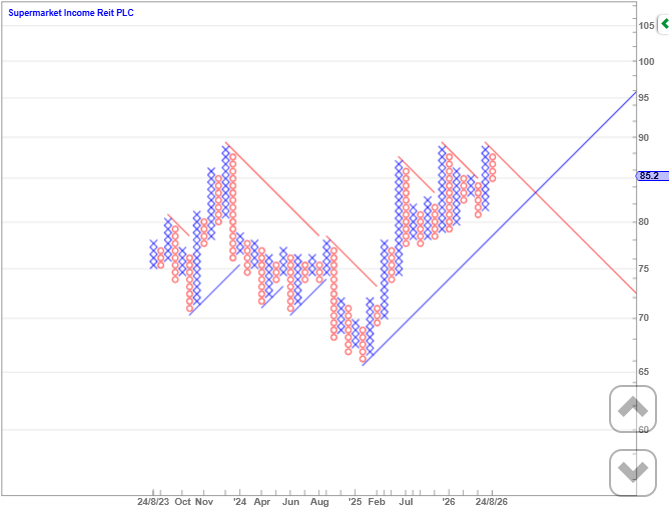
I’ve bought for the SNOWBALL 10256 shares in PHP for 10k.
Current yield 7.3%. The plan is to collect the next dividend and then re-invest in a higher yielder to achieve next year’s target.
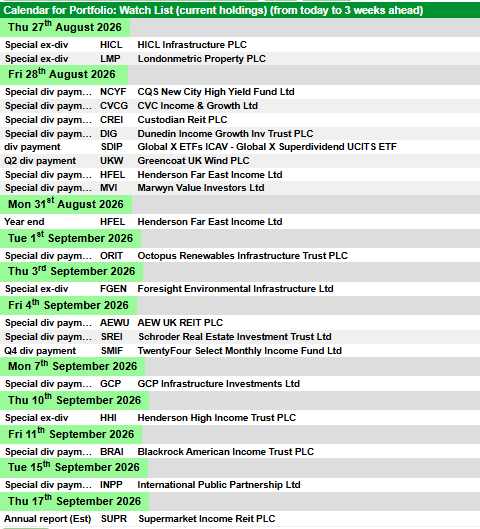
Next xd date early October.
Barclays raises Primary Health Properties target to 115 (110) pence – ‘Overweight’
When the American market opens, I’m going to add 1k to PMT.
Very high risk but the SNOWBALL is ‘risk on mode’ until it achieves repeatable earnings of 1k a month/3k a quarter. When that target is achieved the risk for the SNOWBALL will be lowered. To achieve 12k of income the SNOWBALL needs to earn more dividends to buy more shares to earn more dividends.
I’ve sold the SNOWBALL’s AIRE shares for a loss of £9.00. The bid from AEW could still happen but it’s not certain and also a lot of water has to pass under a lot of bridges, even if it happens.
Whilst making a capital gain can mean buying more shares that pay a dividend, having banked the dividend from AIRE, it’s currently ‘dead’ money.
On 16 July 2026, the Company announced that it was considering a possible all-share offer to acquire the entire issued and to be issued share capital of Alternative Income REIT plc (“AIRE”) (the “Possible Offer”). Following Glenstone’s public statement that it would not support an offer from AEWU and subsequent attempts to engage with Glenstone to discuss the merits of AEWU’s proposals, notwithstanding the indicated support from the board of AIRE, AEWU confirms that it does not intend to make a firm offer for AIRE.
Is a revival on the cards for these high-yielding trusts?
REITs have struggled amid interest rate rises, but with many now trading at bargain-basement prices and with tax efficiency on their side, David Prosser explains why now could be an attractive time to invest.
25th August 2026
by David Prosser from interactive investor
Are REITs due a revival? Real estate investment trusts (REITs) have struggled in recent times, with a challenging economic environment weighing down on valuations, but some analysts are now optimistic the sector is bottoming out.
With many funds trading at bargain-basement prices – and the tax treatment of REITs remaining attractive – now could be the moment to consider a return to the sector, at least for selective investors.
First the basics. REITs offer exposure to portfolios of property assets – usually in the UK – and are structured to distribute at least 90% of the rental income they earn from these assets to their shareholders.
As long as they hit that threshold, REITs pay no corporation tax on their profits.
Instead, shareholders pay income tax, rather than dividend tax, on the distributions they receive, as if they owned the underlying properties themselves.
REIT shares can be held inside an individual savings account (ISA), in which case dividends are tax-free.
In addition, some REITs are incorporated in the Channel Islands, in which case there is no stamp duty to pay when buying their shares.
Challenging times
So far, so good, but tax efficiency is not reason enough alone to justify investment. And in recent years, the investment case for property more broadly has been challenging – mostly because the period since the Covid pandemic has largely been one of rising interest rates
Such an environment – or even just the expectation of higher borrowing costs – can be a killer for all investors in property – including REITs.
The first problem is that since most property, whether residential or commercial, is acquired with at least some debt, demand will fall when debt becomes more expensive. That hits the capital value of property assets.
Also, if you’ve already taken on debt to finance property investments, you may now have to pay more to service it.
With REITs, explains Emma Bird, head of investment trust research at Winterflood, there have been concerns “regarding the financing structures of some investment trusts – for example if they have a large proportion of floating rate debt or material upcoming refinancing requirements, which would likely result in significantly increased debt costs”. That could hit their ability to pay dividends.
A third challenge is that higher interest rates mean the income you can earn from gilts – regarded as risk-free securities given that they’re issued by the UK government – will also increase. The yield on a UK 10-year gilt currently comes to around 5%.
Investors naturally want a premium over gilts when they invest in risker assets such as REITs, so they therefore hold back on investing until the share price sinks to a level where the yield rises enough to restore that premium.
All of which has spelled trouble for REITs.
At the beginning of the year, the Bank of England’s Monetary Policy Committee (MPC) was expected to reduce interest rates further over the course of 2026, having made four cuts in 2025.
But fears of the inflationary impact of war in the Middle East – amid rising energy prices in particular – changed the dynamic.
By the spring, the MPC was tipped to return to raising rates, as it did consistently from 2022 to 2024 to counter inflation.
Why buy now?
No wonder many funds have struggled. The average UK Commercial Property investment trust delivered a negative return of 4.5% over the five years to mid-August according to the Association of Investment Companies (AIC).
Shares in these funds now trade at an average discount to the value of their underlying assets of almost 22%.
Still, perhaps we are finally at a turning point, with some economists pointing out that the inflationary impact of the Iran conflict has been less severe than expected.
That potentially mitigates the need for higher interest rates – particularly if a Middle East peace deal can be reached.
Moreover, property provides important diversification benefits for investors keen to manage risk by reducing their dependence on conventional assets such as equities and bonds.
And the income generated by many REITs looks attractive – at current share prices, the average UK Commercial Property fund yields 7.84%, the AIC reports.
“Now could potentially be an attractive time to invest in property investment trusts, with discounts remaining wide in many cases,” suggests Bird.
“In a more benign interest rate environment, possibly facilitated by a resolution to the Iran war, we would expect to see improvements in underlying asset valuations.”
She also points out that the sector is beginning to see further takeover speculation and deals – because large institutional investors and property companies think REITs are too cheap. “We would also expect downside discount risk from current levels to be limited to an extent by the potential for M&A activity, which has been a common feature of the sector recently, providing somewhat of a floor under valuations.”
The sector has seen lots of consolidation already in recent years but more potential deals are on the table – including for names such as Alternative Income REIT Ord AIRE
Still, don’t assume a different interest rate environment will shift the dial for REITs, which face other problems too.
One worry is that in this ongoing period of slow economic growth, demand for most types of commercial property will suffer.
In a lacklustre economy, businesses rent less office space, retail outlets close and industrial premises operate below capacity.
Also, some areas of commercial property are struggling with deep-seated structural problems.
For example, high streets in most towns in the UK have fared poorly in the face of competition from online shopping; that’s not conducive to robust returns from investments in retail premises.
Care homes: one industry voice believes there’s potential for strong long-term returns as the care home market continues to experience rising demand, with new supply failing to keep up.
Treading carefully
On this basis, analysts urge investors to think carefully about the type of exposure individual REITs offer.
Funds offering access to logistics assets – warehousing, for example – may be preferable to those owning high street shops.
There is also growing interest in REITs that own digital infrastructure assets such as data centres.
“REITs are an area where taking an active approach can add value,” says Alex Watts, senior investment analyst at interactive investor.
“Skilled managers can identify mispriced opportunities, navigate a rife M&A landscape, differentiate between sectors’ and regions’ growth prospects, and assess the strength of individual balance sheets, asset quality and management teams.”
One question for investors, adds Bird, is whether they want a REIT that invests broadly across the UK commercial property sector, or a fund that takes a more specialised approach. Investors new to REITs may prefer the former approach, although certain types of asset have specific appeal.
“This fund invests across a range of sub-sectors, with a focus on smaller lot sizes, which means that the portfolio is well diversified, reducing asset- and tenant-specific risk.”
The focus on smaller properties also provides a yield advantage as the fund’s target assets are off the radar of most institutional investors, improving the supply and demand dynamics, Bird points out.
Custodian Property Income currently offers a prospective dividend yield of more than 7%.
“There is potential for strong long-term returns supported by long-run fundamentals, as the UK care home market continues to experience structurally rising demand, with new supply failing to keep pace.”
The fund’s focus on logistics – and particularly last-mile distribution – is one attraction. But the fund has also grown in size by taking opportunities to buy other real estate businesses at attractive prices.
another logistics-focused REIT also attracts attention, and has been winning praise following a strong set of results in August.
“With supportive market fundamentals including strengthening demand, tightening supply and rents continuing to grow ahead of inflation, we are well placed for 2026,” says investment director Bjorn Hobart.
“Our focus remains on disciplined capital allocation and recycling into higher-return opportunities to ensure long-term value creation for shareholders.”
Watts, meanwhile, suggests a slightly different approach.
takes a hybrid approach to pan-European property, meaning it invests in listed European property-related securities, such as REITs, but is also permitted an allocation (of up to 15%) to physical property,” he explains.
“The benefit of the hybrid approach is that the listed property securities component provides daily liquidity while the closed-ended structure also means investments don’t need to be sold to fund redemptions.”
The latter point is important. One advantage of REITs – and investment trusts more generally – is that their structure is well-suited to illiquid assets such as property. Managers look after a fixed pool of assets, with investors getting exposure to this pool by buying shares in the fund on the stock market.
By contrast, open-ended funds must cope with inflows and outflows of investors’ money according to demand and supply for the fund. In the past, this has seen some funds face serious problems at times when large numbers of investors have demanded their money back, leaving managers trying to sell property in a hurry to fund withdrawals.
Backed by resilient business models, dependable cash flows, strong dividend track records, and attractive growth opportunities, these two Canadian stocks could be compelling buys for income-focused investors right now.
Bank of Nova Scotia and TC Energy offer attractive dividend opportunities for long-term investors, supported by their resilient business models, stable cash flows, and strategic growth initiatives.
With Scotiabank’s diversification and strategic repositioning, along with TC Energy’s predictable earnings and expanding infrastructure, both companies are well-suited for consistent dividend growth and enhanced wealth creation.
Dividend-paying companiesreturn a portion of their profits to shareholders through regular dividend distributions, allowing investors to benefit from both capital appreciation and a steady stream of income. By reinvesting these payouts, investors can further enhance their long-term return potential by harnessing the power of compounding. However, dividends are not guaranteed and remain subject to a company’s financial performance and management’s discretion. Therefore, investors should focus on high-quality dividend stocks backed by resilient businesses, sustainable cash flows, and a strong track record of shareholder returns to improve their prospects for long-term wealth creation.
Against this backdrop, let’s look at two quality dividend stocks that are ideal for long-term investors.
Bank of Nova Scotia
Bank of Nova Scotia (TSX:BNS) could be an attractive dividend stock for income-focused investors, supported by its diversified financial services operations and broad geographic presence. Its diverse revenue streams provide a relatively stable earnings base, enabling the bank to maintain a long history of shareholder distributions, including uninterrupted dividend payments since 1833. Scotiabank has also increased its quarterly dividend at an annualized rate of approximately 4.5% over the past decade and currently offers a healthy yield of 3.6%.
Looking ahead, Scotiabank is pursuing a strategic repositioning to expand its higher-return North American operations while reducing exposure to riskier, lower-return Latin American markets. This transformation could strengthen the stability and profitability of its earnings over the long term, supporting more sustainable dividend growth. As part of this strategy, the bank is pursuing the acquisition of MapleMark Bank to strengthen its presence in the fast-growing Dallas market. It is also seeking to acquire the remaining shares of Scotia Group Jamaica Limited, which could provide greater control over the business while improving capital allocation and operational efficiency.
Tired of guessing which stocks to buy?
When our analyst team has a stock tip, it can pay to listen. After all, Stock Advisor Canada’s total average return is 98% – a market-crushing outperformance compared to 88% for the S&P/TSX Composite Index.
They revealed what they believe are 10 stocks for investors to buy right now, available when you join Stock Advisor Canada.
Meanwhile, a relatively higher interest-rate environment could continue to support Scotiabank’s lending operations and net interest income. The bank’s recently announced share-repurchase program for up to 15 million shares through April 2027 could further enhance shareholder returns by reducing its share count by approximately 1.2%. Given its resilient business model, long-standing dividend record, and strategic growth initiatives, Scotiabank appears well positioned to continue delivering attractive income and shareholder returns, making it a compelling dividend investment for long-term investors.
TC Energy
Another attractive dividend stock is TC Energy (TSX:TRP). The energy infrastructure company operates an extensive natural gas pipeline network and a portfolio of power generation assets with approximately 4.7 gigawatts of capacity. Its highly predictable business model generates around 98% of earnings from regulated assets and long-term take-or-pay contracts, providing substantial cash-flow visibility. This stability has enabled TC Energy to increase its dividend for 26 consecutive years, while its shares currently offer a healthy forward yield of 4%.
Looking ahead, rising natural gas production across North America should continue to support demand for TC Energy’s pipeline infrastructure and related services. The company is also expanding its asset base to capitalize on these favourable industry trends. After placing approximately $2 billion of projects into service year to date, TC Energy expects to bring another $3.5 billion of projects online this year. Beyond that, the company has approximately $20 billion of additional projects in its development pipeline, providing a meaningful runway for long-term growth. Management expects adjusted EBITDA (earnings before interest, taxes, depreciation, and amortization) to reach $12.6–$13.1 billion by 2028, with the midpoint representing an annualized growth rate of approximately 5.4%.
With a resilient business model, visible growth opportunities, and a robust development pipeline, TC Energy appears well positioned to support continued dividend growth. These attributes make the company an appealing option for income-focused investors seeking reliable dividends and long-term wealth creation.
Aberdeen Equity Income Trust PLC ex-dividend date Alliance Witan PLC ex-dividend date CT Healthcare Trust PLC ex-dividend date Fair Oaks Income Ltd ex-dividend date HICL Infrastructure PLC ex-dividend date JPMorgan American Investment Trust PLC ex-dividend date JPMorgan Global Growth & Income PLC ex-dividend date Pacific Assets Trust PLC ex-dividend date Residential Secure Income PLC ex-dividend date Rights & Issues Investment Trust PLC ex-dividend date
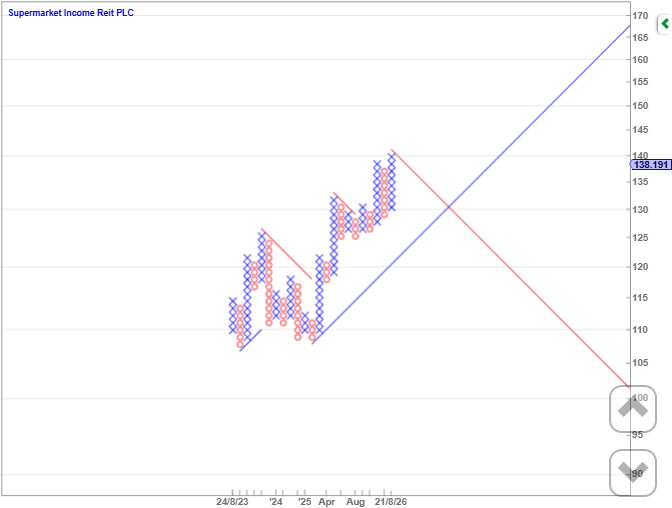
A chart of just the price, where you used the dividends to pay your bills.
As usual timing then timein.
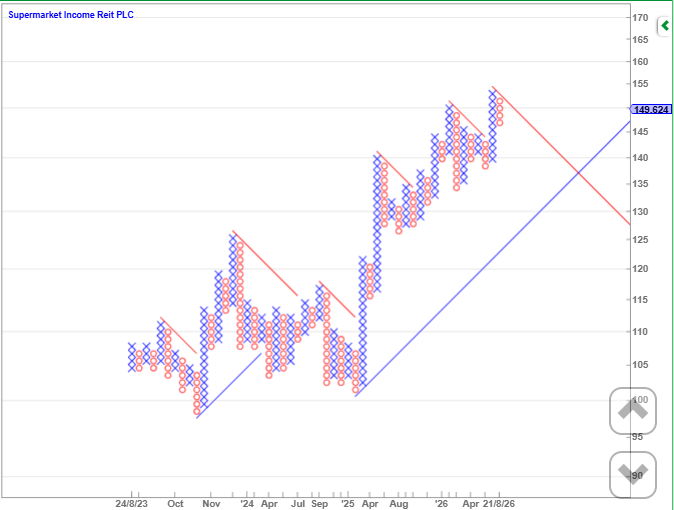
The chart includes the earned dividends, that were re-invested back into your Snowball.
The chart includes if you simply re-invested the dividends back into the share, buying more shares and therefore earning more dividends.
With the higher yielding Trusts, higher yield equates higher risk, it would be better to re-invest elsewhere in your Snowball, just in case you have bought a clunker.
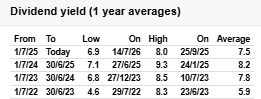
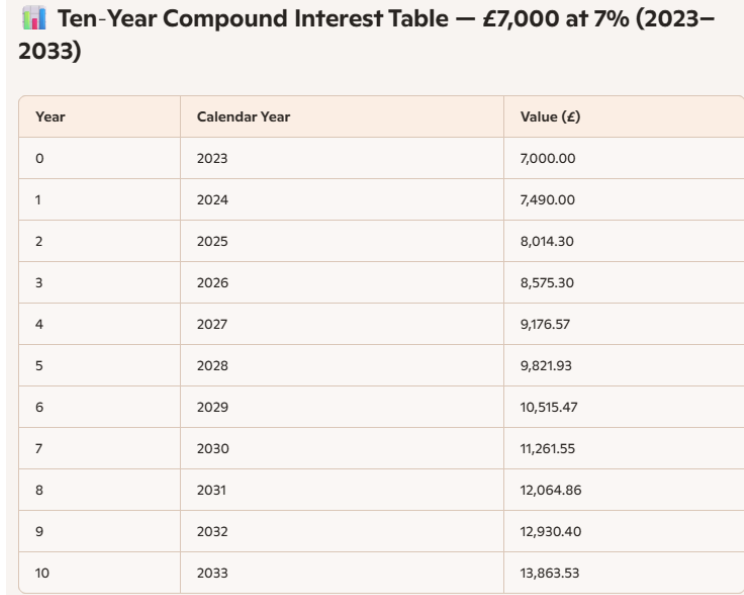
If you bought in 2023, you could expect to earn a gently rising yield of 8% plus, while remembering no dividend is entirely safe.
Swissquote’s Ipek Ozkardeskaya said that “with strong Q2 earnings already baked into prices, AI financing worries and political/geopolitical headlines are gently taking control of market action.
“Trade tensions are back in the headlines this morning following the US and Canada’s failure to reach a trade agreement, tensions in the Middle East continue to disrupt oil flows, and debt levels across the so-called developed world keep rising, with the US’ USD40 trillion debt now sitting like an elephant in the room.”