Investment Trust Dividends

Category: Uncategorized (Page 14 of 382)

Trust in Trusts

ISA deadline looms: experts reveal the investment trusts they favour

Oliver Haill

Published: 16:40 11 Mar 2026

Personal Assets Trust -

With less than a month left before the deadline for savers to use their Individual Savings Account (ISA) allowance on 5 April, financial analysts and commentators have been recommending a focus on long-term strategies to cope with the sort of geopolitical tensions and volatile markets seen recently. 

ISAs are tax-free wrappers that allow savers to invest in shares tax-free. The annual allowance stands at £20,000.

The Association of Investment Companies (AIC) has polled a number of financial experts to find out which investment trusts they recommend for cautious, moderate and adventurous investors.

Investment trusts are London-listed, closed-ended funds. As a closed-ended fund, this means there is a fixed number of shares that investors can buy and sell on the stock market, while the fund manager invests the money in a portfolio of assets.

Trusts can pay resilient and rising dividends, as they can hold back some income in good years and use those reserves to maintain or increase payouts when markets are weaker.

“Trusts can also work well for high growth areas like emerging markets as their fund managers are able to take a long-term view of their portfolio,” says AIC director Annabel Brodie-Smith.

“Despite the war in Iran and worrying headlines about financial markets, most investors have seen these situations before. It’s vital to keep investing as usual and remain calm and patient. Panic selling is never wise – you will not find experienced fund managers radically changing their plans or rushing into short-term decisions because of a conflict with a very uncertain duration and outcome. They know that they need to steer a steady ship and that means sticking to their long-term strategies.”

Trusts for cautious investors

Three wealth preservation investment trusts were tipped by Kyle Caldwell, funds and investment education editor at Interactive Investor, who says this trio has “consistently delivered in terms of protecting capital during periods of stock market weakness”.

They are Capital Gearing Trust PLC (LSE:CGT)Personal Assets Trust (LSE:PNL) and Ruffer Investment Company Ltd (LSE:RICA).

“Each has a low weighting to shares and plenty of defensive armoury, such as low-risk, inflation-linked bonds. Each offers a steady, defensive option for investors seeking long-term real returns with controlled risk.

“As ever investors need to do their homework and look under the bonnet to see how the defensive exposure differs – particularly the equity holdings, where the three trusts have less in common,” Caldwell says.

Jason Hollands, managing director of Bestinvest, also highlighted Personal Assets Trust.

“For investors unsettled by geopolitical events and the debate around a potential AI bubble, Personal Assets Trust, managed by Sebastian Lyon and Charlotte Yonge of Troy Asset Management, stands out as a defensive option,” he says, highlighting its long-standing emphasis on delivering dependable returns but with a strong focus on capital preservation.

“The managers take a multi-asset approach, blending blue-chip global equities with short-dated bonds, index-linked gilts and Treasury Inflation Protected Securities (TIPS) and gold. This diversified toolkit has historically helped dampen volatility and limit drawdowns in turbulent markets. It won’t shoot the lights out in a raging bull market, but for those prioritising resilience over excitement, it merits consideration.”

Emma Wall, chief investment strategist at Hargreaves Lansdown, adds her support for Personal Assets Trust too.

She says Yonge and Lyon are “tried and tested fund managers who deliver on their mandate of capital preservation and steady growth over time. The trust’s allocation to gold has been welcome in recent years, as has their focus on downside protection. The board also has a well-executed discount control mechanism.”

Trusts for moderate risk investors

Hollands highlighted Temple Bar Investment Trust (LSE:TMPL) as one that “takes a disciplined value approach to investing predominantly in UK equities”.

Led by managers Nick Purves and Ian Lance at Redwheel, the team “focuses on companies trading at meaningful discounts to their assessment of intrinsic worth, rather than simply low near-term earnings multiples,” he adds.

“A strong emphasis on balance sheet resilience helps avoid value traps. The bias towards large and mid-sized financially robust dividend-paying companies combined with a strong value discipline makes this a relatively defensive way to access UK equities but with an excellent track record.”

Paul Angell, head of investment research at AJ Bell, went for City of London Investment Trust (LSE:CTY), which he says was “all about giving investors a blend of income and growth.

“That’s appealing to investors of all ages. Younger investors may want to reinvest any dividends to enjoy the benefits of compounding, while older investors typically welcome regular dividends to help pay the bills.

“Key to City of London is a long history of raising the dividend, giving investors a growing income stream. While it invests in big companies on the UK market, a big chunk of earnings from these companies is generated elsewhere in the world. That gives City of London some built-in geographical diversification.”

HL’s Wall also tipped the trust. “It is not sensible to hold a trust with a single region exposure without others to add diversification, but assuming an investor is looking to add to their portfolio this tax year, City of London is my pick. Manager Job Curtis is one of the most experienced UK equity income investors in the industry, running a dividend hero trust invested in quality cash-generative companies. Reinvest the dividends if you’re looking for growth.”

Caldwell also picked Murray International Trust plc (LSE:MYI). “Given global stock markets are becoming increasingly concentrated and there are growing fears of the AI theme potentially being overheated, I am looking more towards those investment trusts that use their full global remit in having a good chunk of exposure (around a third in total) to Asia Pacific and Latin America. Murray International ticks this box.”

He says the Murray portfolio is “very different from the wider market, which gives it plenty of opportunity to add value versus a global index fund or ETF”, with US exposure only 30%, much lower than the MSCI World Index’s allocation of 70%.

“It has a yield of 3.5% and has demonstrated it is a consistent dividend payer with 21 consecutive years of dividend increases.”

Trusts for adventurous investors

For adventurous investors, Wall suggested JP Morgan Emerging Markets Investment Trust (LSE:JMG), which is managed by emerging markets veteran Austin Forey and John Citron.

“It is one of the best ways for investors to access the growth in developing economies,” she says. “The managers benefit from a well resourced team of over 100 investment professionals across nine countries, giving them eyes in most corners of the market. We think this is invaluable given the vast range of countries, cultures and companies within their investable universe.

“Emerging markets are likely to be volatile – as we have seen in recent market activity – but over the long term this trust offers diversification and opportunities for growth.”

Hollands recommended Templeton Emerging Markets Investment Trust PLC (LSE:TEM, FRA:1NK), suggesting it is a great option for long-term investors prepared to tolerate greater volatility in pursuit of opportunities in some of the fastest growing economies globally. 

“Launched in 1989, well before China had joined the World Trade Organisation, this trust was a pioneer in emerging market investing and is still going strong today,” Hollands says. “Managers Chetan Sehgal and Andrew Ness take a patient, pragmatic approach, seeking companies with sustainable earnings power that they believe are mispriced. The portfolio is well diversified by stock, sector and geography.”

AJ Bell’s Angell also points to Polar Capital Technology Trust PLC (LSE:PCT), as technology is at the heart of businesses around the world, seen as central to improving productivity.

“PCT seeks to stay one step ahead of the curve by backing companies leading innovation and shaping the future. The portfolio is big on semiconductor-related stocks, hardware, and electronic equipment, as well as a broad spread of names using technology to their advantage. It even has positions in construction-related companies whose goods and services are being used to help build the massive infrastructure needed to run AI.”

He says the managers reduced software exposure “in good time”, ahead of the recent pullbacks when new versions of Claude AI models spooked many investors.

“The shares currently trade at 8% below the underlying value of their assets, meaning this is a way to buy into big names like Nvidia and Microsoft at a discount.”


NESF: Part 1

NextEnergy Solar Fund – New focus on total returns

  • 11 March 2026
  • QuotedData
  • NextEnergy Solar Fund : NESF
  • James Carthew

New focus on total returns

Following the conclusion of its strategic review, the NESF board is proposing a reset of NESF’s objectives with a new focus on providing shareholders with both attractive income and capital growth. The aim will be to achieve long-term total returns of 9%-11%.

This year’s dividend target of 8.43p will be met. Going forward, the dividend will be set at 75% of operating free cashflows, post debt servicing and portfolio and fund operating expenses. The estimated dividend range for the financial year ended 31 March 2027 is 4.0p-4.6p.

Reducing the dividend should free up an estimated £40m over the next five years, which will be applied to strengthening the balance sheet (a target of 40%-45% loan-to-value) and funding new investments to support NAV growth. This includes repowering existing solar assets to enhance energy yields and the installation of co-located energy storage. The overall exposure to energy storage is targeted to rise to 30% of the portfolio.

NESF has completed its capital recycling programme with the sale of the Grange and South Lowfield solar farms for a total of £46.2m. The money is being used to reduce the outstanding balance on NESF’s revolving credit facility. A further 120MW of additional asset sales, and the realisations of NESF’s private solar fund investment and two co-investments (from 2027 onwards), will free up additional capital.

As we explain in this note, NESF found itself in a difficult situation. The strategic review did not draw out a bidder. The wide discount to NAV lowers its enterprise value which prevents it from buying back shares under the USS preference share covenant. NESF has demonstrated that asset sales to reduce debt are possible but until demand for mature assets picks up, this is no quick fix, which rules out a managed wind down. As NESF is in need of cash, cutting the dividend is the best option. The board and investment advisers believe they have exhausted all other avenues and have laid out, in great detail, how the money conserved within the business can deliver 9%-11% total returns.

A plan for the future

Reducing the dividend will allow NESF to rebuild its balance sheet

The board has concluded that NESF cannot continue as before. It feels that persistent wide discounts, even in the face of falling interest rates and a resolution to the cost disclosure issues that appeared to trigger that discount widening, are a sign that something must change.

Part of the price for that is a reduction in NESF’s dividend. However, the board believes the reward will be attractive long-term total returns for shareholders. Along the way, NESF will rebuild its balance sheet, aided by an ongoing programme of recycling mature investments.

Managed wind downs have been value destructive

Transitioning to an operating company is neither cost effective or value creating

In reaching its conclusion, the board talked to shareholders and independent advisers. It observed that managed wind downs have been value destructive, as funds have been forced sellers into a market where investors are favouring new investments over mature ones. Transitioning away from an investment company to an operating company was felt to be neither cost-effective nor value-creating. M&A seemed unlikely to produce value-enhancing synergies. A sale to a private investor was ruled out – we believe that no bidder came forward at an acceptable price. Gaining access to third-party capital might still be possible and could enhance NESF’s new value creation plan.

Targeting long-term total returns of 9%–11%

NESF’s new focus will be on providing shareholders with both attractive income and capital growth. The aim will be to achieve long-term total returns of 9%-11%.

Buybacks are not possible currently – see the paragraph on the USS covenant on page 7. However, once NESF is permitted to buy back shares, it will do so.

NESF: Part 2

Resetting the dividend

Estimated dividend for FY27 is 4.0p–4.6p

This year’s dividend target of 8.43p will be met. Going forward, the dividend would be set at 75% of operating free cashflows, post debt servicing and portfolio and fund operating expenses.

The estimated dividend range for the financial year ended 31 March 2027 is 4.0p-4.6p.

Reducing the dividend would free up an estimated £40m over the next five years.

On the current share price, the lower dividend translates into a yield for FY27 of between 8.3% and 9.6%.

Helpfully, NESF has set out – in the form of the chart in Figure 1 – some guidance around how the dividend might evolve as the company pursues its new objective. The dividend would likely fluctuate rather than grow every year, but the indication is that there is a good chance it would grow from the indicated level for FY27.

As shareholders should already be aware, without making new investments, the company’s cash flows and dividend paying ability would decline as subsidies roll off and assets reach the end of their lives. This is already modelled within NESF’s NAV calculation.

However, Figure 2 demonstrates there is a chance that the dividend can be maintained if a proportion of operational cash flows are reinvested. The chart is based on what could happen to the dividend if 25% of operational cashflows are reinvested back into the portfolio post subsidy end. The scenario is described as conservative.

Figure 1: Indicative long-term ordinary share dividend guidance

Figure 1: Indicative long-term ordinary share dividend guidance
Source: NextEnergy Solar Fund

Figure 2: Possible long-term ordinary share dividend path post ROC / FiT subsidy end

Figure 2: Possible long-term ordinary share dividend path post ROC / FiT subsidy end
Source: NextEnergy Solar Fund

Conclusion of the capital recycling programme

£119m freed up by capital recycling programme

On 10 March 2026, NESF announced that it had sold the two remaining solar plants that had been identified for sale under its capital recycling programme. The sale of The Grange and South Lowfield raises £46.2m, which will be applied to reducing the balance on NESF’s revolving credit facility, which was £151.9m at the end of December. The sale price came in marginally below the carrying value in the NAV, reducing it by 0.32p. However, overall, the programme freed up £119m, crystalised a 1.1x multiple on invested capital, and added 2.44p to the NAV.

In his remarks, NextEnergy Capital’s investment director Stephen Rossiter observed that there is “renewed momentum in the solar M&A market as we move into 2026”.

New capital recycling targets

Further asset sales planned

The board has plans for up to further 120MW of additional asset sales. The realisations of NESF’s $50m investment in NextEnergy III and two co-investments (from 2027 onwards) – about 116MW in total – will free up additional capital.

A stronger balance sheet

The board believes that the lower dividend and ongoing asset sales can both help fund new investments and bring NESF’s loan-to-value ratio (LTV) to within a 40%-45% range, well inside its 50% investment policy limit.

At the end of December 2025, NESF had total debt of £509.1m, equivalent to LTV of 51%. £200m of that was in relation to its preference shares. The preference shares pay a preferred dividend of 4.75% p.a. until March 2036, after which they have the right to convert, based on 100p per preference share and the NAV per ordinary share at the time of conversion, into new ordinary shares or a new class of unlisted B shares with dividend and capital rights ranking pari passu with the ordinary shares. The preference shares are redeemable at the option of the company at any time after 1 April 2030, in full or in part.

£143.7m of NESF’s long-term debt is amortising and will be repaid in line with the remaining life of the portfolio’s subsidised assets.

The balance relates to NESF’s revolving credit facility (RCF). NESF renewed this £205m facility in March 2025, securing finance at 120bps over SONIA. This is set to mature in June 2026, but NESF has options to extend it up to June 2028.

Significant new investment opportunities

In the face of growing demand for power, the UK government has ambitions to triple the UK’s operational solar capacity to 50GW and quadruple the amount of installed battery storage to 27GW by 2030. Solar has the advantage of being the cheapest form of renewable energy (even here in the UK). It would also help increase our energy security and better insulate us from spikes in fossil fuel prices such as those being currently experienced as a consequence of the Iranian war.

For investors, the availability of predictable, inflation-linked, 20-year revenue streams provided under the government’s new contract for difference (CfD) contracts should help attract private funding.

NextEnergy Capital believes that NESF ought to be playing its part in channelling investors’ capital into this opportunity. It can leverage Starlight, the investment adviser’s development arm, and the considerable resources of Wise Energy, the world’s largest solar-focused asset manager to help it achieve its goals.

Energy storage targeted to rise to 30% of the portfolio

However, given NESF’s inability to raise fresh capital, this morning’s statement identifies more modest goals of improving the health of NESF’s portfolio by repowering existing solar assets with new technology to enhance energy yields and the installation of co-located energy storage. The overall exposure to energy storage is targeted to rise to 30% of the portfolio (this will need shareholder approval, which will be sought at the upcoming AGM).

Co-located storage can optimise generation to align with demand

The board observes that co-located storage can optimise generation to align with demand, unlock additional revenue streams, and materially strengthen project economics by maximising the value of existing grid connections (a lack of grid connectivity is a significant constraint on delivering the government’s clean energy ambitions). NESF says investments in two-hour duration storage can generate IRRs of 10%-13%.

Figure 3: The future of NESF’s portfolio

Figure 3: The future of NESF’s portfolio
Source: NextEnergy Solar Fund

Figure 3 is designed to give an indication of the potential evolution of NESF’s portfolio. The darker orange boxes represent operational solar assets that can be retained and enhanced, the lighter orange represents the potential to add new-build solar assets, and the dark green boxes are the NextEnergy III and co-investment assets that will be realised. The light green box outlined in orange dashes are the assets that will go into the new recycling programme. There is a chance that this will be expanded over time to encompass the rest of the light green assets. The existing Camilla battery storage asset is in blue, and the dark blue box represents potential new energy storage assets.

A brief history

In April 2023, NESF announced a capital recycling programme, with plans to sell a portfolio of subsidy-free assets comprised of five solar plants – Hatherden (which was still at the ready- to-build stage at the time of disposal), Whitecross, Staughton, The Grange, and South Lowfield. The sale of Hatherden for £15.2m was announced in November 2023, Whitecross was sold in June 2024 for £27.0m, and Staughton in November 2024 for £30m.

In May 2025, the board announced that the dividend target for the financial year ended 31 March 2026 would be maintained at 8.43p, and that it expected this to be covered 1.1x-1.3x by earnings post-debt amortisation. The latest quarterly update from NESF reconfirmed this dividend cover forecast.

Fee cut boosts the dividend cover

In June 2025, the annual results statement included a statement that “NESF continues to explore multiple strategic options for the future”. A couple of days later, the company announced that NESF had negotiated a reduction in management fees, which would now be based 50% on NAV and 50% on market cap (down from 100% on NAV). The estimate at the time was this would save the company about £0.6m per annum, boosting the dividend cover.

At the AGM in August 2025, 12% of the shares that were voted, equivalent to 7% of NESF’s shares in issue, voted in favour of discontinuation.

In November 2025, the UK government launched a consultation on changes to the indexation of subsidies (ROCs and FiTs) and then ignored the feedback it received, opting to impose a switch to using CPI with effect from April 2026. This took 2p off NESF’s NAV.

Covenant restricts buybacks

In December 2025, the interim results announcement highlighted the enterprise value covenant ratio that is part of the USS preference share subscription agreement had been breached. The requirement is that this does not exceed 50% (at 31 December 2025, it was 60.1%). This means that USS’s approval or waiver is needed before NESF can buy back shares, distribute special dividends, or take on additional debt.

No shares have been repurchased since the end of April 2025. The issued share capital had been reduced by about 15m shares from end March 2023 until then.

In February 2026, NESF announced that its end December 2025 NAV was 84.9p (this is before the 2p impact of the indexation change referred to above). This represents a 31% decline from its peak at end September 2022. Various factors have been at work here, including a rise in the weighted average discount rate used to forecast NESF’s future cash flows from 6.8% to 8.0%.

Figure 4: UK power prices (£/MWh)

Figure 4: K power prices  (£/MWh)
Source: Bloomberg, day-ahead baseload power

However, chief of these factors has been falls in power prices. In September 2022, NESF was using £139.1/MWh as its estimate of short-term power prices (between 2022 and 2026). That is the equivalent of £156.8/MWh in today’s money (using CPI). However, in its September 2025 NAV calculation, the estimate of short-term power prices (out to 2029) had fallen to £60.7/MWh.

A significant influence on UK power prices is the price of natural gas. That peaked in August 2022 and at the end of September 2022 it was about 350p/therm. At the end of September 2025, it was closer to 80p/therm. Today, following the outbreak of war with Iran, it is about 125p/therm. If the disruption to gas supplies persists, power prices could be set to climb once again.

Important Information

This marketing communication has been prepared for NextEnergy Solar Fund Limited by Marten & Co (which is authorised and regulated by the Financial Conduct Authority) and is non-independent research as defined under Article 36 of the Commission Delegated Regulation (EU) 2017/565 of 25 April 2016 supplementing the Markets in Financial Instruments Directive (MIFID). It is intended for use by investment professionals as defined in article 19 (5) of the Financial Services Act 2000 (Financial Promotion) Order 2005. Marten & Co is not authorised to give advice to retail clients and, if you are not a professional investor, or in any other way are prohibited or restricted from receiving this information, you should disregard it. The note does not have regard to the specific investment objectives, financial situation and needs of any specific person who may receive it.

NESF

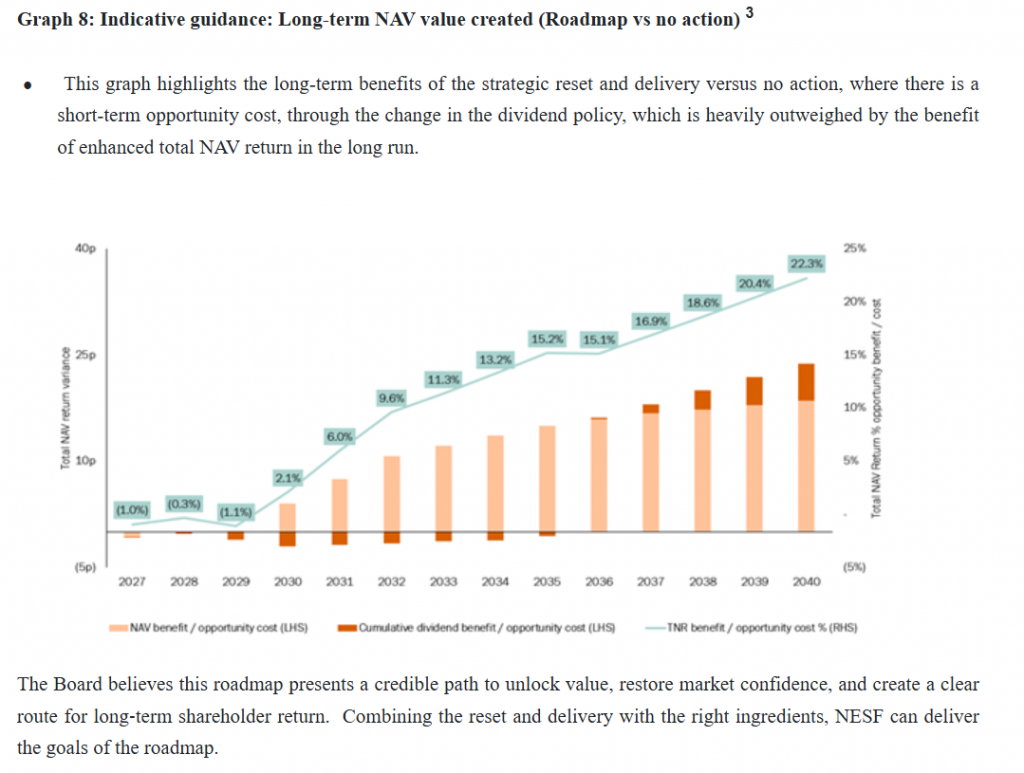
The next dividend income due at the end of this month is £348.00 and the final dividend under the old dividend policy, will be £478.00.

The SNOWBALL will bank both these dividends and then look again to see if the management have made any progress in the roadmap printed above.

NESF

NextEnergy Solar Fund Announces Strategic Reset to Target Higher Total Returns

Fiona Craig

NextEnergy Solar Fund Limited (LSE:NESF) has completed a strategic review and introduced a “strategic reset” designed to shift its focus from primarily delivering income to generating a balanced total-return profile. Under the revised approach, the fund is targeting long-term annual returns of 9%–11%.

A key change involves moving away from a progressive dividend policy. Instead, the fund will distribute 75% of operating free cash flow, a structure expected to release roughly £40m over the next five years. Management plans to use this capital to reduce debt, repower existing solar assets and invest in higher-return opportunities. The dividend for the 2026/27 financial year is projected at between 4.0p and 4.6p per share, representing an estimated yield of around 7%–8% at current share prices.

Alongside the revised payout model, the company intends to lower leverage to a target range of 40%–45% of gross asset value. It also plans to expand its asset recycling programme by selling up to 120MW of capacity and capturing additional realisations equivalent to 116MW starting from 2027. These measures are aimed at supporting renewed growth in net asset value.

Operational improvements will include upgrading existing solar facilities and integrating co-located battery storage. Management expects energy storage exposure to rise to as much as 30% of gross assets over time. The board believes the strategic reset will help narrow the persistent discount to net asset value seen across listed renewable energy funds, strengthen the balance sheet and position the portfolio to benefit from rising demand for clean power aligned with the UK’s long-term energy transition goals.

Despite these initiatives, the company’s outlook remains affected by recent financial pressures. Revenue has declined sharply and the business has recorded net losses in each of the past two years, while technical indicators suggest weak share price momentum. These challenges are partly balanced by strong operating cash flow, a debt-free position reported in 2025 and a relatively high dividend yield.

More about NextEnergy Solar Fund

NextEnergy Solar Fund Limited is a specialist infrastructure investor focused on utility-scale solar power generation and energy storage. Its portfolio includes 99 operational solar sites, primarily located in the UK, as well as a $50m commitment to private solar infrastructure. The fund seeks to deliver stable, inflation-linked cash flows through a mix of subsidised and merchant electricity sales while expanding into co-located and standalone battery storage as part of the UK’s accelerating transition to clean energy.

This article was written by the editorial team at InvestorsHub/ADVFN and is provided for informational purposes only.

The SNOWBALL

The SNOWBALL will lose around £500 of income when NESF cut their dividend.

The yield will still be above 7% so can still contribute to the current plan.

This income will have to be replaced so It’s unlikely the intended/hopeful purchase of some Dividend Hero’s will complete.

NESF

Dividend Policy Change:

·    Following the completion of this year’s target dividend of 8.43p, the Company will transition from a progressive dividend policy to a percentage‑based dividend policy, targeting a 75% distribution of operating free cashflows, post debt servicing and portfolio and fund operating expenses. The new dividend policy is expected to free up approximately £40m of operational free cash flows over the next five years, unlocking capital for the Company to strengthen its balance sheet through additional debt repayments while also supporting future Net Asset Value growth opportunities. Following the sale of the final phase, the current capital recycling programme, during which 100MW of operational assets were successfully sold, and also reflecting the impact of lower power prices, the estimated dividend range for FY26/27 would be 4.0p to 4.6p per Ordinary Share, which is the equivalent to a c.7% to c.8% dividend yield as at 10 March 2026.

·     Cashflows that are not distributed to shareholders will be used to accelerate debt reduction and redeploy capital into higher‑yielding opportunities such as repowering and co‑located energy storage to support long-term growth.

·    The Company is on track to meet its current full-year target dividend of 8.43p per Ordinary Share for the financial year ending 31 March 2026.

« Older posts Newer posts »

© 2026 Passive Income Live

Theme by Anders NorenUp ↑