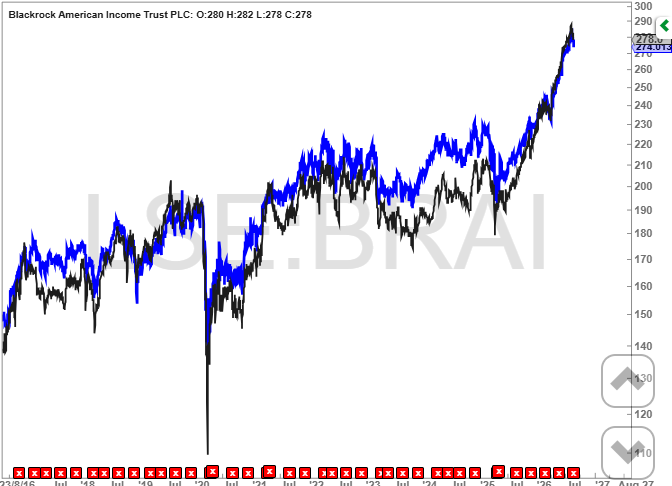
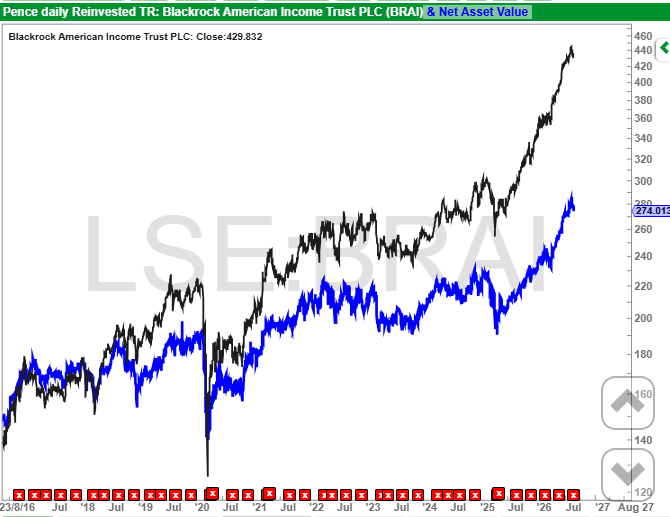
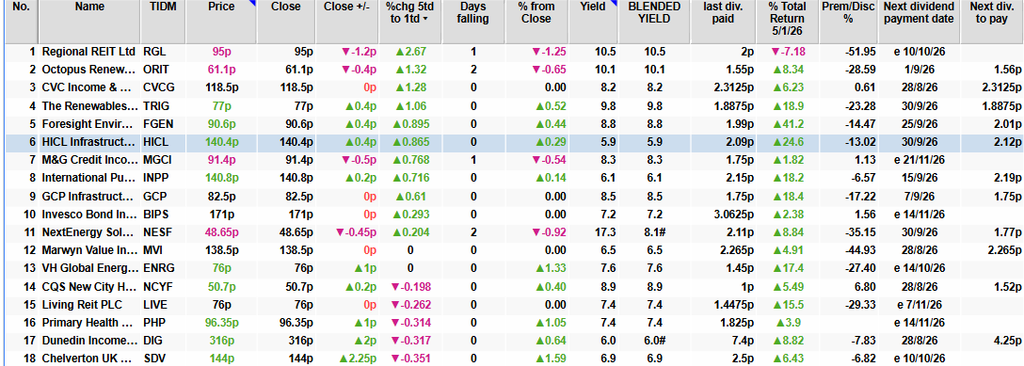
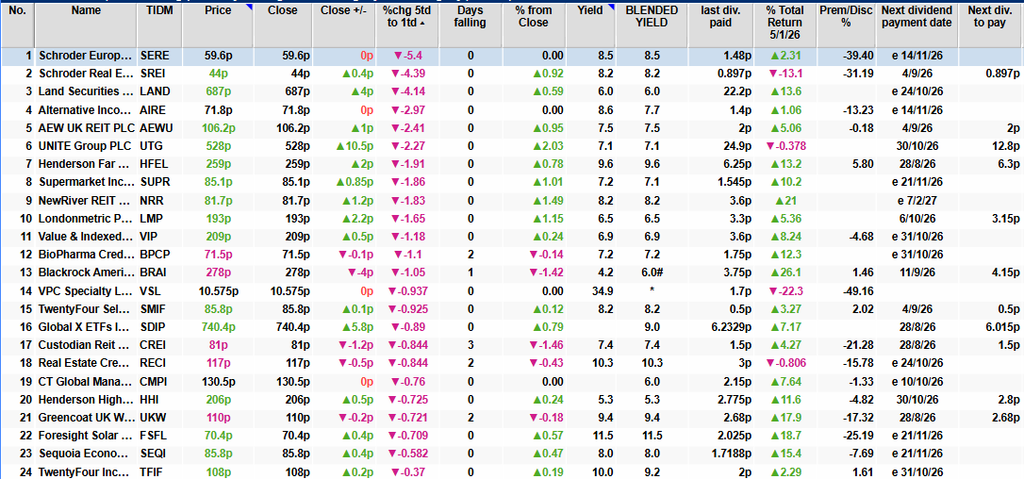
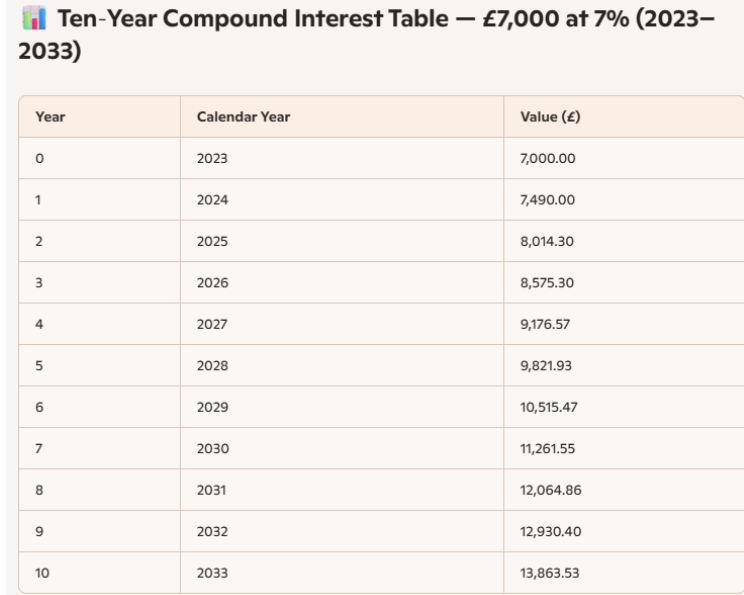
There has been years of under performance but you note the recent performance.
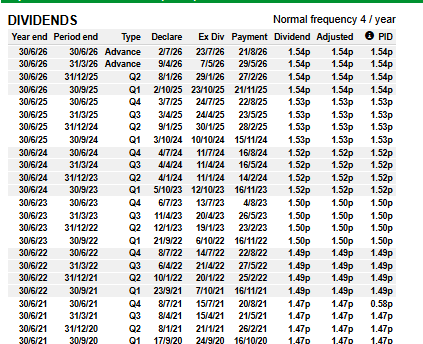
You decided not to risk anymore seed capital but simply re-invest the earned dividends back into the Trust. Anyone who bought near to the covid low around 120p and re-invested the dividends has done extremely well, for sitting.
ANNOUNCEMENT OF QUARTERLY INTERIM DIVIDEND
3 August 2026
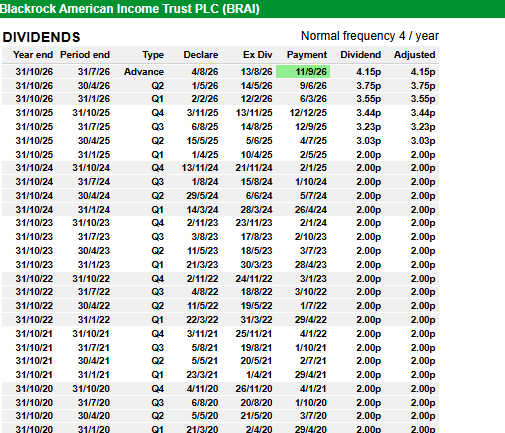
The Board of BlackRock American Income Trust plc is pleased to announce the third quarterly interim dividend in respect of the financial year ended 31 October 2026 of 4.15 pence per ordinary share. The dividend is payable on 11 September 2026 > to holders of ordinary shares on the register at the close of business on 14 August 2026 (ex-dividend date is 13 August 2026). The quarterly dividend has been calculated based on 1.5% of the Company’s NAV at close of business on 31 July 2026 (being the last business day of the calendar quarter) which was 276.96 pence per ordinary share.
BRAI now pays a yield of 6% of NAV, from income and capital. If/when the NAV falls the dividend will follow but in the long term it should be a gently rising yield.
Investors love buying the US, especially with passives
The first ETF was launched back in 1990 in Canada covering 35 stocks on the Toronto Exchange. The first US ETF debuted three years later, covering the S&P 500. Today, there are more ETFs listed in the US than there are individual stocks, so ravenous have investors been for these types of product and, increasingly, that has extended to the UK too.
Calastone has been tracking the fund flows of UK investor’s capital since 2018 and one of the most persistent themes is that while money is often being moved out of markets and sectors such as the UK or fixed income, investors continue to move into the US, and they are doing so via passives more and more.
Spot the difference
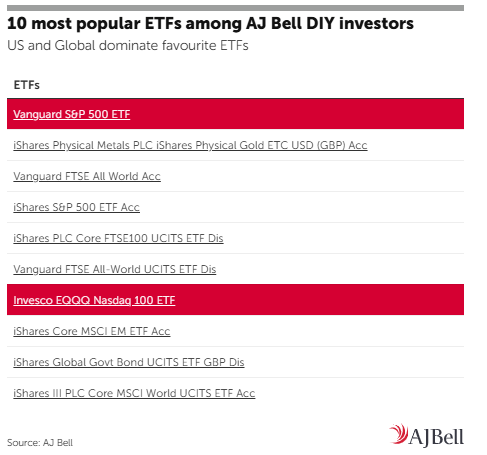
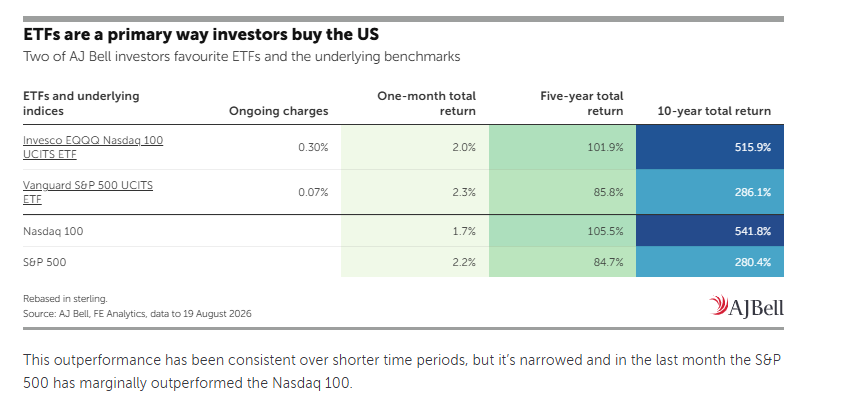
Looking at the most widely held ETF table above, you’ll notice that there’re some other US-focused ETFs ahead of the Invesco name, specifically the iShares S&P 500 ETF. The reason we’re not using this in the comparison is that it tracks the same underlying benchmark as the Vanguard fund: the S&P 500. Though there will be differences between the two, they are likely to be modest.
The Invesco fund instead tracks the Nasdaq 100 and this is the key difference when picking one or the other because it has a big impact on your total returns, and how well diversified your portfolio ends up being.
The S&P 500, and therefore the Vanguard fund, is the more diverse of the two as it covers the 500 largest US-listed stocks.
Because this index covers such a large swathe of the equity market it’s used as the main benchmark for the US stock market.
The Nasdaq is the main listing venue for tech companies in the US and the Nasdaq 100 contains the largest companies on that market.
While both feature the likes of Apple, Nvidia and Alphabet, the Nasdaq excludes sectors like financials, so Warren Buffett’s Berkshire Hathaway and JPMorgan Chase, which feature in the S&P 500’s top 10, are nowhere to be seen in the Nasdaq 100.
These differences inevitably have a sizeable impact on the indices’ returns, and the funds that track them. This has been largely to the benefit of the Nasdaq over the last decade or so as US tech stocks have dominated markets during that time. But in recent months, when the AI-spending story has become a source of market concern, the S&P 500 has fared better.
Over 10 years, the Nasdaq 100 has a total return nearly double that of the S&P 500.
This outperformance has been consistent over shorter time periods, but it’s narrowed and in the last month the S&P 500 has marginally outperformed the Nasdaq 100.
New inclusion rules could matter for IPOs
Changes to how companies join these indices could also impact which ETF is right for you.
Earlier this year, Elon Musk’s SpaceX made the biggest public market debut ever with a $1.78 trillion valuation.
There are specific rules about how and when a company is included in an index once it’s gone public, which matters a lot for ETFs and tracker funds since they’re designed to replicate whichever market they’re tracking, making them ‘forced buyers’.
Historically, a stock had to wait months before it was included in the Nasdaq 100 but in the run-up to the SpaceX IPO an accelerated entry system was introduced which allowed SpaceX to join after just 15 days.
The rules for inclusion in the S&P didn’t change meaning at least a 12-month wait from the date of its IPO before SpaceX could be eligible.
This sets a precedent for any future IPOs, and 2026 could be due a few more record breakers as both Claude creator Anthropic and ChatGPT’s parent company OpenAI are expected to go public later this year.
It’s not guaranteed and there may be more rule changes to come, but, if things stayed as they are, investors in the Vanguard fund and other S&P 500 trackers would not have exposure to these AI titans while Nasdaq-focused products would.
What about costs?
The difference in cost between these ETFs is material, with the Vanguard fund having ongoing charges of 0.07% compared with 0.3% for the Invesco product.
While the Nasdaq 100 is a commonly tracked benchmark, it’s more specialised than the broad-based S&P 500. ETFs tracking more specific benchmarks tend to command a slightly higher ongoing charge than ones tracking a more broad-based index, and Invesco’s cost is in line with its peers.
The Vanguard fund also faces more competition as the S&P 500 is the most heavily tracked equity market in the world, and with little to no performance variance, fees are the main way providers can try and capture investors’ interest.
Brett Owens, Chief Investment Strategist Updated: August 21, 2026
We contrarians rarely play in the tech sector. It’s just not built for us.
Technology stocks are often overhyped, overcovered and valuation-rich. Wall Street already loves them, which means there’s no room for upgrade-triggered pops and few inefficiencies for us to exploit.
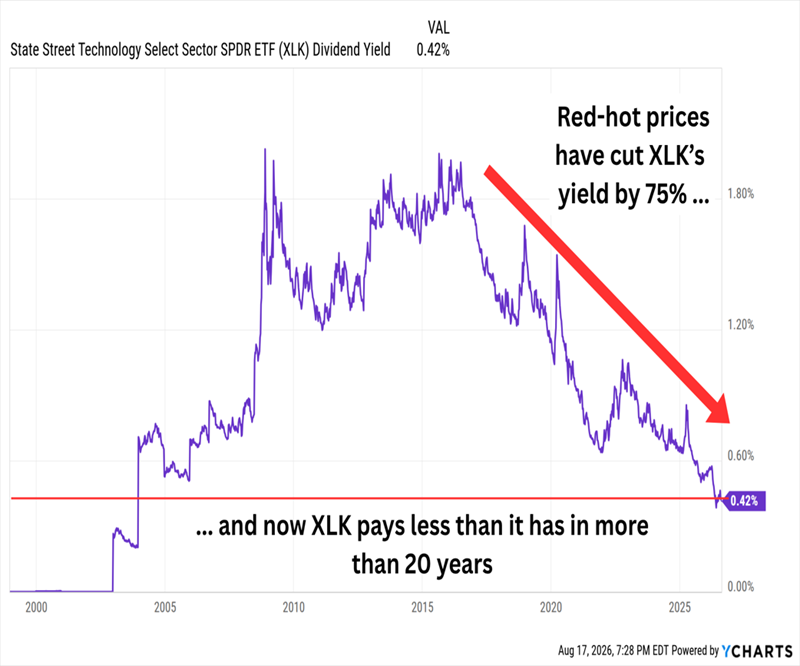
They’re also historically dividend-poor.
And Right Now, Tech Stocks Are Dividend-Destitute
But despite ludicrous prices in the likes of Palantir Technologies (PLTR) and Crowdstrike Holdings (CRWD), the sector as a whole is starting to look more reasonable. Tech stocks’ forward P/E has quickly winnowed to near pre-COVID levels and isn’t much more expensive than the broader market.
And while the S&P 500’s tech companies might as well be paying IOUs, a few of the sector’s less traveled names look downright generous.
Of course, there is usually a reason why tech dividends are large. Often it is because investors are not giving their businesses a lot of credit going forward. Let’s see what is under the hood of these businesses.
Take, for instance, the following six tech plays, which are shelling out staggeringly high yields of between 4.4% and 8.1% that put the rest of the sector to shame.
Several Asian tech stocks have become everyday names here in the U.S. Semiconductor companies such as South Korea’s Samsung and SK Hynix (SKHY), as well as Taiwan Semiconductor (TSM), are tightly tied to artificial intelligence and thus a top priority for the financial media.
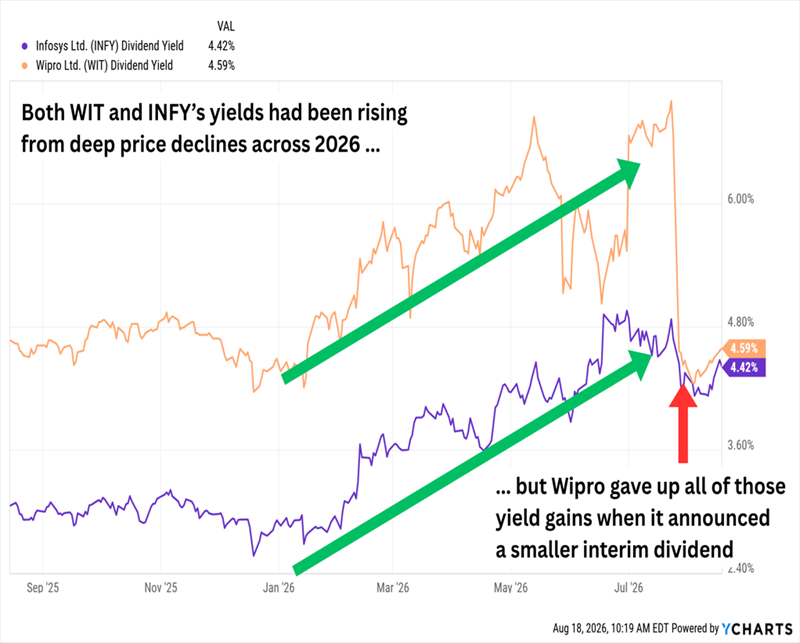
That same AI trade has swept traditional IT services companies like India’s Infosys (INFY, 4.4% dividend yield) and Wipro (WIT, 4.6% dividend yield) into the dustpan. While other businesses have traditionally called upon these and similar companies for coders, testers and other human specialists, they’re increasingly trying to determine whether AI can do the job instead.
Infosys and Wipro both acknowledge the solution is adapting to AI in one way or another. The former says it will hire 6,000 “forward deployed engineers,” or FDEs (a term popularized by Palantir), over the next few years. These engineers work on-site to build infrastructure and customize solutions for clients’ AI needs. The latter is teaming up with Databricks to develop AI-first products to serve the needs of wealth management, telecom, energy and other industries.
Both companies have lost nearly a third of their value in 2026. INFY traded at 22 times 2027 earnings at the start of this year; it currently trades at 14. WIT has thinned out from a 19 forward P/E to just 13.
Infosys and Wipro also both pay semiannual dividends, and like many international programs, those dividends usually fluctuate. Still, they both pay yields near 4.5% that are many times better than the sector average.
They reflect very different stories, however. Infosys’s yield is just a product of its recent losses. Wipro’s yield had been plumping up, too—until recently.
But a Sharp Interim Dividend Cut Knocked Off Several Points of Yield
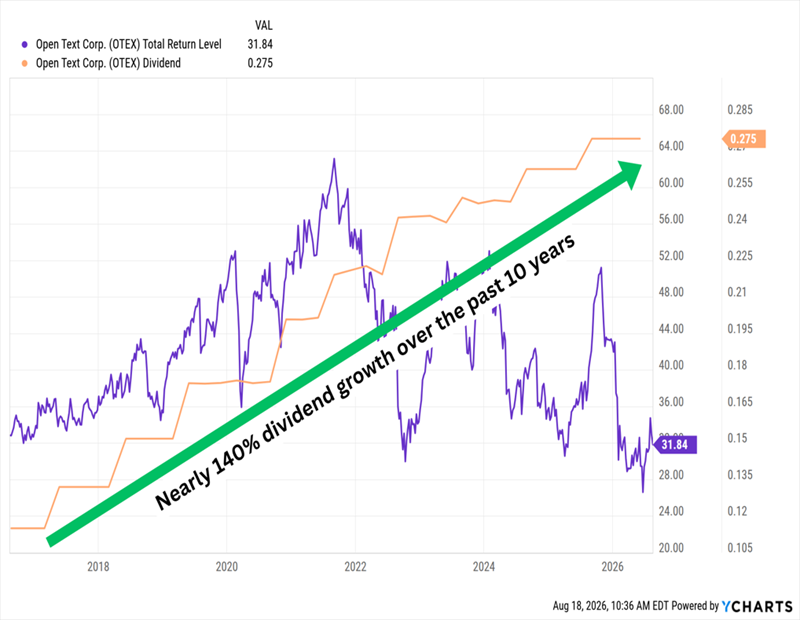
Investors who would prefer a more reliable, regular dividend can look north to Waterloo, Canada’s OpenText (OTEX, 4.6% dividend yield). OpenText is an information management software company whose solutions span business networks, content services, cybersecurity, IT management and more. Like Wipro and Infosys, OpenText is viewed as an “AI loser” and is trying to shed that label by leaning into AI.
Earlier this year, the company divested noncore businesses Vertica and eDOCS. It brought on International Business Machines (IBM) veteran Ayman Antoun in April, and he has since pledged to ramp up the company’s investments in research & development and sales reps.
OTEX lost roughly a quarter of its value near the start of the year, and none of the above developments have gotten the stock out of its funk. So right now, we can own this potential turnaround story for less than 6 times adjusted earnings and collect an extremely well-covered 4%-plus that is paid quarterly and has been growing annually for more than a decade.
OpenText Has Opened Up Its Wallet
While we can capture decent yields from individual tech plays, funds are where we’ll find the sector’s standout income opportunities.
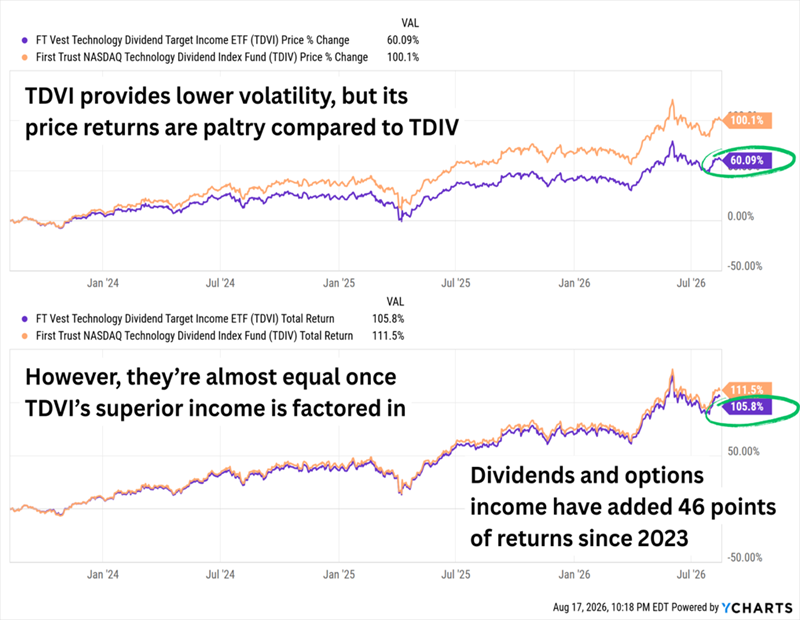
Take the FT Vest Technology Dividend Target Income ETF (TDVI, 5.6% dividend yield), for instance.
This exchange-traded fund owns a basket of Nasdaq Technology Dividend Index companies like Microsoft (MSFT) and Broadcom (AVGO), but it also sells call options—contracts that give the buyer the right to purchase a stock from the seller for a certain price within a certain period of time—on the S&P 500 and Nasdaq-100.
The premiums it collects from selling “covered calls” allow TDVI to take a portfolio that would normally pay us 1%-2% and instead pay out north of 5%!
Covered-call funds typically reduce volatility, but at the cost of lower overall returns. That’s because if the stock rises to (or above) the option’s strike price, the shares will likely be “called away,” and we won’t enjoy any additional upside from the stock.
But FT Vest’s performance gap against the index it’s built around—represented by the First Trust NASDAQ Technology Dividend Index Fund (TDIV)—is modest compared to other covered-call ETFs.
TDVI Competes Despite Having an Arm Tied Behind Its Back
“Hey. Can’t we get 50%-60% yields from ETFs now?” Technically yes, but as I’ve written before, those are gimmicky, poorly run funds that don’t create shareholder wealth—they destroy it.
Back here on Planet Earth, we can get bigger (but still realistic) tech-sector yields from closed-end funds (CEFs). They trade options, too. But they can also use debt leverage to invest more than 100% of their assets in their portfolios, invest in private equity and use other tricks to gin up their performance and income.
Better still? While ETFs are built in a way that keeps their prices tightly locked to their net asset value (NAV), CEFs are much less efficient, so we can often buy these funds’ holdings for less than they’re actually worth.
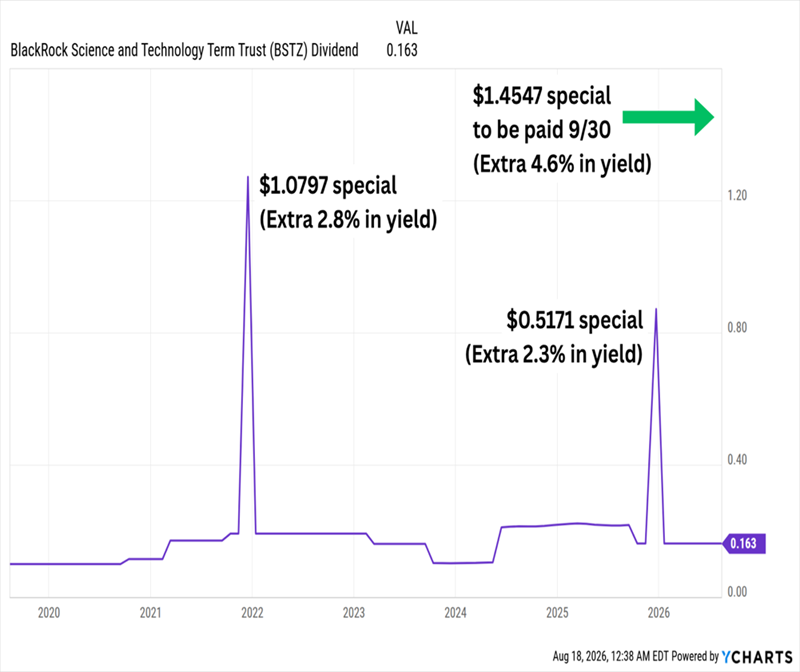
The BlackRock Science and Technology Term Trust (BSTZ, 6.2% distribution rate) is a mostly tech-sector fund (80% of assets) with some global exposure. Comanagers Tony Kim and Reid Menge own companies “selected for their rapid and sustainable growth potential from the development, advancement and use of science and/or technology.”
Not exactly dividend-paying types. Instead, this monthly distribution is almost entirely made up of capital gains and return of capital (RoC). It’s a somewhat managed payout, though it does shift a little higher or a little lower from one year to the next.
We Occasionally Get Special Dividends, Too
That most recent special would’ve kicked up the fund’s total yield to north of 10%.
But it’s not just the dividend that makes BSTZ stand out—it’s also the holdings.
BlackRock owns not just standard tech-sector fare like Nvidia (NVDA) and Micron (MU), but significant chunks of private firms including Databricks, quantum computing company PsiQuantum and Claude maker Anthropic (which might be a publicly traded firm in a couple months).
BSTZ’s ability to tap into the private markets hasn’t always worked out for it—in fact, it has returned only half as much as the broader tech sector since the fund launched in 2019. Things have picked up over the past couple years, though, resulting not just in outperformance, but a couple of booster shots to the already-generous distribution.
We can also buy BSTZ’s holdings for about 7% less than they’re worth. That’s nice, though that’s actually more expensive than its long-term discount to NAV of nearly 12%.
Just know that this CEF is a “term trust” that is expected to dissolve June 26, 2031, though the board can extend its life by up to 18 months.
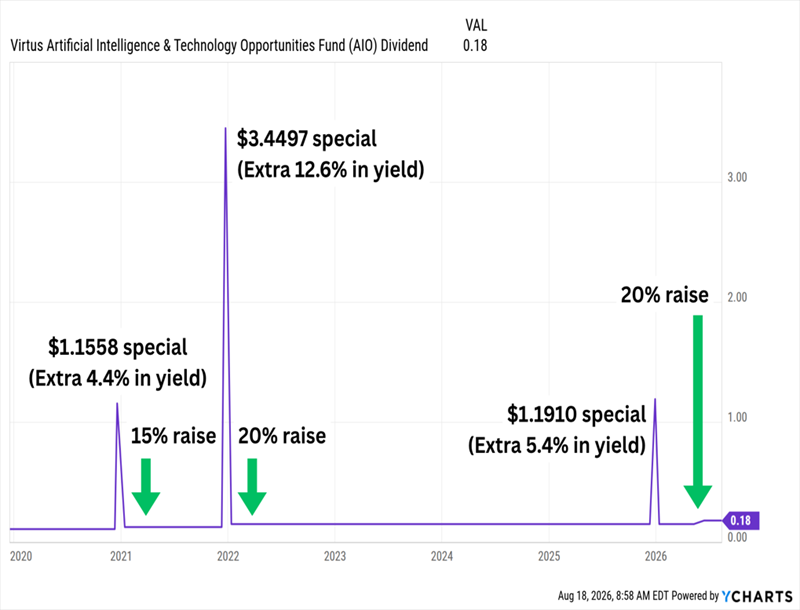
I’ve talked about several tech plays that get us some sort of exposure to artificial intelligence, but the Virtus AI & Tech Opportunities Fund (AIO, 8.1% distribution rate) is a direct, focused play on the technology sector’s most pressing trend.
It’s a distribution monster. It pays us more than 8% on its regular payout alone. It pays us monthly. It pays us specials, too—the most recent extra distribution sends its yield into the double digits.
And AIO Has Given Us a Few Raises to Boot
It’s also a much better deal than BSTZ right now, trading at a nearly 9% discount to NAV versus a long-term average of about 7%.
Unlike BSTZ, which largely just allocates its performance as distributions, AIO is actually constructed with income in mind. Yes, it holds traditional AI plays like Nvidia and Taiwan Semiconductor. But only about half its portfolio is made up of common stocks—the rest is a blend of convertible securities and high-yield bonds. So its distributions are made up of just about everything: dividend and interest income, capital gains, and RoC. The four-person management team also uses a modest amount of debt leverage, currently in the low teens, to juice its payout and returns.
Tech could be an option for long term investing but better to earn a dividend in case you are buying into a rally that is just ending.
Supermarket Income REIT (SUPR) is the only LSE-listed company dedicated to investing in grocery properties, which are an essential part of national food infrastructure. The company focuses on grocery stores, which are predominantly omnichannel, fulfilling online and in-person sales, and are let to leading supermarket operators in the UK and Europe. Its objective is to provide shareholders with an attractive level of income, alongside the potential for capital growth over the longer term.
We highlight the five key points in SUPR’s investment case.
1. Robust and visible income growth.
SUPR provides property that supports the essential distribution of groceries, predominantly let to leading operators like Tesco and Sainsbury’s in the UK and Carrefour in France. The grocery sector is large and consistently growing and, being largely non-discretionary, it has proven resilient through a range of economic conditions. Online grocery shopping is the fastest-growing channel and most of this is fulfilled through the sort of large-format omnichannel stores that SUPR targets. SUPR does not benefit directly from operator sales growth, but indirectly it supports sustainable rent growth and underpins capital values. Strong income visibility is provided by a long average lease length of c 12 years, upward-only, mostly inflation-linked leases, full occupancy for grocery stores and consistent 100% rent collection.
2. A low-cost and scalable platform.
Through a combination of increased scale and internalisation of its previously outsourced management, SUPR has built a lean, shareholder-aligned operating structure, with one of the lowest cost ratios in the UK real estate investment trust sector. Management internalisation was not simply a cost-cutting exercise; it also gave the management team greater flexibility to execute strategy and has coincided with changes to the group’s listing arrangements intended to broaden its appeal to a wider pool of investors. Together, these measures mean a greater share of future income growth should flow through to shareholders rather than being absorbed by overheads or structural constraints.
3. Specialist, active management.
SUPR is not simply a passive investor in grocery property; it combines specialist grocery-property knowledge with institutional real estate and capital-markets expertise. It assesses store trading, rent affordability, local competition, omnichannel relevance and alternative-use potential to identify strategically important assets rather than relying only on tenant covenant or lease length. After acquisition, SUPR creates value through rent reviews, lease extensions, reletting and tenant improvements, with the aim of increasing income, extending leases, strengthening asset quality and optimising shareholder returns.
4. Strong growth opportunities.
SUPR sees strong opportunities to leverage its cost-efficient platform and deep grocery real estate knowledge and has an ambition to increase the portfolio size from more than £2.2bn currently to c £4bn over time. Recent growth has been funded by a successful £100m equity offering and the creation of a joint venture with Blue Owl Capital, a global asset manager, providing access to third-party capital and validating the group’s investment approach. The joint venture also provides an additional, recurring source of management fee income.
5. Dividend growth set to accelerate.
Backed by consistent growth in rental income, SUPR has increased its dividend every year since it listed in 2017. However, growth has been modest, primarily held back by the rising cost of debt. The drag from finance costs has now receded and management has signalled its intention to accelerate dividend growth from next year as recent investment activity and lower administrative costs feed through to earnings. Combined with the group’s inflation-linked income base, this points to a dividend that should continue to grow on a durable, well-supported footing.
Its business model means secure income, yet it offers an 8 per cent yield and a bargain share price
Published on August 20, 2026
by Hugh Moorhead
One megatrend for investors to grapple with at the moment is the UK’s ageing population and the rickety healthcare system that tends to it.
The Labour government needs help turning around the NHS, not least from its largest landlord, Primary Health Properties (PHP).
PHP last year fought off a rival bid from private equity giant KKR (US:KKR) to acquire smaller peer Assura for £1.8bn. That deal has helped to create a £6bn portfolio of British and Irish healthcare properties that can provide shareholders with a secure, growing dividend. We think the market underappreciates this story.
Stay calm in a crazy world – and have a financial plan you can stick to says Ruth Sunderland
Story by Ruth Sunderland
We live in a mad old world, with financial markets to match. Manifestations are everywhere. The mania for AI is increasingly funded by debt rather than cash flow among the hyperscalers.
It’s become hard to tell sci-fi from reality. In Shanghai, shares in Unitree, a Chinese maker of humanoid robots, went up by more than 600 per cent at one point on the first day of trading.
Tech billionaires say people will commute to work on the Moon within a decade. (Have they tried getting WFH – addicted British civil servants back to the office?) The US national debt has hit $40 trillion, a number so large that it defies contemplation.
Observing such things, one hedge fund tycoon confided his belief that a ‘great reckoning’ is on its way to my colleague Alex Brummer, who advises investors to take heed and plan accordingly. I agree.
The problem for earthbound, non-billionaire private investors is: plan how?
Keep calm: History tells us shares recover and investing in them is the best hope for building real wealth that keeps its purchasing power, writes Ruth Sunderland
With the Shiller CAPE ratio flashing red alert on Wall Street, the obvious route might seem to be to sell shares and pile into ‘safe’ havens such as cash or bonds – though recent upheavals on bond markets in the US and here tell us investors see increasing risks attached to the latter.
Research this month by financial services firm Morningstar pointed to what it calls the ‘investor return gap’, whereby investors receive returns lower than those generated by the funds they own.
The gap is caused in part by poor decision-making driven by emotions such as greed or, as now, fear.
Morningstar says this rubbed out roughly 12 per cent of the funds’ aggregate total return over ten years.
In money terms, it adds up to $3.8trillion that has slipped through investors’ fingers through ‘timing-related effects’.
My conclusion: timing the market is an elusive skill beyond many of us, even the most brilliant professionals.
Anyone can predict a crash will happen, but hardly anyone foresees when. Investors therefore sell too soon and miss out on gains, or too late and crystallise nasty losses.
Stay put and with patience – sometimes a lot of patience – history tells us shares recover and that investing in them is the best hope for building real wealth that keeps its purchasing power.
Keep money in cash and there is not merely a risk but a near-certainty it will lose value through inflation.
Bear markets are inevitable. There is no fail-safe method of avoiding the pain, but there are ways of minimising it.
Have a reserve of cash, so there is no need to sell shares at a low point, and you have money to buy in at bargain prices.
Invest small, regular sums rather than big chunks: this purchases more shares for the same money in a market dip.
Diversify geographically and by type of business. Retirees should draw up a schedule for withdrawals and stick to it.
With a dividend re-investment plan, you can welcome falling markets because as prices fall, yields rise. You just need some dividends to re-invest back into the market.
Sat Duhra of Henderson Far East Income explains how call options help enhance the investment trust’s income offering, the Asian countries he’s feeling bullish and bearish about, and the portfolio’s exposure to AI and tech stocks.
5th August 2026
by Dave Baxter from interactive investor
Share on
Related Investments
Sat Duhra of Henderson Far East Income explains how call options help enhance the investment trust’s income offering, the Asian countries he’s feeling bullish and bearish about, and the portfolio’s exposure to AI and tech stocks.
Dave Baxter, senior fund content specialist at interactive investor: Hello and a very warm welcome back to our Insider Interviews series. I’m Dave Baxter here at ii and today our guest is Sat Duhra, portfolio manager on Henderson Far East Income Ord
Sat Duhra, portfolio manager of Henderson Far East Income: Thank you.
Dave Baxter: So, many people are familiar with the fund, but for those who don’t know it, what makes it stand out? What makes it distinctive?
Sat Duhra: So, Henderson Far East Income is an income fund investing in the Asia-Pacific region, and the objective is quite straightforward. It’s to grow the dividend per share every year and alongside that see capital returns from our region.
The thing that sets it apart is not only the high yield. Obviously we have a very high yield, we’ve sustained that for a number of years, but it’s actually alongside that seeking some of the best structural growth themes in the region.
So, when we think about things such as technology supply chains, infrastructure, and financial inclusion, we want to be exposed to those great structural growth themes because Asia after all is the fastest-growing region globally. So, doing that alongside each other is really the redeeming feature of this.
Dave Baxter: You mentioned that high yield. I think the last time I checked, it was somewhere around the 9.5% territory. It tends to be the highest-yielding equity trust out there. Which stocks and sectors are feeding into that yield?
Sat Duhra: In some ways the answer is obvious. There’s a number of sectors that you would expect to be high yield, so utilities, telecommunications, financials. These are all really high-yield sectors in our region. That’s something that’s not very well understood, that in our region we can buy stocks that are 5%, 6%, 7%, 8%, 9% yield stocks in those sectors. And those sectors are actually growing as well.
So, the financials, for example, through wealth management, opening new branches and so on, are growing very fast. And then utilities are doing really well, infrastructure has been built out, that kind of thing. So, these are stocks with high yield, but also good growth.
Now, alongside that, we have a number of very exciting growth stories, mainly in the technology space. They don’t really have much of a yield at this point, partly because performance has been so strong in recent years. There we use an option overlay. So, we write options on the more volatile part of the portfolio, predominantly technology stocks at this point. That will generate a huge amount of premium at this point. The level of volatility is just increasing. So, the premium being generated is really high at this point. In fact, some of the highest levels we’ve ever seen. So, it’s balancing those two things, using the option strategy to get growth exposure, but having a core of very defensive, high-quality names in there as well.
Dave Baxter: This is always a big ask, but for those who don’t know about them, can you explain in layman’s terms what the options overlay is and what you’re doing with the other side of that trade?
Sat Duhra: Yeah, sure. Generally, we write calls, and so it’s a call overwriting strategy. What that means is that when we have a stock that’s performed quite well and we think it’s reaching our target price, we can do a couple of things. We can sell the position, we could reduce it, or we can write a call option on that particular position.
Now, when that stock reaches a strike price, which normally we set out three months ahead, then effectively we will lose the position beyond that level. However, we get on day one, the premium, and that premium can be quite high, maybe 3% or 4%. It can currently be maybe 7%, 8% or 9%. Those are some of the levels we’re seeing now.
So, you get the premium, and that’s income for us. However, you can keep the stock, enjoy the upside, but if it goes beyond the strike price, then you give up that position.
Now, I think something people would say is, well, then you’re going to lose your best-performing stocks. Well, we only do it on a small part of that position. So, we maybe do a fifth of that position and as it moves out, we maybe do a bit more, so we don’t expose the whole position to that, so we don’t lose a position completely.
It’s quite a generally well accepted way of creating income for income funds nowadays. And it’s gained more and more popularity as the years have gone on. So, call overwriting has become quite a nice way of enhancing income for income funds.
Dave Baxter: To simplify, I guess it’s boosting your income, but it is limiting the potential gains you can make on certain bits of the portfolio. I did want to return to the point about the high level of yield. Are there a few examples of stocks that are offering those really interesting yields at the minute?
Sat Duhra: One thing that really stands out when we’re talking about these great themes is, for example, Singapore banks. These banks have performed really well in recent times, but also in the last year they’ve done a really good job.
What they’re doing is taking advantage of this huge deposit flow into Singapore. So, wealth management is a really strong driver of performance for those names. Alongside that, they’re doing buybacks, they’re increasing dividends, they have strong capital positions and they have pretty steady margins and low credit call. I mean, they pretty much tick all the boxes.
While that’s going on, Singapore is attracting a lot of funds. The government and regulators are trying to encourage more investment into that market. So, that money has gone into some of the banks as well. There’s a sector that pays high yield. Some of them pay 4%, 5% or 6% yield, but they also have a great structural theme behind that, which is all about financial inclusion, wealth management, insurance products and so on. So that’s performing very strongly at this point.
Dave Baxter: You do have decent exposure to some of those exciting growth stocks that actually have pretty low dividend yields, so think names like MediaTek, SK hynix Inc ADR
Given that, how do you balance the income and the growth considerations in the fund?
Sat Duhra: Yeah, that’s a very relevant question for what we do because at the end of 2023, we repositioned the portfolio. I took over the management of the fund as the lead manager at that point, and we decided that we had too much invested in deep value cyclical names, which optically looked great because they were on very low price/earnings (PEs) and had very high yields, but they were essentially value traps.
This is where we really changed the way we managed this. We then moved into areas such as technology and we also moved into India. We moved to a number of areas where there was real growth for years ahead in those particular sectors and markets. That was a key thing, balancing that capital growth alongside the income.
So, we didn’t sacrifice the income of the portfolio, and you can see over the last couple of years that we have still increased the dividend per share (DPS) year on year. In fact, we’re getting on to 19 years consecutive DPS increases.
But alongside that, you’ve also seen that the share price has been moving up. We’ve been tracking the benchmark on the way up, and the reason we’ve achieved that really is through a lot of these technology names. So, if we had not done that, we would have really been pretty stable. So, that helped us to move the share price higher because net asset value (NAV) was moving up, and that’s really through these kind of names.
Now, the option strategy allows us to do that. It allows us to buy those names and generate income on that. Some of those names you’ve mentioned, MediaTek, TSMC, we do write options on all these names. So, we get the upside, but we also get income as well. So, it’s balancing those two things.
When we’re more positive on growth names, we can add a bit more to that, use the option strategy more, and when we want to turn more defensive, we can take that down and add more to the Singapore banks, the utilities and those kinds of things, and manage those two parts of the portfolio.
Dave Baxter: In the last year or so, Asian shares have rallied really aggressively on the back of this big AI excitement. What’s your outlook there and how are you navigating that situation?
Sat Duhra: We do have some meaningful exposure to the AI theme. Again, as you’ve mentioned, those technology names, Hynix, MediaTek, TSMC, and so on, are all exposed to that.
Now, if you think about when we bought those stocks, it was well before we got a lot of this hype around the AI story, it was some time back.
When we brought these names, we were looking at valuation, we were look at potential for income growth. The DPS has been increasing on these names. But also the exposure to things such as autos, the semiconductors that are used in the auto industry, smartphones, PCs, those kinds of things. It was not just predicated on AI.
So, the AI came along and obviously boosted the performance of these stocks and is a genuinely strong theme for these companies because while the US companies are investing heavily and you’re seeing they are raising debt, their free cash flows is turning, in some cases, negative, the beneficiaries of that profitability is all in Asia. So, the likes of Hynix and Samsung Electronics Co Ltd DR
are going to be some of the most profitable companies in the world. The earnings have really exploded.
They’re actually not very expensive stocks because the earnings have kept pace with the move in the share price, or maybe the other way around. So, that’s something that makes these things so very attractive. We do like them, but we are managing that risk because there is, for example, a lot of leveraged exchange-traded funds (ETFs) in Korea, a lot of retail participation in these names, so you do have to be a bit careful in some of that.
Our exposure is much broader. We like financials, we like infrastructure, we like technology, but we have a much broader base of exposure in terms of country and sector than maybe our peers and the index.
Dave Baxter: Let’s drill down now into regions and countries. Where in Asia are you most bullish and where are you exercising a bit more caution?
Sat Duhra: An easy way to answer is to look at North and South Asia, because North Asia traditionally has worked very well for us in terms of valuation, income generation, growth and dividends, but also it is the beneficiary of technology.
Those key technology players are in South Korea, they’re in Taiwan, they are in China, but a lot of the dividend growth is coming through in those areas as well. Hong Kong is doing really well in terms of providing dividends from property, telcos, that kind of thing. North Asia also has less policy risk and, to a degree, less currency risk compared to South Asia.
The problem with South Asia is that it is very much driven by the consumer. So, these are more consumption-led economies. You think about India, the Philippines, Indonesia, that kind of thing. Also their currency has been very poor. Part of that reason is that inflation has been, maybe not out of control, but certainly higher than we expected. That’s because fuel and food is a big part of their CPI-like basket. So, fuel prices have gone up, food prices have gone up, fertiliser prices have gone up, that kind of thing.
There’s also been some risk around government policy as well in the likes of Indonesia and India. So, those things have [meant] a lot of foreign outflow from investors, currency risk, government policy, inflation, and a weak consumer.
We have less in South Asia for those reasons and a lot more in North Asia. North Asia has outperformed South Asia, too. So, we still don’t see a reason to change that balance.
Dave Baxter: Which specific countries in North Asia are you especially exposed to?
Sat Duhra: Our biggest weights would be in order, Taiwan, South Korea, and China. It’s not that we are especially positive on the macro in those places. For example, in. China, we think there’s some real risks in terms of macro. However, the stock market doesn’t necessarily reflect the underlying economy in some cases.
and so on, but the real economy is more industrial and it’s less represented in the indices. So, there can be a mismatch in terms of the real economy and stock market indices. That means there’s a lot of opportunity in this market.
In China, we really like the high-yield state-owned enterprises, for example, they’re performing well. Some of the bank stocks have doubled since 2023, insurance companies and so on. You know they’re doing very well, they’re paying very high dividends.
One of our best performers in the last 12 to 18 months has been an aluminium company in China, which had an 11% yield and doubled over a year. These are companies that are being ignored by the market. So, we look for these kind of stocks.
In Korea, obviously, we have the memory names that you mentioned. They are doing very well, and we have exposure to that. But there’s a whole raft of corporate reform that’s been very positive for a number of other sectors in Korea as well that have increased dividends. And Taiwan, we think there’s really good value technology now with the yield as well. So, there’s a lot of opportunities within that.
Dave Baxter: And how are you feeling on India? You’ve mentioned some of the headwinds there. I guess also another interesting premise on India that I’ve seen thrown around slightly is the idea that maybe it doesn’t have any really obvious AI plays. So, it’s kind of missed out on some of this surge that we’ve already discussed.
Sat Duhra: That’s certainly true because what we’ve seen in the past, as China’s done well, for example, money comes out of India to fund China positions. I think some of that’s going on now. Money has come out of India to fund Korea maybe and Taiwan.
But having said that, there’s been a lot of foreign outflow from Korea as well. India saw about $20 billion (£15 billion) outflow from foreigners last year, and it’s a very high number this year as well, so people don’t like that market at this point. It is partly to do with the AI story because that’s sucking money out of South Asia and it’s going into North Asia. So, some of that is going on.
But India’s had its own issues. The macro is not great. Gross domestic product (GDP) growth has been pretty weak. Normal GDP has been coming off. And so even though the real GDP numbers look OK, it’s the GDP deflator that’s creating that number. So, I think there’s a little bit of a mismatch between what’s really going on, on the ground.
If you look at employment prospects, we look at FDI (foreign direct investment), we look at industrial production, none of these things look that great, and profitability… I mean, IT services, which is a big constituent of the Indian indices, has been really smashed by the AI story because there’s a real threat there, and so those stocks have done very poorly.
Sat Duhra: And TCS and so on. I think there’s been a bit of a risk around that. We like some of the utility names. Maybe we’ll be looking at those, maybe that could be interesting for us, but at this point we have zero weight in India and it has certainly been beneficial from a performance point of view over the last 12 to 18 months.
Dave Baxter: I’d be interested to know now how focused the portfolio is on the strong demographics in Asia and the idea of the enriched consumer. I suppose that used to be the real bedrock of Asia and emerging market investing, but it seems like it’s been a bit lost in the noise around AI as of late.
Sat Duhra: I have to say on the consumer, you’re right. In years gone by, it has been a very strong story for Asia, particularly in South Asia. In countries such as India and the Philippines, the consumer’s been very strong, and those consumer companies historically have performed very well. Even in Korea, for example, we talk about cosmetics and that kind of thing, the demand from China and so on. However, it’s just not working anymore.
One of the reasons is that many of these consumer companies are in South Asia, and what happened after Covid is that the household balance sheet just never got repaired. People went through a really tough time in South Asia in terms of their household balance sheet, and they are financially not as strong as they were.
This is one of the reasons why consumers are still weak in South Asia. They haven’t had the support from the government. They are kind of in some of these markets, such as Thailand, Indonesia and India, getting cash handouts, but it’s not enough. So, the consumer is still under a lot of pressure and that means that the consumer stories just don’t have that momentum or the growth that they used to.
As you say, the AI story has certainly crowded out the consumer names as well. People are saying, well, why would you stick around consumer names when some of these stocks are up 50%, 100% in a month? So, the money has flowed out of these names, but there is a fundamental weakness in the consumer in many of these markets. Therefore, we don’t think that particular sector is very attractive at this point.
website, you might see washing machines and fridges made by Midea. They also do air conditioning units [which] have been flying off the shelf. But it also has a robotics business, which they might list. That company is doing very well. It’s also giving great dividends.
So, those kinds of brands in China that are going international, obviously we’ve seen that with electric vehicle (EV) brands, but that’s a nice area to be in rather than South Asia consumers.