Investment Trust Dividends

Category: Uncategorized (Page 26 of 398)

Across the pond

8.9% Dividend Yield Finally Enters The Buy Zone From Annaly Capital Preferred Share

Mar. 16, 2026

Colorado Wealth Management Fund

Investing Group Leader

Summary

  • Yield near 9%. Price support from retail investors about a penny below market price. Solid yield-to-risk ratio. Modest upside.
  • Among Annaly Capital Management’s preferred shares, NLY-I is more attractive than NLY-F, benefiting from a favorable dividend calculation and trading at a lower price with a better yield.
  • I picked up 4,148 shares of NLY-I, representing over $100k.
  • Despite being callable, NLY-I has not been redeemed, and historical trading patterns suggest strong price support just below $25.
  • The REIT Forum members get exclusive access to our real-world portfolio. See all our investments here »
Australian cattle dog catching frisbee disc
Capuski/E+ via Getty Images

Annaly Capital Management (NLY) has 4 series of preferred shares. I’ve traded in them from time to time. Currently, the one I’m excited about is NLY-I (NLY.PR.I).

I’ve written about shares of NLY-I several times. However, it has been rare for us to be able to post bullish ratings on them. Often the shares are just slightly above our targets for entry at The REIT Forum. That means that they are usually around 0.2% to 1.5% above our targets. Our targets adjust for dividend accrual, so they continue to increase leading up to the ex-dividend date, and then they fall by the dividend amount.

Opportunity Strikes

Recently, we have seen a little bit of weakness in shares of NLY-I. The weakness is allowing us to come out with a bullish rating. Presently, shares of NLY-I are trading at $25.01. That gives them an annualized yield to call of about 4.7%. That sounds quite pathetic. However, investors should recognize that the low yield to call would only happen if shares were called immediately. If there is any delay before the call happens, then the investors would be collecting a stripped yield of about 8.94% during that time. That is far more attractive.

Annaly Capital Management Could Have Called

Annaly Capital Management has had plenty of opportunities to call these shares already. They became callable and began floating on June 30, 2024. We are about 21 months past the date when shares became callable.

Further, shares of NLY-F (NLY.PR.F) are also floating-rate shares with a very similar spread. Those shares began floating on September 30, 2022. NLY-F has not been called despite floating for over 3 years.

Relative Value

I believe NLY-I is more attractive than NLY-F because NLY-I costs 36 cents less ($25.01 vs. $25.37) and the yield is better.

Chart
The REIT Forum

The dividend policy results in NLY-I having dividends that are a tiny bit larger. At first glance, it would appear that NLY-F would have the slightly larger dividends because the floating spread is higher by 1.4 basis points (basically a rounding error). However, NLY-I utilizes a more favorable method for calculating dividends. It uses the actual number of days in a dividend period divided by a 360-day year. That sounds complicated, but I’ll make it simple.

  • Take 365 days of accrual and divide by 360 days (the official number of days).
  • You get 1.0138889.
  • Round it to 101.4% because I don’t want to type that many digits again.
  • Therefore, NLY-I gets about 101.4% of the dividend accrual that would normally be expected for each year.

Consequently, our targets for NLY-I are slightly higher than our targets for NLY-F. However, the market has been valuing NLY-F at a higher price than NLY-I. Consequently, the annualized yield to call for NLY-F is negative, but the annualized yield to call for NLY-I is okay. Not great, but it’s okay. Remember that you only get such a low yield if the shares are called immediately after you purchase them. If the shares remain outstanding for longer, then the yield turns out quite a bit better. If they are not called at all, then you have a yield around the stripped yield of 8.95% with quarterly payouts. That’s pretty good.

Since the shares could be called on 30 days’ notice, we are coming to our estimate for annualized yield to call using that brief 30-day window. Being stuck with a return of 3% to 5% for a month is not bad. But if you get under 3%, then you really want it to be related to a brief period. This is a bit strange because, all else being equal, you typically want call protection to exist.

You won’t find call protection on the shares that are already floating, though. The floating-rate shares in this sector were all initially fixed-rate shares that switched over to a floating rate at the same time that the shares became callable. Because treasury rates increased significantly a few years ago, the floating-rate shares became significantly more attractive.

Note About NLY-G

NLY-G is almost always above our targets. I punish it for having such a thin floating spread. The market doesn’t seem to mind, but I find it as a bigger issue because it makes NLY-G even more reliant on short-term interest rates.

Setting Targets

One of my goals in setting the targets for NLY-I was that they would result in a very slightly positive yield to call. Today we have a positive yield to call and a slight discount to our target prices. Consequently, I am approaching shares with a mindset of collecting the attractive yield until we see a bump in the price. I believe we will most likely see a modest increase in the stripped price at some point. That means the share price adjusted for dividend accrual would probably increase by 0.5% to 1.5%. So the objective is to collect the dividend yield for now and then eventually collect a modest price improvement.

If we see the stripped price going up by about 1% or 1.5%, that could be a signal to me that it would be time to consider taking the gains and looking to reallocate. These are pretty steady shares, though. If the market tips lower, they probably won’t fall all that much. In that case, I might end up with mediocre performance but strong relative performance. That would still be okay, because it would allow us to reallocate at favorable ratios. Don’t let perfect be the enemy of good.

Of course, it is always possible that a share price could decline further. However, historically, we haven’t seen that much. Since NLY-I began floating, it has very rarely traded below $25. That makes sense for a few reasons. The first is that it results in a yield around 9% or even higher when the Fed funds rate was higher. The next is that there are more buyers for shares around $25 because there are many retail investors who would scan for shares that offered a high yield and traded below $25. That creates a decent level of support for the shares and explains why they have been so resistant to moving below $25 aside from the large hit to the markets around Liberation Day.

The REIT Forum
Seeking Alpha

For People Who Are New to Annaly Capital Management

Annaly Capital Management is a mortgage REIT. They own a bunch of mortgage-backed securities. The vast majority of the portfolio is in agency mortgage-backed securities. Those have very strong credit qualities because they are supported by Fannie Mae and Freddie Mac. Consequently, the mortgage REITs that focus on agency mortgages, like Annaly Capital Management, Dynex Capital, and AGNC Investment Corp., typically have a low-risk level for their preferred shares. Some investors absolutely love the business model for the agency mortgage REITs. They see a big dividend yield on the common shares and significant “earnings,” which makes the shares look very cheap on a price-to-earnings multiple.

However, many of those investors don’t understand how the earnings metric for mortgage REITs works. They may be confused with the way yields are calculated based on historical price and how hedges flow through the income statement. Consequently, for most investors, it is much better to focus on the preferred shares. We cover the common shares within our service. However, presently, the REIT forum finds NLY-I much more attractive than the common shares.

Big Position

I’ve been buying NLY-I lately. This screenshot is from our tool for subscribers that shows all our open positions. We separate the preferred shares and baby bonds from the other sectors, so this only shows the preferred shares and baby bonds:

Chart
The REIT Forum

It cuts off before showing the new positions we added on 3/16/2026, but I think that’s quite a large amount of open trades for an analyst to include in their article.

Conclusion

NLY-I offers an attractive combination of steady valuation and solid dividend yield. While it could drop further, I find it unlikely. I expect quite a bit of resistance around $25.00, as it shows up on the screening tools for more investors when it hits that price or a couple of pennies below.

Consequently, I believe the downside is relatively low while the yield is high. We have the potential for modest upside in the share price, but I would only expect around 1% to 1.5% beyond dividend accrual. Since dividend accrual is running nearly 9%, that’s not too bad.

I put over $100k into acquiring 4,148 shares of NLY-I. I eat my own cooking. Right now, it tastes like 9% with a bit of upside.

We are not rating NLY common shares in this article.

CTY

If you used the dividends to pay your bills.

With a KISS plan to re-invest all dividends back into the share until you need to spend your dividends.

You don’t need to take high risks with your hard earned but be ready when Mr. Market gives you an opportunity and then overcome your trepidation as Mr. Market will look very bleak.

A Win, Win, Snowball

Are UK income trust yields a problem for investors?

By Val Cipriani IC

Published on March 17, 2026

It’s a basic principle of investing: when prices go up, yields go down. This applies to equity income assets as well as bonds. In the past year, UK companies have seen their share prices rise enthusiastically – even after the dip caused by the war in Iran, the FTSE All-Share is up 22.4 per cent in the year to 16 March

The flipside is that a stock market known for its income generation actually generates a lot less income than it used to, at least as a proportion of the price you pay for the assets. In December 2023, AJ Bell estimated a dividend yield for the FTSE 100 of 3.9 per cent for that year and 4.2 per cent for 2024. Fast forward two years, and the figures were 3.2 per cent for 2025 and 3.4 per cent for 2026. The drop has also partly been caused by companies sometimes prioritising buybacks over dividends.

Investment trusts in the Association of Investment Companies’ UK equity income sector are also yielding less as a result. In the past year, the sector’s average yield has fallen by 0.6 percentage points. The table below shows how the trusts’ yield has changed over the course of a year, as well as their share price performance over the period.

As you’d expect, there is some correlation between those that have performed particularly well and those on lower yields. The six top performers, whose shares returned around 30 per cent or more, all saw their yields decrease by more than a percentage point. These trusts tend to take a value approach, particularly Lowland (LWI) and Temple Bar (TMPL), which now yield around 4 per cent, and traditionally invest in dividend-rich sectors, such as financials.

Then there are trusts with a quality tilt, whose performance has been less strong. Some of these have traditionally tended to have lower yields than their value counterparts, but now look more attractive on this metric – at 3.7 per cent, Edinburgh Investment Trust (EDIN) now yields nearly as much as City of London (CTY), for example. Nick Train’s Finsbury Growth & Income (FGT), the one trust in the sector that lost money this year, actually saw its yield increase as a result of this drop, albeit at 2.7 per cent it remains relatively meagre compared with peers.

For some trusts, discounts to net asset value (NAV) have also narrowed as well as yields, with the sector’s average discount dropping from 5.6 per cent on 28 February 2025 to 3.7 per cent a little more than a year later.

Of course, yields are not everything. Dunedin Income Growth (DIG) has the highest yield in the sector – 6.5 per cent – after introducing an ‘enhanced’ dividend policy that will see it pay out 6 per cent of its NAV, partly out of capital; but its performance record over the past five years looks decidedly poor.

After such a long period of lukewarm performance for the UK market, it would be ridiculous to complain about this change in fortune, regardless of whether or not it lasts. But income investors are less spoiled for choice. They may want to review their portfolio, and remember that the UK market is not the only option – for example, investment trusts in the AIC global equity income and Asia Pacific equity income sectors yield 3.8 per cent and 5 per cent, on average, respectively. That compares with a UK average that has fallen from 4.6 per cent to 4 per cent over the past year.

BUYING YIELD

It’s a win, win, because when you buy a dividend hero Trust the yield you will receive is the yield when you buy, gently increasing as long as you own the Trust

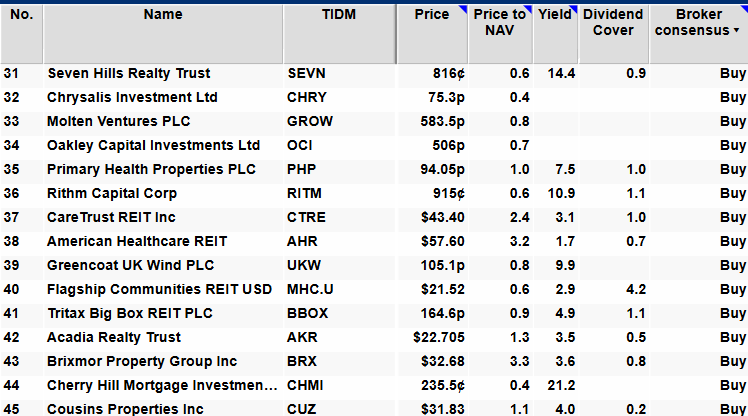
Remember as an example only if you buy PHP today you should receive 5 dividends in just over the calendar year, an enhanced yield of around 9%. of course there is a chance of a capital gain/loss but if you need to pay your grocery bill, a Trust to DYOR

RUNNING YIELD

It’s a win,win because if you buy a dividend hero as the price rises the yield falls and hopefully, you could if you

You could achieve

In that you take out your stake, when/if the Trust doubles and re-invest in another high yielder, also receiving income from a Trust that sits in your Snowball at zero, zilch cost. If the Trust you own becomes a low yielder because the price has risen, you can always re-invest the dividends back into your high yielding shares in your Snowball.

The power of the market is that if you don’t CPA, losses are limited to 100% but gains are unlimited.

Across the pond

My “Battleship” Plan for 8.2%+ Dividends (Paid Monthly)

Brett Owens, Chief Investment Strategist
Updated: March 17, 2026

The bombs continue to fall in the Middle East. But we contrarians know something the crowd always forgets at times like this:

The world is always burning somewhere.

At times like these, our Contrarian Income Report dividend strategy shines. Our portfolio yields 8.2% on average, and those dividends roll in no matter what the world throws at us.

The result? No need to sell into a downturn to get the cash we need. And we get the chance to go on offense, too, snagging dividends on the dips and boosting our income stream (and upside potential) as we do.

Rinse and repeat.

We especially love stocks and funds that pay us monthly, for two reasons:

  1. They line up perfectly with our bills.
  2. They let us reinvest our dividends faster—especially when markets dip.

The problem for most investors is that they limit themselves to the fan favs of the S&P 500, and there are virtually no monthly payers there. But we know there are plenty to be found if we hunt just a little off the beaten path.

Best of all, we can get those high monthly divvies without giving up the large caps we already hold. The key is to buy them through closed-end funds (CEFs), which yield around 8% on average. Plus, most of the 400 or so CEFs out there pay dividends monthly.

Here are two that stand out now.

Monthly Dividend Pick No. 1: A Diversified Pick With an 8.2% Dividend 

The BlackRock Enhanced Equity Dividend Trust (BDJ) is purpose built for a market like this. For starters, its portfolio is balanced among stock sectors—finance is the biggest slice, at 19% of assets, followed by industrials (14.5%), healthcare (14.2%) and technology (12.5%).

Then it goes further, adding in a dash of global exposure, with about 12% of assets outside the US, in stable countries like the UK, South Korea, Germany and Canada.

Let’s get to what we really want to know about here: the (monthly!) dividend, which is not only hefty but has risen a stout 32% in the last decade (not including special dividends, which BDJ has paid five times in that span):


Source: Income Calendar

The fund aims to hold at least 80% of its portfolio in dividend-paying stocks. Right now, its holdings include the likes of Amazon.com (AMZN) and medical-device maker Baxter International (BAX), both of which stand to gain as AI boosts their efficiency; Dollar General (DG), which is nicely set up as consumers cut costs; and BP plc (BP), a clear winner from rising oil.

BDJ further bulks up the divvie by selling options on about half of its holdings. That increases income, particularly in volatile markets.

But despite these strengths, investors have unfairly tossed BDJ aside. As I write this, the fund’s discount to net asset value (NAV, or the value of its underlying portfolio) sits at 6%, having nearly doubled since hostilities broke out in Iran.

BDJ Goes On Sale—as Its Discount Looks for a Bottom

That’s a clear overreaction. And if you look at the right side of that chart, you can see that its discount is looking to form a bottom. That sets up a nice entry point for those on the hunt for a well-diversified monthly paying stock fund.

Monthly Dividend Pick No. 2: An 11.5% Payer With a “Discount in Disguise”

We’ve talked in recent days about how AI is deflationary because it caps wage growth as businesses automate more tasks. Add a cooling job market and a new Fed chair who’s likely to lean toward lower rates, and you get a strong outlook for bonds.

The PIMCO Corporate & Income Opportunity Fund (PTY) is perfectly set up for that. The fund stands out for a lot of reasons, but a key one is the long effective maturity on its credit assets: just over seven years as I write this.

That’s important because longer-duration bonds do better when rates decline, as they’re more attractive than new (and lower-yielding) debt.

Moreover, PTY’s effective leverage-adjusted duration is 3.8 years. That’s enough to position it for gains on lower rates without taking on too much risk if rates rise. With all that in mind, it’s surprising (to me) that PTY is trading at such a bargain now.

That might sound like an odd thing to say about a fund that trades at a 6.5% premium to NAV. But with CEF discounts and premiums, context is everything. And the truth is, PTY is on sale at that level. In fact, that premium is lower than it’s been since the bond (and stock) meltdown of 2022.

PTY’s “Discount in Disguise”

The fund’s drop in valuation is overdone. And if you look at the right side of that chart, it looks like that premium is carving out a bottom, similar to what’s happening with BDJ.

But why the premium in the first place?

It’s simply because PIMCO, founded by legendary investor Bill Gross in the ’70s, has long had an almost superhuman mystique. That’s why most of its funds trade at premiums—many with bigger ones than PTY.

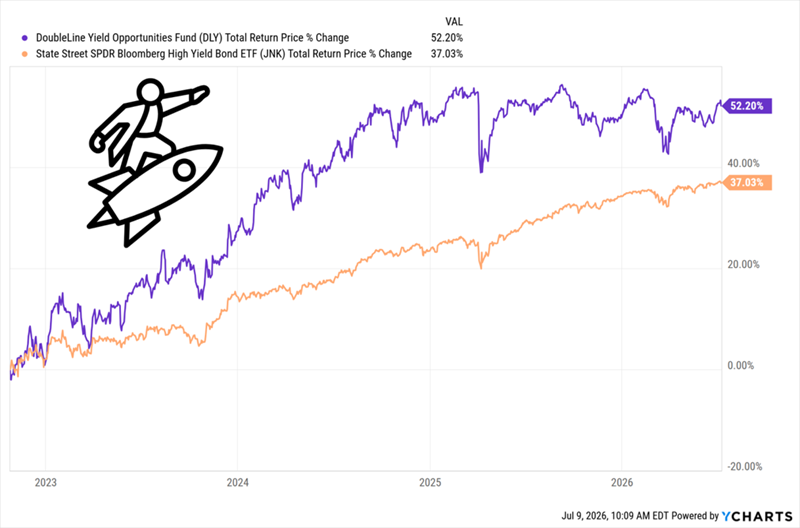
Even without the “PIMCO aura,” it’s tough to argue that PTY hasn’t earned a premium. The fund has been around since 2002, longer than the benchmark US corporate-bond ETF, the SPDR Bloomberg High Yield Bond ETF (JNK). In the years since, PTY has clobbered that benchmark.

PTY Laps JNK—Again and Again

Reinvested dividends drove that return, thanks to PTY’s huge monthly payout.

A Reliable 11.5% Dividend

Source: Income Calendar

Despite a slight cut during COVID, PTY’s payout has held steady for years. And besides, its regular special dividends (the spikes and dips above) have gone a long way toward making up for that cut.

I expect that to continue as the wind shifts toward lower rates and this proven income generator reclaims the premium its track record deserves.

Cash ISA vs stocks and shares ISA: which is better for your money?

The debate over low-risk cash ISAs versus higher-returning stocks and shares ISAs overlooks the fact that both have an important role for different goals

By Laura Miller

Contributions from
Dan McEvoy

Pound Symbol Sitting on Coin Stack representing cash ISAs versus stocks and shares ISAs
(Image credit: mustafaU via Getty Images)

Deciding whether to put your money into a cash ISA or a stocks and shares ISA has always been a head-scratcher.

However new data points to a huge gap in potential gains possible, with a significant gulf between the biggest cash ISAs and stocks and shares ISAs.

The 25 highest-value ISAs in the UK now hold a combined £274.4m, up by more than £50m in just one year, making each of their owners a multi-millionaire, according to figures obtained by investment platform InvestEngine through a Freedom of Information (FOI) request to HMRC.Article continues below 

Stay ahead of the curve with MoneyWeek magazine and enjoy the latest financial news and expert analysis, plus 58% off after your trial.

On average, each of these accounts is worth almost £11 million, and they are all stocks and shares ISAs. In comparison, the 25 highest value cash ISAs have a combined value of £16 million, meaning each is worth on average £10.3 million less at £640,000.

The FOI data also shows that the number of ISA millionaires in the UK has now reached 5,070. This is up by 220 in the past year and nearly ten times higher than the 570 recorded in 2016, according to HMRC. As the 25 highest value cash ISAs have an average value of just £600,000, most ISA millionaires will have reached this level of wealth through stocks and shares.

The difference between saving and investing is further highlighted by the fact that an individual who had maxed out their cash ISA allowance every year since ISAs were launched in 1999, earning interest in line with the average interest rate banks lend money to each other, would have accumulated £418,176 by February 2026.

In contrast, someone who invested their full allowance each year in a stocks and shares ISA – such as an exchange-traded fund (ETF) tracking global stock markets – would now be an ISA millionaire, with £1,357,964 in their account, more than three times higher than the equivalent in a cash ISA.

How can ISA investments make you an ISA millionaire?

As the figures show, investing is one of the most effective ways to grow long-term wealth, but factors like fees can still make a significant difference to the final gains. Two people investing £1,000 each month over 20 years, achieving the same real returns of 5% per year, could end up with a difference of more than £43,000 in today’s money purely because one paid 1% in annual fees while the other paid none, by InvestEngine’s calculations.

Andrew Prosser, head of investments at InvestEngine, said: “The proof is in the pudding: those who have consistently invested their full ISA allowance in stocks and shares since 1999 are now over three times better off than savers who have done the same using cash ISAs.

“This long-term outperformance is already translating into real-world outcomes, with the number of ISA millionaires continuing to climb and reinforcing how investing early and consistently in a diversified portfolio can make a meaningful difference to long-term, tax-free wealth as part of a broader financial plan.

“With the government increasingly encouraging people to invest rather than rely on cash for long-term saving, the widening gap between investors and cash savers is becoming hard to ignore.”

Government ISA reforms

Following ISA reforms at the 2025 Autumn Budget, the differences between cash and stocks and shares ISAs have been thrust into the spotlight.

Chancellor Rachel Reeves confirmed she would cut the annual cash ISA allowance to £12,000 from April 2027, meaning savers under the age of 65 would need to put £8,000 into stocks and shares in order to maximise their annual £20,000 allowance. Over 65s can continue using the full ISA allowance of £20,000 with cash ISAs, if they wish to.

HMRC also confirmed that certain ‘cash-like’ investments, potentially including money market funds, would be excluded from the stocks and shares ISAs allowance to prevent cautious savers circumventing the limit.

The government has been very vocal as well about the desire for more investment in the UK, and by April 2026, the Retail Investment Campaign is expected to be launched. The initiative is intended to raise awareness of the importance of investing for people’s future financial wellbeing and highlight the value of investing to the economy.

Whether saving or investing is best for your money will depend on your financial circumstances and your goals. For instance, it’s recommended people hold an easy to access emergency savings pot which covers three to six months of essential spending, before considering locking money away, such as in investments.

Why choose between cash ISAs and stocks and shares ISAs?

Putting money into cash ISAs or savings accounts will offer security that your money will grow over time in nominal terms.

But advocates of investing often highlight that in real terms, cash holdings tend to be eroded by inflation over time, despite a recent period when the best cash ISAs typically offered above-inflation rates – around 4.47% as of November 2025, for example.

Analysis from AJ Bell shows that £1,000 deposited into the average cash ISA when ISAs were launched in 1999 would, as of December 2025, be worth £2,079. The same investment into UK stocks via a typical UK All Companies fund would be worth almost twice as much, at £3,787.

“These figures highlight the hidden cost of playing it safe,” said Laura Suter, director of personal finance at AJ Bell. “While keeping money in cash can feel comfortable, over time it’s an almost guaranteed way to lose purchasing power.”

Stocks and shares ISA returns have outpaced cash ISAs over the past 12 months, according to the latest analysis by Moneyfacts.

The average stocks and shares ISA fund experienced a growth of 11.22% over the past 12 months from February 2025 to February 2026. There have now been three consecutive years of positive growth returns for stocks and shares ISAs. In contrast, the Moneyfacts average cash ISA rate returned 3.48% over the same period. Furthermore, the average cash ISA return is down compared to the previous 12 months.

Rachel Springall, finance expert at Moneyfacts, said: “Stocks and shares ISAs have now outperformed cash ISA returns for a consecutive year. Over the past 12 months alone, investing in stocks and shares has returned three times more to savers than a cash ISA, based on average returns.

“This should be a wake-up call for those who fear investing, as cash returns have diminished. However, it is important to not rely on returns over the shorter-term when making longer-term investment decisions.”

1 February 2025 to 1 February 2026% growth
Average stocks & shares ISA11.22%
Best-performing stocks & shares ISA fund sector38.24% (Latin America*)
Worst-performing stocks & shares ISA fund sector-4.03% (Healthcare)
Average cash ISA rate3.48%
1 February 2024 to 1 February 2025% growth
Average stocks & shares ISA11.86%
Best-performing stocks & shares ISA fund sector34.74% (Financial & Financial Innovations)
Worst-performing stocks & shares ISA fund sector-11.15% (Latin America)
Average cash ISA rate3.80%
1 February 2023 to 1 February 2024% growth
Average stocks & shares ISA2.80%
Best-performing stocks & shares ISA fund sector34.14% (Technology & Telecoms)
Worst-performing stocks & shares ISA fund sector-32.46% (China/Greater China)
Average cash ISA rate3.73%
1 February 2022 to 1 February 2023% growth
Average stocks & shares ISA-3.27%
Best-performing stocks & shares ISA fund sector24.64% (Commodities and Natural Resources)
Worst-performing stocks & shares ISA fund sector-32.81% (UK Index Linked Gilts)
Average cash ISA rate1.71%
1 February 2021 to 1 February 2022% growth
Average stocks & shares ISA6.92%
Best-performing stocks & shares ISA fund sector27.69% (Commodities and Natural Resources)
Worst-performing stocks & shares ISA fund sector-21.98% (China/Greater China)
Average cash ISA rate0.51%

Source: Moneyfacts

“Cash is considered a safe choice, but investing shows the gains that could be made over the longer-term,” said Springall. “Granted, past performance is not guaranteed to be repeated, so short-term gains should not be a decision maker in isolation. The past year alone laid bare the importance of seeking advice before taking the plunge to invest, some sectors boom one year and perform badly the next but can bounce back.”

How do regular investments compare to cash?

If you invested £1,000 into UK stocks every year since 1999, it would have been worth around £67,866 by the end of September 2025, AJ Bell analysis suggests, compared to just £36,290 if the same payments were made into a cash ISA.

The UK’s stock market has underperformed global competitors throughout that time period. £1,000 invested annually into global stocks would, over the same time, be worth £92,000, while putting it into US stocks would have seen the same investment grow to £127,887 – more than three times the size of the cash equivalent.

Header Cell – Column 0£1,000 one-off investment£1,000 investment every April
Average IA North America sector£6,285£127,887
Average IA Global sector£5,158£92,349
Average UK All Companies sector£3,787£67,866
Average cash ISA return£2,079£36,290
Average UK Gilts sector£1,912£33,931

Source: AJ Bell/Bank of England/FE. Data from 30 April 1999 to end of September 2025. Investment figures show average performance of sector including fund charges; inflation is based on CPI measure; cash ISA returns based on average interest rate available.

“Regular investing has been particularly powerful – turning steady contributions into six-figure sums thanks to the power of compounding,” said Suter. “Over that 26-year period the investment in the average North America fund would be nearly five times the total contributions.”

Is investing in stocks riskier than cash?

In the short term, stocks are more volatile than cash and, unlike cash holdings, they can potentially lose nominal value; that is the non-inflation-adjusted value of your investments can fall, whereas cash can’t.

“Markets don’t move in a straight line and there will always be periods of volatility,” said Suter. That makes stocks riskier than cash if viewed over a short time period.

But over the long term there is evidence to suggest that stocks are a safer investment in real (inflation-adjusted) terms.

Barclays Research into the real returns on cash, UK equities (stocks) and gilts since 1899 found that the longer you hold any of these assets for, the smaller the variation in your real returns. Over 20+ time periods, the minimum and maximum return on equities was higher than the equivalent for either cash or gilts.

This divergence between how stocks compare to cash over different time periods highlights the need for a balanced approach between the two, rather than either/or.

“When it comes to choosing between a cash ISA and a stocks and shares ISA, the key question is: are you saving for the short term or the long term?” said Suter. “If you’re setting money aside for an emergency fund, typically three to six months’ worth of expenses, then a cash ISA is a solid option.”

This way, any money you need at short notice or in the case of emergency is protected and easily accessible.

But for long term goals such as retirement plans or home improvements, Suter believes a stocks and shares ISA is more effective than a cash ISA.

“Markets tend to rise over time and outperform cash, despite short-term fluctuations,” she said.

How to choose between a cash ISA and a stocks and shares ISA

There is a further blow to cash savers following the Budget, as a higher rate of income tax on savings interest held outside a tax-efficient wrapper (like an ISA) will also apply from April 2027.

Despite the new cash ISA limit there is no need to “choose” between either a cash ISA or a stocks and shares ISA. The two are not mutually exclusive, and the government is expected to make further changes to help people allocate their excess funds however works best for them.

“From April 2026 a new ‘Targeted Support’ service will be available, which could equip more people to make the right financial decisions for themselves,” said Steven Cameron, pensions director at from Aegon. “This includes understanding the benefits of moving excess cash into a stocks and shares ISA, potentially benefitting from much higher returns, albeit at the expense of the ‘no loss’ security of cash savings.”

Just Dividends

Dividend heroes: the investment trusts that have increased their dividends for 20+ years

Investment trusts can be a good option for income-focused investors – but which trusts have consistently increased their dividends over the past 20 years?

By Dan McEvoy

young man imitating superman pose while flying against sky representing dividend hero investment trusts
(Image credit: Klaus Vedfelt via Getty Images)

Twenty investment trusts have increased their dividend payment every year for two decades, according to the Association of Investment Companies (AIC). Ten of these so-called “dividend heroes” have gone a step further, stretching this track record to half a century or more.

Topping the list of these reliable income-paying investment trusts are the City of London investment trust (LON:CTY), the Bankers Investment Trust (LON:BNKR) and Alliance Witan (LON:ALW). All three have increased their dividends for 59 consecutive years.

Last year, Murray International Trust (LON:MYI) became the newest dividend hero, and it has retained its place in the list as it was able to increase its dividend payout in the most recent financial year. 

Stay ahead of the curve with MoneyWeek magazine and enjoy the latest financial news and expert analysis, plus 58% off after your trial.

Two of the trusts on the list – Caledonia (LON:CLDN) and Scottish Mortgage (LON:SMT) – are also constituents in MoneyWeek’s investment trust portfolio, a model we set up over a decade ago to help readers build a global, long-term, “all-weather” set of investments.

“Dividends serve a dual purpose for us,” said Richard Clode, co-manager of the Bankers Investment Trust. “They are an important component of the attractive long-term total returns we aim to deliver to shareholders in combination with capital growth.

“Dividends also provide capital discipline to the companies we invest in as well as to how we invest as we seek out companies that can generate long-term profit and cash flow growth,” Clode added.

Investment trusts have a unique structure which allows them to hold back up to 15% of their income each year in a dividend reserve. This can then be used in years when companies pay lower dividends than expected.

This feature can make trusts particularly attractive to income-focused investors. In periods like the coronavirus pandemic, when swathes of companies cut or paused their dividends, trusts were able to fall back on these reserves to deliver a smooth income stream.

Dividend heroes: which investment trusts have increased payouts for 20 years or more?

The full list of the 20 dividend heroes is below:

Investment trustNumber of consecutive years dividend increasedDividend yield (%)5-year annualised dividend growth rate (%)
City of London Investment Trust593.912.31
Bankers Investment Trust592.084.96
Alliance Witan592.3114.52
Caledonia Investments582.223.79
The Global Smaller Companies Trust551.6712.03
F&C Investment Trust55*1.286.10
Brunner Investment Trust541.784.50
JPMorgan Claverhouse534.224.18
Murray Income Trust524.403.15
Scottish American523.155.82
Merchants Trust434.851.43
Scottish Mortgage Investment Trust430.376.15
Value and Indexed Property Income387.082.66
CT UK Capital & Income323.802.48
Schroder Income Growth Fund304.253.13
Aberdeen Equity Income Trust255.692.23
Athelney Trust237.411.25
BlackRock Smaller Companies223.496.25
Henderson Smaller Companies223.263.57
Murray International Trust213.632.61

Source: theaic.co.uk / Morningstar. Data at 12/03/26. * Dividend rise announced on 16/3/2026

Top dividend heroes in focus: three investment trusts that have increased dividends for nearly 60 years

The three trusts at the top of the list have increased the dividend income they generate for investors for 59 years, consistently raising payouts even through market upheavals like the inflationary 1970s, the dot-com bubble in the late 1990s, the global financial crisis of 2008 and the Covid pandemic.

City of London invests in companies listed on the London stock exchange; top holdings as of 28 February include HSBC (LON:HSBA), Shell (LON:SHEL) and British American Tobacco (LON:BATS). Of the three investment trusts that have increased their dividends for 59 consecutive years, City of London has the highest dividend yield, at 3.91%.

Bankers has a global focus, and aims to capture the best 100 stock ideas at any given time. Its largest holdings reflect a tilt towards big tech stocks, with Nvidia (NASDAQ:NVDA), Amazon (NASDAQ:AMZN) and Taiwan Semiconductor Manufacturing (NYSE:TSM) its three largest holdings as of 28 February.

Alliance Witan also invests globally, with a focus on long-term capital growth and, of course, rising dividend payments. Its top holdings, as of the end of February, are Microsoft (NASDAQ:MSFT), Alphabet (NASDAQ:GOOGL) and Amazon.

The SNOWBALL 2027

The first estimate for income for the 2027 SNOWBALL is £10,290.

As the dividends are re-invested this figure will increase but it could be tempered, if any more shares trim their dividend but after the markets reaction to the NESF share price they may think twice before doing so.

The fcast remains £10,500 which should be achieved.

Change to the SNOWBALL:Buy

I’ve bought for the SNOWBALL 13000 shares in PHP for 13k.

The yield is 7.3%, which could be improved in just over a year as the buy precedes the xd date.

It may just be a holding position until markets settle down, which may not happen for a while but I get this itch if there is cash sitting in the account not earning its keep.

Watch List:PHP

TRANSFORMATIONAL ACQUISITION OF ASSURA

Combination between PHP and Assura successfully delivered, creating a £6 billion healthcare REIT investing in critical healthcare infrastructure

On track to deliver annualised synergies identified at the time of the merger of £9 million with £7.5 million or 83% of total annualised synergies already delivered since Competition and Markets Authority (“CMA”) clearance, as integration moves forward at pace and the benefits of the combination are delivered for shareholders

Good progress is being made on expanding the existing primary care joint venture and establishing a strategic joint venture for our private hospital portfolio, where we see exciting growth opportunities

EARNINGS AND DIVIDENDS

Adjusted earnings per share up 4% at 7.3 pence (2024: 7.0 pence)

IFRS earnings per share increased to 6.6 pence (2024: 3.1 pence) reflecting non-cashflow gains arising on the valuation of the Group’s property portfolio and interest rate derivatives

Annualised contracted rent roll now stands at £342 million (2024: £154 million) with rent reviews and asset management in the year generating an additional £9 million of annualised income, an increase of just under 7% over the previous passing rent or over 3% on an annualised basis, which supports our positive rental growth outlook

EPRA cost ratio 9.8% (2024: 10.1%), excluding Axis overheads and direct vacancy costs, representing one of the lowest in the UK REIT sector

Quarterly dividends totalling 7.1 pence (2024: 6.9 pence) per share distributed in the year, a 3% increase, and fully covered

Second quarterly dividend of 1.825 pence per share declared and payable on 8 May 2026, equivalent to 7.3 pence on an annualised basis and a 3% increase over the 2025 dividend per share, marking the start of the Company’s 30th consecutive year of dividend growth

The Company intends to maintain its strategy of paying a progressive, fully covered dividend

TRANSFORMATIONAL ACQUISITION OF ASSURA

Combination between PHP and Assura successfully delivered, creating a £6 billion healthcare REIT investing in critical healthcare infrastructure

On track to deliver annualised synergies identified at the time of the merger of £9 million with £7.5 million or 83% of total annualised synergies already delivered since Competition and Markets Authority (“CMA”) clearance, as integration moves forward at pace and the benefits of the combination are delivered for shareholders

Good progress is being made on expanding the existing primary care joint venture and establishing a strategic joint venture for our private hospital portfolio, where we see exciting growth opportunities

EARNINGS AND DIVIDENDS

Adjusted earnings per share up 4% at 7.3 pence (2024: 7.0 pence)

IFRS earnings per share increased to 6.6 pence (2024: 3.1 pence) reflecting non-cashflow gains arising on the valuation of the Group’s property portfolio and interest rate derivatives

Annualised contracted rent roll now stands at £342 million (2024: £154 million) with rent reviews and asset management in the year generating an additional £9 million of annualised income, an increase of just under 7% over the previous passing rent or over 3% on an annualised basis, which supports our positive rental growth outlook

EPRA cost ratio 9.8% (2024: 10.1%), excluding Axis overheads and direct vacancy costs, representing one of the lowest in the UK REIT sector

Quarterly dividends totalling 7.1 pence (2024: 6.9 pence) per share distributed in the year, a 3% increase, and fully covered

Second quarterly dividend of 1.825 pence per share declared and payable on 8 May 2026, equivalent to 7.3 pence on an annualised basis and a 3% increase over the 2025 dividend per share, marking the start of the Company’s 30th consecutive year of dividend growth

The Company intends to maintain its strategy of paying a progressive, fully covered dividend

Lessons learnt from 10 years of picking investment funds

Previous trends dominated by a handful of companies in a concentrated global stock market

Tom Stevenson writes about investment for fund manager Fidelity International following a 20-year career in financial journalism, most recently at the Daily Telegraph. 

Published 08 January 2026

Businessman checking stock market data
Best performers have been the funds with an uncomplicated goal and a broad investment canvas Credit: Manusapon Kasosod/Moment RF

As I select my annual fund picks each January, I’m reminded of Samuel Johnson’s quip about second marriages. “A triumph of hope over experience” is a bit harsh for my situation – my win percentage has been better, and they’ve cost me less. But it is a yearly reminder that picking funds is trickier than it looks.

For the record, this year’s recommendations are: the Dodge & Cox Worldwide Global Stock Fund; Fidelity Special Situations; and Lazard Emerging Markets. Together, they are the distillation of my latest investment outlook, also published this week. This, like those of many of my fellow pundits, errs as much towards hope as experience, three years into a remarkable bull market.

With earnings rising, valuations outside the US undemanding, and interest rates coming down, it is tempting to think all will be well. But my optimism is tempered by caution and expressed with fingers crossed. A fourth consecutive year of rising stock markets would be welcome but unusual.

The Dodge & Cox fund is a value-focused global portfolio with a big underweight to the US. It assumes a continuation of the rotation out of America that we started to see last year. Fidelity Special Sits will benefit if a proportion of that money flows across the Atlantic to what is now one of the world’s cheapest markets. For the Lazard fund to deliver, emerging markets will need to build on last year’s surprising outperformance of the US. Obviously, I think those scenarios are likely, but I offer the picks with the usual dollop of humility.

So I swing a bottle against the hulls of these three funds and wish them well. For now, though, I’m more interested in looking back to see what, if anything, I can learn from my earlier recommendations. As part of this year’s fund picks process, I tracked the performance of all my picks since 2016 that have had at least five years to run. Those up to and including January 2021.

The good news is that of the 23 fund picks I made over those six years, just one lost investors’ money if held to the end of 2025. The less good news is that in most of those years, a portfolio evenly shared between all the fund picks did not do much better than a passive fund tracking the MSCI World index over the same period.

The first lesson from ten years of fund picks, therefore, is that while some active managers beat the market, many do not – and knowing the difference ahead of time is hard.

The second lesson, however, is that the past is a poor guide to the future. The last ten years has been an unusual period, dominated by a handful of companies in a very concentrated global stock market. It has been extremely difficult to beat the global index unless you had a basket of investments heavily skewed towards America’s technology giants.

Given their stellar performance, and their massive contribution to the global index, being underweight has meant, almost by definition, underperforming the benchmark. It’s been a testing time to be a stock picker, but that could easily change.

The third thing I’ve learnt from a decade of trying to beat the market is that patience is a virtue that few of us possess in sufficient quantities. The best example of this was provided by 2020’s recommendation of the Artemis Smart GARP Emerging Markets fund. This pick lost more than 20pc of its value when Covid struck just weeks after my recommendation. It then took four years to achieve just a 40pc return on the initial investment, but then doubled that gain in just six months this year as emerging markets zoomed back into favour. It has been a long haul, but in the end a satisfactory investment.

The fourth lesson I have learnt from my picks is that when you find a well-managed fund the best thing you can do is to put it in a metaphorical drawer and forget about it. I was lucky enough to find my best-performing fund pick in my first year of trying. Rathbone Global Opportunities delivered in 2016 and, with the exception of a painful 2022, when interest rates rose sharply, has continued to do so ever since. An investor who put £100 into the fund at the start of 2016 has £320 today. Even the tech-heavy world index has only risen to £250 over that 10-year period.

Lesson number five has been to keep it simple. The best performers have been the funds with an uncomplicated goal and a broad investment canvas. Like Rathbone’s global growth remit, the Fidelity Global Dividend Fund has a simple objective – high quality dividend growers. I recommended it in 2019 and 2020. Since the first pick, it has doubled investors’ money in seven years.

The final lesson I take from the past decade’s fund picks is the need to accept your mistakes and move on. While patience can be a virtue, inaction can be a drag on your returns too. As a rule, taking a year’s worst performer and reinvesting the proceeds in the year’s best fund would have significantly improved the overall return in subsequent years. Sometimes you just get it wrong and there’s no shame in switching horses. Investment success is about having more winners than losers, and in running the former while cutting the latter.

Picking the right funds without the benefit of a crystal ball is hard. I’ve tested this to destruction over the past ten years. But it is more than just hope over experience. It’s investing with your eyes open. Because a bride at her second marriage doesn’t wear a veil – she wants to see what she is getting.

Tom Stevenson is an investment director at Fidelity International. These views are his own

« Older posts Newer posts »

© 2026 Passive Income Live

Theme by Anders NorenUp ↑