Passive Income Live

Investment Trust Dividends

Page 199 of 341

Regional REIT Limited

Regional REIT Limited

(“Regional REIT”, the “Group” or the “Company”)

2024 Half Year Results, Q2 Dividend Declaration

& £110.5m Fundraise Successfully Completed Post Period End

Regional REIT (LSE: RGL), the regional commercial property specialist today announces its half year results for the six months ended 30 June 2024.

Post-Period end highlights, Transformational Successful Fundraise:

·      18 July 2024 successfully completed £110.5m equity fund raise, supported by Shareholders

·    Proceeds used for the repayment of the £50m retail bond and £26.3m will be used to reduce bank facilities. The remaining net proceeds of £28.4m will be used in accretive capital expenditure projects on assets, enhancing earnings in the near term and value in the mid to long-term, further underpinning dividend payments going forward

·      29 July 2024 1 for every 10 ordinary share consolidation completed

·      6 August 2024 repaid in full the 4.50%, £50m retail bond

·      LTV reduced to 42.2% from 30 June 2024 58.3%

Financial Highlights:

·     Portfolio valuation of £647.9m (31 December 2023: £700.7m). On a like-for-like basis, the portfolio value reduced by 5.1% during the period, after adjusting for disposals and capital expenditure, comparing favourably against the MSCI Rest of UK offices Index return of -6.4%

·      Rent collection remained strong over the period at 98.0% (equivalent period for 30 June 2023: 98.8%).

·      Rent roll at £63.5m, 3% lower on a like-for-like basis (31 December 2023: £67.8m)

·      Net initial yield on the portfolio 6.1% (31 December 2023: 6.2%)

·      Covered dividend declared per share of Q1 2024 1.20 pence per share (“pps”); following the successful equity capital raise and 1 for 10 share consolidation the dividend for Q2 2024: 2.20pps (30 June 2023: 2.85pps)

·      The fully covered dividend target for 2024 for H2 2024 is 4.4pps

·      The Group’s weighted average cost of debt continued to remain low at 3.5% (31 December 2023: 3.5%)

·      Operating profit before gains and losses on property assets and other investments for the six months ending 30 June 2024 amounted to £19.1m (30 June 2023: £20.6m)

·      The weighted average maturity of the bank debt was 3.0 years (31 December 2023: 3.5 years)

·      EPRA NTA 48.8pps (31 December 2023: 56.4pps); IFRS NAV of 51.7pps (31 December 2023: 59.3pps)

·      Prior to the 1 for 10 share consolidation on 29 July 2024: EPRA EPS of 2.1pps for the period (30 June 2023: 2.5pps); and post share consolidation 21.3p (30 June 2023: 24.6p)

Operational highlights:

·      As at 30 June 2024, 81.8% of portfolio properties had attained an EPC rating of C+ or higher, an improvement from 73.7% as recorded on 31 December 2023. Properties rated B+ and Exempt have surged to 56.3%, up from 42.1% at the end of the previous year. These milestones place us firmly on the path to better the Minimum Energy Efficiency Standard (MEES) target of an EPC rating of B well before the 2030 deadline

·      The Group made disposals amounting to £21.9m (before costs) during the period

·     At period end, 91.5% (31 December 2023 92.1%) of the portfolio by valuation was offices, 3.4% industrial (31 December 2023: 3.2%), 3.1% retail (31 December 2023 3.1%) and 1.9% other (31 December 2023: 1.7%)

·     At the period end, the portfolio valuation split by region was as follows: England 77.5% (31 December 2023: 78.4%), 16.7% Scotland (31 December 2023: 16.2%) and 5.8% Wales (31 December 2023: 5.4%).

·      By income, office assets accounted for 90.9% of gross rental income (30 June 2023: 91.4%) and 4.3% was retail (30 June 2023: 4.6%). The remaining balance was made up of industrial, 3.0% (30 June 2023: 2.7%) and other, 1.8% (30 June 2023: 1.4%)

·     The portfolio continues to remain diversified with 132 properties (31 December 2023: 144), 1,305 units (31 December 2023: 1,483) and 832 tenants (31 December 2023: 978)

·      EPRA Occupancy rate stood at 78.0% (31 December 2023: 80.0%)

Q2 2024 Dividend Declaration

The Company declares that it will pay a dividend of 2.20 pps for the period 1 April 2024 to 30 June 2024. The entire dividend will be paid as a REIT property income distribution (“PID”).

Shareholders have the option to invest their dividend in a Dividend Reinvestment Plan (“DRIP”), and more details can be found on the Company’s website.

The key dates relating to this dividend are:

Ex-dividend date19 September 2024
Record date20 September 2024
Last day for DRIP election27 September 2024
Payment date18 October 2024

The level of future payments of dividends will be determined by the Board having regard to, among other factors, the financial position and performance of the Group at the relevant time, UK REIT requirements, the interest of shareholders and the long term future of the Company.

Stephen Inglis, CEO of London and Scottish Property Investment Management, the Asset Manager:

“The period under review was another challenging period for the commercial real estate sector, with valuations reduced by persistently high interest rates and poor investor sentiment towards UK commercial real estate. However, the regional office market appears to be reaching an inflection point, with the recent cut to the base rate providing a helpful development.

“Post-period end, we repaid in full our 4.50% £50m retail bond, which we were able to achieve following a £110.5m capital raise in July. This also provides us with the opportunity to reduce the Company’s borrowings with the LTV reducing to 42% and we continue to make efforts to reduce the LTV further to the long term target of 40%. The raise also provides greater flexibility for capital expenditure to improve the core assets in our portfolio and increase shareholder value going forward.

“We would again like to thank shareholders for their continued support during this challenging period and we look forward to updating them on our progress in enhancing shareholder value through active portfolio management.”

Subsequent Events summary post 30 June 2024

Since the quarter end, the Group has successfully completed an additional notable letting:

Lettings

·    The Courtyard, Macclesfield – Elior UK Services Ltd. has renewed existing lease for 23,100 sq. ft. of space to August 2028, at a rental income of £542,700 pa (£23.49/ sq. ft.)

·      1175 Century Way, Thorpe Park, Leeds – Greenbelt Group Ltd. has let 2,670 sq. ft. of office space to July 2029, at a rental income of £64,080 pa (£24.00 / sq. ft.).

·      Mandale Business Park, Durham – Avove Ltd. has let 5,000 sq. ft. of office space to July 2034 with the option to break in 2029, at a rental income of £58,750 pa (£11.75 / sq. ft.).

·     St James Business Park, Paisley – Maximus UK Services Ltd. has let 5,456 sq. ft. of office space to September 2029 with the option to break in 2025, at a rental income of £76,384 pa (£14.00 / sq. ft.).

·     Buchanan Gate, Stepps, Glasgow – RPS Environmental Management Ltd. has let 7,710 sq. ft. of office space to September 2029 with the option to break in 2027, at a rental income of £88,665 pa (£11.50 / sq. ft.).

Future asset disposal programme comprises of 54 sales totalling c £106m:

·      2 disposals contracted for c. £1.5m

·      10 disposals totalling c. £12.4m under offer and in legal due diligence

·      7 further disposals totalling c. £10.4m are in negotiation

·      7 further disposals totalling c. £9.1m are on the market

·      28 potential disposals totalling c. £73m are being prepared for the market

XD dates this week

Thursday 12 September

Apax Global Alpha Ltd ex-dividend payment date
Athelney Trust PLC ex-dividend payment date
Globalworth Real Estate Investments Ltd ex-dividend payment date
Henderson High Income Trust PLC ex-dividend payment date
International Public Partnerships Ltd ex-dividend payment date
Pollen Street Group Ltd ex-dividend payment date

MoneyWeek’s Share tips

Share tips 2024: this week’s top picks

Share tips 2024: MoneyWeek’s roundup of the top picks this week – here’s what the experts think you should buy

Stock price chart and trading board

(Image credit: Yuichiro Chino)

By Kalpana Fitzpatrick

If you’ve been keeping a close eye on share tips 2024, then don’t miss this weekly round up of the top stocks to consider for your portfolio each week. 

The MoneyWeek share tips 2024 guide pulls together some of the best UK stocks from some of the top share tipsters around.

As well as the UK financial pages, we look at publications across the pond for investors who want to diversify their holdings internationally.

From investing in UK equities, European stocks, to finding the best performing stocks in the S&P 500 – here are our top share tips of the week.

Share tips 2024: top picks of the week

Five to buy

  1. Unilever (LON: ULVR)
    The Telegraph
    Unilever’s dividend growth has lagged behind inflation since 2019. But the consumer-goods giant’s prospects are improving, with inflation cooling and interest rates falling in developed economies; growth in emerging markets should also prove a tailwind. Recent first-half results showed growth in sales and operating profit margins. A shift in strategy, including planning to sell the ice cream business, is expected to boost profitability. Unilever offers “good value for money”. 4,912p
  2. Nintendo (TYO: 7974)
    The Times
    Nintendo, home to Super Mario Bros. and Donkey Kong, is a giant in the videogame industry. The launch of a new console and sequels to some of its most popular titles next year should bolster the shares. Since Nintendo launched its Switch console in 2017, sales have tripled and the stock has more than quadrupled. The Japanese firm’s success is owed to family-friendly games, digital services, loyal users and powerful intellectual property. ¥8,253
  3. Windward (LON: WNWD)
    This is Money
    With shipping becoming more challenging, aim-listed Windward helps companies, ship owners, and governments manage maritime journeys more efficiently by analysing shipping data. Its clients include the US government, Interpol, BP and Glencore. Windward’s new tool, MAI Expert, which uses generative artificial intelligence to assess risks with vessels quickly, is set to drive future growth. “Buy and hold.” 138p
  4. Renold (LON: RNO)
    Shares
    Renold is the world’s second-largest maker of industrial chains and specialist torque transmission products. Despite having less than 10% market share, there is room for growth through acquisitions in a fragmented market. Customers are prepared to pay a premium for its products, and Renold is benefiting from increasing automation across industries. The potential for double-digit profit growth and increasing cash generation isn’t reflected in Renold’s “lowly” seven times forward price/earnings (p/e) ratio. 55p
  5. Hochschild Mining (LON: HOC)
    Investors’ Chronicle
    Hochschild Mining’s half-year earnings improved thanks to record gold prices, increased production from a new Brazilian gold mine, and closing a costly silver mine. Costs are expected to fall as the new mine hits capacity. The shares are up by 70% this year. They took a knock on the lack of a payout alongside the interims, but Hochschild’s focus on refinancing $300m of debt and hitting free cashflow first “looks sensible”. 174p

One to sell

Starbucks (NASDAQ: SBUX)
The Times
Sales at Starbucks are declining owing to high prices; long waiting times; increased competition in China where younger players are snatching market share; and a social media-driven boycott thanks to the US coffee giant’s position in the Middle East. Investors are pinning their hopes on new CEO Brian Niccol’s impressive record, but the problems at Starbucks seem more complicated than the ones he faced at Chipotle Mexican Grill. Starbucks’ 26.6 times forward earnings ratio and Niccol’s controversial pay package are a steep price for a company with much to prove. “Avoid.” $95

The rest…

Cranswick (LON: CWK)
The Telegraph
FTSE 250-listed Cranswick has “solid fundamentals”, a strong balance sheet, and a solid return on equity. The food producer’s growth strategy makes sense and is set to be turbocharged by lower inflation and expected interest rate cuts. Since July 2022, Cranswick’s shares have gained 55%, outperforming the FTSE 100 and 250. Including dividends, the stock has achieved a 62% total return in just over two years. Investors should “keep buying” it (4,765p).

Melrose Industries (LON: MRO)
The Times
Melrose Industries’ shares dropped by 7% after UBS suggested that the group’s jet-engine business could be worth about half of what its management says. Melrose disputes the report and stands by its calculations. Melrose started as a turnaround specialist but became an aerospace manufacturer after buying GKN in 2018. UBS has downgraded Melrose’s stock to “sell”, arguing that Melrose overestimates the value of revenue and contracts. Melrose’s rising net debt has also prompted concern. Yet recent half-year results beat profit expectations and Melrose has announced a share buyback. Hold (486p).

EDX Medical (EDX.PL)
This is Money
EDX Medical is developing tests for the rapid diagnosis of heart disease and hospital infections such as sepsis and MRSA. The start-up has also devised a blood test for those whose family history suggests they could be vulnerable to cancer. EDX listed in 2022 at 6p. Shares hit 12p this year but are now at 10p, and “at this level, the stock should yield rewards”. With strong partners and billionaire backers, EDX is an “attractive punt for the adventurous investor”. Buy (10p).

This article was first published in MoneyWeek’s magazine. Enjoy exclusive early access to news, opinion and analysis from our team of financial experts with a MoneyWeek subscription.

Change to the Snowball

I’ve booked a ‘profit’ of £400 with SOHO

Current figures for the Trust

Profit £4,741 which includes dividends of £677.33 and

Intra unrealised profit of £1,235.56

The SOHO profit is now in excess of the realised loss with LBOW.

Warehouse REIT

7.4% yield and oversold! Here’s why I’m buying Warehouse REIT shares
Story by Zaven Boyrazian, MSc


Since the start of 2022, shares of Warehouse REIT (LSE:WHR) have been slashed in half, sending its dividend yield surging to 7.4% today. That’s more than double the FTSE 100’s 3.6%, and since management just announced its latest dividend payment, it seems these lucrative payouts are here to stay.


But looking at the latest results, the firm’s share price may also be on the verge of making a comeback. In other words, today’s juicy yield could be a fleeting opportunity for income investors in 2024. Let’s take a closer look.

Investors vs real estate
Real estate has long had a reputation for being a ‘safe’ investment. Yet the recent shake-up in the economy and stock market was an abrupt reminder that this common belief is wildly untrue. With interest rates rising, property values have tumbled, especially in the commercial sector.
In particular, Warehouse REIT’s portfolio of urban logistical warehouses was hit hard. More expensive mortgages paired with lower demand on the back of weak economic conditions saw its asset portfolio shrink in value. Subsequently, fearful investors send the stock plummeting even further.

Yet this downward trajectory appears to have abated. The Bank of England introduced the first interest rate cut last month, reducing pressure on Warehouse REIT’s balance sheet. Meanwhile, management has completed its property disposal programme, which helped refocus the portfolio while simultaneously pouring in some cash to sort out now-expensive loans.


In other words, the firm is in a much stronger financial position than a year ago. And continued on-time rental payments from tenants have enabled dividends to keep flowing despite all the disruption. Obviously, that’s good news, yet the shares still trade at a near-30% discount to net asset value, indicating a buying opportunity that I’m capitalising on.

Please note that tax treatment depends on the individual circumstances of each client and may be subject to change in future. The content in this article is provided for information purposes only. It is not intended to be, neither does it constitute, any form of tax advice.

A change of strategy?
Weak investor sentiment in the real estate sector can easily explain the high level of pessimism. But it’s not the only factor at play. With the balance sheet back in a sturdy position, Warehouse’s management has begun putting growth back in its crosshairs.

It’s recently executed a £38.6m acquisition of the Ventura Retail Park in Tamworth. It seems the group is capitalising on weak market prices and has locked in a yield of 7.4%. That’s pretty high for such a property. And since it exceeds the group’s cost of debt, it will likely translate into new shareholder value creation as well as higher dividends in the long run.


However, a retail park is a pretty different beast compared to logistical warehouses. This may just be a one-time purchase capitalising on a buying opportunity within the real estate sector. However, suppose management starts buying other non-core properties? In that case, it signals an unannounced and risky change in strategy that would require careful scrutiny.

The bottom line
As interest rates continue to fall, the pressure on Warehouse REIT’s financials, profits, and dividends will steadily alleviate. That will organically provide more flexibility to pursue new growth opportunities, with the proceeds channelling into dividends.

Obviously, there are no guarantees, and until growth is back on track, I’m doubtful that dividends will be hiked further. Nevertheless, the worst appears to be over. And with the shares trading so cheaply, the risk is worth me taking, I believe.

The post 7.4% yield and oversold! Here’s why I’m buying Warehouse REIT shares appeared first on The Motley Fool UK.

SOHO

Not that Soho but a REIT

Is SOHO a no go?
Is this Social ‘Housing landlord, all REIT or a REIT off ?
The Oak Bloke

One of my readers asked me to look at SOHO and I’m slowly working through my backlog. So what about this, the third of Triple’s UK offerings? Is this getting sold down too?

Surprisingly no.

In fact the first thing to say is SOHO is a 97 super stock on stocko, it trades at 65.7p, delivers an 8.6% yield (0.85X covered) and NAV is 114.15p a share as at 31/3/24. So a 41.3% discount to NAV. Although HL imagines its NAV is 129.47p a share (incorrectly).

SOHO have 493 properties (with 3,421 units) costing £594.9m in invested funds, and valued at £678.4m today – 14% higher. That’s £1.37m average per property and £198.3k per unit average.

The complete article at

“The Oak Bloke from The Oak Bloke’s Substack”

theoakbloke@substack.com

Interest Rates Matter

Why Interest Rates Matter to Fund Investors

We live in an age when investors are obsessed with central bankers’ actions and words. To cut or not to cut seems to be the question on everyone’s mind. In truth, investors have always been worried (and excited) about macroeconomic policy, but the current environment is especially focused on rate decisions. We unpack the importance of interest rates for investors in a simple ten-step way.

By David Stevenson•05 Sep, 2024

Over the last few months, stock markets have zig-zagged up and down based on worries about interest rates, especially in the U.S. – remember that U.S. stocks overwhelmingly dominate global equity markets. Last week, the first major signs of the much-anticipated interest rate pivot emerged.  The Federal Reserve chair Powell observed,

Overall, the economy continues to grow at a solid pace. But the inflation and labour market data show an evolving situation. The upside risks to inflation have diminished. And the downside risks to employment have increased. As we highlighted in our last FOMC statement, we are attentive to the risks to both sides of our dual mandate.  The time has come for policy to adjust. The direction of travel is clear, and the timing and pace of rate cuts will depend on incoming data, the evolving outlook, and the balance of risks. We will do everything we can to support a strong labour market as we make further progress toward price stability. “

In plain English – We are more worried now about rising unemployment than we are about surging inflation, which could imply a recession, so the time for interest rate cuts is fast approaching.

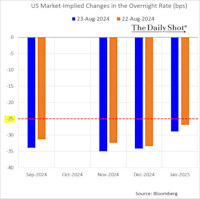
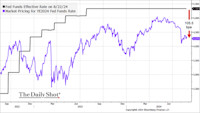
Within minutes of this gnomic declaration the market was pricing in a higher possibility of a 50 bps cut at each upcoming Federal Open Market Committee meeting. The next two charts show market reactions from a week or two ago via the excellent macro-economic news service, The Daily Shot.


Overall, investors are now pricing in 105 bps (1.05%) of rate cuts for this year. Personally,, I think that is a little overcooked, but the market is betting that the U.S. interest rate will be closer to 4% than 5%. And what starts in the U.S. will almost certainly apply to the UK— most investors now expect UK interest rates to stabilise somewhere between 4 and 4.5% by early 2025.

This all sounds terrifically exciting if you are a dismal economist – or potential mortgage applicant – but why does it matter to ordinary investors? As a market observer, I’m painfully aware that analysts and strategists get carried away with jargon and make bold assumptions about investors’ knowledge. For instance, it’s almost a given that investors join up all the dots about rate cuts, whereas my guess is that most investors only have the simplest understanding of why rate cuts matter. 

To help bridge that gap, I thought I’d zip through ten reasons why investors should care about interest rate cuts. Forgive me if it’s a bit simplistic, but the point is simple – investors should care greatly about these cuts.

  1. Interest rates are a signalling device, telling markets what central bankers are worried about. Read that statement by Powell carefully, and it’s obvious he and his colleagues are growing more concerned about increasing unemployment and a weak labour market. That suggests the concerns of an economic slowdown in the U.S. are real and valid. That should concern investors because it suggests that central bankers are worried that the miraculous soft landing – much anticipated – might be replaced by a bumpy landing. That implies you should take seriously if you are a bond investor, the risks of increased corporate defaults (which have been steadily increasing for the last year). That means you need to demand a higher risk premium for lending to risky corporates.
  2. Declining interest rates are good news, by contrast, for indebted corporate borrowers, especially in the real assets (infrastructure and real estate) sector. These sectors are interest rate-sensitive, and thus, declining rates, all things being equal, should mean lower refinancing costs. 
  3. Lower interest rates imply that central bankers are much less worried about surging inflation. There is still every chance that core measures of inflation might crawl back up again, possibly breaching the 3% before coming back down again. But the substantive point is that central bankers are NOT worried about a massive inflation surge pushing past 5% year on year. That might mean the inflation assumptions for many funds invested in real assets might have to be notched down again, which cut into revenue growth if they own inflation-linked assets 
  4. Lower interest rates will reduce the implied real interest rate to more sustainable levels. I’ve already discussed in these articles why real interest rates (the nominal interest rate minus the market forecast for inflation rates in the not-too-distant future) have been heading steadily towards zero for decades but shot up in the last two years. Sustained positive real rates tend to slow down investment spending and generally hinder economic growth. Lower real rates – I guess they’ll stabilise at around 1% in the U.S. and the UK – might mean faster economic growth and improved capex spending. All in all, that’s good news for equities in general. 
  5. Lower interest rates have another very important transmission mechanism via the risk-free rate, widely used in discounted cash flow models and investment trust NAV calculations. You will often see mention of net asset values calculated with reference to a discount rate. A real asset produces a stream of cashflows (rents, payments), which are then plugged into a forward-looking cash flow model. A number is generated representing the potential future value of those cash flows, but then it is discounted back using the risk-free rate. The risk-free rate is the return you could get from holding cash, i.e., it is risk-free, assuming you have bank guarantees. The lower the interest rate, the lower the risk-free rate, the lower discount and the higher the NAV. This risk-free mechanism will take time to work its way through to fund valuations – maybe as long as a year, but the impact should be positive.
  6. That lower risk free rate also has a wider impact across all asset classes. When savings rates and risk-free government bonds paid you 5% or more, many investors were reluctant to go all in for risky equities. 5% risk-free is a great return, and money flooded into money market funds. Cash savings and money market account returns will seem less attractive as rates decline. That, in turn, makes equities more attractive. Dividend-paying, higher-yielding equities might be particularly attractive, especially if the sustainable dividend yield is well above the risk-free rate, i.e. above 4 to 5% per annum. 
  7. Lower interest rates in the U.S. make the dollar less attractive. Over the last few years, high U.S. interest rates – relative to Europe and Japan – have made the U.S. Dollar a desirable currency. The dollar index, which measures the dollar against a basket of currencies, has been historically quite high but has weakened in recent weeks. Even sterling has shown some strength in recent months, as has the Japanese yen. Overall, a weak dollar is good news for indebted emerging market economies and good news for gold. But a weaker dollar and a stronger pound is bad news for UK investors in U.S. equities.
  8. Central bankers have not entirely given up worrying about inflation, but interest rates are not their only mechanism for controlling the economy. They also run extensive balance sheet processes such as buying up bonds and, in Japan, ETFs. In recent decades, these activities have mushroomed into huge quantitative easing (QE) programmes worth hundreds of billions. Central banks have been keen to rein back in these programmes and have initiated quantitative tightening (QT) measures. That’s resulted in central banks quietly selling assets and marking up losses. These losses must be paid for by treasuries, crimping government spending programmes. Lower interest rates usually tend to go along with quantitative easing, i.e. central bankers are worried about increasing recession risks and flooding the market with bank cash. However, central banks are also keen to unwind those QE programmes via QT in the long term. The 64 trillion dollar question is whether QT will continue, which might crimp global liquidity and cause financial stress or retreat their QE programmes. 
  9. Lower interest rates are also good news for indebted governments, including the U.S. and the UK. Lower debt costs help improve the government fiscal position as interest rate costs on gilts decline. However, that could be offset by the losses accumulated on past QE programmes, which are being passed on to treasuries (as noted above).  It’s also worth remembering that much of government debt is fixed at long-term rates, so the immediate impact isn’t always direct. However, the UK government borrows heavily using inflation-linked gilts and shorter-term debt, and these costs will fall markedly, allowing the government more headway to spend more (or cut taxes). That’s a positive for the UK economy.
  10. Residential property markets are a significant driver of consumer spending-dominated economies like the UK. A huge wealth of data suggests that when house prices have stopped falling and are rising again, consumers feel wealthier and spend more. The same argument also applies to equity markets, i.e., when the S&P 500 surges in the U.S., wealthy Americans spend more. All things being equal, lower rates should help stabilise housing markets, even though most mortgage holders have locked in their rates for a few years. Again, that’s potentially great news for the domestic economy and thus corporate profits. 

Results Round-Up

The Results Round-Up – The Week’s Investment Trust Results

Global Opportunities remains conservatively positioned, while International Public Partnerships delivers another solid performance. abrdn UK Smaller Companies Growth continues to outperform, and it’s onwards and upwards for Onward Opportunities.

Frank Buhagiar•06 Sep, 2024

Global Opportunities (GOT) staying conservatively positioned

GOT’s objective is to generate real long-term total returns by investing in undervalued assets. Because of this, the fund does not follow a particular benchmark. But not to worry. For Chairman Cahal Dowds dishes out a couple of indices with which to compare the fund’s +3.1% NAV total return for the latest half year -the FTSE All-World Index, up +12.2% on a total return basis, and the Bloomberg Global Aggregate Bond Index, off -2%. The fund’s +3.1% total return down to what Executive Director Dr Sandy Nairn describes as a “conservatively positioned” portfolio. And that in turn is down to operating in “an environment with elevated valuations and meaningful government debt overhangs.”

No plans to change the cautious stance anytime soon, it seems “We anticipate that the stark economic choices facing the major economies will prove increasingly difficult to ignore and will become ever more evident in company results/forecasts. Combining this with an unfolding election season and the global geopolitical tensions suggests that the seemingly unshakeable optimism of equity markets will be severely tested.” The conservative positioning, focus on identifying attractive investments and avoidance of any meaningful broad equity market risk have worked wonders for the portfolio’s volatility – the portfolio has had a volatility level around one third of equity markets. Dr Nairn however believes “There will come a time when it is appropriate to take a more sanguine view of risk and we are prepared to do this when the potential returns justify.” Just not now. Market keeping its powder dry too it seems – GOT shares closed 2p lower on the day at 294p.

Winterflood: “Portfolio remains conservatively positioned in light of manager’s concerns over equity market valuations remaining at historically high levels implying substantial risk. As at 30 June, cash and equivalents accounted for 33.8% of portfolio value, with 44.0% in equities, 14.9% in long-short fund and 7.3% in Private Equity fund.”

International Public Partnerships (INPP), solid

INPP Chair Mike Gerrard described his fund’s half-year performance as “solid”despite a slight decline in NAV to £2.8 billion (3 December 2023: £2.9 billion). That followed a c.30bps increase in the weighted average of the discount rates used to value the underlying investments. As the half-year report notes, the increase in the discount rate “is designed to reflect perceived changes in the rates of return currently required by investors and, ultimately, ensure that these point-in time valuations reflect prevailing market conditions.” Back to the solidity Gerrard refers to. According to the Chairman, this is based on “the resilience of its diversified, low-risk portfolio and fundamentals of the investment case.” All of which has enabled the infrastructure fund to deliver on its progressive dividend policy every year since its 2006 IPO. “Moreover, the strength of the portfolio is such that no further investments are needed to continue this policy for at least the next 20 years.” All sounds, well, solid.

And yet, as Gerrard notes, the shares trade at a discount to net assets. The Board thinks this materially undervalues the fund. No need to take their word for it. For having raised c.£235 million through disposals in the last 18 months, the “realisation proceeds achieved were in line with the last published valuations.” What’s more, “The Company expects further divestment activity and, as a consequence, also expects to extend its existing share buyback programme, increasing the programme to up to £60 million. This demonstrates our confidence in the Company’s valuation.” Investors happy to pay up for a solid company – shares tacked on 3.2p to close at 130.8p.

Liberum: “The H1 results were largely uneventful at the portfolio level, which is a good thing.”

Investec: “INPP continues to trade at a material discount to NAV and we estimate that the implied returns at the current share price are c.9.3%. We remain comfortable with our Buy recommendation.”

abrdn UK Smaller Companies Growth (AUSC), a believer in the Matrix

for the year, almost double the 10% posted by the Deutsche Numis Smaller Companies plus AIM (ex-investment companies) Index. Share price total return fared even better up +21.0%. The investment managers are particularly pleased with “the consistency of outperformance” after the fund beat the index in nine of the 12 months. That outperformance “has predominantly been driven by stock specifics, companies reporting strong trading and earnings upgrades, with share prices responding appropriately, which is a distinct improvement on the situation over the last couple of years.”

As Chair Liz Airey notes, “The focus remains on the resilience of the companies in which the portfolio is invested and the experience and flexibility of the management teams to adapt their companies to the changes to the economic environment that are occurring.” Picking the right stocks has and continues to be key. Here the investment managers are helped by The Matrix, a screening tool that identifies companies it believes are displaying Quality, Growth and Momentum dynamics. According to the investment managers, “The Matrix will continue to be valuable as we move through economic cycles.” Anyone else feeling the urge to watch the 1999 Hollywood blockbuster – The Matrix? Perhaps enough investors did just that on the day of the results, as the share price closed unchanged.

Winterflood: “Both stock selection and sector allocation contributed to relative performance. Style headwinds have diminished and returns have been predominantly driven by company trading results and earnings upgrades. Managers observe ‘fairly smooth positive return pathway’ since October 2023. UK fund outflows are thought to have stabilised and ‘showing tentative signs of reversal’.”

Onward Opportunities (ONWD) marches onwards

ONWD maintained its good start to life as a public company: a +9.2% NAV total return for the latest half year brings the 12-month tally up to +20.6%. That trumps the UK AIM All Share’s +3.1% with room to spare. As for where that ranks the fund in terms of its peers, fourth out of the 26 trusts in the AIC UK Smaller Companies sector. The strong performance enabled the company to raise a further £4.7m by issuing new equity, thereby increasing the capital base by a quarter. Small wonder ONWD was named ‘IPO of the Year’ at the Small Cap Awards. And as Chair Andrew Henton points out, “the important point to observe over the 18-month trading period since inception of ONWD is the strong, positive NAV growth within the portfolio – and this notwithstanding the vagaries of macro events.”

Henton believes there’s more to come “It remains the view of the Board that there is more upside opportunity in smaller company valuations than downside risk, and any market rerating which does take place will represent a fillip.” Continued strong performance will help continue to grow the size of the fund (currently total assets stand at £20 million). And as the fund grows in size this “will allow the Company to be marketed to a wider range of prospective institutional investors, many of whom are presently excluded from buying shares due to a combination of technical thresholds including minimum ticket sizes and maximum ownership stake.” Shares were unchanged on the back of the results, no doubt taking a well-deserved breather before resuming their onwards and upwards trajectory.

No broker commentary on the latest results at the time of going to press, but below is an extract from ONWD’s IPO of the Year Award back in June 2024:

“Onward Opportunities Ltd was set up by Dowgate Capital to invest in undervalued smaller companies – generally under £100m market capitalisation. It was seeking companies with qualities such as asset backing, cash flow, growth potential and strong management. On 30 March 2023, the company raised £12.75m at 100p/share. A portfolio of predominantly AIM companies has been built up. In a time of tough markets, the NAV has grown to 120.14p/share by the end of May 2024. That makes it one of the top performing smaller company-focused investment companies.”

Something for the weekend

3 fantastic dividend stocks to consider for fresh ISA money

2 shares I’ve just bought for income and growth in my Stocks and Shares ISA

Story by Ben McPoland

A Stocks and Shares ISA is the perfect place to build wealth over the long run. The keys are consistency, patience, and finding the right investments.

With this in mind, here are two shares that I’ve added to my portfolio in the past few days.

FTSE 250 dividend stock

This is a FTSE 250 investment company that focuses on owning and managing infrastructure projects through public-private partnerships.

First up is BBGI Global Infrastructure (LSE: BBGI).

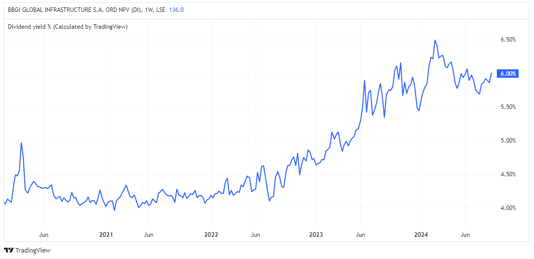
For this year, the dividend is 8.4p per share, which is 6% higher than last year. The forward yield is 6.2%, which is comfortably above the FTSE 250 average

While no dividend is bullet-proof, I’d say this one is very much on the safer side of things.

Moreover, I reckon the share price, which is down 22% over the past two years, could bounce back strongly as interest rates fall and infrastructure projects start to pick back up.

That’s not guaranteed, mind you. A resurgence of inflation could quickly put the handbrake on falling interest rates while negatively impacting the trust’s portfolio value.

However, right now, the trust is trading at a 10% discount to the value of its underlying assets. That’s against a five-year average premium of 12.8%.

With a well-supported 6%+ yield, I like the risk-reward ratio here.Created at TradingView

Created at TradingView

US growth stock

Next, I invested in a very different stock:Uber Technologies (NYSE: UBER).  The share price has risen 22% so far in 2024, but I think it could rise much higher over the next decade.

The reason is that the ride-hailing and food delivery firm is quickly becoming a cash machine. From negative cash flow in 2021, the company’s free cash flow is expected to approach $10bn in 2026.

Talk about scaling up

This is being driven by efficiency savings and ongoing global adoption of the Uber app, which is displacing local taxi firms at a rapid clip.

In Q2, gross bookings grew 21% year on year at constant currency. For Q3, management sees gross bookings of $40.2bn-$41.7bn, representing 18%-23% growth on a constant currency basis.

CEO Dara Khosrowshahi commented: “Uber’s growth engine continues to hum, delivering our sixth consecutive quarter of trip growth above 20%, alongside record profitability…more people are using the platform, and more frequently, than ever before.”

For the full year, Wall Street is forecasting revenue growth of at least 16%. I find that very impressive given how weak consumer spending is worldwide today.

Now, I appreciate that I’m taking on regulatory risk with Uber, particularly relating to whether drivers are classed as independent contractors or employees. There might even be bans in some countries.

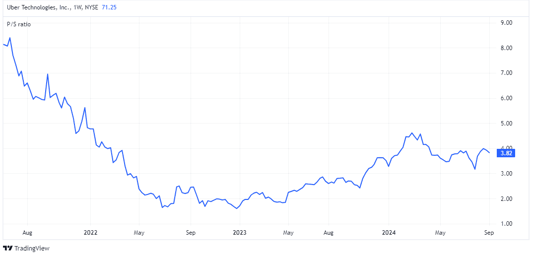
However, the stock is trading on a price-to-sales multiple of 3.8. It’s been much higher than this in previous years.Created at TradingView

Created at TradingView

Looking ahead, I think the likelihood of ongoing double-digit revenue growth and surging profitability make this a top tech stock.

The post 2 shares I’ve just bought for income and growth in my Stocks and Shares ISA appeared first on The Motley Fool UK.

« Older posts Newer posts »

© 2026 Passive Income Live

Theme by Anders NorenUp ↑