Passive Income Live

Investment Trust Dividends

Page 230 of 342

RGL

The portfolio will subscribe for the shares in the open offer, using the funds received from ADIG. That wasn’t the plan, the best laid plans of men and mice.

I will sell the open offer shares if Mr. Market allows me to and retain the original holding until the future dividend intentions are made clear.

ADIG

Dividends

In relation to the year ended 30 September 2024, interim dividends of 1.42p per share were paid to shareholders in October 2023 and January 2024 while a special dividend of 1.65 pence per share was paid to shareholders in December 2023. A further interim dividend of 1.42p per share was paid to shareholders in March 2024.

Following Court approval on 7 June 2024 and in the absence of unforeseen circumstances, it is the current intention of the Board to declare another interim dividend, for the year ended 30 September 2024, to be paid around mid-October 2024. Thereafter, it is likely that dividends will be paid in smaller, less regular amounts principally for the purpose of maintaining the Company’s investment trust status while capital will be returned progressively to shareholders in larger, infrequent amounts by the most tax-efficient mechanism available.

The Board intends to continue to pay a sufficient level of dividend to ensure that the Company will not retain more than 15 per cent. of its income in an accounting period so as to maintain the Company’s investment trust status during the Managed Wind-Down. The Directors will declare certain dividends based on the Company’s net income but the quantum and timing of any dividends in future will be at the sole discretion of the Board.

There can be no guarantee as to the payment, quantum or timing of dividends during the Managed Wind-Down of the Company.

One week left, thankfully.

Investors think UK shares might soar after the general election. Are they right?

If history repeats itself, UK shares could surge following next Thursday’s election. Here’s one FTSE 250 stock Royston Wild thinks might shoot higher.

Royston Wild

Image source: Getty Images

When investing, your capital is at risk. The value of your investments can go down as well as up and you may get back less than you put in.

You’re reading a free article with opinions that may differ from The Motley Fool’s Premium Investing Services.

We’re now just a week away from the Britain’s next general election. If investor predictions prove accurate, we could be about to see a surge in the value of UK shares.

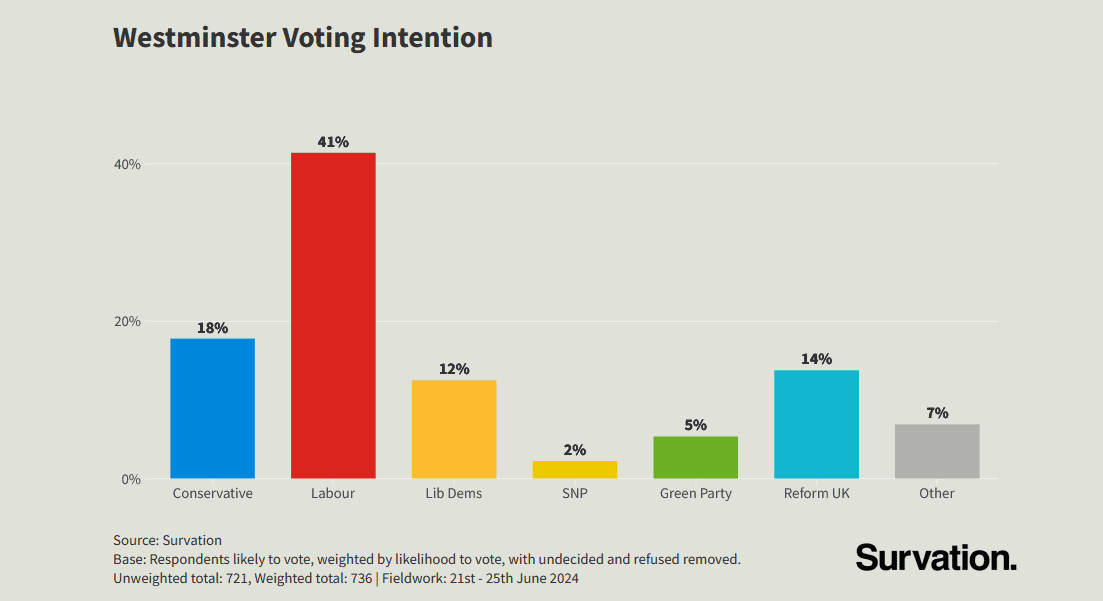
As I type, it appears the Labour Party is on course to secure a thumping House of Commons majority. A convincing win by any political party is always cheered on by the markets, thanks to the stability it provides.

Vote share data from Survation.
Source: Survation

The results are in!

The results are in!
New research suggests that many retail investors believe a Labour victory could be good for the London stock market.

According to eToro, 44% of investors think British share prices will increase if Keir Starmer enters Downing Street. That compares with 30% who believe the opposite.

There’s some historic basis for believing a new bull run could soon be upon us. Dan Moczulski, UK managing director at eToro, says that “when Labour won power in 1997 the FTSE 100 rallied by 35% over the next 12 months.”

He adds that “whilst we’re unlikely to see anything quite so dramatic this time around,” he notes that “the FTSE 100 has already returned 7% so far this year, indicating that markets are comfortable with the expected outcome of this election.”

Nothing’s certain
However, there are some important caveats for investors to remember. Past performance is no guarantee of future returns. And, right now, inflationary pressures and escalating geopolitical tension remain a threat to share prices across the globe.

It’s also important to remember that not all stocks will benefit equally from a potential Labour victory. Housebuilders like Barratt Developments and building materials suppliers like Kingfisher could benefit from a possible rise in newbuild numbers.

Increased spending on healthcare and education might also boost primary healthcare facility provider Assura and educational resources supplier Pearson respectively.

However, potential losers could be water supplier United Utilities and train operator FirstGroup, given the greater threat of re-nationalisation.

A potential riser?
Those seeking possible strong performers after the election may want to look at Greencoat UK Wind (LSE:UKW). It is one of many renewable energy stocks in the UK that could benefit from Labour’s drive to improve green investment.

According to its election manifesto, Labour plans to “work with the private sector to double onshore wind, triple solar power, and quadruple offshore wind by 2030“.

Manifesto promises famously aren’t legally binding. But the growing climate emergency means rising investment in clean energy looks a certainty, regardless of which party wins the election.

Wind turbines generated 29.4% of Britain’s electricity in 2023, according to National Grid. This was up from 26.8% a year before as wind capacity continued to sharply rise.

This doesn’t mean companies like Greencoat will deliver powerful earnings growth every year. Even a ‘supermajority’ won’t allow Labour to control the weather. So businesses will still suffer during calm periods when energy generation tails off.

But over the long term, buying renewable energy shares could offer significant returns to investors. FTSE 250-listed Greencoat has delivered a total shareholder return close to 270% over the past 12 years. This could improve significantly if Labour makes good on its green investment plans.

REGIONAL REIT LIMITED

(“Regional REIT” or the “Company”, together with its subsidiaries the “Group”)

Launch of Underwritten Capital Raising of £110.5m, Share Consolidation and Notice of Extraordinary General Meeting

Regional REIT Limited (LSE: RGL), the regional property specialist, is pleased to announce a Capital Raising of approximately £110.5 million, in aggregate, by way of a fully underwritten Placing, Overseas Placing and Open Offer of 1,105,149,821 New Ordinary Shares at an issue price of 10 pence per New Ordinary Share. The Company also announces a 1 for 10 Share Consolidation. The Capital Raising is being fully underwritten by Bridgemere Investments Limited (“Bridgemere”), which is part of the Bridgemere group of Companies established by Steve Morgan CBE.

The Capital Raising will enable the Company’s £50 million Retail Bond to be fully repaid, eliminating this short term liability and further reducing the constraints caused by the requirement to pay coupon distributions on the Retail Bond. In addition, £26.3 million of the Net Capital Raising Proceeds will be used to reduce bank facilities, which will result in the Company having greater headroom under the covenants in such facilities, and the remaining £28.4 million of the Net Capital Raising Proceeds will provide additional flexibility to fund selective capital expenditure on assets, which will enhance earnings in the near term and value in the mid to long-term, further underpinning quarterly dividends going forward. This will reduce LTV from 56.8 per cent. (based on the valuations as at 21 June 2024 as set out in the Valuation Report) to 40.6 per cent. upon completion of the Capital Raising.

Kevin McGrath, Chairman of Regional REIT, commented:

Following a comprehensive review of a wide range of options to accelerate a reduction in indebtedness and the repayment of the £50 million retail bond which matures in August 2024, the Board believes this Capital Raising is the best available solution for shareholders. The Capital Raising, supported by Bridgemere, will enable the Company to strengthen significantly Regional REIT’s financial position, reducing indebtedness and provide the Company with greater financial flexibility and liquidity headroom.

Stephen Inglis, Chief Executive Officer of London & Scottish Property Investment Management Limited, the Asset Manager, commented:

Since the Covid-19 pandemic the Company has been operating in a challenging environment resulting in the LTV increasing to 56.8% against a target of less than 40%. The fully underwritten and fully pre-emptive Capital Raising provides the best long-term solution to the upcoming retail bond refinancing, will put the Company on a sound footing reducing the LTV to approximately 40% and provide the flexibility to fund capital expenditure on assets to maximise value and income for shareholders over the long term.

Key Highlights

·    Placing, Overseas Placing and Open Offer (the “Capital Raising”) of 1,105,149,821 New Ordinary Shares at an issue price of 10 pence per New Ordinary Share to raise approximately £110.5 million, approximately £104.7 million net of expenses (the “Net Capital Raising Proceeds”).

·    The Capital Raising is being fully underwritten by Bridgemere, which is part of the Bridgemere group of Companies established by Steve Morgan CBE, providing the requisite certainty to recapitalise the Company.

·    Bridgemere will subscribe for the Placing Shares at the Issue Price and the Placing Shares will be subject to clawback to satisfy valid applications under the Open Offer and Overseas Placing.

·    The Open Offer to Qualifying Shareholders is on the basis of:

15 New Ordinary Shares for every 7 Existing Ordinary Shares

·    The Issue Price represents a discount of 50.4 per cent. to the Closing Price of 20.2 pence and a discount of 82.3 per cent. to the latest published NTA per Share prior to the Latest Practicable Date of 56.4 pence.

·    The Net Capital Raising Proceeds of approximately £104.7 million will be used to:

o satisfy the redemption of the £50 million 4.5 per cent. Retail Bond, which matures on the 6 August 2024;

o reduce bank facilities by £26.3 million, which will result in the Company having greater headroom under the covenants in such facilities; and

o the remaining £28.4 million of the Net Capital Raising Proceeds will provide flexibility to fund selective capital expenditure on assets, which will enhance earnings in the near term and value in the mid to long-term, further underpinning quarterly dividends going forward.

·    The Company’s investment properties were independently valued on 21 June 2024 at £647.8 million (31 December 2023: £700.7 million), representing a decrease of 4.6% in the like-for-like value of the portfolio.

·    Following completion of the Capital Raising, and subject to shareholder approval, it is proposed that the Ordinary Shares will be consolidated at the Consolidation Ratio of one Consolidated Share for every 10 Ordinary Shares.

·    Assuming that Admission and Admission of the Consolidated Shares occur, the Board’s current intention is to pay approximately 2.2 pence per Ordinary Share (assuming the Share Consolidation becomes effective) in relation to the 2024 Q2 Dividend, which is expected to be declared in September 2024.

Today’s quest

Richard T

June 26, 2024 at 2:38 pm

Hi Anthony,
I am surprised that you have sold GSF the day before it goes ex-Div.
I thought your no 1 rule for the Snowball portfolio was invest for dividend income, but you appear to have traded this for profit ahead of ex-div date.
I am interested to understand your rationale please.
Perhaps you have a 3rd Snowball rule around trading for profit ? not unreasonable, but is this more of a TR approach ?
Look forward to hearing from you.
Many thanks
RT

£££££££££££

By confusing apples with pears it appears u have confused yourself.

I’m sure, well fairly, that u will be able to work it out for yourself.

FTSE 250 high-yield passive income stocks


The Motley Fool

By Edward Sheldon, CFA
The UK stock market’s throwing up some enormous dividend yields at the moment. For those seeking passive income, it’s a gold mine.

Earlier this week, I searched the FTSE 250 index (the largest 250 companies on the London Stock Exchange outside the FTSE 100) for high yielders. Here’s what I found.


A stack of high-yielders
According to my data provider, there are currently 25 stocks within the FTSE 250 with forward-looking dividend yields of 7% and higher. Of these, 15 have yields of 8% and higher.

Now, not all of these stocks are likely to be good investments in the long run, of course. Often, high yielders turn out to be poor investments overall (a high yield can be a signal that a company has fundamental problems).

But there are certainly a few that look interesting to me.
A play on the UK’s ageing population
One is Target Healthcare REIT (LSE: THRL). It’s a real estate investment trust (REIT) that owns a portfolio of care homes across the UK.

Currently, analysts expect it to pay out total dividends of 5.7p per share for 2024. That translates to a yield of around 7.1% today.

Looking at demographic projections, this stock could almost be considered a ‘no-brainer’, in my view. In the UK, the number of people aged 85 and over is projected to rise 8% in the next five years and 63% by 2043, according to Age UK. This means that demand for care homes should be very high in the years and decades ahead.


Of course, commercial property’s facing challenges right now due to high interest rates (this can be seen in the share price). If rates stay higher for longer, they could put pressure on profitability across the sector.

With rates in the UK likely to come down in the second half of 2024, however, I think this stock is worth a closer look right now. I reckon it has the potential to deliver both gains and passive income in the years ahead.

Please note that tax treatment depends on the individual circumstances of each client and may be subject to change in future. The content in this article is provided for information purposes only. It is not intended to be, neither does it constitute, any form of tax advice. Readers are responsible for carrying out their own due diligence and for obtaining professional advice before making any investment decisions.


A stock for the green revolution
Another high yielder that looks interesting to me is JLEN Environmental Assets Group (LSE: JLEN). It’s an environmental infrastructure investment fund that owns a diversified portfolio of assets supporting the drive towards decarbonisation, resource efficiency, and environmental sustainability.

It recently told investors that it expects to pay out 7.57p per share in dividends this year. That equates to a yield of 8.6% at the current share price.

Like Target Healthcare, JLEN Environmental Assets has a very favourable backdrop. In the years ahead, looking after the environment is only likely to become more of a focus.

What I like about this company is that it’s really diversified. Its portfolio today includes onshore wind farms, solar plants, waste and wastewater processing plants, hydro and anaerobic digestion plants, battery storage, hydro projects, and more.

One risk here (and this is also a risk for Target Healthcare) is that the company may decide to raise money from investors to support its growth plans. This could put pressure on its share price in the short term.

Taking a long-term view however, I think this stock has the potential to deliver attractive returns.

Chart of the day

Dividend Hero, merging with another Dividend Hero Witan.

A trust for, if u were in the early stages of your accumulation plan because the yield is only around 2%. U have to hold thru thick and thin and u can see from the chart there is plenty of thin. But when the chart is thin and u are re-investing your dividends, u are getting more shares for your money.

Having achieved the holy grail of investing, in having a Trust that pays a dividend with a good chance of a capital gain, u could take out your stake and invest it another Trust, maybe a higher yielder as Mr. Market has giving u some great opportunities.

Stick to your plan, until it sticks to u.

If you don’t plan, you plan to fail.

Assuming investments are an end rather than a means.

Investing is not a sport. It’s not something to do for its own sake. It’s something to do to help fulfil your financial purpose.

For that reason — and not because of anything the financial media or investment industry says — investing is critically important. Solid investment performance means you can fulfill your objectives more fully, whatever they are. That’s just true.

So, always think about investing in the context of your own purpose. You’re not investing to compete or compare. You’re investing to help accomplish what you want to.

Think about what this means for investment risk and return . Ask yourself, “How much risk am I willing to take to dream as big as I want to dream?” Maybe you’ll discover you can fulfil your dreams while taking less risk than you are currently. In that case, it’s our responsibility as advisers to help you do that. Or maybe you’ll find you want to take a little more risk to dream a little bigger. That, too, informs our actions as advisers.

Investing isn’t about comparing a line on a piece of paper with another line on the paper; that would be an end in itself. Rather, investing is a means to achieve something far more personal and real.

£££££££££££££

If u don’t plan, u plan to fail.

Compound Interest

By Royston Wild

Stock markets never move in a straight line. But over the long term, investing in FTSE 100 and FTSE 250 shares has proved time and again to be an effective way to build wealth.

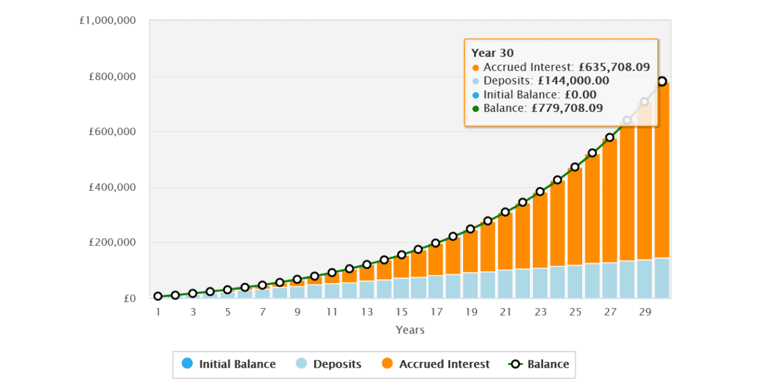
Averaged out, the FTSE 100 and FTSE 250 indexes have delivered an average annual return of 9.3% since the early 1990s. Based on this figure, someone who invested £400 a month for the last 30 years could have made a brilliant £779,708 to retire on.

Created with thecalculatorsite.com

Created with thecalculatorsite.com© Provided by The Motley Fool

I’m confident these long-term records will last. But which shares would I buy to target a nest egg for my retirement?

Market growth

Defence shares like BAE Systems (LSE:BA.) could provide significant returns as the world embarks on what looks like a new cold war.

The firm has had significant share price gains since early 2022. And I believe the bull run has much further to run following Russia’s invasion of Ukraine.

Countries across the West are ramping up military spending, in what some describe as the most dangerous decade since World War II. Fears over Russian and Chinese expansionism are fuelling growth in defence budgets. Lasting concerns over the Middle East and terrorist threats are also supporting arms demand.

In the UK, both the Conservatives and Labour have pledged to lift defence spending as a proportion of GDP, to 2.5%. Spending is also steadily increasing in the US, the world’s biggest military power.

Sales soar

As a top-tier supplier to both countries, BAE Systems is already reporting a significant uplift in demand. It enjoyed £600m worth of new orders in 2023, which in turn pushed its order backlog to a record £69.8bn.

And the company plays a critical role in some of the world’s biggest defence programmes. As a major submarine builder, for instance, its technology will provide a vital role in AUKUS security pact between the US, UK, and Australia. The total cost of the programme is estimated at $268bn-$368bn up until 2050.

For the near term, BAE has predicted sales growth of 10% to 12% this year, up from 9% last year. Underlying earnings before interest and tax (EBIT) are therefore tipped to increase between 11% and 13%.

On the downside, I am concerned about the growing threat of supply chain issues for defence companies like this. This week Airbus issued a profit warning on account of “persistent” problems sourcing parts. Enginebuilder Rolls-Royce has also cautioned of “continued industry-wide supply chain challenges” in recent weeks.

Reassuringly expensive

Any problems here could have significant consequences for BAE Systems’ share price. Its 140%-plus rise since the start of 2022 leaves it trading on a high price-to-earnings (P/E) ratio of 22.2 times.

This is well above the company’s five-year average of 15 times. And it means investors could charge for the exits if any bad news comes down the line.

Still, I think BAE shares are worth this premium valuation. A strong track record of execution, expertise across many sectors, and robust market outlook means its share price could continue rocketing.

« Older posts Newer posts »

© 2026 Passive Income Live

Theme by Anders NorenUp ↑