I’ve bought for the portfolio a further 2433 shares in FSFL for 2k.
Current fcast for dividends received at the end of May £4,353.00 ahead of target.
Investment Trust Dividends
I’ve bought for the portfolio a further 2433 shares in FSFL for 2k.
Current fcast for dividends received at the end of May £4,353.00 ahead of target.

Not a chart buy at the present time.

I currently favour JLEN as the portfolio is in profit with the Trust.
xd early June so still some time to ponder.

I have cash to re-invest so this is my starting point. I will delete some of the shares for personal reasons, it’s always best to DYOR and not rely on other peoples opinions.
First I would delete any Trust I already own as I do not want to open a new position but I may add when the dividends are received.
VSL,NESF,FSFL,RECI,SUPR,AGR,PHP,ADIG
Trusts I don’t know enough about.
AA4, EJF
Trusts I wouldn’t buy, at this time.
GSF battery storage, NRR, Retail Parks, THRL Care Homes, VTAS Enough Loan Companies in the portfolio.
CMPI, GGRP a view for the general market.
March was a strong month for investment firms in the logistics and healthcare properties space, as UK inflation worries subsided, according to the monthly winners and losers list from QuotedData.
Data last month had showed the UK consumer price inflation rate abated to 3.4% in February, from 4.2% in January, moving closer to the Bank of England’s 2% target.
“Green shoots have finally started to emerge in the UK property market with logistics and healthcare the two best performing subsectors in March,” QuotedData said.
It was also a strong month for investors in European small-caps, QuotedData noted, on the rising conviction that the European Central Bank will begin cutting rates soon.
“Traditionally, smaller companies are more rate sensitive than their mid and large cap peers as they tend to hold higher levels of debt, meaning any fall in interest rates is well received,” QuotedData added.
By median share price total return, European smaller companies investors were the fourth best performing sub-sector in March, below North America-focused firms, UK healthcare property and UK logistics property.
The following were the best and worst performing London-listed investment companies in March, excluding trusts with market capitalisations below GBP15 million:
Five best performing funds in NAV terms with % change:
Golden Prospect Precious Metals Ltd 16.1
Blackrock World Mining Trust PLC 13.3
Temple Bar Investment Trust PLC 9.5
Blackrock Energy & Resources Income Trust PLC 8.8
Manchester & London Investment Trust PLC 8.4
Five worst performing funds in NAV terms with % change:
Mobius Investment Trust PLC (5.3)
India Capital Growth Fund Ltd (4.2)
Downing Strategic Micro-Cap Investment Trust PLC (2.6)
Gulf Investment Fund PLC (2.5)
Jupiter Green Investment Trust PLC (2.2)
Five best performing funds in price terms with % change:
Schiehallion Fund Ltd 38.6
Golden Prospect Precious Metals 28.6
Digital 9 Infrastructure PLC 26.6
Taylor Maritime Investments Ltd 15.9
Custodian Property Income REIT PLC 13.1
Five worst performing funds in price terms with % change:
Asian Energy Impact Trust PLC (77.0)
Gresham House Energy Storage Fund PLC (33.7)
Livermore Investments Group Ltd (18.1)
India Capital Growth (14.5)
US Solar Fund PLC (14.4)
Source: QuotedData. Full details at http://www.quoteddata.com
I’ve sold the portfolio shares in AEI for an overall profit of £631.76.
I looked at the opening price where I could have sold at a slightly better price. No one pretends it’s easy.
The reason for selling, I didn’t want to lose the recently banked profits and the yield had fallen to 7.5% versus the higher yields in the Watch List. Also it gives me some cash if there are any ‘bargains’ in the market.
Cash for re-investment £8,339.00.

4 Things You Can Learn from Warren Buffett’s Investing Philosophy
Reuters
Warren Buffett, often regarded as the greatest investor of all time, has not only endured the test of time but also consistently outperformed the
4 Things You Can Learn from Warren Buffett’s Investing Philosophy
Warren Buffett’s unique qualities, including his long-term investment perspective, market detachment, and resilience to drawdowns, underpin his success.
While many investors get caught up in short-term market fluctuations, Buffett focuses on long-term profitability and doesn’t obsess over daily stock price swings.
Stock holding periods keep getting shorter every year and today’s investors can learn a thing or two from the legendary investor
Warren Buffett, often regarded as the greatest investor of all time, has not only endured the test of time but also consistently outperformed the markets throughout his remarkable career.
He’s a name that resonates in the world of investments, and for good reason.
Many have attempted to replicate his success, but what sets Buffett apart are his unique qualities. Let’s delve into what makes him truly exceptional.
He and his business partner, Charlie Munger, don’t base their investment decisions on macroeconomic factors, short-term predictions, or the day-to-day fluctuations of rates, inflation, or GDP.
Their philosophy revolves around investing in profitable businesses with strong long-term potential, not obsessing over stock prices that can swing wildly in the short term.
Now, ask yourself this: How often have you made investment decisions this year based on enticing forecasts about when the Fed will stop raising rates or how much earnings are projected to increase?
It’s safe to say that many investors have fallen into this trap.
Let’s take a closer look at these facets of Buffett’s investing philosophy.
When you closely examine Warren Buffett’s holdings, such as Apple (NASDAQ:AAPL), which he has held in his portfolio since early 2016, you’ll notice that his investment horizon is notably longer than that of the average investor.
In today’s fast-paced financial world, the average holding period for many investors has dwindled to less than a year, in stark contrast to Warren’s enduring approach.
The worst period was probably the one related to the subprime crisis, with a drop of more than 30% in 2008, and a Maximum drawdown probably greater. Most investors exit the markets after a 5 or 10% drop, let alone a 35-40% drop.
The ability to withstand declines is a key characteristic of a good investor, and in his case, since the time horizon is as seen above, it is not surprising that while other investors panic, he is happy to buy at better prices.
And how many of you instead sold at a loss, worried that it could get even worse, of deed losing the recovery (not total but almost) of 2023?
Warren Buffett in each of his interviews always shows his preference in steeply falling markets, because that way you buy better (of course, carefully selected good businesses with correct horizons).
In fact, we can see that his cash holdings fell sharply in 2022 (markets fall he buys) and then rose again during 2023.
So the opposite of what investors normally do, which is to buy on the highs (when risk is higher and expected returns are poor) and sell on the lows (when the opposite occurs).
So again, no one I think will be able to replicate Warren Buffett, what we can do is to take a cue from his behaviours and try to make the most of them, with the humility of knowing that everyone is different, and no one like him
He’s a name that resonates in the world of investments, and for good reason
Many have attempted to replicate his success, but what sets Buffett apart are his unique qualities. Let’s delve into what makes him truly exceptional.
At one of Berkshire Hathaway’s (NYSE:BRKb) numerous annual meetings, when asked how he evaluates specific market moments, Warren’s response was crystal clear.
He and his business partner, Charlie Munger, don’t base their investment decisions on macroeconomic factors, short-term predictions, or the day-to-day fluctuations of rates, inflation, or GDP.
Their philosophy revolves around investing in profitable businesses with strong long-term potential, not obsessing over stock prices that can swing wildly in the short term.
Now, ask yourself this: How often have you made investment decisions this year based on enticing forecasts about when the Fed will stop raising rates or how much earnings are projected to increase?
It’s safe to say that many investors have fallen into this trap.
Could you imagine holding a stock in your portfolio for 34 years, enduring the inevitable ups and downs along the way? Warren Buffett certainly can and has. His commitment to long-term investing is remarkable, making it a crucial aspect of his success.
Let’s take a closer look at these facets of Buffett’s investing philosophy.

Warren Buffett’s 10 Longest Held Stocks© Provided by uk.investing.com
When you closely examine Warren Buffett’s holdings, such as Apple (NASDAQ:AAPL), which he has held in his portfolio since early 2016, you’ll notice that his investment horizon is notably longer than that of the average investor.
In today’s fast-paced financial world, the average holding period for many investors has dwindled to less than a year, in stark contrast to Warren’s enduring approach.

Stock Holding Period© Provided by uk.investing.com
Source: Refinitiv
The difference in why he makes money and others do not can largely be explained by comparing the graphs above.
Warren Buffett, at over 90 years old, has weathered a multitude of challenging market periods. The Bear Market ’73/74, the Dotcom bubble, the Subprime crisis, the Covid pandemic, just to name a few.

Berkshire Hathaway Vs. S&P 500© Provided by uk.investing.com
Source: S&P Global
The worst period was probably the one related to the subprime crisis, with a drop of more than 30% in 2008, and a Maximum drawdown probably greater. Most investors exit the markets after a 5 or 10% drop, let alone a 35-40% drop.
The ability to withstand declines is a key characteristic of a good investor, and in his case, since the time horizon is as seen above, it is not surprising that while other investors panic, he is happy to buy at better prices.
Without wishing to go too far back in time, how many of you (again, you don’t have to answer to me, but to yourselves) bought stocks or bonds in 2022 on falling markets?
And how many of you instead sold at a loss, worried that it could get even worse, of deed losing the recovery (not total but almost) of 2023?
Warren Buffett in each of his interviews always shows his preference in steeply falling markets, because that way you buy better (of course, carefully selected good businesses with correct horizons).

Fonte: Ycharts© Provided by uk.investing.com
In fact, looking at the image above, we can see that his cash holdings fell sharply in 2022 (markets fall he buys) and then rose again during 2023.
So the opposite of what investors normally do, which is to buy on the highs (when risk is higher and expected returns are poor) and sell on the lows (when the opposite occurs).
So again, no one I think will be able to replicate Warren Buffett, what we can do is to take a cue from his behaviours and try to make the most of them, with the humility of knowing that everyone is different, and no one like him.
The Efficient Market Hypothesis (EMH) has long been a cornerstone theory in understanding stock market behaviour. It posits that at any given moment, stock prices accurately reflect all available information about a company. This theory gained significant traction during the 1970s, buoyed by the rapid expansion of the Information Age, which revolutionized data storage and exchange.
In an era where even casual investors wield valuation tools that would have seemed like science fiction to traders of the past, one might assume that market efficiency has reached unprecedented levels. However, Warren Buffett challenges this notion, noting that the market is mostly efficient but not completely efficient.
Buffett contends that in some cases the market is far from efficient. Contrary to the belief that stock prices consistently reflect a company’s true value, Buffett argues that market inefficiencies are inherent. He asserts that stocks often become mispriced due to various factors.
Speaking at the 2012 Berkshire Hathaway Annual Meeting, Buffett referenced Benjamin Graham’s seminal work, “The Intelligent Investor.” In particular, he highlighted Chapter 8, which introduces the concept of “Mr. Market.” According to Graham, Mr. Market is an erratic and unpredictable figure, prone to irrational behaviour akin to a “psychotic drunk.” Buffett emphasizes that investors should view Mr. Market as a partner rather than an advisor, seizing opportunities when prices deviate from intrinsic value.
In essence, Buffett’s perspective underscores the importance of recognizing and capitalizing on market fluctuations, leveraging them to make sound investment decisions, especially when stocks in rare instances sell at “silly prices.”
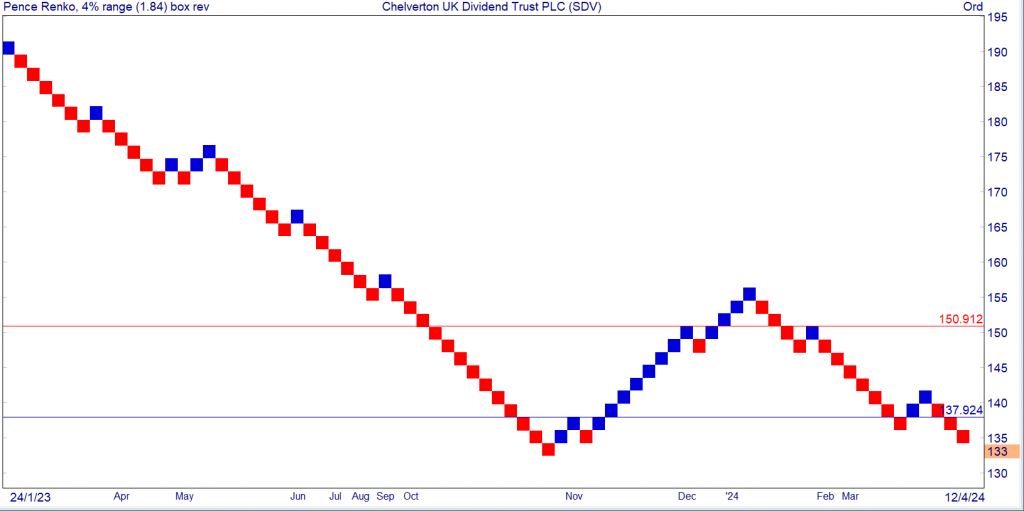
U have been watching the SDV price fall, as the price falls the yield rises.
U decide to buy hoping for a Santa Rally, if u are wrong u could still collect the dividend. U are correct and as xmas is now over u decide to sell as u have collected the 3.15p dividend. Tks to Mr. Market as u search for your next dividend Trust, where the outcome may be the opposite.
Discount Watch
This week’s Discount Watch sees 27 Investment Companies trading at 52-week high discounts. Eight less than last week. A sign things are looking up for the sector, or just a blip?
By
Frank Buhagiar
08 Apr, 2024
We estimate there to be 27 investment companies whose discounts hit 12-month highs over the course of the week ended Friday 05 April 2024 – eight less than the previous week’s 35.discount watch pic 1 08.04.24Fair few 52-week highs were made on Tuesday 02 April 2024, a weak day all round for global markets following a sell-off in US Treasuries – strong economic data continues to weigh on the timing of those much-anticipated interest rate cuts. No surprise then that the interest-rate sensitive renewables remain the biggest contributors to the list with seven names, same number as last week. UK Equity Income funds held onto second place but only contributed four names compared to six previously.
The top-five discounters
Fund Discount Sector
Gresham House Energy Storage GRID -72.19% Renewables
LMS Capital LMS -67.30% Private Equity
Life Science REIT LABS -53.99% Property
Gore Street Energy Storage GSF -45.46% Renewables
Downing Renewables & Infrastructure DORE -37.29% Renewables
The full list
Fund Discount Sector
Asia Dragon DGN -19.73% Asia Pacific
Scottish Oriental Smallers Cos SST -18.17% Asia Smaller Cos
NB Distressed Debt NBDD -23.19% Debt
NB Global Income NBMI -26.52% Debt
Real Estate Credit Investments RECI -21.22% Debt
Jupiter Green JGC -30.65% Environmental
RIT Capital Partners RCP -30.56% Flexible
abrdn New India ANII -22.53% India
JPMorgan India JII -20.78% India
LMS Capital LMS -67.30% Private Equity
Value and Indexed Property VIP -27.78% Property
Develop North Prop DVNO -1.26% Property
Life Science LABS -53.99% Property
Gore Street Energy Storage GSF -45.46% Renewables
Bluefield Solar Income BSIF -26.80% Renewables
Downing Renewables & Infrastructure DORE -37.29% Renewables
Foresight Solar Income FSFL -30.24% Renewables
Greencoat Renewables GRP -24.43% Renewables
Gresham House Energy Storage GRID -72.19% Renewables
Octopus Renewables Infrastructure ORIT -33.36% Renewables
Dunedin Income Growth (DIG) -12.88% UK Equity Inc
Shires Income SHRS -15.03% UK Equity Inc
Merchants MRCH -4.56% UK Equity Inc
Schroder Income Growth SCP -14.80% UK Equity Inc
Miton UK Microcap MINI -17.54% UK Microcap
BlackRock Throgmorton THRG -10.52% UK Smallers Cos
Henderson Smallers HSL -15.27% UK Smallers Cos
© 2026 Passive Income Live
Theme by Anders Noren — Up ↑