Passive Income Live

Investment Trust Dividends

Page 317 of 456

The Week’s Investment Trust Results

The Results Round-Up

Literacy Capital, BBGI Global Infrastructure, CT Private Equity and Chelverton UK Dividend Trust all reported this week, but which of the four is ranked No.1 out of ALL UK-listed investment companies in terms of NAV performance over the three years to June 2024?

By Frank Buhagiar•30 Aug, 2024

Literacy Capital (BOOK) Tops the Charts

BOOK’s Interim results for the six months ended 30 June 2024 opens with a one-line summary “Strong first half; celebrates third year anniversary with NAV performance ranked #1 out of all UK-listed investment companies.” As for what a strong first half looks like, how about a +4.4% NAV increase and +9.9% share price rise. That compares to the FTSE Investment Company Index’s +5.8% increase and the FTSE All-Share’s +7.4%.

And according to CEO, Richard Pindar, for the three years to June 2024 the fund was ranked #1, with its NAV performance being comfortably ahead of all other UK-listed investment companies. A thumbs up for BOOK’s strategy of “focusing on smaller businesses that are poorly served or ignored by traditional private equity funds, as well as the benefits that our fund structure can deliver to portfolio companies and BOOK’s shareholders. We believe it is worth continuing to emphasise these points, as they are still not widely understood by the market.” And right on cue, share price was unmoved on the day of the results. But more numbers like the above and likely won’t be too long before the market sits up and takes notice.

Winterflood: “Manager sees signs of UK domestic trading conditions improving. NAV TR +49% p.a. since IPO in June 2021; top performer across all UK investment trusts.”

BBGI Global Infrastructure (BBGI) Keeps Delivering

BBGI reported a +2.4% NAV total return for the six months to 30 June 2024. Other financial highlights at the half-year stage include zero drawings on the revolving credit facility; net cash of GBP20.6 million; and a 6% dividend increase. And it was the dividend that Chair, Sarah Whitney, chose to focus on “Our high-quality inflation-linked cash flows generated by our portfolio of availability-style core infrastructure assets has enabled us to meet consistently or exceed dividend targets since the IPO in 2011, providing our shareholders with predictable, progressive and fully cash-covered dividends for over a decade.” Whitney goes on to note how, at the current share price, the shares offer FY 2024 and FY 2025 dividend yields of 6.3% and 6.4% respectively.

CEO, Duncan Ball, meanwhile has his eyes fixed on the future “Stabilising, and potentially reducing interest rates, combined with an ever-increasing demand for infrastructure investments, presents a long-term growth opportunity for BBGI.” Shares barely budged on the day of the results – market clearly focusing on the long term.

Jefferies: “The portfolio valuation was little changed over the half, while cash flow generation was typically robust.”

Liberum: “The results were largely as expected with limited changes from the FY 23 results. We continue to prefer: (1) infrastructure funds with a higher terminal value and better scope for earnings growth at the investment level which can drive NAV growth.”

Winterflood: “With the shares trading at a current discount of 8% (relative to 11% 5-year average premium), we believe that BBGI is undervalued and hence we continue to recommend the fund for core Infrastructure exposure.”

Investec: “The portfolio continues to perform well operationally and financially, and the company remains well positioned with a conservative balance sheet. We remain comfortable with our Hold recommendation.”

Numis: “We view BBGI as a high-quality business but maintain a preference for the revenue diversification and higher inflation linkage on offer elsewhere in the Core infrastructure sub-sector.”

CT Private Equity Trust’s (CTPE) Growing Realisation

CTPE noted a pick-up in realisation activity during the first half – realisations and associated income came in at £52.3m, a +31.4% increase on the same period last year. What’s more, realisations were struck at a 35% premium to prior valuations. Other half-year vitals include a +0.8% NAV total return; and a 6.5% dividend yield based on the period-end share price. Letting the side down, however, a -4.5% share price total return on the back of a widening discount. Chairman, Richard Gray doesn’t sound overly concerned though, as “there now appears to be a mild but definite pick-up in activity.” This includes a “substantial increase in realisations over the course of this reporting period with some more significant ones to come in the near future.” As for why this is important “Realisations are usually at a significant premium to recent carrying value and so have the benefit of enhancing NAV as well as strengthening the balance sheet and creating more shareholder value.”

And doesn’t sound like reinvesting the proceeds from realisations will be all that hard either “There are many investable funds and co-investments being appraised by our managers. Experience shows that investments made during, or immediately after, economic slowdowns usually perform very well.” Market liked what it heard – shares tacked on 11.5p on results day to close at 454p.

Winterflood: “In our view, realisations of c.10% of NAV YTD at a +35% uplift offer transactional evidence to support the prevailing NAV, which is particularly relevant given a 36% share price discount, and represents a continuation of the trend across the sector.”

JPMorgan: “The shares are trading at a headline discount of 34.7%, but taking into account proforma net debt the implied discount on the unquoteds is narrower at 30.2%. This looks about fair relative to peers in our view and therefore we see no need to change our Neutral recommendation.”

Chelverton UK Dividend Trust’s (SDV) Year of Two Halves

SDV’s NAV total return of -7.5% for the full year doesn’t tell the whole story. For performance at the UK equity income trust picked up markedly in the second half of the year with NAV rising +20.3% in the six months to 30 April 2024, a nod to the improvement in sentiment seen towards the mid and small-cap stocks that SDV invests in. And according to the Investment Manager’s Report, the majority of the fund’s portfolio companies “continue to trade profitably, generate significant levels of cash and pay dividends.”

The relatively strong operational showing at the portfolio company level is not going unnoticed if an uptick in corporate activity is anything to go by – six of the fund’s holdings were the subject of corporate activity in the year to April 2024. The investment managers don’t sound 100% happy about this though “We must also hope that we do not lose too many of our holdings to takeovers at prices which do not reflect the full medium-term potential of the business. As long-term, fundamental investors, we would far rather continue to back the management teams of growing, cash generative businesses, than settle for a quick return based on current low levels of valuation.” Results were good for an initial 3p spike in the share price to 172p.

Winterflood: “Ordinary shares moved from 3.8% premium to 6.5% discount; 395k shares issued at a premium over FY. 2025 ZDPs moved from 4.6% to 6.3% discount.”

Passive income

pensive bearded business man sitting on chair looking out of the window

The Motley Fool

How much do I need to invest in UK shares to stop working and live off passive income?

Story by Royston Wild

The Motley Fool

To my mind, the best way to try and create a passive income is to invest in a broad range of UK shares.

What about savings accounts? Well, with interest rates falling again, I’m expecting these products to start delivering mediocre returns again.

Past performance is no guarantee of future returns. But with the Stocks and Shares ISA delivering an average annual return of 9.64% (according to Moneyfarm research) in the past decade, I think building a portfolio of British stocks will be the best way to go.

But how much would I need to invest so I can stop work and live off the passive income?

Hitting a £50k income

The first thing I need to consider is how much my everyday expenses will be. I also must think about what luxuries I want to enjoy. After all, none of us want to work for decades without having some lavish living to look forward to.

It says the average single person needs £43,100 a year to live a comfortable retirement. People in this bracket will get to enjoy regular holidays in the UK and overseas, a new car every few years, and a four-figure kitty to spend on clothes.

For this exercise, I’ll round my annual income target up to £50,000 to give me a margin of safety. So how much will I need to invest each year to reach this?

If I can manage to hit that 9.64% average return that ISA investors enjoy, I’ll need to spend £8,376 a year on UK shares for 25 years, reinvesting any dividends I receive along the way.

At this point, I’ll have built a nestegg north of £833,420.

Source: thecalculatorsite.com

Source: thecalculatorsite.com

I could then invest this in 6%-yielding dividend shares to target just over £50,000 in passive income each year. Remember, however, that dividends are never guaranteed.

Dirt cheap FTSE 250 share ?

The Motley Fool

Story by Royston Wild

Demand for FTSE 250 shares has risen sharply in 2024 thanks to the improving UK economic outlook. This pickup probably isn’t a surprise. Around 60% of the index’s earnings come from Britain.

The UK’s second-most-prestigious index has consequently risen around 7% in value in the year to date, pushing valuations higher. But don’t be mistaken, there are still many great bargains for investors to go hunting for.


Buying cheap shares has two significant advantages. Undervalued stocks can deliver stunning capital appreciation over time as the market wises up to their cheapness and share prices soar.

Value shares also provide investors with a margin of safety. If a company suddenly experiences adverse conditions, the scale of share price losses can be far more limited.

Value shares also provide investors with a margin of safety. If a company suddenly experiences adverse conditions, the scale of share price losses can be far more limited.

Solar star

Solar star
The threat of higher-than-normal interest rates means property and infrastructure companies like NextEnergy Solar Fund (LSE:NESF) remain ultra cheap.

This particular investment fund — which owns more than 100 renewable energy assets mainly in the UK — trades at a 20.2% discount to the estimated value of its assets.

While they’re not without risk, renewable energy stocks like this have terrific long-term potential. As the climate emergency worsens, demand for their power should rapidly increase. This makes NextEnergy worth serious consideration, and especially at current prices.

The Fund Monitor

Cordiant Digital Infrastructure’s Chairman buys shares AGAIN; Gulf Investment Fund launches a tender offer; Diverse Income maintains its unbroken record of dividend growth; while Partners Group Private Equity shares sit on a 6.7% yield full-year payout was raised.

By Frank Buhagiar•28 Aug

Cordiant Digital Infrastructure Chair Tops Up Holding

Cordiant Digital Infrastructure (CORD) Chairman and co-founder, Steven Marshall, snapped up a combined 440,919 CORD ordinary shares at an average price of 74.56 pence each. As per the company’s press release, following the purchases, which were made in July and August 2024, Marshall now holds 9,516,119 ordinary shares in the company. Regular readers will know, the purchases are not the only ones made by Marshall over the past year or so. With the share price still trading at a steep discount to net assets (-37%) chances are they won’t be the last.

Gulf Investment Fund Launches Tender Offer

Gulf Investment Fund (GIF) announced a tender offer for up to 100% of each shareholder’s holding in the fund. The tender offer is being proposed in line with the authority granted by shareholders at the December 2023 Annual General Meeting. The Tender Price will be announced at a later date.

Winterflood notes that “As it would not be in the interests of shareholders to be invested in a sub-scale illiquid fund, the fund shall not be obliged to proceed with any tender offer where the Board believes it would reduce the fund to such a size that it would no longer be fit for purpose. This minimum size condition shall be a post tender offer share capital of not less than 38m shares.” Thing is, according to the February Half-year Report, the US$2.5352 NAV per share reported for 31 December 2023 was based on 40,103,204 ordinary shares in issue. The tender then unlikely to be a particularly large one.

Dividend Watch

Diverse Income (DIVI) increased its full-year dividend by +4.9%. As announced in the latest Annual Report, a recommended final dividend of 1.2p per share will raise the payout for the year to 4.25p from 4.05p. The dividend increase maintains the trust’s “unbroken good and growing dividend record.”

Partners Group Private Equity (PEY) shares are currently sitting on a prospective dividend yield of 6.7%. That’s according to the latest Half-year Report and follows the payment of the first interim dividend of EUR 0.355 per share to shareholders in June. All in line with the fund’s objective to distribute 5% of previous year-end NAV for each financial year via semi-annual payments in June and December.

Today’s quest

Pearle Skoienhearthis.at/htnweb/d-drillCrumb@gmail.com207.228.38.159 How do I know if a WordPress theme supports a subscribe option. | Reply |

Hey there,
Ever wanted to start an online coaching business?
People from all kinds of professional backgrounds are seeking advice online for personal growth and lifestyle improvement.
So, now is the right time to start an online coaching business.
If you’re looking for an all-in-one coaching platform, then you might want to take a look at CoachKit by MemberPress.
It is an all-in-one platform that combines memberships, branding, payments, recurring subscriptions, content access rules, scheduling, community support, client management, reminders…and more.
It is indeed the only complete coaching toolkit for WordPress. Here’s what makes it different from the rest:
Effortless integration. CoachKit is guaranteed to work seamlessly with your existing WordPress website.
Unlimited EVERYTHING. Build as many coaching programs as you want, onboard new coaches, and grow your business without restrictions.
Seamless client management. CoachKit’s milestones and habits will keep your clients accountable and motivated, while the built-in messaging system keeps you and your clients connected.
Automate everything. Free yourself from tedious tasks and focus on what you do best. CoachKit handles renewals, reminders, upgrades, payments, reminders, and more.
Imagine a world where you can focus 100% on coaching, not tech. That’s CoachKit by MemberPress for you.

TFIF or Thank F… It’s Friday

      A 9.5% yield! Could 10,000 shares of this FTSE 250 fund grow to £12k a year of passive income?

      A 9.5% yield. Could 10,000 shares of this FTSE 250 fund grow to £12k a year of passive income?

      There are many great high-yield dividend shares on the FTSE 250 index. I’ve found one that could deliver a lucrative second income.

      by Mark David Hartley

      Published 28 August

        TFIF

        A graph made of neon tubes in a room
        Image source: Getty Images

        When investing, your capital is at risk. The value of your investments can go down as well as up and you may get back less than you put in.

        You’re reading a free article with opinions that may differ from The Motley Fool’s Premium Investing Services. Become a Motley Fool member today to get instant access to our top analyst recommendations, in-depth research, investing resources, and more. 

        I’ve found a lesser-known FTSE 250 stock that looks like it could be a promising dividend payer. Over the past 10 years, its annual dividend’s increased from 6.38p per share to 9.96p — an annual increase of 4.15%.

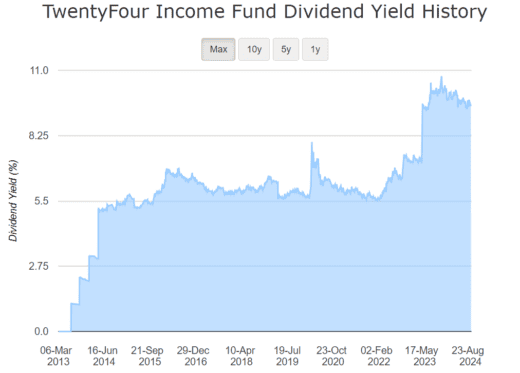
        If it keeps that up, it could pay 15p per share in 10 years. That’s a pretty decent return on shares that currently cost just over £1. The yield‘s now 9.5%, having almost doubled in the past few years.

        So what kind of income could I expect to earn from the stock? Well, assuming the yield and growth continue, 10,000 shares could be worth £114,330 in 21 years (with dividends reinvested). And that’s not taking into account any potential share price growth. At that point, the annual dividend could be around £12,000 a year.

        See the 6 stocks

        That would be a nice bit of extra income for a relatively small initial investment. But what stock am I talking about — and will it keep performing well?

        TwentyFour Income Fund‘s (LSE: TFIF) a closed-ended, fixed-income mutual fund managed by Numis Securities. The fund invests primarily in high-yield European asset-backed securities. Based in Guernsey, it’s only been operating for just over 10 years but already seems to be doing well.

        Screenshot from dividenddata.co.uk

        A high yield means this fund is in the top 10 dividend payers of 250 UK companies. It also offers good value with a price-to-earnings (P/E) ratio of only 5.7. That’s well below the UK market average of 14.4. 

        Sometimes this figure’s low because the price has been crashing, but over the past year it’s up 6.48%. That suggests the fund’s not only cheap but also performing well.

        In the same vein, the high yield isn’t inflated by a falling price. Rather, it’s the result of generous payouts by the company. This increases the likelihood that it could remain high for the indefinite future. 

        Considerations

        One problem I find with close-ended funds is that they provide little or no information about their holdings. This requires a lot of trust on the investor’s part, with only the performance of the fund to go on.

        TFIF is mostly investing in UK-based asset-backed securities and securitised loans. This puts it at risk of falling in price if the UK economy takes a dip. We all know from 2008 that certain investments like mortgage-backed securities can be risky.

        The level of risk depends on how well the fund’s managed. And with a market-cap of only £786m, liquidity could be an issue — meaning it may be hard to find buyers at the right price when trying to sell.

        There’s always a level of risk and reward involved!

        Making the most of an investment

        To maximise gains, I think it’s best to invest via a Stocks and Shares ISA. This type of ISA allows UK residents to invest up to £20,000 a year tax-free.

        Please note that tax treatment depends on the individual circumstances of each client and may be subject to change in future. The content in this article is provided for information purposes only. It is not intended to be, neither does it constitute, any form of tax advice. Readers are responsible for carrying out their own due diligence and for obtaining professional advice before making any investment decisions.

        I already hold several similar funds in my portfolio so I’m not planning to buy the stock today. But it’s on my watchlist and I think it’s worth considering for investors looking to increase their dividend income.

        ££££££££££££

        Note the dividend is 2p which equates to 8p a yield of 7.3%, any surplus funds are paid with the final dividend in April where the last dividend was 3.96p, so the headline yield is not guaranteed. Trading at 4.4% discount to NAV

        There is a sister company SMIF which pays a monthly dividend but trades at a small premium. As always it’s best to DYOR.

        Passive Income


        The Motley Fool

        How to create a ton of passive income within an ISA in 3 easy steps

        By Edward Sheldon, CFA
        Passive income’s often said to be the ‘holy grail’ of personal finance. With this form of income, investors get paid without having to actively work for the money.

        Here, I’m going to explain how UK investors can potentially build up a ton of passive income within an ISA in just a few simple steps. Let’s get into it.


        Pick the right ISA
        Thanks to higher interest rates, it’s possible to generate passive income within a Cash ISA. At present, some of these accounts are offering interest rates of around 5%.

        However, if an investor wants to generate a really high-level income, Stocks and Shares ISAs are a better bet, in my view. That’s because these products offer access to high-yielding investments such as dividend stocks and income funds.
        So if I was looking to create a powerful passive income stream, I’d start by opening this type of ISA.

        Look for attractive dividend stocks
        Once I have an account open, my next move would be to identify some attractive high-yielding dividend stocks.

        Now, this part of the process can be a little tricky. This is due to the fact that high-yielding stocks don’t always turn out to be good investments.

        Sometimes, a high yield’s actually a signal that the underlying company has fundamental problems. So it’s important to look beyond a company’s yield and think about its long-term prospects.


        One dividend stock I like the look of today is FTSE 250 company the Renewables Infrastructure Group (LSE: TRIG). It’s an investment company that owns a portfolio of clean energy assets (wind and solar farms etc).

        Looking ahead, the transition away from fossil fuels towards renewable energy is likely to be a huge theme. So the backdrop for this company should be quite favourable.

        Currently, the yield here is around 7.0%. This means that a £3k investment could potentially generate annual income of about £210 (dividends are never guaranteed though).

        Over the last two years, this company’s share price has taken a hit due to higher interest rates. After this fall, I reckon now’s a good time to consider building a position in it.

        That said, there’s always the chance that the share price could dip further. Falling energy prices are one risk to consider with this company.


        Diversify to reduce risk
        Given that every company has its own risks, the last step in my passive income plan is spreading capital out over a number of different stocks.

        This move – which is known as ‘diversifying’ a portfolio – can help to reduce stock-specific risk. This, in turn, can improve the chances of generating strong overall returns.

        For example, if you only own three stocks and one of them tanks, your overall returns could be ugly. However, if you own 20 stocks and one falls heavily, it’s probably not going to be so bad.

        « Older posts Newer posts »

        © 2026 Passive Income Live

        Theme by Anders Noren — Up ↑