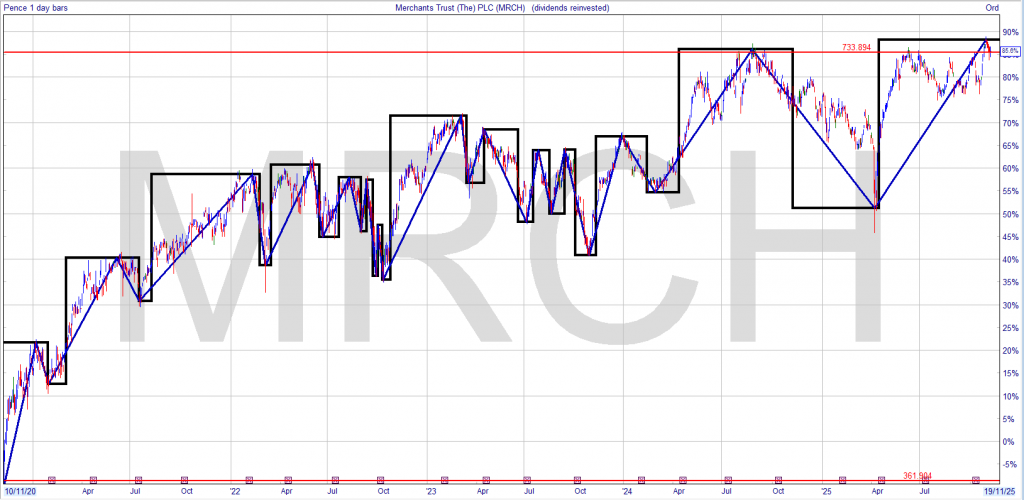
A equal weighted Investment Trust portfolio of higher risk and lower risk shares.
The blended yield is 8.9%, maybe for those that are closer to their retirement date, who have less time to recover from buying a clunker, although that is still a possibility.
This is definitely
But it is definitely a tale of the tail and not the dog.
Everything crossed for a market crash were you could get a better yield.
Debt funds finally have their day in the sun – how to invest
Story by Rupert Hargreaves
In the world of bonds and fixed income, US billionaire Howard Marks is a titan. After making a name for himself at Citicorp in the 1970s and then TCW Group in the 1980s trading distressed bonds, he founded Oaktree Capital Management in 1995, focusing on high-yield debt, distressed debt and private equity. Today, Oaktree manages about $200 billion in assets for its clients across distressed-debt and private-equity funds. Over the years, Marks, one of the most successful debt investors of all time, has become famous for his so-called investment “memos”. These are emailed to clients and posted online, and contain his thoughts on everything from the state of the markets to the economy and even family life.
With 55 years of experience behind him, Marks has witnessed multiple investment markets and cycles, including crashes, inflation peaks, interest-rate cycles and booms. His memos have become particularly poignant in the last few years as he is one of the handful of remaining fund managers who experienced the rate-hiking and inflationary periods of the 1970s and 1980s.
Debt trumps equity
When discussing investments, equities often take centre stage, but global debt markets are far larger, more diverse and more significant to the global economy. According to the Institute of International Finance (IIF), global debt reached a record high of more than $324 trillion in the first quarter of 2025 – that’s around three times the size of the entire market capitalisation of all global equity markets.
Howard Marks and Oaktree have carved out a niche in the distressed-debt section of the market. When a bond or a loan is first issued, it’s issued at what is known as “par”. This is generally a round number such as £1,000 or £100,000. This is both the issue price and the redemption price. Bonds are issued at a round number and then repaid at the same number. Prices are then quoted in pennies or cents and this gives an indication of what the market thinks about the instrument. For example, if a bond is trading at 97p on the £1, it indicates that the market believes it will be repaid in full. However, if the value of the bond slumps to, say, $0.30 on the $1, that’s a strong indication the market believes the bond won’t be repaid in full. Bonds trading at a significant discount to their issue price are generally described as being distressed. Transactions can be conducted at any point between the parties that own the bonds, even the company itself. Oaktree, for example, may come in and buy a bond at $0.10 on the $1. As a distressed-debt investor, it buys in the hope it will be able to generate some sort of profit either in a bankruptcy situation, or if the business makes a strong recovery.
A rough guide to bonds
Bonds have a stronger claim on a company’s assets than equity does. The most senior debt type is generally the senior secured first-lien, then there’s the secured second-lien loan, senior unsecured debt, senior subordinated, subordinated and junior subordinated. Other types of debt may exist below these senior debts, but in the worst-case scenario, these are the ones that are going to be paid first. Senior secured debt is both higher in the capital structure and secured against an asset, so if a company should fail, the security of that asset, such as a large warehouse, can be used to pay off the bond. Oaktree may come in and acquire a senior secured bond at pennies on the dollar from another debt holder and then pursue the company through the courts to reclaim the asset and potentially achieve a return of multiple times its initial investment.
That’s a rough guide to the trading value of bonds and the seniority of capital structures. The other core component of a bond or loan is the interest rate paid to investors. In many respects, the interest rate on a bond or loan tells investors more about the quality of the debt than the price. Pricing the interest rate on debt is somewhat of a fine art and will often depend on the quality of the debt, the level of debt in the capital structure and the position of the borrower, whether the debt is secured or not, and the duration of the debt as well as the firm’s credit rating.
A credit-rating agency such as Standard & Poor’s, Moody’s and Fitch Ratings are usually paid to assess the risk of every credit instrument and give a rating of credit quality. AAA is generally the highest (each agency has a slightly different system); C or D are the lowest ratings. The credit rating will affect the bond’s price and the interest-rate spread. The spread relates to the interest rate offered on the debt compared with a fixed benchmark, often referred to as the “risk-free rate”, such as the Bank of England base rate, or, more commonly, a US treasury of the same duration (the number of years outstanding: a ten-year Treasury vs a ten-year bond, for example). The wider the spread, the more risky the debt instrument is perceived to be.
Interest rates are set when the bond is issued, but prices and rates move inversely as the bond trades. If the price of the bond falls, the interest rate, which is set based on the issue price, will rise. For example, a £100 bond with a 5% yield will pay out £5 in interest a year. That won’t change, but the price could fall to £80 (80p on the £1). The £5 annual interest remains unchanged, which means investors purchasing at the lower price are buying with a yield of 6.3%. The same happens if the price of the bond rises above par, although in that case, the yield will decline.
Interest rates themselves can be fixed or variable. A fixed interest rate, often referred to as a “fixed coupon rate”, means that the bond issues a constant, predetermined interest payment (coupon) at regular intervals (semi-annually, for example) throughout its entire life, from issuance until maturity. A floating interest-rate bond, or “floater”, is a debt instrument whose coupon payments are not fixed, but rather adjust periodically (quarterly or semi-annually, for example) based on a benchmark interest rate plus a specified spread. Common benchmarks include the Secured Overnight Financing Rate (SOFR) or the Euro Interbank Offered Rate (EURIBOR).
Understanding the key risks
This, in a nutshell, is how bonds, loans and credit instruments work. When trying to understand the risk associated with any particular credit investment, investors only need to be concerned with two metrics: duration risk and credit risk. Credit risk, also known as default risk, represents the likelihood of the issuer making timely interest payments and repaying the principal amount at maturity. It’s the risk that the bond issuer will fail to meet its financial obligations. Duration risk is a measure of a bond’s price sensitivity to changes in interest rates. The longer a bond’s duration, the more sensitive its price will be to interest-rate fluctuations.
Austria’s 100-year bond, which launched at the peak of the zero-interest rate era, is the best example of duration risk. The bond was issued at par with a yield of 0.9%, with a modified duration of 40%. That means that for a 100bps increase or decrease in yield, the bond price moves by 40%. As interest rates have surged, the value of the bond has fallen by nearly 70%. Investors who are able to hold until maturity in 100 years’ time will still see redemption at par, but anyone selling today will have to stomach a 70% loss of principal (the yield has risen to 2.6%). Short-term bonds and those credit instruments with floating interest rates have the lowest duration risks. Long-term fixed-rate products have the highest duration risk.
Despite the size of the credit and debt markets, these areas are usually out of reach of individual investors. Wholesale bonds, typically traded by institutional investors, often have minimum denominations of £100,000, and most brokers won’t even bother dealing with trades below several million pounds in size. The more esoteric debt instruments, where the best returns and opportunities can be found, aren’t usually publicly traded. However, there’s a range of investment trusts that specialise in just this area, and right now investors can build a portfolio of credit with a near double-digit yield and reduced down-side risk compared with an equity portfolio.
The investment trusts to buy now
Investment trusts are perfectly suited to holding different types of debt, especially in situations where there isn’t a liquid market. There are 24 listed debt and lending trusts and, of these, nine have less than £100 million in assets under management and don’t really have the scale needed to compete effectively. GCP Infrastructure Investments (LSE: GCP), Sequoia Economic Infrastructure (LSE: SEQI) and BioPharma Credit (LSE: BPCR)are the largest.
GCP and Sequoia both specialise in lending to infrastructure projects. Sequoia, the largest of the two, has an average investment of £23.7 million with a weighted average maturity of 3.5 years. Just under two-thirds of the debt is senior and secured against an asset, with 41% on floating interest rates. The floating-rate nature of the portfolio, coupled with the relatively short duration of assets, means duration risk is relatively low. It’s an active trader of assets when opportunities emerge. For example, it recently acquired the bonds of Navigator Holdings, a market-leading owner and operator of liquefied gas carriers, owning 56 vessels, at 7.25% – 10/2029 bonds for $8.0 million. That’s a small holding for the portfolio, but it’s an attractive debt play that’s not available to the average investor.
Sequoia’s portfolio has a much shorter duration compared with GCP, with the average life of GCP’s investments standing at 11 years. With the shorter lifespans in the portfolio, Sequoia has been able to recycle its assets into higher-yield investments to take advantage of the changing interest-rate environment and, on a purely net-asset-value basis, Sequoia does offer the higher yield. At the end of May Sequoia’s net asset value (NAV) stood at just under 92p per share, suggesting the shares are currently trading at a discount of 14%. The yield is just under 9%. GCP’s last-reported NAV is around 102p, but it’s trading down at 74p, a discount of nearly 30%. This is a reflection of the long-duration of the assets. With a target annual dividend of 7p, the stock yields around 9.5%.
BioPharma Credit is managed by Pharmakon Advisors, LP, a specialist $10 billion biotechnology investor that’s been around since 2009. BioPharma lends money to small and mid-sized companies in the life-sciences sector. As Pedro Gonzalez de Cosio, co-founder and chief executive officer of Pharmakon Advisors, said earlier this year, this is a niche but lucrative market if you get it right. These businesses have “a monopoly in treating a certain disease in a certain way… but most of these companies are at a stage where they are probably still investing more in launching the product… So they have these assets worth a lot of money, but they’re still burning cash”.
At the end of January, just over 60% of the portfolio was allocated to just three senior loans (to three separate companies). However, as Pedro argued, the portfolio shouldn’t be viewed in isolation. “I can guarantee you that [by] investing in us [you] diversify your portfolio because there is no other way that you can get access to these assets.” The bulk (76%) of the portfolio is floating rate, to be repaid within two years at interest rates of between 8% and 12%. And companies generally commit to additional payments if the bonds are repaid earlier than scheduled. That’s helped the trust pay around 50% more in special dividends than was initially projected at its initial public offering. At the end of May the trust was trading at a discount to net asset value of 12.8% and offered a dividend yield of 11.6%.
There are two debt trusts managed by TwentyFour Asset Management, a boutique manager of the Swiss-based Vontobel Group. The Swiss group manages £18.1 billion in total, of which Twenty Four Income (LSE: TFIF) accounts for about £850 million and TwentyFour Select Monthly Income (LSE: SMIF)makes up £250 million. The larger trust is a rarity among UK investment trusts in that it currently trades at a premium, and it’s been issuing new stock to take advantage of strong demand for the shares. A total of 42% of its portfolio is in residential mortgage-backed securities (RMBS) and the rest of the portfolio is a mix of other securities, such as student loans and commercial mortgage-backed securities (CMBS). These assets, which are a bit further up the risk curve than the senior and secured loans typically held by other trusts, offer more in the way of yield. At the end of May, the average yield of the portfolio was close to 12%. Over the past year, the company has paid a dividend yield of 11p per share, boosted by higher interest rates as its portfolio has rolled over, a dividend yield of around 10% on the current share price.
CVC Income & Growth (LSE: CVCG) is part of the private-equity giant CVC Group. Overall, the CVC Group has €200 billion of assets under management and buys high-yielding sub-investmentgrade loans in the direct lending market. Like TwentyFour, this market can be perceived to be a bit riskier than other loan and debt markets, but CVC is very careful about where it puts its investors’ money. “We attach at a 50% loan-to-value [ratio],”
Mitchell Glynn, the assistant portfolio manager, said and “80% is secured…we are a secured investor,” he adds. As a result, “there’s a big equity cushion below us, so there’s protection if something goes wrong”. Often, CVC is lending money to companies that have been shut out of other markets, which means the fund can charge 12%-13% or more to borrowers. If it’s able to buy debt on the open market at a discount, returns are even higher.
That’s happening a lot right now as highly leveraged firms are struggling in the higher-rate environment. There’s an “abundance of opportunities”, but there’s also an “abundance of toxic opportunities”, says Glynn. The fund is also trading at a premium and has been raising money to take advantage of the increased demand for its shares. The company is guiding for 9.25p per share in dividends over the coming year, giving a dividend yield of 7.8%, although it’s likely to top this up with special dividends. However, this isn’t just an income play – over the past five years, CVC’s debt-trading strategy has helped it generate both income and capital growth. The trust has generated an annualised total return of 16.7% over the past five years, with a total return of 29.2% last year for the sterling shares and 18.1% in 2023.
AI generated image, doesn’t yet understand the game of cricket.
One in particular, the Royal London Short Term Money Market fund has been one of the most-bought funds for every month this year. So what are money market funds? Well, they’re effectively a cash savings account that you can own in an investment wrapper. So your General Investment Account, your ISA, or your SIP, and you’re paying a normally very low fee, can be 0.1% a year for a professional fund manager to deliver a cash like return for you.
Bull points
Returns around the current bank rate.
Tax free if held inside a tax free account.
Income either paid Monthly or an Accumulation unit available.
Bear points
Being a Unit Trust it only trades at noon, so a small wait for funds to be credited to your account.
When interest rates fall so will the money market returns, so one option if you think rates are going to fall is to lock in the rate with a Gilt purchase.
If held outside a tax free wrapper, easiest if the monthly income option is bought as there is a rather convoluted tax calculation for the accumulation unit.
Key trends and top-performing funds so far in 2025
Our latest episode runs through key trends and reveals the best-performing funds and sectors so far in 2025.
2nd July 2025
by the interactive investor team from interactive investor
We’re halfway through the year and for investors it has been very eventful. This week’s episode takes a look back at key trends that have played out so far. Joining Kyle to help unpick it all is interactive investor’s Sam Benstead. The duo give their take on the investment lessons from the US tariffs causing stock markets to slump in the first quarter, talk through trends within the funds industry, and crunch the numbers to reveal the best-performing funds and sectors year-to-date.
Kyle Caldwell, funds and investment education editor at interactive investor: Hello, and welcome to the latest episode of On the Money, a weekly bite sized show that aims to help you get the most out of your savings and investments. We’re now at the halfway point of the year, so this week’s episode is taking a look back at the key trends that have played out so far in 2025. We’re going to be looking at the investment lessons that were learned from the tariff turmoil that caused stock markets to sell off earlier this year, and we’ve also crunched numbers to look at the top performing funds and sectors year to date. And all that data is to the time of this recording, which is on the 27th June.
Joining me to unpick all of this is interactive investor’s Sam Benstead. Alongside myself, Sam regularly interviews fund managers and writes lots of news analysis articles related to funds, investment trusts and ETFs. So, Sam, let’s start off with tariffs, which have dominated the headlines. They caused stock markets to become more volatile, particularly in the first quarter this year. Let’s take a step back. Could you give an overview of why US President Donald Trump’s tariff policies caused the US stock market and by extension the global stock market to suffer sharp falls from around mid-February to 8th April? And could you also detail the extent to which both US and global markets fell over that period?
Sam Benstead, fixed income lead at interactive investor: So the real key period was between 19th February and 8th April. And what started out as lots of optimism when Donald Trump was elected for the second time, quite quickly turned into pessimism when investors realised that his pre-election promises of tariffs were actually probably going to come true and could be way worse than investors were anticipating. So we had this big build up to what he called Liberation Day on the 2nd April, and people were expecting relatively modest modest tariffs. But what they got was a big presentation with lots of graphics on high tariffs on almost every country in the world.
And if actually Donald Trump went through with these, it would have caused a really deep global recession and would have been a massive shock to stock and bond markets around the world. So during that key period from the 19th February to the 8th April, the S&P 500 dropped -19%, the Nasdaq composite dropped -24%. UK shares fell about -10% over that period, so they were relatively well protected versus the US. And we had this capitulation on that key week on Wednesday, Thursday, Friday when the Liberation Day tariffs were announced. That caused a really key moment in bond markets when actually investors went from buying bonds causing yields to fall to suddenly dumping US bonds and causing US bond yields to rise, which of course increases the cost of the government deficit in The United States. And at the same time, we had an unusual environment where, actually, the US dollar was falling at the same time that bond yields were rising, which is actually pretty typical of an emerging market confidence crisis where everybody just wants to get their money out of that market.
But things, turned quite quickly when the bond market was collapsing. I think it was the influence of the Treasury Secretary Scott Bessent that actually, you know, made him whisper in Trump’s ear saying, this is a bit too much. Things are getting very panicky. This is not good news at all. And Trump actually announced a ninety day pause in tariffs, which sparked a huge reversal in the stock market losses.
And, actually, if you now look back at the year-to-date, you hardly know anything happened during those critical few months in in February, March and April. The S&P 500 in dollar terms is up 5% this year. The FTSE All Share, excluding dividends, is up 6%. But, actually, your portfolio might not look quite so rosy because the dollar is down -9% against the UK pound. So that means if that that if you own US assets via an index fund tracking the S&P 500 or a global stock market fund, which is 70% invested in the US, you are still not back to even quite yet.
Kyle Caldwell: And as you mentioned, Sam, what sparked that market recovery was Donald Trump announcing a ninety-day delay on implementing tariffs for most countries. And then following on from that, we had The US and China announced the reduction in the tariffs that they were imposing on each other. And, of course, we also had the US/UK trade deal. A key lesson for me, Sam, during that tariff turmoil was the power of diversification. Over that period, if you owned a mixture of different investment types, both shares and bonds, your portfolio was typically well protected against the stock market volatility.
So if you look at the performance of multi-asset funds year-to-date, so funds that sit in the 0% to 35% Shares sector, which is the safest of the multi-asset sectors. The average fund is up 2.4% year-to-date. And if you are willing to take a bit more risk, the average fund in the Mixed Investments 20% to 60% Shares sector is up 2.9%. So this shows to me that bonds worked very well as a defensive ballast during that turmoil. And if you were patient and held on, then year-to-date, you are in positive territory if you had a mixed investment approach.
Sam Benstead: Yeah. And I think these these difficult market periods, any 20% drop, in theory, you might think you can withstand that psychologically. But, if you have all of your all of your wealth and your pension and your your ISA and you see a big 20% drawdown it may be much more painful than you think. So having a spread of of of different assets and outsourcing that to a fund manager is a very sensible decision. And if you’re investing in a fund run by someone else, you actually should have confidence they are going to protect you be invested sensibly rather than picking everything yourself where you can own all that all those decisions and you see your decisions actually leading to a stock market drop, that can be quite a difficult thing to go through.
Another key takeaway for me was that money market funds actually were a very sensible place to be invested, and we’ve seen money market funds really rise in popularity this year. One in particular, the Royal London Short Term Money Market fund has been one of the most-bought funds for every month this year. So what are money market funds? Well, they’re effectively a cash savings account that you can own in an investment wrapper. So your General Investment Account, your ISA, or your SIP, and you’re paying a normally very low fee, can be 0.1% a year for a professional fund manager to deliver a cash like return for you.
And to do this, they invest in ultra safe short-term bonds maturing in just a couple of months. They also put money away with banks and overnight deposit tools and generally have access to lots of ultra safe money market instruments to generate a return on your behalf. And returns are typically in line with the Bank of England base rates. So because of that, about halfway through the year, money market funds are up just over 2%, which makes sense given that the Bank of England interest interest rate has been 4.5% this year until a couple of months ago. If you look at that in the context of inflation, inflation has been about 3% this year, so you are getting a positive real return.
I interviewed fund managers managing money market funds during all the tariff tension and when stock market is in bond markets were falling. And they said there’s been no impact on money market instruments. It’s been business as usual, no volatility, and they’re just delivering that safe return for you. So holding cash in account has been a very good tool against stock and bond markets falling as you would expect, and yields have been ahead of the inflation rate this year.
Kyle Caldwell: And as well as money market funds, other defensive investment types performed well during the tad of turmoil. Well, I say they perform well, they performed as one would expect and hope that they would. We often talk about the trio of wealth preservation investment trusts, which are Capital Gearing Ord
and Ruffer Investment Company RICA0.00%. All three of them did fulfil their mandate of protecting capital during that period that we just spoke about from mid-February to 8th April.
However, star of the show has been gold, which we will come onto later on in the podcast, as spoiler alert it has been gold funds that have dominated the top-performing funds in the first half of this year. But before we get to that, we will turn our attention to a couple of trends and themes we’ve spotted in the first half of this year. The first one is the defence sector. So we’ve seen investors up exposure to defence as a geopolitical hedge.
And another factor at play is that some investors have been viewing the increases in European defence spending as a potential opportunity. It’s a sector that’s been running hot. So, for example, Germany’s biggest weapons maker, Rheinmetall, has seen its share price soar by nearly 200% since the start of the year. We’ve seen among customers of interactive investor, Sam, two defence-focused ETFs climb up the popularity rankings. Could you talk through them?
Sam Benstead: Yeah, of course. So, actually, I identified four ETFs tracking the defence sector with a couple launching more than a year ago and two launching this year. So the ones for the full 2025 record are HANetf’s Future of Defence ETF Acc
and both are up more than 20% since launch. So amazing returns from the sector. And as always, an ETF is a very efficient way of getting access to a theme without having to do your own stock market research. And I’m normally sceptical of ETFs when they launch, particularly thematic ETFs because there’s generally a hype cycle. The big fund managers get on board with this. They see demand for a product, and then they launch it. And, actually, by the time they they’ve launched a product, often it’s too late and you see a bit of a drop in the ETF before before the theme comes back around again. But this time around, think the defence theme has much further to go. We had a NATO summit this week, and all the NATO members announced big increases in in spending on defence. And there’s only a limited number of defence companies out there, so naturally all this capital go goes into those companies.
And before this boom over the past couple of years, they were super, super cheap as well. No one wanted to own these shares. So even though we’ve seen this big run up, fund managers have been telling me that actually these companies still look good value. And if all this spending actually comes to fruition, it should be extremely good for these companies still. One of those was Alec Cutler at Orbis, who’s a very savvy value investor, and he started buying defence shares a few years ago. And he told me recently that actually he still likes the sector and it still has further to run.
Kyle Caldwell: So that’s certainly been a trend within the ETF space. Now let’s switch to investment trust trends. So it has been a very eventful six months for the investment trust industry. US activist investor, Saba Capital, attempted to oust the boards of seven investment trusts early this year. Now while it wasn’t successful in its campaign, it has had success elsewhere as Middlefield Canadian Income Ord
has proposed converting into an ETF or offering shareholders an exit close to the value of its investments, which is the net asset value, NAV.
Now the reason why Saba has circled the investment trust industry is due to the fact that investment trust discounts are at historically wide levels, and they’ve been at those wide levels for a couple of years now ever since interest rates rose and peaked at 5.25%. This has lowered demand for investment trusts. And as a result, lots of investment trusts are trading on discounts, and the average investment trust discount is over 10%, and it has been like that for a couple of years as I’ve just mentioned. Now while Saba wasn’t successful in its campaign, four of the seven trusts that it did target made changes. So some of them have merged with open-ended funds, some have announced tender offers, which give shareholders the opportunity to exit at close to NAV, which in effect removes the discounts that the investment trust are trading on for those investors. So it could be argued that, actually, Saba has been successful in its campaign because boards have introduced those measures, given shareholders an opportunity to exit at a better price rather than seeing their investments languish on a stubbornly wide discount.
Sam Benstead: It’s been such an interesting thing to watch play out this year. You’ve been you’ve seen this big American activist hedge fund go on the attack against relatively sleepy, archaic part of the investment world where a lot of these boards can potentially be accused of being a bit lazy and not doing enough to close discounts. And I think the impact overall for shareholders has has been brilliant. It’s shaken it up.
We’ve seen lots of discounts narrow. And, you know, if you were if you were sitting in one of these investment trusts, you’ve now got the option to get out at at NAV. I think that’s been a very good option. And, of course, you don’t have to take up that right, and you can hold on to the shares. But, generally, I think it’s been a good thing, and I don’t think it’s over yet as well. I think we’ll see Saba come out with some more high profile attacks on investment trusts.
One of the other trends we’ve seen this year in the investment trust world is scale becoming more and more important for boards. There were a couple of recent mergers announced in the European investment trust sector with the proposed combination of Henderson European Trust Ord
So as you mentioned, Kyle, the fact that investment trust discounts have been stubbornly wide for a couple of years now is prompting boards to become more and more proactive to try and increase demands. Ultimately, the bigger the investment trust, the greater the chance of higher demand due to the likelihood of it being on the radar of both retail investors and wealth managers. And for wealth managers, this is particularly important as the minimum size they tend to look at is £300 million for an investment trust due to the amount of money that they run on behalf of clients. Basically, if they are large investors, they cannot commit a large sum of money to investment trusts with a smaller amount of assets for liquidity reasons as it can prove problematic to sell a large sum when investment trust is less popular and not seeing much demand.
Kyle Caldwell: I can only see these trends accelerating over the next couple of years. I think scale will become more even more important for boards. At the moment, for wealth managers the minimum size they tend to look for investment trust is around £300 million. Over time, that will likely increase, in turn putting pressure on the more potentially subscale investment trusts. For a retail investor, that doesn’t mean that you can’t consider investment trusts that got £100 million or £200 million of assets. And in some cases, some may be potentially hidden gems. However, one thing that I’d look out for is the bid offer spread when it comes to size because for smaller investment trusts the bid offer spread can be, on occasion, quite wide. So that’s something retail investors should bear in mind and take a look at when they’re doing their wider research.
Let’s now turn to the best-performing funds and fund sectors since the start of the year. Let’s focus on sectors first. So, Sam, I I ran the numbers. And at the time of this recording, As I mentioned earlier 27th June, the top five overall sectors and their performances are Latin America, the average fund is up 15.8%, followed by European Smaller Companies, the average fund is up 13.2%. Then it is Europe excluding the UK, up 11.6%, then Europe including the UK, with the average fund up 9.6%. And then in fifth is UK Equity Income in which the average fund is up 8.2%.
Sam, are you surprised to see Latin American funds in top position? It’s, of course, a very specialist fund sector. It’s very high risk. I don’t think many investors will have much exposure to it. And if they do have exposure to it, it should ideally be a small amount of exposure as part of a well diversified portfolio. Can you put your finger on the reasons as to why it has performed so well?
Sam Benstead:Yes, I was also surprised to see Latin America there. It’s not a sector I’ve read much about this year, and it’s also a bit of a yo-yo sector. It can have really good years followed by really poor years. Like you say, only really worth a small allocation unless you have a really strong view on the investment sector.
But I did some digging, and there are a few factors that stood out. So the first one, and I think this is the most important one, is that a weaker US dollar has been good for a lot of the mining and oil and gas companies that operate in Latin America. And these types of companies generally make up the lion’s share of the investment market. So a weaker dollar means that because these commodities are priced in dollars, it means they can sell more of these assets to overseas buyers. So it’s generally been good news for profits at a lot of the mining and oil and gas companies in Latin America.
And the other reason, and it’s a bit like the UK, is that there’s just been a rotation out of the US market into better value markets, and Latin America is definitely better value after a poor 2024 and a poor 2023. So, generally, this move to cheaper assets, better value shares has been good news for Latin America in the same way that it’s been good news for UK.
Kyle Caldwell: However, I wasn’t surprised to see European funds among the top-performing sectors in the first half of 2025. Europe has been performing well for the past 18 to to 36 months. While investors may find some of the sectors less exciting, for example Europe offers less technology exposure. However, these defensive areas, the likes of healthcare, financial services, defence, they’ve they’ve been performing well in a periods in which economic growth has been sluggish because they offer stable performance due to the consistent demand for their products and services. So on a three-year view, the average European fund is up 40.3%. This compares to the average return of 28.2% for the average UK equity fund.
Sam, let’s continue with the UK. While the average UK fund has underperformed the average European fund over three years, we have seen an upturn in performance of late for the UK. The UK Equity Income sector was the fifth best-performing sector in the first half of 2025. Sam, what have been the key performance drivers for UK funds?
Sam Benstead: So for me, the biggest driver of returns has been that value shares are back in fashion. So investors are taking money out of the pricey US market and looking at better value opportunities, particularly in Europe and in the UK. As the UK market has been cheap, there’s lots of great value opportunities there, and that has been boosting share prices. But while shares have been cheap and that’s been attracting assets, the market is still very underpriced versus the US. I think there’s going to be continued demand for UK shares for that reason. You’ve also got a pretty punchy dividend yield on The UK FTSE All Share at about 3.5%.
So in a world of really high geopolitical uncertainty and volatility, getting that dividend yield has also been appealing to investors. I think another thing that stands out about the UK market is that we’re quite insulated from trade wars with the US. So we have this UK/US trade deal. Generally, relations are quite strong. And also The UK market isn’t full of complex multinational manufacturing companies similar to Apple in the US or car companies across Europe.
So, actually, if we do see a big turndown in global trade, the UK market could look quite competitive in that environment. Will this continue? I recently wrote a story for our website on ‘three reasons the UK outperformance can continue’ and brought in a few views from leading UK value investment managers. Their view is that, yes, the UK market is still cheap. As well as, this installation from trade wars is a good thing for the market. And the final thing they said is that actually global investors are seeing this opportunity and flows coming back into The UK will be good news for share prices.
Kyle Caldwell: And in terms of the worst-performing fund sectors, the bottom three are North American Smaller Companies, the average fund is down -11.7%. Then Health care, the average fund is down -10%. And then the India/Indian subcontinent sector in which the average fund is down -7.2%.
North American Smaller Companies being the worst-performing sector is not much of a surprise. If you invest in smaller companies, they can, of course, offer greater rewards compared with larger firms, but they do carry greater risk. When there’s a downturn, smaller company shares do tend to fall further, and so it proved in the first half of this year when there was a pickup in stock market volatility. There was also quite a lot of expectations that US domestic stocks would perform well with Donald Trump returning to the White House. The expectation was that Trump’s American first policy would boost the demand for domestic stocks and The US economy. However, this has not played out so far, and I think that also has played into the fact that North American Smaller Company funds have had a tough time in the first six months of 2025.
Let’s now turn to the best-performing funds in the first half of the year. Sam, I did mention earlier, I gave it away, gold funds have stood out as the best performers. Could you run through some of the fund names and explain why gold continues to shine?
Sam Benstead: So definitely, let let’s start with the gold price. So it started the year at $2,625 per ounce. It’s now at nearly $3,300 an ounce. So that’s a 25% increase in US dollar terms this year. And and why is gold rising?I think there’s two main reasons. The first one is what you would expect. So we’ve had a lot of worry in markets this year, trade tensions, war The Middle East. As gold is a proven hedge against uncertainty, it often rises when investors are afraid.
But that’s just one part of the story. I think the most important part actually is this idea that government deficits are rising. Inflation is still quite high. There’s lots of spending being announced by governments, lots of borrowing, and all this just means that there’s an increased money supply, an increased supply of dollars, an increased supply of pounds swirling around the economy. And, actually, that’s just a reason for inflation to be longer for higher. And in a time of inflation, what you really want is a fixed asset where the supply isn’t going to increase, and gold is the thing that investors turn to during those times. So because they’re worried about the money supply rising, gold being fixed in supply is rising versus fiat currencies. So that, I think, has been behind the rise in the gold price this year.
But if you dig into the data, gold price up about 25%, but gold miners has to have done even better. So it’s funds that have been investing in gold miners that have done incredibly well this year. So what are the risks and opportunities with gold miners? Well, for me, they can just be viewed as a levered bet on gold. So a rising or falling gold price leads to big swings in the profits or losses at these gold miners. There’s also a few other things to be aware of when when investing in gold miners. So there’s the risk that managements do something very positive or very negative at a specific company. Companies can find new reserves, which can be a boon for profits, but also gold mines can get caught up in local issues around mines, particularly in the emerging world. So this also increases the risk and opportunity of gold miners over gold.
And in terms of funds that invest in gold miners that have done really well this year, so I’ll just name three of them, the top three in terms of returns year-to-date. And at number one is the SVS Baker Steel Gold & Precious Metals fund, which is up 52% this year. Then Hanetf AuAg Gold Mining, an ETF with stock market ticker ESGP, is up 49% this year, while the Jupiter Gold & Silver fund is up 47%.
Among the other top performers, there are a few other thematic funds. I think this is typical really. So when funds track a niche theme, it’s often boom or bust because they’re very concentrated bets on a specific type of the stock market. So alongside all these gold names, we’ve seen funds investing in banks, defence, Polish shares, and Korean stocks do well this year.
Kyle Caldwell: And for investors that have not had exposure to gold and now have FOMO and are thinking about having some exposure now, there’s, of course, always the danger of buying in potentially at the peak after a strong run. What are your thoughts, Sam? Is it now too late to join the gold party?
Sam Benstead: I don’t think so, but there’s a risk of trying to make a short-term bets on the price of a metal. But if you think, actually, I like the story of gold. I like this idea that it holds its value when normal currencies do not, and you want to to add a long term allocation portfolio, say three or 4%, I I don’t think now is a bad time to try and make that decision as long as you’re investing for the long term and not looking to make a short term profit. So how would you do that? There’s the gold mining funds, which as I explained, are a bit riskier, but actually, I think the most I think the purest way of adding to gold to a portfolio is to do it with an ETF that is backed by physical gold. So one of those features on our Super 60 list, and that’s the iShares Physical Gold ETC, stock market ticker SGLN. That I would say is the best way of doing it. Try and keep the allocation fixed. So actually, if you see gold go up a lot, you might want to trim to try and keep that allocation at 3% or 4%. If gold is falling a lot, then actually you might want to buy more to try and get that allocation at your desired amount.