Stop Buying Junk: These 2 Quality Income Picks Pay 8% And 10%


Leo Nelissen
Investing Group Leader
Summary
- Adams Diversified Equity Fund and Ares Capital Corp. stand out as high-quality income vehicles with strong track records and distinct risk profiles.
- ADX delivers an 8% annualized distribution from a diversified, actively managed large-cap equity portfolio, mainly funded by capital gains, with total returns beating the S&P 500.
- ARCC provides a stable 10% yield from private credit, supported by a diversified loan book, low non-accruals, and a 17-year record of stable or growing dividends.
- Both trade near NAV/book value, offering fair entry points, with ADX distributions taxed as capital gains and ARCC as ordinary income—key for after-tax returns.

(A Way Too Long) Introduction
I remember that in the very first book on investing I ever read (I think I was 14 or 15 back then), it included a story about people who were so frugal that they collected shower water in buckets to water the plants and used thick blankets to keep heating to a minimum during winter.
Unfortunately, I have no idea who this was about and what eventually happened to them (I don’t even know the name of the book anymore), but I thought about that a lot. I’m a bit frugal, too, but only relatively speaking. I don’t do any weird things, and I’m known to spend a lot of money on things if it makes my life even a tiny bit easier (I’m also a bit lazy in some regards).
There are a number of reasons why I’m not a typical compounder from the FIRE movement who saves every penny and cuts costs to the bone just to retire early. One of them is that no new day is guaranteed. Don’t forget to enjoy life. I know so many people who earn below average, yet I am pretty sure that they have happiness levels way above the levels of many millionaires. Also, I am very blessed to make OK money, which means I don’t have to turn over every penny (or euro cent, in my case) before making a purchase.
Having said all of this, my biggest message to people isn’t to be overly frugal, but to focus on growing one’s salary/income. Income is our most powerful lever, as that’s the money that comes in every month. And while this is Seeking Alpha, where I believe many people are good at picking stocks, in general, I tell people to just buy ETFs and focus their energy on getting a higher income.
I hope it doesn’t sound condescending, but someone who spends weeks thinking about where to invest $500 or $1,000 is way better off buying an ETF and just excelling at their job (which is hopefully based on their passion). If your income grows by just $500 a month, and you invest all of it, you end up with almost $100,000 after ten years based on no initial investment and 10% annual returns (see below).
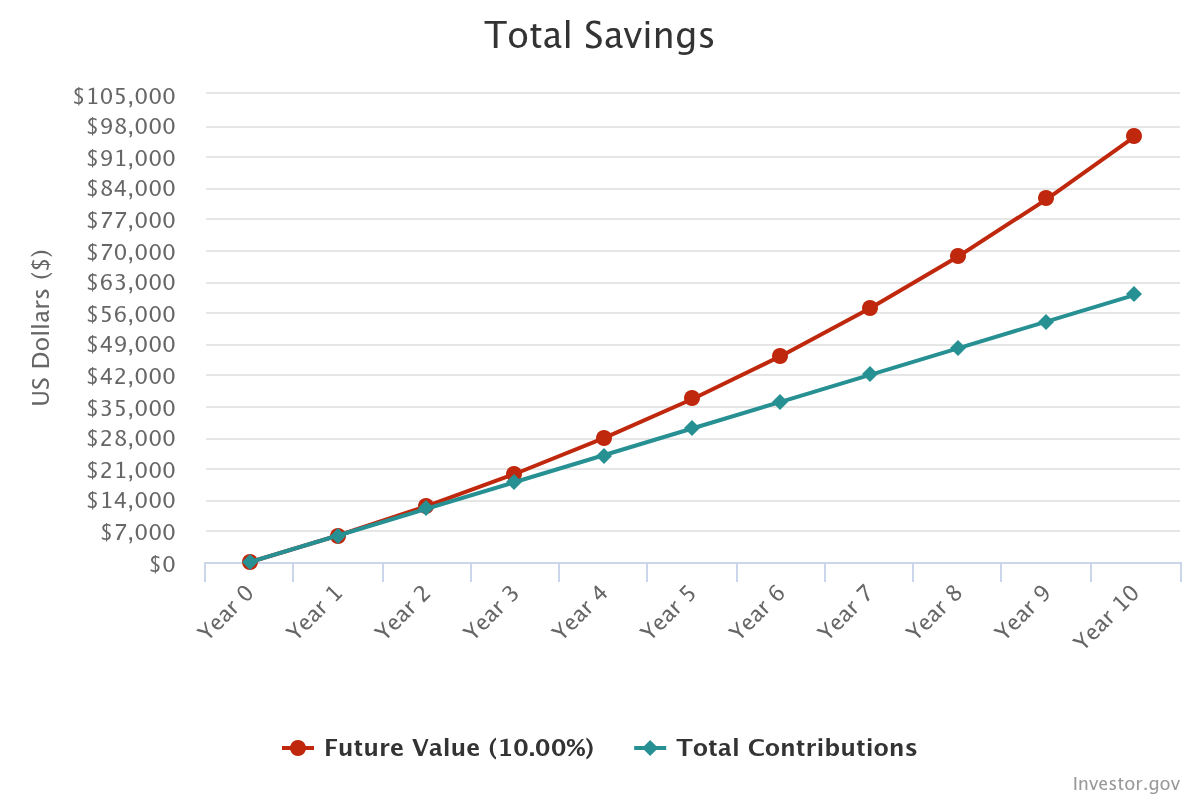
It’s purely theoretical, but you get the point.
Then, there are costs. As important as income may be, costs can be huge pitfalls. Just think about overly expensive rents, that car you want but don’t need that costs $700 in monthly payments, or that addictive hobby (think of sports betting). Or even eating out and stuff like that.
It is so incredibly easy to waste a lot of money.

Another great example of costs is the Kiplinger ranking of the richest counties in the U.S. That ranking took the cost of living into account, as it adjusted the median household income for the cost of living. For example, if I earn 10% above average in a given city but have to deal with 25% higher costs, I don’t really win, do I?
To give you a real example from the article, Stafford County is the 18th-richest county on paper. But after adjusting for costs, it’s the third-best. Falls Church drops from 5th to 8th place due to 21% higher-than-average costs.
By the way, the winner was Loudoun County, Virginia. As some/many of you may know, it’s where many defense contractors are. It’s where Washington Dulles International was built in the 1960s. It is a massive data center market, and many people have high degrees. Also, its cost of living is 13% above the U.S. average, which isn’t horrible in light of its income profile.
And that’s what the second part of this article is about, as I focus on high-quality income where costs are under control and risks are acceptable. After all, we’re talking about 8% and 10% income, which is usually an area where I get extremely careful due to the risks that come with seriously elevated income.
That’s also why taxation and other costs are important, as we don’t want to waste our capital on items like tax before we get to decide what to do with it.
Now, let’s get to it!
Adams Diversified Equity Fund (ADX) – The One That Pays 2% Each Quarter
In a recent article, I brought up PEO, which is the Adams Natural Resources Fund (PEO).
ADX is similar, as it’s also a closed-end fund (“CEF”). However, unlike PEO, ADX brings a lot of diversification to the table, which is a great thing if you want to avoid stock picking. And, for many investors who focus on income, avoiding stock picking and the related costs (think of transaction costs) is a great way to keep more of your income (which brings me back to the intro of this article).
With that said, ADX has been around for a long time, as it was founded in 1929. And because there are many CEFs on the market, I need to add that this one is special, as it’s an actively managed one that doesn’t use leverage and focuses on large-cap U.S. stocks.
Here’s the current list of its biggest holdings. Note that it also owns PEO (2% exposure).
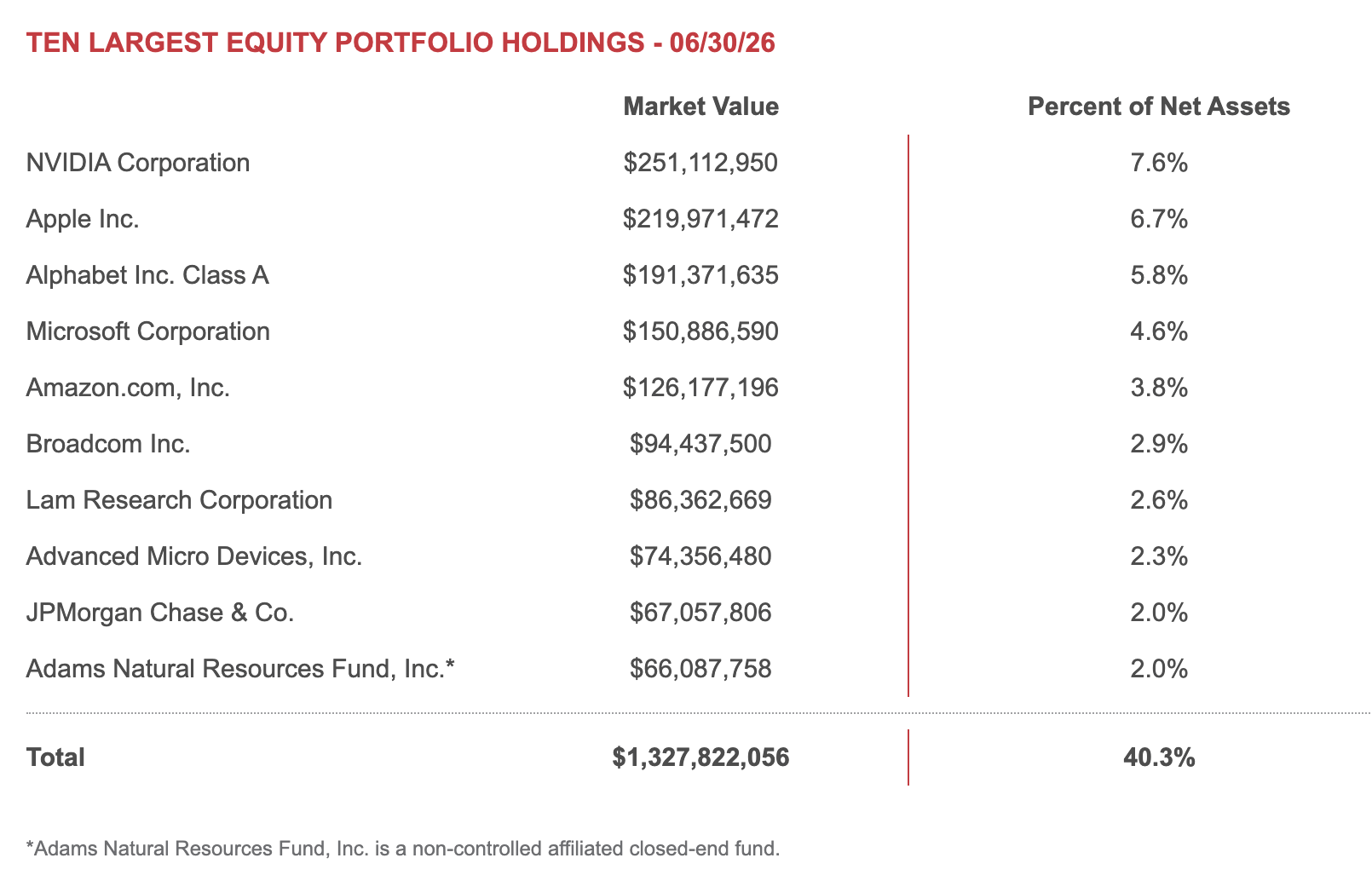
The problem is that, as much as I love most of these stocks, they don’t provide much income.
ADX, however, pays 2% per quarter in distributions (dividends). That’s 8% per year.
So, how does that work?
There are multiple ways for CEFs to pay distributions. That’s almost obvious, as there’s no way you can get 8% income from a fund that owns some of America’s biggest companies that all yield way less than 8%.
As we can see in the handy overview below, income dividends account for just a tiny part of total distributions. These are the dividends it receives from the companies it holds. Most income came from both short-term and long-term capital gains. The company sells these stocks at a profit and returns the proceeds to its investors. They do that to avoid being taxed, as they are forced to distribute at least 90% of these proceeds.
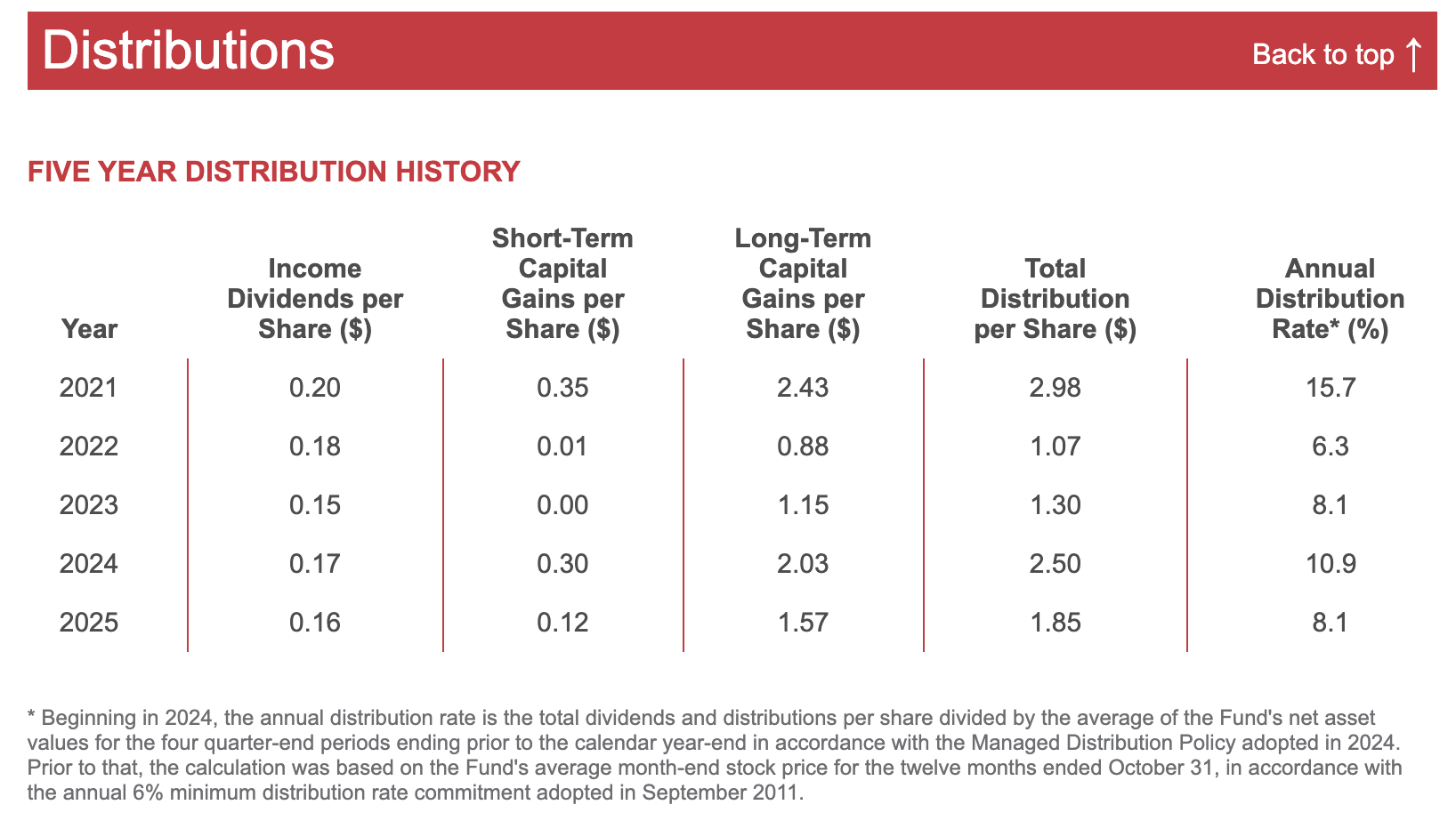
That explains the variance in distributions, as poor stock market years tend to result in the absence of major gains to distribute. That’s something investors need to keep in mind.
And now comes a very important thing. An 8% payout of its NAV basically means that the NAV grows at the total return minus the 8%. That’s simple, as it’s the growth that doesn’t return to shareholders. As ADX returned 16.5% per year over the past ten years (see below), it means that the company grew its total assets even after distributions. That’s great (and important), as I highly dislike it when investors get paid their own capital.
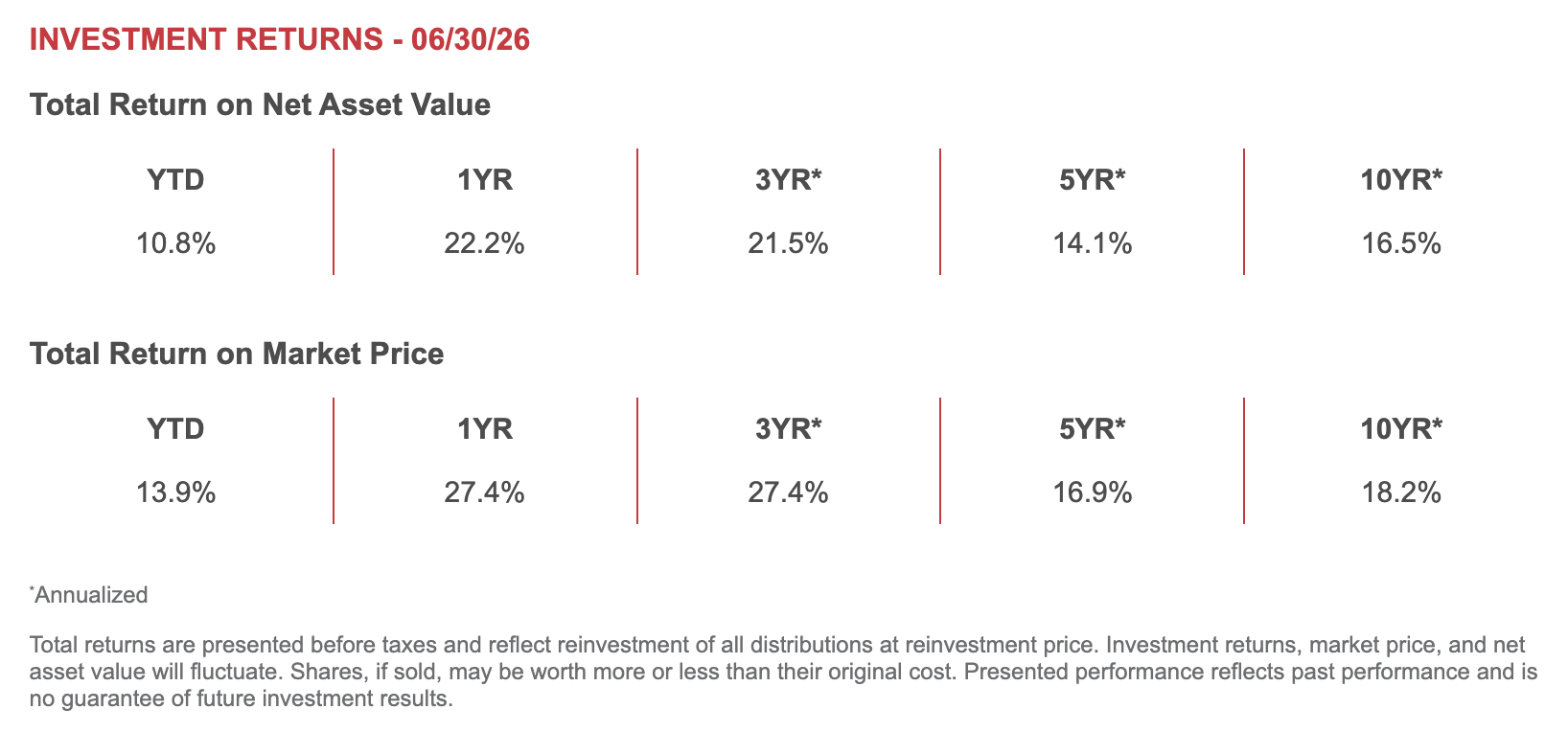
Also, this breakdown means that it’s mostly taxed as long-term capital gains. I’m not a tax specialist, but that can be very beneficial for investors, as it’s usually taxed at 0%, 15%, or 20%, depending on the tax bracket.
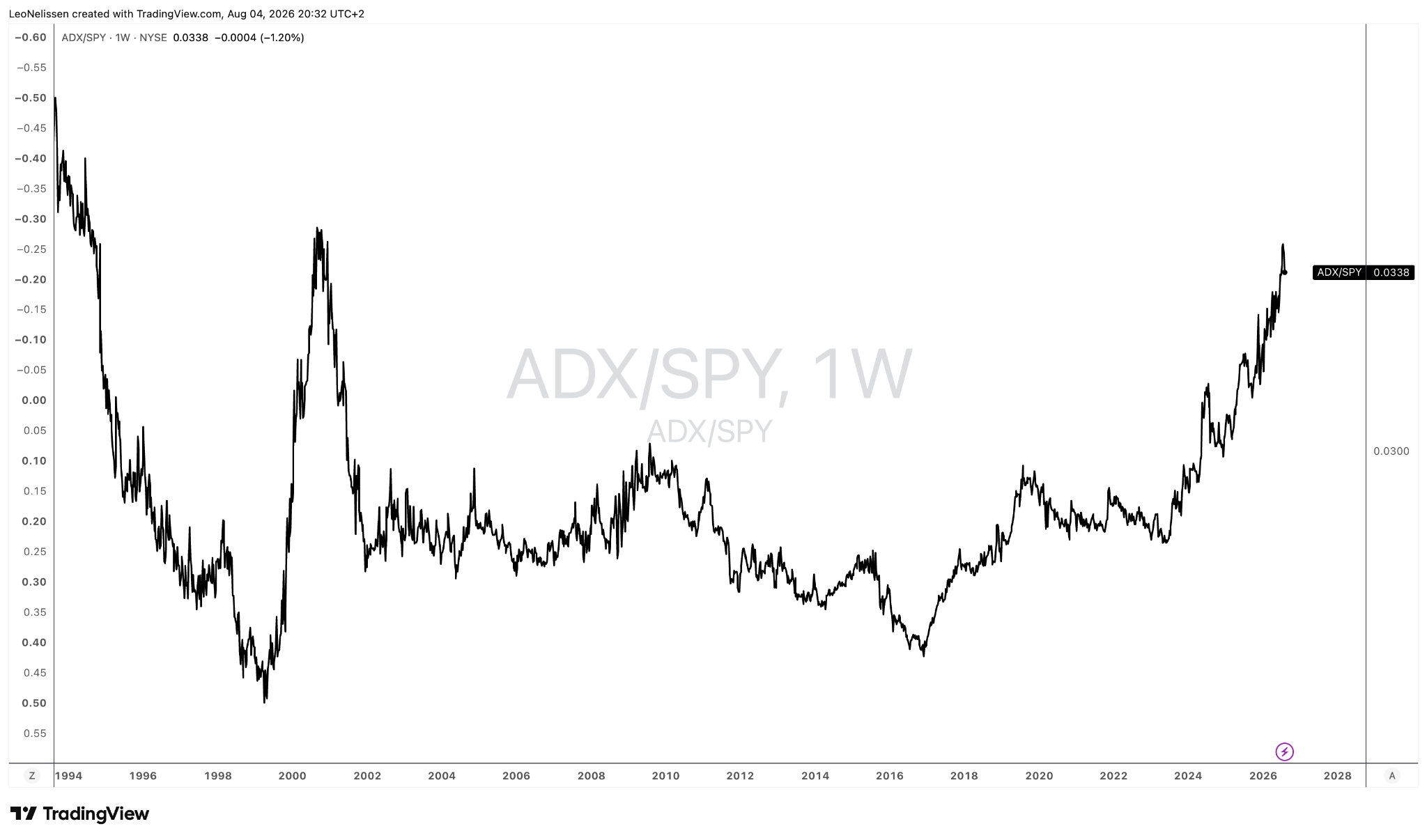
Even better, on a total return basis (reinvested distributions), ADX has beaten the S&P 500 on a very consistent basis since the early 2000s, as the ADX/SPY total return ratio below shows.
Last but not least, note that the default situation is that ADX pays distributions in shares. So, if you want a cash payout, you need to select that. Most do it on their broker’s platform.
All things considered, while I’m not investing in income yet, I love ADX. It’s a terrific income vehicle that tends to come with a great total return for investors who require income without the will to give up on growth.
Valuation-wise, you’re basically paying NAV to get ADX. A discount would be better, but to me, that’s not a deal-breaker at all due to the qualities that ADX brings to the table.
The next pick is different.
Ares Capital Corp. (ARCC) – Buying 10% Income And A Terrific Track Record
I like Ares Management (ARES). It’s one of my favorite asset managers. There’s just one problem, which is that it doesn’t have a high yield. That’s not a problem for my strategy, but for the purpose of this article, it’s a big problem.
ARCC is nothing like ADX, as it’s a Business Development Company. It means that it lends money to middle-market companies that are too small for the large corporate bond market and too big to go to the bank for a loan (I’m painting with a broad brush).
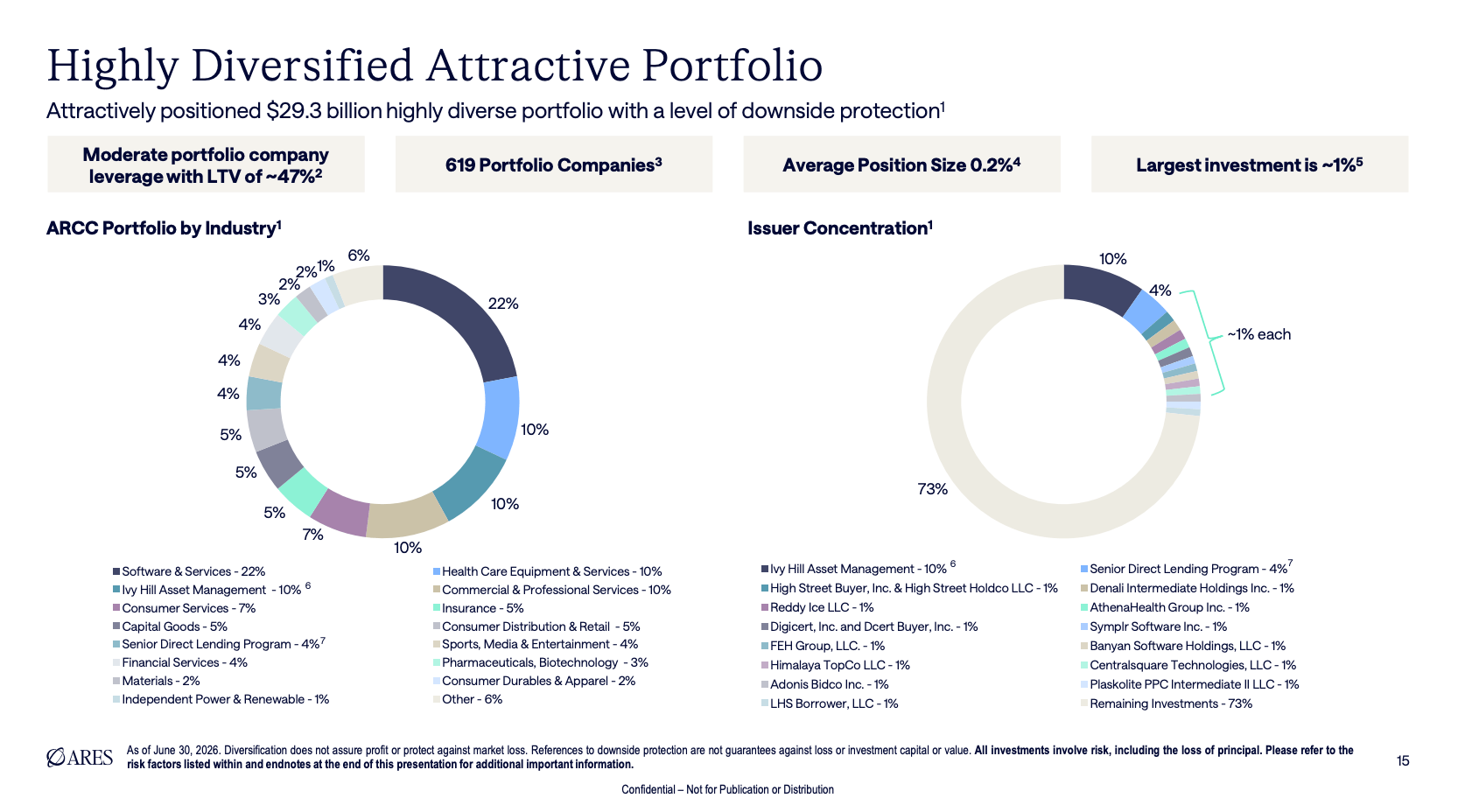
Everything in this business is about creating a favorable risk/reward. As I have often said, lending money is easy. Getting it back (with interest) is the hard part. As the handy overview below shows us, ARCC has close to $30 billion in assets in its portfolio. That’s mostly loans with 619 portfolio companies, none of which account for more than 0.2% of the portfolio.
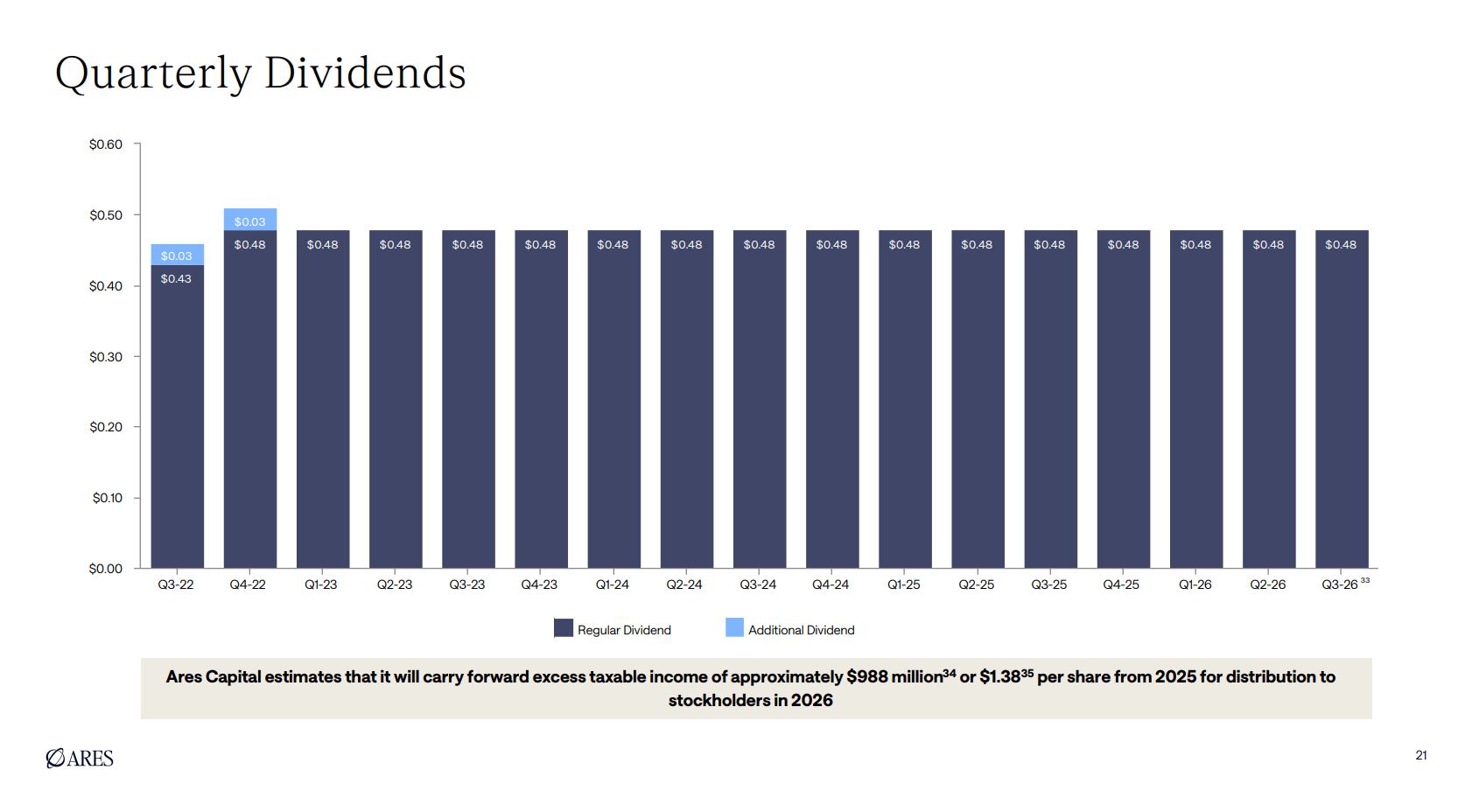
This portfolio provides investors with a yield of roughly 10% with a very stable payout that hasn’t been cut for 17 consecutive years, as the company said during its 2Q26 earnings call. During that call, it was very upbeat about its dividend, as the quote below shows:
Turning to our dividend outlook. We continue to believe ARCC’s current regular dividend appropriately reflects our long-run underlying earnings power. Our earnings and dividend profile is further supported by substantial spillover income, modest leverage, a more stable interest rate environment, and continued overall healthy credit performance.
Our significant spillover income provides an additional layer of flexibility and can help bridge during periods of slower transaction activity. In addition, over the last 12 months, core earnings have exceeded our regular dividend, while an additional $0.15 per share of net realized gains has provided further support for our overall dividend paying capacity. Taken together, these factors support our outlook for relative stability in earnings and our decision to maintain a stable quarterly dividend, building on our track record of stable or growing regular quarterly dividends for 17 consecutive years. – ARCC 2Q26 Earnings Call
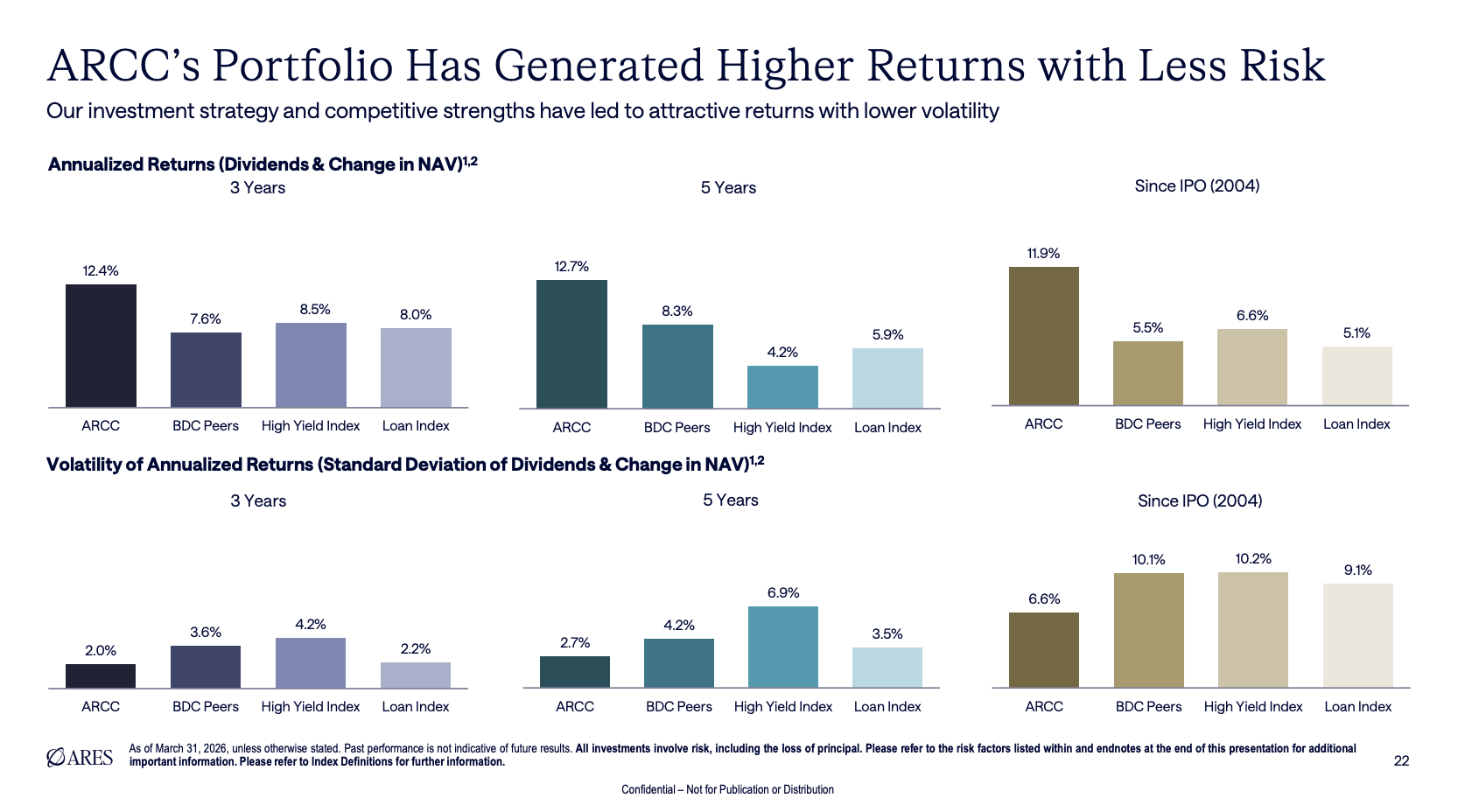
Its net investment income per share is $0.50, which implies a payout ratio slightly below 100%. And, even better, the company has a stellar track record. As we can see below, since its IPO in 2004, it has returned 11.9% per year (capital gains + dividends). That’s way above the BDC average. That outperformance has lasted, as it also occurred on a three- and a five-year basis.
And going back to the second quarter, the company showed some very important things, including the fact that non-accruals were just at 2.4% at cost. This is below its own 3% post-Great Financial Crisis average and even further below the BDC industry average of 4%.
The biggest risk for Ares Capital is a steep downturn in the economy that comes with lower short-term rates. It would pressure the yields on new deals and hurt the credit quality. However, I believe we get to a best-case scenario, as I expect sticky inflation to result in sticky rates and economic growth broadening to support loan quality. Note that ARCC has an investment-grade rating of BBB (or equivalent) from all three major rating agencies, which gives it access to attractive funding deals and helps to improve the yield on deals.
I also think that credit fears in software are overblown.
Although software is prone to more disruption due to AI and ARCC has 22% software exposure, I believe ARCC is doing a stellar job managing these risks. Here’s what the company said during its 2Q26 earnings call:
Nearly all of our software investments are focused on what we view as foundational infrastructure for complex businesses, often serving as systems of record in regulated end markets with high switching costs and significant embedded value.
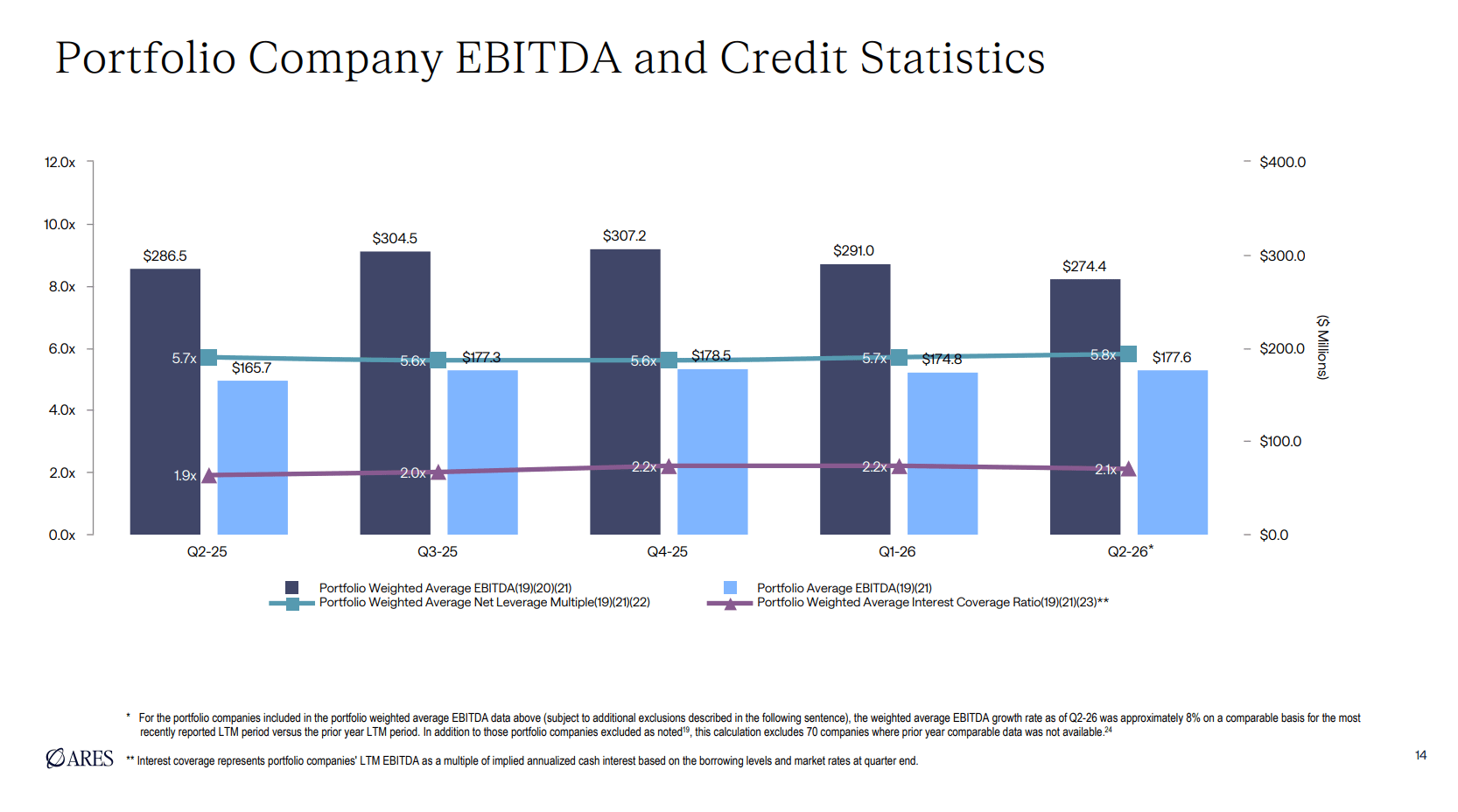
Importantly, we continue to see strong operating performance across our software investments with organic LTM EBITDA growth accelerating during the second quarter and exceeding the broader portfolio average. Within our software portfolio, only one small loan is currently on nonaccrual, and our debt investments remain supported by loan-to-value ratios in the low 40% range, providing substantial equity value beneath our positions. – ARCC 2Q26 Earnings Call
And in general, its portfolio companies remain very healthy, as we can see below:
Now comes the bad news. ARCC is taxed as ordinary income, which is not something everyone likes. ARCC is taxed differently because its revenue comes from interest. ADX makes most money from capital gains, as we just discussed.
That is something to keep in mind, especially as this article started by explaining that sometimes, costs (taxes) can create a different picture than one might expect.
But either way, ARCC’s elevated gross yield and stellar management make it very attractive for me. It’s the reason it’s a holding of the Main Street Alpha Dividend Income Model Portfolio. I would also own it myself, but then again, I’m currently more focused on growing my principal before I squeeze more income out of it.
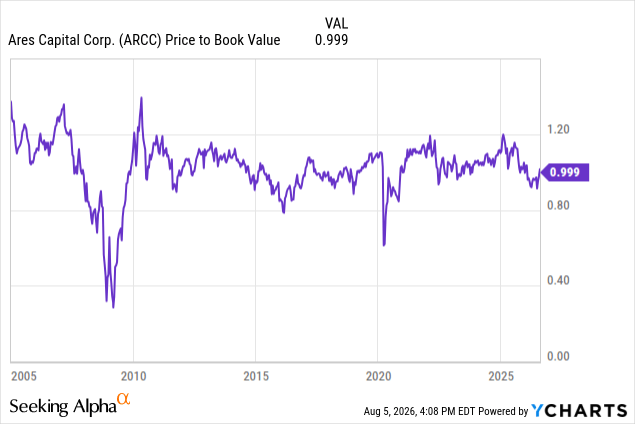
And valuation-wise, you’re basically paying 1x book value for the company, which is roughly in line with its long-term average and a price I consider to be very fair. Please note that I have often said that I have no interest in buying steep discounts. For me, in BDCs, the number one priority is quality. Getting high quality at book value here is a great deal, if you ask me.
Now, let’s summarize!
Takeaway
I say it a lot, but I truly believe that one of the biggest mistakes investors can make is hunting for the highest yields. I’ve seen many portfolios get demolished by investors ignoring risks and simply buying high income.
It’s all about establishing goals, looking for quality, reducing costs, and investing in what works. That’s why I brought up ADX and ARCC today. To me, they are two of my favorite assets to buy for income. ADX offers an 8% annualized distribution that comes from a very diversified equity portfolio, while ARCC offers 10% income from private credit.
Both have risks, as ADX cannot efficiently distribute capital gains if the market isn’t favorable, and ARCC is prone to economic/credit and interest rate risks. That’s what makes them so different, which is great for diversification.
However, even in light of these risks, I think the risk/reward for income investors is great, as both assets show that high income can work very well if the underlying foundation is strong. That’s also why both have such great track records in their areas.
They aren’t perfect (nothing is), but for income, I love both.

Leave a Reply