
Point Break
If big institutions are coming back to the sector, which trusts will benefit first?
Thomas McMahon
Updated 02 Sep
Disclaimer
This is not substantive investment research or a research recommendation, as it does not constitute substantive research or analysis. This material should be considered as general market commentary.
KTI readers will be ‘experienced’ and ‘distinguished’ enough to remember the 1991 film Point Break. Skating over the fact it is now 35 years’ old, some readers might not know a point break is a surfing term for a piece of land which produces long, straight and predictable waves – perfect for surfing and analogously perfect for investing. Sadly, rocks are more predictable than stock market fundamentals, so the waves of momentum that pass over markets are always obvious in retrospect but very hard to see in advance. However, we think the conditions are just about right to see a wave of institutional money gathering to sweep through the investment trust sector.
To be clear, we can’t see it happening yet, although we may be seeing some early signs. This year we have noted some institutional investors adding to specialist equity trusts and to alternative assets trusts, both of which are arguably best accessed through the closed-ended structure. We also hear of pension funds and family offices researching, or adding to, alts and PE trusts. There is still some selling going on, perhaps around benchmark changes and other specific factors, but it is certainly not one-way traffic like it was a couple of years ago, and our ears to the ground may possibly be picking up some slight trembling. It may take some time, but we think that good medium to long-term returns might be achievable by getting the board lined up now (there may still be time to learn to surf). Here we consider which trusts are most likely to benefit if institutional investors start to return.
Cost disclosure
Costs have been one of the pressure points for professional investors for well over a decade. Regulators and analysts have focused on the all-in cost of investment services, spurred in part by the growing availability of low-cost tracker funds. This attention produced some perverse requirements which were particularly significant for institutional investors. The KID RIY figures which had to be reported until recently had a very liberal interpretation of costs which produced some very high numbers for certain business models. Particularly questionable, in our view, was the incorporation of the cost of debt facilities. Gearing is an essential part of the business model for some investment companies and a key advantage of the structure. Gearing gives the potential for much higher returns, and while there are also risks, this is a separate issue from cost. By incorporating gearing within the figure that institutions have to report in clients’ portfolios, regulation made any that included geared investment trusts look particularly expensive. This was a massive disincentive for institutions to invest.
Compounding this was the decision to treat the costs of investment companies like the charges of funds rather than the internal costs of other listed companies. This issue comes out most clearly when considering REITs. An AIC REIT would have to report an OCF and any institutional investor would have to report this as the cost of the investment in the portfolio reported to clients. However, if they bought a non-AIC REIT, like LondonMetric, there would be no OCF and therefore absolutely no cost to report. In that light, it is hardly surprising that LondonMetric has hoovered up so many AIC REITs in recent years and gone from strength to strength. Compounding the injury, stamp duty has to be paid on investment company shares but not on purchases of open-ended funds. So, investment companies were treated like open-ended funds when it hurt them, and shares when it hurt them. Ultimately, this has to stem from the fact the AIFM Directive (2013), which set out many of the rules, was a response to the GFC and was motivated by fear of alternative investment funds, some of which had blown up in the crisis.
The upshot of the old regulation was to disincentivise using investment companies over open-ended funds, and to disincentivise using those which have geared business models at all. These tend to be those investing in asset classes where the closed-ended fund structure enjoys the greatest advantages: infrastructure, renewables and private equity. In this light, the fact that fund of funds managers and other institutional investors no longer have to include the OCFs of investment companies when they calculate their costs makes investment companies much more attractive.
It isn’t just costs that have kept institutions out of the market. Successive governments have recognised underinvestment in the relevant asset classes of infrastructure and unlisted equity by large UK investors such as pension funds. Since 2023, chancellors have unveiled successive measures aimed at boosting allocations to UK infrastructure and private markets by pension funds and other institutions, with July 2025’s Mansion House Accord seeing 17 major workplace pension providers commit to invest at least 10% of their DC funds in private markets by 2030, of which half of that should be in the UK. The expectation is for these numbers to rise over time.
One of the key aims of the governments’ actions is to see more UK capital, more British savings, invested in the UK, in the interest of spurring growth, promoting entrepreneurship, and keeping control of UK-originated businesses at home. This is part of a global retrenchment from globalisation which seems likely to continue for years, if not decades, and we think further measures in this direction may follow.
The Mansion House Accord represents an opportunity for those closed-ended funds which have sufficient size to be investable by large institutions. However, the government is pushing to consolidate multi-employer private sector and local government pension funds, arguing that ‘mega-funds’ will be better placed to provide funding to the UK’s essential infrastructure. This means ‘sufficient size’ will be higher in future for many institutional investors.
Which investment trusts will benefit the most?
We think that regulatory and cultural change is laying the groundwork for institutions to invest more in the investment trust sector. The main beneficiaries, in our view, will be companies in the real assets and alternative sectors, including private equity and growth capital. Investment trusts offer a way to get a liquid and diversified investment in these sectors.
Turning to private equity, we think HarbourVest Global Private Equity (HVPE) looks well-placed to be a beneficiary. It has a large market capitalisation, meaning large investors could take meaningful positions. It also has quite a high OCF, and so the removal of the obligation to report these in look-through cost figures could weigh more heavily on the investment decision. Pantheon International (PIN) has the size, and cost disclosure changes work to its advantage. Neither of these have substantial UK exposure, however, so for investors looking for that, CT Private Equity (CTPE) would fit the bill better. On the other hand, its much smaller market cap will limit its appeal to the larger institutions, at least while the sector trades at a discount. If the trust’s shares get back to par, there would always be the possibility of raising fresh capital.
PRIVATE EQUITY AND GROWTH CAPITAL
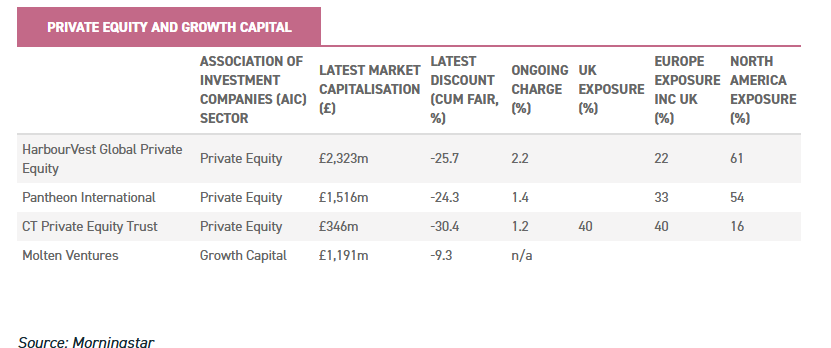
The growth capital sector includes venture capital and investing in pre-IPO businesses, typically as a minority investor and usually without the level of influence of the private equity model. Providing growth capital to UK businesses is an explicit goal of the Mansion House Accord and regulation on consolidating pension funds. Molten Ventures (GROW) has the scale to offer meaningful exposure to a diversified portfolio of UK and European growth capital businesses. An interesting dynamic with GROW is that the Molten team also manage external funds and earn fees which benefit Molten Ventures plc. This means shareholders stand to benefit second hand from any segregated mandates or new funds the management team are involved in.
Within the infrastructure sector, we think HICL Infrastructure (HICL) and International Public Partnerships (INPP) stand out both for their size and their majority allocations to the UK. This sector has re-rated significantly over the past year and both trusts are on single digit NAVs, and buying by institutions may have played a role. Being on a narrow discount may also be an advantage: rather than seeing an opportunity, some investors may see wide discounts as a feature to be feared, while they may read a narrow discount as validation. 3i Infrastructure (3IN) also has the size to appeal, and the narrowest discount in the sector. On the other hand, it has much less invested in the UK, while its model of buying operating companies may not fit the bill.
INFRASTRUCTURE AND RENEWABLES
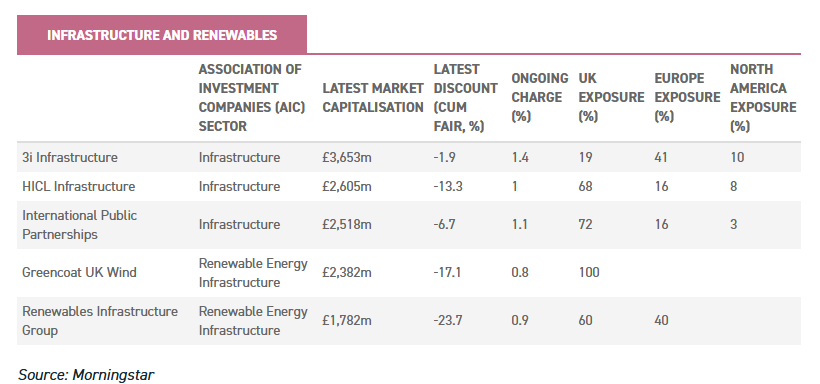
In the renewables sector, Greencoat UK Wind (UKW) really stands out. Not only does it have the largest market cap in the sector, but it is 100% invested in the UK, so it can make the biggest hit towards hitting the target allocation of 5% in UK private assets. The Renewables Infrastructure Group (TRIG) should also appeal, with 60% invested in the UK and a market cap approaching £2bn. OCFs are lower in these two sectors, but KID RIYs would have to carry the cost of the high gearing levels essential to these business models, so the changing legislation on cost disclosure should be impactful across the board.
Conclusion
Media narratives usually trail the facts because received wisdom is slow to change. As we have written elsewhere, the equity trusts are more or less back to ‘normal’ discount levels, while even over the past year the alternative assets space has started to see discounts move in. Equity trusts moved due to some basic technical factors in our view: lower rates are good for risk appetite, while consolidation meant there were fewer vehicles to take the inflows when they returned. We think some basic technical factors should see growing institutional interest in the sector over the coming months and years: regulation has reduced some of the disadvantages in how trusts had to be treated while encouraged investment in precisely those assets they are best designed to hold. While there is a new rival in town in the form of the LTAF, we don’t think it is clear this new structure’s advantages outweigh the disadvantages. So while it may divert some of the flows which could head for investment companies, we don’t think it can hold back the wave entirely. It’s always possible these dynamics could lead to the next cycle of expansion for the sector which history tells us should eventually follow, even if it is hard to imagine at the moment. But that is how investor psychology works in all markets!

Leave a Reply