Summary
- In January, consensus was to sell BDCs and buy REITs for impending rate cuts; today, it’s inverted into panic-selling REITs over Treasury rate spikes, creating a textbook contrarian buying window.
- According to Blackstone, new commercial construction across multifamily, industrial, and office assets has plunged to near 12-year lows due to high financing hurdles and a rise in construction costs.
- Leases signed during the zero-interest-rate era often had fixed or capped annual escalators. As they expire, landlords can now reset rents to market levels, capturing years of pent-up market rent increases.
- While a 30-year Treasury yielding +5% offers a rigid, non-growing coupon, a high-quality REIT yielding 5% to 8% compounds cash flow over time as rolling leases re-price into positive spreads.
- Look past short-term borrowing cost noise; accumulate high-quality REITs at discounted multiples to capture high starting yields backed by embedded, contractual rent resets.

Co-authored with Luuk Wierenga
The market is often very reactive to the news of the day. A lot of investors will be buying or selling based on whatever is in the headlines at the moment. Why, just in January, people were telling us to sell all our BDCs because interest rates were coming down. Sectors like real estate were off to a strong start in 2026 as investors rushed into companies that are perceived to benefit from lower interest rates.
Today, the script has flipped. Now everyone is running around declaring that Treasury rates are going higher, and they are selling REITs. Over the past three months, we’ve seen a decline in REITs alongside a rise in Treasury Rates.
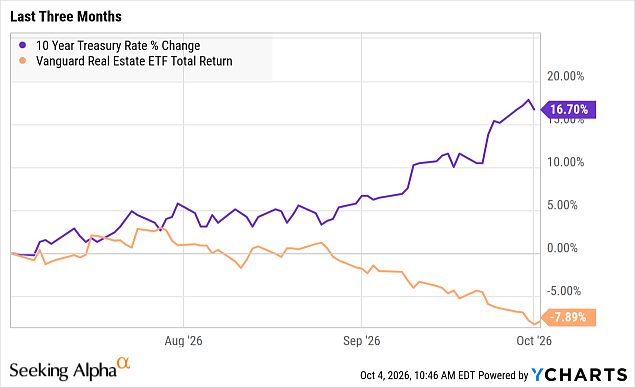
The market is as equally convinced that rates will go up as it was convinced in January that they would be coming down. The latest weak jobs report casts doubt that the Fed will hike its target rate in October, but as the Magic 8-Ball famously said: “The future is uncertain”.
What is certain is that we are seeing an opportunity to buy REITs at cheaper valuations than we’ve seen in a while. While the market is focused on rates, there are also positive factors that will drive more earnings growth in the future. Ultimately, REITs’ growing AFFO is what pays for our dividends. And when it comes to dividends, more is always better in my book.
How Inflation Creates Future Rent Growth
High inflation is leading to higher interest rates in order to bring inflation back down. Higher interest rates are usually a bad sign for REITs, since borrowing costs go up and therefore interest expenses go up. Since REITs are leveraged vehicles, this can often have a negative impact on their bottom line.
But there is positive news as well, which we’ve already talked about: lack of new construction.
Today we will talk about another big contributor to future AFFO growth that is made possible due to the higher interest rate environment: positive re-leasing spreads.
Re-leasing spreads show you the difference between the rent paid under an expiring lease and the rent agreed upon when the lease is renewed or leased to another tenant. The higher the re-leasing spreads, the higher the contribution to revenue and, therefore, ultimately AFFO growth.
When inflation runs hot, the following happens: a lot of the current leases were signed years ago, and these leases contain annual rent escalators. Many of those are fixed, with a few examples like VICI Properties (VICI) and W. P. Carey (WPC). Both are REITs that have some sort of CPI-linked rent clauses embedded, which provide some protection against inflation. Yet sometimes, these clauses fail to keep up with market rent because CPI measures all inflation, not just rent inflation. Additionally, these clauses often have a cap; for example, rent might go up a maximum of 3%/year, so if CPI is 3.5%, rent only goes up 3%. After several years of high inflation, this can add up.
Meanwhile, expensive financing with higher construction costs makes it harder to develop new properties. It’s just harder to make a good return on these investments when it is very expensive to develop new properties in the first place.
When REITs have lease contracts that roll over, they have an opportunity to benefit from years of accumulated market rent growth. They couldn’t harvest it because of the current lease contract, but when these leases expire, re-leasing spreads can go up tremendously to compensate for both lack of new supply (competitive advantage) as well as years of inflationary effects that weren’t included in the previous leases.
Real World Examples
Just take a look at Kilroy Realty Corporation (KRC). Management talked about the fact that year-over-year leasing volumes increased by a whopping 40% in the first six months of 2026. When you exclude leases signed on spaces that had been vacant for over 12 months, Q2 cash rental rates went up a staggering 15.6%:
“During the second quarter, we executed approximately 376,000 square feet of new and renewal leases, bringing year-to-date leasing volume to roughly 944,000 square feet, an increase of more than 40% versus the first 6 months of 2025. For all comparable leases signed during the quarter, GAAP rental rates were up 21% and cash rents were up 6.1%. And when excluding leases signed on spaces vacant for longer than 12 months, re-leasing spreads improved further to 27.3% and 15.6% on a GAAP and cash basis, respectively.” – KRC Q2 conference call
Lack of new supply benefits landlords’ bargaining power. We saw several years of elevated vacancy, especially in spaces like offices. This discouraged new construction, and it also encouraged activity like converting office space to something else. In other cases, properties simply weren’t maintained as the owners were unable or unwilling to invest in maintaining a vacant property. The longer real estate is left without proper maintenance, the more expensive it is to rehab it. REITs that have the capital to keep their vacant space in shape to rent have the ability to bring that space to market.
For KRC, for the first time in nearly two years, both GAAP and cash re-leasing spreads were both positive – indicating (like we’ve discussed a lot in recent times) that the office market is recovering: Source

The fact that management is saying that the market is experiencing FOMO (Fear Of Missing Out), is the final strong indicator that the market can turn bullish very rapidly:
“There’s definitely some degree of FOMO in the market. I think we’ve seen that on the new lease side for a while, where people who were new tenants looking for new space were acting pretty decisively and prioritizing things like we’ve talked about move-in ready space and space that they thought could accommodate future growth objectives.”
The Market Will Catch Up Eventually
It is very straightforward: eventually many REITs will experience more growth because of re-leasing spreads going up and a lack of new supply coming to the market, which in turn will favor current REIT portfolios’ valuations. Blackstone discussed this in its latest Q2 2026 BREIT stockholders’ letter, noting that new supply was scarce as new construction starts and deliveries in multifamily and industrial are near 12-year lows. BREIT notes that construction costs have risen 50% over the past six years.
It’s really simple: higher rates are hurting REIT valuations now. It makes perfect sense, since refinancing becomes more expensive and REITs use a lot of debt; therefore, interest expenses go up. Additionally, many REIT investors invest for the dividends, and Treasury yields are now a more competitive option for investors to choose.
Yes, you can invest in 30-year Treasuries and get a +5% yield for 30 years. That might make a REIT with a yield of 5-6% look less attractive. Yet there is a key difference: REIT dividends can grow, and Treasury coupons are flat. Future rent growth will be a lot higher due to the factors that we discussed in this article. Higher rates make it harder to fund new construction, while inflation continues to push market rents higher.
As older leases come due for renegotiation, we expect re-leasing spreads to continue going up. While the market focuses on today’s higher interest expenses, long-term-oriented dividend investors can scoop up cheap shares of a multitude of REITs while they wait until the embedded rent growth quietly builds inside existing REIT portfolios.
Buy for a decent yield today, and hold for the faster dividend growth that will be coming in the future. It is a fantastic time to be buying income stocks, and it is a fantastic time to be buying REITs.
This article was written by
Analyst’s Disclosure: I/we have a beneficial long position in the shares of VICI AND KRC either through stock ownership, options, or other derivatives. I wrote this article myself, and it expresses my own opinions. I am not receiving compensation for it (other than from Seeking Alpha). I have no business relationship with any company whose stock is mentioned in this article.
Beyond Saving, Philip Mause, and Hidden Opportunities, all are supporting contributors for High Dividend Opportunities. Any recommendation posted in this article is not indefinite. We closely monitor all of our positions. We issue Buy and Sell alerts on our recommendations, which are exclusive to our members.

Leave a Reply