One of my heroes is Warren Buffett, often considered the world’s greatest investor. His wisdom has guided me for decades, but had I listened earlier, I’d be worth millions more. The Oracle of Omaha warns about passive income: “If you don’t find a way to make money while you sleep, you will work until you die.”
Unearned income
Passive income is earnings from outside of paid work. Alas, there’s no such thing as a free lunch and everything worthwhile takes effort. I’ve built passive income over decades, but what are the snags? Here’s ChatGPT’s reply:
The main problems with passive income are that it often requires significant upfront effort or capital, comes with inherent risks and no guarantees, and still demands some level of ongoing maintenance to be successful. The idea of truly effortless passive income is largely a myth.
I agree with this chatbot’s summary. Today, my family’s passive income can exceed £10,000 a month from various sources, including these four income streams:
* Savings interest (from cash deposits)
* Interest from government and corporate bonds (mostly safe, but not 100% guaranteed)
* Occupational pensions (from companies my wife and I previously worked for)
* Dividends from company shares (a risky, but mainstream, investment).
I’ve listed our four income streams from smallest to largest. Largest is our dividends from owning stakes in American, British, and global businesses. While we sleep, hundreds of millions of workers work for us — exactly as Buffett suggests.
Today, our passive income is a river, but it began as a trickle. Indeed, I started investing in the 1980s with only a few pounds. Back then, £20 a week was too much for me, but it’s what some investors might start out with today.
Here’s the maths: £20 a week is roughly £1,000 a year, so let’s say someone invests £1k each year into shares. Growing at, say, 8% a year, this produces a pot worth £125,020 after 30 years. That’s the initial £25k and £100,020 of gains, showing the power of compound interest.
But here’s the trick: as our incomes and capital increased, my wife and I kept ratcheting up our investment levels. Today, we invest thousands of pounds a week into owning more shares. For us, this has been one path to lasting wealth.
I am really loving the theme/design of your weblog. Do you ever run into any browser compatibility issues? A couple of my blog visitors have complained about my website not operating correctly in Explorer but looks great in Safari. Do you have any advice to help fix this problem?
The design is my own, it just sort of evolved. Ditto Explorer/Safari, no advice on how to resolve the problem.
The Perfect Defense? 5 Stable Dividend Stocks Paying Up to 11.5%
Brett Owens, Chief Investment Strategist Updated: July 31, 2026
Hey, remember tariffs? Well, they’re baaaaaaaack!
As of last week, new import taxes of 10% to 12.5% were slapped on 60 trading partners. This covers a cool 99.4% of everything that America buys abroad. Let’s pile the tariff return on top of the recent Fed news and tensions that keep rolling in the Middle East. There’s obviously plenty of bricks in the current Wall Street wall of worry for this stock market to climb.
This climb, however, is no problem for “low drama” dividends like these. I’m talking about five companies yielding between 4.9% and, get this, 11.5%! No matter the headlines these payouts keep flowing.
Plus, these stocks hold up better than the broader market during pullbacks.
The technical term for low drama on Wall Street is “low beta.”A beta below 1 signals that a stock is calmer than the market. That’s what we want.
These five companies offer up low beta and high yields, an excellent combination.
The financial sector has generally been a smoother ride than the broader market in 2026, but First Interstate BancSystem (FIBK, 4.9% yield) stands out not just for its low volatility, but its relatively high yield of nearly 5%.
FIBK is the company behind First Interstate Bank, a Montana-based regional operator with 271 banking offices in 10 states across the Midwest and Pacific Northwest. Its offerings are what we’d expect: consumer products (checking and savings accounts, credit cards and mortgages), business products (commercial and SBA loans), wealth management and treasury solutions.
It’s a boring, under-the-radar company whose shorter-term struggles (such as loan declines and elevated payoff activity) are masking encouraging longer-term trends, including its expanding net interest margin. Its shareholder reward story is similarly mixed.
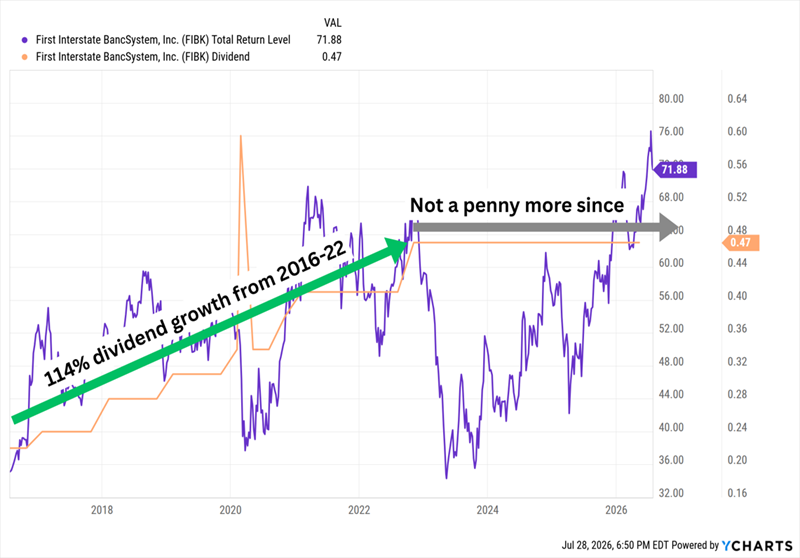
First Interstate Slammed the Brakes on Dividend Growth a Few Years Ago
However, FIBK has been aggressively repurchasing stock since it announced a buyback program during the second half of 2025. It has so far clawed back roughly 8% of its outstanding shares, and the company just green-lit another $150 million, putting the total program authorization at $450 million. The open question: Will its improving bottom line eventually flow back into the dividend?
As for volatility: FIBK’s one- and five-year betas are 0.6 and 0.8, respectively, both of which signal that the company is less shaky than not just the S&P 500, but the financial sector, too.
Real estate as a whole has had every bit as much volatility as the broader market over the past few years—without the gains to show for it. But Sabra Health Care REIT (SBRA, 5.4% yield) has been less choppy on average while still delivering much better returns.
Sabra is a senior-focused healthcare real estate investment trust (REIT) with about 360 property investments across the U.S. and Canada. The biggest chunk of its business is skilled nursing and transitional care real estate, at a little less than half the portfolio’s annualized cash net operating income (NOI). The rest comes from managed senior housing, leased senior housing, behavioral health properties, specialty hospitals, and more.
The relative stock stability is great—the company boasts a five-year beta of 0.6 and a downright gentle one-year beta of 0.2.
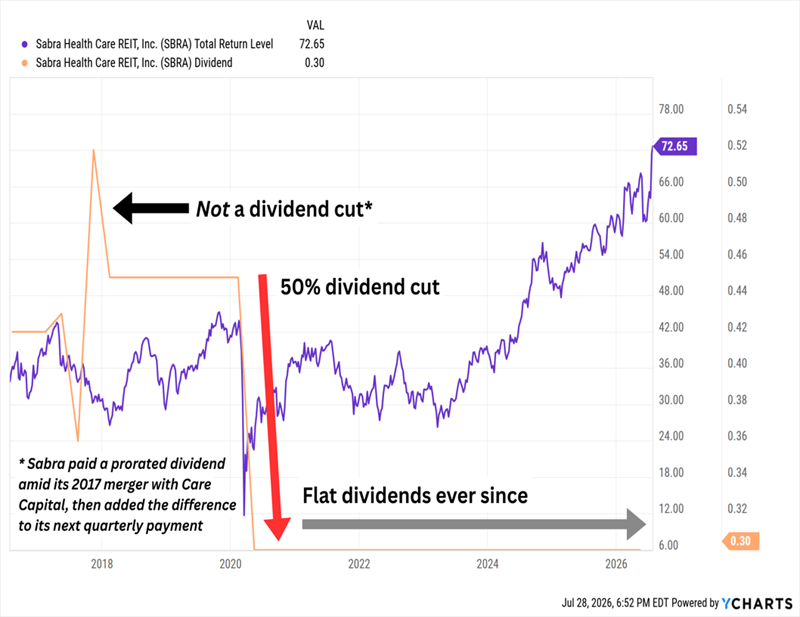
But the Dividend Is Too Sleepy … For Now
There’s reason to believe that could change. SBRA’s current 30-cent quarterly dividend comes out to $1.20 per year, which is 77% of estimates for this year’s funds from operations (FFO, a profitability metric for REITs). That’s a healthy coverage ratio for a REIT—one that leaves room for growth, in fact.
And Sabra just raised its full-year FFO and adjusted FFO (AFFO) guidance following a coup of a tenant transition. The company announced that all 26 properties currently leased to Avamere will be moved to a new tenant—Cascadia, a high-quality operator—under a deal that includes a nearly 30% increase in rent.
But Wall Street isn’t sleeping on Sabra. Shares now trade at roughly 14 times FFO estimates, which is on the steep side.
Getty Realty (GTY, 5.5% yield) is another well-grounded REIT. It owns more than 1,160 freestanding (aka single-tenant) retail properties across 44 states and D.C.
Retail generally isn’t synonymous with reliable, but Getty is built different. That’s because its tenant base includes convenience stores, express tunnel car washes, auto service centers, drive-through quick-service restaurants, gas stations, repair shops and more. It’s not flashy, but Getty prints cash as a result.
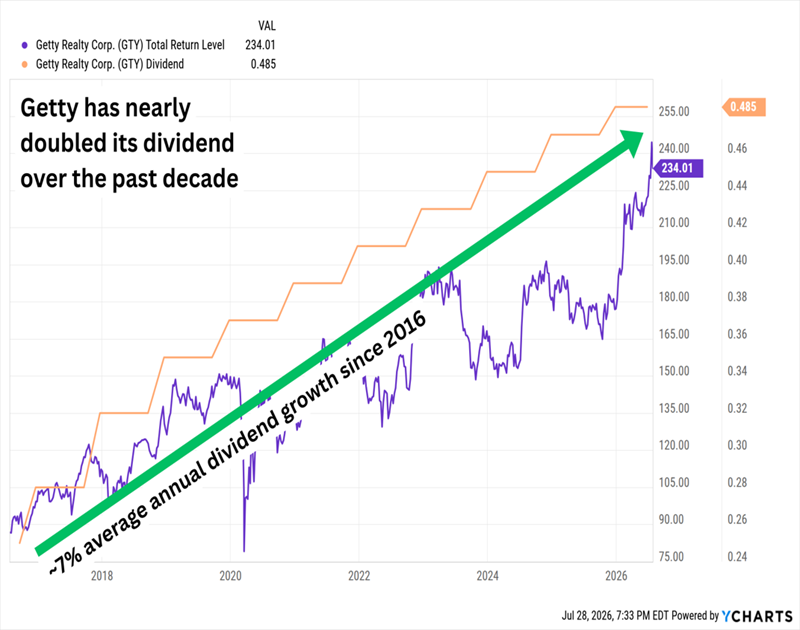
And the More It Prints, The More We Get
Getty’s 5%-plus dividend accounts for less than 80% of FFO estimates, and it’s backed by sturdy tenants with good credit. It’s no surprise that GTY shares are historically cool cucumbers—their five-year beta is under 0.8, and their 1-year beta is close to zero.
The flip side? Getty grows like a defensive stock, too. It’s also coming up against some near-term headwinds, including weakness in lower-end consumers that’s weighing on its convenience store and gas station tenants.
Kinetik Holdings (KNTK, 6.6% yield) is a midstream energy company that operates in Texas’ Delaware Basin, which is part of the larger Permian Basin. Its assets include 200 miles of crude oil pipeline, 90,000 barrels of crude oil storage, 3,500 miles of steel natural gas gathering lines, 2.2 billion cubic feet of nat-gas processing capacity, 360 miles of water pipelines and more.
KNTK, and the energy sector as a whole, also help illustrate how a low beta doesn’t always tell the whole story.
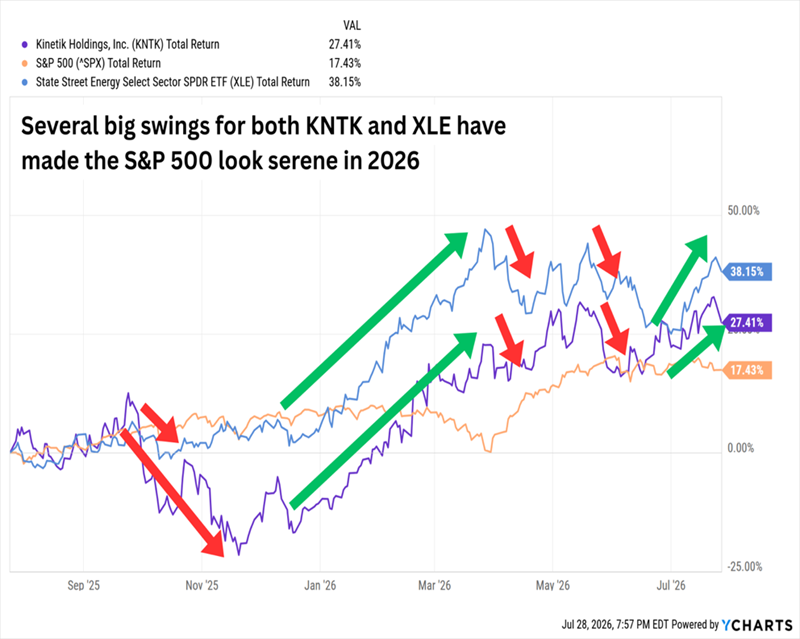
Kinetik Is a Stock in (a Lot of) Motion
While beta is used as a gauge of volatility, what it really does is measure how an investment moves relative to a comparable index. So while a low beta can mean a stock isn’t volatile, it can also mean something else—like in this case, KNTK’s almost nonexistent one-year beta is really saying that the stock hasn’t been at all correlated with the market.
Kinetik is more sensitive to commodity prices than many midstream peers, so it has been prone to larger swings—and yet its performance is merely par for the industry. So we can’t rely on KNTK for defense. Upside is a question mark, too. It operates in one of the fastest-growing formations in the country, but it has at times been dogged by weak Waha Hub natural gas prices and price-related volume curtailments from its customers.
The dividend is a bright spot, albeit not blinding. Kinetik was formed in 2022 from the merger of Altus Midstream and BCP Raptor Holdco LP. It quickly started paying 75 cents per share. After a couple years of holding flat, it raised by 4% in 2024, then by another 4% or so in 2025.
Ellington Financial (EFC, 11.5% yield) is a mortgage REIT (mREIT) that deals not in physical properties, but instead “paper” holdings such as residential transition loans, residential and commercial mortgage loans, commercial mortgage-backed securities (CMBSs) and collateralized loan obligations (CLOs). It also deals a bit in agency MBSs, though it’s reducing that business.
The game is pretty simple here: mREITs borrow money at short-term rates to buy mortgages and other paper tied to long-term rates. They pocket the difference. So they need short-term rates to be lower than long-term rates (which they usually are), and they thrive when the spread between the two is wide.
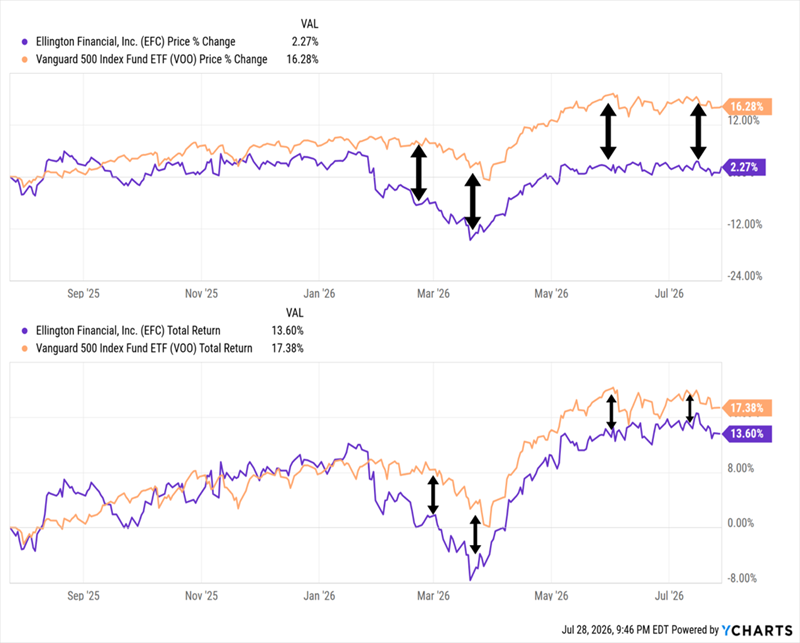
Ellington’s five-year beta is around 0.9, so it has been only a little less volatile than the market over that time. The one-year beta of 0.5 implies it has been much calmer of late—not an advantage given that EFC’s stock has been flat while the S&P 500 has climbed. But check this out:
EFC’s Total Returns Are More Tightly Tied to the Market
Like with many mREITs, the lion’s share of EFC’s returns come from its super-sized monthly dividend, not stock movement—but financial-data sites usually calculate beta from pure price performance. The good news? Ellington might be more volatile than the numbers suggest, but it has still been relatively less wiggly.
Whether we’d want to hunker down in Ellington is another matter.
The yield, while sky-high, looks safe for now. The company’s adjusted distributable earnings guidance of 45 cents per share comfortably covers the 39 cents it pays out every three months. However, the fate of EFC’s stock is largely tied to interest rates—shares likely would react well to signs of a cut, but if the market thinks hikes are inbound, this mREIT could be in for a bumpy ride.
This 11%+ Dividend Is My Favorite Way to Fight Off Market Chaos
The news cycle is back into overdrive, which means the market is a minefield of headline risk right now. That’s why I’m always on the lookout for double-digit yields like what EFC offers right now. That massive income can go a long way toward stabilizing our portfolios while helping us come out ahead.
Net dividend cover restored to 1.1x for H1 2026, in line with TRIG’s long-term target and up from 1.0x for 2025. Net dividend cover is stated after the scheduled repayment of £111m of project-level debt for the half year and is supported by £209m of operational cash generation. Gross cash cover before debt amortisation was 2.3x for the half year.
2026 dividend target reaffirmed at 7.55p per share, representing a c. 10% dividend yield at the current share price
Chair’s Statement
The Renewables Infrastructure Group’s strategy is focused on offering shareholders a compelling total return proposition underpinned by resilient income. Our H1 2026 underlying portfolio performance demonstrates progress against this. Looking ahead, I am confident that we will maintain this strategic momentum through active management of our diversified portfolio, disciplined capital allocation and by reinvesting into higher-returning proprietary opportunities that are funded through retained cash, debt capacity and portfolio rotation.
At TRIG’s 2026 Annual General Meeting, the Company held its first continuation vote, which passed with a 99.3% majority. This demonstrates strong shareholder support for the strategy we set out at our Capital Markets Seminar in May 2026, when we articulated our disciplined approach to capital allocation and the Managers detailed the key levers to support resilient income generation and long-term capital growth creation. I would like to extend my thanks to our shareholders for their support and extensive engagement.
While the share price discount to NAV has narrowed in the first half of the year, it remains elevated, and we continue to take action to support a sustainable share price recovery. In May 2026, a clear capital realisation target was set of £400m over the subsequent 12 months to May 2027, principally from asset disposals and complemented by modest debt issuance. We are pleased with the strong start made against this objective, having signed an agreement to sell TRIG’s 17.5% stake in the Beatrice offshore wind farm for c. £155m. The sale process benefited from price competition from a number of bidding parties. Nonetheless, the market for asset sales remains challenging. Further divestment processes are underway.
Capital realised will be deployed in line with the Board’s capital allocation priorities of reducing RCF borrowings, returning capital to shareholders and investing in higher-returning proprietary internal opportunities within TRIG’s existing portfolio. The Board remains focused on disciplined capital allocation to drive shareholder returns and will continue to consider carefully the right balance between retaining capital for accretive growth and returning capital to shareholders through dividends and share buybacks. At the current share price, and subject to meeting the capital realisation target, the Board expects to continue to buy back the Company’s shares beyond the current £150m programme, of which £123m had been deployed at 6 August 2026 having repurchased 158 million shares.
The resilience and robustness of TRIG’s underlying business model is reflected in our Interim Results for the first half of the year, with £209m of operational cash generated,1 which restores net dividend cover to 1.1 times in line with our long-term target. Net dividend cover is stated after the scheduled repayment of £111m of project-level debt for the half year. Gross cash cover before project-level debt repayment was 2.3 times. The structure of TRIG’s balance sheet remains conservative with long-term debt representing 39% of enterprise value, once the announced disposal is completed. Approximately 90% of debt across the Group is fixed interest rate and amortising over the period of fixed-price revenues. TRIG’s RCF balance as at 30 June 2026 was £276m, with £155m disposal proceeds from the sale of Beatrice expected in H2 2026 to be applied principally to reduce this balance further.
The Board remains committed to delivering resilient income to shareholders and I am pleased to reaffirm the dividend target for 2026 of 7.55p per share, which represents a c. 10% dividend yield at the current share price.2
The Company’s NAV per share as at 30 June 2026 was 101.1p, a 2.9p reduction to the 31 December 2025 NAV, driven principally by the mechanical flow through of reductions in third-party revenue price forecasts from both projected power prices (including the UK Government’s announcement of the early removal of Carbon Price Support in April 2026) and green certificate income across all countries in which TRIG has investments. While power prices are currently elevated, commodity market pricing assumes swift resolution of the conflict in the Middle East. In the medium term, independent forecasters expect greater US gas supply to result in lower gas prices and also faster renewables build-out reducing the price captured by renewables generators. Earnings per share for the period was 0.1p, reflecting the movement in portfolio valuation.
There have been two policy announcements in the UK in 2026 that are potentially helpful for renewables valuations but are yet to be reflected in the portfolio valuation. Power price forecasts do not yet include the potential benefit from the high volume of long-duration storage contracts expected to be awarded in the UK, which could increase the price captured by renewables generators. TRIG’s valuation does not include the potential benefit from use of the Wholesale Contract-for-Difference in the UK, which is expected to provide an additional path to fixed price revenues in the medium term.
Active portfolio management remains central to TRIG’s strategy, supported by disciplined portfolio rotation and reinvestment, developing and constructing new projects, revenue management and operational enhancements.
Key highlights of strategic progress made by the Managers include:
sale of TRIG’s 17.5% interest in the Beatrice offshore wind farm for c. £155m;
issuance of £200m of amortising private placement debt at a 5.23% interest rate, maintaining low interest rate risk and low refinancing risk, terming out a significant portion of the RCF;
build-out of our development pipeline, with c. 200MW in construction. The Ryton battery project is expected to be energised in autumn 2026, while the repowering of the Cuxac onshore wind farm in France is progressing well with the new, higher-capacity turbines now being installed on site;
placing of revenue price fixes to improve revenue visibility. In June, the Gode offshore wind farm signed a new seven-year offtake agreement with Ørsted; and in February and March, when power prices were relatively elevated, a number of projects entered into short-term price fixes for 560GWh of expected generation out to the end of 2028; and
progression of operational enhancements programme with blade hardware and software upgrades continuing to be rolled out across the portfolio.
In total, value enhancement activities have added £40m to the portfolio valuation from 1 January 2025 to 30 June 2026. However, the £70m value enhancement target across 2025 and 2026 has been revised to £55m. This results from a delay in the rollout of hardware and software upgrades to turbines made by a particular manufacturer; delays to grid connection dates; and capital allocation decisions. Beyond 2026, the Managers will continue to drive value enhancements through active portfolio management, in particular from TRIG’s development and construction pipeline, which is subject to capital allocation decisions.
Value enhancement activities optimise TRIG’s high-quality portfolio of renewables assets located across the UK and Europe. In H1 2026, our 2.3GW portfolio of renewables infrastructure assets produced 2.9TWh of clean electricity. Of the portfolio’s revenue 64%3 are fixed per MWh generated over the next ten years. Together with conservative gearing, this deliberate approach to revenue and balance sheet management is unique among listed renewables investment companies and gives the Board flexibility when evolving the strategy and maximising long-term returns for shareholders.
On 1 July 2026, the Company’s investment and operations management fees were altered to be based solely on market capitalisation. This equates to a further 19% reduction in fees in addition to the 28% reduction secured by the Board in 2025. This change in fee basis further aligns the interests of the Managers with those of shareholders. The pro forma operating expenses ratio is expected to reduce to 0.83% following the implementation of the new fee basis.
Outlook
The relevance of the energy transition has never been greater with macroeconomic events and the growing adoption of energy-intensive technologies, including AI, increasing demand for secure and domestically generated electricity across the UK and Europe. Renewables and batteries remain central to this shift, reflected in the policies of governments and strategies of corporates. The UK Government’s recent Call for Evidence in relation to the use of Corporate Power Purchase Agreements is aligned with TRIG’s strategy and highlighted the importance of such agreements with renewables generators in achieving long-term and affordable energy resilience for corporates, independent of their additional sustainability benefits.
TRIG’s portfolio provides investors with immediate access to this key megatrend as Europe’s energy market accelerates towards energy security at scale. TRIG offers value and scale through its diversified portfolio and sizeable development pipeline, both of which are actively managed by two expert Managers. As set out at the Capital Markets Seminar, the TRIG Board continues to believe that the Company has the key characteristics to deliver long-term attractive value to shareholders.
Equity income investing isn’t just for retirees seeking an additional income stream. Investors with a longer time horizon can also benefit, using dividend reinvestment to help grow their ISA or SIPP and build wealth over time.
Author
Aberdeen Investments
Date: 20 Jul 2026
Glorious summer weather is for pottering in the garden, bike rides and barbecues. It is not conducive to sitting in front of a screen, monitoring your portfolio, poring over performance tables or researching new investment options.
Indeed, many people favour a low-maintenance approach to their finances, regardless of the weather.
They know that planning for retirement and building long-term wealth are hugely important – but it’s not how they would choose to spend their spare hours, so their investment priorities revolve around long-term steady growth, reliability and not too much market choppiness.
If that’s the way you feel, it’s worth considering income investing – channelling your money into investment trusts designed to generate regular cash distributions to shareholders through a portfolio of dividend-paying businesses. Such an approach could well suit your needs even if you don’t yet need the investment income potential.
In this article we’ll be focusing on equity income trusts, but income-focused trusts may also use other assets such as bonds, infrastructure or property.
Equity income for income or growth
Equity income investing is actually a somewhat misleading title. It’s certainly true that the dividends that may be paid out by these investment trusts are great for retirees looking for additional income to supplement their pensions in a sustainable way.
But what if you’re still working, decades from retirement and very much focused on building up your ISA or SIPP through regular contributions? The good news is that equity income trusts can also work very effectively if you don’t require an immediate cash flow.
Crucially, you don’t have to take your investment income as cash withdrawals. You have the option of automatically channelling it back into additional shares in the same investment trust, by reinvesting your dividends.
If you hold your shares through an online platform (as most retail investors tend to do these days) you can easily arrange for any dividends you select to be reinvested automatically. The service is cheap to set up. Interactive investor, for example, charges just 99p per trade. If you hold your shares on the main register you can still participate by enrolling in a Dividend Reinvestment Plan (DRIP). Whichever way you invest, once up and running dividend reinvestment can be a remarkably painless way of boosting your long-term returns.
Compounding at work
And it really can make a big difference. That’s because you’re taking advantage of a phenomenon known as compounding, whereby your new shares themselves generate dividends, which in turn can be reinvested into additional shares, and so on.
Over the long term, compounding can have a profound effect on the value of your portfolio. As a simple example, let’s consider an investor, Ella, who has £1,000 to invest in an equity income investment trust.
Ella is able to contribute an additional £100 per month, so £1,200 per year, to her investment. The share price rises by an average of 5% a year; the trust also yields 5% a year and the dividend payout grows at 2% a year.
If Ella takes the dividend cash and uses it to fund an exotic holiday every year, after 10 years her investment is worth £16,700, a total return of 29% on her capital investment. However, if she reinvests them back into the trust, it grows to £21,000 over that time, providing a total return of 61%.
Importantly, the gap widens exponentially – so after 30 years Ella’s trust with dividends withdrawn is worth £84,000 (a return on capital of 127%), but with dividends ploughed back in it’s worth more than 75% more, at £149,000. That’s a return of over 300% on the capital she’s invested.
The attraction of potential dividend growth
Investment trusts are a natural choice for income investors, because the trust structure allows them to hold back some of the dividends received from the underlying companies and build up reserves. That cash cushion can then be drawn on by the board to improve payouts to shareholders in leaner years, effectively smoothing dividend ups and downs.
But some trust boards have gone further, committing themselves to a target of dividend increases each year. There are no guarantees, but the ability to draw on dividend reserves means that those trusts that prioritise income can generally stick to their knitting.
Indeed, the importance of reliable dividend growth for shareholders reliant on investment income has been brought to the fore by the Association of Investment Companies (AIC). Its Dividend Heroes table comprises the 20 trusts that have achieved more than 20 years of growth.
The AIC has also introduced the Next Generation Dividend Heroes to highlight the 30 names with between 10 and 20 years of dividend growth under their belts.
Thus, for instance, Dividend Hero Aberdeen Equity Income Trust (AEI), with a current 5.2% yield, aims for dividend growth ahead of inflation each year; it has chalked up 25 consecutive years of dividend rises. Meanwhile Aberdeen Asian Income Fund (AAIF), yielding 5.1%, is a next generation hero with 16 years of uplift to its name.
For these and the other dividend heroes, this status is highly prized, giving shareholders additional reassurance that the board will do all it can to protect its dividend growth track record over coming years.
Moreover, while dividend growth may seem less significant to investors looking at long-term total returns rather than an immediate income stream, it does mean that they receive a reliable and rising chunk of return each year – even if stock markets are struggling and capital growth is hard to come by.
A less volatile ride
There are further advantages to equity income trusts for investors in search of a relatively quiet life in investment terms.
The dividend-paying companies that attract equity income managers tend to be more mature, established businesses with strong earnings and little debt, well-placed to return cash to their shareholders. Such businesses also tend to show greater resilience in the face of market downturns. As a consequence, equity income investments may experience less volatility than their growth-oriented peers.
But importantly, maturity does not necessarily equate to stagnancy. For example, a £10,000 investment in AEI, which invests in the managers’ best ideas across the market cap spectrum of UK income-paying businesses, would have more than doubled in value to £21,600 over the 10 years to 6 July, assuming dividends were reinvested.
AAIF’s focus on the dynamic Asian economies has served it even better over the decade, and £10,000 invested in July 2016 with dividends reinvested would have increased by 200%, to £30,000.
Conclusion
Equity investors seeking capital growth plus a secure, sustainable and rising income stream to keep them abreast of inflation will be well-served by equity income investment trusts such as AEI or AAIF. But they may also be an excellent choice for those with their sights on rewarding and reliable total returns in decades to come.
Aberdeen Asian Income Fund important information:
Risk factors you should consider prior to investing:
The value of investments, and the income from them, can go down as well as up and investors may get back less than the amount invested.
Past performance is not a guide to future results.
Investment in the Company may not be appropriate for investors who plan to withdraw their money within 5 years.
The Company may borrow to finance further investment (gearing). The use of gearing is likely to lead to volatility in the Net Asset Value (NAV) meaning that any movement in the value of the company’s assets will result in a magnified movement in the NAV.
The Company may accumulate investment positions which represent more than normal trading volumes which may make it difficult to realise investments and may lead to volatility in the market price of the Company’s shares.
The Company may charge expenses to capital which may erode the capital value of the investment.
Movements in exchange rates will impact on both the level of income received and the capital value of your investment.
There is no guarantee that the market price of the Company’s shares will fully reflect their underlying Net Asset Value.
As with all stock exchange investments the value of the Company’s shares purchased will immediately fall by the difference between the buying and selling prices, the bid-offer spread. If trading volumes fall, the bid-offer spread can widen.
The Company invests in emerging markets which tend to be more volatile than mature markets and the value of your investment could move sharply up or down.
Yields are estimated figures and may fluctuate, there are no guarantees that future dividends will match or exceed historic dividends and certain investors may be subject to further tax on dividends.
Derivatives may be used, subject to restrictions set out for the Company, in order to manage risk and generate income. The market in derivatives can be volatile and there is a higher than average risk of loss
Performance
Discrete performance (%)
31/05/26
31/05/25
31/05/24
31/05/23
31/05/22
Share Price
68.2
8.9
8.2
(1.3)
0.1
NAV
58.7
7.3
8.9
(5.6)
5.6
MSCI AC Asia Pacific ex Japan
51.7
8.0
9.6
(6.0)
(8.3)
Total return; NAV to NAV, net income reinvested, GBP. Share price total return is on a mid-to-mid basis.
Dividend calculations are to reinvest as at the ex-dividend date. NAV returns based on NAVs with debt valued at fair value.
Source: Aberdeen and Morningstar.
Past performance is not a guide to future results.
Aberdeen Equity Income Trust important information:
Risk factors you should consider prior to investing:
The value of investments, and the income from them, can go down as well as up and investors may get back less than the amount invested.
Past performance is not a guide to future results.
Investment in the Company may not be appropriate for investors who plan to withdraw their money within 5 years.
There is no guarantee that the market price of the Company’s shares will fully reflect their underlying Net Asset Value.
As with all stock exchange investments the value of the Company’s shares purchased will immediately fall by the difference between the buying and selling prices, the bid-offer spread. If trading volumes fall, the bid-offer spread can widen.
The Company may borrow to finance further investment (gearing). The use of gearing is likely to lead to volatility in the Net Asset Value (NAV) meaning that any movement in the value of the company’s assets will result in a magnified movement in the NAV.
The Company may accumulate investment positions which represent more than normal trading volumes which may make it difficult to realise investments and may lead to volatility in the market price of the Company’s shares.
Yields are estimated figures and may fluctuate, there are no guarantees that future dividends will match or exceed historic dividends and certain investors may be subject to further tax on dividends.
The Company may charge expenses to capital which may erode the capital value of the investment.
The Alternative Investment Market (AIM) is a flexible, international market that offers small and growing companies the benefits of trading on a world-class public market within a regulatory environment designed specifically for them. AIM is owned and operated by the London Stock Exchange. Companies that trade on AIM may be harder to buy and sell than larger companies and their share prices may move up and down very sharply because they have lower trading volumes and also because of the nature of the companies themselves. In times of economic difficulty, companies listed on AIM could fail altogether and you could lose all your money.
The Company invests in the securities of smaller companies which are likely to carry a higher degree of risk than larger companies.
Performance
Discrete performance (%)
31/05/26
31/05/25
31/05/24
31/05/23
31/05/22
Share Price
29.8
20.2
6.8
(8.2)
6.7
NAV
30.3
10.7
14.8
(12.7)
4.7
FTSE All-Share Index
21.6
9.4
15.4
0.4
8.3
Source: Aberdeen, total returns. The percentage growth figures are calculated over periods on a mid to mid basis. NAV total returns are calculated on a cum-income basis.
Past performance is not a guide to future results.
Achieving ‘FIRE’ – financial independence, retire early – involves extreme levels of frugality and disciplined investing, but can it really help you achieve early retirement and financial freedom?
By Sam Shaw
(Image credit: Getty Images)
Do you dream of giving up the day job and enjoying the freedom that would bring? You’re not alone. But many don’t want to wait until retirement age winter years to kick back. Can the FIRE movement help?
FIRE – financial independence, retire early – is a personal finance strategy that involves extreme investing and frugality during your working life in order to enable early retirement and financial freedom. In theory.
The concept was first established in the US in the 1990s, and encourages a series of tactics that have the potential to allow someone to give up work in their 40s.
Summer Sale
Try 6 free issues and enjoy an extra 10% off after your trial. Limited time only.
So, how does FIRE work and can it really help you stop work sooner and ‘retire’ comfortably
What types of FIRE strategy are there?
There are number if ways you can approach a FIRE strategy. These include:
‘LeanFIRE’ requires strict frugality and living on a bare minimum budget to achieve your goals faster;
‘FatFIRE’ means putting significantly larger amounts away in the hope of a more luxurious retirement;
‘BaristaFIRE’ strives for an early retirement funded by a healthy income-generating investment pot, topped up with a part-time or low-stress job.
Katharine Photiou, managing director, workplace savings at Legal & General (L&G) says the approach that appeals to most people is likely the third, because it offers maximum choice for less sacrifice.
“We go from birth to nursery, into primary school, then secondary school, university or further education, then work… there’s all this structure and process. There’s no sense of freedom.”
She says the true benefit of FIRE-related movements is raising awareness of money matters.
“They shift the conversation from being one of ‘when can I retire’ to one of financial freedom. And anything that gets people thinking about their finances – especially encouraging youngsters to engage with their finances sooner – is positive.”
If FIRE taken to the letter feels extreme, she says thinking about the kind of life you want to live, what makes you happy or how much is enough are healthier conversations.
“At its heart, FIRE is about control, flexibility, choice and having options. Having a career break, reducing your hours, starting your own business or taking a sabbatical, these are all positive.”
What can the FIRE movement teach you?
Louise Matthews is an advertising copywriter who lives in North London. She stumbled upon the Rebel Finance School – which runs courses to help people better manage their money (and advocates the FIRE movement) – on Facebook.
“At first the group felt quite aspirational, and at times annoying,” she says. “People were talking about having a lot of money and it didn’t feel aligned to my situation. I almost left a couple of times. But since participating in the course, I’m finding it more helpful – plus a lot more people have joined who are just starting out and have debt questions.”
Matthews was self-employed for over a decade before taking a full-time job two years ago, seeking financial security as freelance life was looking more precarious.
“My partner started his own business about five years ago and hasn’t been able to contribute much to the household bills, so it’s pretty much all on my shoulders.
The couple doesn’t have a mortgage (they rent from a private landlord), nor any real savings besides a £3,000 nest egg set aside for their daughter. Matthews has around £50,000 saved into a pension.
“Finances-wise, we’re in quite a bit of debt, which was my impetus for doing the course. I have a personal loan with around £11,000 still outstanding (it was £25,000 so I’ve paid quite a bit off over the past two years), and another £14,000 on interest free credit cards.”
One lesson the course teaches is to try and put away £1,000 into an emergency fund before proactively paying off any debt.
Like many Brits, even though she’s only 42, she’s feeling the consequences of not starting sooner.
“I grew up with a mentality that money is fun money – ‘you only live once’ – that has made it hard to get out of debt. I used to say ‘yes’ to everything and worry about it later, hence having lots of interest-free credit cards,” she says.
Financial independence, or freedom, for Matthews isn’t about giving everything up to retire in her 40s, but about building better habits for a financially ‘freer’ future.
“What I’ve learnt is that [my lifestyle] isn’t sustainable. I don’t want to be in debt anymore. So my priority is to work hard to get out of it.”
Why investing earlier is so important
L&G’s Decades Ahead research estimates around nine million people aged 25-54 are currently not on track for an adequate retirement, taking into account basic needs, current income and housing costs.
Starting early and taking small steps beyond the bare minimum (like the 8% auto-enrolment through a workplace pension) has such a greater impact than thinking about saving huge amounts, says Photiou.
“A 27-year-old putting in just an extra £30 a month, at state pension age would have an additional £100,000. Just invest as early as you can, and stay invested.”
Alex King, founder of personal finance education platform Generation Money says it’s worth bearing in mind that, traditionally, the FIRE movement came from the US, so to beware guidance may be aimed at different audiences.
Done well, he says FIRE can deliver real freedom, but it relies on strong earnings, careful planning and navigating risks like inflation, market volatility and longevity.
Is FIRE for you?
There are limitations to such strategies.
Having a reliable income is a basic starting point. Being employed obviously helps, because of the employer contributions on offer.
It’s more challenging if you have dependants, be they children or elderly parents, says Photiou.
Anyone renting or paying off a mortgage has further outlay – especially high if they live in London or another major city.
“FIRE has clear appeal but works best for a specific group,” says King.
“In the UK, it favours higher earners who can save aggressively and benefit from higher pension tax relief, while keeping spending in check. At its core, it’s a simple mix of disciplined saving and smart use of tax wrappers like ISAs and pensions.”
So while the dream may be to kick back and relax for the next 40 years, the reality of ever achieving that looks quite different.
Recent years have thrown a series of cost-of-living challenges, with the majority of people undersaving and underinvesting.
Rules of thumb around optimal savings rates vary but assuming 8%-12% for a moderate retirement – based on a ‘normal’ retirement age, anyone hoping to retire sooner needs to do some serious budgeting.
In Australia, they suggest a 15% contribution rate, while in the US many suggest a ‘half your age’ savings rate (if you’re starting age 20, save 10% of your salary; if you’re starting at 30, 15%; those starting at 40 should save 20% and so on).
But these frameworks or ‘rules’ are blunt instruments, overlooking a multitude of factors.
Traditional retirement plans talk about a U-shaped expenditure path, with more outlay at the beginning, followed by a period of lower outgoings, which may pick up again if long-term care has to be factored in.
Photiou says: “The Australians call them the go-go years, the slow-go years and the no-go years.”
But if you’re looking at FIRE, you’ll likely be wanting more go-go, and less slow-go. So Photiou suggests a higher proportion of working life salary will be required.
Like the sound of FIRE?
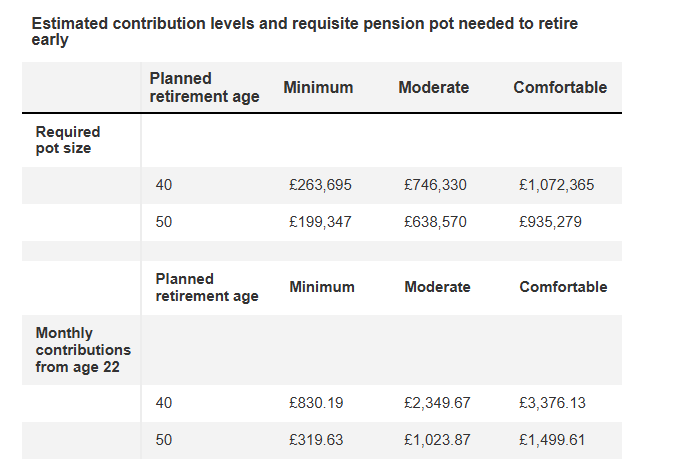
L&G have kindly crunched some numbers for MoneyWeek using certain assumptions such as starting work age 22 and using the minimum, moderate and comfortable lifestyle costs as estimated by Pensions UK in its Retirement Living Standards.
3 key things to know before you start investing for passive income
Want to start investing to build a sizeable portfolio and second income? Here are some important considerations to take on board first.
Posted by
Ben McPoland
Published 8 September, 2025
Image source: Getty Images
You’re reading a free article with opinions that may differ from The Twelfth Magpie’s Premium Investing Services. Become a member today to get instant access to our top analyst recommendations, in-depth research, investing resources, and more.
Many people start investing because of the lure of passive income. This is understandable, as enough dividends flowing into an investing account may make it possible to escape the rat race and travel the world.
So, rather than a boss breathing down your neck, you could instead be enjoying a cool ocean breeze on a Bali beach. It sounds wonderful, and lots of people have achieved it well before retirement age.
However, without wanting to rain on anyone’s passive income dream parade, it’s vital to keep three things in mind when it comes to dividend investing.
Watch out for yield traps
The first is that not all that glitters is gold. I mean, just because a stock carries a massive dividend yield, it doesn’t mean the income is in the bag. It could be a yield trap.
Take WPP (LSE:WPP), for instance. The FTSE 100 advertising group currently has an 8% yield, which is the fourth-highest in the blue-chip index. It towers above the index’s 3.3% average and was 9%+ not long ago.
However, this is just the backwards-looking yield, and is the result of a falling share price. It doesn’t say what will come next.
WPP has lost 51% of its value this year. Often, this is a red flag. It signals that the market is deeply concerned about something, and this needs serious attention from would-be investors.
Dividends are not bullet-proof
Next, individual payouts are not guranteed. Returning to WPP, the firm just slashed its interim dividend by 50%, from 15p to 7.5p per share. So the real yield when investing today is under 8%.
In H1, WPP’s operating profit plunged 48%, while pre-tax profits crashed by 71%. This was due to falling client spending and fierce competition across the industry.
Meanwhile, investors are also concerned about the impact of AI on ad agencies, with new cutting-edge capabilities automating parts of ad creation and placement (the ‘where/when’ bit).
However, WPP has a new CEO at the helm, with a turnaround plan underway to survive in the age of AI. So it’s not inevitable that the company is doomed to perpetual decline.
Looking ahead, analysts see the dividend declining both this year and next. Yet, this still gives a well-covered forward yield of 6.3%, based on current forecasts. That’s around a fifth less than the headline 8%, though.
Personally, this isn’t a stock I am considering. The long-term income prospects seem too uncertain.
Tax realities
Third, most UK dividend income received outside of a Stocks and Shares ISA is taxed. So this needs to be taken into account.
Everyone gets a small dividend allowance of £500 per year. Anything above that is taxed, depending on your income band.
Please note that tax treatment depends on the individual circumstances of each client and may be subject to change in future. The content in this article is provided for information purposes only. It is not intended to be, neither does it constitute, any form of tax advice. Readers are responsible for carrying out their own due diligence and for obtaining professional advice before making any investment decisions.
Still worth pursuing
With those reality checks out of the way, I want to end on a positive note by highlighting how it’s possible to mitigate these three things.
On yield traps, basic research can be done to assess a company’s financial health and prospects. Meanwhile, owning a diversified portfolio of shares can help cushion any possible dividend cuts.
Finally, any income and returns generated in a Stocks and Shares ISA is tax-free, with the annual contribution allowance of £20,000 a year. Investing £1,000 a month at a 9% return could build a £1m ISA portfolio within 25 years.
Fortunately for you and me, the financial markets aren’t 100% efficient. And some corners are even less mature and less combed through than others.
These corners provide us contrarians with stable income opportunities that are both safe and lucrative.
There are anomalies in high yield. In an efficient market, you wouldn’t expect funds that pay big dividends today to also put up solid price gains, too.
We’re taught that it’s an either/or relationship between yield and upside – we can either collect dividends today or enjoy upside tomorrow, but not both.
But that’s simply not true in real life. Otherwise, why would these monthly payers put up serious annualized returns in the last 10 years while boasting outsized dividend yields?
For example, take a look at these 5 incredible funds that pay monthly and soar:
This is the key to a true “Monthly Payer Portfolio” – banking enough yields to live on while steadily growing your capital. It’s literally the difference between dying broke and never running out of money!
But I’m NOT suggesting you run out and buy these funds.