Investment Trust Dividends
Why MoneyWeek likes investment trusts© Getty Images
The investment-trust structure was conceived in the mid-1800s to fill a gap in the market for a low-cost, mass-market investment vehicle. One of the first was Foreign & Colonial, founded by City of London financier Philip Rose. The entrepreneur had a revolutionary goal: to provide the “investor of moderate means the same advantages as the large capitalist”
In the 1800s, investing was largely the preserve of the wealthy, with limited options available to the smaller investor. Foreign & Colonial pooled investors’ money and invested it in a diversified portfolio, spreading risk across a basket of assets.
The closed-ended structure, which provided a stable pool of long-term capital, made these investment companies ideal vehicles for financing the expansion of the British Empire and the rapid industrialisation of the Americas. As global investment markets grew and diversified, the range of investment options available to investors with investment trusts expanded, and the range of trusts available also expanded.
Investment trusts are structured as companies. They issue a set number of shares at the time of their flotation, and this forms a fixed capital base. Investors are then free to buy and sell the shares on an exchange. As the shares are freely traded and the asset base is fixed, trusts can trade at a premium or a discount to their underlying net asset value.
Open-ended vehicles, such as exchange-traded funds (ETFs), unit trusts and open-ended investment companies (Oeics) issue or eliminate excess shares at the end of each day to ensure the NAV and the share price match. This means there’s no room for a discount or premium to emerge.
This also means the capital base can shrink dramatically if the number of sellers consistently exceeds the number of buyers (and the price of shares in the fund falls). As the capital base shrinks, the vehicle has to continue selling assets to fund investment outflows. If those assets are challenging to sell, this can lead to a liquidity crunch. That’s why investment trusts tend to be the best vehicle for holding illiquid assets. They have no obligation to sell the assets, no matter how wide the discount to underlying NAV may become.
Some of the biggest trusts in illiquid sectors are the infrastructure trusts 3i Infrastructure (LSE: 3IN), Greencoat UK Wind (LSE: UKW) and the Renewables Infrastructure Group (LSE: TRIG). All of these trusts own portfolios of illiquid infrastructure assets, which generate steady inflation-linked cash flows.
Infrastructure isn’t the only asset class that lends itself well to the investment-trust structure. Trusts are ideally suited to owning portfolios of mixed assets, such as bonds, gold and stakes in hedge funds or private-equity investment funds. BH Macro (LSE: BHMU) has a position in the global macro hedge fund Brevan Howard, giving investors access to a fund that would otherwise be unavailable
HarbourVest Global Private Equity (LSE: HVPE) is just one investment trust in the private-equity sector, offering investors exposure to this asset class via the trust structure. RIT Capital (LSE: RIT) and Caledonia (LSE: CLDN) are two examples of trusts making the most of the flexibility offered by the structure. Both are majority-owned by their founding families and own a broad portfolio of assets, from private-equity holdings to direct investments in other companies and portfolios of equities.
The structure of the investment trust also lends itself well to borrowing money. Investment trusts that specialise in acquiring illiquid assets – such as wind farms, property and infrastructure assets – can borrow against those assets to increase growth and build the asset base. These companies can also borrow to invest in equities. Borrowing money to invest in shares can be risky, but trusts can often mitigate some of the risk by issuing long-term fixed bonds.
For example, Scottish American (LSE: SAIN) issued £95 million of long-term debt between 2021 and 2022 with a blended interest rate of under 3%, maturing between 2036 and 2049. The trust, which owns a portfolio of equities, as well as property and infrastructure via other investment trusts, used the cash to reinvest into the portfolio.
The ability to borrow money is particularly helpful for the real-estate investment trust (Reit) segment of the market. Reits are a version of the typical investment trust, but with tax benefits when the majority of the portfolio is deployed into property. Companies like Supermarket Income (LSE: SUPR) and PHP (LSE: PHP) have leveraged this structure to build property portfolios designed around supermarkets and healthcare facilities, respectively.
MoneyWeek has always preferred investment trusts to open-ended funds for the above reasons – and the fact that they have historically outperformed other actively managed, open-ended funds. However, this has started to change in recent years. Investment trusts, particularly in equities, have struggled to keep up with the performance of other funds. As a result, investors have drifted away, and discounts to NAVs have risen sharply.
But there’s still a place for trusts within investors’ portfolios. Thanks to the structure of trusts, they are invaluable to build exposure to specific themes such as small caps, emerging markets, property and infrastructure. There are virtually no mass-market alternatives to the infrastructure offering, and trusts such as BH Macro, RIT and Capital Gearing (LSE: CGT) offer the sort of portfolio diversification that just can’t be found elsewhere.

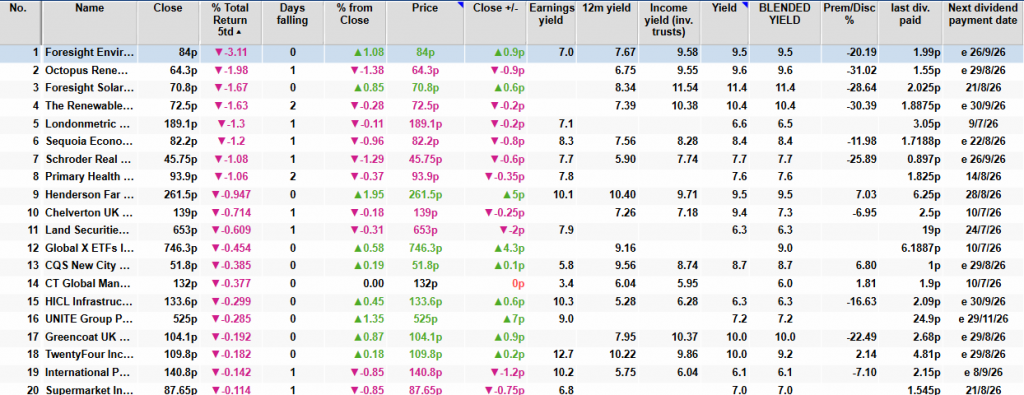
I’ve bought for the SNOWBALL a further 7593 shares in TRIG for £5.5k.
Yielding 10.4%

I’ve sold the SNOWBALL’s shares in FSFL for a profit of £621.00.

Mainly as it’s been a long wait for any news and if when there is news the funds will need to be re-invested, so it’s better to re-invest now, when there are some still above market yields available.

Cash for re-investment £12,014.

This high-yield FTSE 250 stock has exposure to some brilliant growth stories, as well as dividend payers. Our writer likes its passive income potential.
Posted by Christopher Ruane
Published 2 July
You’re reading a free article with opinions that may differ from The Twelfth Magpie’s Premium Investing Services
When it comes to looking for high-yield opportunities in pursuit of passive income streams, FTSE 250 stocks can be a fruitful hunting ground.
For example, one investment trust in the index already pays quarterly dividends that add up to a 9.6% yield. On top of that, it has been growing its dividend per share annually for the past few years.
The FTSE 250 stock in question is Henderson Far East Income (LSE: HFEL). As the name suggests, the investment trust is focused on the Asia-Pacific region.
That gives it possible exposure to plenty of opportunities that have strong growth stories. Indeed all three of the trust’s current largest holdings (MediaTek, Taiwan Semiconductor Manufacturing and SK Hynix) operate in the semiconductor space, currently booming on the back of AI demand.
Buying growth shares then selling them for a higher price down the line could be one way to fund dividends. Typically though, growth shares are not associated with high yields.
However, growth shares are not the only string to Henderson Far East Income’s bow. It also owns some lucrative dividend shares, like 5.7%-yielding Swire Properties.
Despite steady dividend growth and a notably high yield, Henderson Far East Income’s share price has actually fallen 19% over the past five years.
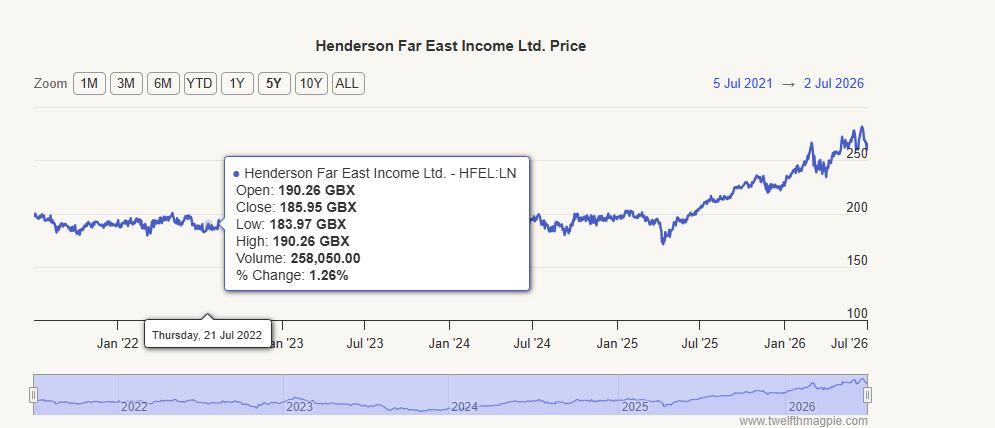
More encouragingly, recent performance has been decent. The FTSE 250 stock is up 15% over the past year, outpacing the 9% seen in the index during that time.
Still, does the long-term value destruction indicate possible investor concerns about the sustainability of the bumper dividend?
Just because a company has had a steady history of regularly raising dividends does not mean it will keep doing so.
Just look at Guinness brewer Diageo as an example. Until several years ago, it had grown its dividend annually for decades. This year though, it sliced it in half.
I certainly see risks for Henderson Far East Income.
Its heavy exposure to the semiconductor industry is one, if the bottom falls out of that heated market. On the plus side, as recent performance shows, it is an opportunity as well as a risk.
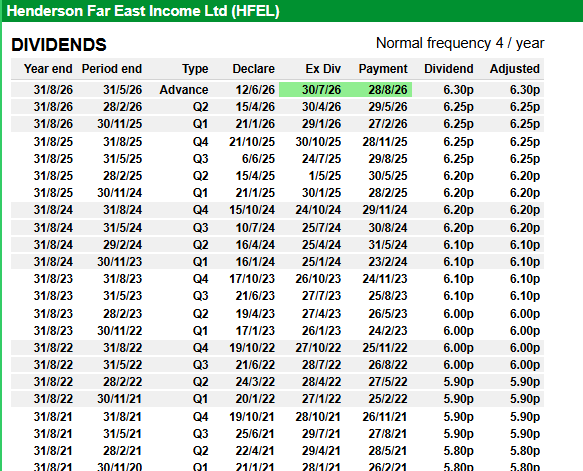
Weakening economic indicators in some large Asian economies suggest another risk. Any economic slowdown could eat into the prices of the shares in the trust’s portfolio — and also the ability of companies it has invested in to pay large dividends.
Yet stepping back to the bigger, long-term picture, I am upbeat about this high-yield FTSE 250 stock’s ongoing potential.
I continue to see Asia Pacific as having good long-term growth prospects and reckon Henderson Far East Income stands to benefit from that given its portfolio allocation.
For investors who are focused on trying to earn regular passive income streams from their share portfolio, I see it as a stock worth considering.

This TFSA stock offers regular cash flow backed by retail and mixed-use real estate.
Posted by Jitendra Parashar
Published July 2
You’re reading a Fool.ca free article. Go to your Premium Motley Fool experience to see member-only content.
Key Points
Ask most income investors what they enjoy most about dividend investing, and many won’t mention the yield first. They’ll talk about consistency. In addition, if the dividend income is received every month, it makes a Tax-Free Savings Account (TFSA) feel more tangible. Instead of waiting for a once-a-quarter payment, investors see cash arrive every month, which could be reinvested or saved for future opportunities without triggering tax on the income.
That is why a well-run real estate investment trust (REIT) could be appealing inside a TFSA. The right trust gives investors exposure to hard assets, recurring rental income, and steady distributions. For example, SmartCentres Real Estate Investment Trust (TSX:SRU.UN) has worked to build exactly that kind of business, pairing a large portfolio of Canadian real estate with a distribution yield that’s difficult to ignore.
In this article, I’ll discuss why SmartCentres stock stands out as a solid TFSA stock offering both an attractive dividend yield and the appeal of monthly paycheques.

If you don’t know it already, SmartCentres REIT develops, leases, owns, and manages shopping centres, office buildings, rental residences, and industrial properties across Canada. Its portfolio includes about 200 strategically located properties, giving the trust a broad footprint in the Canadian real estate sector.
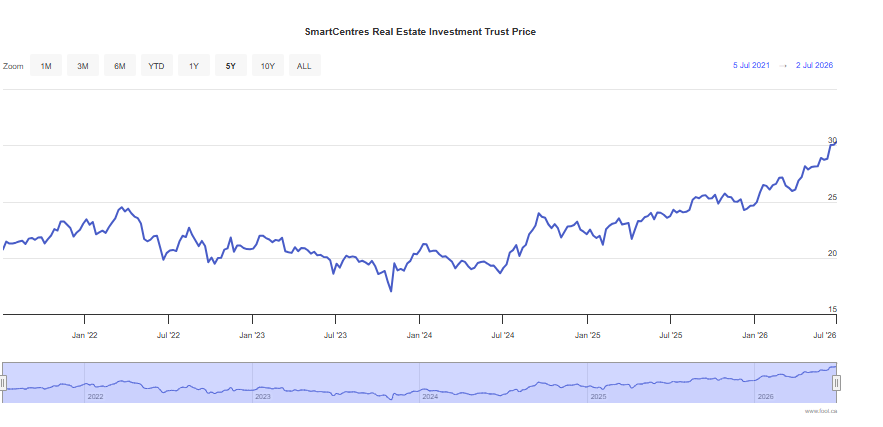
After climbing by 18.4% in the last year, SmartCentres stock currently trades at $30.31 per share with a market cap of about $4.4 billion. With this, it’s trading just 2% below its 52-week high. At this market price, the stock also offers an attractive dividend yield of 6.1%, paid on a monthly basis.
That price strength matters because many REITs have struggled with higher borrowing costs and investor caution in recent years. However, SmartCentres has still managed to move higher, suggesting the market continues to see value in its property base and monthly distribution.
Retail demand remains strong across SmartCentres REIT’s portfolio. In the first quarter of 2026, its lease extensions were completed with average rent growth of 11.5% year-over-year (YoY), excluding anchors, as the trust continued focusing on value-oriented retail and higher-quality tenants.
This is an important distinction. Retail real estate is cyclical, but properties tied to everyday shopping needs tend to be more resilient than destination malls or weaker locations. That could support occupancy and recurring rental income.
Meanwhile, the REIT continues to focus on development as many of its new retail projects are underway in Kingston, Lindsay, and Winnipeg. Similarly, it’s constructing a 200,000-square-foot retail building pre-leased to Canadian Tire in Toronto.
Financially, SmartCentres reported net operating income of $137.7 million for the first quarter, up 0.7% YoY. The company’s funds from operations (FFO) were $0.54 per share, while adjusted FFO per unit was $0.52, as higher base rent helped offset rising interest and administrative costs.
The trust is also working on larger mixed-use opportunities. Its ArtWalk condo Tower A in the Vaughan Metropolitan Centre is nearly 93% pre-sold, with 340 units, highlighting demand for its residential pipeline.
At the same time, the REIT has simplified the business by settling legacy earn-out arrangements, terminating mezzanine loans, and consolidating certain fees paid to Penguin. Those steps should improve its cash flow visibility and make its structure easier for investors to understand.
For TFSA investors, a simpler structure could be useful because it gives more visibility to cash flow. If SmartCentres REIT keeps improving that visibility while prudently advancing development projects, its share price could deliver solid returns on investment.


Disclosure – Non-Independent Marketing Communication
This is a non-independent marketing communication commissioned by Greencoat UK Wind (UKW).
Overview Analyst’s
Re-examining the fundamentals behind UKW.

Greencoat UK Wind (UKW) was the first renewable energy infrastructure trust to launch in the UK, and it contributes around 2% of electricity generation in the UK each year. UKW’s success has been the result of a straightforward investment proposition, and a focus on the higher financial returns and cash flows from wind farms relative to other renewables assets, not to mention the scale economies that come with having a £5bn portfolio of assets.
We discuss the financial returns that UKW has delivered for investors in the Performance section. At a basic level, UKW gives investors a relatively pure exposure to the economics of wind farms. Those economics, in their simplest form, rely upon a basic ‘price × volume’ equation; i.e. how much electricity the wind farms produce and the price received (via subsidies and merchant power prices). UKW generates a predictable amount of power over the long term. On the other hand c. 50% of UKW’s lifetime cash flows are exposed to merchant power prices that vary over time. Long term, the ‘energy transition’ is in full swing. Electricity demand looks well set to increase thanks to widespread adoption of EVs, heat pumps, and not forgetting AI and data centres. This growth in demand should underpin both power prices and the demand for additional renewable capacity.
Operational wind farms are highly cash generative, and UKW’s high structural dividend cover gives investors a degree of comfort that the dividend will be paid through the ups and downs of energy prices and wind speeds. As we discuss in greater detail in the Dividend section, the inflation-linked dividend that UKW has paid since launch is core to its attractions. Having a high dividend cover is beneficial as it gives the trust flexibility to deploy surplus income accretively into the best opportunities available to the manager. Reinvestment into the portfolio is key to sustaining cash flows that underpin the dividend (wind farms depreciate over time, and have an assumed 30-year operating life). We expect the manager to increasingly allocate excess capital towards reinvestment to deliver an evergreen portfolio, supporting its sector leading CPI-linked dividend pledge.
Analyst’s View
UKW’s long term NAV total returns have been 7.01% per annum since IPO to 31/03/06 (Bloomberg). Whilst the years since interest rates rose in 2022 have detracted from UKW’s strong track record, we believe the fundamental attractions of the investment proposition have not been impaired. Underpinning everything is the trust’s ability to contribute very significantly to UK homes’ and businesses’ energy demands. As we discuss in the Dividend section, UKW has structurally strong dividend cover. This enables the trust to not only weather short term volatility in energy prices and wind speeds, but also provides enough excess cash generation (post dividend payment) to reinvest into the portfolio to ensure an evergreen portfolio capable of supporting the sector leading CPI-linked dividend pledge.
On the other hand, there has been scrutiny on the subsidy regimes that apply to renewables, given the high cost of energy in the UK and tight public finances. No one expects UK politics to return to stability any time soon. The truth is that the UK needs to continue to attract long-term private sector investment in renewables (and other infrastructure) so the government would need to be very careful about impacting the confidence of investors. Further, renewables is both quicker to market and cheaper to deliver than the alternatives (gas and nuclear).
As we discuss in the Discount section, worries about what a new energy price regime will look like are part of the reason for UKW’s shares trading at a wide discount to NAV. With the manager focussed on maximising NAV total returns and the reinvestment of excess cash flows (see Performance section), whilst also de-gearing the trust to below its self-imposed limit of 40% of GAV, there is clear potential for any resolution in political worries to boost shareholder returns through the discount narrowing. In the meantime, shareholders stand to benefit from the attractive dividend yield of 10.2%.
Dividend
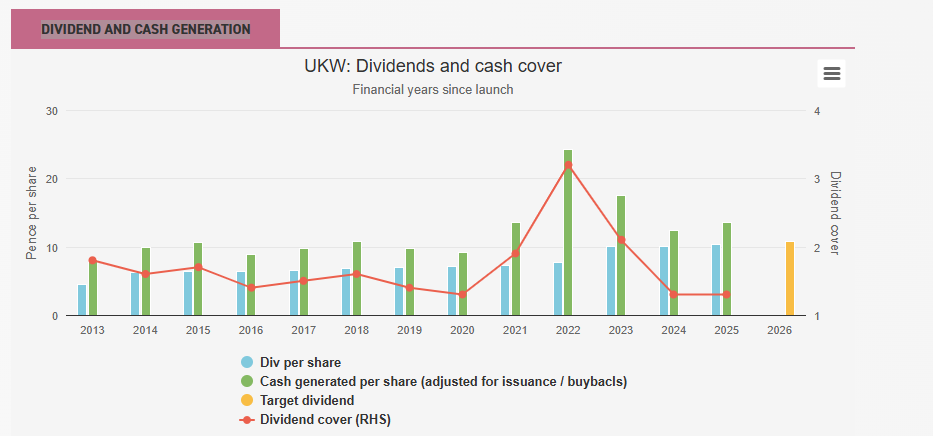
As we discuss in the Portfolio section, wind farms are highly cash generative and UKW was IPOed to deliver to shareholders a high and attractive income stream, linked to inflation, alongside preservation of the NAV in real terms. As such, the historic dividend serves as one important yardstick of whether the trust has achieved its aims. As the chart below shows, UKW has increased its dividend each year from an annualised 6p per share at IPO in 2013 to 10.35p paid last year. UKW’s dividend target for 2026 is 10.7p per share, equivalent to a yield of 10.2% at the current share price. The board has an explicit aim of raising the dividend in line with inflation, which they have achieved since IPO, and they continue to repeat this ambition publicly.
Clearly the board’s aims may or may not reflect reality, and so other than its wish to avoid being seen to have failed, we believe shareholders should also take a lot of comfort from the strong dividend cover that UKW has exhibited historically. In fact, UKW’s dividend cover has averaged 1.7× since launch, which provides protection against the natural variability in energy production and cyclicality in energy prices. Underpinning cash flows is UKW’s subsidies’ explicit link to inflation. According to the manager, over the next seven years (2026 onwards), 59% of the portfolio value will be comprised of fixed cash flows, the vast majority of which are explicitly linked to inflation. The graph below shows that the last two years have seen below target dividend cover of 1.3×, mostly a reflection of below average wind speeds and lower energy prices.
The managers appear confident that dividend cover will improve in coming years. During the current financial year, UKW has reported a strong start to 2026 with Q1 output 4% ahead of budget and anecdotal evidence suggesting Q2 will also be above budget. Higher power prices as a result of the Iran war might suggest that the trust could return to dividend cover more in line with the long-term average of 1.7× for 2026. Over the next five years, according to the company, UKW expects to achieve a dividend cover of 1.7–2.1×. In early 2026, the UK government announced that, given RPI is being discontinued as an inflation measure, subsidies previously linked to RPI will be linked to CPI in future. Mirroring this move, UKW’s board has adopted CPI as the new target for the 2026 dividend increases, and for future dividends henceforth.
Source: Schroders Greencoat
Past performance is not a reliable indicator of future results
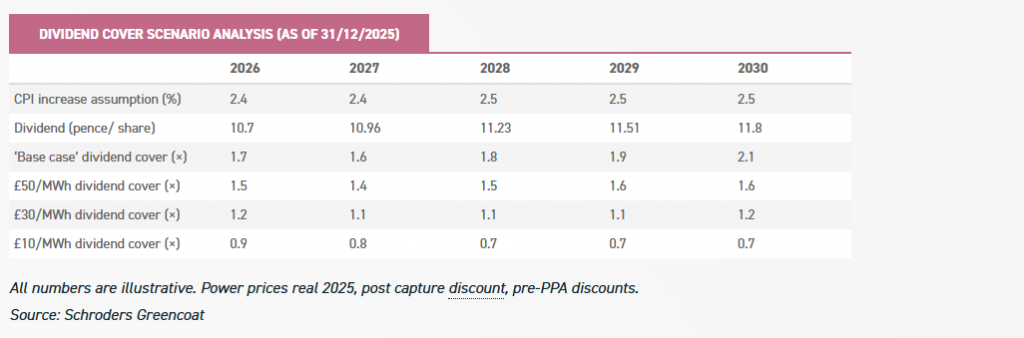
President Trump’s ill-thought-out war with Iran, and the potential for a lasting truce or end to the war, have meant energy prices have been volatile. UKW has been a beneficiary of this turbulence, and took the opportunity in Q1 2026 to fix around a quarter of its expected electricity output for 2026 at an attractive rate. If a lasting peace is secured then energy prices might be expected to fall. In this context, UKW provides this table, which should provide reassurance to shareholders that UKW’s dividend should remain resilient in the coming years, even if electricity prices fall precipitously.
Source: Schroders Greencoat
How to become an Isa millionaire
As savings rates fall, and tax bills rise, it’s a key time to reassess your Isa strategy – doing it well could make you a millionaire.
At the last count, there were nearly 5,000 Isa millionaires in Britain, and the top 25 have pots averaging a whopping £11.3m.
But joining this exclusive club does not just happen overnight – it takes time and patience.
An Isa is an all-important tax shelter for your savings, where you will escape tax on dividends and capital gains tax on any profits when you sell, as well as income tax.
How much you invest, the investments you choose and their performance, are the main factors that will determine whether you can one day reach the £1m milestone.
Chancellor Rachel Reeves has confirmed reforms to cash Isas will be introduced in 2027 for savers under 65, but there is no suggestion (at the moment) that stocks and shares Isas are under threat.
If anything, the Government wants to encourage more small investors to put their money into the stock market, particularly into London-listed shares and infrastructure.
Here, Telegraph Money explains how to invest your way to £1m.
To get to £1m, investors will need to max out their Isa each year, and their investments must provide a certain level of returns.
Someone starting from scratch today putting the full £20,000 annual allowance into a high-risk stocks and shares Isa could expect to reach millionaires’ row in under 21 years, assuming 8pc annual return
If you’re more comfortable with lower-risk investments, investing at this same rate could still get you to £1m – but it would take around 35 years, assuming 2pc annual returns.
The average Isa millionaire has £1.35m, investment company Plum found. But the top 25 Isa investors are sitting on pots averaging £8.8m.
Lord John Lee became an Isa millionaire more than 20 years ago and has written for Telegraph Money sharing his insights.
Plum’s Rajan Lakhani said Isa millionaire wealth was continuing to grow “even as other savings and investment products lose a little of their shine due to rising complexity and lower interest rates.
“A large part of the Isa’s appeal is the flexibility and liquidity it offers investors. In simple terms, you can crystallise your wealth whenever you choose and regardless of age, unlike, for example, pension holdings or buy-to-let properties.”
It’s not just a feat for the elderly, either – at brokers AJ Bell, the youngest Isa millionaire is just 33 – and the oldest is 100
There are four key habits that will help you become an Isa millionaire:
To get to £1m as quickly as possible, the first step is to invest the maximum each year.
It is arguably easier to become an Isa millionaire today, with a £20,000 a year Isa allowance for savers (assuming you can afford to put away the maximum), compared to older investors who started out when Isas launched in 1999 with a £7,000 limit.
If you started saving today and the Isa limit remained at £20,000, it would take you 25 years to become an Isa millionaire, assuming an average annual return of 5pc.
The next key part of your strategy could be to invest early in the tax year. It means you will have up to an additional year invested, which will also help power portfolios in a rising market, as more of your assets are invested for longer.
When it comes to selecting investments you’ll need a diverse, balanced mix according to your risk appetite. Buying individual shares can produce outstanding returns, but you are very exposed to a small number of companies (read on to discover the most popular shares held by Isa millionaires this year).
The alternative is investing in funds, either actively managed or “passive” where an algorithm mirrors a given index or industry. You might also wish to consider listed funds, also called investment trusts, which have been a good bet over the years.
At Interactive Investor, Britain’s second largest stockbroker, equities are the most popular type of holding among millionaires, accounting for 39pc of portfolios. Investment trusts come in a close second, at 34pc.
A total of 50 investment trusts would have made investors more than £1m if they had invested the full annual Isa allowance in the same company each year to 2024, according to research from the Association of Investment Companies, a trade body.
Investing the full Isa allowance each year from 1999 to 2024 – a total of £326,560 – and reinvesting the dividends into one of the four investment companies below would have generated a tax-free pot of over £2m at the end of January 2025.
These top four performing funds are: Allianz Technology Trust, HgCapital Trust, Polar Capital Technology and Scottish Mortgage. Among the common investment themes in these listed funds are technology and smaller companies.
While these figures are compelling, it is not advised to have all your money in one investment or one investment type.
The average Isa millionaire portfolio includes 23 holdings, according to AJ Bell.
While choosing long-term investments is often a good strategy, it is still advisable to periodically assess and adjust your investment choices. As you approach retirement, your appetite for risk may decline.
Laura Suter, head of personal finance at AJ Bell, said: “Most Isa millionaires are in their 60s and 70s, illustrating the crucial impact of compound returns over the long-term. Nonetheless, nearly a fifth of Isa millionaires have hit the milestone before their 60th birthday.
“Astonishingly, a handful of extremely successful Isa investors in their 40s have racked up portfolios worth over £3m. Although it’s worth pointing out those with a sizeable portfolio at such a young age often tend to pursue a high conviction strategy focused on specific stocks, which won’t be for everyone.”
Ms Suter warned there was “no guaranteed recipe for success”.
“Some investors invest in highly diversified portfolios, while others have just a handful of positions. And while shares and trusts are especially popular among millionaires, there are plenty using funds too. The important thing is to invest in what you feel comfortable with and understand the level of risk you are taking in return for the potential reward.”
Investing over a long period is a tried and tested strategy.
The sooner you start saving the more you can put aside, and early contributions are the most valuable because they have the longest to grow.
Compounding will also boost returns. In simple terms, your money earns a return in the first year and both the original cash and the return benefit from any growth in the second year. In the third year your investment is further enhanced by any returns achieved. This snowball effect is known as compounding.
Experts insist that getting rich slowly is a smart strategy.
Sarah Coles, head of personal finance at Hargreaves Lansdown, says: “Isa investors don’t take enormous risks.
“Their focus is to consistently invest as much as possible of their annual allowance, as early as possible in the tax year, in a diverse and balanced portfolio. And they’ve done this every year for decades.”
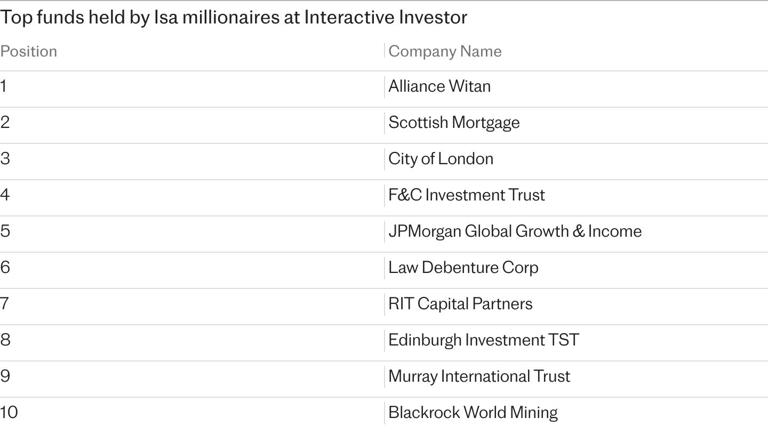
Listed investment funds have powered Isa millionaire portfolios at Interactive Investor, and account for the largest share of Isa portfolios.
Alliance Witan and Scottish Mortgage are the two most common investment trust stocks found in the average Isa millionaire top 10 holdings.
Investment trusts, the oldest form of collective investment in the UK, have several advantages over unlisted funds, according to advocates. One of these is their ability to hold back some of the income they receive from their underlying investments in good years to pay out to investors when times are tougher.
They can borrow money to invest extra than that provided by their investors to boost performance in an upturn. Many also have great track records for paying dividends. The downside is they can be expensive to trade, with many brokers charging flat fees for the purchase of shares, while units in unlisted funds can be purchased for a negligible fee.
Many investors have had success from unlisted funds, however. Popular funds include Rathbone Global Opportunities, Lindsell Train Global Equity, Fundsmith Equity and Fidelity Special Situations.
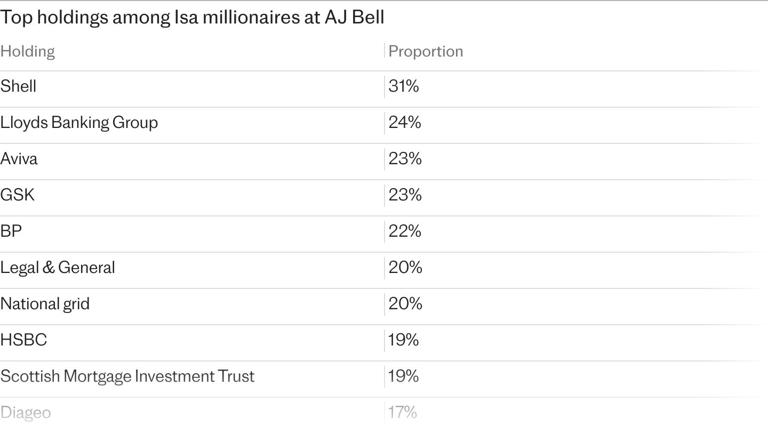
FTSE blue chips are widely held in Isa millionaire accounts. They include Shell and BP; Lloyds Banking Group and Aviva; GSK; and National Grid.
How to become an Isa millionaire in four simple steps
How to become an Isa millionaire in four simple steps
There is one passive fund in the top 10 at brokers Interactive Investor. These funds use computer algorithms to automatically track an index such as the FTSE 100. A common thread here is being – almost – fully invested.
Camilla Esmund, senior manager at Interactive Investor, said: “The not-so-secret sauce of Interactive Investor’s Isa millionaires is staying invested and being diversified – the latter involves spreading money across different asset classes, sectors, and geographies.
“Their success requires time, patience, and benefiting from the magic of compounding. Plus, our Isa millionaires are savvy to the fees they are paying, making sure they aren’t paying a percentage fee that risks eating into their growing pots.”
This is one of the most common questions we get asked on the Telegraph Money desk.
The truth is that the best stockbroker, fund supermarket or “platform” to hold your Isa investments depends on several factors: how much money is in your Isa, what support you need, and the types of investment you plan to make.
You pay holding fees to your provider, which can be a percentage or a flat charge.
On top of this you will pay fund management charges, which will vary greatly – you can find this information on the fund’s factsheet.
While a percentage charge can be cheaper for those with smaller holdings, it can quickly start eating into your returns as your portfolio grows. It’s a good idea to revisit your fees regularly and check whether you could get a better deal elsewhere.

Brett Owens, Chief Investment Strategist
Updated: June 23, 2026
New Fed Chair Kevin Warsh’s hawkish debut has given us a “3-stage” plan for 12% dividends now—and strong gains later.
Here’s how I see that playing out, plus two tickers we can use to grab that reliable double-digit income stream.
3 Reasons Why My Falling-Rate Call Still Stands
First up, I haven’t budged on my call for lower rates. But these things rarely happen in a straight line. In fact, had the Iran conflict not occurred, we’d almost certainly be talking about rate cuts today.
But oil prices are falling as I write this, and the International Energy Agency just predicted a supply glut next year. And despite all the noise around the current deal to end the war, it will end. Neither side can afford any other outcome.
The drop in energy prices is the first, and most immediate, stage of our “falling rates” setup.
The second? Warsh himself, who Trump has charged with cutting rates. My take: He’ll start calling for cuts as soon as he can justify it. When push comes to shove, I expect Warsh will choose self-preservation.
Third (and more important) is AI, which provides a sweeping level of automation to white-collar work that is highly deflationary.
In the 1990s, the Internet acted as a similar “deflator” on prices. The move from snail mail to email and from fax machines to web browsers made businesses wildly more efficient, which kept a lid on consumer prices—and a floor under bond prices (hint!). They rallied throughout the entire decade.
For now, though, bonds are hated. Which is fine by us! We’re happy to take the opportunity to scoop up the best closed-end funds (CEFs) holding them while we can do so at some nice discounts.
If rate cuts happen sooner, great. The discount on a buy made today will snap shut, giving us price gains on top of our 12% payout. If it takes longer, fine. We’ll collect our 12% divvies in peace, confident we got in at a bargain.
CEF #1: The “Bond God’s” 12.2% Payout
The 12.2%-paying DoubleLine Income Solutions Fund (DSL) is a holding of my Contrarian Income Report service that’s done exactly what we’ve wanted it to since we bought it in April 2016: deliver steady income.
On a total-return basis, it’s up 83.2% as I write this—solid in a volatile time for bonds (and everything else!). In that span, the massive payout has only moved lower once, in the pandemic-rattled market of 2021, when DSL had the chance to snap up bond bargains as rates plunged.
Since then, DSL’s manager, Jeffrey Gundlach (a.k.a. the “Bond God”) has kept the monthly divvies flowing, with two healthy special dividends, too:
Source: Income Calendar
Fast-forward to today and overwrought inflation worries have given us another sweet buy window on this smartly run fund.
As I write this, DSL trades at a 6.5% discount to net asset value (NAV, or the value of its underlying portfolio). That’s a level we haven’t seen this consistently since the last days of 2022, a year in which inflation hit 8%!
Of course, the CPI is less than half that now, and back then, we didn’t have AI, and its deflationary impact, on the radar:
Warsh Drops DSL’s Discount …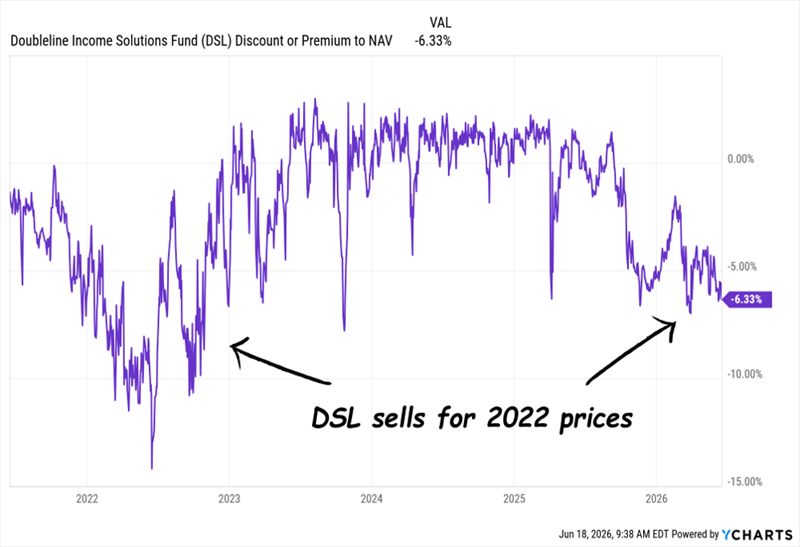
That’s way too cheap for a fund run by a proven manager like Gundlach, who’s got a wide mandate to scour the credit market on our behalf. The discount’s widening has also pushed the yield up to that sweet 12.2%.
… and Gives Its 12% Yield Another Kick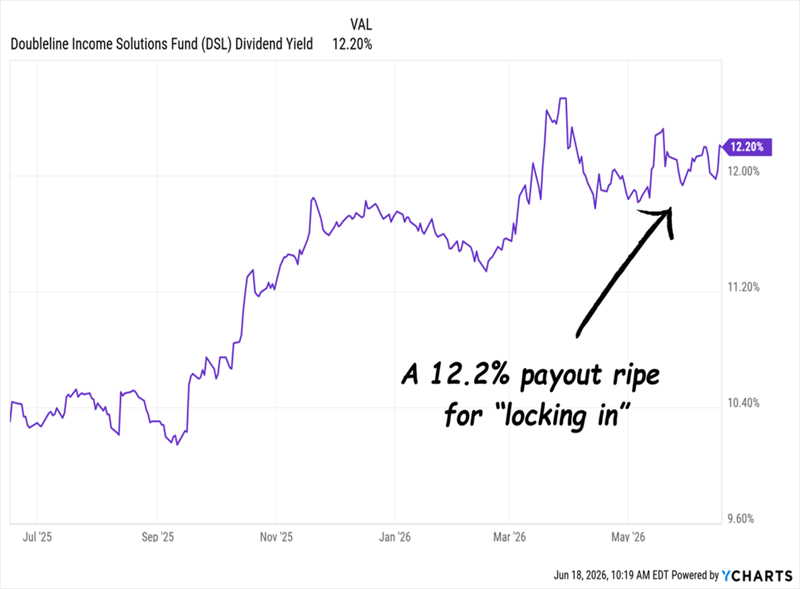
DSL is a textbook contrarian play on today’s overdone rate worries. We’re happy to take the opportunity to grab this steady 12% payer at 2022 prices.
CEF No. 2: A Discount Disguised as a Premium (With Another 12% Payout)
Many first-level investors ignore the PIMCO Corporate & Income Opportunity Fund (PTY) because they think it’s expensive. And to be fair, it does appear so: As I write this, this 12.1%-payer trades at a 3.25% premium to NAV.
But they’re missing the point.
You see, PTY is a PIMCO fund, and that firm, founded by legendary bond investor Bill Gross, holds a stable of CEFs that always trade at premiums, and usually much wider ones than this.
That includes PTY, whose premium has averaged 12.1% in the last year and 20.7% (!) in the last five. Today’s 3.25% premium is also the lowest it’s been, in any kind of sustained way, in the last eight years.
Think DSL Is Cheap? PTY Says “Hold My Beer”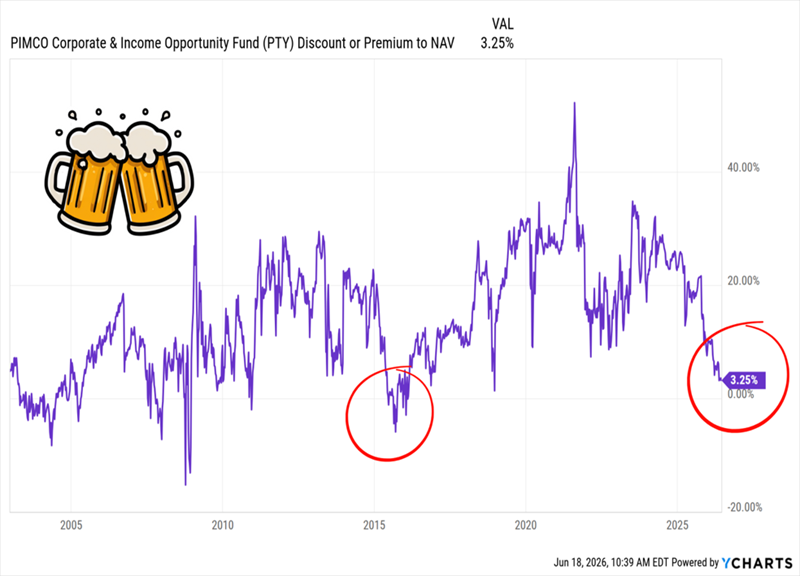
One reason why the fund’s premium has shrunk is likely because of the long effective maturity on its credit assets: 8.5 years. That’s important because longer-duration bonds fall when rates rise and do better when rates fall. But even if rates do rise a bit from here, I think this once-in-eight-year valuation has more than priced that in.
What’s more, the crowd is ignoring PTY’s effective leverage-adjusted duration of 4.3 years. That positions it for gains on lower rates without adding too much risk if rates rise. And PTY, like DSL, delivers a rock-solid monthly payout:
Source: Income Calendar
PTY’s payout, also like that of DSL, saw a slight cut during COVID, but it’s otherwise held steady for years, with regular special dividends (the spikes and dips above) that have more than rewarded investors for sticking around.
So where does all this leave us? As the prospect of lower rates comes into view, PTY’s premium looks set to pop back to its usual double-digit level.
DSL, too, will be in for a repricing, with its discount narrowing from today’s depths. That sets up both funds for gains, and investors to collect their rich dividends as their oversold valuations correct—and beyond.
The 1 Way to Retire on Dividends Alone (Without Investing a Fortune)
These two funds show us what’s possible when you zero in on the right high-yield investments—particularly those that pay you every single month.
To cut to the chase, they give you what I consider the “retirement holy grail”: the ability to clock out on dividends alone—without having to invest in the seven figures to do it!
As with DSL and PTY, though, these discounts are likely to compress as the crowd comes around on falling rates.


Brett Owens, Chief Investment Strategist
Updated: June 30, 2026
Sell in May? Ha! Try “buy in July.”
Truth is, summer is the best time to troll for dividend deals—especially July. We’re going to “back up the truck” on two tickers in a sec.
Why July?
Because it’s the strongest month of the year for stocks, according to a 2024 report from the Carson Group, a financial-advisory firm. Here’s the upshot: Over the 20 years leading up to July 2024, the S&P 500 rose 2.3% on average.
And that’s just the average. Many years saw bigger gains than that.
This is our short-term play.
On the horizon, we’ve got the midterms. We’re not going to linger on that dreaded event. Suffice it to say, the vote is not what we’re interested in—it’s what traditionally comes in the year after it: stock-market gains.
A May study by RBC Wealth Management sets the table here. Going back to 1932, it found that the year following the midterms was the strongest in the four-year presidential cycle, with S&P 500 rising 14% on average.
The bottom line for us is that we’ve got a nice setup for gains this summer, plus another price pop setting up for 2027.
And despite what the headlines say, inflation (and interest rates) will come down. We’re already seeing it in oil prices, and the International Energy Agency (IEA) actually forecasts an oil glut next year.
Oversupply of the goo is fuel (sorry, couldn’t resist!) for growth. It’s an inflation-killer, too.
But we don’t want to be naïve. There’s certainly concern out there. But at times like these, it pays to remember the old stock-market adage: Stocks climb a wall of worry.
They’re certainly doing that now! And my indicators suggest they’ll keep it up. That makes now a good time to buy. Here are two dividend-growth plays to put on your list.
ITW: Hated By Wall Street, Loved By Dividend Investors
Illinois Tool Works (ITW) is one of those stocks analysts hate. That’s because it’s basically an umbrella name covering a range of businesses that aren’t really connected.
Kitchen ovens and fryers? ITW makes ’em under its Hobart and Vulcan brands. Gear for testing electronics? It makes that, too. Fasteners and components for cars? Check.
It’s enough to drive Wall Street—which loves a “clean” single-product story—batty! According to the WSJ, and only two analysts covering the stock rate it a buy right now, with 11 at hold, two “underweight” and five sells. Perfect. We love disliked stocks like these because as they beat low expectations, more analysts come onboard, creating a feedback loop that boosts its price.
And there’s every reason for that to happen.
For one, the company follows what it calls the 80/20 model, where it zeroes in on its biggest/most profitable clients or products—the top 20% or so—which the company sees as providing the bulk (or 80%) of the company’s sales. That tight focus keeps margins high: in Q1, operating margins rose 60 basis points, to 25.4%.
Revenue also jumped a tidy 5% and EPS gained 12%. And management raised full-year guidance by $0.10, to between $11.10 to $11.50. The stock trades at a reasonable 24-times the midpoint of that range.
Which brings me to another reason why ITW is overlooked: the dividend. As I write this, shares yield 2.4%, which sounds okay—until you look at the company’s payout history:
ITW’s “Industrial Strength” Dividend Magnet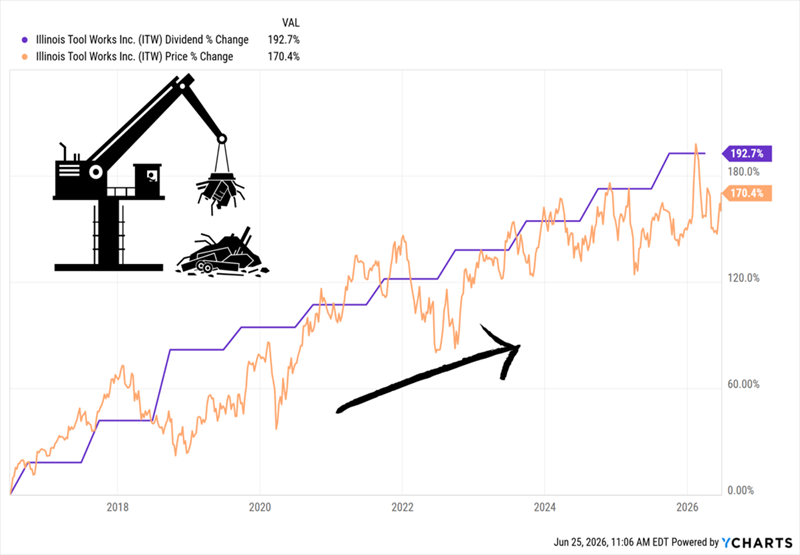
As you can see, over the last decade, ITW has nearly tripled its dividend. You can also see what I call the “Dividend Magnet” in action: The share price has climbed in lockstep. That gap on the right side represents further upside.
That means, of course, that an investor who bought back then is not yielding 2.4% today. They’re pocketing 6.2% (and climbing) on their buy instead. And that’s before we account for the 17% of the company’s float that management has bought back in that time, throwing an additional lift under the stock.
ITW, in other words, is the picture of shareholder friendliness, which makes it worth our attention now.
Deere: Buy for the Construction Boom, Stay for the Farm Revival
Deere & Co. (DE) is sitting in a “sweet spot” for us to buy now.
For starters, the company, a holding my Hidden Yields service, boasts a booming construction-equipment segment, with management forecasting a 20% sales gain, plus 10% to 12% operating-margin expansion for this business, in 2026.
That’s the good news.
The drag? The segment of its agricultural business focusing on large farms, where sales slumped 14% in Q1, and management sees slipping 5% to 10% this year, according to the company’s latest earnings presentation.
But there are green shoots in these numbers, namely that corn and wheat prices have been firming up in the last few weeks, according to the two Teucrium ETFs tracking them, and management itself has said it sees now as the bottom of the ag cycle:
Corn, Wheat Prices “Plant” a Bottom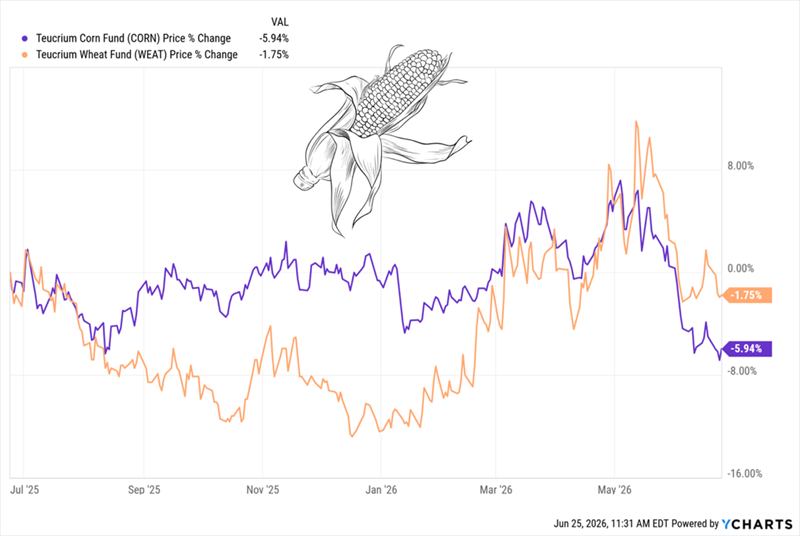
That’s a nice window for us: We never chase a boom. We buy the bottom instead. And as with ITW, we’re looking at a stock that Wall Street doesn’t understand.
Beyond that, high fuel and fertilizer costs, as well as high borrowing costs, have been squeezing farmers, but fuel costs look set to trend lower (see the oil glut mentioned above), and a decline in overall inflation should slow the rise of other costs, as well.
Meantime, as with ITW, Deere’s share price has been following the furrow plowed by its dividend—a trend I expect to continue as the ag cycle turns and global infrastructure spending (including, yes, on data centers) keeps Deere’s construction-equipment business booming:
Another High-Powered Dividend Magnet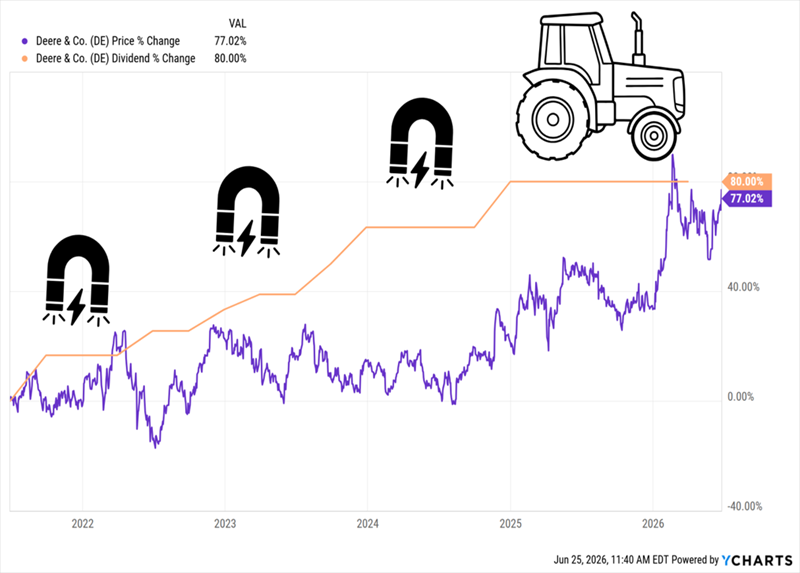
A final upside driver for the payout? Deere’s low payout ratio, with the divvie accounting for just 47% of the last 12 months of free cash flow. That’s very manageable and lends itself to strong payout growth, especially in this “sweet spot” in the ag-growth cycle.
These “Dividend Magnet” Winners Are Our Top 5 July Buys
The Dividend Magnet is more than just a pattern—it’s a proven way to build wealth. It drives price upside. And it lets us “stair step” to those 6%+ yields on cost our long-term ITW holders have booked.

© 2026 Passive Income Live
Theme by Anders Noren — Up ↑