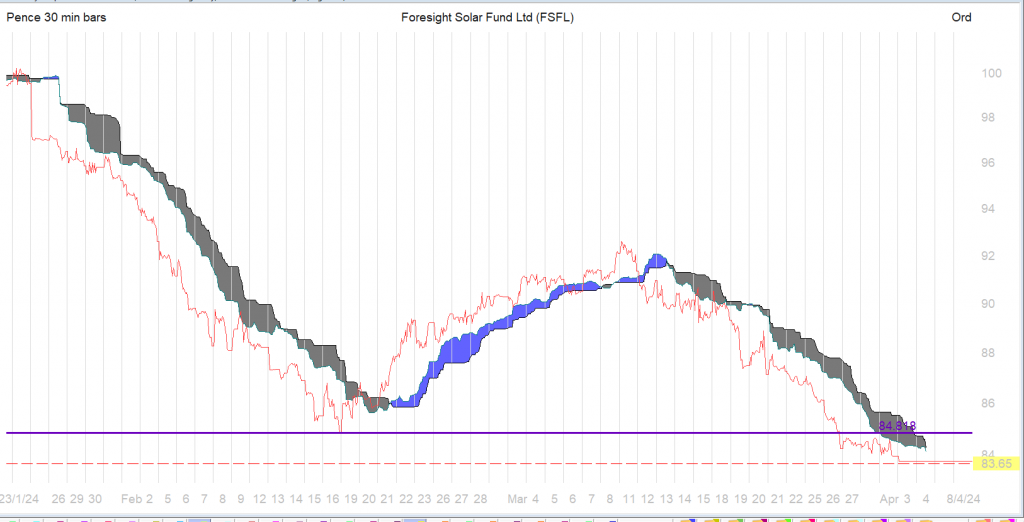
100p going to be support or is it going to continue down ?
Don’t ask me. I know the yield is 8.8%.
Share Buyback Programme
The Board notes the recent weakness in the Company’s share price and the significant discount that the current share price represents to the value of the Company’s assets. Adjusting for the first interim dividend , the closing price of 99 pence per share (as at 14 February 2024) represents a discount of 26% to the 31 December 2023 NAV.
The Board of the Company keeps its capital allocation policy under regular review, evaluating the relative merits of further investment (into both new and existing assets), the management of debt and returning value to shareholders via dividends or through other methods such as share buybacks. As part of this review, and in the context of addressing what the Board views as the excessive discount at which the Company’s shares currently trade relative to the underlying NAV, the Board announces its intention to commence a share buyback programme. In the first instance it has allocated £20 million for the purchase of its own shares.
Share repurchases will be carried out under the existing shareholder authority granted at the last Annual General Meeting, held on 28 November 2023, which allows for purchases of Ordinary Shares by the Company in the market for up to 14.99% of the Company’s issued share capital. Any share repurchases will be funded from a combination of available liquidity, excess operating cash flows from the portfolio and the proceeds from any asset sales as already announced. It is expected that any share repurchases will be accretive to NAV per share.
The Company expects to announce its interim results for the half year ended 31 December 2023 on Wednesday, 28 February 2024. Until such announcement, the Company remains in a closed period in respect of those results and thus unable to buy its own shares, but the Board intends to commence share buybacks following the release of the interims and while the Company’s shares continue to trade at an excessive discount to NAV.
Dividend Guidance Reaffirmed
Shareholders will be aware that the Board of Bluefield Solar has recently declared a first interim dividend for the current financial year of 2.20 pps and has reiterated its target dividend for the full year of not less than 8.80 pps. This represents a dividend yield of 8.9% based on the closing share price of 99p per share on 14 February 2024. The Company’s operations remain robust, trading conditions are attractive, and the Board expects this year’s dividend to be approximately two times covered.
City of London achieved a 6.5% net asset value total return during the six months to 31 December 2023 against a backdrop of falling inflation and market expectations that interest rates have peaked.
The Markets
Although economic growth slowed, the main developed countries appear to have avoided a significant downturn, with employment remaining at high levels. Inflation fell by more than expected, especially towards the end of the period, with investors anticipating cuts to interest rates by central banks globally during 2024. The 10-year gilt yield, which was 4.4% at the beginning of July, ended 2023 at 3.5%.
The UK equity market returned 5.2%, as measured by the FTSE All-Share Index, with medium-sized and small companies slightly outperforming larger peers. The best performing sector was real estate investment trusts, reflecting the downward move in gilt yields, followed by technology, in line with trends overseas. Some more defensive sectors, such as food & beverage and health care, were notable underperformers.
Net Asset Value Total Return
City of London’s net asset value total return was 6.5% – higher than the FTSE All-Share Index (5.2%) and the AIC UK Equity Income sector average (5.0%), but behind the IA UK Equity Income OEIC sector average (6.9%). The negative impact of the fall in gilt yields on the fair value of the Company’s fixed interest debt detracted performance by 34 basis points. It should be noted, however, that the £30 million 2.67% 2046 and £50 million 2.94% 2049 secured notes, both issued in recent years, provide borrowings at fixed low interest rates for investment in equities by City of London over the next quarter of a century.
Stock and sector selection contributed by 171 bps. The underweight positions in pharmaceuticals and AstraZeneca were respectively the biggest sector and stock contributors. The second biggest sector impact arose from being overweight in real estate investment trusts, with Land Securities a notable stock contributor. The biggest detracting sector was food producers, with Nestlé a detractor over the six months. The second biggest detracting sector was aerospace and defence, where the Company missed out on the rise in Rolls Royce (which was not held) but benefited from its position in BAE Systems. Other notable stock contributors were 3i, whose main asset is its shareholding in Action, a fast-growing discount retailer in Europe, and Round Hill Music Royalties Fund, which was taken over. The biggest detracting stock was St James’s Place, which announced changes in the structure of its customer fees.
Earnings and Dividends
Earnings per share rose marginally compared with the same six-month period last year, from 8.79p to 8.80p. Special dividends, received and accounted as income, were down from £2.4 million to £0.9 million. The trend in ordinary dividends received was similar to City of London’s last financial year, with cuts from mining companies being offset by increases from banks and oil companies.
City of London has declared two interim dividends to date of 5.05p each in respect of this financial year. The Company’s diverse portfolio, strong cash flow and revenue reserve give the Board confidence that, in line with its objective to provide long-term income and capital growth, it will be able to increase the total annual dividend for the 58th consecutive year. The quarterly dividend rate will be reviewed by the Board before the third interim dividend is declared in April 2024.
BBGI Global Infrastructure S.A. (LSE ticker: BBGI), the global infrastructure investment company, is pleased to declare a second interim cash dividend of 3.965 pence per share for the period 1 July – 31 December 2023, to be paid on 5 April 2024. Payment of this second interim dividend is consistent with the Company’s target dividend payment of 7.93 pence per share in respect of the financial year ending 31 December 2023.
Details of the second interim dividend are as follows:
Dividend per share: 3.965 pence
Ex-Dividend date: 22 February 2024
Dividend Record date: 23 February 2024
Payment date: 5 April 2024
A scrip alternative will not be available with this dividend payment.
Distributions on the ordinary shares are planned to be paid twice a year, subject to market conditions and to conditions as prescribed by Luxembourg law. The Company has set a target dividend of 8.40 pence per share for 2024.
Note: The distribution guidance above is a target only and not a profit forecast. There can be no assurance that this target will be met or that the Company will make any distributions whatsoever. The times and dates in this announcement are expected times and dates only and are subject to change. Any such changes will be notified to shareholders through a Regulatory Information Service.
Dividend Guidance Reaffirmed with Earnings Cover for the Full Year of Approximately Two Times
Bluefield Solar (LON: BSIF), the London listed UK income fund focused primarily on acquiring and managing solar energy assets, has today announced the Unaudited Directors’ Valuation as at 31 December 2023, equivalent to a Net Asset Value (“NAV”) of £831.3 million, or 136.0 pps (September 2023 136.4 pps, June 2023 139.7 pps).
Unaudited Net Asset Value as of 31 December 2023
Key movements in the NAV since 30 September 2023 include recognition of value from the Company’s Renewable Energy Guarantees of Origin certificates (“REGOs”) until 2030, which have been included in the valuation for the first time owing to sustained market prices over the last 12 months and expectations of future value from forecasters. In addition, the Company has recognised a slight uplift in expected power prices due to a small increase in long term power forecasts whilst short term hedging has predominantly offset reductions from near term power price weakness. There was additionally a minor negative adjustment due to operational cost updates and working capital movements.
The discount rate being applied remains unchanged at 8.0% (30 September 23: 8.00%) and inflation assumptions also remain unchanged from 30 September 23 (2024:3.5%, 2025-2029:3.0%, 2.25% thereafter). All other core assumptions also remain unchanged.
Pence per Ordinary Share
Unaudited NAV as at 30 September 2023
136.4
REGOs
0.9
Power prices
0.4
Operational cost update
-1.0
Other movements
-0.7
Unaudited NAV as at 31 December 2023
136.0
Full details on the movements for the 6 month period to 31 December 2023 will be outlined in the Company’s Interim Statement due for release on 28 February 2024.
Share Buyback Programme
The Board notes the recent weakness in the Company’s share price and the significant discount that the current share price represents to the value of the Company’s assets. Adjusting for the first interim dividend , the closing price of 99 pence per share (as at 14 February 2024) represents a discount of 26% to the 31 December 2023 NAV.
The Board of the Company keeps its capital allocation policy under regular review, evaluating the relative merits of further investment (into both new and existing assets), the management of debt and returning value to shareholders via dividends or through other methods such as share buybacks. As part of this review, and in the context of addressing what the Board views as the excessive discount at which the Company’s shares currently trade relative to the underlying NAV, the Board announces its intention to commence a share buyback programme. In the first instance it has allocated £20 million for the purchase of its own shares.
Share repurchases will be carried out under the existing shareholder authority granted at the last Annual General Meeting, held on 28 November 2023, which allows for purchases of Ordinary Shares by the Company in the market for up to 14.99% of the Company’s issued share capital. Any share repurchases will be funded from a combination of available liquidity, excess operating cash flows from the portfolio and the proceeds from any asset sales as already announced. It is expected that any share repurchases will be accretive to NAV per share.
The Company expects to announce its interim results for the half year ended 31 December 2023 on Wednesday, 28 February 2024. Until such announcement, the Company remains in a closed period in respect of those results and thus unable to buy its own shares, but the Board intends to commence share buybacks following the release of the interims and while the Company’s shares continue to trade at an excessive discount to NAV.
Dividend Guidance Reaffirmed
Shareholders will be aware that the Board of Bluefield Solar has recently declared a first interim dividend for the current financial year of 2.20 pps and has reiterated its target dividend for the full year of not less than 8.80 pps. This represents a dividend yield of 8.9% based on the closing share price of 99p per share on 14 February 2024. The Company’s operations remain robust, trading conditions are attractive, and the Board expects this year’s dividend to be approximately two times covered.
Edinburgh Worldwide – “The opportunity is as exciting as ever”
13 February 2024
QuotedData
Edinburgh Worldwide
Investment companies | Update | 13 February 2024
“The opportunity is as exciting as ever”
As the rate of inflation continues its descent (barring a small bounce in the UK in December 2023) interest rates look likely to fall. Growth stocks have been recovering and Edinburgh Worldwide (EWI), the most growth-focused of the global smaller companies trusts (see pages 22 and 23) has seen a pickup in its relative performance.
Within the portfolio, valuations are relatively low, and history suggests that we are only at the beginning of what could be a significant period of outperformance.
EWI shareholders could benefit further as this should trigger a narrowing of EWI’s own wider than average discount (see page 27). At the same time, EWI’s managers say that the portfolio remains operationally resilient, technological transformation is continuing, and “the opportunity is as exciting as ever”. Reflecting this, team members have been adding to their EWI shareholdings.
Capital growth from entrepreneurial companies
EWI aims to achieve capital growth from a global portfolio of initially immature entrepreneurial companies, typically with a market capitalisation of less than $5bn at time of initial investment, which are believed to offer long-term (over at least five years) growth potential.
Fund profile
EWI is an investment trust which invests globally in a portfolio of listed and private companies. It aims to profit from a global portfolio of initially immature entrepreneurial companies, typically with a market capitalisation of less than US$5bn at the time of initial investment, which are believed to offer long-term growth potential.
Long-term growth potential
The board chooses to compare the trust’s performance to the S&P Global Small Cap Index (total return in sterling). However, the composition of the index has no bearing on the manager’s choice of stocks or position sizes. As evidence of this, the active share at the end of December 2023 was about 99% (relative to the S&P Global Small Cap Index.
To achieve a spread of risk, the portfolio should have between 75 and 125 holdings and have exposure to at least six countries and 15 industries. No more than 5% of the portfolio will be invested in a single security (at the time of acquisition).
The trust was launched in 1998 but did not adopt its current strategy until 31 January 2014.
EWI’s AIFM is Baillie Gifford & Co Limited, a wholly-owned subsidiary of Baillie Gifford & Co.
Douglas Brodie is the lead manager on the trust and its open-ended equivalent Global Discovery. He is supported by two deputy managers – Svetlana Viteva and Luke Ward – along with two analysts and two product specialists. Collectively, they make up the global discovery team within Baillie Gifford. Some more biographical details are provided on page 30.
The wider firm had £225.7bn of AUM at 31 December 2023 and the global discovery team was managing £2.3bn of that.
Exposure to unlisted securities
Up to 25% of the portfolio (at the time of investment) may be invested in unlisted securities (shareholders approved the increase from 15% to the current limit at the AGM in February 2022).
Up to 25% of the portfolio may be invested in unlisted securities.
At the end of December 2023, 23.9% of EWI’s portfolio was in unlisted securities, some of which are discussed from page 14 onwards. The board and the managers believe that for EWI to gain access to the most exciting immature entrepreneurial companies, increasingly it must have the flexibility to invest across private and listed companies. The reason being that technological advances have lowered the initial capital requirement needed to establish and scale many companies.
The quantum of funding available to promising private companies is considerable. Entrepreneurs may never need to turn to public markets for growth capital, instead choosing to use an IPO as a means to provide liquidity for backers once the business is large and mature.
The small company effect
As we have discussed in our previous notes, a key reason for making an allocation to smaller companies is that, while often perceived as being riskier and therefore more volatile, smaller companies tend to outperform larger companies over the longer term (this is sometimes referred to as the small company effect). This can be due to a variety of factors, but experience tells us that it is intrinsically easier for a smaller company to grow, perhaps doubling or quadrupling in size in a relatively small space of time, than it would be for a comparable much larger company.
It is intrinsically easier for a smaller company to double or quadruple in size.
Many reasons for the small company effect are often cited, including a tendency towards greater nimbleness (smaller companies tend to have less-complex structures that might otherwise prove a barrier to innovation) and a greater range of opportunities due to their size (larger companies are more likely to have to exclude a range of opportunities that are not sufficiently large to meaningfully impact their performance). It is also true that smaller companies are more likely to be in less mature industries where new products are naturally creating new demand and these companies are able to benefit from lower competitive pressures in a market that is naturally expanding. Although there are exceptions, larger companies tend to be in more mature industries where growth can be harder to come by, particularly if a significant element of this has to come from taking market share from competitors.
It is easier to grow in a new industry that is creating its own demand.
Figure 1 illustrates the performance of global small caps versus global large caps over the last 20 years. It shows that, while there have been distinct periods where global small caps have been out of favour and have underperformed global large caps, these tend to give way to periods of recovery with small caps providing strong outperformance.
As inflation in developed markets peaked some time ago and interest rates now appear to be on a path of retrenchment, growth stocks whose valuations were disproportionately affected by rising interest rates look set to benefit from a strong re-rating from the relatively low valuations that these stocks are trading at versus their own history.
Small cap equities look very cheap versus their history.
As Figure 2 illustrates, global small caps have tended to trade at a marked premium to global equities as a whole (arguably reflecting their superior growth prospects) but, despite valuations edging up over the last 18 months, small caps still look attractive (a current P/E of 21.1x versus a five-year average of 26.9x), while large caps are close to their longer-term average (a current P/E of 20.7x versus a five-year average 20.3x). We reiterate or view that, when coupled with EWI’s own wider than average discount (see Figure 38 on page 27), this still represents an attractive entry point for the long-term investor.
As Figure 33 on page 23 illustrates, EWI’s focus is on small-cap growth stocks and, while the performance of small cap growth versus small-cap value appears to have stabilised recently (see Figure 3), it is clear that small-cap growth suffered heavily from the rotation out of growth into value that began in late 2020. As explained above, we think that small cap growth is well positioned for a recovery from this nadir.
The impact of generative AI
The release of Chat GPT-4 in March 2023 jumpstarted a period of mania in markets for anything related to artificial intelligence (AI), which led to a remarkable run of outperformance for the ‘magnificent seven’ mega-cap tech stocks with exposure to the theme: Apple, Microsoft, Amazon, Alphabet, Meta, Nvidia and Tesla. These stocks were collectively up 80% over the year, while the remaining 493 stocks that make up the S&P 500 index were relatively flat at around 5%.
The release of Chat GPT-4 started a period of AI-related mania in markets.
Generative AI has been an incredibly hot topic and, as markets have settled after this initial sprint, EWI’s managers have been doing a lot of work reflecting on its impact – looking not just at primary effects but also second order impacts. For example, within the portfolio, Upwork is becoming more profitable as it is getting paid to find AI talent, while CyberArk has been doing well as cybersecurity has moved up most businesses’ agendas. As a result, EWI’s managers have evolved their thinking, and this has given rise to some portfolio changes.
Hardware 2.0
Traditionally, hardware and software have been seen as very different businesses that require different skill sets and have significantly different drivers and revenue streams. For decades, software – aided by higher IP and greater defensive moats – is where the bulk of value-adding innovations have arisen.
The lines between hardware and software are becoming blurred.
Hardware, in comparison, has been a much more commoditised business. The industry innovated, but with competition limiting the ability of the industry to expand margins, it has tended to be the case that software businesses have built on hardware’s development successes and captured a disproportionate amount of the value added. Microsoft was always touted as a better investment than IBM, for example. However, because of the impact of AI on the development of software, all of this is changing and the lines between software and hardware development are increasingly being blurred.
Increasingly, value-creating innovation has been coming through on the hardware side.
EWI’s managers observe that we are now seeing much more value-creating innovation coming through on the hardware side and they expect this trend to continue. They cite the example of 3D printers, where they say that the applications of this potentially game changing technology are being driven by the technological limits of both the hardware and software but, with software development evolving, the opportunities increasingly hinge on the capabilities of the hardware. However, whereas previously hardware and software tended to be separate businesses, to maintain a competitive advantage the two need to progress in tandem.
To capitalise on Hardware 2.0, EWI’s managers are allocating towards earlier stage companies that the market is struggling to value.
EWI’s managers say that the big question is, how do they capitalise on opportunities in the evolving hardware landscape in the market? They say that they are allocating away from more mature businesses (for example, Axon Enterprise and CyberArk) and reallocating to earlier stage growth companies (for example, Oxford Nanopore and Transmedics). They argue that the market is not yet extending its horizon far enough to value these earlier-stage hardware-orientated companies properly, which is creating an opportunity for longer-term investors such as EWI.
In the private company space – the managers have also been moving more towards holdings that are hardware-focused for the same reason, as well as those that are a key part of the AI toolset. For example, they see satellite connectivity (think SpaceX) as a game changer for AI as systems such as SpaceX’s Starlink network will allow AI to be used anywhere, with the myriad of benefits this could bring.
EWI’s managers point out that this is where the trust’s closed end structure comes into its own as many of these investments are not suitable for inclusion in an open-ended fund but EWI’s structure allows it to arbitrage this market inefficiency.
Philosophy and process
The philosophy that drives the construction of EWI’s portfolio is common to other Baillie Gifford trusts and is based on the manager’s observation of the asymmetry of returns. Only a few stocks have the ability to become global leaders in their fields and sustain that position. The rewards that accrue to them are considerable. By contrast, most companies will struggle to outperform and, as is especially the case with the younger, more immature companies that EWI focuses on, quite a few will fail. It is important that investors in EWI understand this.
Tools and technology have levelled the playing field. Advances such as the internet, cloud computing and online payments are enabling even relatively small businesses to scale fast and address a global market. If the market is global, differences in country and regional macroeconomic and political environments are much less relevant.
A true stock-picking portfolio
EWI, therefore, represents a true stock-picking portfolio, constructed without reference to index weights or to reflect the views of an asset allocation committee. The portfolio has a bias to technology, but as the managers point out, technology is everywhere.
The managers are not compelled to sell good companies on market cap grounds
Potential investments should typically have a market cap of no more than $5bn at the time of initial investment. Nevertheless, the emphasis is on identifying the winners and running with them and EWI may end up with holdings in far larger companies. EWI can act as an incubator of companies that grow to become large enough to be included in Baillie Gifford’s larger-cap strategies and identify up and coming disrupters. However, they can retain exposure to these; the managers are not compelled to sell good companies on market cap grounds.
Only a few stocks have the ability to become global leaders in their fields and sustain that position
This is not a venture portfolio – the managers tend not to consider companies less than $300m–$400m in size – but these are relatively immature companies on the frontiers of change. The uncertain outlook for these businesses makes it hard for the market to value them properly. This is especially true for those companies that are expected to become significantly profitable some years in the future. The managers believe that most of these stocks are poorly understood and that creates the space for bottom-up research to add value. The universe is vast – perhaps 30,000 companies – but most of these will not have the characteristic traits that they are looking for and some entire sectors are not a fit.
The sector is full of companies that are small and will stay that way
The managers seek to assess the potential of the business model and the risk that it does not succeed. Companies need to have a scalable business model and a clear competitive advantage. Credibility of management is very important as is an alignment between the interest of management and investors. Only a very small number of stocks fit their criteria. The sector is full of companies that are small and will stay that way.
EWI’s evergreen structure is an advantage
To deliver transformational growth, a business needs to have a culture of innovation which allows it to identify and solve problems for their customers. It often helps if they are starting with a clean sheet of paper rather than simultaneously managing the decline of an incumbent business. EWI is often a provider of growth capital and, in some instances, this could be before a company is revenue generating (as is the case with many of the trust’s healthcare investments, for example). For the companies, EWI’s evergreen structure is an advantage. It means that they can think long-term without having to be bound to the normal 10-year cycle of private equity LP funds.
Generally, the managers are not keen on situations where a number of companies are competing in the same niche, unless they can demonstrate differentiated propositions, each with their own edge. This is true of the trust’s oncology-focused stocks, for example.
EWI’s board and managers take their stewardship role seriously. However, the company will not seek to influence the strategic direction of the companies that it invests in.
EWI may end up holding a significant stake in a business (Baillie Gifford has informal caps on the size of the stakes held across all funds), especially early in a business’s life. However, the managers are mindful of the daily liquidity in listed stocks and factors that into position sizes. A typical new position will start life in the portfolio as a 0.5%–1.5% position. Where the risks associated with the business model are binary, the position size will be smaller.
Flawed investment cases trigger a sale
Sales are triggered once it is clear that the investment case is flawed. M&A activity is also a source of involuntary sales – often companies end up being taken over for less than the managers think they could be worth. In addition, positions will be re-evaluated and may be sold if the managers feel that the upside is limited.