Investment Trust Dividends

M&G Credit Income
Disclaimer
Disclosure – Kepler Non-Independent Marketing Communication
This is a non-independent marketing communication commissioned by M&G Credit Income. The report has not been prepared in accordance with legal requirements designed to promote the independence of investment research and is not subject to any prohibition on the dealing ahead of the dissemination of investment research.
Overview
MGCI has delivered strong returns over the past year…
Overview
M&G Credit Income (MGCI) is a highly flexible fixed income fund, able to invest across public and private debt markets in pursuit of a high yield. Unlike many funds that offer such a high yield, it does so without taking on a lot of credit risk or gearing up. Nevertheless, it currently offers a 9.1% dividend yield from a portfolio of investment-grade quality.
The portfolio has delivered strong returns over the past year, c. 11% on a NAV total return basis (see Performance). This has been mainly due to the high income generated, while there have also been capital gains on some investments as spreads in public debt markets have tightened. Demand has generally remained high for the shares, with the trust frequently trading on a small premium in recent months and the board issuing into the market.
Manager Adam English reports that he has been seeing an increasingly attractive pipeline of private debt opportunities, and he has been reinvesting profits into them. These should allow him to boost the income being generated by the portfolio while spreads are less attractive in public markets – the key advantage of the flexible structure.
Private debt is mostly floating rate, and MGCI tends to run with 70–80% in floating-rate debt. This means that income rises or falls as UK interest rates do, with a lag. The Dividend is therefore likely to fall slightly over the coming months, as the target is 400bps over SONIA (an interbank rate that closely tracks the base rate). However, Adam expects the yield to remain high, with rates set to fall slowly and risks to the upside still around.
Analyst’s View
We think MGCI’s high yield and low NAV volatility should be appealing to many income-seeking investors. The spread of 400bps over what is effectively a cash rate should remain, even if we see the absolute yield fall gradually as interest rates do. This should be highly attractive versus the yields available on other income-paying investments such as high yield bonds, which carry greater credit risk and duration, and many alternative assets in the investment trust space, which use high levels of gearing to generate their yield.
MGCI seems to be well suited to the current economic environment, and we think absolute returns should remain high for some time to come. While economic growth remains weak in the UK and its key trading partners, serious recession looks unlikely. Inflation has proven relatively resilient, thanks in part to economies performing better than feared. As a result, it looks likely that rate cuts in the UK and US will be gradual and well-ordered, which would keep the income paid out by the trust high. Meanwhile companies’ ability to service their debts should remain resilient, which would create a strong outlook for credit risk. We note that Adam reports a steady flow of attractive deals in the private debt space, which speaks of a healthy market and healthy corporate sector and should mean the manager has plenty of opportunities to maintain the yield and quality of the portfolio.
Bull
High yield linked to interest rates, with average investment-grade quality credit
Offers access to private debt markets, providing attractive risk/return characteristics and diversification
NAV should prove resilient due to many defensive characteristics
Bear
Complexity makes it harder for investors to understand exposures
Limited capital gain potential, including from duration
Rate cuts will reduce portfolio income, absent offsetting investment decisions.
££££££££££££
Loans are at the riskier end of investing so if u are investing u need a higher yield for the risk. Here the Trust trades around its NAV so maybe better for a De-Accumulation stage or to reduce the risk if paired with a higher yielder in your Accumulation stage.
If your savings plan is for your retirement (accumulation stage) u will have the following three choices when that day arrives.
Option One.
Buy an annuity.
The biggest risk is the unknown amount. It could be
Canada Life figures show the 65-year-old with a £100,000 pension pot could buy an annuity linked to the retail price index (RPI) that would generate a starting annual income of £3,896. That’s up from £2,195 in the New Year following a 77% spike in rates this year.
Oct 22
You have to surrender all your hard earned, so not a good outcome, unless markets have crashed and interest rates are near to double figures. Of course the value of your portfolio will most probably have crashed so the benefit may not be that great.
Option two.
Use the 4% rule.
Invest for capital growth hoping for growth of around 7%, depending on your skill level. If u buy a tracker there will be several years of flatlining where your capital will most probably fall and when u want to start spending your hard earned keep everything crossed the market hasn’t crashed before u need the cash.
Option Three.
Buy Investment Trusts that pay a dividend and use those dividends to buy more Investment Trusts that pay a dividend, the accumulation stage. When u enter your de-accumulation stage switch into the safest yields available.
Accumulation stage. Trusts that pay a high dividend and better if trading at a discount as u may be able to book profits to re-invest to earn more dividends.
De-Accumulation stage. Income is most important and making a profit is less of a consideration.
Remember with Compound Growth, u should make more income in the final few years than in most of the early years, so the sooner u start the better chance of a better retirement.
But as always best to DYOR as it’s your hard earned.
dadu online
stacksprojects.com/bee-artinya-2
kay.waldo@neuf.fr
49.68.63.151
dls bni life
Hello there! This is my first comment here so I just wanted to
give a quick shout out and say I really enjoy reading your articles.
Can you suggest any other blogs/websites/forums that cover
the same subjects? Thank you !
Some sites for further information about Investment Trusts
Trustnet
Kepler Trust Intelligence
QuotedData
Edison Investment Research
Motley Fool
Doceo
But as always only to DYOR with GL
THE COMPANY’S BUSINESS
In line with the wind-down policy approved by Shareholders in June 2023, the Investment Manager has continued to realise value through debt repayments and the sale of equity securities. In the first half of this year, proceeds of approximately $45 million were generated from the sale or redemption of Company investments. These proceeds have either been distributed to Shareholders or used to reduce the level of gearing in the portfolio. While it is too early to predict when the gearing will be eliminated entirely, the Company intends to continue to reduce the gearing as progress towards full wind-down continues.
In May, the Company made an initial distribution to Shareholders of $15 million, equivalent to approximately £11.9 million as at the date it was announced, through the issue and redemption of B Shares. The capital returned represented 5.12% of the Company’s net asset value on 31 January 2024.
With the changes to the portfolio brought about by the wind-down, we anticipate impacts on both dividends and hedging. As we have previously indicated, the dividend paid by the Company has started to be reduced proportionately with the distribution of capital from the portfolio. For the three-month period to 31 March, the Company paid an interim dividend of 1.89 pence per share on 18 July. This was equivalent to the preceding dividends of 2.00 pence per share when the reduction in the Company’s net asset value caused by the B-share distribution was taken into account, and we have announced a further dividend of 1.89p in respect of the period to 30 June 2024. We expect that the dividend will be reduced further as the portfolio’s income falls during the progression towards wind-down.

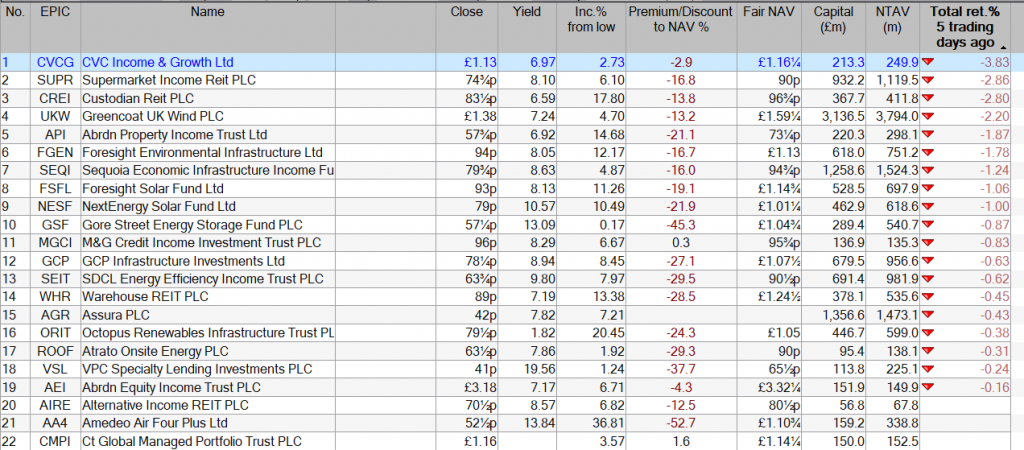
Own a portfolio of Investment Trusts that outperform the table above with a dividend investment plan.
The current income fcast for 2025 is 9.12%. The Snowball started two years ago this month.
£9,120 compounded at 7% for the next 22 years would equal income of 39k a yield of 39% on seed capital.

2024
With the current dividends declared the Snowball will earn £8,913.00 thus achieving the fcast of 8k and the target of 9k (when SUPR pay their dividend in Nov).
Further dividends are projected for December but may be received in 2025 which would be a positive start for the 2025 fcast of income of £9,120.00.
Real Estate Credit Investments Limited (the “Company”)
Ordinary Dividend for RECI LN (Ordinary shares)
Real Estate Credit Investments Limited announces today that it has declared a first interim dividend of 3.0 pence per Ordinary Share for the year ending 31 March 2025. The dividend is to be paid on 18 October 2024 to Ordinary Shareholders on the register at the close of business on 27 September 2024. The ex-dividend date is 26 September 2024.
UK REITs: a rare passive income opportunity right now© Provided by The Motley Fool
by Zaven Boyrazian, MSc
REITs open the door to investing in national infrastructure like logistics, energy, hospitals, retail outlets, and even car parks. And thanks to higher interest rates, these shares are currently trading at dirt cheap valuations, resulting in mouth-watering dividend yields.
However, time might be ticking to capitalise on this rare opportunity. The FTSE 350 Real Estate Investment Trust (FTSE 350 REIT) index still trades firmly below pre-inflation levels. Yet over the last 12 months, it’s up almost 20%. That suggests the real estate market cycle is slowly ramping back up, and with it, the chance to lock in enormous yields might be going with it.
Please note that tax treatment depends on the individual circumstances of each client and may be subject to change in future. The content in this article is provided for information purposes only. It is not intended to be, neither does it constitute, any form of tax advice
nside my income portfolio, I’ve already snapped up four REITs: Safestore Holdings (LSE:SAFE), Warehouse REIT, Londonmetric Property, and Greencoat UK Wind. And thanks to dividend hikes since my initial investments, these companies are now generating yields as high as 7%. Yet, this might be just the beginning.
Each firm sits on a multi-year streak of dividend hikes, with Safestore leading the charge at 14 years in a row. And since each owns a portfolio of critical economic assets from warehouses to wind farms, the long-term demand isn’t likely to disappear in my opinion. That means there is plenty of future cash flow to fund passive income.
Let’s zoom in on Safestore. As the UK’s largest self-storage operator, the firm leases its facilities to individuals and businesses alike. Renting out a storage facility doesn’t sound like a lucrative endeavour. Yet, this business’s track record of dividend growth and market dominance speaks for itself.
Right now, management’s trying to replicate its success across Europe. The self-storage market in countries like Belgium and Germany is still in its infancy compared to Britain. But by investing early, the group’s attempting to give itself a first-mover advantage. And if management’s strategy works out, then the enormous dividend growth seen to date could just be the tip of the iceberg.
No reward without risk
These companies are not the only REIT opportunities British investors can capitalise on today. But while I’m bullish on the overall sector, I cannot ignore the abundant risks facing the industry.
An international expansion is expensive, especially when chasing an underdeveloped market. Suppose European demand for self-storage solutions fails to materialise or grow sufficiently in the long run? In that case, Safestore’s proactive investment could backfire spectacularly, potentially compromising its balance sheet.
Zooming out to macroeconomic risks, REITs are highly sensitive to interest rates. With the bulk of rental income being paid out as shareholder dividends, these firms are almost entirely dependent on debt financing. So when rates go up, besides dragging down the market value of their asset portfolio, interest expenses can often surge through the roof.
With that in mind, it’s no surprise that the FTSE 350 REIT index was almost slashed in half between 2022 and October 2024. But assuming we’ve reached the bottom of the cycle, considering an investment today, while risky, could unlock tremendous long-term passive income, in my opinion.
The post UK REITs: a rare passive income opportunity right now appeared first on The Motley Fool UK.

To be ready for the next market crash, there will be one the timing is the unknown. We need to re-visit the last crash (Covid), as always a picture saves a thousand words.

U knew that LWDB was a dividend hero, if u didn’t u do now.
From the chart u buy the yield, of course there was no way of knowing if the price would continue to fall but u are happy with the yield.

Your knowledge rewarded u and then simply re-invest the dividends back into the Trust.
Today, u could take out your stake and re-invest in a higher yielder, also u could take out some profit and re-invest in another higher yielder.
The dividends from LWDB are now free u have achieved the holy grail of investing that u have a share that pays u regular income and sits in your account at nothing, zero, zilch.
Your yield on your initial investment would now be around 20%.
Everything crossed for another market crash ?
© 2026 Passive Income Live
Theme by Anders Noren — Up ↑