
A list of current — and potential future — Dividend Kings and learn how to leverage these strong companies to build wealth.
By Matthew DiLallo – Updated Jun 3, 2026 at 3:11 PM EST | Fact-checked by Parker Hicks
Key Points
- Dividend Kings have raised their dividends for 50+ years, indicating stable, mature companies.
- Key traits of Dividend Kings include durable moats, EPS growth, and a profit-return focus.
- 57 stocks were Dividend Kings in 2026, with sectors like industrial and consumer goods dominating the list.
A Dividend King is a company that’s grown its dividend payment for at least 50 consecutive years. Many Dividend Kings have delivered market-crushing wealth gains over the very long term, but not all continue to deliver above-average total returns to shareholders.
Companies that pay — and then increase — their dividends every year generally have several important characteristics investors should look for:
- Durable competitive moats that help them generate steady profits year after year
- The ability to grow earnings per share over the long term
- Prudent board members and management who prioritize returning excess profits — those not needed to support the long-term growth of the business — to shareholders
What is a Dividend King?
There’s a single qualification for becoming a member of the Dividend Kings. A stock must record at least 50 consecutive years of dividend raises.
These dividend stocks are usually mature businesses with stable cash flow and rising earnings. Management will typically protect the dividend and ensure it can continue to raise its payout every year. That can be good in most cases, but it can cause some irrational management decisions in others.
Dividend Kings vs. Dividend Aristocrats®
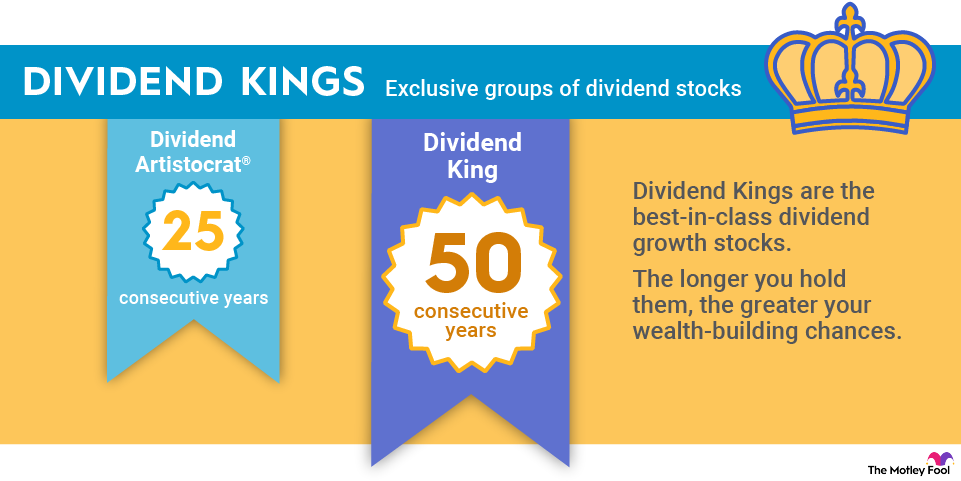
Many investors are familiar with the Dividend Aristocrats®. (The term Dividend Aristocrats® is a registered trademark of Standard & Poor’s Financial Services, LLC.) These stocks are members of the S&P 500 that have increased their dividends for at least 25 consecutive years.
Dividend Kings don’t have to be members of the S&P 500, but they’ve all increased their dividends for 50 years, at least twice as long as the Aristocrat threshold.
2026 Dividend Kings
These 57 stocks qualified as Dividend Kings as of June 3, 2026, including two that qualify depending on how you interpret dividend growth.
| Dividend King | Sector | Dividend Increase Streak |
|---|---|---|
| American States Water (NYSE:AWR) | Utilities | 71 |
| Dover Corporation (NYSE:DOV) | Industrials | 70 |
| Northwest Natural Holdings (NYSE:NWN) | Utilities | 70 |
| Genuine Parts (NYSE:GPC) | Consumer Goods | 70 |
| Procter & Gamble (NYSE:PG) | Consumer Goods | 70 |
| Parker-Hannifin (NYSE:PH) | Industrials | 70 |
| Emerson Electric (NYSE:EMR) | Industrials | 69 |
| Cincinnati Financial (NASDAQ:CINF) | Financials | 66 |
| Coca-Cola (NYSE:KO) | Consumer Goods | 64 |
| Johnson & Johnson (NYSE:JNJ) | Healthcare | 64 |
| Kenvue (NYSE:KVUE) | Consumer Goods | 63* |
| Marzetti (NASDAQ:MZTI) | Consumer Goods | 63 |
| Colgate-Palmolive (NYSE:CL) | Consumer Goods | 63 |
| Nordson (NASDAQ:NDSN) | Industrials | 62 |
| Illinois Tool Works (NYSE:ITW) | Industrials | 62 |
| Farmers & Merchants Bancorp (OTC:FMCB) | Financials | 61 |
| Hormel Foods (NYSE:HRL) | Consumer Goods | 60 |
| California Water Service Group (NYSE:CWT) | Utilities | 60 |
| Federal Realty Investment Trust (NYSE:FRT) | Real Estate | 58 |
| Tootsie Roll Industries (NYSE:TR) | Consumer Goods | 58** |
| Stanley Black & Decker (NYSE:SWK) | Industrials | 58 |
| ABM Industries (NYSE:ABM) | Industrials | 58 |
| Stepan (NYSE:SCL) | Industrials | 58 |
| Commerce Bancshares (NASDAQ:CBSH) | Financials | 58 |
| H2O America (NASDAQ:HTO) | Utilities | 58 |
| H.B. Fuller (NYSE:FUL) | Materials | 57 |
| Altria Group (NYSE:MO) | Consumer Goods | 56 |
| Black Hills Corp. (NYSE:BKH) | Utilities | 56 |
| MSA Safety (NYSE:MSA) | Industrials | 56 |
| Sysco (NYSE:SYY) | Consumer Goods | 56 |
| Universal Corporation (NYSE:UVV) | Consumer Goods | 56 |
| National Fuel Gas (NYSE:NFG) | Energy | 55 |
| W.W. Grainger (NYSE:GWW) | Industrials | 55 |
| Lowe’s (NYSE:LOW) | Consumer Goods | 54 |
| Target (NYSE:TGT) | Consumer Goods | 54 |
| Abbott (NYSE:ABT) | Healthcare | 54 |
| BD (NYSE:BDX) | Healthcare | 54 |
| Tennant (NYSE:TNC) | Industrials | 54 |
| AbbVie (NYSE:ABBV) | Healthcare | 54**** |
| Canadian Utilities (OTC:CDUAF) | Utilities | 54*** |
| Kimberly-Clark (NASDAQ:KMB) | Consumer Goods | 54 |
| PPG Industries (NYSE:PPG) | Industrials | 54 |
| PepsiCo (NASDAQ:PEP) | Consumer Goods | 54 |
| ADM (NYSE:ADM) | Industrials | 53 |
| Middlesex Water (NASDAQ:MSEX) | Utilities | 53 |
| The Gorman-Rupp Company (NYSE:GRC) | Industrials | 53 |
| Nucor (NYSE:NUE) | Industrials | 53 |
| Walmart (NASDAQ:WMT) | Consumer Goods | 53 |
| S&P Global (NYSE:SPGI) | Financials | 53 |
| Consolidated Edison (NYSE:ED) | Utilities | 52 |
| RPM International (NYSE:RPM) | Industrials | 52 |
| United Bankshares (NASDAQ:UBSI) | Financials | 52 |
| Fortis (NYSE:FTS) | Utilities | 51 |
| Automatic Data Processing (NASDAQ:ADP) | Technology | 51 |
| RLI Corp. (NYSE:RLI) | Financials | 51 |
| MGE Energy (NASDAQ:MGEE) | Utilities | 50 |
| Pentair (NYSE:PNR) | Industrials | 50 |
The industrial and consumer goods sectors make up more than half of the 2026 Dividend Kings list. This shouldn’t be a surprise. Companies in these sectors tend to pay dividends and raise their prices with inflation, and many have also been in operation for a long time. The list breaks down as follows:
There aren’t any exchange-traded funds (ETFs) that focus exclusively on Dividend Kings. However, the ProShares S&P 500 Dividend Aristocrats® ETF (NOBL +1.79%) owns shares of all Dividend Aristocrats®.
Dividend King changes in 2026
Companies that make this list don’t often lose their status; the qualities that make a company strong enough to last 50 years with annual dividend increases are usually very durable. Plus, there’s tremendous pressure on companies that have increased their dividends for 50-plus years to keep the streak going. No CEO wants to be known as the leader who messed up such an impressive dividend track record.
Industrial water treatment solutions and equipment maker Pentair (PNR +2.56%) joined the club after making its 50th consecutive annual dividend increase in February 2026.
A note on two unofficial Dividend Kings
Canadian Utilities (CDUAF +0.91%) and Tootsie Roll (TR +1.66%) are on this list, but for slightly different reasons. Some investors may argue that they make the cut on a technicality or two.
Canadian Utilities is certainly a King if you’re a Canadian investor; however, changes in foreign exchange rates have at times reduced the effective dividend paid to U.S. investors. We don’t want to shortchange the company or our Canadian investor friends because of this. The dividends per share — in Canadian dollars — have indeed increased for 54 years in a row.
Tootsie Roll is a little more complex. To start, the company has a long history of paying dividends, but the $0.09 quarterly cash portion has remained unchanged for years.
Its payout has grown via the 3% stock dividend it has also paid every year for the past six decades. So, as long as the stock price increases, the total dividends paid grow. We thought this quirk was worth explaining in detail. It can be argued that maybe it isn’t a King but is worthy of consideration as a sweet treat for dividend investors.
Future Dividend Kings
Several large, well-known companies are on track to join the Dividend Kings list in the next year. Carlisle Companies (CSL +2.84%) announced its 49th year of consecutive dividend hikes in August 2025, and McDonald’s (MCD +1.61%) also marked its 49th consecutive hike in October 2025. Medtronic (MDT +1.60%) just raised its dividend for the 49th consecutive year in June 2026. It appears poised to join the group in 2027.
Pros and cons of investing in Dividend Kings
Here are some of the reasons investors should consider Dividend Kings:
- Proven businesses across many economic cycles.
- History of adapting to disruption and new markets.
- Track record of earnings growth that funds higher dividends.
- Often lower volatility, making it easier to hold through market downturns.
There are also reasons to be cautious:
- Like other dividend stocks, future dividend growth is not guaranteed.
- Many Dividend Kings have underperformed the total returns of the stock market despite dividend growth.
- Sometimes, management may fail to fix (or just ignore) ongoing issues and keep raising payouts, resulting in big losses and forced dividend cuts, as seen with 3M (MMM +1.65%) and Walgreens in recent years.
Factors to consider when choosing Dividend Kings
One of the most important factors to consider when choosing a Dividend King to buy is its financial health.
Be sure the dividend is supported by strong free cash flow that exceeds the total dividend payment. Steady, growing earnings per share and a solid balance sheet are also important factors that help ensure management can continue to raise its dividend.
Beyond the current earnings profile, does the business have competitive advantages that will protect it in economic downturns? Is the industry it operates in growing or declining?
On top of that, investors will want to assess a Dividend King just as they would any other stock. Most Dividend Kings are slow growers; like value stocks, it makes sense to ensure the stock trades for an attractive valuation.
How to invest in Dividend Kings
- Open your brokerage app: Log in to your brokerage account where you handle your investments.
- Search for the stock: Enter the ticker or company name into the search bar to bring up the stock’s trading page.
- Decide how many shares to buy: Consider your investment goals and how much of your portfolio you want to allocate to this stock.
- Select order type: Choose between a market order to buy at the current price or a limit order to specify the maximum price you’re willing to pay.
- Submit your order: Confirm the details and submit your buy order.
- Review your purchase: Check your portfolio to ensure your order was filled as expected and adjust your investment strategy accordingly.
Why invest in Dividend Kings?
Dividend Kings may not be a good fit for every investor, but their long records of growing payouts are often underpinned by good businesses worth owning. A few key reasons:
- Dividend Kings can be a great part of retirement portfolios or for investors looking for reliable income.
- Most offer higher dividend yields than the average yield of S&P 500 members.
- Their consistency in paying and increasing dividend payouts can also provide a measure of confidence for people living on the income generated by the dividend stocks they own.

Leave a Reply